Home Blog Page 185

CFTC Backs Crypto Perpetual Contracts, Issues Advisory on 24/7 Trading

The US Commodity Futures Trading Commission (CFTC) took positions on cryptocurrency perpetual futures contracts and how the industry may be more suited for “24/7 trading, clearing, and settlement.”

In a Friday notice, the CFTC said it had approved perpetual futures contracts tied to the spot price of Bitcoin for prediction markets platform Kalshi. The company announced at about the same time that it would launch the perpetual futures contracts on its platform in a move closer to a derivatives exchange.

“​​The Order was based on representations and submissions made by Kalshi in support of its request for Commission approval, including its explanation and analysis of the BTCPERP Contract’s terms and conditions, the nature of the underlying commodity market, and the BTCPERP Contract’s compliance with applicable provisions of the Commodity Exchange Act and the Commission’s regulations thereunder, including the Core Principles applicable to [Designated Contract Markets],” said the CFTC.

Source: CFTC

The perpetual futures contracts, or “perp” products, would allow Coinbase and Kalshi users to speculate on crypto prices without owning the underlying assets. The CFTC no-action position for Coinbase and approval for Kalshi represented the US agency being more open to crypto derivatives.

Coinbase chief legal officer Paul Grewal called the CFTC decision a “massive first for the industry” in a Friday X post. The exchange launched stock perpetual futures for non-US traders in March.

Related: CFTC seeks to reverse settlement deal with Gemini

In a separate notice, the CFTC distinguished between the suitability of traditional markets and crypto markets for 24/7 trading. According to the agency, “derivatives referencing crypto assets may be well-suited for 24/7 trading due to their digital infrastructure and global reach” while others, like agricultural markets, may not be based on their “unique customer bases, regional nature” and other factors.

CME Group also announces 24/7 crypto futures trading, pending regulatory review. Source: CME Group

Trump touts CFTC’s authority, with no additional commissioner nominations

On Tuesday, US President Donald Trump posted to social media, in a statement supporting Michael Selig and the CFTC in their fight for jurisdiction over prediction markets. The post came amid several state-level lawsuits attempting to restrict or ban the platforms, while Selig claims the agency has “exclusive jurisdiction” under the Commodity Exchange Act.

Selig remains the chair and sole commissioner at the federal commodities regulator in a panel intended to consist of a bipartisan group of five people. As of Friday, Trump had not announced any nominations to fill the seats.

Magazine: HYPE chases $100 target, ETH could dump below $1800: Market Moves

Bitcoin, ether, XRP, dogecoin lag a nine-week stocks rally as ETF demand cools

0

The S&P 500’s longest weekly winning streak since 2023 and Brent crude settling near $92 on U.S.-Iran ceasefire hopes have failed to pull bitcoin and ether (ETH) higher, with the two largest cryptocurrencies finishing the week down nearly 3% as cooling spot bitcoin ETF inflows reinforced the pullback.

The S&P 500 posted its ninth consecutive weekly gain on Friday, the longest such run since 2023 and a streak matched only a handful of times in the past four decades, putting the index up almost 20% from its March lows.

Brent crude settled around $92 a barrel and Treasuries climbed on the week, trimming some of their war-driven losses.

The macro tailwind has come on hopes the U.S. and Iran will sign off on a 60-day ceasefire extension. President Donald Trump said Friday he was ready to make a “final determination” on a preliminary agreement but restated his demand that any deal require Iran to abandon its nuclear program, surrender its enriched uranium and open the Strait of Hormuz.

Crypto did not move with the tape. Bitcoin slipped 2.6% over the past seven days to $73,445, ether 2.5% to $2,011, solana (SOL) 2.2% to $82.42 and TRON’s TRX 5.6%, its worst weekly drop in the top 10, according to CoinDesk data.

finished roughly flat. The slide came alongside softer spot bitcoin ETF inflows, which was flagged this week as adding to the downward pressure even as macro conditions improved.

The exception was the smaller side of the leaderboard. Hyperliquid’s HYPE token ripped 19.4% on the week to $65 as sentiment for the asset continues to grow. Intercontinental Exchange chief Jeffrey Sprecher praised the decentralized perpetuals venue at a Bernstein conference and calling it “bigger than NASDAQ.” BNB closed up 1.9% and XRP eked out a 0.7% weekly gain.

The Iran deal still needs Trump’s signature, and the red lines he restated on Friday sit well beyond what Iran has indicated it would accept publicly. The macro rally is one bad headline from reversing.

Major UX Upgrades To Flagship Bitcoin Hardware Wallet

0

Coinkite the Bitcoin-only hardware wallet manufacturer, recently released the MK5, a significant quality of life and user experience upgrade to the MK4 Coldcard, building on the strong security foundations set by its predecessor. The MK5 comes in many colors and styles. Today, I will review the Orange and Glow in the dark versions, as well as their form factor and user experience upgrades, to answer the question: are the upgrades to the device worth the money? 

Building on the well-known and trend-setting MK4 security platform, which brought two secure element chips from different manufacturers and an MCU to the same device. The MK5 focuses instead on quality of life, improving the NFC connectivity, reworking the buttons and plastic chassis of the hardware wallet, as well as adding a much larger screen, among other new features. This is the first hardware upgrade to the Coinkite MK line since the launch of the MK4 in 2022, integrating into it some of the technologies debuted by the Coldcard Q in 2023.

Left MK5, center MK4, right MK3.

What is new with the MK5 Coldcard?

The big upgrades to the UX are immediately visible; the screen, for one, is much larger, perhaps 30% bigger. Their announcement blog describes it as a “1.54-inch display protected by Gorilla Glass,” which does look and feel much sturdier than older models.

The next obvious upgrade is the buttons. Unlike the MK4 buttons, which are indented, requiring your fingers to go into the socket to get a click, the MK5 buttons are almost at par with the chassis of the device, making them much easier to press. The press feels good, it clicks, giving the user a solid tactile feedback. Much more comfortable than the warm, slightly uncomfortable, unresponsive feel of a touch screen, as seen in other hardware wallets. 

Coinkite Launches Coldcard MK5: Major UX Upgrades to Flagship Bitcoin Hardware Wallet

You also quickly notice the chassis has been redesigned. The screen section no longer pops out above the keyboard; instead, it’s all one rectangle with comfortable curved edges. It looks more modern, more elegant, while keeping that cypherpunk transparency that shows off the underlying hardware, a signature design principle of Coinkite products. 

The MK5 also comes with a button and screen protector half case that slides and clicks in and out. It can be entirely removed and fits perfectly from the back of the device, exposing the USB power input at the bottom of the device without issue. 

NFC Push Transactions

Last but not least, Coinkite doubles down on NFC support with the MK5. An acronym for near field communication, the NFC antenna is an increasingly popular tech stack in the Bitcoin industry. From NFC tap to pay lightning Bolt cards with cool designs and laser eyes, or Coinkite’s own Tapsigners, to Cashu’s tap to send features developed by Calle. 

NFC is a powerful alternative to other wireless connection technologies like Bluetooth or Wifi, which some hardware wallet providers have adopted, but come with some arguable downsides, mainly their range. Unlike the alternatives, NFC is short-range by design; we are talking centimeters in range, whereas Bluetooth and Wi-Fi are talked about in tens of meters. So the paranoid level threat that someone with a long-range antenna pointed at your house might catch a transaction in transit or be able to connect to your device remotely, vanishes. 

There’s also no multi-step device connection protocol with NFC; phones either have the feature on and off, the app starts scanning, and transmission can occur. No pin codes, no sifting through lists of Bluetooth-powered devices. Much simpler UX in theory. It is also far superior in terms of user experience to the SD card transmission of pre-signed transactions back and forth from laptops or phones. While NFC may technically cross the ‘airgapped’ line in the MK4 and MK5, NFC still has the best qualities of all wireless connectivity options, and is set to off in the default settings. Similar to the option to connect the MK5 to a computer via USB for data transmission, the NFC antenna can also be severed at a hardware level by scratching off a specific wire within the hardware. 

Coinkite’s NFC push Tx software is open source and much smaller in terms of lines of code than Bluetooth or Wifi. The full NFC push Tx code is open source. The client web app side of the protocol has no license defined and is presumably meant to be integrated by any web application. While the hardware side of the code is public, but is limited by the non-commercial use license.

The Colors of the MK5

https://store.coinkite.com/cdn-cgi/image/fit=scale-down,background=white,width=512/static/images/sku/bundle-mk5-colours.png 

Playing into the Bitcoiner’s hunger for collectibles, the MK5 comes in a wide range of cases, such as gold flaked transparent gray, gorgeous orange and even glow in the dark! I got to play with the Orange and blue glow-in-the-dark version, though I kind of wish I’d gotten my hands on the gold flaked one.

Nevertheless, the designs are beautiful, transparent enough to see the hardware, but colorful enough to be stylish. Here’s what they look like in practice. 

Supply Chain Security

The packaging was also very interesting; the box containing the hardware came with a purchase order of the items, which were inside tamper-proof security bags. These bags had pretty strong plastic, not something you can easily rip, requiring a knife to slice through them. The bags were also marked with a unique number, seen in the pictures below. Inside the bag, another plastic strip contained the same number. And when the devices were first powered on, they displayed the same number on the screen. This is a flash memory code that gets set up per device at the factory. Making interception and manipulation of the firmware of hardware that much more difficult. The next level would be to notify the user of the bag number via email or behind a login on the site, so they can have a side channel to verify the number as well.

If you see anything off with the packaging, you are encouraged to take pictures and reach out to Coinkite support. 

The battery and exposed hardware device in the picture below is the COLDPOWER Adapter by Coinkite, which I happened to have laying around and figured I’d test out as well. It is meant to give the device power entirely airgapped, no cables connected to any computer whatsoever, as even a malicious Wifi repeated plugged into a power outlet could transmit signals across the power wires (lol). 

Things to improve?

Integration of NFC Push Tx with mobile wallets was a bit inconsistent. I tried Cove, Bull Bitcoin and Nunchuck. Of the three, Nunchuck had the best integration, with Cove not far behind. Bull Bitcoin seems to have disabled the feature or hidden it quite well. Cove is a young project likely to improve leaps and bounds in the coming months, while Nunchuck a very advanced and powerful wallet, took me a few minutes to figure out but ultiumetly turned out to be the best interface of the three.

Even with a stronger NFC antenna, I had to remove my phone’s ridiculously thick case in order to get a reliable data transmission, but that’s not the end of the world. 

Conclusion: Is the MK5 worth the money to upgrade? 

As a proud owner of what I now realize is an ancient MK3, the move to an MK5 is a significant upgrade, and the low cost of $167 plus shipping, I’d say it is a no-brainer. That’s a whole generation of security and UX upgrades that I did not realize I needed.

For active users of the MK4, the bigger screen and better buttons are definitely an improvement in quality of life, and the better NFC antenna will likely yield dividends as well by making transaction flows smoother. Again, compared to other hardware wallets in the market, the price is very reasonable.

For passive MK4 owners who make a couple of transactions a year, however, the juice might not be worth the squeeze. They are still getting firmware updates and get all the security benefits, and likely won’t miss the improved UX that much. 

Disclaimer: Coinkite provided Bitcoin Magazine with a couple of free MK5 Coldcards to use for the purpose of testing their product for review.

US Seizes Nearly $1 Billion in Iranian Crypto Assets, Treasury Secretary Says

The United States has seized roughly $1 billion in Iranian crypto assets, Treasury Secretary Scott Bessent said Friday, adding that some of the wallet owners may not yet know the funds are gone.

“I believe that we have seized about a billion dollars of their crypto,” Bessent said while speaking at the Reagan National Economic Forum. “Just outright grabbed the wallets. Some of them may be typing in right now and not have realized that their wallet had been grabbed,” he added.

Bessent said the seizures are part of the US financial pressure campaign against Iran, known as Operation Economic Fury. Launched in March 2025, the operation has targeted Iranian assets across multiple fronts, seizing cryptocurrency, freezing bank accounts and working with European allies to confiscate properties.

Scott Bessent at the Reagan National Economic Forum. Source: YouTube

“I think between five and a half to six weeks of an incredibly successful military campaign and Operation Economic Fury, where we have really cut them off. They are at the end of their Tether now financially,” he said.

Related: Crypto markets shed $80B after fresh US strikes on Iran

Iran’s financial state is dire

The Treasury secretary said the regime had been siphoning $400 to $500 million a month and dividing the proceeds among roughly 80 leaders before the US intervened. He said inflation in Iran has likely surpassed 200%, food vouchers are being distributed, the internet has been shut down and 40 to 50% of Iranian troops are not getting paid.

Bessent also addressed ongoing negotiations with Iran, noting the complexity of dealing with a fractured leadership structure following US and Israeli strikes on senior regime figures.

The newly disclosed $1 billion figure is roughly double the $500 million in Iranian cryptocurrency assets the Treasury Department announced it had seized in late April, and much higher than the $344 million in cryptocurrency frozen after the US Office of Foreign Assets Control sanctioned Iran-linked wallets on April 24.

Related: Bitcoin bounces as Trump prepares to announce ‘negotiated’ Iran deal

Iran eyes Bitcoin-powered insurance scheme for Hormuz

As Cointelegraph reported, Iran is weighing a plan to monetize control of the Strait of Hormuz through a Bitcoin-based insurance model. A state document cited by Fars News Agency, an outlet closely affiliated with the Islamic Revolutionary Guard Corps, outlined a platform called “Hormuz Safe,” which would sell digital marine insurance paid in Bitcoin and settled on the blockchain, potentially generating over $10 billion in revenue for the country.

In early April, a spokesperson for Iran’s Oil, Gas and Petrochemical Products Exporters’ Union said certain ships would be able to pass through the strait provided that they pay a tariff of $1 per barrel of oil in Bitcoin.

Magazine: Guide to the top and emerging global crypto hubs — Mid-2026

Bitcoin Bears Break $75K Support: Is $70K Next?

0

Bitcoin’s (BTC) rising funding rate and aggregated open interest suggest bullish investors are opening longs in an attempt to defend the range lows and an important support at $70,000, but another day of spot ETF outflows has investors concerned that the institutional stance on BTC is shifting.

As shown in the chart below, Bitcoin open interest remains relatively stable despite the day-over-day selling, further re-enforcing the view that long positions are either topping up to stay open or newly created. The cross-exchange funding rates (the last indicator at the bottom of the chart) are also mostly positive to neutral, indicating a long-leaning bias among investors. 

BTC/USDT one-hour chart. Source: Velo.xyz 

Prior to the drop to $73,000, liquidations remained within norms of BTC’s intra-day range percentage-wise, suggesting that this week’s price action is a continuation of the current consolidation rather than early confirmation of a higher-timeframe trend change. 

One important point to consider is “who” is propping BTC up. Hyblock’s True Retail Longs & Shorts Accounts indicator shows retail investors increasingly viewing corrections as dip-buying opportunities. 

Hyblock analysts said that,

“Long exposure now sits near 62%, a level where retail traders have historically been vulnerable to getting trapped. Over the last three months, backtested 15-minute data shows that when retail long positioning was above 62%, BTC posted positive returns 82% of the time seven days later, with a median forward return of 3.6% across 1,459 occurrences.”

 True retail longs and shorts accounts’ seven-day future price change %. Source: Hyblock 

Related: Bitcoin miner inflows to Binance soar as BTC struggles to hold uptrend: Is $70K next?

ETF outflows, negative Coinbase premium counters spot and perp traders’ efforts

According to Bitfinex analysts, Bitcoin investors are “cautious heading into Thursday’s (May 29) Personal Consumption Expenditures (PCE) report for April.” 

The analysts said, 

“Since 15 May, futures open interest (OI) has fallen sharply following a price correction that has seen BTC fall over 10 percent from recent highs above $82,000. Bitcoin’s aggregated global OI has now dropped back below $55 billion, the lowest reading since 11 April, and is down 14 percent from when BTC was trading above $80,000.” 

On Wednesday, outflows from spot Bitcoin ETFs topped $200 million, while cumulative outflows over the past seven days exceeded $1.5 billion. In addition to the reversal in ETF flows, Bitfinex pointed to the negative Coinbase premium as a “significant warning sign.” 

Spot Bitcoin ETF weekly flows. Source: SoSoValue.com

“In the post-ETF landscape, this reflects a structural reality: direct US spot demand on Coinbase has been largely displaced by indirect institutional demand via ETFs, structured products, and over-the-counter desks.”

The analysts noted that even while Bitcoin price is “in an uptrend on the lower timeframes since the breakout” from $72,000, “the continuation set-up is absent.” 

“A strong uptrend is typically driven via the spot tape, which would mean persistent negative funding rates and a persistent positive Coinbase premium. The opposite is the case at present.” 

How Low Can XRP Price go After Falling Below $1.30?

0

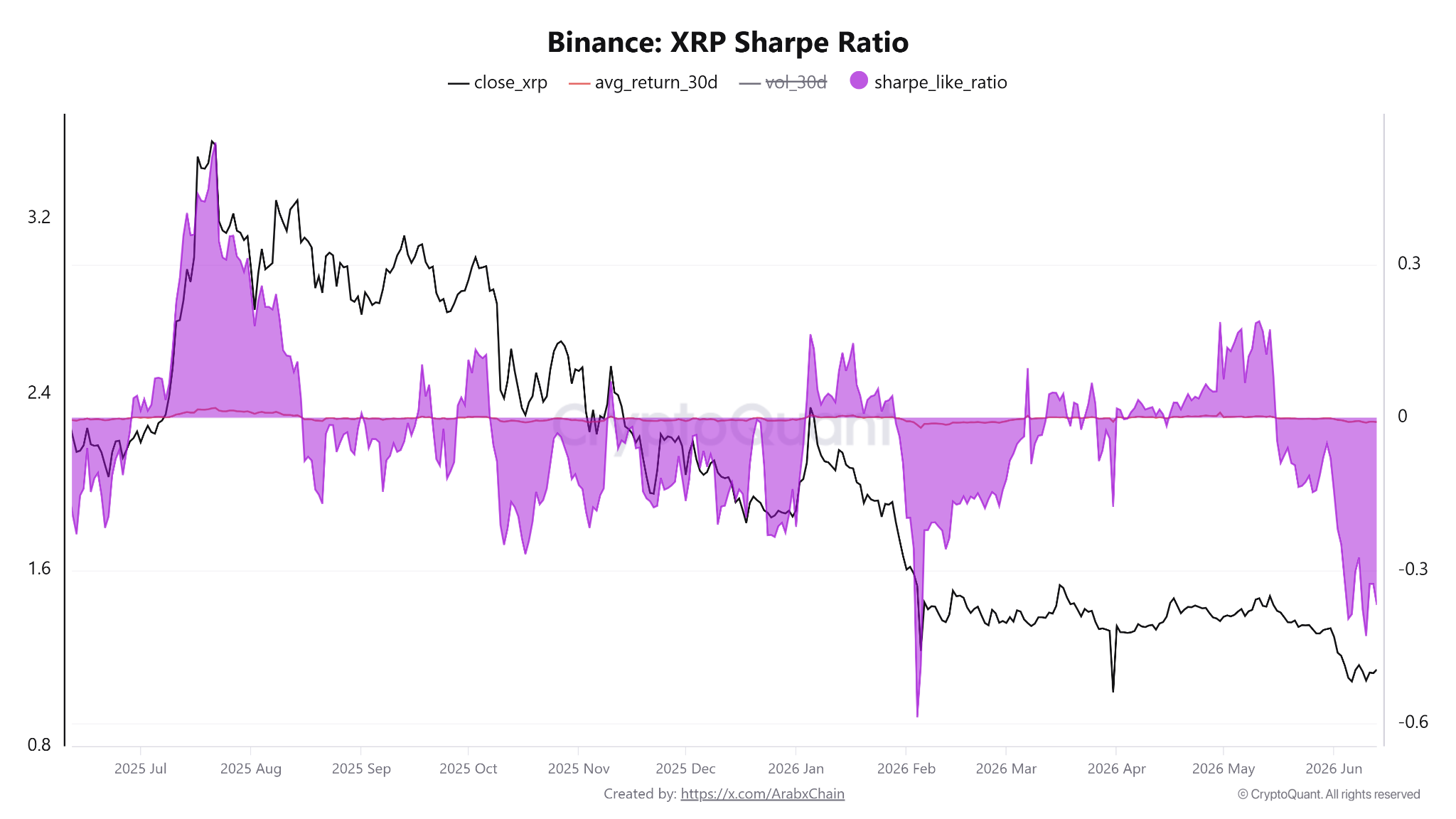
XRP (XRP) price dropped to $1.26 on Thursday, its lowest in over 16 weeks. A bearish technical setup suggested that the pressure may extend into June.

XRP/USD daily chart. Source: Cointelegraph/TradingView

Key takeaways:

  • XRP’s bear pennant pattern breakdown on the weekly chart targets $0.63.
  • XRP social sentiment hit a three-week low, while Net Unrealized Profit/Loss data shows rising fear and investors underwater.

XRP price bear pennant breakdown underway

XRP has been displaying several bottoming signals, including a falling MVRV ratio and rising XRP Ledger activity, which suggested that the price was extremely undervalued within the $1.40-$1.50 zone.

The latest drop, however, has seen the XRP/USD pair drop below this zone to enter the breakdown phase of its bear pennant setup, as shown on the weekly chart below.

Related: XRP adds 4,300 new wallets in 24 hours, but why is price stuck?

XRP has dropped below the pennant’s lower trendline at $1.35, opening the way for a deeper move toward the measured target of the prevailing chart pattern at $0.63, a 50% drop from the current price.

XRP/USD weekly chart. Source: Cointelegraph/TradingView

XRP became “structurally bearish” with the latest breakdown below $1.30, analyst Egrag Crypto said in a Thursday post on X, adding:

“The bearish targets are $1.27, $1.1 and a possible capitulation wick toward $0.88.”

XRP daily chart. Source: Egrag Crypto

Technical analyst ChartNerd said that after breaching the support line at $1.30, the path is now clear for a drop toward $1 “sooner rather than later.”

XRP/USD daily chart. Source: X/ChartNerd

As Cointelegraph reported, XRP’s next major support level now lies at $1.27. If this level is lost, the XRP/USDT pair may plunge to $1.11 and then test $1 support.

XRP sentiment turns negative

XRP’s sentiment on social media has turned sharply negative over the last few days, according to data from Santiment.

Santiment’s Positive/Negative sentiment indicator, which measures the ratio of positive to negative social media mentions for a cryptoasset, shows XRP crowd FUD is at its highest level in three weeks.

The ratio of positive to negative commentary has dropped to “just 1.1 bullish comments for every 1 bearish comment,” the market intelligence data provider said in a recent post on X.

Santiment, however, pointed out that this kind of fear and skepticism has historically acted as a “contrarian signal for XRP’s price,” adding:

“When traders across social media become overly fearful, many weak hands have already sold, reducing selling pressure and creating conditions for a rebound.” 

XRP’s Positive/Negative sentiment metric. source: Santiment

The chart above shows that previous dips into the “FUD zone” were followed by price stabilization or bounces shortly afterward.

However, XRP’s Net Unrealized Profit/Loss (NUPL) is still oscillating between the capitulation and fear zones, suggesting that traders are still showing signs of fear.

XRP’s NUPL vs. price performance chart. Source: Glassnode

With more than 58% of XRP holders underwater at current prices, there is still room for more losses, based on past cycles. Such setups in 2018 and 2021 preceded sharp corrections, raising the possibility of similar pullbacks over the next few weeks.

ICE Chief Sprecher Calls Hyperliquid ‘Bigger Than Nasdaq’ as HYPE Run Draws TradFi Notice

0

The founder of the company that owns the New York Stock Exchange praised the small decentralized exchange and its SpaceX pre-IPO market, even as ICE presses regulators over how to police perpetual futures.

Jeff Sprecher, founder and chief executive of Intercontinental Exchange, the roughly $90 billion exchange giant that owns the New York Stock Exchange, called decentralized exchange Hyperliquid “bigger than Nasdaq” at an investor conference this week, a rare endorsement of a crypto-native venue from one of the most powerful figures in traditional finance.

HYPE, the token of the Hyperliquid blockchain, has gained about 70% over the past 30 days and touched an all-time high of $67 today, outpacing a broader crypto market that slipped roughly 5% over the past week, according to CoinGecko data. The token is up 13% over 24 hours. It is the 11th-largest cryptocurrency by market value, at about $15 billion.

The comments are notable because ICE is not a bystander in the space it is praising. The company has taken stakes in crypto exchange OKX and prediction market Polymarket, and Sprecher said it has hooked the New York Stock Exchange to a private blockchain for settlement. His framing of an onchain rival as a credible market signals how far the line between regulated exchanges and decentralized venues has blurred, just as institutional money begins flowing toward HYPE through US exchange-traded funds.

A founder’s salute

Speaking at the Bernstein Strategic Decisions Conference on Tuesday, Sprecher said he had met the Hyperliquid team several times and described them as “extremely smart.” “I love these guys. I wish I was younger and doing it,” he said. He pointed to the wealth the platform has minted with a small team, saying “it’s bigger than Nasdaq” and noting “it’s 11 people.”

Hyperliquid is the largest decentralized perpetual futures exchange, with about $5.9 billion in total value locked, according to DefiLlama. Perpetual futures, or perps, are derivatives that let traders bet on an asset’s price with no expiry date, often with heavy leverage. The protocol runs its order book entirely onchain on its own Layer 1 network and channels most of its trading fees into buying back HYPE.

ETF inflows fuel the climb

Much of HYPE’s ascent has tracked the arrival of US spot ETFs. Funds from Bitwise and 21Shares drew more than $100 million in combined net inflows within their first 10 trading sessions, extending an eight-day inflow streak that included a record single day. Bitwise has said it will direct 10% of its fund’s management fees toward holding and staking HYPE.

The pipeline is widening. Grayscale filed a fourth amendment to its spot HYPE ETF registration with the Securities and Exchange Commission on Thursday, renaming the product the Grayscale Hyperliquid Staking ETF and setting it up to list on Nasdaq under the ticker GHYP. VanEck has also filed for a staked HYPE fund. Repeated amendments often reflect active talks with regulators rather than delays.

The SpaceX wager

Sprecher reserved particular attention for Hyperliquid’s synthetic market tracking SpaceX, which lets traders take leveraged positions on the rocket maker before it goes public. The Defiant reported the launch of that pre-IPO perpetual earlier this month. Sprecher said the price discovered there could rival the offering itself, calling it “really interesting to watch” when SpaceX lists, which he pegged to June 11, and said the onchain market “could be bigger than the IPO.”

A regulatory caveat

For all the praise, Sprecher framed Hyperliquid as both an opportunity and a regulatory problem. He pushed back on a report that had ICE “freaked out” about the venue, saying the firm was instead “talking to these people and learning.” But he questioned why incumbents face restrictions that crypto-native rivals do not. “Why are you prohibiting us from doing this when it’s already happening?” he said. “Can’t we have a level playing field?”

He flagged the risk in the product, too. Hyperliquid offers “up to 100 to 1 leverage, which is part of the allure,” he said, a structure that can magnify losses as fast as gains. He argued regulators must decide whether to create a new category for perpetual futures or fold them into the swaps rules written after the 2008 financial crisis. The danger is not theoretical: a SpaceX-linked perpetual on the platform crashed about 45% in half an hour this week, triggering an estimated $1.5 million in liquidations, though it did not drag down HYPE.

What’s next

Traders now look to two near-term tests: SpaceX’s planned debut next month, which will show how closely Hyperliquid’s onchain price tracked the real thing, and the SEC’s handling of the Grayscale and VanEck filings. A scheduled unlock of about 9.9 million HYPE tokens on June 6, worth more than $500 million at current prices, could also weigh on the market.

Bitcoin Dip Marks Distribution But BTC May Avoid New Bottom

0

Bitcoin’s drop below $73,000 on Wednesday marks a short-term turning point for the market, as multiple BTC distribution signals point toward rising sell-side pressure. 

While the increasing chance of a correction into the $60,000 to $70,000 range remains in play, long-term holder data points to improving investor sentiment, suggesting that traders view the current price as a buying opportunity.

Coinbase discount confirms market stress

Crypto analyst CryptoOnChain noted that Bitcoin’s drop to $72,500 followed a period of weakening spot demand and unsustainable long positioning in derivatives markets. The Coinbase premium index posted a -1,083% deviation from its three-month average, one of the deepest discounts recorded since 2025.

The premium gap fell to -$94.95, indicating that US-based traders sold Bitcoin at prices below offshore market levels. Readings at similar levels have historically occurred during major distribution periods rather than during standard pullbacks.

BTC: exchange netflow on Binance. Source: CryptoQuant

The selling pressure also shifted toward Binance. Bitcoin netflows on the exchange averaged +1,496 BTC over the past seven days, a 528% jump above the three-month average. 

BTC futures data added more pressure. Binance funding rates climbed 781% above their three-month average before Bitcoin lost the $75,000 level. Crypto liquidations also hit $935 million on Wednesday, as the total crypto market cap dropped by $41 billion.

Onchain activity across BTC wallet cohorts also showed large exits. Bitcoin address outflows across entities holding between 100 BTC and 10,000 BTC reached 648,000, the highest since Feb. 5 and Feb. 6, when exits exceeded 1 million and 905,000 BTC, respectively. 

BTC outflows across various balances. Source: CryptoQuant

Related: Crypto liquidations hit $935M as Bitcoin price dips to $72.6K

BTC long-term holders signal conviction

The latest correction differs from the the selloffs in October 2025 and February 2026, when long-term holders actively reduced exposure to price weakness. Older Bitcoin cohorts are not distributing at the same pace during the current pullback, keeping a larger share of supply inactive despite the move below $75,000.

BTC long-term holder supply. Source: CryptoQuant

Long-term holders now control 84.3% of Bitcoin’s circulating supply, matching levels seen when BTC traded between $105,000 and $126,000 in Q3 2025. The lack of aggressive selling from these wallets may slow the pace of the downside breakout below $75,000.

BTC spot trading activity has also cooled sharply. Market analyst Darkfost noted that Binance spot volumes dropped to $36.4 billion from $198.6 billion in October 2025, an 81% decline. Monthly Bitcoin spot volumes stood near $84 billion in February before falling by another $50 billion over the past three months.

BTC Spot trading volume. Source: CryptoQuant

Lower spot volumes often reduce the amount of immediate sell pressure entering the market, since fewer coins are actively changing hands during periods of weak participation. Similar conditions appeared near the end of the 2023 bear market before volatility and trend strength returned.

BTC realized losses also continued to decline as fewer participants sold Bitcoin at a loss. The 30-day moving average for realized losses dropped to $12.85 million on May 26, from $56 million on Feb. 19, suggesting weaker capitulation activity near the $75,000 level.

BTC daily realized profit loss ratio 30-day average. Source: CryptoQuant

Related: Bitcoin price falls to six-week lows as US PCE inflation hits highest since 2023

CFTC Approves First US-Regulated Bitcoin Perpetual Futures

0

The agency approved Kalshi’s BTCPERP contract, the first bitcoin perpetual on a registered U.S. exchange, and in a separate action cleared Coinbase to route customers to its offshore Deribit affiliate. Together the moves open an onshore path for a product long pushed abroad and raise the competitive stakes for dominant venues such as Hyperliquid.

The Commodity Futures Trading Commission approved the first bitcoin perpetual futures contract on a registered U.S. exchange on Friday, clearing a product that American traders have long had to access on offshore venues.

The agency issued an Order for Approval to KalshiEX, a designated contract market, for its BTCPERP contract, a perpetual that references the spot price of bitcoin and will be listed as a futures contract, the CFTC said in a release Friday. KalshiEX is the CFTC-registered designated contract market operated by Kalshi, the prediction-market company.

The CFTC paired the order with a policy statement setting a case-by-case review process for future perpetuals. Perpetual futures, contracts that let traders take leveraged positions without an expiration date, have become the dominant form of crypto derivatives trading globally, yet have been largely unavailable on regulated U.S. exchanges. The new framework does not carry the force of a formal rule, meaning future agency leadership could change it.

Selig Frames It as Onshoring

CFTC Chairman Mike Selig tied the move to the agency’s stated goal of bringing crypto perpetuals onshore. He called it “historic action” that charts a path for one of the most liquid parts of the crypto market “to exist within the US regulatory framework,” Selig wrote on X Friday.

Selig said earlier regulators had taken a “decelerationist approach” of regulation-by-enforcement that forced builders to “flee the US,” and credited President Trump with reversing course, adding that the U.S. is “now the crypto capital of the world.” He said the action keeps novel products on regulated exchanges that uphold customer protections and market integrity.

A Separate No-Action Path for Coinbase

In a separate action the same day, the CFTC’s Market Participants Division granted no-action relief to Coinbase Financial Markets, the derivatives arm of Coinbase, the largest U.S. crypto exchange. The relief lets U.S. customers access perpetual contracts listed on Coinbase’s offshore affiliate, which the staff said can be treated as foreign futures. It also permits Coinbase to post customer crypto and stablecoins, including bitcoin and ether, as margin collateral.

The arrangement routes U.S. traders into Deribit, the largest crypto options venue, which Coinbase acquired for $2.9 billion. Coinbase framed the development as the first time a regulated firm has brought global crypto options and perpetuals to U.S. customers. Paul Grewal, Coinbase’s chief legal officer, called it a “massive first for the industry” in a post on X.

The distinction between the two actions is that Kalshi received an order to list a domestic perpetual, while Coinbase received relief to connect customers to products listed offshore.

Onshoring Perpetuals

Perpetuals account for the bulk of crypto derivatives activity, but U.S. regulators historically pushed that trading to venues outside their jurisdiction, leaving American retail and institutional traders reliant on offshore exchanges such as Binance, Bybit and OKX. The policy statement said the market for perpetuals had largely developed offshore because of regulatory uncertainty over how the contracts should be classified.

The order also marks a step beyond the perpetual-style futures that Coinbase and others began listing in 2025 through self-certification, which carried multi-year expirations rather than the open-ended structure of a true perpetual. The policy statement said other asset classes, including equities and commodities, must go through case-by-case review, and that equity-linked perpetuals would also require input from the U.S. Securities and Exchange Commission.

Implications for Hyperliquid

The approval introduces a regulated, onshore alternative to the offshore and decentralized venues that have run the perpetuals market, a category led onchain by Hyperliquid, the largest perpetual futures DEX.

Hyperliquid welcomed the decision but pressed for a framework that reaches beyond centralized firms. The agency’s actions should be workable “not only for centralized intermediaries, but for the onchain protocols where the most significant perpetuals activity actually occurs,” the Hyperliquid Policy Center said in a statement on X Friday.

It called the moves “a long-overdue acknowledgment” that perpetuals are a legitimate tool for price discovery and risk management, and said regulatory ambiguity had driven the market offshore and undermined U.S. competitiveness.

Decentralized vs. Centralized Perps

Hyperliquid held open interest of roughly $7 billion to $9 billion across recent snapshots and processed about $173 billion in perpetual volume over the past 30 days, DefiLlama data show. That puts it well ahead of rivals such as Aster and Lighter. Even so, decentralized perps account for only about a tenth of total perpetuals volume, according to CoinGecko’s 2026 perpetuals report, with offshore centralized exchanges handling the rest.

Hyperliquid’s draw, self-custody, no identity checks, high leverage and permissionless markets that list long-tail assets through its HIP-3 framework, is largely what a CFTC-regulated venue cannot match. The Kalshi and Coinbase-linked products carry leverage limits, volatility controls and know-your-customer requirements.

The risks of thinly traded perpetuals surfaced this week, when a flash crash in Hyperliquid’s SPACEX-USDH contract, which tracks a valuation for SpaceX, wiped out about $1.5 million in notional value within 30 minutes after one outsized position absorbed the market’s limited liquidity. Regulators have cited such episodes in arguing for the controls built into the new onshore products.

To be sure, a credible onshore venue could capture institutional and U.S.-based demand that might otherwise have moved onchain over time, and regulatory legitimacy could expand the overall perpetuals market in ways that benefit decentralized platforms too.

HYPE, Hyperliquid’s native token, carried a market value of nearly $14.6 billion and is up about 10% over the past week, according to CoinGecko. The token reached a record near $66 today, driven by Hyperliquid-specific catalysts including pre-IPO trading activity and ETF inflows rather than the regulatory news.

What Comes Next

Selig has said more perpetual authorizations are coming, and the policy statement lays out how the agency will review contracts referencing other assets.

The pace of those approvals, and whether the framework extends to the onchain protocols Hyperliquid flagged, will test whether regulated onshore products can pull volume from the offshore and decentralized venues that still dominate the market.

Bitcoin, ether steady despite record stocks, falling oil and easing war fears

0

A convergence of record highs in global stocks, oil at multi-month lows and a tentative U.S.-Iran ceasefire extension did little to buoy bitcoin prices.

The largest token is still hovering near $73,000 after sliding nearly 6% on the week as institutional buyers wait on U.S. regulatory clarity rather than macro headlines.

Ether (ETH) traded just under at $2,000, down 6.4% on the week even after a 1.2% bounce on the day, while solana (SOL), XRP and each lost between 4.9% and 6.7% over the past seven days despite small gains in the past 24 hours, according to CoinDesk’s price page. Hyperliquid’s HYPE bucked the trend, up 5.8% on the week.

The macro tape, meanwhile, lit up. The MSCI All Country World Index, the broadest measure of global equities, climbed 0.3% to an all-time high, and Asian stocks rallied 2% to a record of their own, Bloomberg reported.

Brent crude slipped 0.5% to about $93 a barrel and is now down more than 18% in May, its worst month since March 2020, after the U.S. and Iran reached a tentative deal to extend their ceasefire by 60 days and reopen talks on Tehran’s nuclear program.

The deal still needs President Donald Trump’s signoff, and Iran’s Tasnim news agency said the memorandum of understanding had yet to be finalized.

That setup, in any other tape, prints money for crypto but didn’t this time.

Javier Martinez, CEO at sFOX, said in an email the market had already priced in a relief rally on the ceasefire news and that the trade unwound when bitcoin failed to break higher.

Institutional investors are now looking past Tehran headlines and toward Washington, he said, pointing to U.S. crypto market structure legislation like the CLARITY Act. “They’re waiting on regulatory confirmation, not just macro improvement,” Martinez said.

Analysts at FxPro said bitcoin has fallen below its 50-day moving average and the longer-running 200-day average is sloping lower, the kind of crossover that has tended to mark stretches of broader weakness. “The time for a long-term bull market has not yet come,” they wrote.

Earlier this week, Swissblock said bitcoin has slipped into a “high-risk zone” amid selling pressure and a fading bid from spot bitcoin ETFs, the institutional product that powered much of the 2024-2025 rally. Softer ETF demand and a market no longer trading every Iran headline leave crypto without an obvious near-term driver.