The upgrade is shaping up to be one of Ethereum’s most ambitious since the network’s transition to proof-of-stake in 2022. Jayanthi described Glamsterdam as “probably the largest fork we’ve had since the Merge,” adding that it will “change a lot of assumptions about Ethereum and set us up for much more scaling in the future.”
Among the headline features are enshrined Proposer-Builder Separation (ePBS), formally tracked as EIP-7732, and Block-level Access Lists (EIP-7928).
ePBS would bring into Ethereum’s core protocol a separation between the entities that build transaction blocks and those that propose them. Today, that process largely relies offchain, where there are additional trust assumptions and centralization concerns. By moving the mechanism onchain, developers hope to reduce opportunities for manipulation related to maximal extractable value, or MEV.
Another major proposal, Block-level Access Lists, would allow blocks to declare in advance which accounts and smart-contract data they intend to access. The change would enable Ethereum clients to preload information more efficiently, helping make block execution faster, more predictable and easier to optimize.
Beyond those headline proposals, Glamsterdam also includes a sweeping set of gas repricings that could significantly alter the economics of using Ethereum.
“This will majorly change the cost of actions on Ethereum. High-level compute gets cheaper and state gets more expensive.”
Coinbase (COIN) said it plans to introduce tokenized stocks backed one-for-one by underlying U.S. equities, joining the growing competition among crypto firms and traditional financial companies to bring stocks onto blockchain networks.
In a post on X on Tuesday, the exchange said “the first real, 1:1 backed tokenized stocks are coming,” allowing users to own, trade, hold and redeem the securities onchain while automatically receiving dividends.
The announcement comes ahead of a product event scheduled for 3 p.m. ET Tuesday, in which the company, best known as a crypto exchange, is expected to unveil a series of offerings spanning trading and financial services.
“For the first time, these are real 1:1 backed tokenized stocks you can trust,” CEO Brian Armstrong said in a statement. “You own an actual piece of the company onchain.”
Armstrong said the products differ from many existing tokenized stock offerings, which are often structured as derivatives or synthetic exposures rather than direct ownership interests.
“Other current solutions are some form of derivative or IOU — not real ownership,” he said. “Our tokenized stocks will give all the benefits of true ownership (e.g. dividend upside), with all the benefits of tokenized assets.”
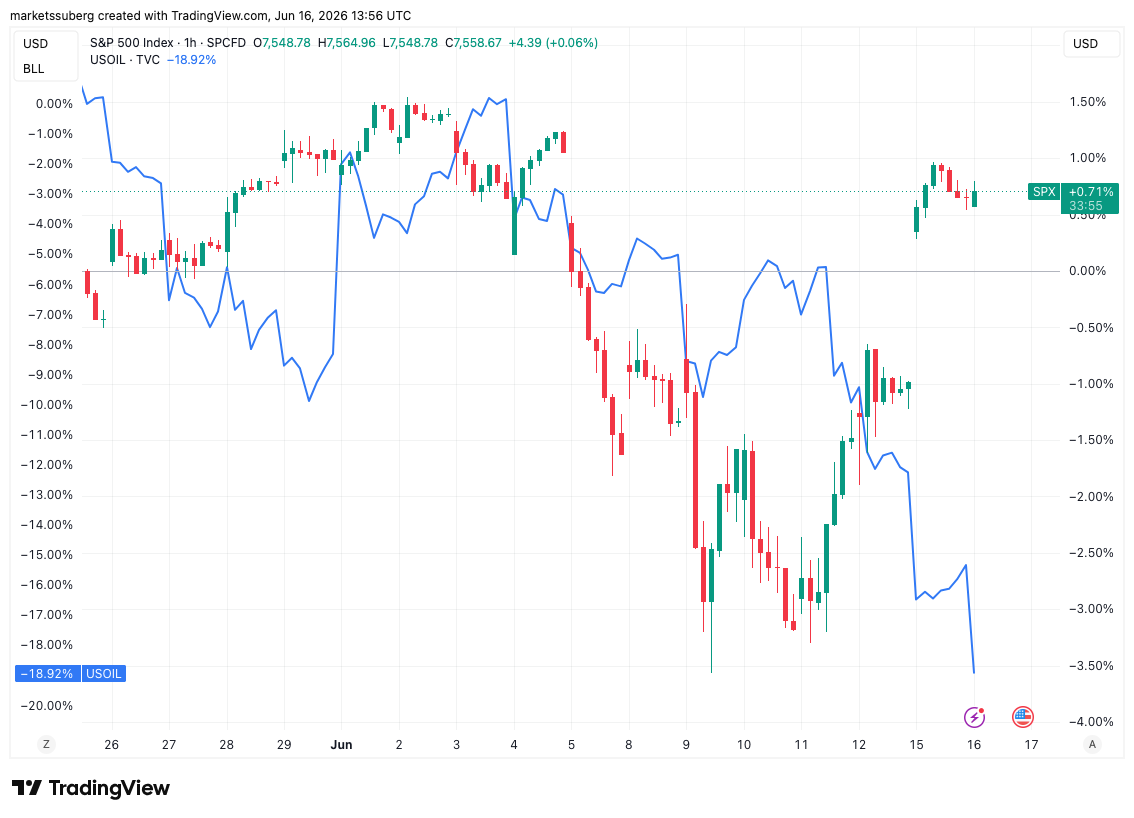
Hopes that a US-Iran peace deal would go ahead kept equities bullish, with the S&P 500 adding over 1.5% on the day, while US WTI crude oil hit three-month lows.
“News of an peace deal between the U.S. and Iran has made headlines frequently in the past. But this time, both sides along with other parties involved with negotiations are confirming the deal,” trading resource Mosaic Asset Company wrote in the latest edition of its regular newsletter, The Market Mosaic.
“That’s leading to a spillover effect in the stock market, where oil prices and longer-dated bond yields are both pulling back. A negative correlation between stocks and oil prices means the drop in energy prices is a tailwind for equities.”
S&P 500 vs. WTI crude oil one-hour chart. Source: Cointelegraph/TradingView
Bitcoin nonetheless brought back its own divergence from other risk assets, and traders avoided bets on major BTC price upside.
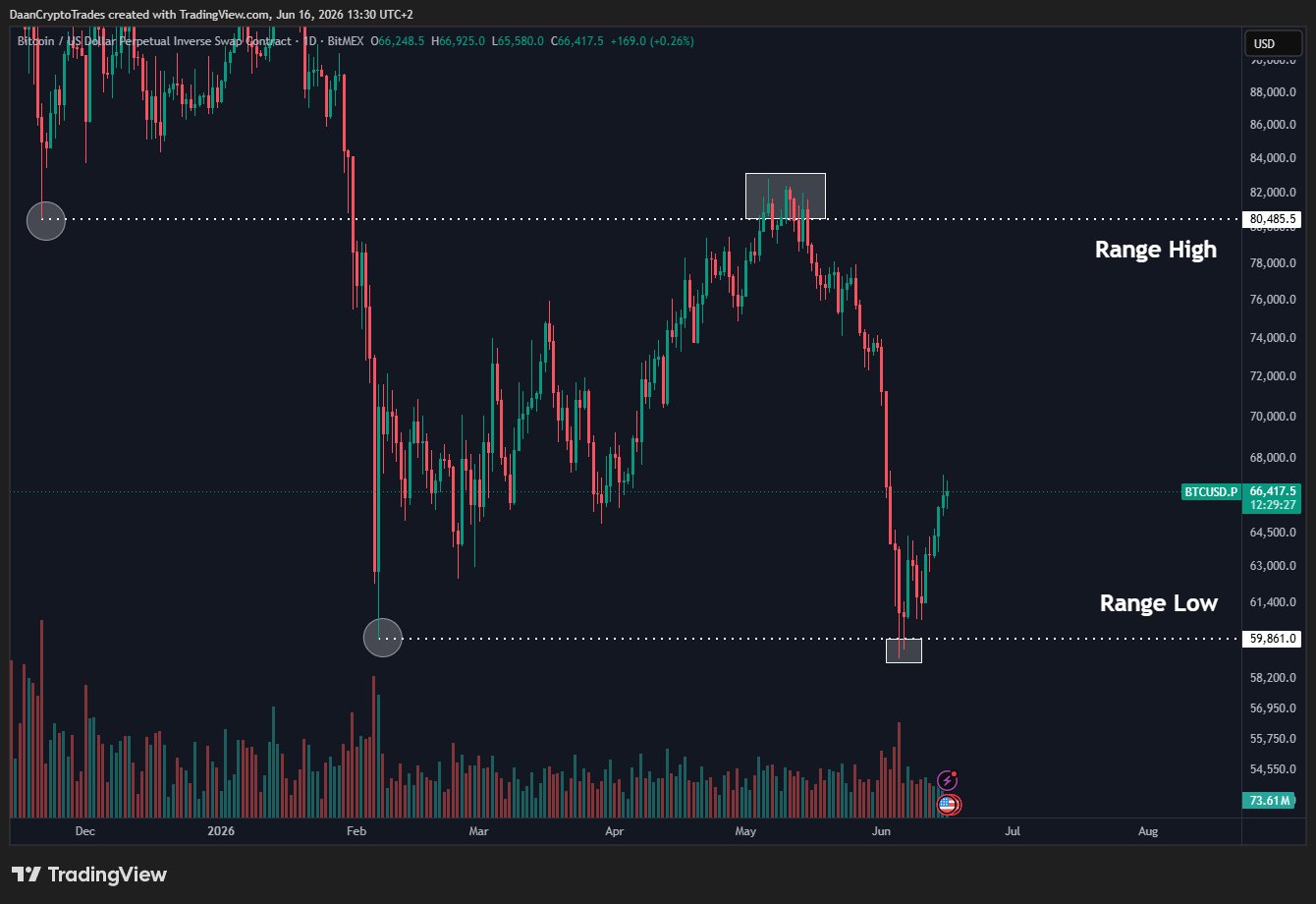
“$BTC Has moved up further back into its range,” Daan Crypto Trades wrote in his latest analysis on X.
“I would not be surprised if we hang around this big area for a few more weeks at least. Especially with Summer coming up and lower liquidity/volatility.”
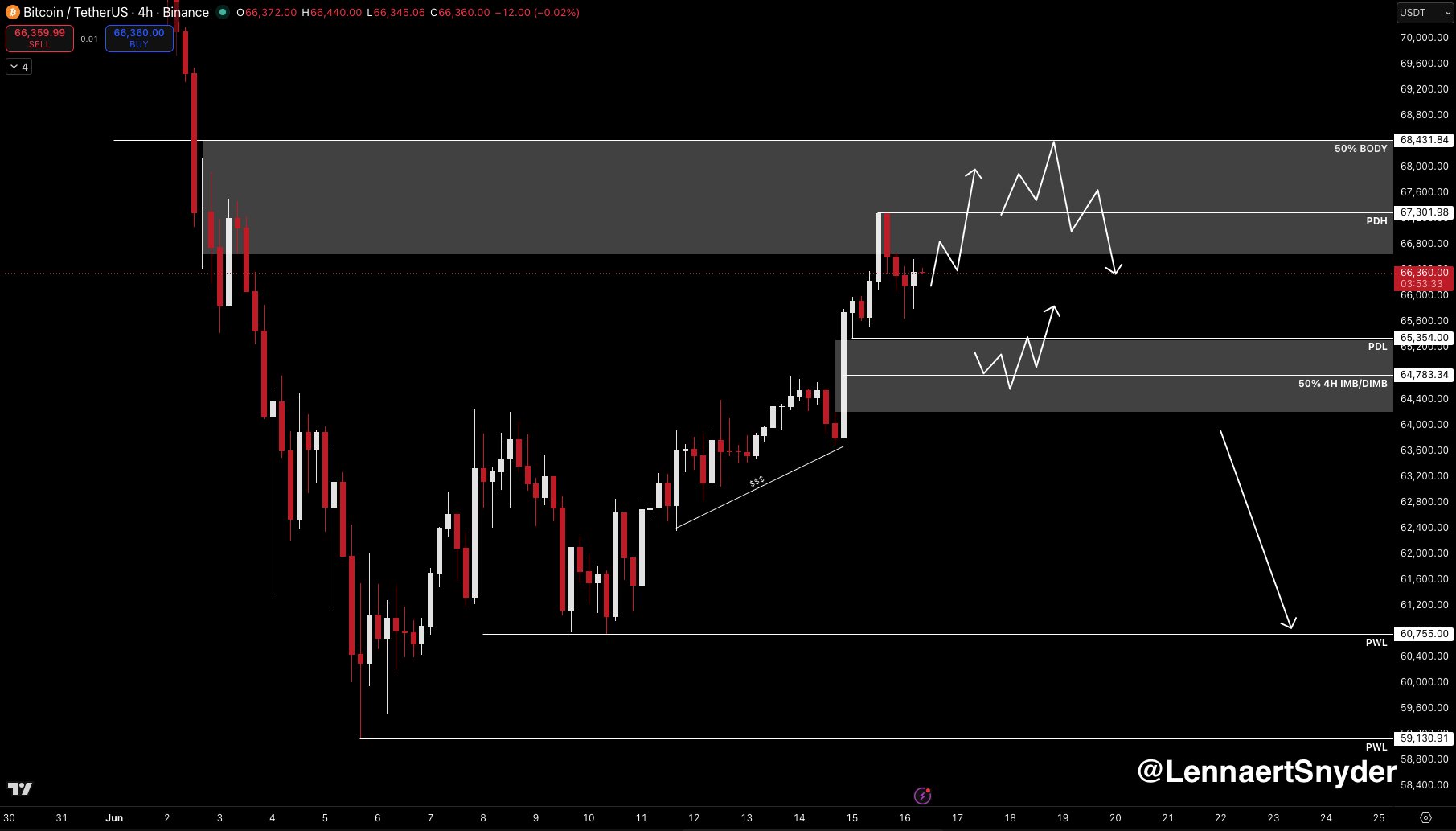
Trader Roman joined those putting the area around $70,000 as a likely local top target.
“Still eyeing the 70k level for our bounce to be completed.,” he told X followers.
“Hourly TFs look good to continue a bit higher. There aren’t any ‘issues’ that I see yet to stop this bounce.”
Bitcoin trader calls “classic market psyop”
As Cointelegraph reported, other market analysis has cast doubt over the strength of $60,000 as long-term support, arguing that the bear market is too young to be over yet.
Related: Bitcoin analysis warns over BTC price rejection as $67K approaches
Countering this, trader Killa suggested that both market makers and trading algorithms had lured traders into betting on new lows that would never come.
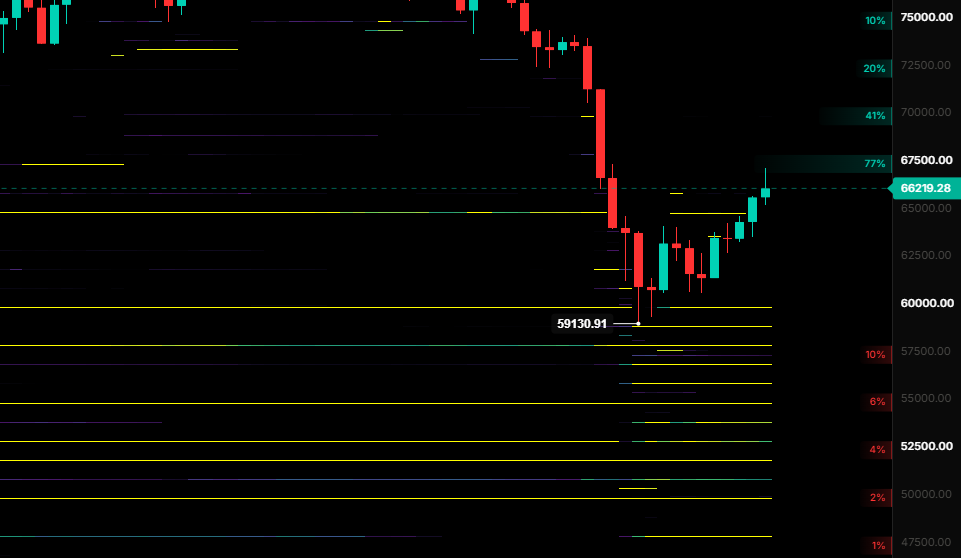
“Just another classic market psyop,” they summarized alongside a chart of order-book liquidity data.
Ripple, the blockchain firm closely associated with the XRP Ledger (XRP) network, invested in African payments company Flutterwave as part of its Series E funding round, a deal centered on expanding the use of stablecoins for cross-border payments.
Flutterwave said Tuesday that the funding round values the company at $3.2 billion. Financial terms of Ripple’s stake were not disclosed.
The deal will integrate Ripple’s U.S. dollar-backed stablecoin, RLUSD, into Flutterwave’s payments infrastructure, allowing businesses to settle some international transactions using digital dollars rather than relying solely on traditional banking networks.
Flutterwave will also connect to Ripple Payments, Ripple’s global payments network, and use the XRP Ledger blockchain to process transactions.
The companies said the goal is to make it easier and cheaper for businesses across Africa to send and receive money internationally.
The deal points to the growing role of stablecoins in international payments, one of the digital asset industry’s fastest-growing use cases. While cryptocurrencies are often associated with trading, stablecoins are increasingly being used by businesses and everyday people to move money across borders and manage U.S. dollar liquidity in regions where access to foreign currencies can be limited.
Binance, the world’s largest cryptocurrency exchange, is on the brink of losing access to the European Union after its application for a Markets in Crypto-Assets (MiCA) license in Greece faces rejection, according to Reuters reporting on the matter.
The decision, if confirmed, would prevent Binance from offering services across the 27-member bloc when the MiCA transition period ends on July 1. Under the new regulatory framework, crypto firms must secure approval from a national regulator to gain passporting rights across the EU.
Binance submitted its application through a Greek entity earlier this year, positioning the country as its regulatory base in Europe. The exchange pointed to Greece’s workforce and operating environment as factors behind the choice. Co-CEO Richard Teng had expressed confidence that the firm would meet the requirements ahead of the deadline.
Two sources told Reuters that Greece’s Hellenic Capital Market Commission is set to reject the application. The regulator declined to comment, citing confidentiality rules. Binance said it has received no formal notice of a denial and maintains that its submission meets MiCA standards.
The firm said they believe it complies with the framework and has not been told otherwise by the Greek authority.
Despite that stance, the timeline leaves little room for delay. Without a license in place by the end of June, Binance would need to halt services to EU clients or risk enforcement action from national regulators. That could include fines or restrictions that limit access across key markets such as France, Germany, and Italy.
After the report came out, Binance sought to reassure users on X over its regulatory status in Europe. In a series of posts, the exchange said it remains committed to the region and is working to minimize disruption while it navigates the approval process.
“Binance remains committed to its European users and will continue to operate in compliance with applicable law,” the exchange posted.
EU, MiCA, Binance, and crypto protections
The EU has emerged as a major test case for global crypto regulation. MiCA introduces a single rulebook for digital asset firms, covering areas such as consumer protection, capital requirements, and governance. The regime is designed to replace a patchwork of national rules with a unified system.
Binance has faced regulatory pressure in several jurisdictions over the past few years, including the United States and the United Kingdom. The outcome in Europe could shape its global strategy as it seeks to align operations with stricter oversight.
Rivals that have secured MiCA licenses, including Coinbase and Kraken, stand to benefit if Binance exits the region. A shift in market share could follow as users migrate to platforms that can offer uninterrupted access under the new regime.
The potential loss of the EU market also raises questions about liquidity and product availability on Binance’s platform. Europe represents a large base of retail and institutional users, and any disruption could affect trading volumes and token flows.
Binance, the world’s largest cryptocurrency exchange, may be unable to serve customers in Europe if its regulatory license application in Greece is turned down, as Reuters reported on Tuesday.
Binance’s Markets in Crypto Assets (MiCA) license application, which has to be approved by a deadline at the end of this month, is going to be rejected by the Greek financial watchdog Hellenic Capital Market Commission (HCMC), according to the report, which cited two people familiar with the situation.
Binance said it has been pursuing a MiCA license over the past 18 months, including through a comprehensive application process with the HCMC in Greece.
“Our understanding is that the HCMC completed its review of the application and considered it compliant with MiCA requirements, and that the application was also reviewed at ESMA level,” a Binance spokesman told CoinDesk via email.
The spokesman also said that “HCMC informed ESMA that it was their view that the application was compliant and that they intended to progress the licence and move to authorise at an upcoming Board meeting.”
Bitcoin climbed past $67,000, its highest level in roughly two weeks, after President Trump declared the US-Iran deal “complete” and authorized reopening the Strait of Hormuz. Oil fell about 4% and around $150 million in crypto short positions were liquidated.
Bitcoin pushed above $67,000 on Monday, its highest level in roughly two weeks, after President Trump said the US-Iran deal was “complete” and that he had authorized reopening the Strait of Hormuz.
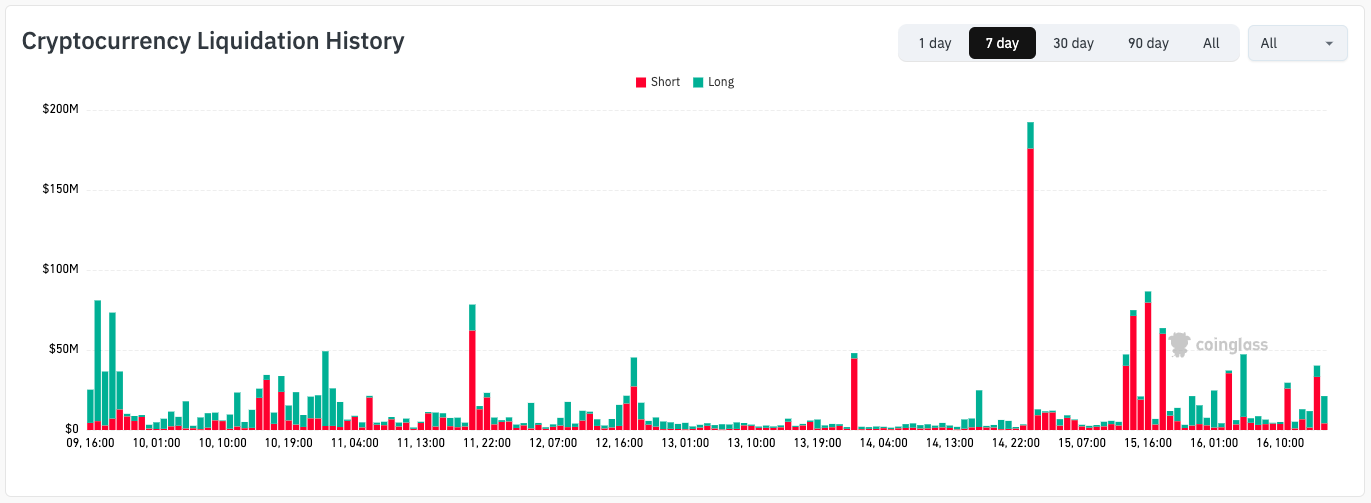
The largest cryptocurrency traded around $67,170, up 4.9% over 24 hours, touching an intraday high over $67,200, per CoinGecko. The move tracked a broad risk-on rally, with the S&P 500 rising about 1.5% and Treasury yields falling as war-risk premia unwound. Roughly $150 million in crypto short positions were liquidated as the price advanced, per Coinglass data, squeezing traders who were positioned for further downside.
Trump declared the agreement done in a Truth Social post, writing that he “fully authorized the toll-free opening of the Strait of Hormuz” and ordered “the immediate removal of the United States Naval blockade.” He added: “Ships of the World, start your engines. Let the oil flow!” CNBC and Bloomberg reported that the US and Iran had reached terms to end nearly four months of war, with both sides agreeing to halt military operations.
The terms center on the waterway and on sanctions. A draft memorandum has the US lifting oil sanctions in exchange for Iran committing to reopen the Strait of Hormuz within 30 days, according to Bloomberg. Trump also said ships, “many loaded up with Oil,” were already starting to move out of the strait.
The Oil Channel
The clearest market signal came from crude. Brent fell about 4% to around $83 a barrel, with US crude sliding toward $80 as traders priced in the return of tanker traffic through a waterway that carries a fifth of the world’s seaborne oil.
Lower oil cools one of the inflation inputs that has kept the Federal Reserve cautious. Bonds rallied alongside equities and crypto, with Treasury yields falling as rate-hike bets receded, per Bloomberg. Bitcoin has spent the spring trading as a high-beta proxy for that risk appetite, selling off on escalation and bouncing on every step toward de-escalation.
A Recovery From the June Lows
Monday’s high marks a sharp turn from earlier this month. Bitcoin had cracked $60,000 on June 5, its lowest level since October 2024, as the war ground on and ETF outflows mounted. It remains down about 15% over the past 30 days and roughly 47% below its $126,080 October record, per CoinGecko.
The de-escalation arc has driven Bitcoin’s price for weeks. The Defiant reported on June 11 that Bitcoin rose above $63,000 after Trump canceled scheduled strikes on Iran and signaled a peace deal was close. The latest leg extends that move as the framework firms up.
The Hormuz question has whipsawed the market all spring. Bitcoin touched $78,000 in April when Iran declared the strait “completely open,” then stalled below $80,000 as geopolitical risk returned and triggered $288 million in long liquidations. Each shift in the conflict has registered in the price within hours.
What’s Not Locked In
The deal is not signed. Trump said the formal agreement would be signed Friday, June 19, in Switzerland, with the strait reopening to follow. Earlier in the week the two sides gave conflicting accounts of the draft terms, and Trump accused Iran of misrepresenting the memo before talks settled.
European governments welcomed the agreement and signaled openness to sanctions relief, urging a swift Hormuz reopening, per CNBC. For now the short squeeze has cleared out the most bearish positioning, but the price still sits well below where it traded before the conflict began.
The Layer 1’s gasless stablecoin design pushed transfer throughput to nearly $65 billion since June 10, recasting Sui as a fee-free settlement rail for institutional and agentic payments.
The Sui blockchain has moved nearly $65 billion in stablecoins in five days, the payoff from a protocol change that made those transfers cost nothing. The figure measures transfer throughput over the window, and it lands as Mysten Labs pitches the network as a replacement for traditional payment rails.
CertiK Skynet, a data dashboard by the blockchain security firm, reported that Sui settled close to $65 billion in stablecoin transfers since June 10 without users paying fees. The same data put cumulative stablecoin volume on the network above $2.27 trillion since early 2024. The catalyst was a protocol-level change that Mysten Labs, Sui’s founding contributor, rolled out on May 20, dropping stablecoin transfer fees to $0.00 and removing the need to hold the native SUI token to move funds.
The $65 billion measures transfer volume cleared over a five-day window. Sui’s standing stablecoin supply sits near $470 million, per DefiLlama, which ranks the chain outside the 15 largest by stablecoin market capitalization. A sub-$500 million float turning over tens of billions in days reflects dollars recirculating as payments, the behavior the fee-free design was built to encourage.
Sui stablecoin market cap, Jan 17 – Jun 15 2026. Peak $606M; trough $466M; latest about $486M. Source: DefiLlama.
How the Gasless Design Works
Sui’s change covers single and batched peer-to-peer transfers of supported stablecoins, with the network absorbing the gas cost. Supported assets at launch included USDC, USDY, AUSD, FDUSD and the Bridge-issued USDsui and Ethena-issued suiUSDe. Mysten Labs framed the mechanism as structural rather than promotional, calling it “not a subsidy, sponsorship program, or temporary promotional initiative.”
Fireblocks, the custody and infrastructure platform that says it secures more than $14 trillion in digital asset transactions, integrated the feature before the rollout. That integration is what routes the design toward enterprises and financial-service providers rather than retail wallets alone.
The Institutional Pitch
For institutions, the friction Sui targets is operational overhead. Adeniyi Abiodun, Mysten Labs co-founder and chief product officer, argued that gas fees impose overhead far beyond their face value. “Even at 1/1000th of a cent, gas forces you to hold reserves, build payment logic, monitor balances, and account for a second asset just to move the first,” he wrote. “For any service provider, that overhead is infrastructure, headcount, and audit scope.”
Abiodun has positioned the feature as a bid to displace correspondent-banking rails. At launch he described the goal as making Sui “the global rail for payments, whether they are for businesses, AI agents, and consumers.” Ran Goldi, Fireblocks’ senior vice president of payments and network, said the design “removes a major point of friction for enterprises building onchain payment flows.”
$1 Trillion
The throughput surge builds on momentum the network had already booked. Sui passed $1 trillion in cumulative stablecoin transfer volume since August 2025, a milestone reached before fees went to zero. Removing the per-transfer cost lowered the floor for micropayments and high-frequency machine-to-machine transfers, the use cases Mysten Labs has tied to agentic commerce.
The model leans on Sui’s parallel-execution architecture, which processes independent transactions simultaneously rather than in sequence. That throughput headroom is what lets the network absorb gas on stablecoin transfers without congestion pricing pushing costs back onto users.
Sui is separately testing private-by-default stablecoin transfers on its devnet, a feature that would add confidential transfer amounts with controlled visibility for compliance. The foundation has not set a mainnet date for that change.
The new fund offering comes as bitcoin struggles to break out of a bear market, trading around $67,000, down about 23% year to date. IBIT, which debuted in January 2024, has amassed nearly $49 billion in assets, making it the largest spot bitcoin ETF on the market. The fund has seen significant outflows since the beginning of the year, though, amid lower bitcoin prices and excitement around other asset classes, including the highly anticipated initial public offerings (IPOs) of SpaceX (SPCX) and Anthropic.
But Jacobs said BlackRock sees several potential audiences for the new fund.
One group consists of income-focused investors looking to diversify beyond traditional sources such as dividend-paying stocks and bonds. Another includes bitcoin holders who remain bullish on the cryptocurrency but want to generate cash flow from their positions.
“You could imagine this could be people who have a significant portion of their wealth in bitcoin but would like to have an income stream to support their lifestyle,” Jacobs said.
A third group may be investors who have historically avoided assets such as bitcoin or gold because they do not produce cash flow.
“We’ve encountered this type of investor for years,” Jacobs said. “How can I own gold in a portfolio if it’s not generating cash in any way? This product seeks to help address that market as well.”
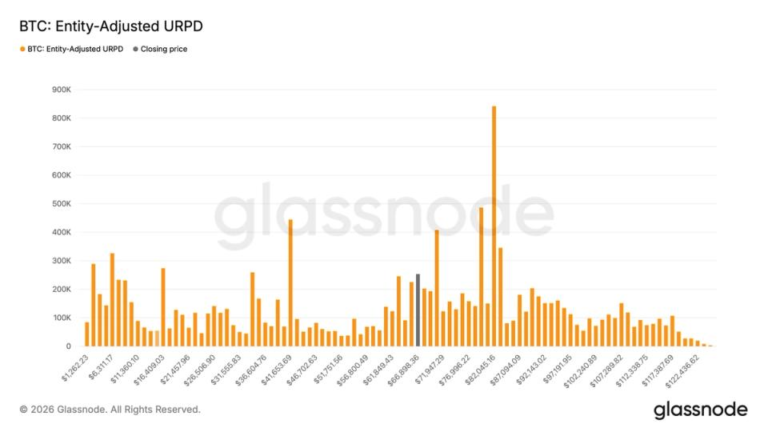
Bitcoin’s BTC$66,455.13 drop below $60,000 earlier this month spurred investors to pile into the largest cryptocurrency, with almost 260,000 BTC bought over 10 days and one measure of demand increasing to its highest possible level.
Investors have bought a net 259,298 BTC since June 5, paying between $59,000 and $67,000, according to Glassnode UTXO Realized Price Distribution data. Glassnode’s Accumulation Trend Score by Wallet Cohort, which measures the relative strength of purchasing fervor based on both the size of buyers and the amount acquired over the previous 15 days, stands at 1.0, the top reading.
Buying has been broad-based across wallet cohorts, ranging from holders with less than 1 BTC, typically retail investors, to those with as many as 1,000 BTC. Notably, from March through May, most groups were net distributors, or sellers, as bitcoin stagnated around $70,000.
The aggregate Accumulation Trend Score has now remained at a peak level for more than two weeks, indicating aggressive buying across cohorts and marking the strongest accumulation behavior observed during the current drawdown.