Home Blog Page 184

Wintermute Starts Quoting Prediction Markets as Event-Contract Volume Tops $60B in 2026

0

The $3.5 trillion-a-year crypto market maker said it is streaming two-sided quotes across event contracts on leading venues, including Polymarket and Kalshi, as monthly turnover passes $20 billion.

Wintermute, a London-based algorithmic trading firm with more than $3.5 trillion in annual trading volume, said on Friday it is now providing two-sided liquidity on prediction markets, becoming the latest institutional market maker to plug into a sector that has cleared more than $60 billion in trading volume so far in 2026.

The firm is “quoting two-sided markets across event contracts on leading venues,” it said in a blog post, citing more than $20 billion in monthly volume across those venues as of early 2026. A person familiar with the matter told Decrypt the venues include Polymarket and Kalshi, the two largest event-contract platforms.

Wintermute’s role is as a market maker, not a bettor. It is posting continuous bid and offer prices to tighten spreads and absorb large orders, rather than taking directional positions on contract outcomes.

The move puts a top-tier crypto liquidity desk into a category that has graduated from political-betting curiosity into a derivatives-style venue for trading real-world event risk.

Billions in Monthly Volume

Combined monthly global trading volume on Kalshi and Polymarket climbed from less than $5 billion in September 2025 to about $24 billion in April 2026, according to a Pew Research Center analysis of data from The Block. Lifetime trading volume across the two platforms crossed $150 billion in April, with Kalshi posting a record $14.81 billion in monthly notional volume and Polymarket clearing $9.01 billion.

Sports drive the majority of activity on Kalshi — 80% of its volume since July 2024 — while Polymarket’s mix is more varied, with politics at 32% and crypto at 20%, the Pew analysis found.

“Prediction markets have the demand profile of a major asset class but the liquidity profile of an early-stage one,” Jake Ostrovskis, Wintermute’s Head of OTC Trading, said in the company’s statement. “For these markets to become a reliable real-time source of probability estimates, they need sustained two-sided liquidity. That depth tightens spreads, supports larger trade sizes, and in turn improves the signal embedded in market prices.”

Wintermute Is Not First

Wintermute joins Jump Trading and Galaxy Digital, both of which already provide liquidity on event contracts, according to The Block. The arrival of a third top-tier liquidity provider, and one that processes more than $3.5 trillion a year across spot, derivatives and DeFi, signals that professional market makers now see event contracts as a derivatives frontier rather than a side bet.

Same-day regulatory news reinforced the institutionalization arc: the CFTC on Friday cleared Kalshi to offer Bitcoin perpetual futures in the U.S., pushing the platform further into traditional derivatives turf. Defiant has reported separately on Polymarket’s recent Nasdaq Private Market partnership opening event contracts on private-company valuations.

What Could Cool the Sector

Regulatory pressure is mounting in lockstep with the volumes. Spain on May 26 ordered ISP-level blocks on both Polymarket and Kalshi over unlicensed-gambling concerns, the fifth country to move against the platforms in 2026 after Brazil, Indonesia, India and Portugal. In the U.S., a New York Times investigation reported that CFTC officials who raised internal concerns about prediction markets had been suspended and removed from the agency.

The platforms also remain split on regulatory posture. Kalshi is CFTC-regulated and U.S.-only. Polymarket International, the offshore venue that accounts for the bulk of the company’s volume, is not CFTC-regulated; Polymarket US — newly CFTC-approved — cleared $1.3 billion in April 2026 compared with $9 billion at the international venue, per Pew.

For Wintermute, the math still works as long as event-contract volumes keep compounding at the pace of the last eight months. Ostrovskis described the sector as “early-stage” on liquidity — which is the same thing as saying the spreads are still wide enough to make showing up worthwhile.

Retired Couple Loses $76,000 Life Savings To Bitcoin ATM Scam, Sues Bitcoin Depot In Federal Court

0

A class action filed in Idaho accuses the now-bankrupt crypto ATM operator of profiting from fraud while leaving vulnerable consumers unprotected.

A retired Idaho couple has filed a federal class action lawsuit against Bitcoin Depot Inc., alleging the company’s ATM network served as a pipeline for scammers who drained their entire retirement savings — $76,000 — over five consecutive days in August 2025.

Karen and Robert Lacey, named plaintiffs in Lacey et al. v. Bitcoin Depot Inc., et al. (Case No. 1:26-cv-00288-DKG), say fraudsters posing as Norton customer service representatives and FBI agents convinced them their accounts were tied to child pornography and illegal gambling investigations. 

The scammers directed the couple to deposit cash at Bitcoin Depot ATMs between August 9 and August 13, 2025. To reinforce the deception, the fraudsters caused wireless networks labeled “FBI” to appear on the Laceys’ phones — signals that remained visible for months after the deposits.

The 43-page complaint, filed May 11, 2026, in U.S. District Court for the District of Idaho, charges that Bitcoin Depot processed each transaction “without meaningful intervention” despite what it calls clear warning signs: first-time users making large cash deposits while on phone calls with unknown parties. 

The lawsuit further alleges the company charges fees of up to 50% per transaction and relies on on-screen warning stickers — a safeguard the plaintiffs call “demonstrably ineffective”.

After Karen and Robert’s son filed a federal crime complaint, Bitcoin Depot issued two $1,000 refund checks — an amount the lawsuit states did not cover even the fees the company collected. Karen Lacey, who was retired when the fraud occurred, has since returned to the workforce, now working rotating hospital shifts.

The complaint cites Bitcoin Depot’s own SEC filings, which state its services “may be exploited to facilitate illegal activity such as fraud” and that its risk management “may not be sufficient”. 

Federal Trade Commission data show Bitcoin ATM fraud losses increased nearly tenfold between 2020 and 2023, with a median victim loss of $10,000. By 2025, the FBI reported Americans lost $333 million to Bitcoin ATM fraud — more than 10,000 victims in a single year.

Bitcoin Depot filing for bankruptcy 

The lawsuit arrives as Bitcoin Depot’s corporate position collapses. The company filed for voluntary Chapter 11 bankruptcy on May 18, 2026, and shut down its entire network of more than 9,000 ATMs across North America. The company had earlier disclosed a $3.6 million Bitcoin theft from its own wallets in March 2026 and reported a 49.2% revenue decline in Q1 2026.

Plaintiffs seek a jury trial, injunctive relief, compensatory and punitive damages, restitution of fees paid, and attorney’s fees. 

U.S. says it seized about $1 billion in Iranian crypto as pressure campaign expands

0

The United States has seized about $1 billion worth of cryptocurrency tied to Iran, Treasury Secretary Scott Bessent said, describing the action as part of a broader campaign to cut off funding channels used by Tehran.

Speaking in an interview on Fox Business, Bessent said U.S. authorities had “grabbed the wallets” and seized cryptocurrency connected to Iran.

He said the effort falls under Operation Economic Fury, an administration initiative aimed at restricting Iran’s access to overseas revenue, banking networks and digital-asset infrastructure.

“In addition, Treasury has cracked down on Tehran’s global shadow banking networks; designated networks supplying weapons and other military components to Iran; sanctioned a corrupt Iraqi official who has facilitated the sale of oil along with Iran-backed militias operating in Iraq,” a press release from the Treasury reads.

Bessent said the pressure campaign had contributed to worsening economic conditions in Iran. He added that large numbers of military personnel were not being paid, police officers were failing to report for duty, and inflation had exceeded 200%.

He also said Iranian authorities had resorted to food vouchers and internet shutdowns.

The Treasury secretary said the U.S. and its partners were also targeting overseas real estate and other assets that he described as proceeds diverted from the Iranian people.

He added that Iranian officials had previously moved hundreds of millions of dollars each month before Treasury intervention.

Read more: Iran crisis puts the regime’s $7.8 billion crypto shadow economy in spotlight

JPMorgan Chase CEO Jamie Dimon Declares War On Clarity Act, Calls Coinbase’s Armstrong ‘Full Of Sh*t’

0

JPMorgan Chase CEO Jamie Dimon has drawn a battle line in Washington: the Clarity Act, as written, is dead on arrival — and Coinbase CEO Brian Armstrong is the enemy driving it.

In a Fox Business interview on Friday, Dimon unloaded on the pending crypto market structure legislation, calling it a threat to the financial system and a gift to an industry that wants the privileges of banking without the responsibilities.

“It allows cryptocurrency firms to effectively pay interest on deposits — stablecoins or something like that — without the protection that they should have,” Dimon said. “It has almost no legal protections.”

His core argument: if a crypto platform walks like a bank and talks like a bank, it needs to be regulated like one. That means Anti-Money Laundering compliance, Bank Secrecy Act obligations, FDIC insurance, capital requirements, liquidity rules, and the full weight of financial oversight that traditional banks carry. The Clarity Act, in his view, lets crypto firms skip all of it.

The fight over stablecoin rewards sits at the center of the dispute. Banks say allowing crypto exchanges to pay customers for holding stablecoins would accelerate deposit flight from traditional institutions — a ticking clock on the business model that has defined American banking for a century. 

Crypto advocates counter that such incentives are a natural evolution of payments infrastructure. The bill’s markup is approaching, and neither side is backing down.

Dimon also flagged the AML problem with cross-border stablecoin payments.

“The first one may be legitimate,” he said, “the second one may be a sex trafficker.” Once money lands in a digital wallet overseas, it can move to a third wallet, a fourth — with no visibility and no accountability. That, he said, is the unresolved risk hiding beneath the optimism around stablecoin utility.

Dimon: Coinbase CEO Armstrong is full of sh*t

But Dimon reserved his sharpest words for Armstrong. The Coinbase CEO, he claimed, is spending hundreds of millions of dollars in Washington to push the legislation through. “No one is going to bow down to this guy,” Dimon said, calling Armstrong “full of sh*t.” 

It was not the first time — Dimon made similar remarks at the World Economic Forum in Davos earlier this year.

JPMorgan is not alone. The American Bankers Association, community banks, and credit unions are aligned in opposition to the bill’s current form.

Dimon made clear this is a fight — not a negotiation. “We’ll fight it,” he said. “If we lose, we lose. But it will be fought.”

Why AI-powered hackers are keeping big banks off the blockchain

0

Traditional financial institutions are preparing to move trillions of dollars of assets onchain, but the risk of hacks and exploits is putting them off, according to blockchain security firm CertiK’s CEO Ronghui Gu.

“Right now, more and more institutions are trying to move assets onchain,” Gu told CoinDesk in an interview. “They imagine that, let’s say in 10 years, multiple trillion dollars — even tens of trillions of dollars — of assets are going to move onchain.”

The potentially massive migration of financial assets is hitting a wall because, although bankers and legacy institutions want to capture the efficiency of decentralized ledgers, the current operational reality is still too risky for conservative capital allocators.

“When they move assets onchain, they need to face all these AI attacks, smart contract vulnerabilities, oracle manipulation, and cross-chain bridge hacks,” Gu explained. “So, that’s being considered as one of the major blockers for all this TradFi to move trillions of dollars of assets onchain.”

Gu said their concerns are legitimate, noting that CertiK detected hacks nearly every day in April, making it the worst month in four years, fueled mostly by AI-driven attacks, notwithstanding “April was the worst month in four years with only three days without a hack,” Gu said, adding that CertiK believes this sudden rise could only be possible with AI.

Drift Protocol and Kelp Dao were hacked by North Korean cybercriminals in April in two exploits that drained nearly $600 million from the two lending crypto pools. In February 2025, Bybit suffered a $1.46 billion attack, described as the biggest hack of all time.

DefiLlama data recently showed more than $1.1 billion had been lost to DeFi hacks in a year, exposing how vulnerabilities in cross-chain infrastructure can quickly spill into the broader ecosystem.

Persistent operational failure is the primary symptom of what Gu calls an “unfair game” in favor of malicious actors, because they possess infinite resources.

Deep pockets

Hackers focus on highly lucrative protocols with massive total value locked (TVL), so they are economically incentivized to pump immense capital into their exploits.

A single protocol attacker can easily spend $10,000 to $20,000 worth of computer tokens to keep advanced engines running continuous vulnerability scans against a protocol for days or weeks on end. Conversely, Gu said, protocol defenders operate under strict, localized project budgetary constraints.

“We have 5,000 clients,” Gu explained. “When we receive a request from a client, there’s a budget. We will spend tokens plus human experts within that budget.” That creates a massive structural gap: while a defense team is bound by a strict commercial contract to scan a protocol over a few hours, the machines of a hacker or group of hackers never stop hunting for a single crack in the code.

Gu said exploits have increased in speed and efficiency with AI and what’s worse is that the nearly-daily trend seen in April could continue through to the end of this year.

Binance aims for 3 billion users by 2030 amid a market it says is going through hard times

0

The crypto market is struggling, competitors are either passing through hard times or pivoting to other areas, while Binance is building with eyes on increasing its active user base ten-fold to 3 billion by 2030, Catherine Chen, the head of VIP and Institutional told CoinDesk in an interview.

“It is true, the market is going through a hard time,” Chen said. “There is still some regulatory development, we are seeing some of our competitors either struggling or perhaps shifting their focus.”

Coinbase, for example, recently reduced its workforce by 14% or nearly 700 staffers, citing negative market conditions as well as AI challenges, part of a wave of crypto employee layoffs this year.

As BTC faces resistance to reclaim the psychological six-figure mark over $100,000, a level it has not seen since mid-November, the broader market seeks sustainable growth drivers beyond retail speculation. The total crypto market capitalization was hovering around the $2.7 trillion mark, down by nearly 40% from its all-time-high of $4.38 trillion before the October Flash Crash, from which bitcoin has not recovered.

Chen said Binance’s position remains robust despite the market downturn, noting the exchange currently serves more than 310 million active users. She emphasized these are “actual active individual users,” verified through stringent KYC and corporate KYB protocols, not just “registered” accounts, she clarified. Binance is considered the largest crypto exchange in the world, dominating in the market in trading volume and registered users. Coingecko ranks Binance second with daily trading volume averaging roughly $7 billion.

Bridging the $2 billion institution spending gap

Chen speaks of a digital asset market that is growing so significantly and with such enormous potential, that only collaboration between traditional finance (TradFi) and native cryptocurrency will see both sides emerge winners in the future.

Binance is going after the massive spending disparity between traditional and digital asset desks, Chen said. She noted that TradFi spends north of $2 billion annually on advanced Order Management Systems (OMS). In crypto, infrastructure spend is less than a tenth of that, sitting at around $185 million.

Binance’s newOMS tool kit is designed to bridge this exact gap, partnering with industry mainstays like Coin Metrics, Talos and 3Commas to provide institutional-grade flow analytics, Chen said.

“Financial institutions are increasingly merging with crypto exchanges and blockchain infrastructure providers,” said Chen. “They don’t want to be building all that infrastructure themselves.”

Pledging Wall Street assets on crypto rails

This convergence has moved past theoretical trading and into the core plumbing of institutional custody. So, while the market watches retail trends, Chen noted, Binance has rolled out an institutional “triparty” banking framework designed to alleviate the ultimate TradFi pain point that is counterparty risk.

Institutional clients do not want to custody crypto directly nor do they want to leave their capital on an exchange, Chen added. Instead, they want to custody fiat or fiat-equivalents with their existing banking partners.

To solve this problem, Binance has silently integrated with sovereign-grade asset management, Chen stated, adding that the crypto exchange now accepts tokenized money market funds from institutional giants BlackRock and Franklin Templeton as eligible triparty ecosystems.

Instead of manually rolling Treasury futures and incurring heavy administrative fees, institutional traders can now pledge real-time, yield-bearing tokenized shares to back their trading operations.

“Whether it is equities, treasury, or debt, this is the way forward,” Chen notes, pointing to a 12-to-18-month horizon where real-world asset (RWA) tokenization matures rapidly. “People have finally figured out that you don’t magically change the fundamental characteristics or price of an asset by tokenizing it. It is fundamentally an improved form to ensure better accessibility.”

Binance also recently rolled out its Crypto-as-a-Service (CaaS) platform designed exclusively for financial institutions seeking to get involved in the digital asset sector in September of last year, Chen recalled. Since then, she added, over 15 major financial institutions have sought their services.

“Whenever the market is bad, it is always the best time for us to build,” Chen says. “We are building and positioning ourselves to 10x our user base when people aren’t noticing—and then, hopefully, we are already there.”

Grayscale says Hyperliquid could become a ‘financial services juggernaut’

0

Hyperliquid (HYPE), a decentralized trading platform that began as a crypto perpetual futures exchange less than three years ago, is increasingly being viewed by Wall Street analysts as a broader financial infrastructure play that could challenge parts of traditional exchanges and derivatives markets.

In a new report, Grayscale described Hyperliquid as a fast-growing blockchain-based platform that generated roughly $800 million in revenue in 2025 while capturing meaningful market share in crypto perpetual futures, one of the largest segments of digital asset trading.

“Hyperliquid is not directly comparable to another project in either crypto or traditional finance,” Grayscale wrote. “If it continues to execute well … we think Hyperliquid could become a financial services juggernaut.”

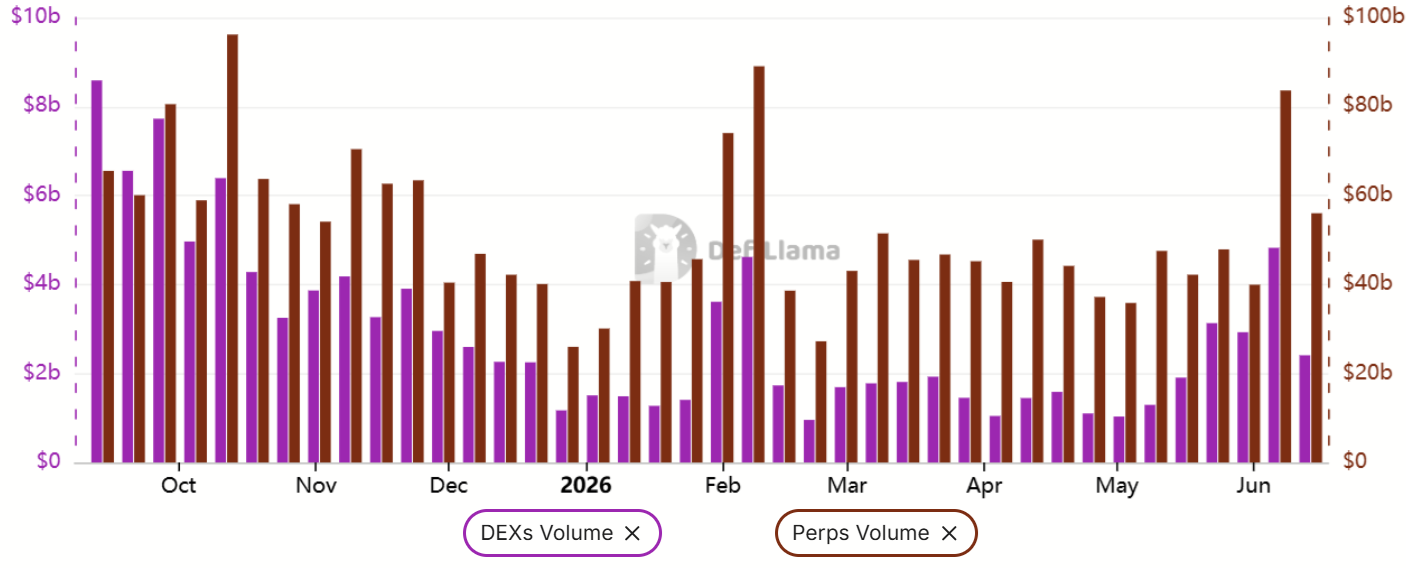
Perpetual futures, or “perps,” are derivatives contracts that allow traders to speculate on asset prices without expiration dates. The market has become a cornerstone of crypto trading, averaging roughly $200 billion in daily volume this year, according to Grayscale.

Historically, the market has been dominated by centralized exchanges such as Binance and Bybit. Hyperliquid, however, earlier this year emerged as one of the first decentralized exchanges to compete at scale while offering self-custody and onchain transparency.

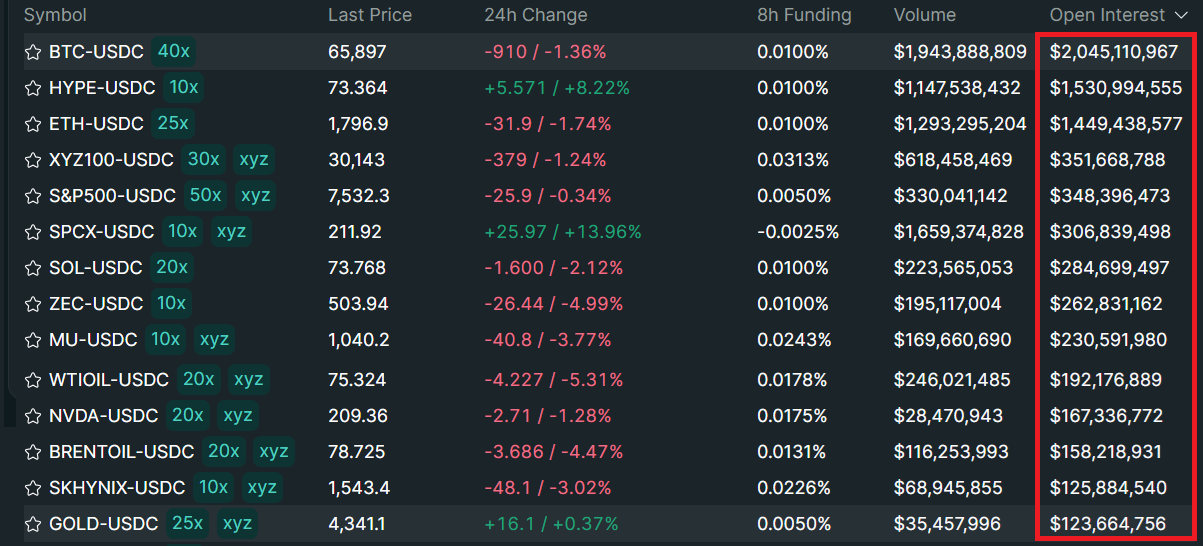
The platform processed roughly $2.9 trillion in perpetual futures volume in 2025 and now holds about $7 billion in open interest, according to the report.

Grayscale argued Hyperliquid’s ambitions now extend far beyond crypto trading.

The platform has expanded into tokenized equities, commodities and prediction-style markets through its HIP-3 and HIP-4 systems, allowing developers to launch new markets directly on the network. Grayscale said those products are increasingly functioning as round-the-clock trading venues for assets traditionally confined to Wall Street hours.

FalconX reached a similar conclusion in a separate report last week, saying Hyperliquid is beginning to compete with firms such as CME Group and prediction market operators including Kalshi and Polymarket.

“Hyperliquid is seeing traction as demand for its HIP-3 markets expands to include pre-IPO markets,” FalconX strategist Martin Gaspar wrote.

Both reports pointed to regulation as a critical factor for Hyperliquid’s future growth.

Hyperliquid currently blocks U.S. users because perpetual futures markets operate in a regulatory gray area under American law. But Grayscale said evolving guidance from regulators and growing interest from firms such as Coinbase (COIN), Robinhood (HOOD) and Kraken suggest regulated perpetual-style products could eventually enter the U.S. market.

Even so, risks remain. Grayscale noted that Hyperliquid’s token, HYPE, remains highly volatile and warned that the platform’s long-term growth depends heavily on future regulatory changes.

Still, both firms suggested Hyperliquid has moved beyond being viewed as just another crypto exchange.

Instead, analysts increasingly see it as an early attempt to build a 24/7 global financial market on blockchain rails.

Ripple said to lead $1 billion XRP treasury raise

0

Ripple Labs is reportedly leading an effort to raise at least $1 billion for a new public-market vehicle that would accumulate XRP, per Bloomberg, testing whether the digital asset treasury trade still works beyond bitcoin.

The raise would be done through a special purpose acquisition company, the report citied to people familiar with the matter. The funds would sit inside a new XRP-focused digital asset treasury, and Ripple is expected to contribute some of its own XRP to the vehicle.

Terms are still under discussion and could change. Ripple did not immediately respond to CoinDesk’s requests for comment or confirmation.

If completed, the deal would be the largest known XRP treasury vehicle to date. XRP is the world’s fifth-largest token, with a market value of about $138 billion. It has gained 13% this year, compared with a 16% rise in bitcoin.

Digital asset treasury companies became one of crypto’s biggest stock-market trades in 2025, as listed firms used SPACs, reverse mergers and equity issuance to buy tokens. The model worked while crypto prices rose and investors paid premiums for balance-sheet exposure.

That trade has weakened, however. Shares of major token accumulators, including Strategy and Metaplanet, have fallen sharply in recent months as crypto prices turned choppy and investors started questioning how many public companies can run the same accumulation play at once.

Ripple’s plan would test whether XRP has enough institutional demand to support a similar structure.

XRP has not drawn the same treasury-company interest as bitcoin. One of the larger examples came in May, when VivoPower announced a $121 million raise to pivot toward XRP investing.

Ripple has its own reasons to back a larger vehicle. The company held 4.74 billion XRP in wallets as of July 31, worth about $11 billion at current prices, according to its website. Another 35.9 billion XRP were locked in on-ledger escrow accounts scheduled for monthly release.

A public XRP treasury company could create a new buyer for the token while giving Ripple another way to place part of its holdings with investors.

Bitcoin’s biggest quantum risk may not be wallet keys. An early investor fears something bigger

0

A venture capitalist who has spent a decade backing deep-tech and quantum hardware startups says the bitcoin industry is fixated on the wrong half of the quantum problem, the wallet keys instead of the encrypted messages already moving between exchanges, bridges and custodians today.

“The financial system’s most dangerous vulnerability isn’t stored data, it’s the data moving between institutions right now,” Andrew Gault, CEO of networking firm ZeroTier, told CoinDesk in a recent chat.

Gault is CEO of networking firm ZeroTier and a founding partner of 7percent Ventures, a London- and San Francisco-based deep-tech firm whose portfolio includes British quantum-computing startup Universal Quantum.

“Every interbank message, every payment authentication record, and every digital signature traveling across a network today is being collected by sophisticated adversaries who don’t need to read it yet,” he noted.

“CISOs and security teams have been trained to protect data at rest. What nobody wants to say out loud is that the adversary’s strategy has changed. They’re patient, they have storage, and they’re building a library of today’s encrypted traffic to decrypt the moment quantum capability crosses the threshold,” he added.

The Google Quantum AI research that rattled bitcoin in March showed a sufficiently powerful quantum computer could derive a bitcoin private key from an exposed public key in about nine minutes, came from outside his portfolio.

The conversation since that paper has centered on the roughly 6.9 million BTC sitting in addresses with exposed public keys and Bitcoin’s missing post-quantum migration plan.

But Gault says the more urgent exposure is the data already being collected off the open internet for decryption later, regardless of whether a working quantum computer exists yet.

Google’s own security engineers have moved the same direction. In a March post, the company set 2029 as its target for completing a post-quantum cryptography migration, citing progress on quantum hardware, error correction and factoring resource estimates.

The post, written by Google vice president of security engineering Heather Adkins and senior cryptography engineer Sophie Schmieg, said the company has reprioritized its internal threat model to focus on authentication services and digital signatures, the same wire-level signing infrastructure Gault has been pointing at.

“The threat to encryption is relevant today with store-now-decrypt-later attacks,” the post said.

The strategy driving that urgency is known in cryptography circles as “harvest now, decrypt later.” It assumes adversaries don’t need to read encrypted traffic today, only store it cheaply until a sufficiently powerful quantum computer arrives.

Citi modeled the bank-system version of the scenario in February, estimating a quantum-enabled attack on a single top-five U.S. bank’s access to the Fedwire Funds Service payment system could trigger a $2 trillion to $3.3 trillion cascade across the U.S. economy, equal to a 10% to 17% decline in real GDP.

The Global Risk Institute, cited in the same Citi report, puts the probability of a cryptographically relevant quantum computer arriving by 2034 at between 19% and 34%.

For crypto, the wire-level surface is broader than the wallet one. Cross-chain bridge proofs, exchange API authentication packets, signed transactions broadcast and archived in public mempools, and the back-channel signing traffic between cold storage and trading desks all sit on the same vulnerability spectrum as the bank-grade encryption Citi was modeling.

CoinShares argued in a February report that the wallet-key fear is overstated, estimating only about 10,200 BTC are concentrated enough to move markets if stolen.

Gault’s worry is a different one. “The particularly uncomfortable reality for financial institutions is that the authentication records being harvested aren’t just sensitive,” he said. “It’s the proof layer that determines who owns what, who authorized which transaction, and who bears legal liability.”

Ethereum (ETH) has launched a coordinated post-quantum migration, but Bitcoin has not done the same. Major crypto exchanges and custodians, where most of the signing traffic lives, have not publicly committed to one either.

CFTC Backs Crypto Perpetual Contracts, Issues Advisory on 24/7 Trading

The US Commodity Futures Trading Commission (CFTC) took positions on cryptocurrency perpetual futures contracts and how the industry may be more suited for “24/7 trading, clearing, and settlement.”

In a Friday notice, the CFTC said it had approved perpetual futures contracts tied to the spot price of Bitcoin for prediction markets platform Kalshi. The company announced at about the same time that it would launch the perpetual futures contracts on its platform in a move closer to a derivatives exchange.

“​​The Order was based on representations and submissions made by Kalshi in support of its request for Commission approval, including its explanation and analysis of the BTCPERP Contract’s terms and conditions, the nature of the underlying commodity market, and the BTCPERP Contract’s compliance with applicable provisions of the Commodity Exchange Act and the Commission’s regulations thereunder, including the Core Principles applicable to [Designated Contract Markets],” said the CFTC.

Source: CFTC

The perpetual futures contracts, or “perp” products, would allow Coinbase and Kalshi users to speculate on crypto prices without owning the underlying assets. The CFTC no-action position for Coinbase and approval for Kalshi represented the US agency being more open to crypto derivatives.

Coinbase chief legal officer Paul Grewal called the CFTC decision a “massive first for the industry” in a Friday X post. The exchange launched stock perpetual futures for non-US traders in March.

Related: CFTC seeks to reverse settlement deal with Gemini

In a separate notice, the CFTC distinguished between the suitability of traditional markets and crypto markets for 24/7 trading. According to the agency, “derivatives referencing crypto assets may be well-suited for 24/7 trading due to their digital infrastructure and global reach” while others, like agricultural markets, may not be based on their “unique customer bases, regional nature” and other factors.

CME Group also announces 24/7 crypto futures trading, pending regulatory review. Source: CME Group

Trump touts CFTC’s authority, with no additional commissioner nominations

On Tuesday, US President Donald Trump posted to social media, in a statement supporting Michael Selig and the CFTC in their fight for jurisdiction over prediction markets. The post came amid several state-level lawsuits attempting to restrict or ban the platforms, while Selig claims the agency has “exclusive jurisdiction” under the Commodity Exchange Act.

Selig remains the chair and sole commissioner at the federal commodities regulator in a panel intended to consist of a bipartisan group of five people. As of Friday, Trump had not announced any nominations to fill the seats.

Magazine: HYPE chases $100 target, ETH could dump below $1800: Market Moves