Home Blog Page 175

Coinbase Teases 1:1-Backed Tokenized U.S. Stocks With On-Chain Dividends

0

Coinbase announced plans for what it calls the first tokenized U.S. stocks backed 1:1 by actual shares, with automatic on-chain dividend distribution. The exchange described the product as ‘no derivatives, no IOUs,’ a direct contrast to the synthetic equity structures currently dominating on-chain equity trading.

Coinbase said Tuesday it will launch tokenized stocks backed one-for-one by shares of U.S. companies.

The exchange announced the product on its official X account, writing that “the first real, 1:1 backed tokenized stocks are coming” and that customers will be able to own, trade, hold and redeem the tokenized shares onchain while receiving dividends automatically.

In fine print, the post said tokenized stocks “will only be available in eligible jurisdictions outside the United States,” with no date attached. No custody partner, token issuer, or list of supported equities was disclosed.

The move targets a market led by xStocks, which holds about $516 million in total value locked, almost entirely on Solana, according to DefiLlama..

The launch would make Coinbase the latest U.S.-based exchange to tokenize American equities while keeping the product away from American users. Robinhood, Gemini and Kraken have already opened tokenized-stock trading to customers outside the U.S. Coinbase’s “not a derivative, not an IOU” framing also raises the bar in a category where most existing offerings give holders price exposure rather than a direct claim on shares.

“For the first time, these are real 1:1 backed tokenized stocks you can trust. You own an actual chunk of the company onchain,” Coinbase CEO Brian Armstrong said in a post on X. He added that the product would deliver “all the benefits of true ownership, with all the benefits of tokenized assets,” calling it “a great step towards unlocking global access to U.S. markets.”

‘Not a Derivative, Not an IOU’

The framing is aimed at the current generation of tokenized-equity products. The onchain market leader is xStocks, whose tokens are issued by Backed Assets (JE) Limited, a Jersey-based firm that holds shares in custody and issues tokens against them. Those tokens are redeemable only for qualified investors under EU rules, and U.S. persons are blocked from participating.

Binance’s bStocks product tokenizes holdings that users already hold on the exchange, creating an onchain representation of an exchange-side position rather than a direct claim on externally custodied shares. Kraken offers xStocks-bundled products through Backed Assets’ issuance infrastructure. Securitize, which won FINRA approval to custody tokenized securities and partnered with Computershare to tokenize U.S.-listed equities, represents a third path: tokenization through a registered broker-dealer.

Coinbase’s description — a U.S. exchange holding shares directly, with onchain tokens that constitute a redeemable claim and automatic dividend pass-through — implies a structure closer to the registered-custody approach than to the Jersey-issuer or exchange-re-tokenization models. Coinbase has not said which legal entity will issue the tokens or who will hold the underlying shares.

Starting Outside the US

The decision to launch abroad first tracks the regulatory split between the two products Coinbase already runs. The CFTC oversees derivatives, and Coinbase holds a CFTC-regulated derivatives clearing organization designation that lets it offer equity-linked derivatives to U.S. retail customers. Actual equity ownership, which is what the tokenized-stock product describes, falls under SEC jurisdiction.

The SEC’s Division of Trading and Markets has outlined a framework to list and trade tokenized securities on existing market infrastructure, alongside a parallel effort to harmonize rules with the CFTC. Until that work is complete, a 1:1 custody model with automatic dividend pass-through for U.S. retail customers would have to be classified as a security requiring broker-dealer registration or a specific exemption, or structured through a transfer-agent arrangement. Launching in eligible jurisdictions outside the U.S. sidesteps that requirement at launch.

A Delivery Gap to Close

The tokenized-equity model ran into a high-profile failure this month, when Bybit, Binance and Bitget Wallet canceled tokenized SpaceX allocations after xStocks did not deliver actual shares ahead of SpaceX’s public listing. The episode illustrated the gap between tokenized exposure and share ownership that Coinbase’s announcement is explicitly designed to address.

Not New

“1:1 backed” is not itself a new claim. Kraken already markets its tokenized Coinbase stock as backed one-for-one by real Class A shares held with a third-party custodian, yet holders of that product receive no shareholder rights.

What Coinbase says distinguishes its product is direct ownership, automatic dividends and onchain redemption. Those claims rest on a legal and custody structure the company has not yet disclosed, and the announcement is a teaser rather than a live product. Tokenized stocks also remain small next to traditional equity markets; xStocks’ roughly $516 million in TVL is a fraction of daily volume on a single large-cap U.S. stock.

Coinbase said it will share more at a product event at 3 p.m. ET Tuesday, which it billed as covering additional launches.


Bitcoin falls below $63,000 as risk assets sell off

0

The pressure came from a wider retreat in markets. Global equities slipped in holiday-thinned trading, with US, Chinese, Hong Kong and Taiwanese markets closed, and a gauge of Asian shares falling 0.6% after a five-day run to record highs. Brent crude traded around $79 a barrel, down about 9% on the week, as shipping through the Strait of Hormuz returned to normal under the signed US-Iran deal and eased what had been a historic supply shock.

Attention now turns to talks over Iran’s nuclear program, with Vice President JD Vance saying a 60-day clock to settle the deal’s details has started.

The bigger question hanging over the market is where this cycle goes, and whether the altcoins that usually rally late in a bull run get their turn at all. Michael Egorov, founder of Curve Finance, told CoinDesk he thinks bitcoin is behaving differently this cycle because spot ETFs were approved just before the 2024 halving, the roughly four-yearly event that cuts the rate of new bitcoin issuance, pulling in institutional demand that did not exist before and breaking the old pattern.

The speculative energy that once flowed into altcoins, he said, went instead into “useless memecoins” right after the ETFs launched.

Matter Labs Cuts Staff, Pivots Fully to Institutional Privacy Platform Prividium

0

Matter Labs CEO Alex Gluchowski announced layoffs and a full strategic pivot on Tuesday, committing the company behind zkSync entirely to Prividium, its institutional on-chain privacy infrastructure platform.

Matter Labs, the company behind the zkSync Ethereum layer-2 network, cut staff on Tuesday and said it is committing the entire organization to Prividium, an institutional on-chain privacy infrastructure platform it began building in 2024.

Matter Labs co-founder and chief executive Alex Gluchowski confirmed the reductions in a post on X Tuesday afternoon, framing the move as a skills realignment rather than a cost cut.

“In 2024 we began building for regulated financial institutions,” Gluchowski wrote. “That work became Prividium, and the entire company is now committed to one goal: building the infrastructure that brings enterprises and regulated financial institutions onchain, with privacy at its core.”

Gluchowski said departing employees had been offered financial support and that the company is coordinating job placement through an opt-in talent list shared with outside employers. He did not disclose the number of positions eliminated.

The zkSync token, which has a market cap of $115 million, is up 4.3% in the past 24 hours, according to CoinGecko.

What Prividium Is

Prividium is Matter Labs’ institutional-grade stack for on-chain privacy and compliance, built on top of the ZK cryptography that underpins zkSync. Where zkSync was designed as a general-purpose Ethereum rollup for DeFi and consumer apps, Prividium targets banks, asset managers, and other regulated entities that require transaction confidentiality alongside audit-trail access for compliance purposes.

Gluchowski described the pivot as a response to specific product feedback from institutional customers, saying the company has “learned a great deal about where our customers need it to go.”

L2 Specialization Pressure

The pivot follows a broader wave of layer-2 and ZK-project consolidations. Hyli wound down its ZK blockchain project earlier this year, citing weak market traction for general-purpose ZK infrastructure. Botanix shut down its Bitcoin L2 Spiderchain after a year of mainnet operation.

The pattern points to a maturing layer-2 market where broad horizontal platforms face pressure to find defensible verticals or exit.

For Matter Labs, the institutional privacy vertical carries a clearer revenue thesis: regulated entities pay for compliance tooling, and ZK proofs offer a technically credible path to selective disclosure, the property that lets a counterparty prove a transaction is lawful without revealing its full details.

As of publication, Gluchowski’s post and the Matter Labs X account have made no statements about the future of the zkSync network or its ZK token as a separate product line.

Bitcoin traders load up on bearish bets all the way down to $52,000

0

A hawkish Federal Reserve is bolstering the U.S. dollar, bitcoin ETFs have seen persistent outflows, and Strategy, the largest publicly listed bitcoin holder, faces mounting pressure.

Strategy’s preferred stock, STRC, has plunged to record lows well below its $100 par value, complicating the company’s aggressive bitcoin accumulation strategy.

Arca CIO Jeff Dorman highlighted the precarious situation:”Either sell an enormous amount of BTC and MSTR to help bring $STRC back up near par, and at least buy yourself some time, or continue to watch every part of your cap structure melt because of the uncertainty you’ve created,” he said on X.

As of writing, BTC changed hands near $62,400, down 0.8% since midnight UTC hours, according to CoinDesk data. Prices hit highs near $67,000 early this week.

Bitcoin’s ‘Deep Value’ Discount Faces Hawkish Fed Test: Bitwise

0

Bitcoin’s (BTC) valuation metrics continue to highlight a deep discount even as markets brace for a potentially hawkish Federal Reserve under new chair Kevin Warsh. Analysis from Bitwise Investments said BTC remains in a “deep value” zone after a valuation metric fell below 1.0, a level associated with long-term accumulation periods.

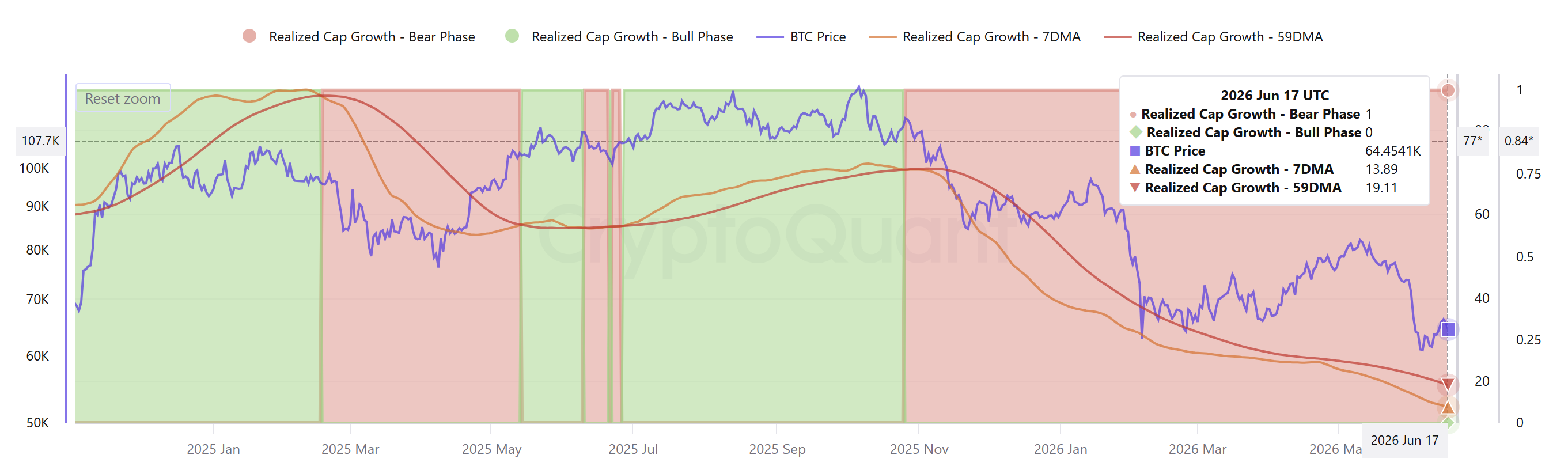
However, investor participation remains subdued, with CryptoQuant’s realized cap growth metric remaining in a bear phase since late October 2025. This points to a steady slowdown in fresh capital entering the BTC network.

At the same time, a growing list of key companies going public raises increased competition for liquidity across the investment market, so the focus shifts to whether BTC attracts new capital amid tighter liquidity conditions.

Deep-value or liquidity squeeze, which is most important?

The Federal Reserve kept interest rates unchanged at 3.5%-3.75% on Wednesday, a decision that largely matched Bitwise’s market expectations and avoided the hawkish surprise the market had feared. 

While BTC dropped back below $64,000 on Thursday following the Fed’s interest rate announcement, Bitwise described its price as a “deep value” opportunity based on its Mayer Multiple, which compares price to its 200-day moving average. The firm noted the metric had remained below 1.0, a level that has historically aligned with accumulation periods. 

Bitcoin’s Mayer multiple vs Nvidia. Source: Bitwise

Bitwise argued that Bitcoin’s valuation stood out compared with AI-linked equities like NVIDIA, which were trading at significant premiums to long-term trend levels. The firm also flagged a growing pipeline of major capital raises, including potential offerings tied to SpaceX, Anthropic, and OpenAI. Collectively, those deals could attract more than $200 billion in investor demand.

Large listings often coincide with strong investor appetite. They also absorb liquidity that might otherwise flow into equities and cryptocurrencies. Bitwise said that elevated rates continue to limit the availability of capital for speculative assets despite Bitcoin’s attractive valuation profile.

The subdued participation is also reflected in Bitcoin’s capital flow trends. CryptoQuant’s realized cap growth metric has remained in a bear-phase regime since Oct. 30, 2025, even as Bitcoin’s valuation indicators moved into historically attractive territory.

Bitcoin’s realized cap growth analysis. Source: CryptoQuant

Since entering the bear phase, the metric’s seven-day and 59-day moving averages have declined to 13.9 and 19.1 on June 17 from roughly 70 in Q4 2025. The slowdown suggests the pace of new capital entering the Bitcoin network has continued to weaken, highlighting investor caution.

Bitcoin researcher Axel Adler Jr. pointed to a separate concern following the Fed’s decision. While rates remained unchanged, the updated dot plot showed nine officials expecting at least one rate hike this year and six projecting two or more.

Bitcoin reacted negatively to the update, with selling volume expanded during the decline on Wednesday, marking the heaviest trading activity at the point of rejection at $66,200. For gold, an initial rebound above $4,300 faded, leaving the metal trading near $4,244 on Thursday.

The reaction aligns with Adler’s view that markets are pricing in a higher-for-longer rate path rather than a near-term policy easing. 

Related: Capital B shareholders approve up to $120B in financing capacity for Bitcoin strategy

BTC traders split on the next move

Market data shows that BTC traders are interpreting the Fed’s outcome in different directions.

Market commentator Crypto Rover highlighted a newly opened $38.5 million Bitcoin short position using 30x leverage shortly after the FOMC meeting. The trader was reportedly sitting on roughly $750,000 in unrealized profit as Bitcoin moved lower.

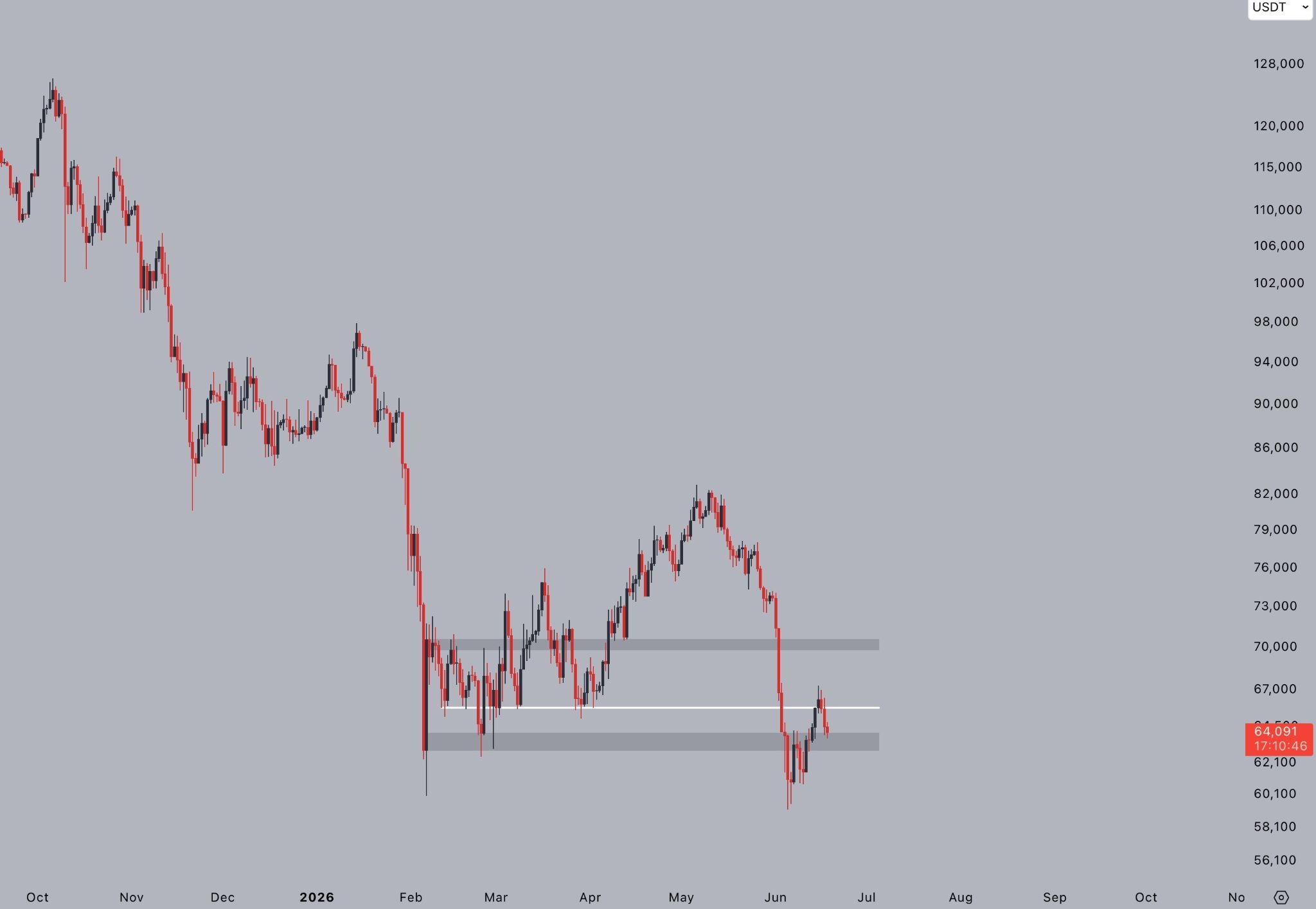
Meanwhile, Bitcoin investor Jelle viewed the pullback below $64,000 from the weekly high of $67,255 as a routine retest of support. The analyst identified the $64,000 threshold as a key price point for buyers, adding, 

“Hold here, and we likely see extended relief into $70k in the coming weeks. Big day ahead.”

BTC/USD, one-day analysis by Jelle. Source: X

Related: Bitcoin capitulation ‘twice as weak’ after spot liquidity turns supportive: Glassnode

Bitcoin has traded below its mining cost for five months, squeezing miners

0

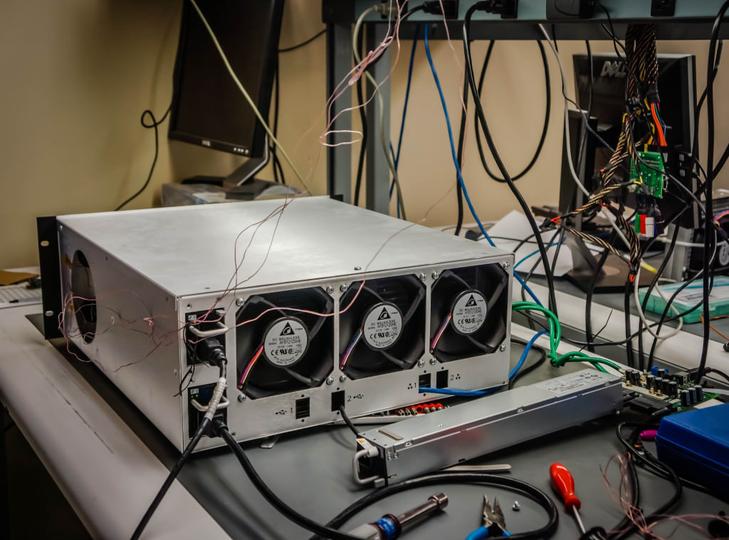
Bitcoin has spent five straight months trading below what it costs to produce, squeezing miners and forcing some to sell, JPMorgan said in a note. The bank pegs the cost to mine one bitcoin at about $78,000, well above the roughly $62,500 the asset fetches now.

The strain is showing and about 20% of miners are now unprofitable, the bank said citing CoinShares data, and publicly traded miners sold more than 32,000 bitcoin in the first quarter to cover operating costs, more than they offloaded in all of 2025.

The network is adjusting on its own. When the price drops below cost, higher-cost miners power down, the hashrate, or total computing power securing the network, falls, and mining difficulty, the automatic setting for how hard it is to mine, resets lower.

That played out in early June, when difficulty dropped 10%, the second decline of that size this year.

Miners are also reacting faster than before. JPMorgan says the sensitivity of difficulty to price has climbed, with more operators sitting near breakeven and flipping machines on or off as prices move. The bank expects larger and more frequent adjustments for as long as bitcoin stays below its production cost.

The outlook is cautious, but JPMorgan flags one upside. The weak sentiment around the sector could itself prove a bullish contrarian signal, echoing the run of accumulation readings, from whale buying to falling exchange reserves, pointing the same way this month.

Ripple-linked token falls 3% after losing $1.15 support

0

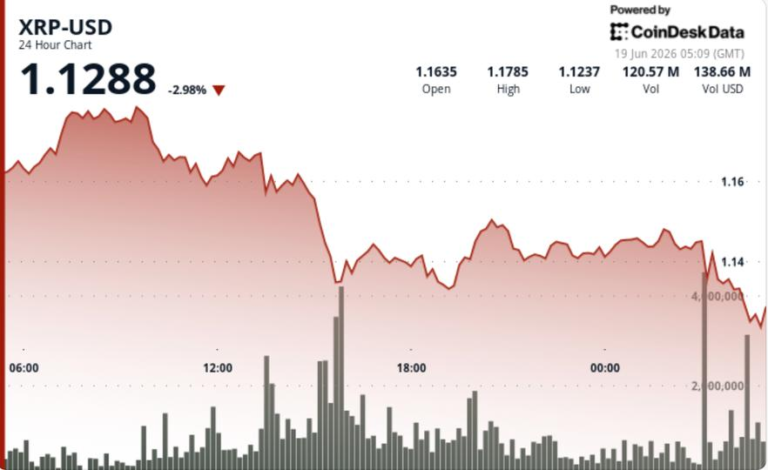
XRP gave back more of last week’s rally on Wednesday after sellers pushed the token through $1.15 support, a level traders had been watching since the recent move above $1.20.

The decline came on some of the session’s heaviest volume and followed another rejection below the descending trendline that has capped every recovery attempt for months.

News Background

• XRP remains caught between growing expectations for U.S. crypto legislation and a market that continues to prioritize technical levels over narrative.

• Traders are also watching the year-long symmetrical triangle that has compressed price action between support near $1.10 and resistance around $1.25.

Price Action Summary

• XRP fell from $1.1873 to $1.1465 during the 24-hour session, losing 3.4%.

• The sharpest selling arrived around 15:00 UTC when volume surged to 134.2 million XRP, roughly 170% above average, breaking support at $1.1550.

• Buyers emerged near $1.13 and helped lift XRP back toward $1.15 into the close, though the rebound failed to reclaim broken support.

Technical Analysis

• The key development was the loss of $1.15. That level had acted as support following last week’s breakout and now risks turning into resistance.

CFTC Settlement Bans Celsius Founder Mashinsky From Trading

0

The US Commodity Futures Trading Commission has resolved its action against Celsius Network founder Alex Mashinsky, permanently banning him from trading in markets the commodities regulator oversees.

The CFTC said Thursday that a court consent order also bars Mashinsky from ever registering with the regulator and ends the enforcement action it first filed in 2023.

“Mashinsky and Celsius engaged in a scheme to defraud hundreds of thousands of customers by mispresenting the safety, profitability, and regulatory compliance of Celsius’ digital asset-based finance platform,” the regulator said.

The latest order means Mashinsky will never be able to trade US commodities, futures and derivatives. Earlier this year, the CFTC and the US Securities and Exchange Commission issued guidance saying they considered most major cryptocurrencies to be commodities.

Source: CFTC

The settlement also puts an end to the CFTC’s first case against a digital asset lending platform and marks the end of one of the last remaining regulatory actions pending against Mashinsky.

Mashinsky was sentenced to 12 years in prison in May 2025 after pleading guilty to securities and commodities fraud for misleading Celsius’ customers about the safety of the crypto lending platform, which collapsed during a major market drawdown in 2022.

The CFTC alleged that Celsius received about $20 billion in funds and made risky investments to meet the returns it promised. 

Related: Onchain, in court: What happened in crypto legal news this week

Mashinsky has already been banned from ever working in crypto or finance after settling a Federal Trade Commission complaint in April that permanently barred him from working with any product or service that can be used to “deposit, exchange, invest, or withdraw assets.”

Mashinsky is still facing charges filed by the SEC in July 2023, accusing him of making an unregistered securities offering, misrepresenting Celsius’ business and safety and manipulating the price of its Celsius (CEL) token.

The SEC told a federal court in late May that it has “engaged in substantive settlement discussions” with Mashinsky, but no agreement had been reached, with the court granting the regulators’ request for another 60 days to continue discussions.

Mashinsky filed on May 26 to vacate his 12-year criminal sentence, claiming his lawyers were ineffective, that evidence was tainted by authorities’ misconduct and that FTX co-founder and convicted fraudster Sam Bankman-Fried was to blame for the manipulation of the CEL token.

A court on Saturday ordered prosecutors to respond to Mashinsky’s request by mid-August.

Magazine: Big Questions: Do we really only need 2–5 cryptocurrencies?

Cap Labs CAP Token Auction Closes at $106 Million FDV With 5.5x Oversubscription

0

Cap Labs’ batch auction for its CAP governance token drew 1,002 bids and $16.4 million in commitments, clearing at $0.011 per token for a $106 million fully diluted valuation.

Cap Labs has closed its public CAP token auction with 1,002 unique bids, $16.4 million in total commitments, and a 5.5x oversubscription rate, the EigenLayer-backed stablecoin protocol announced Wednesday night.

The auction opened June 8 and drew a final clearing price of $0.011 across a total supply of 10 billion CAP tokens, yielding the $106 million FDV figure. Per Cap’s published tokenomics, the ICO allocation represents 5% of total supply, or 500 million tokens. At the clearing price, that tranche raised approximately $5.5 million.

Cap is a covered credit protocol that issues cUSD, a synthetic dollar backed by a basket of regulated stablecoins including USDC, PYUSD, BlackRock’s BUIDL, and Franklin Templeton’s BENJI. Users who stake cUSD receive stcUSD, a yield-bearing version that earns returns from Cap’s operator network.

The protocol separates yield generation from risk management through three participant groups. Operators, typically institutional trading firms and market makers, borrow from Cap’s reserve to deploy yield strategies. Restakers, who lock capital via EigenLayer or Symbiotic, underwrite those operators and face slashing if an operator defaults. cUSD and stcUSD holders sit above the risk stack, insulated from losses by the restaker layer.

In the event of an operator default, Cap runs a Dutch auction on the restaker’s slashed collateral to replenish the reserve. Idle reserve capital not borrowed by operators is deployed into Aave or Morpho to generate a base yield floor for stcUSD holders.

Backing and Traction

Cap raised $11 million in seed funding in April 2025 from Franklin Templeton, Susquehanna, Triton Capital, and market makers Flow Traders, Nomura’s Laser Digital, GSR, and IMC Trading.

In its Q1 2026 investor update, Cap reported originating a $100 million revolving credit facility to Susquehanna Crypto, which it described as the largest onchain credit facility of its kind. Borrower adoption rose 175% over the quarter, with total loans outstanding up more than 300%.

The team had initially planned the token auction for Q1 2026 but postponed as ETH fell more than 30% in the past year.

Cap’s cUSD is deployed on Ethereum mainnet and on MegaETH. The protocol has also integrated with Pendle and Morpho, allowing yield-bearing stcUSD positions to be traded as term instruments or used as collateral.

The total stablecoin market stands at approximately $270 billion in combined supply, with USDT at $185.9 billion and USDC at $74.6 billion, per DefiLlama. Ethena’s USDe, the largest yield-bearing stablecoin by circulation, holds $4.51 billion.

Token Structure

The CAP token gives holders governance rights over core protocol parameters: reserve asset composition, eligible operator collateral, liquidation thresholds, minting fees, borrower whitelisting, and maximum coverage limits. Per Cap’s tokenomics, 47.97% of supply goes to the ecosystem and community, with private investors and the project team each capped at 20%. The ICO tranche was 5%. Cliff-gated allocations for private investors, the team, and the Echo community sale begin unlocking 12 months post-TGE.

A 5.5x oversubscription means committed capital exceeded the available supply by more than five times. The $16.4 million in total commitments against the approximately $5.5 million raised implies the clearing mechanism returned the majority of committed capital to losing bidders. The batch-auction format, which clears all winning bids at a single price, concentrates genuine demand and avoids the gas-war dynamics of first-come-first-served sales.

Hive gains 10% after securing Canada sovereign AI contract with Bell Canada

0

HIVE Digital Technologies (HIVE) shares jumped 10% in pre-market trading on Thursday after the company announced a $220 million, three-year GPU cloud contract with Bell Canada and AI firm Cohere, as the company continues its transition away from pure-play bitcoin mining.

The deal will see HIVE’s BUZZ High Performance Computing unit deploy 2,304 Nvidia Grace Blackwell GPUs at Bell’s AI Fabric facility in Merritt, British Columbia, forming the dedicated compute layer for Cohere’s enterprise AI models serving Canadian government and corporate clients.

All infrastructure will remain on Canadian soil, supporting Ottawa’s broader push to reduce reliance on foreign-controlled AI technology.

The deployment is expected to go live from late 2026 to early 2027, adding roughly $70 million in annual recurring revenue (ARR). Combined with approximately $35 million of current realised ARR, HIVE’s contracted HPC revenue target now exceeds $100 million, a clear signal that its infrastructure pivot is gaining serious commercial momentum.