Home Blog Page 174

Bitcoin Price Crashes To $67,000 Range, Down 13% In A Week

0

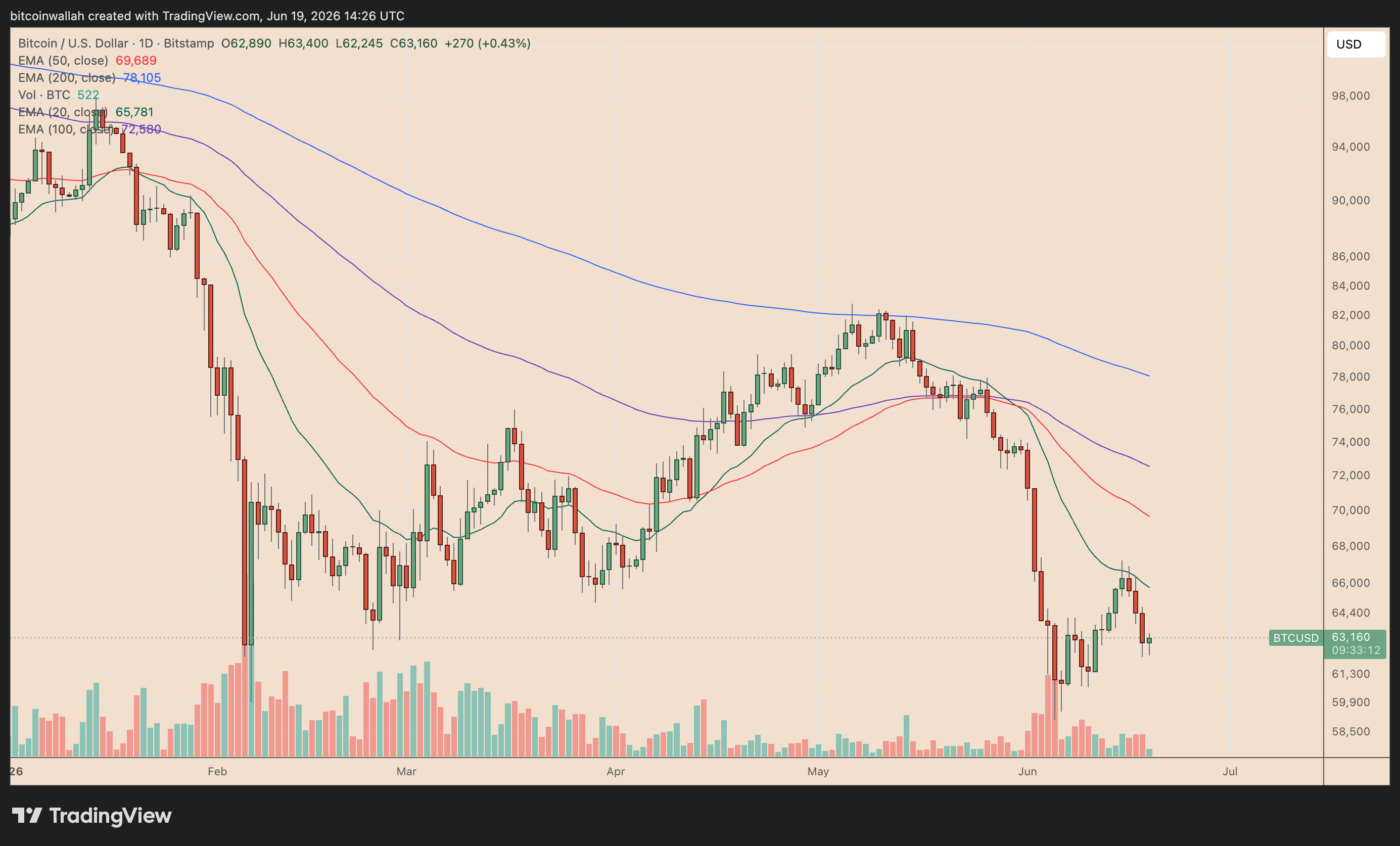
Bitcoin price has fallen below $68,000 on Tuesday, its lowest level since early April, battered by a multitude of forces. Some of them include Strategy’s first Bitcoin sale in three and a half years, a record ETF outflow streak, and fresh on-chain movement from the long-dormant Mt. Gox estate.

The catalyst that some think rattled markets was a disclosure from Strategy filed with the SEC on Monday. The company sold 32 Bitcoin between May 26 and May 31, fetching an average bitcoin price of $77,135 per coin for total proceeds of roughly $2.5 million. 

The sale is intended to fund distributions on STRC, Strategy’s perpetual preferred stock carrying an 11.5% annual variable dividend.

The numbers are small in isolation — 32 BTC represents just 0.004% of Strategy’s total holdings of 843,706 Bitcoin, purchased at an average bitcoin price of $75,699 per coin. But the symbolic weight hit hard. 

It is the company’s first reported net reduction in Bitcoin holdings through a standalone SEC filing, and the market responded: MSTR stock fell 5.85% on Monday and is falling around 6% so far Tuesday morning. 

Strategy’s sale did not arrive in isolation. U.S. spot Bitcoin ETFs recorded roughly $3.45 billion in withdrawals across 11 straight trading sessions through late May — the largest monthly ETF exodus of 2026. A single session saw $484 million in redemptions.

Bloomberg Intelligence analyst Eric Balchunas pushed back on the panic, noting to CoinDesk that $3 billion in outflows from a $100 billion asset base is “totally meaningless” relative to normal ETF flow patterns. 

He pointed out that cumulative net flows since spot Bitcoin ETFs launched remain near $57 billion, down from a peak of $63 billion — an unusually resilient figure for a volatile asset. ETF share counts have continued to grow even as Bitcoin’s price declined, which Balchunas described as a sign of ongoing adoption rather than investor flight.

Mt. Gox moves $739 Million

Adding pressure to an already fragile bitcoin price, Mt. Gox moved roughly $739 million worth of Bitcoin from its cold wallets on Tuesday — its first on-chain movement in over two months, according to Arkham Intelligence. 

The defunct Japanese exchange, which collapsed in 2014 after a hack that wiped out roughly 850,000 BTC, has been repaying creditors in phases since 2024. The repayment deadline for remaining creditors now stands at October 31, 2026.

Any large wallet movement tied to Mt. Gox triggers anxiety in crypto markets, as creditors who receive repaid Bitcoin have historically sold their holdings. 

The estate still holds thousands of BTC, and each transfer renews questions about how much supply could enter the market before the final deadline.

Bitcoin price teeters on Iran news

A renewed flare-up in the U.S.-Iran conflict has added a risk-off tone across markets. Iran suspended nuclear negotiations with the U.S. in response to Israel’s escalating military operations in Lebanon, raising the risk of broader regional conflict and potential retaliation by Tehran. 

Despite the pause, Donald Trump claimed talks are still progressing “at a rapid pace” while also brokering a tentative ceasefire understanding between Israel and Hezbollah.

At the time of writing, the bitcoin price is in the mid $67,000s. Strategy (MSTR) and Strive (ASST) are both trading nearly 10% lower today as Bitcoin price fluctuations expose the leverage in their “Bitcoin treasury” business models.

The selloff reflects investors reassessing how much premium they are willing to pay over the underlying Bitcoin exposure, especially as spot Bitcoin ETFs and direct crypto products offer cheaper, cleaner ways to access the asset. Because both firms have tied their equity stories so tightly to Bitcoin accumulation, any sharp move in the crypto market is now getting amplified in their share prices on the downside as well as the upside.

Franklin Templeton Wires BENJI Money-Market Fund Into MoonPay Trade for Onchain Stablecoin Swaps

0

The $1.74 trillion asset manager is letting institutions move directly between stablecoins and shares of its tokenized US government money fund through MoonPay’s new institutional rails, marking one of the first listings of a US-registered tokenized MMF on a third-party onchain trading venue.

Franklin Templeton plugged its BENJI tokenized money-market fund into MoonPay Trade on Tuesday, opening an onchain path for institutional users to swap supported stablecoins directly into shares of the asset manager’s US government money fund and back without leaving the blockchain.

The integration, disclosed in a joint statement over Business Wire on Tuesday, links Franklin Templeton’s Benji Technology Platform, the firm’s proprietary blockchain recordkeeping and transfer-agency stack, with MoonPay Trade’s institutional quote, routing, and execution engine.

Franklin Templeton, which reported about $1.74 trillion in assets under management in its latest quarterly report, said BENJI holders will be able to swap into stablecoin liquidity through MoonPay and use the fund inside onchain workflows like treasury management, portfolio rebalancing, and collateral.

The deal turns MoonPay, until recently best known as a fiat-to-crypto onramp, into one of the first institutional trading venues to list a US-registered tokenized money-market fund alongside crypto, fiat, and stablecoins. It also extends BENJI’s distribution beyond Franklin Templeton’s own Benji Investments app and Benji Institutional portal, and lands in a tokenized-treasuries category that CoinGecko now tracks at $11.2 billion in market value, part of a $64.9 billion real-world-assets segment.

Kaul on the “Universal Liquidity Layer”

“Tokenized money market funds only become more useful when they can move with the speed and programmability of the broader digital asset ecosystem,” Sandy Kaul, Franklin Templeton’s head of innovation and digital assets, said in the announcement.

“Teaming up with MoonPay creates another trusted gateway for institutions to move between stablecoin liquidity and tokenized fund exposure.”

Caroline D. Pham, the chief executive of MoonPay Institutional and former acting chair of the Commodity Futures Trading Commission, framed it from MoonPay’s side: tokenized money market funds deliver “improved liquidity and capital efficiency, but only if institutions have access to the onchain financial ecosystem.”

BENJI’s Place in the Tokenized-Treasury Stack

BENJI represents one share of the Franklin OnChain US Government Money Fund, known as FOBXX, which launched in 2021 as the first US-registered mutual fund to use a public blockchain as its system of record. The token now lives across multiple public blockchains, with Total Asset Value at $821 million, according to RWA.xyz.

The product still trails BlackRock’s BUIDL, at $2.4 billion in circulating supply, and Ondo’s USDY at $2.1 billion, according to RWA.xyz. But BENJI is the only entry in that top tier issued by a US-registered mutual fund, a structural distinction that has kept it off most third-party trading surfaces.

MoonPay Trade as Institutional Pipe

MoonPay launched MoonPay Trade in late May as a single-API platform for institutions to execute trades, move liquidity, and settle payments across more than 200 blockchains and protocols. The trading engine pulls together three recent MoonPay acquisitions: Decent for cross-chain routing and liquidity, DFlow for trading technology, and Sodot for crypto key management. MoonPay Trade sits underneath MoonPay Institutional, the regulated trading arm Pham was hired to run.

Franklin Templeton has been widening BENJI’s surface area for more than a year. The firm has partnered with Binance to allow BENJI as off-exchange collateral, has worked with Payward, the parent of Kraken, on tokenizing additional traditional investment products, and in April agreed to buy 250 Digital, a CoinFund spinoff, to grow its crypto-investment business. It is also working with Ondo Finance to tokenize a group of ETFs.

What Stays Off the Pipe

Access is gated to “eligible institutional users” — the same KYC and accreditation gating that applies to BENJI itself, layered on top of MoonPay Institutional’s compliance flow. Retail holders of BENJI in the US still buy and redeem through the Benji Investments app, not through MoonPay. Neither party disclosed the fee structure for stablecoin-to-BENJI conversions through MoonPay Trade or whether settlement runs through any specific network’s BENJI deployment.

Franklin Templeton said the integration is “expected to serve as the foundation for a broader strategic relationship” with MoonPay.

Bitcoin’s ‘fear gauge’ surges nearly 20%, its biggest jump since Feb. 5 crash

0

Bitcoin traders are finally taking the price selloff seriously. The cryptocurrency’s fear gauge, the BVIV index, shows it.

BVIV, which measures the 30-day implied or expected volatility in the cryptocurrency, surged nearly 20% on Tuesday to 46.45%. That’s the biggest single-day spike since Feb. 5, according to data source TradingView.

Here’s why it matters.

For roughly two months, the bitcoin market sentiment was calm. Even when BTC dropped from its early May high of $82,000 to $75,000 last week, the market sentiment barely flinched. The BVIV actually remained around its year-to-date low of 40% during that move.

In other words, it was orderly selling. No panic. But that changed Tuesday as BTC’s spot price fell over 6% to $66,000.

The BVIV index exploded with that price drop. The index is essentially a fear gauge. When it rises, traders are aggressively buying options to protect against further downside. Tuesday’s nearly 20% surge signals that protection buying is back.

To put Tuesday’s move in context: back on Feb. 5th, BVIV surged over 50% in a single day, hitting above 90% as bitcoin crashed toward $60,000. Tuesday’s jump is nowhere near that level. But the direction of the move is what traders should care about right now.

VIX like behavior

Think of BVIV like bitcoin’s version of Wall Street’s VIX fear gauge. Since U.S. bitcoin ETFs launched over two years ago, institutional players have flooded into the market. That institutionalization has created something interesting: BVIV now moves in the opposite direction of bitcoin’s spot price with increasing consistency. Price drops, fear spikes. Price rises, fear fades.

That’s a relatively new dynamic for crypto, but not so much on Wall Street where the S&P 500 and its fear gauge, the VIX, have been inversely correlated for decades.

The takeaway is that after two months of unusual calm, fear is creeping back into the bitcoin market. Whether Tuesday’s spike is a one-day blip or the start of a sustained volatility regime remains to be seen.

Bullish crypto bets lose $1.6 billion as ETH, SOL, DOGE drop 9%

0

Crypto traders hoping the market would catch up to the global stock rally were left nursing tears on Wednesday as a sharp price drop triggered the largest liquidation event since early February.

Roughly $1.84 billion in crypto leveraged positions were liquidated across the past 24 hours as bitcoin plunged below $66,000 and ether (ETH) broke under $1,900, the largest single-day wipeout since February 5 and a near-pure flush of long bets, with longs taking $1.66 billion of the total and shorts only $180 million, per CoinGlass data.

A liquidation is when an exchange automatically closes a leveraged trade because the trader’s losses have exceeded the collateral they posted to open it. Long positions bet that the price will rise, while short positions are bets on prices falling.

Bitcoin longs absorbed $883.66 million of the damage, ether longs another $475.73 million and solana (SOL) longs $91.18 million, with the remaining roughly $390 million spread across HYPE, DOGE, SUI, BNB, NEAR, AAVE, LINK and the broader top-30 long book.

The single largest order was a $59.67 million BTC-USDT long unwinding on HTX.

Binance accounted for $748 million of the total liquidations, or roughly 41% of the cascade, with 89% of those positions long. Hyperliquid handled $314 million, of which 94% were longs, and Bybit logged $247 million with 93% longs.

Meanwhile, Bitcoin open interest, the total value of all unsettled leveraged futures contracts, actually rose during the cascade.

The contract count climbed from roughly 759,000 BTC to 788,600 BTC even as the long book was being wiped out, per CoinGlass data. Rising open interest into a falling price can indicate new short positions are opening rather than long positions closing, signaling that fresh bearish bets are building on top of the long flush rather than the cascade finding a clearing level.

The positioning split is uneven across trader types. Retail bitcoin traders on Binance, OKX and Bybit are still leaning long at ratios of 2.22, 2.01 and 1.58 respectively, refusing to capitulate even after the wipeout, while whale accounts on OKX have flipped to a 0.54 long-short ratio that CoinGlass flags as ‘extremely bearish.’

Aggregate taker volume across the period showed $65.39 billion in sells against $60.16 billion in buys, with sellers as the marginal actors.

OI rising into a falling price, retail still leaning long, and whale accounts flipping short on OKX all point to a market that has not found a clearing level. A break below $65,000 brings $60,000 into play; a hold opens the door to a relief bounce, but the positioning data argues against the bounce being the more likely outcome.

Bitcoin Fair Value Closer To $224K Based On Debt Risk Model: Bitwise

0

New reporting from Bitwise suggests that Bitcoin’s (BTC) undervaluation could expand if investors’ concerns over sovereign debt deepen. The asset management firm said that mounting pressure in global bond markets and rising government debt levels could strengthen Bitcoin’s role as a hedge against macroeconomic risks, with one valuation model suggesting a theoretical fair value of $224,000. 

Debt market turmoil may support Bitcoin in the long-term 

Bitwise pointed to mounting pressure across the global bond markets. The Organization for Economic Co-operation and Development (OECD) estimates governments and companies will need to borrow roughly $29 trillion in 2026, up 17% from 2024 and nearly double the amount raised a decade ago. Around 78% of OECD government borrowing is expected to be used solely to refinance existing debt.

10-year sovereign swap spreads across nations. Source: Bitwise

Bitwise noted that Japan remains a key focus. The country’s 10-year government bond yield recently climbed to 2.78%, while its 30-year bond yield reached a record high. At the same time, Japan’s public debt stands near 230% of GDP, among the highest levels in the current macroeconomic environment.

The report noted that Japanese investors hold approximately $1.2 trillion in US Treasurys, but higher domestic yields are making overseas bonds less attractive. Currently, the 10-year Japanese bond yield is 2.66% on Tuesday, compared to 2.19% for Yen-hedged 10-year US Treasurys, potentially encouraging capital to return to domestic markets.

Bond market stress is not limited to Japan. US 30-year Treasury yields recently reached 5.11% on May 11, its highest level since 2007, while sovereign risk premiums, measured through 10-year swap spreads, have risen to their highest levels since the European debt crisis of 2011-2012.

While these trends could weigh on risk assets in the short term, Bitwise believes a deeper bond-market disruption could eventually become a bullish catalyst for Bitcoin if central banks are forced to inject liquidity to stabilize financial markets.

Bitcoin probability of default vs model value. Source: Bitwise

The firm cited a model developed by investor Greg Foss that values Bitcoin at roughly $224,000 if it gains broader adoption as a hedge against sovereign default risk. Bitwise stressed that the figure is a theoretical estimate rather than a price target.

Despite the long-term bullish case, the report noted that Bitcoin may remain range-bound in the near term as higher real yields and tighter financial conditions continue to pressure demand.

Related: Bitcoin back in ‘distribution phase’ as extreme fear grips crypto market

Declining real yields may improve Bitcoin’s macro backdrop

Bitwise noted that Bitcoin’s near-term outlook may depend heavily on real interest rates, which measure the Federal Reserve’s policy rate after adjusting for inflation. In the report, real rates are calculated as the Fed Funds rate minus US CPI inflation. Historically, Bitcoin has tended to perform well when real rates fall, as cash and bonds become less attractive in inflation-adjusted terms. 

Bitcoin vs year-on-year change in US real rates. Source: Bitwise

The firm noted that Bitcoin’s 2021 bull market coincided with declining real rates, while the 2022 bear market unfolded alongside rising real rates and aggressive monetary tightening. Although real rates remain restrictive, Bitwise said that a scenario in which inflation rises while the Fed keeps rates unchanged could push real rates lower, potentially creating a more supportive backdrop for Bitcoin. 

Meanwhile, Bitcoin researcher Sminston outlined that BTC could trade between $90,000 and $255,000 by the end of 2026, based on the Bitcoin Decay Channel, a logarithmic price model that has historically identified major cycle tops and bottoms. The analyst noted Bitcoin’s recent rebound emerged near the model’s long-term support zone, keeping the broader bullish outlook intact. 

Related: Bitcoin volatility is down 56% but analysts still expect up to 20% BTC price move

Bitcoin ETF Outflows And AI Stock Pivot Trigger Bear Run

0

Key takeaways:

  • Bitcoin’s sharp 8% drop triggered $1.5 billion in forced liquidations, ending a tight two-month small-cap correlation.
  • Worsening market sentiment was driven by $2.1 billion in Bitcoin ETF outflows and rising fears of a Federal Reserve interest rate hike.

Bitcoin (BTC) faced a sharp 9% drop over 48 hours, hitting the $67,000 support for the first time in two months. This correction wiped out a substantial $176 billion from the total crypto market cap in just two days, triggering $1.5 billion in forced liquidations for overleveraged long positions. 

Traders remain uncertain about the drivers behind crypto’s underperformance, especially since US equities have shown notable strength.

US Russell 2000 small cap equities index (left) vs. Bitcoin/USD. Source: TradingView

The tight correlation between Bitcoin and US small-cap stocks officially broke on May 21 after a solid two-month run. Worsening market sentiment was likely fueled by $2.1 billion in net outflows from US-listed spot Bitcoin ETFs between May 12 and May 20, though derivatives data had already been hinting at a lack of institutional appetite.

Bitcoin 2-month futures basis rate. Source: Laevitas

The annualized BTC futures premium relative to spot markets has held below the neutral 4% threshold for over three months, confirming weak demand for bullish leverage. 

Strategy’s Bitcoin accumulation pause and strength in AI investments

Strategy (MSTR US), led by Michael Saylor, also sparked mixed reactions after it chose to buy back convertible debt while pausing its signature weekly Bitcoin purchases.

Source: X/bjunjo

X user ‘bjunjo’ said that Strategy entered “survival mode for their debt holders and shareholders,” putting aside the sole mission to accumulate more Bitcoin. According to the analysis, the company will do whatever it takes to meet its financial obligations, as shown by a recent BTC 32 sale. Jeff Dorman, Chief Investment Officer at Arca, called the move “a complete balance sheet mismanagement.”

Source: X/ScroogeCap

Meanwhile, X analyst ScroogeCap noted that Google’s (GOOG US) decision to raise equity rather than debt suggests that private equity is effectively dead as liquidity dries up. The analysis highlights that the Oracle (ORCL US) debt-to-equity ratio remains unusually high, while Meta (META US) might be forced to tap more capital due to “irrational spending.” 

Jim Bianco of Bianco Research reportedly said, “We have not seen the market this concentrated around a single theme in 150 years.” Additionally, JPMorgan research found that 41 AI-related stocks account for half of the S&P 500’s market value.

Related: Bitcoin gets new $50K target after BTC price crashes 6% in a day

Interest rate target probabilities for the Sept. FOMC meeting. Source: CME Group

Traders became increasingly risk-averse as the war in Iran showed no sign of imminent relief, explaining the broader sell-off across cryptocurrency markets. US government bonds are now pricing in a 23% probability of the US Federal Reserve hiking interest rates by September, up from 0% just one month prior according to the CME FedWatch Tool.

Ultimately, the cryptocurrency market crash on Tuesday reflects heavy outflows from spot Bitcoin ETFs, an extreme capital concentration in AI investments and a macroeconomic environment signaling stricter monetary policy for longer than the market had previously anticipated.

Bitcoin (BTC) faces an ‘identity crisis’ and DeFi devs need to stop acting like tech bros

0

The cryptocurrency market is enduring a sharp narrative shift, but the real growth is happening away from the spotlight, according to the co-founder of Solana-native yield protocol Solstice Labs.

Ben Nadareski argued that the industry’s biggest asset is experiencing structural confusion in an interview with CoinDesk on Tuesday.

“Bitcoin is going through a bit of an identity crisis right now,” Nadareski said. “It’s not the store of value, like gold, to the masses. It’s also not the speculative investment vehicle that everybody was really attracted to. While bitcoin and the core assets go through their identity crisis, quiet players in the DeFi industry are growing rapidly.”

Decentralized finance’s “silent” growth is heavily challenged by ongoing exploits, according to Nadareski, a flaw he blamed on developers frequently building innovative code while completely ignoring the core responsibilities of managing capital.

“They don’t quite realize you’re now also a financial asset manager if you’re working in DeFi,” Nadareski stated. “That doesn’t mean you’re in tech. That means you’re building tech in financing, which adds two aspects of risk to the market.”

OpenZeppelin co-founder and former CTO Manuel Aráoz said “DeFi is not safe anymore” last month noting that AI coding agents have made smart contracts fatally vulnerable.

Drift Protocol and Kelp Dao were hacked by North Korean cybercriminals in April in two exploits that drained nearly $600 million from the two lending crypto pools. In February 2025, Bybit suffered a $1.46 billion attack, described as the biggest hack of all time.

Nadareski said that to bridge this trust gap, DeFi platforms must hold themselves to traditional banking standards, implementing real-time proof of reserves and automated multi-signature time locks rather than relying on unproven code layers.

DeFi principles

The entry of legacy banking giants does not mean crypto natives have lost the space, Nadareski said. Instead, he pointed to market structure where Wall Street uses faster digital rails for its operational back offices, while decentralized platforms preserve direct user access.

“The convergence is already among us. The institutions have been coming for years and now they are here,” he highlighted.

Winning platforms will be those that accommodate large financial entities while maintaining low fees and equal access for everyday retail users. Since its launch, Solstice has scaled past $500 million in total value locked (TVL) from over 40 institutional allocators, including Galaxy Digital and Susquehanna.

Solstice has also unveiled a strategic partnership with big-data analytics platform ApexE3, which is backed by Consensys and Tensorix.

Treating decentralized networks as a financial utility rather than a tech playground is the only path forward, according to Nasareski.

“Expect more out of DeFi than you do TradFi,” he concluded. “The average retail end-user anywhere in the world should expect 10 times more of an output of transparency, trust, and optimization of their capital.”

Bitcoin’s slide to $67,000 is accelerating a shift into digital dollars

0

A week ago, CoinDesk informed readers of the renewed rotation of funds into dollar equivalents such as tether and USD Coin (USDC) stablecoins as bitcoin pulled back from the early May highs above $80,000. That combination was an early warning sign of potential full-blown risk aversion in the crypto market.

Those early warning signs have now turned into a full-blown trend.

Bitcoin has dropped about 12% over the past week to around $66,800, pulling the broader crypto market lower with it, CoinDesk data show. Bitcoin’s dominance rate, or its share of the total crypto market, has fallen to 58.5%, reversing gains that had pushed it as high as 61.2% in April and early May.

At the same time, tether , the world’s largest dollar-pegged stablecoin, has seen its dominance jump to 8.30%, the highest level since late February. USD Coin (USDC) has also climbed back to levels last seen in early April.

While the two stablecoins still make up just 11% of the overall market, which is paltry compared to bitcoin, their rising share signals a clear flight to dollar liquidity inside crypto. And that shift is getting harder to ignore, as BTC loses ground.

This pattern has played out in previous market swoons, including the sharp sell-off from over $90,000 to nearly $60,000 in January and February.

Bitcoin isn’t alone in the sell-off. Ether (ETH), XRP, and Solana (SOL) have each dropped 8-11% over the past week. Other coins such as BCH, SUI, and RAO have plunged nearly 20%. All of this is seemingly feeding a clear flight into the dollar equivalents.

Interestingly, traditional markets are showing no such flight to the dollar. The Nasdaq and S&P 500 are both trading near record highs, while the U.S. Dollar Index, which measures the greenback against a basket of major currencies, remains stuck in a tight range between 98.50 and 99.50.

Galaxy enters institutional prediction markets with $10 million Arca trade

0

Galaxy Digital (GLXY) said Tuesday it had launched over-the-counter (OTC) prediction markets trading for institutional investors, becoming one of the first major digital asset firms to offer large-scale access to event-driven markets through a bilateral trading framework.

The Nasdaq-listed company said that the new service, offered through its global markets trading desk, will allow hedge funds, family offices and other institutional investors to trade contracts tied to political, economic and geopolitical events while accessing liquidity and trade sizes typically unavailable through retail-focused prediction market platforms.

Shares of the company are down 6% on Tuesday, in line with the broader crypto stock market.

The launch comes as prediction markets have gained traction among investors seeking ways to express views on real-world events ranging from elections and central bank decisions to regulatory developments. Platforms such as Kalshi and Polymarket have experienced rapid growth over the past two years, with many crypto-native companies entering the market.

Galaxy said its offering initially covers non-sports event contracts traded on Kalshi and Polymarket, with plans to expand to additional venues. The firm will also allow clients to combine prediction market positions with hedges across equities, commodities and other asset classes, creating broader event-driven investment strategies.

As part of the launch, Galaxy facilitated a $10 million trade with crypto-focused hedge fund Arca tied to the outcome of the proposed CLARITY Act, legislation that would establish a regulatory framework for digital assets in the United States.

“Event-driven markets are becoming core to how sophisticated investors express macro views, and they deserve institutional infrastructure to match,” Jason Urban, Galaxy’s global co-head of digital assets, said in a statement.

Jeff Dorman, Arca’s chief investment officer, said prediction markets offered an effective way to hedge the fund’s exposure to ongoing negotiations in Washington surrounding crypto regulation, but that liquidity constraints on existing platforms made it difficult for large investors to participate directly.

The move reflects a broader institutionalization of prediction markets, a sector that has historically been dominated by retail traders. By acting as a principal counterparty, Galaxy can warehouse risk and facilitate larger transactions while providing greater discretion than exchange-based trading.

Earlier today, Polymarket completed its first block trade in a transaction between crypto broker FalconX and trading tech startup Anera Labs.

Industry observers say the entrance of firms such as Galaxy could help deepen liquidity and improve pricing efficiency in prediction markets by bringing professional investors into the space. Supporters argue that greater institutional participation could make market prices more useful as indicators of future outcomes, while critics caution that regulatory uncertainty remains a key challenge for the sector.

The launch further expands Galaxy’s growing derivatives and trading business. The New York-based firm, which provides institutional digital asset trading, asset management, staking and tokenization services, has increasingly positioned itself as a bridge between traditional financial markets and emerging digital asset infrastructure.

Coinbase (COIN) backs Ethena (ENA) ahead of savings product launch for 100 million users

0

Coinbase Ventures, the investment arm of crypto exchange Coinbase (COIN), said it had backed Ethena (ENA), buying the protocol’s token on the open market as the two firms prepare to launch a new onchain savings product for the exchange’s more than 100 million users.

Ethena announced Tuesday that it partnered with Coinbase to expand onchain finance and savings offerings, with the first initiative scheduled to launch next week.

“Excited to partner with Coinbase for the first time to support their dollar savings products,” Ethena founder Guy Young said in a post on X. “The upcoming integration next week will be the first time Ethena products are available for their 100m+ user base.”

As part of the deal, Coinbase said it is already Ethena’s primary custodian, wallet provider and perpetuals venue, while the protocol’s USDe yield token will be distributed on the Base network and the “wider [Coinbase] ecosystem.”

ENA, Ethena’s governance token, surged 20% following the news before paring gains. The token was up 3% over the past 24 hours despite the broader crypto market pullback.

The investment marks a notable endorsement from Coinbase as Ethena seeks to expand beyond crypto-native users. Ethena emerged as one of crypto’s fastest-growing protocols, combining stablecoin demand with derivatives-based funding strategies to provide yield to investors in a token form. Assets on the protocol swelled to $15 billion by the October market peak, but since then declined to $5.3 billion as demand and yields vaned amid the crypto downturn.

The announcement comes as lawmakers continue to debate the CLARITY Act, a market structure bill that could provide a clearer regulatory framework for crypto products in the U.S. Young said the legislation could create additional tailwinds for onchain-native assets such as USDe, Ethena’s synthetic dollar token.

Tapping into Coinbase’s user base

While neither company disclosed details of the upcoming product, investors speculated the partnership could significantly expand Ethena’s distribution.

Access to Coinbase’s user base could provide a new source of capital as the protocol seeks to expand beyond decentralized finance into mainstream crypto brokerage platforms.

Yan Liberman, managing partner at Delphi Ventures, an investor in Ethena, said the deal could potentially connect Coinbase’s roughly $19 billion USDC stablecoin ecosystem with Ethena’s yield-generating infrastructure.

“If sUSDe yields clear baseline USDC rates, Coinbase can offer better USDC lending yields,” Liberman wrote on X. “Ethena gets deeper and cheaper funding than native DeFi alone.”

Expansion to institutional credit market with Anchorage

Ethena is also pushing deeper into institutional markets.

On Tuesday, the protocol and crypto bank Anchorage Digital said it had broadened its partnership with Ethena to support institutional lending.

Under the arrangement, Anchorage will manage collateral for Ethena’s loan investments through its Atlas platform, allowing borrowers to keep assets in custody rather than moving them onchain.

The setup aims to make crypto-native lending more accessible to institutions that require regulated custody and compliance controls.

“Institutions want access to crypto-native capital, but not at the cost of custody, controls, or operational rigor,” Anchorage CEO Nathan McCauley said in a statement.

The announcement builds on an existing relationship between the firms. Anchorage Digital Bank already serves as the U.S. issuer of Ethena’s USDtb stablecoin.