Home Blog Page 173

Mt. Gox Moves 10,422 Bitcoin While Bitcoin Price Craters Below $69,000

0

Mt. Gox has moved 10,422 bitcoin worth about $739 million, marking its largest transfer in months as the deadline for creditor repayments approaches in October 2026.

Blockchain data from Arkham Intelligence shows the transfer took place in Bitcoin block 952,072 at 04:47 UTC on June 2. Of the total, 10,306 BTC was sent to a new address with no prior transaction history, while 116 BTC was routed to a known Mt. Gox hot wallet. 

A later transaction moved another 116 BTC to a separate address, along with a small test transfer to a Bitstamp cold wallet.

The structure of the transfer mirrors earlier movements tied to administrative preparation for creditor payouts. In past cases, similar wallet activity preceded distributions through partner exchanges such as Kraken and Bitstamp. The newly used address remains unmarked, and the transferred bitcoin has not been sent to any exchange or custody provider.

Mt. Gox was a Tokyo-based bitcoin exchange that launched in 2010 and grew to handle more than 70% of global bitcoin trading at its peak, making it the dominant venue for early BTC markets.

It collapsed in 2014 after losing hundreds of thousands of bitcoin to hacks and operational failures, entered bankruptcy, and has spent the past decade working through a court-supervised process to repay creditors with remaining funds.

Mt. Gox still controls about 34,504 BTC, valued near $2.43 billion at current prices. This remains one of the largest concentrated bitcoin holdings linked to a failed exchange. 

Repayment efforts began in mid-2024, with about 19,500 creditors receiving funds so far. 

The process has faced repeated delays, with a Tokyo court approving the latest extension in October 2025, pushing the final deadline to October 31, 2026.

Mt. Gox transfers as bitcoin price teeters

The timing of the transfer has drawn attention across the market. Bitcoin fell below $69,000 and touched levels near $68,950 this morning. The decline followed a stretch of sustained outflows from spot bitcoin ETFs and added pressure from recent selling activity tied to large holders.

Creditors who held bitcoin before the exchange collapsed in 2014 acquired their coins at much lower prices. Any distribution creates the possibility of profit-taking, which could increase selling pressure during a period of weaker demand.

On-chain data suggests the transferred funds have not reached exchange order books. Exchange inflow metrics remained stable in the hours following the transaction, indicating no direct selling tied to this movement so far. 

Even so, the psychological impact has proven significant. Automated trading systems and leveraged positions reacted to the headline, leading to liquidations that amplified price moves.

This pattern has repeated since distributions began. Large transfers from Mt. Gox wallets have triggered market reactions even when coins did not enter active circulation. In earlier instances, movements were followed by staged payouts through partner exchanges, reinforcing expectations that similar steps could follow.

The destination of the latest transfer remains a key unknown. Analysts note several possibilities, including internal wallet reorganization, preparation for over-the-counter transactions, or staging for future distributions. A transfer to a known exchange wallet would signal a higher likelihood of near-term selling, while movement to new addresses leaves the timeline unclear.

As the October 2026 deadline approaches, each transaction from Mt. Gox draws close scrutiny. With billions in bitcoin still under trustee control, the estate continues to act as a major variable in market structure and sentiment.

US Treasury Adds Nobitex and Three Other Iranian Exchanges to OFAC SDN List Under ‘Economic Fury’

0

The Office of Foreign Assets Control designated Nobitex, Wallex, Bitpin and Ramzinex, along with their leadership, naming the exchanges as the digital-asset rails for Iran’s central bank and the Islamic Revolutionary Guard Corps.

The U.S. Treasury Department’s Office of Foreign Assets Control added Nobitex, the largest cryptocurrency exchange in Iran, and three other Tehran-based digital-asset platforms — Wallex, Bitpin and Ramzinex — to its Specially Designated Nationals list on Tuesday, naming them as the rails the Iranian regime, its central bank and the Islamic Revolutionary Guard Corps have used to move funds around Western sanctions.

OFAC’s press release said Nobitex processed more than 50% of all Iranian digital-asset inflows in 2025, Wallex took 12% and Bitpin 10%. Ramzinex, founded in 2018, has processed more than $2.45 billion in transactions, including flows tied to the IRGC and a state-backed Iranian financial institution.

Treasury also designated Nobitex chairman, co-founder and former chief executive Amir Hossein Rad, current chief executive Seyed Ali Khoee and two co-founders — Seyed Mohammad Ali Aghamir Mohammad Ali and Seyed Mohammad Aghamir Mohammad Ali — whom it identified as members of the Kharrazi family, an inner-circle dynasty in the Islamic Republic.

The designation is the first time OFAC has named an Iran-incorporated digital-asset exchange directly to the SDN list — Iranian platforms had until now been treated as blocked by program rather than by individual listing — and the first entity-level escalation of the Trump administration’s Economic Fury campaign into the crypto rails themselves. Tuesday’s action puts a compliance perimeter around the four exchanges that every U.S. person, every dollar-clearing bank and every foreign financial institution touching their flows now has to enforce.

What Treasury Says the Exchanges Did

Treasury said Nobitex helped the Central Bank of Iran access “hundreds of millions of dollars” in stablecoins used to defend the plummeting rial, while letting regime insiders reach international exchanges and evade sanctions across multiple jurisdictions. The release tied the exchange to IRGC-affiliated ransomware operators and said it “played a role in protecting and moving assets and funds out of Iran to shield regime wealth despite internet blackouts” after U.S. combat operations began. Wallex and Bitpin were each cited for facilitating IRGC-linked transactions, with Bitpin’s volume running into “millions of dollars.”

The action follows a Reuters investigation published May 1 that traced how Nobitex had become a central node in a parallel financial system for the Iranian central bank and the IRGC. Nobitex told Reuters in April it was a “private and independent business” with no affiliation to the central bank, the IRGC or any state institution. Treasury’s release directly contradicts that defense.

Bessent’s Framing

Treasury Secretary Scott Bessent said in an emailed statement that “while Iran’s economy is in free fall, the regime has chosen to co-opt digital asset technologies for its own corrupt agenda, including evading sanctions and transferring wealth out of the country.” Bessent added that “Treasury will continue to follow the money in support of Economic Fury, whether it is through the banking system or through digital assets, to prevent the regime from developing a nuclear weapon.”

The framing extends a $1 billion running total Bessent disclosed Friday at the Reagan National Economic Forum for cumulative Iran-linked crypto seizures under Operation Economic Fury. That figure ran ahead of any named exchange-level action; Tuesday’s designations are the first time Treasury has put specific company names and individuals behind the campaign’s digital-asset leg.

Sui Blames Triple Mainnet Halt on Gas-Charging Bug and a Known-Risk Patch That Backfired

0

The Sui Foundation’s post-mortem ties two of three outages to an edge case in the v1.72 address-balances feature, and the third to a randomness-state bug exposed by an interim fix the team shipped knowing it carried halt risk.

The Sui Foundation on Sunday published a post-mortem on the three mainnet outages that took its Layer 1 down on May 28 and 29, pinning the first two halts on a gas-charging bug introduced by the v1.72 “address balances” upgrade and the third on a separate randomness-state fault exposed when validators restarted to install an interim fix the team admits it shipped knowing it carried a low-probability halt risk.

SUI, the network’s native token, slid 6.6% in the 24 hours after the post-mortem and is down 18.5% over seven days at $0.82, trimming Sui’s market capitalization to $3.31 billion, per CoinGecko. The chain holds $479.66 million in total value locked, the thirteenth-largest among networks tracked by DefiLlama, behind Avalanche and ahead of Monad. Sui-based DEXs cleared $77.33 million in 24-hour volume on Sunday — led by DeepBook V3 at $26.69 million.

Last week, Sui restarted after back-to-back halts tied to the same 1.72 release. It is also one of the more granular Layer 1 incident reports published this year, naming specific code paths and conceding the validator network briefly ran on a fix Mysten Labs engineers knew might fail.

The Gas-Smashing Bug

The first two halts traced to a corner of execution Sui calls “gas smashing” — the process by which the runtime combines all of a transaction’s input coins into a single coin and debits it for gas, before the transaction itself runs. The v1.72 release introduced “address balances,” a feature that lets users withdraw from and deposit to a single address concurrently by emitting balance deltas that a system settlement transaction reconciles each block.

The edge case, per the Foundation: when a transaction attempted to overdraft an address balance to cover gas, it was correctly marked cancelled with an `InsufficientFundsForWithdraw` error — but gas smashing then ran again on the same reservation object, spending funds the transaction had just been told it could not access. The settlement layer received a negative delta applied to a zero balance and the validators crashed. Once a crash bug is in the input pipeline, every honest validator hits the same bad input and the chain stops.

The Known-Risk Patch

Sui’s interim fix, deployed Thursday to bring the chain back, was to stop running gas smashing on transactions cancelled with `InsufficientFundsForWithdraw`. The Foundation now says the team “accepted the risk accompanying this proposal in order to bring the halted network back as quickly as possible while a robust fix was developed.” On Friday morning, the network hit a variant of the same edge case and halted a second time. A second patch followed.

The third halt arrived hours later at the next scheduled epoch change. Validators restarting to adopt Friday’s patch failed to meet the participation threshold for the new epoch’s distributed key generation — the protocol step that initializes randomness for an epoch. DKG disabled itself by design, but a latent bug meant that failure verdict was never written to disk. As further restarts followed, each validator came back up unaware DKG had failed, the queue of randomness-dependent transactions grew, and end-of-epoch logic stalled waiting on a DKG that would never run. The permanent fix persisted DKG status across restarts and added a force-close mechanism to converge validators on a stuck epoch.

What’s Off the Hook

No user funds were at risk across the three halts and no committed transactions were rolled back, per the Foundation. The incidents had no relation to traffic load and no relation to an external exploit, and transactions returned to sub-second finality after the third restart. The Foundation also said an internal AI agent with access to production validator logs “materially accelerated diagnosis.”

The Reliability Bar

For context: Solana’s last officially confirmed mainnet halt was February 6, 2024, when a bug in the validator program cache forced a roughly five-hour coordinated restart. Sui, by comparison, was hit by a brief halt in November 2024 on a congestion-control assert and a six-hour consensus stall in January 2026 before this latest run.

The Foundation named four remediation priorities: extending Sui’s “safe mode” graceful-degradation patterns across the rest of the reconfiguration path; rebuilding gas-charging logic to a code-quality bar comparable to the Move VM or the Mysticeti consensus protocol; broadening the production-debugging AI agent program; and adding a defense-in-depth layer that would let a validator skip a crash-inducing input rather than halt the chain.

Mysten Labs CEO Evan Cheng and Chief Product Officer Adeniyi Abiodun had not posted public commentary on the post-mortem as of publication. The Defiant has requested comment from the Sui Foundation.

UK Lords Warn BoE on Strict GBP Stablecoin Rules

The United Kingdom should press ahead with stablecoin regulation but avoid rules that make a pound sterling stablecoin market commercially unworkable, a House of Lords committee warned in a report released Wednesday.

The cross-party Financial Services Regulation Committee said the UK was “lagging behind” the United States and the European Union and that the absence of a clear regime has “suppressed stablecoin development and investment in the UK,” despite the growth of global US dollar-pegged tokens such as USDt (USDT) and USDC (USDC).

While backing much of the Bank of England (BoE) and Financial Conduct Authority’s proposed framework, the committee warned that some measures risk undermining the viability and competitiveness of UK-issued stablecoins.

The report backs requirements for fiat-referenced stablecoins to be backed 1:1 by high-quality assets and a proposed BoE backstop lending facility for systemic issuers.

However, it singles out several elements of the Bank’s November 2025 consultation as potentially damaging, warning that a requirement for systemic issuers to hold at least 40% of their backing assets in unremunerated central bank deposits has attracted “considerable criticism” and could “impact negatively on the viability of stablecoin issuers and the international competitiveness of the UK market.”

Proposed temporary holding limits for businesses and individuals are also flagged as measures that could “unnecessarily inhibit the growth of GBP stablecoins” and prove impractical to implement.

Related: UK FCA seeks feedback on guidance for crypto rules ahead of 2027 rollout

Interest bans and rewards uncertainty cloud UK tokens

Peers also turn to the politically sensitive question of returns. The Bank’s draft regime would prohibit remuneration for coinholders of sterling-denominated systemic stablecoins, putting the UK on a similar footing to the EU’s Markets in Crypto-Assets Regulation (MiCA), which bars stablecoin issuers from paying interest to holders. The US GENIUS Act prohibits payment stablecoin issuers from paying interest, though US debate continues over whether exchanges and other intermediaries can offer rewards.

House of Lords Stablecoin Report. Source: House of Lords

The committee presents payment-focused stablecoins primarily as instruments for fast, low-cost transactions rather than as investment products. However, it warns that the combination of strict reserve rules and a ban on interest or other remuneration could weigh on the “business viability” and competitiveness of UK-issued tokens, especially while it remains unclear whether card-style rewards or other non-interest incentives will be allowed.

Inquiry evidence highlights risks and UK’s strategic choice

The conclusions follow months of evidence gathering in which the committee pressed industry and academic witnesses on whether stablecoins can move much beyond “on and off-ramps into crypto,” challenged them on financial stability, bank funding and consumer protection risks, and probed sharply divergent views on the US GENIUS Act’s approach to non-bank issuers.

While stressing that the expansion of stablecoin markets “must not create new opportunities for illicit activity to flourish,” the Lords argue the UK should aim to nurture, not just police, a pound-denominated stablecoin sector.

They urge His Majesty’s Treasury, the Bank of England and the FCA to stick to existing timelines, clarify how dual regulation of systemic issuers will work in practice, and recalibrate measures such as holding limits and reserve requirements so that sterling stablecoins can “compete with other forms of payment in the UK” rather than be regulated out of relevance.

Magazine: Guide to the top and emerging global crypto hubs — Mid-2026

US Treasury Sanctions Iran’s Nobitex Crypto Exchange

The US Treasury has sanctioned four Iranian crypto exchanges, including the country’s largest, Nobitex, marking the latest effort in its campaign called “Economic Fury” that aims to cut Iran off from the financial system.

The Treasury said on Tuesday that it added crypto exchanges Wallex, Bitpin and Ramzinex to the Office of Foreign Assets Control’s sanction list, prohibiting US businesses and persons from providing services to those platforms.

“While Iran’s economy is in free fall, the regime has chosen to co-opt digital asset technologies for its own corrupt agenda, including evading sanctions and transferring wealth out of the country,” said Treasury Secretary Scott Bessent.

The Treasury’s efforts to cut financial networks from Iran are at the center of its “Economic Fury” campaign, which commenced on April 14, months into the Iran war that kicked off with joint US-Israeli strikes on the country in February.

Source: Treasury Department

The US has repeatedly struck Iran amid efforts to reach a ceasefire agreement and resolve a dispute over the Strait of Hormuz, a vital shipping lane that transits about one-fifth of the world’s oil.

One of the top priorities for Treasury is to end Iran’s nuclear programme, Bessent said. 

“As promised, Treasury will continue to follow the money in support of Economic Fury, whether it is through the banking system or through digital assets, to prevent the regime from developing a nuclear weapon.”

The latest sanctions come four days after Bessent revealed that the Treasury had seized nearly $1 billion in crypto from Iranian crypto exchanges and wallets since the Iran war began.

Nobitex the centerpiece of Iran’s “digital dollar pipeline”

The Treasury said Nobitex, Iran’s largest crypto exchange, has continued to facilitate payments for the Islamic Revolutionary Guard Corps and other sanctioned entities.

On Tuesday, blockchain forensics platform Chainalysis said that Nobitex is at the center of Iran’s “digital dollar pipeline,” and that it handles about 50% of the country’s crypto trading volume.

Related: US Senate advances resolution to curb Trump’s Iran war powers 

The Treasury claimed that Nobitex has contributed to the repression of the Iranian people by facilitating state-linked surveillance of civilians. 

Nobitex’s CEO, Seyed Ali Khoee, and chairman Amir Hossein Rad were also added to OFAC’s sanction list.

The Treasury said it has cut off “tens of billions of dollars” worth of funding channels from otherwise being accessible to the Iranian regime and its proxies.

That includes action taken against alleged shadow bank networks, as well as foreign officials and companies seeking to support Iran’s oil trade and military activities.

Magazine: Should users be allowed to bet on war and death in prediction markets?

Banks’ survey says people don’t want to rock the boat if stablecoin yield risks lending

0

U.S. banking lobbyists unveiled a survey to back up their campaign against U.S. stablecoins that return yield to their users, seeking to reinforce their ongoing contention with results indicating 57% of people think Congress should stop crypto firms from offering anything that resembles bank interest on stablecoins if it could harm community lending.

The American Bankers Association, which commissioned the survey, is among the banking groups seeking 11th-hour changes to the Digital Asset Market Clarity Act that would establish a U.S. regulatory regime for the crypto industry. The banks are specifically pushing to rewrite the sections involving stablecoins, which their representatives have repeatedly argued to lawmakers and the White House would threaten the interest-bearing deposit accounts at the core of their businesses by drawing off customers.

As the Clarity Act stands, crypto platforms would not be allowed to offer yield for static holdings of stablecoins, but they could set up rewards programs akin to credit-card programs for the active use of the tokens.

“As lawmakers consider creating a regulatory framework for stablecoin and other digital assets, they need to know that Americans don’t want them to put in place rules that undermine lending and economic growth,” ABA President and CEO Rob Nichols said in a statement.

CoinDesk viewed the results of the online survey conducted by Morning Consult, which polled 2,000 U.S. adults, with a margin of error around 2%. The survey’s questions were worded with assumptions that stablecoins are likely to pose risks to banking and lending — a narrative opposed by research from the crypto sector and countered by White House economists.

A separate poll of U.S. voters recently commissioned by CoinDesk, revealed that they trusted banks more than crypto when it came to financial inclusion (65% to 5%). About 52% said in that poll that they thought digital assets were more than a passing fad.

Despite its intent to support the crypto sector’s adversary in this legislative effort, the ABA’s new polling indicated a relatively high interest from respondents in digital assets, which had been a niche arena until recent years. Some 30% of those polled said they’re likely to buy or use digital assets in the next year, and 24% said stablecoins and crypto could provide “meaningful benefits” to them.

The survey pool included 17% who said they currently own digital assets, which was 10% less than CoinDesk’s survey of registered voters.

When the pollsters asked if people thought the approach to crypto rules should be cautious and not threaten the traditional financial system (especially mentioning community banks), 61% agreed. A contrarian 15% seemed to suggest that the safety of the rest of the financial system wasn’t a concern when pursuing digital assets regulation.

Senators who are working on the Clarity Act have already heard months of arguments from the banks and recently moved forward in the Senate Banking Committee with a compromise crafted by members from both parties. That legislative language, however, must still be merged with a similar bill that passed the Senate Agriculture Committee, and more changes will come after that merger if the bill progresses toward the Senate floor for a potential vote.

For its part, the crypto industry is pushing hard for final passage of the Clarity Act, countering other concerns that the legislation may leave openings for the abuse of crypto as a tool of criminality and illicit finance. The Blockchain Association has shared a letter signed by 160 former members of the law enforcement, national security and intelligence communities who favor the establishment of “a modern federal framework in the United States for digital asset oversight.”

The association intends to visit Senate offices with some of those people on Wednesday, as the Senate session finishes its final weeks before its summer recess and the height of the midterm elections season.

Read More: ‘The banks will not accept it’: Dimon escalates battle over stablecoin rewards in CLARITY Act debate

Bitcoin Drops 7% to Nine-Week Low Amid US-Iran Strikes

0

Bitcoin prices have dropped 7% on the day, breaking key support to a nine-week low after the US and Iran launched fresh strikes as talks over a possible ceasefire have stalled. 

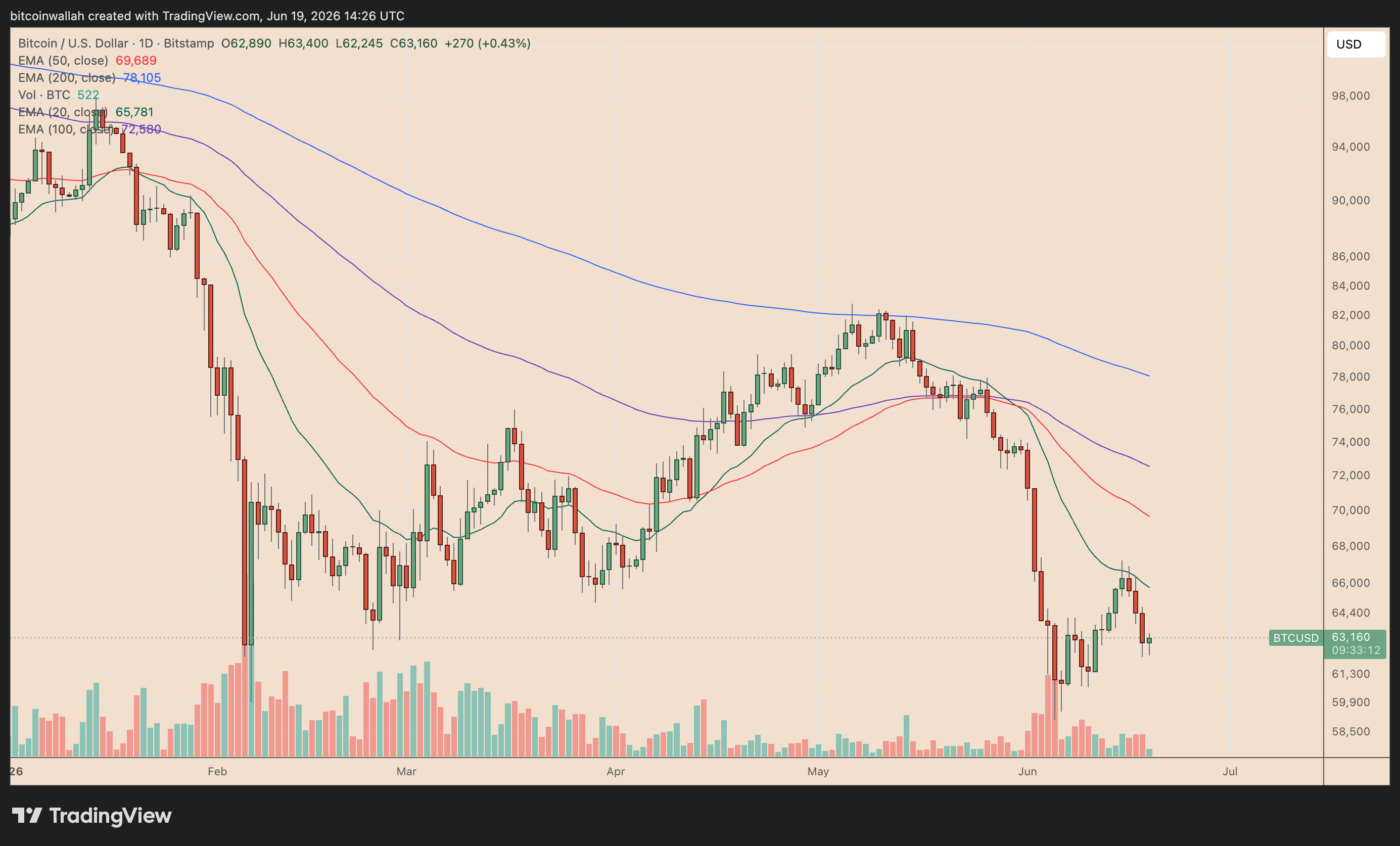
Bitcoin (BTC) fell to $65,385 on Coinbase in early trading on Wednesday, its lowest level since late March, according to TradingView.

The slump follows the largest daily fall since Feb. 5 as BTC shed more than $4,500 on Tuesday. 

According to CoinGlass data, around 277,000 traders have been liquidated over the past 24 hours, with total liquidations of around $1.83 billion. More than 90% of them were long positions, primarily in Bitcoin and Ether (ETH).

Bitcoin has fallen below $66,000 in the most significant single-day drop since February. Source: TradingView

Andri Fauzan Adziima, the research lead at Bitrue Research Institute, told Cointelegraph that Bitcoin’s current drop is more about “leveraged liquidations, heavy ETF outflows, and technical breakdowns than pure Iran news, but it amplifies the fear.” 

Adziima said he expected “choppy consolidation,” as real support sits lower around $64,000 to $65,000, “with any de-escalation or strong macro rebound potentially sparking a sharp relief rally.”

The $150 billion crypto market capitalization exodus came as the US continued its military strikes against what it called “aggressive Iranian behavior.” 

US Central Command stated on Tuesday that it had successfully defeated multiple Iranian ballistic missiles and drones, and “conducted self-defense strikes” on Qeshm Island in response to attempted attacks by Iran across the Middle East.

“Iran launched several ballistic missiles toward regional neighbors; however, all failed to hit their intended targets,” CENTCOM said. Two Iranian missiles were fired at Kuwait, and three missiles were launched at Bahrain, it added. 

Related: Crypto turns ‘contrarian bet’ as AI stocks draw investor attention: Bitwise

The latest skirmish comes amid a two-month ceasefire between the US and Iran, which has included indirect talks on extending the ceasefire and lifting a blockade of the Strait of Hormuz. However, negotiations have yet to yield an agreement. 

President Donald Trump claimed on Truth Social on Tuesday that “reports that the Islamic Republic of Iran, and the USA, stopped speaking a few days ago are false and erroneous.” 

“The conversations between us have been going on continuously, including four days ago, three days ago, two days ago, one day ago, and today,” he said. 

The comments came after Iran’s Tasnim news agency reported on Tuesday that the country would halt all conversations with the US until Israel ceased attacking Lebanon.

Magazine: Big Questions: Do we really only need 2–5 cryptocurrencies?

Prediction market traders bet bitcoin’s selloff has further to run

0

Prediction market traders are increasingly wagering that bitcoin’s correction is far from over, even after the cryptocurrency tumbled toward $65,000 this week amid mounting pressure from ETF outflows and weakening institutional demand.

On Kalshi, traders currently assign a 66% probability that bitcoin drops below $55,000 this year and a 50% probability of sub-$50,000 prices. They also give a 31% chance that prices could even dip below $40,000.

Polymarket traders are expressing a similar view. Contracts on the platform imply a roughly 67% chance bitcoin falls below $55,000 this year and a better-than-even chance it drops under $50,000.

On prediction platform Polymarket, traders now give bitcoin only a 30% chance of outperforming gold in 2026. Gold is down approximately 1.5% in the last month but is up 33% in the last year while BTC is down around 37%.

This comes amid dwindling institutional appetite for the leading cryptocurrency. According to data from SoSo Value, traders withdrew $2.4 billion from U.S.-listed BTC ETFs in May and $1 billion in the first two trading days of June, with the record-breaking outflow continuing.

Meanwhile, K33 Research argues that bitcoin is also losing a battle for investor attention against artificial intelligence-related stocks. As CoinDesk previously reported, in a report on Tuesday, the firm said many investors view the opportunity cost of holding bitcoin as too high while AI-linked companies continue to post outsized gains and major equity indexes push to record highs.

“Much of the market views the opportunity cost of holding BTC as too high while anything AI-related soars,” K33’s Vetle Lunde wrote.

While K33 still views bitcoin as undervalued relative to equities over the long term, prediction markets suggest traders are increasingly positioning for lower prices before any recovery arrives.

While traders increasingly bet on lower bitcoin prices, capital does not appear to be leaving crypto entirely. Instead, it is increasingly moving into digital dollars.

USDT and USDC have both gained market share during bitcoin’s slide to $66,000, CoinDesk previously reported, a sign that traders are raising cash and waiting for better opportunities rather than immediately buying the dip.

Big tech is ‘terrified’ of AI agents wiping out ad revenue, says Billions Network CEO

0

The legacy financial and digital frameworks propping up the current internet architecture face an imminent, existential crisis.

Evin McMullen, co-founder and CEO of Billions Network, told CoinDesk in an interview during the Proof of Talk conference in Paris that tech giants and global telcos are actively scrambling to deal with an impending collapse of their primary revenue engine: display advertising.

As autonomous AI agents replace human-driven semantic search, the traditional system of monetizing user eyeballs breaks down completely, she added.

“They are terrified—existentially threatened,” McMullen said bluntly, describing the internal reaction of media and telecommunications conglomerates approaching her firm. “AI agents don’t have eyes.

They are not swayed by the visual decoration on the edges of the main body of information that they seek. The interest is less in finding new surfaces to place display ads on, and more of an existential question of how discovery happens. Are we inverting the internet?”

During Consensus in Miami 2026, Cardano Founder Charles Hoskinson mirrored similar thoughts to express how Big Tech feel about AI agents.

“Amazon, Google, Facebook, they’re terrified of the agentic revolution,” Hoskinson said, adding that they are investing heavily because “all of their business models are going to be disrupted.”

With the rise of AI agents, software can scrape a webpage, summarize content and keep the source user inside a chatbot or automated workflow instead of sending a person back to the original site.

Also at Consensus Miami, Cloudflare Chief Strategy Officer Stephanie Cohen said that shift is breaking the internet’s old business model, with non-human traffic now exceeding human engagement.

The core challenge facing the modern web isn’t the technical sophistication of machine intelligence, but a complete absence of programmatic accountability. McMullen pointed out that more than 51% of current online and onchain interactions are driven by unidentified, unaccountable automated bots.

Scaling On-Chain Infrastructure to Legacy Systems

Billions Network has quietly grown to support the third-largest on-chain agent population on the internet, trailing only Binance and Base. According to McMullen, the network’s open-source cryptographic libraries are already utilized by more than 9,000 corporate and sovereign developers worldwide.

In the corporate sector, Billions Network’s technology infrastructure is utilized by platforms like TikTok, the financial giant HSBC, and the decentralized tracking protocol DeBank. It also collaborates with India’s Ministry of Labor to secure credential access for national social security programs, alongside a deployment with the Indian Railway system that protects the digital identities of over 1.2 million personnel.

Franklin Templeton says Wall Street fears blockchain because it threatens its profits

0

The future of asset management is shifting on-chain, but the transition is exposing a major structural conflict over traditional corporate revenue.

Speaking on a panel at the Proof of Talk summit in Paris, Jenny Johnson, CEO of Franklin Templeton, a $1.74 trillion asset manager, openly addressed the industry hesitation to deploy decentralized networks. According to Johnson, major financial firms are dragging their feet because public blockchain architecture directly challenges their existing profitability.

“This technology threatens a huge number of business models that exist today in traditional finance,” Johnson stated bluntly. “If you see any kind of hesitation, it’s because there is a threat to the business model. Think about the toll-takers in a transaction.”

She explained that if a blockchain can handle settlement instantly via a smart contract, large banks can no longer collect transaction fees as third-party intermediaries.

While crypto-native networks favor open architecture, traditional financial systems are beginning to migrate to public networks due to the significant transaction efficiencies. To demonstrate the cost savings, Johnson cited Franklin Templeton’s history running its tokenized money market fund, Benji, on public networks.

“It was so dramatically cheaper,” Johnson explained, breaking down the internal data. “It cost us about $1.30 a transaction for 50,000 transactions on the old system. And it cost us about $1.13 to run on the Stellar blockchain.”

Johnson’s mention of Benji comes just hours after the Wall Street giant announced it is expanding its digital asset strategy through a new partnership with MoonPay that will allow institutional investors to move between stablecoins and the asset manager’s tokenized money market fund through an onchain workflow.

“In everyday life, anybody—individual, medium, or large enterprise—we want to have a trusted party,” Johnson noted. “We don’t want to keep our assets in our private wallets, in our safes at home. We want to delegate this peace of mind to a third party. And that’s why custodians or banks still have a future.”

The shift of institutional wealth into digital assets will depend entirely on building standard, low-cost compliance rails for legacy investment funds. While Blockstream CEO Adam Back pointed out that bitcoin allows users to maintain true fiscal privacy without an institutional partner, Johnson concluded that standard investors will continue to demand a heavily regulated custody layer.