Home Blog Page 170

Revolut Plans 2027 US Bank Launch With Stablecoin Services Built In From Day One

0

The British neobank, with 70 million customers and a $75 billion valuation, will pair FDIC-insured accounts with stablecoin access on a single platform — a tier-one fintech entering US banking with stablecoins designed in, not bolted on.

Revolut plans to open a US bank in 2027 that will pair FDIC-insured accounts with stablecoin services in the same app. US chief executive Cetin Duransoy disclosed the plan in a Reuters interview on Wednesday. The British neobank counts 70 million customers globally and was valued at $75 billion in a November 2025 secondary share sale.

The entity will be called Revolut Bank US, N.A. and headquartered in Stamford, Connecticut, with a second office in New York, per Duransoy. Product scope spans FDIC-insured checking and high-yield investment accounts, multi-currency deposits, stock and crypto trading, and stablecoin access on a single platform. Revolut filed for a national bank charter with the Office of the Comptroller of the Currency and the Federal Deposit Insurance Corporation on March 5, and has committed $500 million in US investment to back the application.

The structural point is that a tier-one fintech is entering US banking with stablecoins designed in as a core product rather than bolted on later. SoFi Technologies, the only US national bank that currently offers a proprietary stablecoin, was granted its charter in January 2022. It did not launch SoFiUSD inside its banking app for retail customers until May 27 of this year. Revolut would arrive in 2027 with that integration as the launch product.

The Charter Path

Revolut’s filing seeks a federal charter that would let it operate uniformly across all 50 states under a single regulator. The application replaces an earlier track in which Revolut had considered acquiring an existing US lender. It also follows roughly six months after then-US head Sid Jajodia told Banking Dive that a charter would give Revolut “a seat at the table with the regulator.” Jajodia is now Revolut’s global chief banking officer; Duransoy succeeded him in January.

“Filing for a national bank charter is a major milestone toward our vision of building the world’s first truly global banking platform,” Revolut co-founder and chief executive Nik Storonsky said at the time of the filing. The charter would give Revolut direct access to Federal Reserve payment rails such as Fedwire and ACH. It would also let the bank offer FDIC-insured deposits without partner banks, and originate personal loans and credit cards directly.

OCC charter approvals typically run 12 to 18 months. The application lands in a surge of new-bank activity: the OCC received 18 de novo applications in 2025 and several more in 2026. Crypto-native firms including Ripple, Paxos and Circle have also filed. Crypto.com received a conditional national trust bank charter earlier this year; Erebor Bank is already operating with a full charter.

What “Stablecoin Services” Means

Duransoy did not name which stablecoins Revolut intends to offer, whether the bank would issue its own coin, or what custody arrangement would apply. The product description so far refers to “access” to stablecoins alongside FDIC-insured deposits, not a Revolut-issued dollar token. Revolut already supports zero-fee USDC and USDT swaps for European users. It also crossed $1.2 billion in onchain stablecoin volume on Polygon in 2025. Third-party-stablecoin distribution is the more likely starting point than a proprietary issue.

The bank-issued model still has a clear US precedent. SoFi’s SoFiUSD launched on Ethereum and Solana on May 27, redeemable 1:1 for dollars and accessible inside the consumer app for SoFi’s 14.7 million members. Cash App, which does not hold a US bank charter, supports USDC across Ethereum, Solana, Polygon and Arbitrum. Chime remains a non-bank fintech that partners with chartered institutions and has no stablecoin product.

Whichever model Revolut chooses, it would operate inside a framework that did not exist when SoFi got its charter. The Guiding and Establishing National Innovation for U.S. Stablecoins Act, enacted on July 18, 2025, gives US banks a federal path to issue payment stablecoins under their existing regulators. The OCC’s implementing rulemaking was published in the Federal Register on March 2. It proposes specific requirements for national-bank stablecoin issuance and custody. Comments closed on May 1.

The Distribution Argument

The number that matters for the stablecoin market is reach. The combined circulating supply of the five largest dollar stablecoins is roughly $281 billion, with Tether at $187.5 billion and Circle’s USDC at $76 billion. Revolut has about 1 million existing US customers and 70 million globally. Storonsky has set a target of 100 million customers by mid-2027.

A charter-holding Revolut that defaults users into stablecoin rails for cross-border transfers would be a distribution channel several orders of magnitude larger than any crypto-native firm currently operating. The initial customer wedge is explicitly cross-border. “We’ll begin by focusing on business and retail customers that need multiple currencies, such as dollars, rupees or Latin American currencies,” Duransoy told Reuters. The bank will not operate physical branches; customers will rely on ATM networks. The app currently supports more than 30 currencies.

What’s Not Locked In

The OCC and FDIC have not signaled a decision date. Charter approvals can come with conditions that materially shape a launch product — capital floors, activity limits, or restrictions on certain digital-asset offerings — and none have been disclosed. Revolut’s 2027 target is a company goal, not a regulatory commitment.

Revolut’s last completed financing was a November 2025 secondary share sale at the $75 billion valuation, up from $45 billion fifteen months earlier. The company has ruled out a public listing before 2028, with Storonsky saying a US IPO is the preferred venue when one comes.

PENDLE Token Goes Live on Revolut, Reaching 20M EEA Crypto Traders

0

The yield-tokenization protocol’s $233M-mcap token is now buyable inside Revolut’s MiCA-licensed crypto app across the UK, EU, Norway, Iceland and Liechtenstein — the second on-chain yield protocol to land on the fintech’s regulated rails after Maple’s SYRUP in April.

Pendle’s PENDLE token went live on Revolut on Wednesday, the yield-tokenization protocol said in a post on X, giving roughly 20 million crypto traders across the UK and the European Economic Area direct access to PENDLE through Europe’s largest fintech app.

PENDLE was little changed at $1.36 with a market capitalization of about $233 million at the time of the listing, ranking #165 on CoinGecko. The token is down about 82% from its $7.50 all-time high set in April 2024. The underlying Pendle protocol holds $1.32 billion in TVL on DefiLlama, with 57% on Ethereum and 14% on Plasma, and finished 2025 as the #13 DeFi protocol by TVL after settling $69.8 billion in yield across the year.

The listing is a distribution event, not a product integration. Revolut customers transact the PENDLE token through the fintech’s regulated crypto rails. Pendle’s actual fixed-yield mechanics — splitting yield-bearing assets into Principal Tokens and Yield Tokens — still run on the protocol’s own front-end on Ethereum, Plasma, Arbitrum and other chains. Pendle framed it as reaching users “through regulated rails rather than DeFi frontends.”

Revolut Crypto

Revolut picked up a MiCA license from Cyprus’s CySEC in October 2025, giving its Cyprus-domiciled crypto entity passporting rights across all 30 EEA member states. The firm has rolled out Crypto 2.0, a refreshed product line slated to cover more than 280 tokens, alongside Revolut X, its pro-grade exchange charging 0% maker and 0.09% taker fees.

Revolut reported more than 14 million crypto users globally late last year. The PENDLE listing follows SYRUP, Maple Finance’s token, which became available on Revolut across the UK and EU on April 30. Revolut also partnered with Morpho to power a stablecoin-yield product in July 2025.

The selloff In Bitcoin, Altcoins Deepened, Will Bulls Buy The Dip?

0

Key points:

  • Bitcoin risks falling below $65,000, but lower levels are likely to attract solid buying by the bulls.
  • HYPE, ZEC and XLM look strong on the charts while other major altcoins risk resuming their downtrend.

Bitcoin (BTC) is attempting a bounce off the $65,426 level, but the bulls are struggling to hold onto higher levels. The launch of fresh strikes by the US and Iran has hurt sentiment, but Bitrue Research Institute research lead Andri Fauzan Adziima told Cointelegraph that the fall was more about “leveraged liquidations, heavy ETF outflows, and technical breakdowns than pure Iran news, but it amplifies the fear.”

All eyes have shifted to BTC’s yearly lows of $60,000. Veteran trader Peter Brandt said in a post on X that BTC has formed an expanding triangle, a common and reliable pattern. He projects a decline to about $56,000, but added that a move above $75,000 would invalidate this bearish view.

Crypto market data daily view. Source: TradingView

The short-term trend has turned negative, but the bulls are unlikely to give up without a fight. Buyers are expected to enter the $65,000 to $60,000 zone, but relief rallies are likely to be sold into. Volatility is likely to increase over the next few days as the bulls and bears battle for supremacy. Buyers will have to propel the price above $77,000 to signal that BTC has bottomed out in the short term. 

What are the crucial support levels to watch out for in BTC and the major altcoins? Let’s analyze the charts of the top 10 cryptocurrencies to find out.

Bitcoin price prediction

BTC collapsed after breaking below the support line on Tuesday, indicating aggressive liquidation of long positions.

BTC/USDT daily chart. Source: Cointelegraph/TradingView

There is support at $65,000, but that may not hold. That clears the path for a drop to the $62,500 to $60,000 support zone. Buyers are expected to defend the zone with all their might, as a close below it would signal a resumption of the downtrend. The BTC/USDT pair then risks falling to $50,000.

The bears will attempt to maintain their advantage by selling the relief rallies to the 20-day exponential moving average ($74,064). Buyers will have to secure a close above the 50-day simple moving average ($76,966) to signal a comeback.

Ether price prediction

Ether’s (ETH) $1,916 to $2,465 range resolved to the downside on Tuesday, indicating that the bears are in control.

ETH/USDT daily chart. Source: Cointelegraph/TradingView

The ETH/USDT pair may dip to the solid support at $1,750. The oversold level on the relative strength index (RSI) suggests a bounce is possible from $1,750, but rallies are likely to be sold into. A shallow rebound increases the possibility of a break below the $1,750 level. If that happens, the ETH price may plummet to $1,550.

Buyers have an uphill task ahead of them. They will have to swiftly push and sustain the price above the 20-day EMA ($2,056) to suggest that selling pressure is easing. The pair may then rise to the 50-day SMA ($2,218).

BNB price prediction

BNB (BNB) fell below the breakout level of $687 on Monday and extended its decline to the 50-day SMA ($645) on Tuesday.

BNB/USDT daily chart. Source: Cointelegraph/TradingView

The drop back below $687 may have trapped the aggressive bulls. The $628 level may act as a temporary support, but it is likely to be broken. If that happens, the BNB/USDT pair may plummet to solid support at $570.

This negative view will be invalidated in the near term if the BNB price turns up sharply from the current level and breaks above $745. That signals solid demand at lower levels. The pair may then march to $790 and later to $900.

XRP price prediction

XRP (XRP) broke below the strong support of $1.27 on Tuesday, indicating that the bears are in charge.

XRP/USDT daily chart. Source: Cointelegraph/TradingView

The next support on the downside is the Feb. 6 intraday low of $1.11. Buyers are expected to fiercely defend the $1.11 level, as a close below it signals the start of the next leg of the downtrend to $1.

On the way up, the downtrend line is the first hurdle for the bulls to overcome. If they clear that, the XRP/USDT pair may climb to $1.61. Sellers are expected to pose a substantial challenge at the $1.61 level, but if the bulls prevail, a new up move may begin.

Solana price prediction

Solana (SOL) closed below the $76 support on Tuesday, indicating that the bears have overpowered the bulls.

SOL/USDT daily chart. Source: Cointelegraph/TradingView

The bulls will attempt to push the SOL price back above $76, but are expected to face significant resistance from the bears. If the price declines from $76, the next stop is likely the Feb. 6 low of $67. Buyers will strive to hold the $67 level, as a close below it may sink the SOL/USDT pair to $60.

Buyers will have to drive and maintain the price above the moving averages to suggest that the break below $76 may have been a bear trap.

Hyperliquid price prediction

Hyperliquid (HYPE) has held strong among all the mayhem, signaling that the bulls expect the uptrend to continue.

HYPE/USDT daily chart. Source: Cointelegraph/TradingView

Profit-booking was seen near $75, but the shallow pullback suggests the bulls view the dips as buying opportunities. If buyers push the HYPE price above $75, the rally could reach the $85-$89 zone.

The first support on the downside is $64, and then the breakout level of $59.41. If the HYPE/USDT pair rebounds off $59.41, it suggests that the bulls have flipped the level into support. The buyers will then again attempt to resume the uptrend.

Dogecoin price prediction

Dogecoin (DOGE) has dipped to the support of the $0.09 to $0.12 range, where buyers are expected to step in.

DOGE/USDT daily chart. Source: Cointelegraph/TradingView

If the DOGE price turns up from the current level, the bears will attempt to halt the recovery at the 20-day EMA ($0.10). If the price turns down sharply from the 20-day EMA, the risk of a break below $0.09 increases. The DOGE/USDT pair may then slump to $0.08.

This negative view will be invalidated in the near term if the price rises above the moving averages. That suggests the pair may extend its stay inside the range for a few more days. 

Related: Bitcoin copying 2022 ‘almost perfectly’ as trader sees key support failing

Zcash price prediction

Zcash (ZEC) turned up and closed above the 20-day EMA ($568) on Tuesday, indicating buying at lower levels.

ZEC/USDT daily chart. Source: Cointelegraph/TradingView

The bulls will have to drive and maintain the ZEC price above $690 to signal the resumption of the uptrend. If they manage to do that, the ZEC/USDT pair may rally to $750, where the bears are expected to mount a strong defense. However, if buyers overcome the barrier, the pair may soar to $856.

Sellers are likely to have other plans. They will attempt to pull the price below the neckline of the developing head-and-shoulders pattern. A close below the neckline signals that the pair may have topped out in the short term.

Cardano price prediction

Cardano (ADA) continued lower, plunging below the $0.22 support on Tuesday, signaling the resumption of the downtrend. 

ADA/USDT daily chart. Source: Cointelegraph/TradingView

The RSI has slipped into oversold territory, increasing the likelihood of consolidation or a relief rally in the near term. Any recovery attempt is expected to face selling at $0.22 and then at the 20-day EMA ($0.24). If the ADA price breaks down from the overhead resistance, the bears will attempt to pull the ADA/USDT pair down to $0.20.

Buyers will be back in the driver’s seat on a close above the 50-day SMA ($0.25). That suggests the market rejected the break below $0.22.

Stellar price prediction

Stellar (XLM) has been in a bull phase of its own, rising from $0.14 on May 23 to $0.30 on May 30. 

XLM/USDT daily chart. Source: Cointelegraph/TradingView

The sharp rally prompted profit-booking by short-term traders, pulling the XLM price down to the 50% Fibonacci retracement level at $0.22. If the price rises from the current level, the bulls will attempt to push the XLM/USDT pair above $0.27 and then $0.30. If they succeed, the pair may surge to $0.35.

Contrary to this assumption, if the price declines and breaks below the 61.8% retracement level at $0.20, it suggests the pair may have topped out in the near term.

Tom Lee’s Bitmine (BMNR) to offer preferred stock with 9.5%, following Strategy’s playbook

0

BitMine Immersion Technologies (BMNR), an Ethereum treasury company led by Fundstrat co-founder Tom Lee, is borrowing a page from Strategy’s financing playbook and launching a $300 million preferred stock offering as crypto treasury firms search for new ways to secure funding.

According to a Wednesday filing with the U.S. Securities and Exchange Commission (SEC), the company is offering 3 million shares of its Series A Perpetual Preferred Stock at a stated value of $100 per share. The securities carry a 9.5% annual dividend rate, with dividends paid weekly in cash if declared by the company’s board.

The preferred shares will be listed on the New York Stock Exchange (NYSE) under the ticker BMNP, subject to approval, BitMine said.

The offering comes as digital asset treasury firms, recently under pressure from the downturn in crypto prices, explore new funding sources. Strategy (MSTR), the largest corporate holder of bitcoin, introduced various classes of preferred equities. Bitcoin treasury peers Strive (ASST) and Metaplanet also issued dividend-paying preferred stocks.

Bitmine is aiming to bring that playbook to its Ethereum treasury strategy, according to the filing.

The firm has been among the most aggressive buyers in the sector, accumulating more than 5.3 million ETH worth roughly $10 billion and controlling about 4.5% of Ethereum’s circulating supply over the past year. That ETH bet is currently sitting at an estimated $9 billion unrealized loss as ETH prices fell below $1,800 from around $5,000 in October.

Bitmine’s preferred stock can be redeemed by the company at premiums ranging from 10% to 0% depending on when the redemption occurs. Holders will also have repurchase rights if certain fundamental corporate changes occur. The filing did not specify how BitMine intends to use the proceeds.

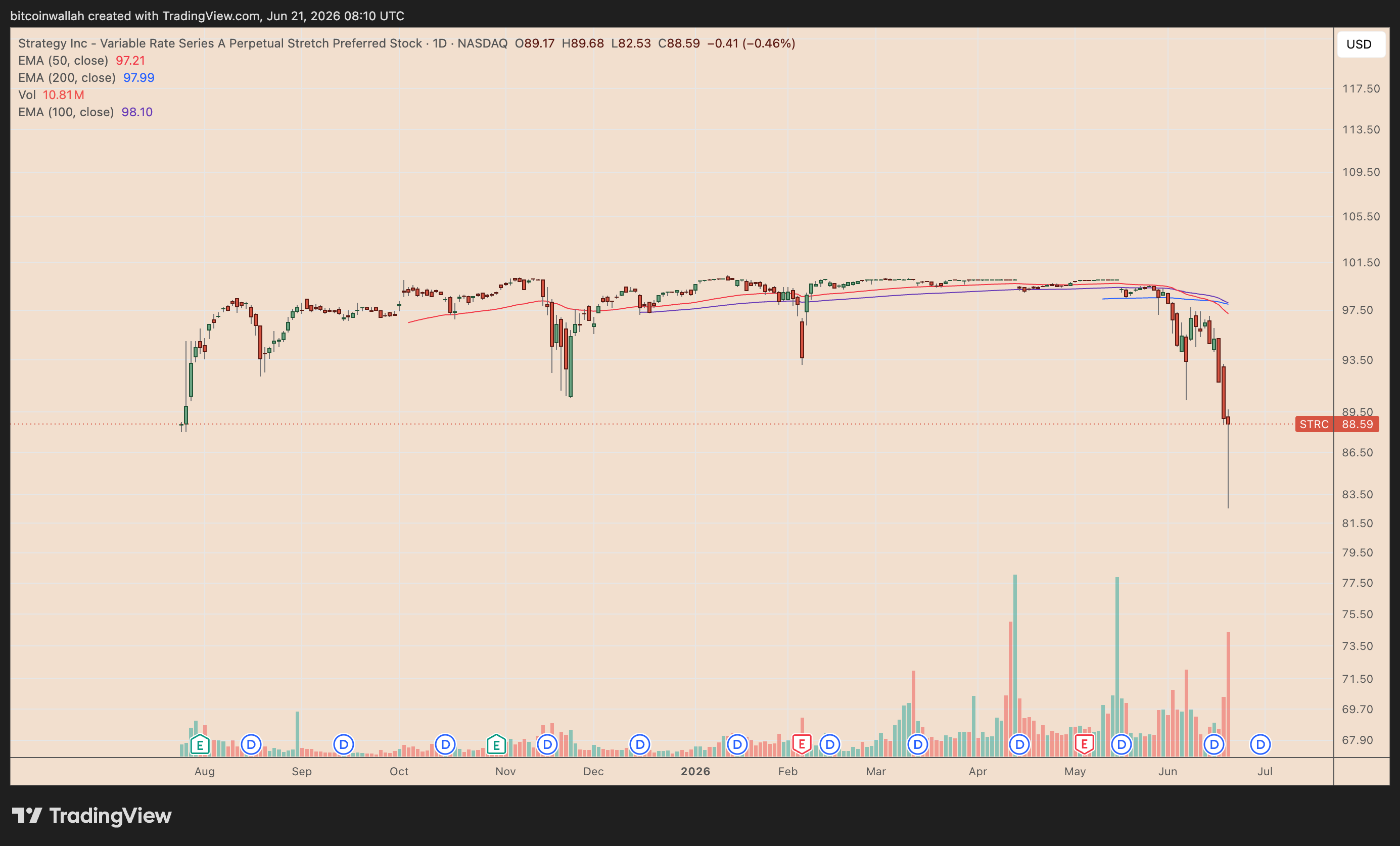
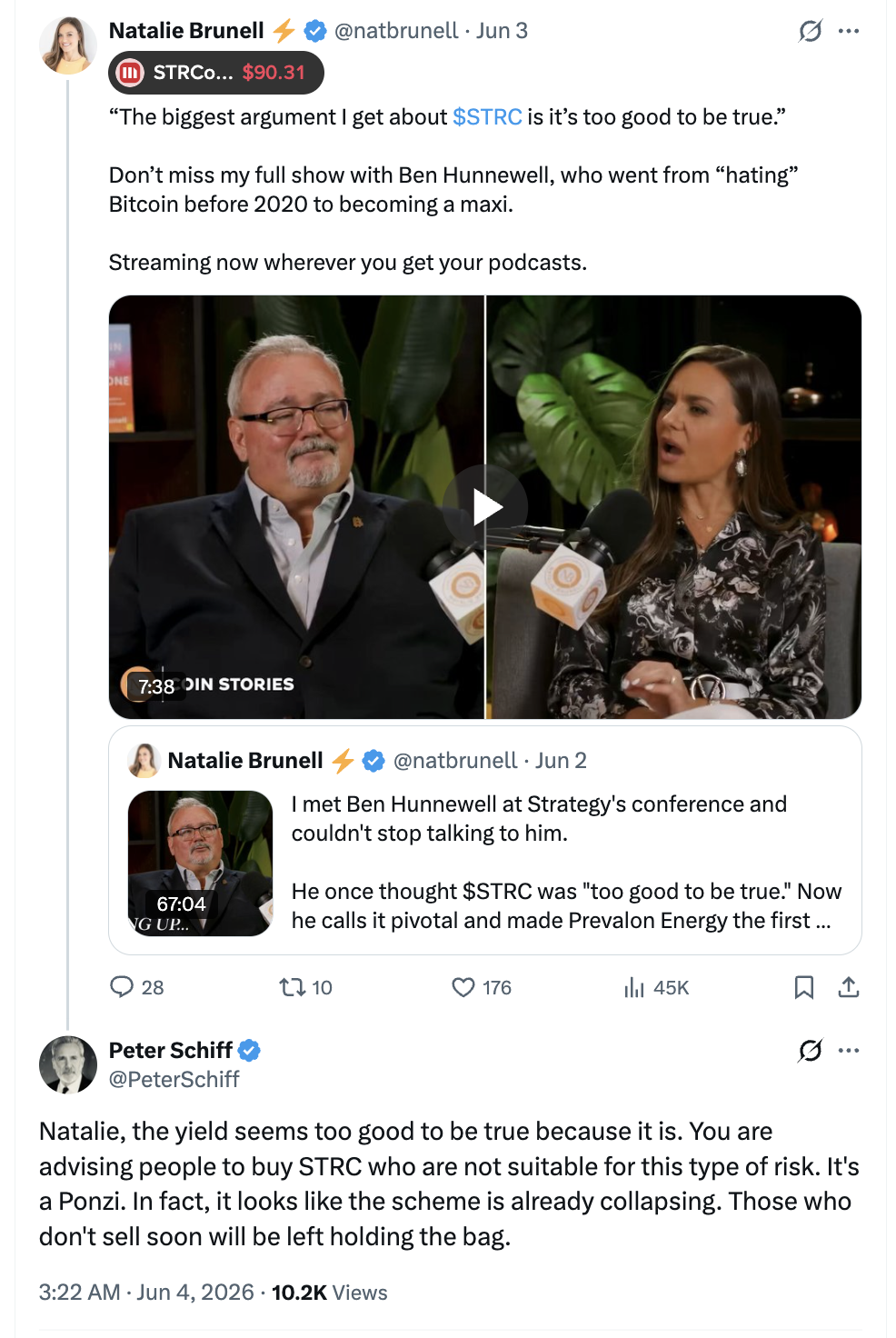
The timing is notable given the growing pressure on Strategy’s preferred equity funding model. The firm’s STRC preferred stock fell 5% below its $100 par value on Wednesday as investors debate whether the company can comfortably maintain its dividend payments while bitcoin prices slide.

Clarity Act survival depends on the U.S. Senate getting a lot of non-crypto work done

0

At some point, the progress of the crypto sector’s top policy priority — the Digital Asset Market Clarity Act — becomes an insurmountable math problem, with not enough time left in the U.S. Senate’s work calendar to allow for passage. But the bill has now been formally offered for the Senate calendar, and the industry’s lobbyists are still shooting for a last-moment win.

There are about eight weeks of floor time available in the Senate before the lawmakers scatter for the summer break and the political demands of the midterm congressional elections. And as the election season grows more urgent, the appetite for legislative cooperation could also take a hit.

In that brief work window in Congress’ upper chamber, the Clarity Act would need to go through several procedural steps that can only begin once the market structure bill is finalized — a goal that still requires some big-ticket disputes to get ironed out between the political parties and the White House.

The Clarity Act would establish a tailored regulatory regime for crypto in the U.S. — an idea that carries significant bipartisan support. But even if the bill were ready for action, a significant array of Senate business items are competing for time and attention. And some of them haven’t been going very well.

A deadline is looming this month for extending the Foreign Intelligence Surveillance Act (FISA), and getting a long-term deal on U.S. spy powers has been a challenge, including over the insertion of a ban on central bank digital currencies (CBDCs). Senate leadership had warned that the CBDC component could kill the effort in that chamber, and an impasse had set in between the House of Representatives and Senate that’s still being resolved, but the latest version of the bill reportedly includes a temporary ban that ends in three years.

Even more fireworks, though, had erupted from the process to approve an immigration-enforcement funding bill. The spending plan was derailed by an internal outcry from Republicans opposing President Donald Trump’s $1.8 billion Department of Justice “anti-weaponization” fund to compensate allies. A court ordered the plan halted during the dispute over its legality, and Acting Attorney General Todd Blanche reportedly gave in to the pressure on Tuesday to assure lawmakers that the idea is dead, which is expected to re-open the path for the immigration bill.

Must-pass bills

Those two bills — FISA and immigration — must pass in order for aspects of the federal government to continue functioning, giving them priority over other work. Crypto lobbyists are expressing quiet confidence that they’ll be resolved soon.

But once they’re approved, that doesn’t necessarily mean smooth sailing for the crypto bill, which was formally forwarded to the Senate calendar this week.

Adding some potential drama has been President Trump’s insistence that one of the legislative efforts — FISA or a bill overhauling U.S. housing regulations — be saddled with his effort to impose voter identification and proof of citizenship at the polls before the congressional midterm elections, which he has said will lead to his impeachment if Democrats win. Adding that controversial bill atop another would sharply decrease the odds of its host bill’s passage, but Trump has previously threatened to halt congressional progress on other matters if lawmakers don’t make it happen.

That housing bill he’s looking at may be among the Clarity Act’s big competitors for floor time. The bipartisan legislation to encourage U.S. home building (while also restricting certain institutional investors) has been lobbed back and forth by the House and Senate, but leaders in the two chambers are reportedly working on a version that will satisfy both. Even if it all goes well, the Senate calendar is a zero-sum proposition at this stage, meaning every hour devoted to anything that isn’t Clarity reduces the odds for the chamber having enough bandwidth for the bill.

The Senate is also wrestling with a debate over a war-powers resolution aimed at halting U.S. military action in Iran. And the coming days are also expected to see action on the legislation known as the farm bill that may get a hearing in the Senate Agriculture Committee that’s also supposed to be working on a final version of the Clarity Act, plus potential movement on the National Defense Authorization Act for next year.

Summer plans

Though White House officials had expressed an Independence Day goal for the Clarity Act to clear Congress at the start of next month, various lawmakers have suggested end-of-July timing or even early August — the final week before the start of the long congressional break.

“Under my Leadership, we will codify a FUTURE-PROOF Digital Asset Market Structure that cannot be undone by the Crypto Haters,” the president wrote in a recent post on his social-media site. “The new Frontier of Finance is being Built in America, and ‘TRUMP’ will NEVER let Crypto down!”

His codifying promise may be dependent on what Trump is willing to allow into the Clarity Act involving an ethics provision aimed straight at him: banning government officials from personal stakes in the crypto industry. A bill without such limits is widely considered to be a dealbreaker for Senate Democrats, but crypto insiders are suggesting that a runway period has been raised that may not force Trump to divest from his own interests.

The Clarity Act recently cleared the Senate Banking Committee in a narrow bipartisan vote that drew loud fanfare from the industry. But a party-line approval of a parallel version in the Senate Agriculture Committee is now being litigated on certain points to bring that committee’s Democrats on board, including the potential requirement that the Commodity Futures Trading Commission — a leading regulator of crypto activity — get nominations from the White House to fill all four of its commissioner vacancies (two Republicans and two Democrats).

Ongoing fights

Lobbyists from the banking industry are also expected to keep hammering away at the bill, which includes a section on stablecoin yield that bankers see as a threat to their deposit base. And the decentralized finance (DeFi) interests are still trying to acquire more legal shielding for developers who don’t want to be punished for illicit usage of their work.

So the bill isn’t done, and crypto advocates in Washington say it hasn’t leapt into June with a particularly quick start. Once the legislation is finished, including combining the versions from the banking and agriculture panels and adding an ethics provision, Senate leadership would need to set up some floor time — potentially a full week (one of the precious eight remaining before the August recess).

If not by then, there’s another smidge of time in September, and then comes the biggest wild card of the congressional calendar: the so-called “lame duck” session in which the members of this Congress will keep working for about four weeks after the elections have effectively fired some of the lawmakers and others are retiring. Desperate deals have been made for significant legislation during those sessions, but the odds are long.

Senator Cynthia Lummis, who chairs the digital assets subcommittee on the Senate banking panel, has been posting a steady stream of encouragement for pushing the Clarity Act.

“We are closer to a functioning digital asset market structure than we have ever been,” Lummis posted Tuesday on social media site X. “Now is not the time to flinch.”

Read More: Clarity Act clears U.S. Senate committee, on its way to a final test in Congress

Deel Deploys Stripe’s Full Stablecoin Stack to Pay 1.5M Contractors in DLUSD

0

Deel is the first enterprise to combine Bridge, Privy, and Tempo in a single product, issuing a custom USD-denominated stablecoin for 1.5 million contractors across 150 countries, starting in Argentina.

Deel, the global payroll and compliance platform serving 40,000 businesses and 1.5 million workers across 150-plus countries, has tapped Stripe’s full crypto-infrastructure stack to launch DLUSD, a USD-denominated stablecoin balance contractors can hold, earn rewards on, and spend without leaving the Deel app.

The product went live in Argentina on June 3. Remaining Latin America markets follow in the coming weeks, with Asia-Pacific, the Middle East and North Africa, and Africa after that, according to a Stripe newsroom press release.

The Three-Layer Architecture

The deployment bundles all three of Stripe’s crypto-infrastructure acquisitions in one enterprise product.

Bridge, a Stripe company, issues DLUSD via its Open Issuance platform, a service that lets enterprises mint custom stablecoins backed by US dollar reserves. Each contractor’s balance sits in an embedded Privy wallet. Privy, also a Stripe company, provides the key-management and wallet infrastructure that makes the balance accessible inside Deel’s existing interface. Every transaction settles on Tempo, a Layer 1 blockchain purpose-built for payments, incubated by Paradigm and Stripe.

On the employer side, Stripe handles direct-debit collection from businesses and screens for fraud before funds enter the stablecoin flow. The Deel Card will let contractors spend their DLUSD balance at any merchant worldwide.

“Contractors want dollar-backed pay they can hold, earn on, and spend without leaving the platform,” said Alex Bouaziz, co-founder and CEO of Deel, in the press release. “Stripe’s stablecoin stack gives us the infrastructure to make that happen, simply and compliantly, at scale.”

Argentina as Launch Market

The Argentine peso lost between 20% and 40% of its USD value in a single year, according to the Stripe press release. In 2025, 85% of contractors in Argentina told Deel they wanted to be paid in dollars rather than pesos.

Turkey faces comparable currency volatility. Both countries are part of the LATAM and MENA expansion sequence Deel is working through.

Stablecoin Scale Context

The launch enters a stablecoin market with $263 billion in total circulating supply, per DefiLlama data. USDT leads at $187.4 billion, followed by USDC at $76 billion. DLUSD is not publicly tracked as a standalone entry — it is a captive enterprise balance issued under Bridge’s Open Issuance infrastructure, held within the Deel ecosystem rather than trading on public markets.

For comparison, USDC — the dominant dollar stablecoin for institutional and fintech applications — carries a $75.9 billion market cap, per CoinGecko.

Henri Stern, CEO of Privy, described the arrangement as infrastructure-level: “With Stripe’s crypto infrastructure under the hood, Deel gets tighter control, better economics for the business, and a seamless experience for their end users.”

The Invisible Onchain Layer

Stripe’s press release is explicit about the UX philosophy: the mechanics of Tempo, Bridge, and Privy are invisible to contractors. The end user sees a dollar balance arriving in their account. Blockchain settlement and stablecoin issuance are abstracted behind Deel’s existing interface.

Tempo reached 3.9 million transactions across 177,000 addresses in its first two months on mainnet, per Defiant coverage from May 28. MoneyGram joined as an anchor remittance validator in May. The Deel deployment is Tempo’s most prominent enterprise integration to date.

Per-transaction fee structure for contractors, the regulatory framework for DLUSD issuance in each target jurisdiction, and the precise rollout timeline beyond LATAM have not been disclosed.

shares gain on new AI data center

0

IREN (IREN) shares rose more than 4% in pre-market trading on Wednesday after the company announced plans for an 800-megawatt data center campus in South Australia, marking its first major Australian data center project.

The agreement secures a high-voltage grid connection capable of supporting up to 800MW of power for the campus without requiring major network upgrades.

IREN said the project remains on track for initial energization beginning in 2028, subject to regulatory approvals and other conditions. The site will also benefit from submarine fiber connectivity linking it to key Asia-Pacific markets, including Singapore, Indonesia, South Korea and Japan.

Management highlighted strong regional demand for AI infrastructure, noting a widening gap between projected computing needs and available capacity across Asia-Pacific. South Australia’s push toward 100% net renewable energy by 2027 was also cited as a key competitive advantage for the development.

Co-Founder and Co-CEO Daniel Roberts said the project combines access to abundant renewable energy, international connectivity and a supportive policy environment. The campus is expected to create more than 500 construction jobs and over 200 permanent skilled positions once operational.

Recently, Daniel Roberts said the company’s long-term AI strategy is built on owning power, land and data centers.

ETH falling below $1,800 leaves Tom Lee’s Bitmine (BMNR) with $8.9 billion paper loss

0

Bitmine Immersion Technologies (BMNR), the largest corporate holder of ether (ETH), is staring at nearly $9 billion in losses as the token’s slide below $1,800 drags down the value of its massive treasury.

Shares of the Tom Lee-chaired company fell another 5.9% Wednesday, slipping below $17 and extending their decline to 28% since early May. The stock has now dropped below its February lows to its weakest level since the company announced its pivot to an Ethereum treasury strategy in May 2025.

The selloff comes as ETH retests its February lows. The second-largest cryptocurrency has lost more than 20% since early May, when Lee, Fundstrat’s co-founder and BitMine’s chairman, argued that the market’s “mini crypto winter” had likely ended and a new “crypto spring” had begun.

Under Lee’s leadership, Bitmine has amassed more than 5.4 million ETH, or roughly 4.5% of Ethereum’s circulating supply, in roughly a year. That position is worth about $10 billion at current prices.

Those holdings, however, are now deeply underwater, carrying an estimated $8.9 billion in unrealized losses, according to data collected by DropsTab.

Digital asset treasuries under pressure

Bitmine’s drawdown highlights renewed pressure across the digital asset treasury sector, where companies seek to replicate the playbook pioneered by Michael Saylor’s MicroStrategy (MSTR): raise capital through public markets and use the proceeds to accumulate crypto.

That model has become increasingly harder to sustain as crypto prices weakened and many treasury stocks drifted below the value of their underlying assets.

Strategy itself recently disclosed its first bitcoin sale since 2022, sparking debate about how the company might fund future obligations tied to its preferred stock offerings.

Bitmine’s situation differs in some key respects. The company financed its ether purchases primarily through equity issuance rather than debt, leaving it without the leverage concerns and interest payments that some treasury peers face.

The company also generates revenue from staking its ETH and operating its staking service MAVAN. Bitmine said it has staked more than 4.7 million ETH — about 87% of its holdings — and recently estimated annualized staking revenue at roughly $276 million.

Lee calls for $250,000 ETH

The recent price action has not tempered Lee’s long-term outlook.

Speaking at the Proof of Talk conference in Paris earlier this week, he said ETH could eventually reach $250,000 as tokenization, AI-driven transactions and corporate staking reshape Ethereum’s role in the global financial system.

For now, investors appear focused on a more immediate reality. Ether is back near levels last seen during February’s selloff, leaving Bitmine’s treasury deep underwater and highlighting the gap between Lee’s long-term thesis and the market’s current view of the asset.

Crypto PAC-Supported Candidates Sweep US State Primaries after Media Buys

[Update (June 3 at 8:01 pm UTC): This article has been updated to include a response from Fairshake in the fourth paragraph.]

Democratic and Republican candidates across California, New Jersey and South Dakota won their respective primaries on Tuesday after being the beneficiaries of supportive ads purchased by cryptocurrency industry-backed political action committees (PACs).

On Tuesday, Democrats Jacqui Irwin, Ted Lieu, Zoe Lofgren, Dave Min, Mike McGuire, Hilda Solis, George Whitesides, Lou Correa and Lateefah Simon won their respective California primaries for House seats. Democrat Rob Menendez and Republican Mike Rounds also won primaries for New Jersey’s 8th congressional district and a South Dakota Senate seat, respectively.

Selection of results after Tuesday’s primaries for California House seats. Source: CalMatters

The political wins came after the Protect Progress and Defend American Jobs PACs spent about a combined $3.5 million on media to support the candidates. The groups are affiliated with Fairshake, a political action committee funded largely by cryptocurrency exchange Coinbase and Ripple Labs that reported having a war chest of $193 million in January.

“America needs members of Congress who will act to lay out responsible guardrails for the community to maintain our global leadership,” Fairshake spokesperson Geoff Vetter told Cointelegraph.

The PAC spending came on the heels of similar buys for supportive media in Texas runoff primaries last week, which resulted in Democrat Christian Menefee defeating incumbent US Representative Al Green, and four Republican candidates winning primaries in smaller House districts. Many of the candidates in the state races have supported advancing digital assets, either through voting on “pro-crypto” legislation while in office like the GENIUS Act or in public statements.

Related: PACs laud Texas primary wins, look to back more pro-crypto candidates

Maryland is shaping up to be the next focus for Fairshake and its affiliates. Federal Election Commission (FEC) filings showed Protect Progress had spent more than $3.1 million as of Wednesday to support Democratic candidate Adrian Boafo in Maryland’s 5th Congressional district, which is scheduled to hold a primary on June 23.

Crypto advocacy organizations back new developer-focused PAC

On Wednesday, industry leaders announced the launch of Defend Developers, a hybrid PAC that will support “incumbent members of Congress who actively champion developer protections and crypto builders.” According to the group, Defend Developers’ board of directors includes “CEOs, CLOs, and policy leaders at top crypto organizations, including DeFi Education Fund, Orca Creative, Solana Policy Institute, and Uniswap Labs.”

“For too long, developers building decentralized technologies have faced regulatory uncertainty and enforcement actions instead of clear rules and guidelines,” said the PAC’s founder, Gavin Zavatone. “While legislation and rulemakings are being written as we speak, for some policymakers there is limited incentive to understand the fundamental nature of software development.”

No official data available on Defend Developers as of Wednesday. Source: FEC

The FEC portal did not show any funding or expenditure activity, as of Wednesday. Nick Stoltzfus, co-CEO of on-chain student loan digital asset platform Stratofied, was listed as treasurer and custodian of records in the PAC’s statement of organization on May 15.

The PAC did not say where or how it would focus its efforts as part of the 2026 US midterms other than “key races across the country.” Cointelegraph reached out to Defend Developers for comment but did not receive an immediate response.

Magazine: Korea’s first memecoin rug-pull case, China’s crypto rules review: Asia Express

Bitcoin isn’t crashing because of Saylor, it’s losing the momentum trade

0

Bitcoin’s recent struggles to rise in tandem with U.S. stocks has sparked a wave of explanations, from concerns about Michael Saylor’s Strategy (MSTR) selling bitcoin to questions about whether institutional demand is beginning to fade.

Charles Schwab director of digital currencies research and strategy Jim Ferraioli sees a simpler explanation: Bitcoin is losing the momentum trade.

“Bitcoin has been in a bear market since October,” Ferraioli said in an interview. “Not to say it’s as simple as that, but it’s kind of simple as that.”

The comments stand in contrast to a market narrative that has remained largely focused on positive developments. Over the past year, crypto has secured spot ETF approvals, attracted billions of dollars in institutional capital and moved closer to regulatory clarity in Washington. Yet despite those developments, bitcoin has struggled to sustain the type of explosive rally many investors expected.

Instead, capital has been flowing elsewhere.

“We found a bottom in early February, and since then another large Wall Street firm had a successful ETF launch, and so you saw this kind of return to the institutional adoption narrative,” Ferraioli said.

That rebound helped bitcoin recover from its February lows. But unlike previous crypto cycles, the recovery stalled before developing into a broad speculative frenzy.

That’s because crypto investors are not fundamentally driven, but chase momentum, he said. In his view, bitcoin’s problem isn’t a lack of bullish news. It’s competition.

Historically, crypto has benefited when it becomes the market’s most compelling speculative opportunity. When prices rise, traders pile in. When another asset class begins attracting attention, capital often follows.

“Crypto investors historically just go wherever the momentum is,” Ferraioli said. “And momentum is out of crypto at the moment.”

The destinations for that capital have changed over the past year.

Some investors have gravitated toward precious metals. Gold has attracted significant inflows as investors seek alternatives to both equities and crypto. Others have become increasingly focused on artificial intelligence, which has emerged as the dominant growth narrative across financial markets.

The AI boom has created a new class of speculative opportunities that didn’t exist in previous crypto cycles. Public companies tied to AI infrastructure, data centers and advanced computing have generated strong returns, while anticipated IPOs from firms such as OpenAI and Anthropic have become focal points for investors looking for the next growth story.

According to Ferraioli, crypto investors are participating in that shift as well.

“I think people that are excited about momentum are getting excited about IPOs,” he said. “Then some of these you can actually access the private shares on these decentralized exchanges on Hyperliquid.”

That trend is significant because it highlights how crypto-native trading infrastructure is increasingly allowing investors to speculate on assets beyond cryptocurrencies themselves.

Platforms such as Hyperliquid (HYPE) have introduced perpetual contracts tied to private companies, commodities and other non-crypto assets, giving traders new places to deploy capital.

For bitcoin, that means it is no longer competing solely against other cryptocurrencies.

It is competing against every major speculative narrative in the market.

Ferraioli also downplayed concerns surrounding Strategy’s recent sale of 32 bitcoin, a transaction that sparked debate among investors because of Saylor’s long-standing reputation as one of bitcoin’s most committed advocates.

“The narrative has been that they’ll never sell,” Ferraioli said. Yet he believes the market impact of the transaction itself has been overstated. “But I don’t think [the sale] is what’s really driving it,” he said.

Instead, he views the sale as a convenient narrative attached to a broader trend that was already underway.

Part of that trend may be tied to investor cost bases and many ETF investors are still recovering from sharp swings over the past year and see the current price point as an opportunity to exit positions rather than increase them.

“I think you get to those levels and you get people that are saying, ‘Hey, I made my money back, maybe I’ll revisit it later,'” Ferraioli said.

That dynamic has contributed to a market that feels very different from the euphoric phases of previous cycles.

Ferraioli argues that institutional adoption, while real, remains smaller than many market participants assume. Bitcoin ETFs have expanded access to crypto, but much of the asset class remains dominated by retail investors and momentum-driven traders.

“Again, this is primarily a retail asset,” he said.

The distinction matters because retail investors often react differently than traditional institutional allocators. Rather than building positions based on discounted cash flow models or long-term valuation frameworks, they tend to chase trends.

That behavior helps explain why bitcoin has struggled to capitalize on positive regulatory developments.

The crypto industry is awaiting potential passage of the Clarity Act, a bill that many industry participants believe could provide a clearer framework for digital assets in the U.S. Over the longer term, Ferraioli believes such developments could support adoption.

In the short term, however, regulation alone may not be enough to reverse the current trend.

“There is still more demand for downside protection,” he noted elsewhere in Schwab’s market outlook, though that pressure has begun to ease in recent weeks.

Seasonality may also be contributing to the slowdown. Summer has historically been one of bitcoin’s weaker periods, as trading activity declines and investors shift attention elsewhere.

“People know that for bitcoin seasonally summer is the weakest time,” Ferraioli said.

That leaves the market in an awkward position.

Institutional adoption is improving. Regulatory clarity is advancing. Major financial firms continue building crypto products. Yet none of those developments guarantee higher prices if investor attention is focused elsewhere.

“There’s a lack of a reason to be buying here when there’s other things you can choose,” Ferraioli said.

For now, he argues, the biggest challenge facing bitcoin isn’t Saylor, regulation or even macroeconomics.

It’s that investors have found something else to chase.