A widely watched indicator has flipped to “altcoin season,” for the opposite reason the label suggests. Glassnode’s Altcoin Cycle Signal, which reads above 50 when alternative coins, or alts, outperform bitcoin, has climbed to 86. Alts are not rallying. Bitcoin is just falling faster than they are.
[@portabletext/react] Unknown block type “image”, specify a component for it in the `components.types` prop
The signal tracks relative performance, so alts can lead either by rising or by falling less. This is the second case. After nearly two years of declines, alts have run out of sellers and steadied, while bitcoin has dropped hard, sliding back toward $63,600, per CoinDesk data. Bitcoin, as Glassnode puts it, “is still doing most of the work.”
A real altcoin season has capital rotating into smaller tokens as they climb. This is the hollow version, where the reading turns bullish for alts because bitcoin is selling off, which is bearish for the market as a whole. Relative strength is not a rally.
Until alts start rising on their own rather than holding while bitcoin falls, the signal says more about bitcoin’s weakness than about demand for anything else.
It explicitly says that adversaries may already be collecting encrypted U.S. data, or information mathematically scrambled into an unreadable format to protect it from unauthorized access, and could decrypt it in future with the help of quantum computers.
That’s the “harvest now, decrypt later” problem. Steal the locked box today, crack it open whenever the tool to do so finally exists.
The fix, according to the order, is a hard post quantum cryptography (PQC) migration timeline. Federal agencies must move their most sensitive systems to post-quantum cryptography for key establishment by the end of 2030, and for digital signatures by the end of 2031.
In other words, the government plans to replace the current method for setting up secure, encrypted connections with a new way that remains secure from future quantum computers.
The crypto angle
Quantum computing has been a buzzword in the crypto industry since Google researchers said a sufficiently powerful machine could crack Bitcoin’s blockchain with significantly less firepower than previously expected.
The March paper, co-authored with Ethereum Foundation researcher Justin Drake and Stanford cryptographer Dan Boneh, said that breaking the elliptic curve cryptography behind Bitcoin and Ethereum blockchains could take fewer than 500,000 physical qubits. That’s a 20-fold drop from earlier estimates.
Bitcoin fell toward $63,000 on Tuesday, caught in a broad retreat from risk as investors pulled out of the technology stocks that have led markets all year.
The token traded around $63,640, down 0.9% over 24 hours and 3.3% on the week, per CoinDesk data, after touching about $65,076 on Monday and sliding through the session. The selling was marketwide. Ether fell 0.9% to $1,719 and is also down 3.3% on the week, XRP dropped 1.6% to $1.12 for a 9% weekly loss, solana lost 3.4% to $71 and dogecoin slid 6.6% over seven days.
Tron was the rare gainer, up 1.3% on the day and 4.6% on the week. Hyperliquid’s HYPE fell 4.8% on the week.
The pressure came from outside crypto. A rotation out of this year’s best-performing technology and chip shares sank global equities, with a gauge of Asian stocks falling more than 2% after a record close and South Korea’s Kospi plunging more than 6% on fears that the rally in chipmakers had run too far.
Former New York Governor Andrew Cuomo is leading an OKX and New York Stock Exchange owner Intercontinental Exchange (ICE) joint venture to build infrastructure to bridge traditional and digital financial markets.
“The ICE-OKX joint venture is a step towards building the infrastructure that will define how global markets operate in the decades ahead,” said Trabue Bland, senior vice president at ICE in a statement Monday morning.
Subject to regulatory approvals, the OKX and ICE project is expected to operate as a registered broker-dealer and a futures commission merchant, the statement noted.
The goal of the joint venture is to enable OKX’s 120 million users in the U.S. and overseas to access ICE futures and NYSE tokenized equities markets. It will also explore adjacent opportunities for the regulatory-compliant blockchain-enabled market, it added.
Cuomo, who served as New York’s 56th governor, New York State Attorney General, and Secretary of Housing and Urban Development, began working with OKX in 2023.
Multiple XRP (XRP) indicators have hinted at a potential 25% relief rally in the coming weeks.
Key takeaways:
XRP price looks poised to print a rare death cross with a rebound setup toward $1.40.
XRP may also be forming a broader bottom, eyeing a larger rally toward $8 in the coming months.
XRP’s mean-reversion setup may send price toward $1.40
As of Monday, XRP’s 20-week exponential moving average (20-week EMA, green) near $1.40 was on the verge of crossing below its 200-week EMA (blue) near $1.39.
A confirmed weekly close below the longer-term average would mark a rare death cross between the two trend gauges.
XRP/USD weekly chart. Source: TradingView
In the past, XRP’s previous 20-week/200-week EMA crosses were followed by relief rebounds back toward the 200-week EMA. That includes a roughly 20% recovery in 2019 and a larger 82.7% rebound in 2022.
A similar mean-reversion move this time would put the $1.39–$1.40 area in focus, implying roughly 23%–25% upside by July from XRP’s current price near $1.13.
XRP’s weekly relative strength index, or RSI, was also hovering just above the oversold threshold of 30 on Monday.
The RSI measures whether an asset is becoming overheated or overly sold. Readings near 30 typically suggest that sellers may be running out of momentum, raising the odds of a short-term rebound even if the broader trend remains weak.
XRP shorts create $1.40 price magnet
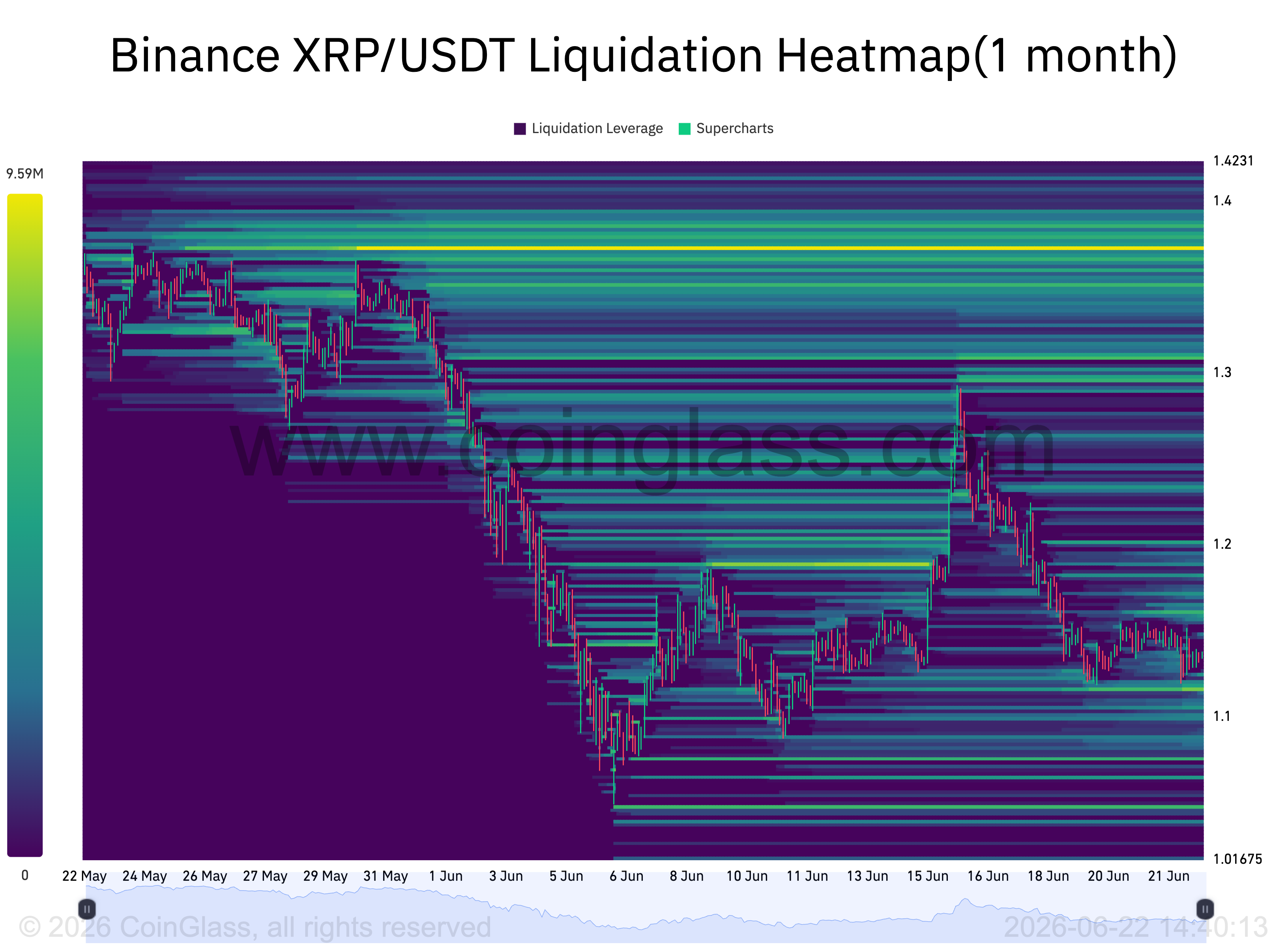
Binance XRP/USDT liquidation heatmap data further supports the relief-rally setup.
The chart shows a heavier concentration of short liquidation liquidity above the current price than long liquidation liquidity below it. The largest upside cluster, of around $236.5 million, appears around the $1.37–$1.40 zone, according to CoinGlass data.
Liquidation heatmaps often highlight where prices may move to flush out crowded leveraged positions.
Short sellers positioned above the spot price could be forced to buy back their exposure if XRP starts rebounding from the current $1.13 price levels, adding fuel to a move toward the $1.39–$1.40 area.
XRP may rebound toward $8: Analyst
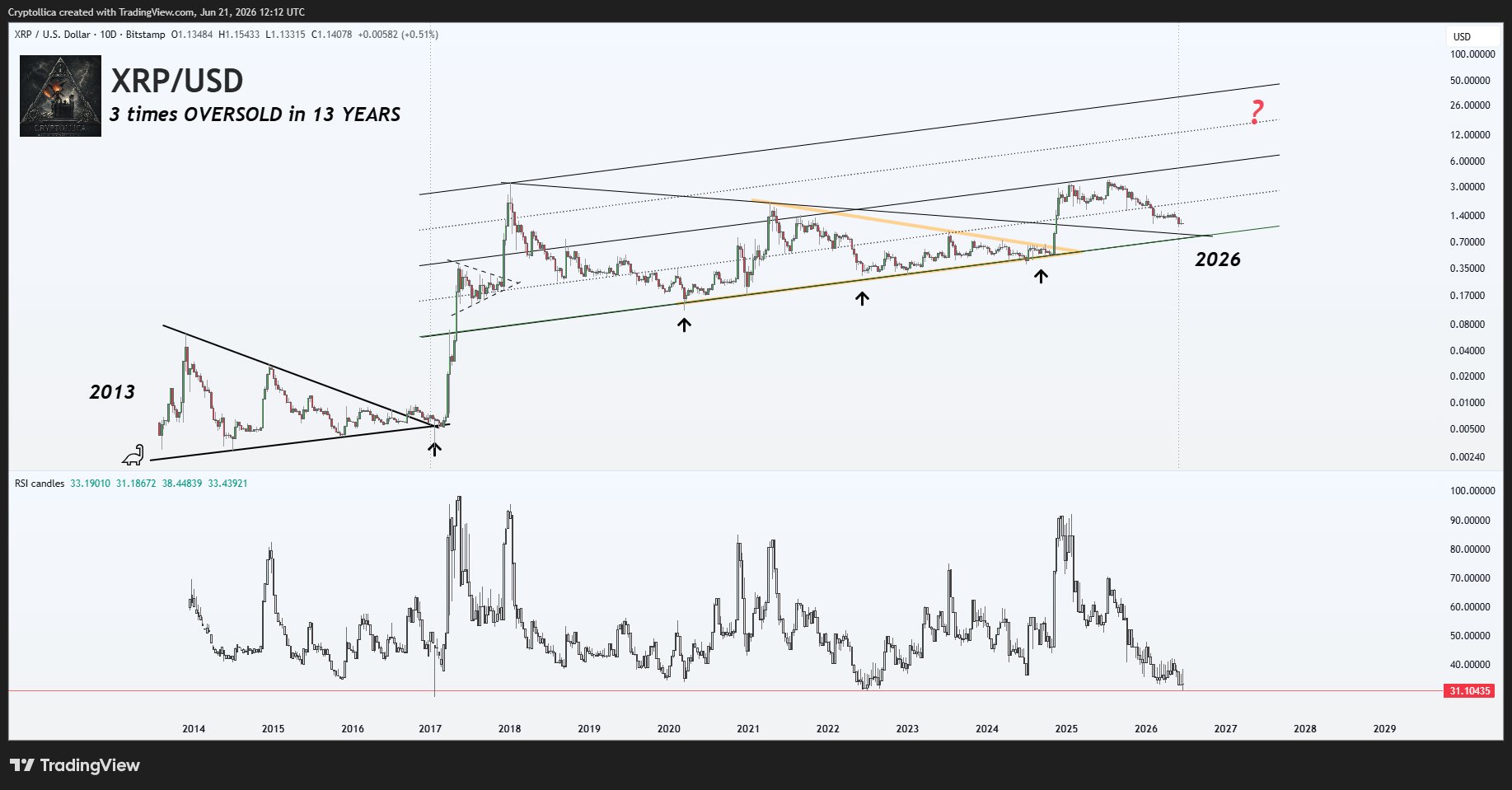
A separate long-term chart from analyst Cryptollica suggests that XRP’s next rebound could be part of a broader bottoming setup.
The chart shows XRP’s 10-day RSI hovering near the low-30s, close to the level that has historically appeared around major accumulation phases.
XRP/USD 10-day chart. Source: TradingView
“In 13 years, XRP has only been this washed out 3 times,” Cryptollica said in a Sunday post, adding:
“The first 2 times, the crowd laughed, ignored it, and only understood the setup after price had already left.”
Cryptollica’s chart also shows XRP trading above the lower boundary of a giant ascending channel, a long-term support line that has connected multiple macro lows since 2017.
Related: XRP whale wallet withdrawals top 720M as risk-adjusted return data points to opportunity
That trend line currently sits near $0.75, meaning XRP could still see one more downside sweep before a larger recovery begins. In previous cycles, tests of this support area preceded major upside expansions.
XRP could first retest the channel support before entering a broader bull-market phase, with the channel’s upper boundary putting a long-term target near $8 in focus if the pattern plays out again.
Against that backdrop, Ethlabs represents what supporters describe as a broader transition toward a “multi-node” development model, where independent organizations share responsibility for advancing the network rather than relying heavily on the Foundation.
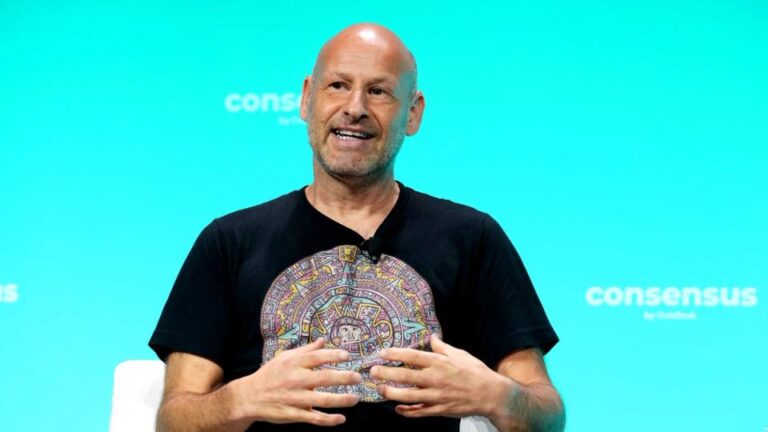
“We are now poised to recognize and implement the idea that there should be a number of steward nodes of Ethereum,” Joe Lubin said, “each configured in their unique way to evolve and protect what is sacred about the network and massively grow the world’s appreciation and utilization of it.”
Ethlabs’ initial work will focus on faster transaction settlement, expanding Ethereum’s capacity and improving infrastructure for institutions issuing tokenized assets and stablecoins onchain. Ethereum dominates the $300 billion stablecoin market with a 53% market share and hosts roughly half of the $32 billion tokenized asset market, RWA.xyz data shows.
The initiative also reflects the growing institutional investment in Ethereum. SharpLink and Bitmine have both built sizable ETH treasury strategies, while Ethereum continues to host the majority of stablecoins and tokenized real-world asset issuance.
“Ethereum is at a pivotal moment,” Ansgar Dietrichs, Ethlabs’ executive director, said in a statement. “As blockchain systems move rapidly into mainstream use, the coming years will define the shape of the onchain economy for decades.”
If you are into Bitcoin, you might have heard “Nostr,” a strange, nearly unpronounceable word that stands for “Notes and other stuff transmitted by relay”. This acronym that’s captured the imagination of Bitcoin technologists for years has a big idea. That you don’t need to be locked into a social media giant to talk to your friends.
Invented at the start of COVID19 by Fiatjaff in March of 2020, today the Nostr protocol has a seemingly infinite amount of websites custom-built around this niche, with world-class influencers like Edward Snowden and Jack Dorsey prominently on the platform.
Unlike the internet and social media ecosystem of today, Nostr lets users take their followers and content with them from website to website, from app to app, as they see fit. The algorithms are fundamentally in the hands of users, supporting maximum control, variety and censorship resistance, qualities largely lost from the modern big tech clear web.
A Tool of Bitcoin Evangelism
Built on Bitcoin native technology, Nostr has supported bitcoin micro payments called zaps from almost day one. Its login system resembles a Bitcoin wallet more than it does any other login credential, resulting in a fresh and novel experience of the web.
Artists have started to find their way to this strange corner of the internet, as they do, growing their brands into international communities that tip in Bitcoin, not just in appreciation for great art, but to make a point. To demonstrate that, regardless of where you are in the world, Bitcoin can be delivered to your door.
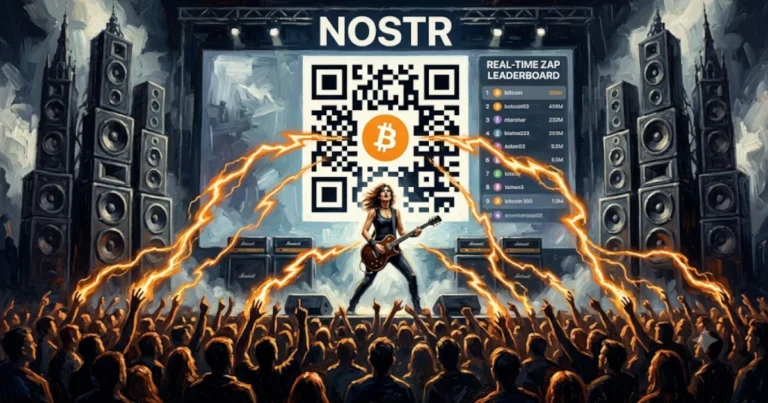
Take Pubpay, for example, a Nostr-powered music site built to elevate the musicians not just online, but in live performances. I got to see this app in action at a Bitcoin party in Las Vegas just a few weeks ago. The site seen on that massive screen showed off the artist on stage, with a massive QR code and a leaderboard of Zaps, tiny bitcoin donations made to the artist over the lightning network. Those who donated most rose to the top, claiming the bragging rights, while the artist claimed the sats.
Have a listen to the trending tab of Wavlake, for example, another music dedicated Nostr site with a smooth design and instant access to surprisingly good music.
Stories of onboarding new people to Bitcoin via Nostr social media apps like Primal are common at Bitcoin meetups and conferences. Primal is a Twitter clone of sorts built from the ground up around Nostr, it is without a doubt the fastest way to get into this social media niche, start growing your followers and start stacking sats by posting great content.
Unlike the boring payments-only Bitcoin wallet whose design principles are now more than 15 years old, the Nostr app is fresh and has a direct pipeline of content that can be delivered to newcomers if done right, keeping them tumbling down the Bitcoin rabbit hole.
Easy to Understand Nostr Fundamentals
Built on Bitcoin native cryptography, Nostr uses public addresses and privacy keys to authenticate its users, the same as Bitcoin wallets. Nostr public addresses start with “npub” while private keys start with “nsec”. Users sign posts or messages they want to publish to the Nostr network with their private key. Those signed posts can be found by looking at the same user’s public address. Like normal social media apps, users can follow and mute each other across the Nostr ecosystem.
Data about who follows whom, and what they have published, is stored on relays, special servers that users can run themselves, and which sync with other relays to varying degrees, similar to Bitcoin nodes.
Interfaces and apps can be built on top of Nostr to let users experience their social network in different ways, and many different approaches exist, from Twitter-like clones like Primal and Amathyst, to blogging platforms, music and even micro video sites like Divine. Basically, any website can be Nostr integrated as long as it makes its users’ identities Nostr compliant, and user-generated content becomes available via relays.
If you get tired of one app or don’t like how they are treating you, you can just grab your nsec and move to another. The new app will look up your npub, find all your friends, notes and preferences and let you continue connecting with them without issue. In other words, the network effects built on Nostr apps are owned by you, controlled by you and not by the platform. This is the big idea of Nostr, and it is why so many Bitcoiners are obsessed with it.
A lot more than Social Media
It’s important to note that Nostr isn’t just a social network protocol; it is actually an open-source and actively growing information protocol that can transfer any kind of data. Devices can talk to each other via the nostr without you having to see them. In fact, a wide range of apps have already been built to transmit data over Nostr; many of those apps can be found in one of the most important places of this ecosystem, the Zapstore.
That’s right, Nostr has its own dedicated app store, and it’s quite impressive. Led by a gentleman known as Franzaps, this open source Nostr-powered app store gives you direct and often early access to over 150 apps in the Nostr ecosystem, published directly to it by its developers, signed cryptographically and publicly with their Nostr keys.
But Zapstore goes beyond just its Nostr niche; it lets you download a wide range of popular apps that publish to GitHub. We are talking over 3000 of the most popular apps, according to Fran, who talked to Bitcoin Magazine in an exclusive interview. Examples like Mullvad VPN and Brave browser can be found on the Zapstore, along with many others; it could very easily replace the Play Store and App Store for a privacy-conscious user, by passing the choke point that Google and Apple have been building inside mobile phones.
The Zapstore software goes through significant lengths to verify the authenticity of apps via cryptography. Fran explained that “Android uses the APK format. All APKs have a developer signature, and this is what Android checks during updates.” Google now effectively KYCs its app developers, but Nostr is decentralized, so to know whether an app was actually published by its developer, Nostr social proof is used. “Nostr is a *social* protocol where keys carry social weight, so now that Zeus signed their wallet, you can be certain it’s the real one.”
This concept of Nostr social proof is historically known as a Web of Trust. If you log into Zapstore with your Nostr keys, you get to see if anyone you follow has engaged with the publishers of the app, an early web of trust solution to the question of security and authenticity in a decentralized world.
Fran estimates the Zapstore has around 4,000 daily users, with half installing or updating at least one app. These are estimates — he clarified, “because we value privacy, we have zero tracking in the client and must derive them from relay and Blossom server data.”
Digital Identity on Hard Mode
Since authentication into Nostr is done via Bitcoin-style private-public key pairs, the security practices to protect your identity are similar. Rather than emails, passwords and password resets, in Nostr, you have to take precautions to make sure your nsec (private key) does not get hacked. If it ends up on the dark web somehow, there’s not much you can do to recover it, and your identity and data can not be transferred to a new key pair either; the hacker can take control. For years, I’ve criticized this design, but while a protocol-level solution to password resets in Nostr has not been widely adopted, other solutions have emerged, such as remote signers.
Amber, an app created by Greenart7c3, a popular Nostr developer, can generate and sign Nostr events remotely, giving you full control over the nsec, without exposing it to every website you connect to. This technology works quite well, with wide adoption. It takes advantage of NIP-46 — an open-source Nostr improvement proposal designed for this purpose.
If you have never had a Nostr account, Amber is a great place to start, have it generate your Nostr keys, and use it exclusively to login to Nostr apps.
Zap Zap Zap!
The most viral and innovative element of Nostr, a feature called by some “the moat” of Nostr apps, is, of course, the Zap. Those small bitcoin tips, which can be as little as 1 satoshi, though can be much higher as well, with a new Nostr site designed specifically around onchain Zaps, making the minimal viable over 1500 sats. Zaps, as a result, can deliver an excess amount of dopamine to its recipients relative to the cost, a reinvention of the Facebook “like”, with the weight of the hardest money in the world behind it. The Zap anchors approval and value to something that can not be faked by sock-puppet accounts on social media. If you want to try to game the popularity of a post, you have to pay up.
The potential of Zaps is likely still in its infancy, but may one day serve as a novel kind of advertisement medium, ultimately paying consumers to experience content, or simply as an undeniable sign of gratitude from Nostr users towards a piece of content and its creator.
Setting up Zaps on your Nostr account however could be easier, there are two sides to getting your Zaps up and running, sending and recieving, and for both you need the right kind of Bitcoin wallet. Not all Bitcoin wallets are made the same, as you might know. Most focus on handling onchain transactions, which, for the most part, are not compatible with Zaps. You need a lightning wallet that supports NIP-57, which gives you an email like nym, such as [email protected], a human-readable address that can receive lightning payments. And you also need to be able to send Zaps from a lightning wallet, which does not have to be the same one you receive them to.
The easiest way to start by far is by using Primal.net, likely the most popular Nostr social media client to date. Primal has a deep range of tools for Nostr users and often serves as the gateway to the ecosystem. It has a wallet built in that manages to stay on the self-custodial side of the regulatory line, while also being a low effort, low cost lightning wallet. It does this by using Spark, a layer 2 protocol similar to lightning.
Most important of all, Primal’s wallet support Nostr Wallet Connect (NWC) a very powerful and standard in the ecosystem under NIP-47, which lets you connect Nostr enabled websites to a wallet, to enable Zaps, without giving every website custody of your satoshis.
Other options range from running an Alby lightning node, which costs $12 dollars a month on server fees, far too much if you ask me, though a viable option for power users. Or running an Electrum Lightning wallet from a home machine and making sure it is always open and online. From there, there’s a wide range of lightning node software that enthusiasts can set up and make compatible with NWC and Nostr Zaps.
A Glimpse of the Nostr Ecosystem
Including all the tools mentioned above, here are some of the most notable Nostr sites and tools I discovered in my deep dive into the Nostr ecosystem, in no particular order.
Latest developments: Digital credit products tied to Strategy’s bitcoin-backed ecosystem suffered steep declines last week before partially recovering.
Strategy’s preferred stock funding vehicle STRC fell as low as $82.53 on Thursday before rebounding to roughly $90.50, according to Strive Chief Risk Officer Jeff Walton.
Strive’s SATA dropped into the low $90 range before recovering to about $98.59.
Walton attributed the move to leverage liquidations and heavy selling pressure rather than deterioration in the underlying credit quality.
CEO Matt Cole previously described the episode as a “leverage liquidation event, not a credit failure.”
CoinDesk’s Jennifer Sanasie interviewed Strive Chief Risk Officer, Jeff Walton on Public Keys.
What happened: Strive’s analysis points to forced selling rather than a breakdown in decentralized finance markets.
Walton said trading data suggests holders sold the instruments, triggering liquidations elsewhere in traditional financial markets.
He said the event did not appear to originate from DeFi protocols.
The selloff occurred amid unusually large trading volumes across both securities.
Walton characterized the volatility as part of the maturation process for a new asset class.
The liquidity story: Strive argues the market’s ability to absorb large trading volumes is a positive signal.
The move contrasted with US stock markets, which opened lower on continued uncertainty over the fate of the US-Iran peace deal. The mood settled as the US allowed Iranian oil trading for two months.
“Iranian oil is officially returning to global markets for the first time since 2018,” trading resource The Kobeissi Letter responded in a post on X.
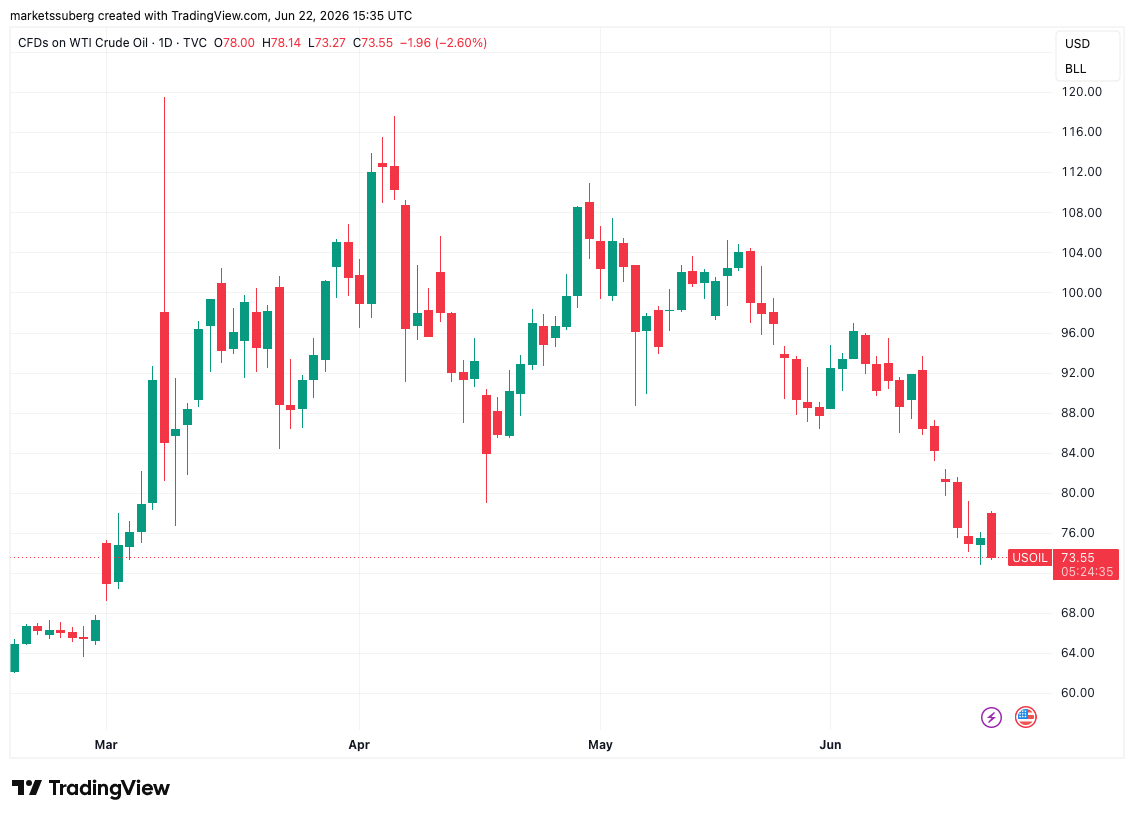
US WTI crude returned to near $73 per barrel, marking some of its lowest levels since early March and the start of the war.
CFDs on WTI crude oil one-day chart. Source: Cointelegraph/TradingView
For Bitcoin traders, it was all about nearby pockets of liquidity around the spot price on the day.
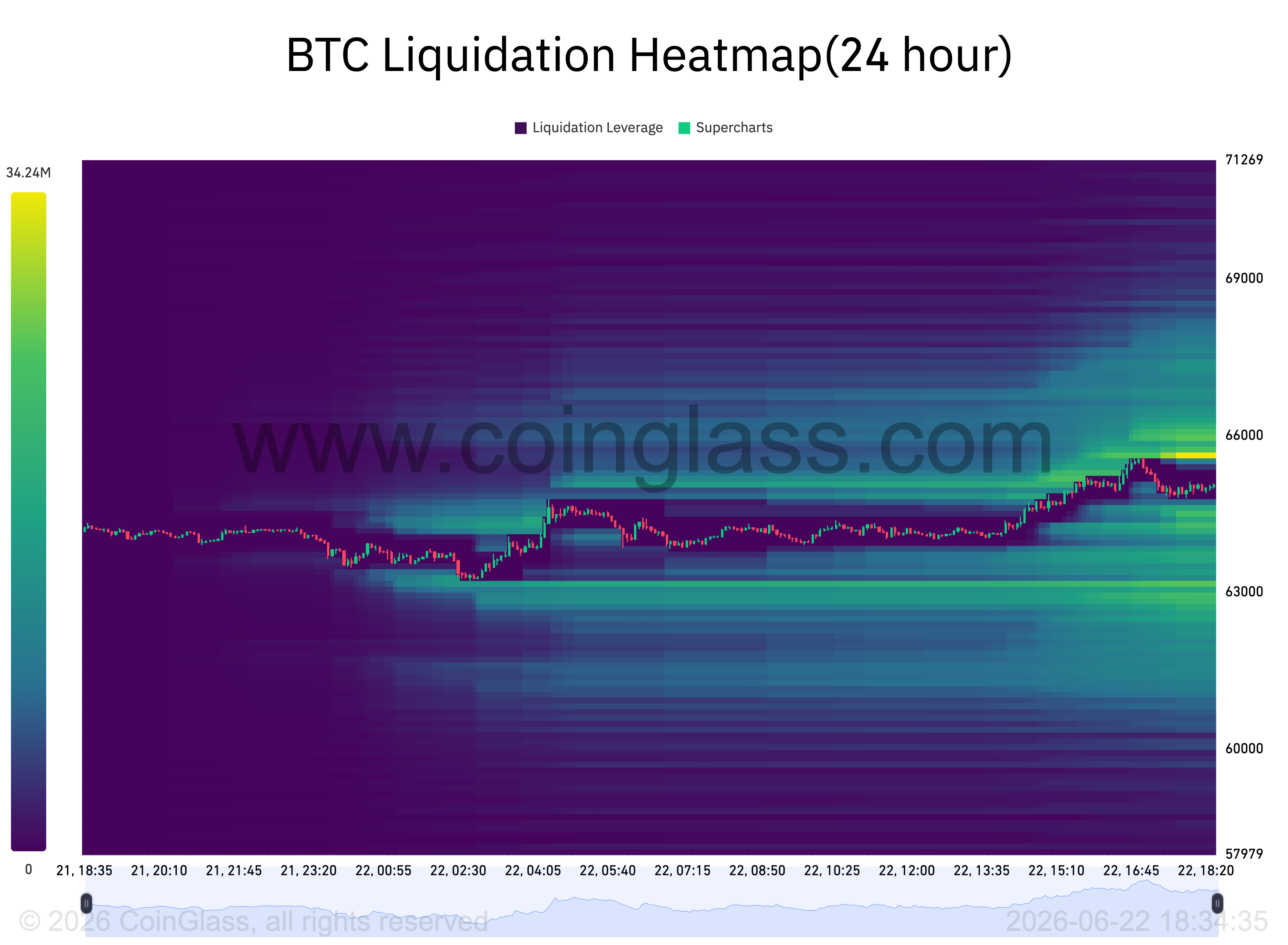
“Took out that thick liquidation cluster above $65K. Right after the US Market open. Going to be important where this moves in the next few hours,” Daan Crypto Trades commented alongside data from CoinGlass.
BTC liquidation heatmap. Source: CoinGlass
“If it rejects here, it will likely try to clean up some liquidity lower. So this is $65K area is a good level to gauge for low timeframe strength/weakness I’d say.”
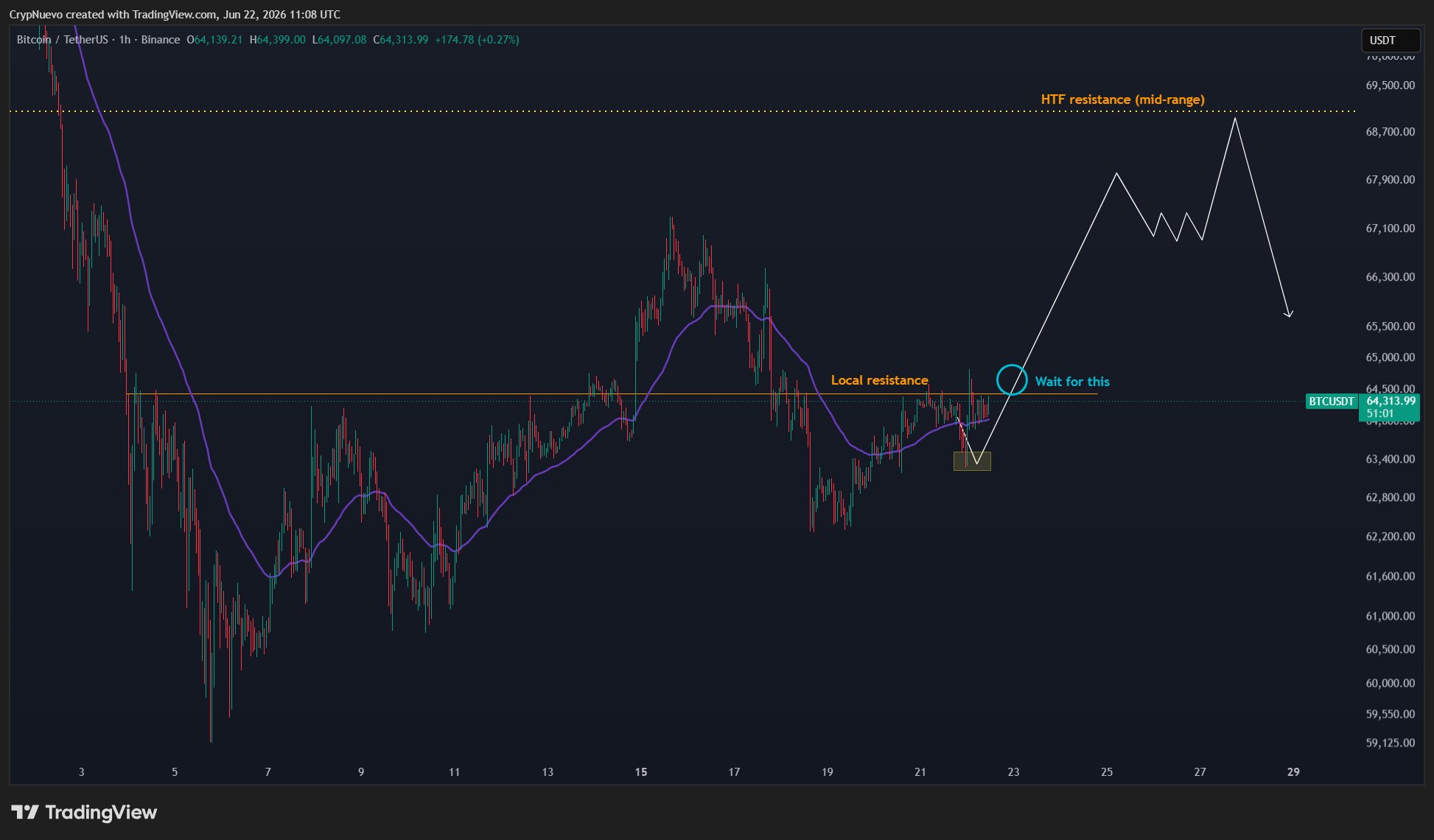
Trader CrypNuevo eyed a potential trip toward $70,000 should bulls manage to sustain the low-time frame breakout.
BTC/USDT one-hour chart. Source: CrypNuevo/X
BTC sees “insane” multibillion-dollar liquidations
Trading and liquidity analysis account CryptoReviewing, meanwhile, described recent liquidations as “completely insane.”
Related: US dollar strength hits highest since May 2025: Five things to know in Bitcoin this week
Bitcoin, it noted, had liquidated $2.5 billion in just seven days.
“Now, $65,000 – $67,000 has sizable liquidity above that could be swept next – potentially leading to higher levels,” an X post read.
“However, $61,000 – $63,000 has significantly larger liquidation clusters stacked up, making this the ‘higher probability’ zone to visit next.”
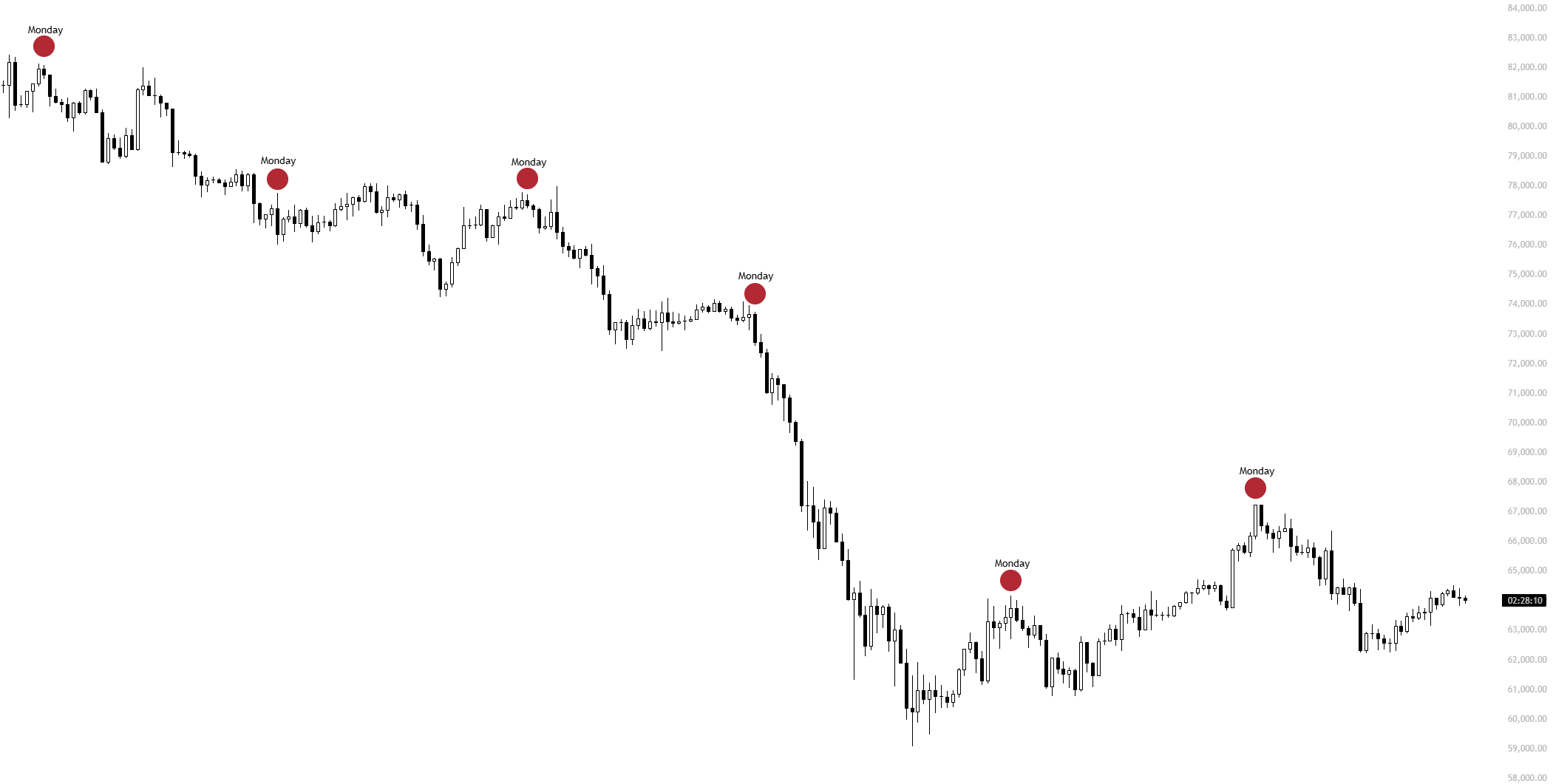
A cautionary note came from trader Killa, who noted that Mondays had tended to mark the week’s swing high for Bitcoin in recent months.
“Over the past six weeks, 6 out of 6 Mondays have marked a local pivot high before price moved lower. Worth keeping an eye on if we start seeing strength and a push higher heading into Monday,” they told X followers.
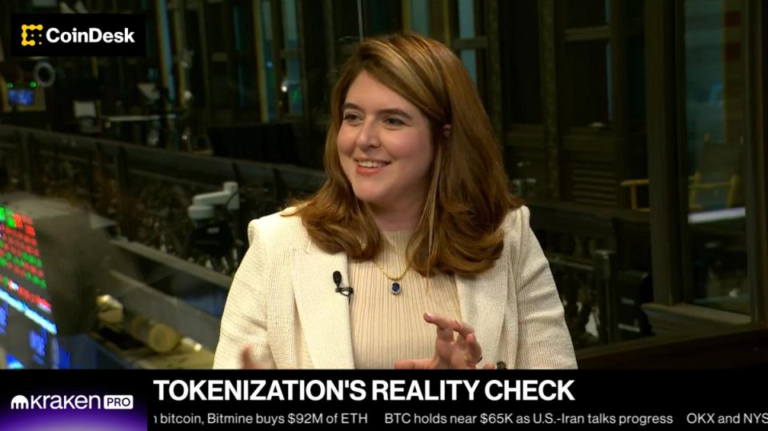
What she’s saying: Former 21Shares co-founder Ophelia Snyder argues that crypto and traditional finance are talking past each other when it comes to tokenization.
Tokenization solves real problems around settlement rails and moving assets, Snyder said.
The larger challenge is integrating blockchain-based assets with the systems banks, brokerages and asset managers already use.
Existing discussions often overlook the operational processes that occur after a trade is executed and before assets are fully settled.
Snyder joined CoinDesk’s Jennifer Sanasie on Public Keys.
The gap: Snyder said blockchain firms have largely addressed transaction throughput but not the broader operational requirements of financial institutions.
Questions remain about how tokenized assets fit into books and records systems, compliance workflows and regulatory reporting.
Financial institutions also must rethink risk management frameworks if tokenized assets can trade around the clock.
Many firms rely on third-party software providers that have not yet adapted their systems for blockchain-native transactions.
Why it matters: Snyder believes the industry’s biggest challenge is scale, not functionality.
A tokenization project can work at a limited scale and still struggle to support the volume of U.S. capital markets.
“A billion dollars is nothing when it comes to traditional financial flows,” Snyder said.
Moving large amounts of digital bearer assets on behalf of clients requires significantly more oversight and controls than existing book-entry systems.