

Before we rush to tokenize U.S. equities, we need compliance systems that understand context, not just checkboxes. Investors like Michael Burry see the danger, so should the rest of us, urges Chamarajnagar.
BTC might need to fall below $53,500 before bottom is in
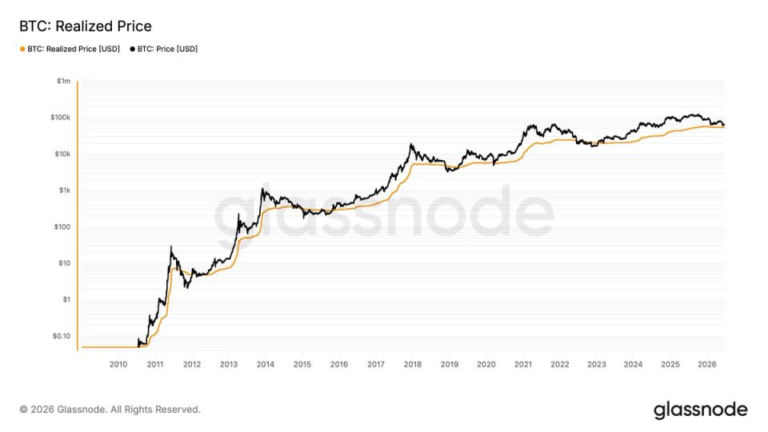
As bitcoin trades near its 200-week moving average, a long-term support indicator currently sitting around $62,400, investors are closely watching whether the level can hold. If the 200WMA breaks, attention is likely to shift to bitcoin’s realized price, currently around $53,457, which has historically acted as the final line of support during major bear markets.
The realized price represents the average on-chain acquisition cost of all bitcoin in circulation and has historically served as a key support level during the depths of bear markets.
In every major bear market cycle, including 2011, 2015, 2018 to 2019, the March 2020 crash, and 2022, bitcoin eventually traded just under its realized price before establishing a cycle bottom. So far, bitcoin has not fallen beneath this level in the current cycle.
From a psychological and sentiment perspective, capitulation tends to occur when investors see the market price fall below their cost basis. Once an asset trades below what investors paid for it, realized losses spread, often leading to panic selling and extreme bearish sentiment. With the realized price near $54,000, it is reasonable to expect increased investor stress if bitcoin falls below that level.
EU Committee Advances Digital Euro CBDC Bill After Vote

The creation of an EU-issued digital euro moved a step closer Tuesday after a key European Parliament committee vote.
The EP’s Economic and Monetary Affairs Committee (ECON) approved its position on the digital euro package with a 43–14 vote, according to an official announcement on Tuesday.
Fernando Navarrete Rojas, a member of the European Parliament (MEP), said the package “protects citizens’ freedom to choose how they pay,” adding that the digital euro would “complement cash, never replace it.”
The vote marks a key step in shaping the rules for the EU’s potential central bank digital currency (CBDC), as the European Central Bank (ECB) targets a 2029 digital euro launch.
Privacy and offline payments at core
Under the approved draft, the digital euro would be issued by the ECB and function both online and offline.
Online payments would use an account-based system, while offline payments would operate through local device storage, similar to cash in terms of user control.
“The offline functionality would be equivalent to using physical cash, as losing the device would mean losing the offline money with no refund possible,” the announcement read.
Source: ECB
The proposal includes privacy-by-design features, including technologies such as zero-knowledge proofs (ZKPs) to verify transactions without exposing personal data. “The ECB would not have access to personal identification data,” the announcement said.
Digital euro won’t pay interest
The draft also introduces holding limits to protect financial stability, with caps on how much digital euro individuals can hold. These limits would be set by the European Commission based on ECB recommendations and reviewed regularly.
The currency would not pay interest, and businesses would only be allowed to hold digital euros temporarily to accumulate incoming payments for up to 24 hours. Businesses would generally be required to accept the digital euro, with some exceptions for very small firms and self-employed operators who do not already accept digital payments.
Related: ECB signs standards deals to cut digital euro integration costs
Basic services such as account access and payments would be free, while additional services could carry capped fees for providers. Offline transactions would remain free under the proposal.
Wider rollout and institutional roles
The legislation also outlines a broader distribution model involving banks, payment providers and regulated crypto firms. Post offices and e-money providers could also distribute the digital euro across the eurozone.
Before launch, the ECB would need to finalize technical rules, run pilot tests and coordinate with payment providers. A rollout period of at least two years would follow approval of the final law.
Related: ECB official says stablecoins risk importing old market flaws
The latest approval marks clearing a key hurdle to rollout of digital euro after the ECB laid groundwork for a CBDC in 2020.
The project has faced repeatedly delays due to unfinalized legislation, with ECB Executive Board member Piero Cipollone projecting as recently as September that the digital euro would likely not launch until 2029.
EU consortium moves ahead with regulated stablecoin
Last month, Qivalis, a European banking consortium developing a regulated euro stablecoin, expanded to 37 member institutions after adding 25 new banks across 15 countries.
The new members include ABN AMRO, Rabobank, Nordea and Intesa Sanpaolo. The Amsterdam-based consortium is targeting a second-half 2026 launch, according to a statement shared with Cointelegraph.
“We are not merely building payment rails; we are ensuring that European principles around data protection, financial stability and regulatory rigour are embedded into the next generation of digital money,” said Howard Davies, chairman of Qivalis’ supervisory board.
The move comes as European institutions race to establish alternatives to US dollar-dominated stablecoins, which currently account for 98% of the market, according to CoinGecko.
“Europe does not have to choose between the digital euro and successful private payment solutions. We need both to work together,” MEP Rojas said in an email response to Cointelegraph’s query. “The agreement recognizes the right dual approach: existing standards and infrastructure should be reused wherever possible and, where new standards are necessary, they should be open and accessible to banks, payment providers and innovative solutions.”
Magazine: Clarity Act risks repeat of Europe’s mistakes, crypto lawyer warns
Bitcoin volatility looks cheap as $10 billion options settlement nears: Crypto Daily

“Call spreads remain attractive for anyone wanting recovery exposure into the post-quarterly reset. And now look even better on a relative-vol basis, since call spread longs are buying the cheaper wing of a skew that is leaning the other way,” he said.
There are a number of factors that might drive volatility higher in the near term. Friday’s options expiry, for example, which Péquignot described as “traditionally one of the most significant liquidity events on the annual calendar.”
Moreover, ahead of the expiry, options traders who bought puts, or downside bets, in recent months are sitting in profit. That is, they are in the money, while those who bought calls are set to see their bets expire worthless.
“With spot at 64k, the June 26 book is net long puts in the money and long calls out of the money – the embedded loss is sitting with the call buyers who chased the 80k+ strikes,” Péquignot noted.
The sharp decline in Alphabet (GOOG) and SpaceX (SPCX) stocks, and declines in Asian equity indexes is another factor that could stoke volatility in bitcoin, which often takes its cue from technology stocks.
Not to forget, the Fed’s preferred inflation measure, the core PCE, is scheduled for release Thursday and is expected to show price pressures at their strongest since May 2024. Such a reading may breed volatility across assets, including Treasury notes and cryptocurrencies. Stay alert!
THORChain Resumes Trading More Than a Month After $10M Exploit

THORChain has resumed activity after over a month of security verifications and upgrades, following a $10.7 million exploit that prompted a trading halt on May 15.
In a Tuesday X post, THORChain said it restored its network, including trading, signing, swaps and liquidity provider actions.
On Sunday, the protocol said it had confirmed the safety of most of its vaults through the KeyVerify protocol and retired the remaining legacy vaults as part of a migration to a new set of vaults. THORChain called the upgrade the “most significant milestone” in its recovery process. It also said it completed verification of every node’s keyshare on Friday.
THORChain is one of the crypto industry’s largest cross-chain trading protocols, enabling swaps between networks such as Bitcoin and Ethereum. The protocol has drawn scrutiny from blockchain investigators because hackers have used it to move stolen funds between blockchains.
Source: THORChain
THORChain ships security upgrades and migrates old vaults
THORChain attributed the exploit to a vulnerability in its GG20 threshold signature scheme, which is used to secure protocol vaults by distributing key control across multiple node operators. According to the protocol, the flaw allowed a malicious node operator to reconstruct a full private key through what it described as “progressive key material leakage,” enabling the theft of $10.7 million.
Related: Kelp DAO exploiter launders nearly all 75,700 in stolen ETH through THORchain
The protocol implemented an emergency patch on May 20 to protect the remaining vaults before releasing an upgrade on June 9, which included a fix for the exploited vulnerability. A follow-up upgrade was rolled out on June 11 with additional stability improvements and fixes to the KeyVerify protocol.
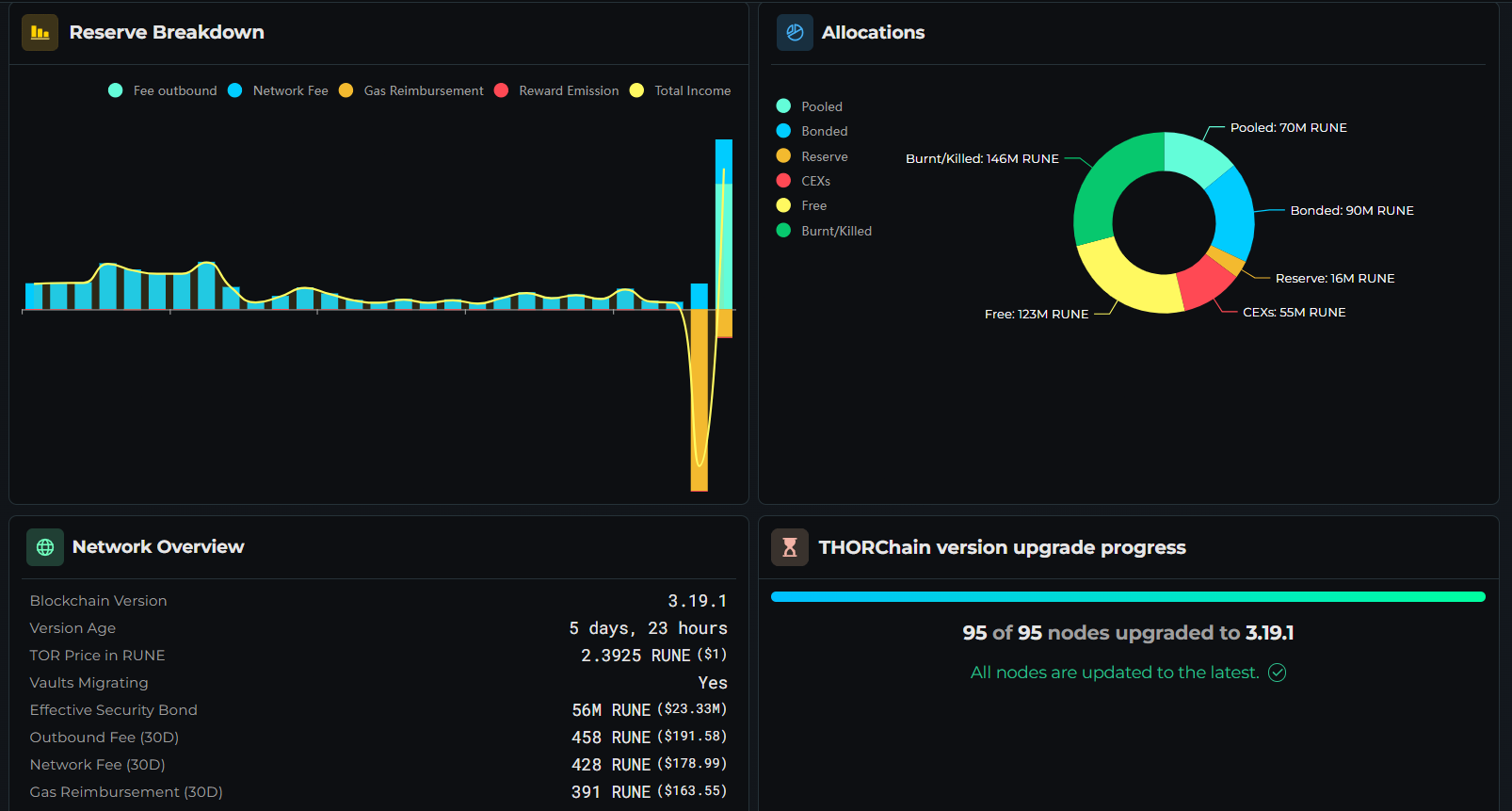
THORChain network overview, node upgrades. Source: THORChain Explorer
With the recovery process largely complete, THORChain has also outlined plans for new network integrations.
THORChain said it will launch native swaps and vaults for privacy-preserving cryptocurrency Zcash (ZEC) within the next two weeks, followed by Monero (XMR).
It also plans to launch support for the Bittensor (TAO) token in about six weeks after the network’s restart.
Magazine: 53 DeFi projects infiltrated, 50M NEO tokens could be ‘given back’: Asia Express
Cointelegraph is committed to independent, transparent journalism. This news article is produced in accordance with Cointelegraph’s Editorial Policy and aims to provide accurate and timely information. Readers are encouraged to verify information independently.
AI miner Hut 8 to pay $2.35 million to settle investor claims tied to 2023 USBTC merger

Former bitcoin miner Hut 8 (HUT) agreed to pay $2.35 million to settle a securities class action alleging it misled investors in connection with its 2023 merger with U.S. Bitcoin Corp. (USBTC).
The lawsuit, filed in the U.S. District Court for the Southern District of New York, focused on Hut 8’s all-stock merger with USBTC, which closed in November 2023.
Investors alleged the company, which now focuses on AI data centers and high-performance computing, overstated the transaction’s benefits while failing to disclose persistent energy curtailment and internet connectivity issues at King Mountain, a Texas bitcoin mining joint venture in which USBTC held a 50% interest.
The litigation gained momentum after short seller J Capital Research published a critical report in January 2024, prompting a slide of more than 23% in Hut 8’s share price.
According to a court filing, the $2.35 million recovery represents roughly 19.6% of the estimated maximum recoverable damages, exceeding the 12.9% median and 14.6% average recovery rates for Securities Act-only settlements in 2025.
As part of the agreement, Hut 8 denies any wrongdoing or liability. Hut 8 shares have gained more than 640% over the past year.
Bitcoin price has limited downside, likely near bottom, contrarian indicator suggests
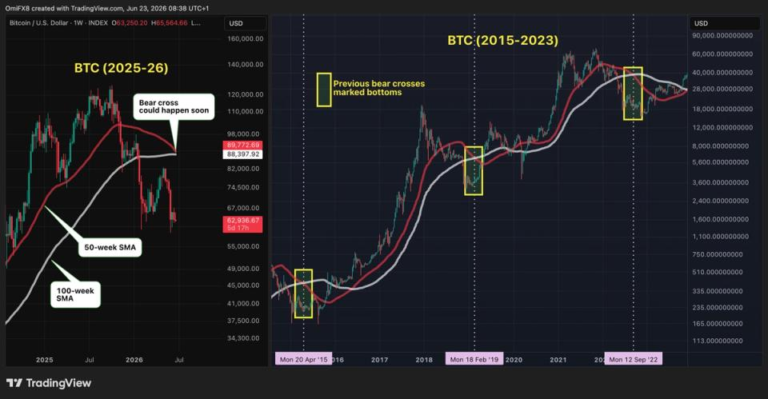
The bitcoin price’s long-term moving averages are set to flash a bearish signal soon. That’s good news for the bulls.
Ripple Secures Preliminary MiCA Approval Ahead of EU Deadline

Luxembourg’s financial regulator granted Ripple preliminary approval for a crypto asset service provider (CASP) license under the European Union’s Markets in Crypto-Assets Regulation (MiCA), the company said Tuesday.
Ripple said in a statement that the approval, once finalized, would allow it to offer regulated crypto services to banks, fintechs and other businesses across all 30 countries in the European Economic Area (EEA) through a single regulatory passport.
The move builds on Ripple’s existing Electronic Money Institution (EMI) license in Luxembourg, which allows it to provide regulated cross-border payments and electronic money services across the EEA. The update comes just days before the July 1 transitional deadline, when EU countries begin fully applying MiCA rules.
Cointelegraph reached out to Luxembourg’s Commission de Surveillance du Secteur Financier but did not receive an immediate response.
Full crypto asset and stablecoin payments infrastructure compliant with MiCA
Ripple said its pending CASP license, combined with the EMI license issued in February 2026, would enable a “full crypto asset and stablecoins payments infrastructure” through a single integration for the first time.
The company added that the approval also positions Ripple to expand into broader crypto asset activities in Europe, which is “already a leading region” for its products.
Source: Cassie Craddock
“MiCA has helped to unlock a new wave of institutional digital assets adoption, and we are seeing that demand accelerate across the region,” said Cassie Craddock, managing director of the UK and Europe at Ripple.
Europe becomes the regulatory battleground
Ripple’s CASP approval comes as Europe emerges as a key regulatory test case for the crypto industry as the MiCA framework takes effect.
Related: EUR trading accounts for 1% of Binance spot volume, CryptoQuant says
Crypto companies are racing to secure MiCA authorization ahead of the July 1 deadline, but major exchanges, including Binance, are still awaiting approval under the new regime.
Media reports have indicated that Greek regulators may be preparing to deny Binance’s application.
Ripple currently holds more than 75 regulatory licenses globally, including a UK license from the Financial Conduct Authority received in January 2026.
Magazine: SBF will never get a pardon, Trump peace deal boosts Bitcoin: Hodlers Digest June 14-21
MoneyGram Becomes Solana Validator, Joins Institutional Developer Platform

MoneyGram has launched an active validator node on Solana and joined its institutional developer platform, making Solana the payments giant’s third blockchain validator commitment alongside Tempo and Midnight. The move deepens a blockchain infrastructure push that began with Stellar remittances in 2021.
MoneyGram has launched an active validator node on the Solana network and joined Solana’s institutional developer platform, marking the payments company’s third blockchain infrastructure commitment and its first direct participation in Solana consensus.
The company announced the move via press release on June 22, describing its validator as staking SOL, processing transaction blocks, and contributing to network security. MoneyGram simultaneously joined the Solana Developer Platform, an AI-ready, API-driven institutional build environment designed for compliant financial product development whose members include Mastercard. Luke Tuttle, MoneyGram’s chief product and technology officer, framed the move in operational terms: “We help run the rails we move money on.” MoneyGram serves more than 60 million active customers through nearly 500,000 retail locations, with over 70% of transactions now digital.
Solana Third After Tempo, Midnight
Solana is now MoneyGram’s third active blockchain validator position. The company serves as anchor remittance validator for Tempo and holds a validator stake on Midnight, Cardano’s privacy-focused sidechain. The trio reflects a pattern of MoneyGram placing infrastructure bets alongside payment-focused partnerships rather than simply integrating third-party rails.
Sheraz Shere, general manager of payments and commerce at the Solana Foundation, noted that MoneyGram’s “global scale and experience serving customers across markets” matches the kind of counterparty the foundation wants engaged as more payments activity shifts on-chain.
MGUSD, Stellar Context
The Solana move follows MoneyGram’s June 2 launch of MGUSD, a USD-backed stablecoin issued on Stellar via Stripe-owned Bridge. That token, described as “GENIUS Act-ready,” makes MoneyGram an issuer of a U.S. dollar token on a public chain. MoneyGram has operated on Stellar since a 2021 partnership with the Stellar Development Foundation that has since facilitated more than $4.2 billion in USDC remittance volume.
Chairman and CEO Anthony Soohoo described the company’s direction: “We believe the future of global money movement will be built on open, interoperable stablecoin rails that anyone, anywhere can access.”
SOL was trading at $71.71 at the time of the announcement.
US Senate Bans Federal Reserve CBDC in Housing Bill

The US Senate has passed housing legislation that includes a ban on the Federal Reserve creating or working on a central bank digital currency (CBDC) until 2030, which is expected to be quickly taken up and passed by the House.
The Senate on Monday voted 85-5 to pass the 21st Century Road to Housing Act, which aims to increase the housing supply after a bipartisan group of House and Senate leaders reached a deal last week to move forward with the legislation.
The bill has included a CBDC ban since the Senate first passed a version of the bill in March, which outlines that the Fed may not, directly or indirectly, “issue or create a central bank digital currency or any digital asset that is substantially similar to a central bank digital currency.”
Crypto advocates have long criticized CBDCs, which they see as an attempt by governments to bring digital currency under central bank control, and the bill is set to be a win for Republicans who have for years attempted to ban CBDCs.
The bill will now be sent to the House for a vote, where it is expected to pass quickly with the deal struck by House leaders last week, before it’s then sent to the president to sign it into law.
The CBDC clause in the bill became wrapped into the housing package as a political sweetener to secure support from House Republicans and the administration for faster passage.
Related: South Carolina governor signs bill protecting Bitcoin miners, banning CBDC
The ban makes a carve-out for stablecoins, or any “dollar-denominated currency that is open, permissionless, and private,” and that even after the CBDC ban lifts in 2030, the Fed can’t act on a CBDC without explicit congressional authorization.
A section of the housing bill banning the Federal Reserve from creating a CBDC. Source: Senate Banking Committee
Meanwhile, other nations are charging ahead with their plans for a CBDC.
Reuters reported on June 16 that China signed up 26 financial institutions to its digital yuan (e-CNY) cross-border payment platform.
Three countries have officially launched a CBDC, while 41 are in the pilot phase, 33 are in development, and 40 are still researching, according to the think tank Atlantic Council.
Magazine: Bitcoin decouples from tech stocks, Ether eyes ‘selling wave’: Market Moves