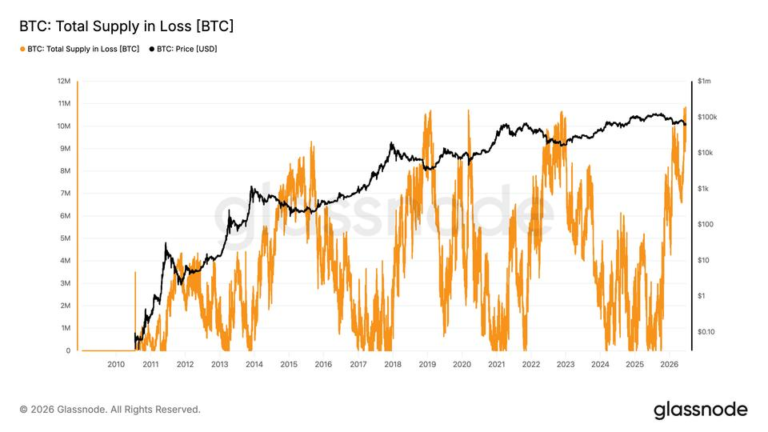
As bitcoin BTC$61,646.55 fell below $59,100 on Wednesday, the number held at a loss rose to a record 10.83 million BTC, data from Glassnode shows.
The largest cryptocurrency has tested the $60,000 level repeatedly since February, briefly falling below it several times. Four months ago, the supply in loss peaked at 9.8 million BTC. It climbed to 10.78 million in early June.
Looking at previous bear market bottoms, around 10.5 million BTC in loss is broadly consistent with the levels seen near cycle lows in 2019, 2020 and 2022.
Breaking this down further, 5.58 million BTC are held at a loss by long-term holders (LTHs), defined by Glassnode as investors who have held their coins for at least 155 days. This is the second-highest level on record, behind only March 2020, when more than 5.6 million of the cohort’s bitcoin were held at a loss.
Even so, long-term holders now control approximately 14.8 million BTC, another all-time high. With roughly 20 million BTC in circulation, these investors hold close to 75% of the circulating supply, 37% of which are in the red,
Historically, long-term holders tend to accumulate and continue holding throughout bear markets, increasing their share of the supply. During periods of peak bull-market euphoria, they typically begin selling into market strength.
Besides, both core and headline readings may be seen as stale, or backward looking, considering the recent slide in oil prices. WTI crude futures have dropped to $70, significantly below the $100-plus level seen during the Iran war in March and April. Headline inflation is expected to hit 4.1%, the highest since early 2023, driven largely by energy prices.
“The main question is less whether both headline and core go up—they are widely expected to—but rather how “stale” these numbers already are,” economist Mohamed A. El Erian, the former CEO of Pimco, noted on X.
“These numbers come before the recent sharp fall in oil prices, which will result in lower headline inflation and ease some of the pressures on core. The question being debated is by how much, including whether May will prove to be the peak inflation month.”
Beyond inflation numbers, watch out for volatility in Strategy’s common shares, MSTR, and preferred stock, STRC, plus AI names on Wall Street. MSTR is flashing a well-recognized major bearish pattern (Check the Daily Signal). Stay alert!
Read more: For analysis of today’s activity in altcoins and derivatives, see Crypto Markets Today . For a comprehensive list of events this week, see CoinDesk’s “Crypto Week Ahead.”
The crypto market showed signs of resilience on Thursday, with bitcoin BTC$61,240.95 adding 1.1% since midnight UTC after dipping below $60,000 on Wednesday to its lowest since October 2024.
The largest cryptocurrency remains at a critical level in terms of broader market structure. A potential break lower in price could trigger a slide to around $52,000. For now, it appears to have weathered the storm.
Ether (ETH) rose 1.5% on Thursday and was recently trading at $1,644 after briefly tumbling to $1,550 at around 17:00 UTC on Wednesday.
Thursday’s gains can possibly be linked to a recovery in U.S. equities. S&P 500 and Nasdaq 100 futures are 0.7% and 2.2% higher, respectively.
Derivatives positioning
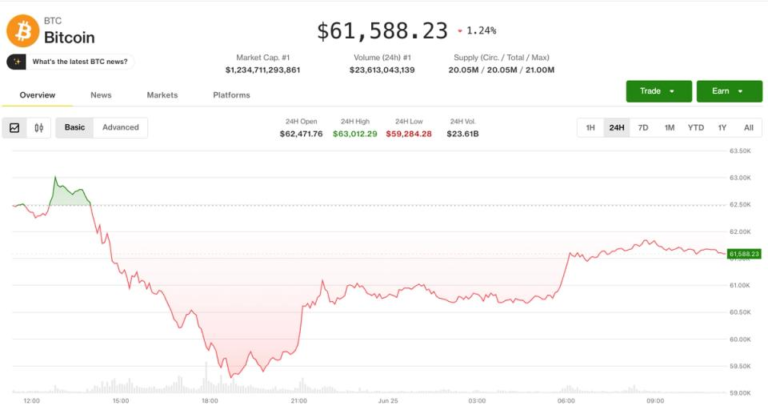
BTC revisited lows near $59,000 on Wednesday and has since bounced back to over $61,000.
The two-way volatility has proven costly for leveraged futures bets across the market. Centralized exchanges liquidated nearly $1 billion in crypto futures positions within 24 hours, with longs accounting for the largest portion.
Still, bitcoin’s futures open interest (OI) has jumped to 763K BTC, the most since June 4, ending a stretch of steadiness around 730K BTC. In other words, the price drop has triggered an inflow of money, but not necessarily on the bullish side. In fact, annualized funding rates have flipped negative, a sign of traders paying a premium for downside exposure.
The ether futures market hasn’t seen any notable increase in OI, and funding rates remain slightly positive.
SOL’s OI remains near Wednesday’s record high, alongside largely neutral funding rates that point to balanced positioning in the market. The same is true for XRP, whose OI is hovering at its highest levels since October.
The OI-normalized, 24-hour cumulative volume delta for most coins, including BTC, is negative for a third straight day. That’s a sign bears are leading the price action by shorting at market prices rather than using passive limit orders.
BVIV, which measures the 30-day implied volatility in BTC, has pulled back to 46% a high of 51%. This decline in the so-called “fear gauge,” representing demand for options, supports the cryptocurrency’s overnight rebound. The same is true for ether’s implied volatility index, EVIV.
Still, ether is seen as more volatile than BTC, with implied volatilities richer by 10 points or more compared with bitcoin’s across all timeframes.
Option skews for the two largest cryptocurrencies indicate downside concerns that are both persistent and strengthening . For instance, BTC’s one-week skew shows a nearly 25-point volatility premium for puts. This also means upside bets are currently cheap and could draw strong demand should Thursday’s U.S. Core PCE for May reveal a slowdown in inflation.
Token talk
The altcoin market posted an exaggerated bounce on Thursday after losses on Wednesday, a reflection of a low-liquidity environment.
Jupiter (JUP) fell by more than 12% in six hours on Wednesday before bouncing by more than 18%, liquidating futures traders in both directions.
Coinglass data shows that $1 billion in futures positions were liquidated in the past 24 hours, with $585 million of that being attributed to altcoin trading pairs.
Decentralized finance (DeFi) tokens AAVE and ETHFI also performed well on Thursday, rising by 2.5% and 4.7%, respectively, since midnight.
AI tokens, meanwhile, struggled to recover. RENDER and NEAR posted losses of between 0.8% and 1.9% despite a bounce across other crypto sectors.
Layer-1 network token solana (SOL) tumbled to $64 on Wednesday to complete a 75% slide since September. A break below June 6’s low of $60 would mark its lowest point since December 2023.
Blockchain intelligence firm TRM Labs said CoinEx served as a gateway for the crypto sector in Iran, having traced more than $3.84 billion in flows between the exchange and sanctioned Iranian entities in the last seven years.
TRM Labs said CoinEx became the single biggest trading partner of Iran’s largest crypto exchange Nobitex, which accounted for around $2.7 billion of the flows, according to a report published Wednesday.
CoinEx had direct transaction exposure with more than 60 Iranian crypto platforms, according to TRM Labs’ analysis, which argued that this patterns suggested a coordinated relationship rather than organic market activity.
TRM Labs identified CoinEx exposure to several terrorist-linked entities, such as $6 million in transactions involving wallets associated with the Islamic Revolutionary Guard Corps and $374,000 of exposure associated with Palestinian Islamic Jihad.
The U.S. Treasury sanctioned an array of Iranian crypto exchanges as part of its campaign against the country’s government at the start of this month, including Nobitex, Wallex, Bitpin and Ramzinex, all of which are cited in TRM Labs’ report.
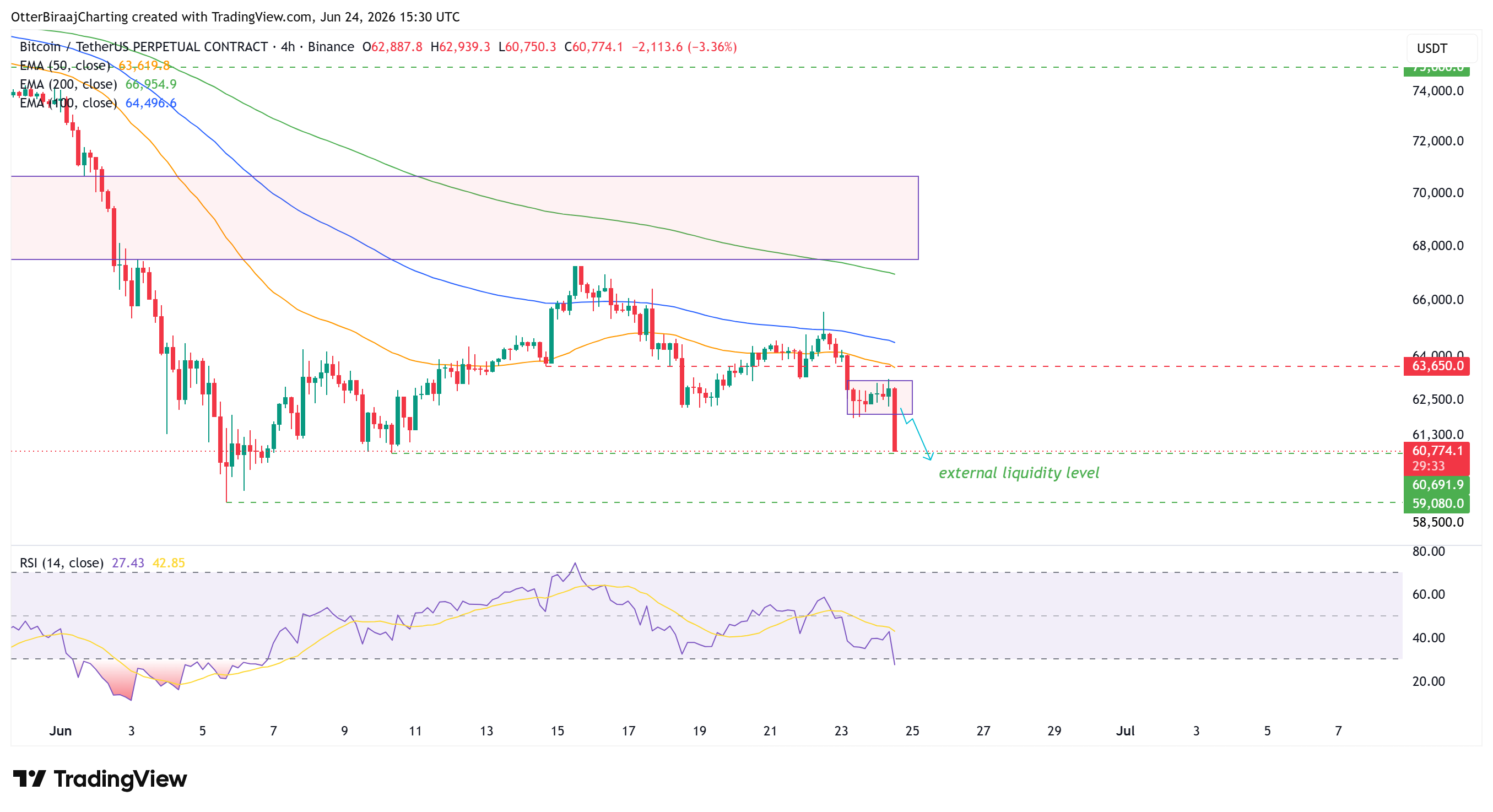
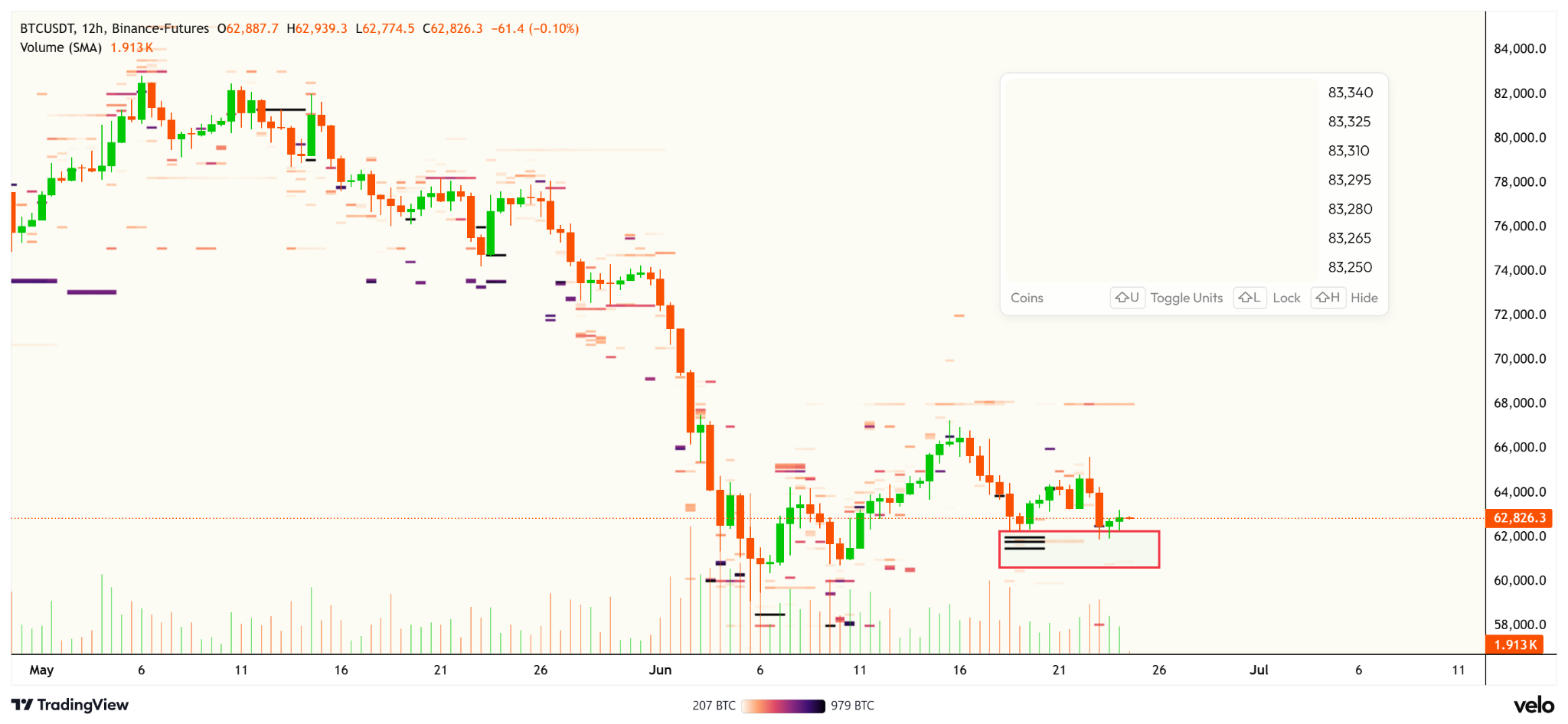
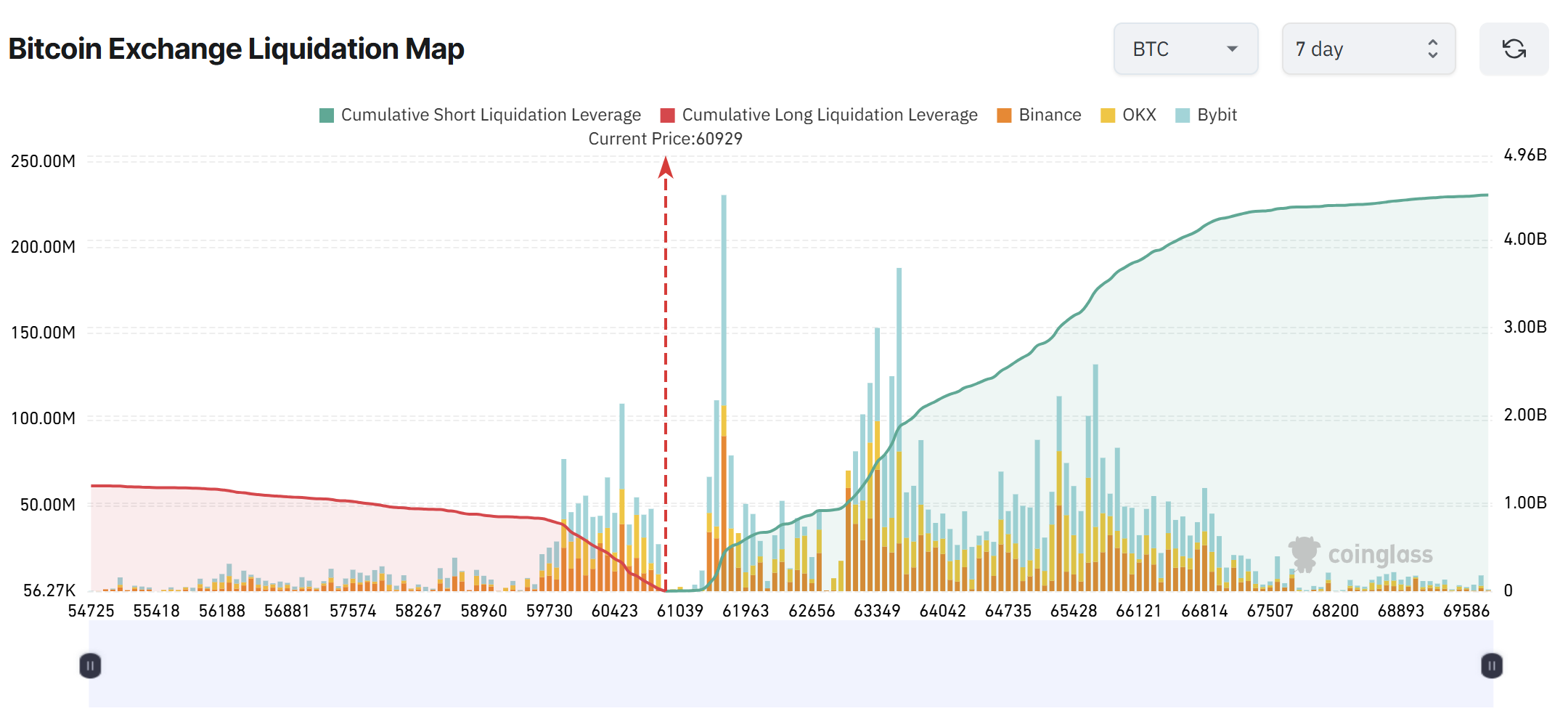
Bitcoin (BTC) has fallen 3% over the past 24 hours, trading into a dense buy-side liquidity zone after slipping below $61,000. More than $525 million in buy bids initially stacked between $60,500 and $61,500 created a key area of demand as liquidation risk builds on both sides of the market.
BTC’s orderbook data shows concentrated liquidity pockets below $60,500 and near $65,000, placing liquidity flows at the center of Bitcoin’s short-term price action.
Bitcoin momentum weakens below $63,000
Bitcoin closed at $62,700 on Tuesday, its lowest daily candle close since June 10. The move also produced a bearish engulfing candle against Monday’s range, erasing the prior day’s gains and signaling weaker short-term momentum.
The price has since consolidated beneath $63,000 after losing that level as support. The one-hour chart shows a series of lower highs following the rejection near $66,000 earlier this week. The momentum indicator, or relative strength index (RSI), has cooled from recent overbought levels, while Bitcoin continues to trade above the June range low near $60,500.
Crypto trader Lennaert Snyder called for caution and expected BTC to test the lower liquidity before considering long exposure. The trader said,
“Bitcoin started a little bounce, but I’m not convinced and not buying in yet,” Snyder wrote in a recent market update.
The trader identified $61,500 and $60,500 as the primary levels to watch for bullish reactions. On the upside, he pointed to $63,500 and $64,000 as potential areas where liquidity could attract price before another move lower.
Related: Multi-year Bitcoin holder selling falls to 19-month low as halving model flags new market bottom date
$530 million in BTC buy bids sit below $61,000
Data from Velo shows that BTC traders initially added 8,366 BTC to bid liquidity between $61,500 and $60,500. At the time of writing, Bitcoin has traded through a significant portion of that range, triggering roughly $270 million worth of buy orders as the price dipped below $61,000.
The remaining bids remain near the lower end of the liquidity cluster, where traders are attempting to absorb the latest wave of selling pressure.
BTC buy bids analysis. Source: Velo Chart
The move below $61,000 has already flushed a significant portion of the leveraged long positions clustered around $61,500. CoinGlass data shows more than $125 million in long liquidations over the past hour, reducing downside liquidation pressure near the current price.
With much of the nearby long-side leverage cleared out, the liquidation map now shows a growing imbalance toward short positions positioned above spot price.
Now, more than $1.2 billion in short positions sit near $63,500. A stabilization in the remaining bid liquidity around $60,500-$61,000 may shift attention toward those positions, especially as the downside liquidation pools become less concentrated following the latest flush.
Bitcoin liquidation map. Source: CoinGlass
The next major concentration of liquidation risk sits near $65,000, where more than $2.4 billion in short positions are vulnerable. Such setups often trigger fast moves as liquidations fuel additional buying. For now, the largest liquidity concentrations remain near $60,500, where both spot demand and leveraged exposure remain heavily stacked.
Related: BTC price four-year trend calls for $76K as analysis says Bitcoin ‘not broken’
Kanga, a crypto exchange founded in Poland, said it has obtained a Markets in Crypto-Assets Regulation (MiCA) license in Latvia, allowing it to provide services across the European Union in accordance with the cross-border notification procedure under the framework.
SIA AlphaRoute, operating under the Kanga Exchange EU brand, received a Class 3 MiCA license from the Bank of Latvia after its Supervisory Committee approved the authorization, according to a Wednesday statement shared with Cointelegraph.
The license was granted on June 18 and authorizes the company to provide services, including crypto custody, trading and transfers, across the EU, said the exchange.
Kanga’s approval comes as Poland remains without MiCA implementation legislation ahead of the EU’s July 1 transitional deadline, with lawmakers still trying to break a deadlock following three presidential vetoes.
Source: Kanga
Kanga’s path to EU-wide operations
Kanga began the pre-licensing process in Latvia in November 2025 after reviewing several jurisdictions, according to SIA AlphaRoute CEO Dominik Tomczyk.
“From the very beginning, we knew that we had to use the transitional period provided for under the MiCA regulation to prepare the organisation to operate within the new regulatory framework,” Tomczyk said.
The company said it will provide customers with additional details about operational changes and service terms through its official communication channels.
Poland’s MiCA deadlock
President Nawrocki vetoed a government-backed crypto bill for a third time on June 11, saying successive versions failed to address his objections, including provisions he considered overly burdensome for crypto companies.
Members of the Poland 2050 party, part of Prime Minister Donald Tusk’s governing coalition, have since reportedly submitted a new proposal incorporating several changes requested by the president.
According to the bill’s sponsors, the proposal would reduce some fees, remove certain regulatory provisions and make the framework less restrictive for crypto companies. Poland 2050 reportedly called for the legislation to be fast-tracked through parliament.
Poland’s crypto sector also faces heightened scrutiny following a fraud investigation into Zonda, the country’s largest crypto exchange, where prosecutors estimate customer losses exceed 350 million zlotys (about $92.7 million).
Ether falls harder than Bitcoin in a market-wide risk-off move, while Aave bucks the selloff on V4 and Grayscale tailwinds; total DeFi value drops to about $69 billion
Bitcoin slid below $60,000 and Ether fell harder still on Wednesday, as a selloff in AI and semiconductor stocks and rising bets on a Federal Reserve rate hike pushed investors out of risk assets across the board.
Bitcoin dropped about 4% over the prior 24 hours, slipping under the $60,000 level for the first time in roughly two weeks, while Ether fell about 5%, according to data from CoinGecko. The broad crypto market followed equities lower: total value locked in DeFi protocols fell to about $69.3 billion from roughly $73.2 billion a day earlier, a one-day drop of about 5%, DefiLlama data show.
A Macro-Led Selloff
The immediate trigger sat in equity markets. The Nasdaq Composite closed the prior session down about 2.2%, dragged lower by a sharp drop in semiconductor and AI-linked shares, with a closely watched chip index falling roughly 8%.
Compounding the equity weakness, traders sharply raised the odds of a Federal Reserve rate hike this year after the central bank held its target range at 3.50% to 3.75% but dropped its easing bias. Higher rates lift the dollar and raise the opportunity cost of holding non-yielding assets, a headwind for Bitcoin and Ether alike. The U.S. Dollar Index climbed to its highest level in more than a year.
Institutional flows have reinforced the pressure. U.S. spot Bitcoin ETFs have logged their largest 30-day outflow on record, with redemptions running for five straight weeks, according to figures circulated by The Kobeissi Letter. ETF redemptions force authorized participants to sell spot Bitcoin into the market, adding mechanical selling pressure on top of the macro move.
Aave Bucks the Trend
Against a sea of red, Aave was the standout gainer among large-cap tokens, with its AAVE governance token rising about 4% over 24 hours even as the rest of the market fell, CoinGecko data show. Aave, one of the largest decentralized lending protocols with roughly $12 billion in deposits, has drawn a cluster of bullish catalysts this month.
Standard Chartered initiated coverage of Aave on Tuesday with a price target of $3,500 by end-2030, up 50x from roughly $70 today. The same week, Aave published a security audit tied to its V4 upgrade and founder Stani Kulechov outlined a proposal to bring traditional securities-finance markets onchain.
The Laggards
The sell-off hit higher-beta large caps the hardest. Cardano’s ADA token slid about 6% over 24 hours, the worst performer among major tokens, while Dogecoin’s DOGE fell about 6% and Chainlink’s LINK dropped roughly 5%, all underperforming Bitcoin’s 4% decline, per CoinGecko. Solana’s SOL and XRP each fell about 4%, roughly in line with Bitcoin, while BNB slipped about 4%.
Tron’s TRX held up best among majors, falling less than 1%, and Hyperliquid’s HYPE fell about 3%. None of the laggards showed a token-specific catalyst on the day; the moves tracked the broad risk-off flush rather than any protocol-level development.
Liquidations
The decline looks orderly rather than disorderly. Liquidations across the market totaled more than $700 million over 24 hours, with the large majority hitting long positions — a sign that leverage is being flushed rather than fresh capital fleeing in panic. That leverage reset can reduce the risk of a sudden cascade lower.
The next catalysts are macro, not onchain. Traders are watching upcoming U.S. inflation data, which could reset rate-hike expectations, and any stabilization in ETF flows that would signal institutional demand returning.
The bitcoin BTC$61,670.64 market has found a new support level, and Thursday’s U.S. core PCE release may test its mettle.
That level is $59,000, which has emerged as strong support, capping downside moves in recent days.
A support level in trading is a specific price point or range where a downtrend tends to pause or reverse, paving the way for a bounce as concentrated buying interest becomes strong enough to counter selling pressure. However, a single instance does not make a level a strong support. Traders typically look for at least two instances of price holding or bouncing from a specific level before identifying it as new support.
On Wednesday, as the sell-off gathered pace, prices fell to nearly $59,000 before bouncing back to $61,000 overnight. As of this writing, BTC is trading near $60,800, according to CoinDesk data. A similar move occurred earlier this month on June 5, when the sell-off lost steam near $59,000, paving the way for a bounce to $67,000 in the following days.
That explains why $59,000 is now the key support, a new line in the sand that bulls need to defend to avoid a deeper slide.
Indonesia’s financial regulator has introduced certification requirements for influencers who recommend crypto and other digital financial assets, as the country expands oversight of financial promotions on social media.
Under Financial Services Authority Regulation No. 6 of 2026, announced Wednesday, individuals recommending digital assets must obtain competency certifications unless they are already subject to a separate licensing requirement.
Influencers may recommend only digital assets listed on authorized exchanges, while any service provider they recommend must also be licensed. Marketing campaigns must be conducted through regulated financial services businesses, which are responsible for the promotional content, and distributed through their official communication channels.
Indonesia joins a growing number of jurisdictions tightening oversight of financial influencers, also called finfluencers, with Australia and the United Kingdom introducing broader rules for investment promotions and the Philippines adopting crypto-specific marketing restrictions.
Machine translated excerpt of the OJK announcement. Source: OJK
Global regulators tighten oversight of finfluencers
Australia and the UK were among the earlier jurisdictions to clarify how existing financial laws apply to influencers.
In March 2022, the Australian Securities and Investments Commission (ASIC) said influencers may require a financial services license when their content amounts to financial advice or helps arrange transactions. It also warned that licensed financial firms may be liable for misconduct by influencers they engage with.
In 2024, the UK Financial Conduct Authority (FCA) issued guidance saying unauthorized influencers may commit a criminal offense when promoting regulated financial products without approval from an appropriately authorized firm.
Related: Indonesia blocks Polymarket after bets on president’s exit
On April 24, the FCA led an international “week of action” campaign targeting illegal finfluencers. According to the FCA, 17 regulators participated, conducting enforcement activity, consumer awareness campaigns and educational programs for influencers who want to act responsibly.
The FCA said it submitted 120 account-takedown requests covering 1,267 illegal financial advertisements that had reached at least 2.3 million UK social media accounts.
Meanwhile, the Philippines introduced crypto-specific marketing restrictions in 2025 that cover endorsements, sponsored material, social media posts, podcasts, livestreams and certain paid educational content.
Under the rules, crypto asset service providers are required to disclose their authorized third-party marketers to the Philippine Securities and Exchange Commission.
Magazine: Japanese pension fund tips 1% in crypto, G7 urges action on NK hackers: Asia Express
The launch delivers on a memorandum of understanding the two firms signed in August 2025 and builds on a relationship dating to 2016, when Ripple and SBI began working together on cross-border payments and blockchain infrastructure in Asia.
RLUSD will “serve as a bridge for payments, tokenization and collateral management,” connecting Japanese businesses to global dollar liquidity, said Jack McDonald, Ripple’s senior vice president of stablecoins, in a statement.
RLUSD is Ripple’s bet on the regulated end of the stablecoin market, and it is separate from XRP, the closely-linked token the company is best known for. Ripple has long pitched RLUSD as an enterprise token for settlements and tokenization, the practice of issuing real-world assets onchain.
The Japan launch extends that effort into Asia at a moment when stablecoins are drawing formal rules in the U.S., Europe and across the region, turning the dollar-token market into a race for official approval as much as for users.
Whether RLUSD can close the gap on USDT and USDC remains to be seen, however. Approvals like Japan’s give it the credentials to compete for institutional use, but it still has to convert that standing into the volume and liquidity its much larger rivals already command.