Home Blog Page 149

Crypto Industry Heavyweights Urge Senate To Pass Clarity Act With Developer Protections Intact

0

More than 60 of the most prominent CEOs and founders in the cryptocurrency industry sent a letter to Senate Majority Leader John Thune and Minority Leader Chuck Schumer on June 9, calling on the full Senate to pass the Digital Asset Market Clarity Act with its blockchain developer protections intact — a provision the signatories described as a non-negotiable condition of their support.

The letter, signed by executives from Coinbase, a16z crypto, Uniswap, Solana Labs, Kraken, Paradigm, Galaxy, Ledger, and dozens of other leading firms, focused on Section 604 of the Clarity Act — the Blockchain Regulatory Certainty Act, or BRCA — which shields non-controlling software developers from Bank Secrecy Act obligations and federal money transmission prosecution. 

The signatories argued that without the BRCA, the broader market structure bill would fail to deliver the legal certainty needed to sustain blockchain innovation in the United States.

“From core Bitcoin development to novel DeFi smart contract designs, developers need clear legal certainty to openly build, maintain, and contribute to community-driven software projects,” the letter reads.

Where the Clarity Act stands

The Clarity Act, formally known as H.R. 3633 — the Digital Asset Market Clarity Act — has been years in the making. The bill passed the House of Representatives in July 2025 on a bipartisan 294-134 vote, a commanding margin that reflected broad legislative appetite for a federal framework governing digital asset classification. 

The bill then stalled twice in the Senate, most notably in January 2026 when the Senate Banking Committee postponed a scheduled markup after Coinbase withdrew support over a proposed ban on stablecoin rewards.

The Senate Banking Committee cleared the legislation on May 14, 2026, by a 15-9 vote, with Democrats Ruben Gallego of Arizona and Angela Alsobrooks of Maryland crossing the aisle to join Republicans. The bill was placed on the Senate Legislative Calendar on June 1, 2026. Galaxy Research estimates the bill has a 60-75% chance of becoming law in 2026 and projects a possible presidential signature during the week of August 3, though Senator Cynthia Lummis, one of the bill’s architects, cautioned after the committee vote: “Nobody is popping the champagne quite yet”.

Similarly, over the weekend, more than 200 crypto companies and organizations, led by Stand With Crypto, urged Senate leaders to bring the Clarity Act to a full Senate vote, arguing that clear regulations are needed to keep digital asset innovation in the United States.

The Clarity Act’s long timeline ahead

The BRCA, incorporated as Section 604 of the Clarity Act, codifies a principle from FinCEN’s 2019 guidance: that developers and infrastructure providers who do not custody or control user funds are not money transmitters subject to Bank Secrecy Act registration or criminal prosecution under 18 U.S.C. § 1960. 

The provision draws a firm line between intermediated financial services — exchanges, hosted wallets — and open-source protocol development. The DeFi Education Fund and Coin Center have both described the BRCA as a baseline requirement for any market structure bill, arguing that without it, developers face the threat of prosecution for building permissionless software.

The June 9 letter also urged the Senate to preserve companion protections in Clarity Act Section 601, which carves out developers from SEC registration requirements, and Section 207 of the Senate Agriculture Committee’s Digital Commodity Intermediaries Act, which does the same for commodities law.

The bill still faces a demanding path to enactment. The Senate Banking Committee version must be merged with the Senate Agriculture Committee’s jurisdiction framework before a full Senate floor vote, where the bill requires 60 votes to clear the filibuster threshold.

The Senate and House versions must then be reconciled before arriving at President Trump’s desk. Senate Democrats, led by Sen. Elizabeth Warren, have argued the bill’s anti-money laundering provisions remain too weak.

Prediction Market Need Measured Approach to Insider Trading

0

Prediction market regulators should consider a measured approach to insider trading enforcement as opposed to an outright ban, according to research from an academic at the Stevens Institute of Technology.

In a paper released on June 2, assistant professor of finance Balbinder Singh Gill developed a formal economic model to answer the question of how strictly insider trading in prediction markets should be policed.

A paradox exists in that “the same insider trade that improves the accuracy of the price today can reduce the participation that makes the price informative tomorrow,” he said. 

The model showed that prediction market price accuracy is “hump-shaped” in enforcement intensity, with too little enforcement letting insiders crowd out participants, while too much enforcement removes the insider’s genuine informational contribution.

“Tougher enforcement curbs the insider, raising participation, so accuracy is hump-shaped and optimal enforcement is interior, neither laissez-faire nor a ban,” he said.

Insider trading has been a persistent problem for prediction markets, with regulators pushing for crackdowns or banning platforms outright.

The CFTC’s chief enforcement director warned prediction market insider traders in April that violators would face enforcement action. In May, US House lawmakers launched a probe into Kalshi and Polymarket over insider trading. 

Different levels of enforcement needed

Singh Gill argued that the level of enforcement should be determined by where the insider information comes from.

Researched information where a trader has worked hard to learn something should have the least, or no enforcement, adding that any crackdown on this level discourages valuable information production.

Related: US House lawmakers launch probe into Kalshi, Polymarket insider trading

Misappropriated information, such as leaked data or classified information, which would be considered insider information, should have a higher level of enforcement.

Meanwhile, cases where the insider can influence the outcome, such as a political candidate betting on their own campaign, should have the most enforcement.

“Trading on a genuine, independently researched edge is the activity society should be most reluctant to punish […] And trading by those who can move the outcome warrants the stiffest enforcement, because their positions invite manipulation.” 

Enforcement in a prediction market should be “calibrated rather than maximal,” he concluded. 

Balanced enforcement provides optimal welfare. Source: Balbinder Singh Gill

Kalshi to check user employment details 

The paper came as Kalshi is introducing new measures to combat insider trading by requiring users in some sensitive markets to disclose employment information. 

Users betting in sensitive markets, such as company performance or national security, will need to disclose their employer via an online form. It has also developed a “specific risk score” assigned to markets with heightened insider trading or manipulation risk.

The changes follow an audit committee report recommending better data collection and pressure from lawmakers and regulators.

Two recent high-profile insider trading cases involving competitor Polymarket were flagged and also referenced in Singh Gill’s paper. 

A Google employee was charged in May with using insider information about the company’s search trends to make $1.2 million on Polymarket, and a US soldier was charged in April with trading on classified knowledge of a military operation.

Magazine: Vietnam preps crypto pilot, HK pushes tokenization: Asia Express

What next for bitcoin as it faces headwinds from Fed rates to Claude’s Mythos

0

Anthropic released Claude Fable 5 on Tuesday, its most capable public model running on Mythos, as it pursues a fall listing it has already filed for confidentially alongside OpenAI, which filed Monday, and SpaceX.

Mythos is Anthropic’s most advanced tier of artificial intelligence models, and Fable is the first publicly released version of this powerful underlying architecture but it comes with strict built-in safety filters.

Bitcoin has spent the past week trading as the high-beta arm of the Nasdaq, sliding with chipmakers and Asian tech as the AI trade unwound. An Anthropic listing, after its $65 billion round at a $965 billion valuation, would hand index funds and retail traders a single AI-lab stock to pile into. Crypto already moves with the AI trade, and giving that trade its own ticker only tightens its grip.

AI-linked tokens caught a modest bid on Fable’s launch while bitcoin barely moved, because model releases are narrative for the sector’s small caps while the majors now trade on what the AI trade does to risk appetite, not on the models themselves.

Bitcoin ETF assets slide to $77.6 billion, lowest since Trump won the election

0

Bitcoin spot exchange-traded funds (ETFs) have fallen out of investor favor and how.

Total dollar value of net assets across the 11 spot ETFs stood at $77.58 billion on June 9. That’s the same level seen just after President Donald Trump won the presidential election in early November 2024.

This is not to say the ETFs didn’t grow in the 19-month period. Hopes that Trump would deliver on his campaign promise of friendlier crypto regulation helped push bitcoin higher, along with ETF assets. Total net assets crossed $90 billion within a week of this election win and went on to hit a record high of $169.54 billion in October 2025.

But since then, these post-election gains have been erased even though the Securities and Exchange Commission (SEC), under the Trump administration, dropped several high-profile enforcement actions. The U.S. has established a strategic bitcoin reserve and, further, the Digital Asset Market Clarity Act, which seeks to establish jurisdictional boundaries between the SEC and CFTC and give the industry the legal heft, is advancing in Washington.

In other words, the regulatory environment has never been more favorable, yet investors’ response has been to leave, pulling the net assets lower.

These ETFs have registered a net outflow of over $5 billion in four weeks. Cumulative net inflows since inception, which peaked at $62.77 billion in October 2025 when bitcoin was at its all-time high, have since declined by nearly $9 billion to $53.77 billion, the lowest since August last year.

Analysts blame macro factors, especially elevated inflation, for recent outflows from the ETFs.

“ETF outflows reflected short-term pressure as inflation drives the Fed hawkish, while on-chain supply tightening remains intact,” Binance Research said in a report shared with CoinDesk.

Market analyst and former co-founder of 21Shares, Ophelia Snyder, said AI and other trending corners of the financial market are draining capital from crypto.

“You have ETF outflows as investors are increasingly distracted by other narratives competing for attention and capital, whether that’s AI, SpaceX, or other high-profile growth stories. You have ongoing market jitters around geopolitics, the Strait of Hormuz, U.S. jobs data, inflation, and broader macroeconomic uncertainty,” she said in an email.

Bernstein sees AI trade, not quantum fears, behind bitcoin’s (BTC) weakness

0

Bitcoin’s recent weakness is being driven by softer capital flows rather than concerns over quantum computing or other risks, according to Wall Street broker Bernstein.

Growing concerns that future quantum computers could eventually break the cryptography underpinning Bitcoin have become a recurring topic in crypto markets, especially after recent research from Google suggested the computational resources needed to crack key blockchain security systems may be far lower than previously thought.

Bitcoin treasury companies and exchange-traded funds (ETFs) have attracted about $12 billion of inflows this year, down sharply from $60 billion in 2025, the broker said. ETFs have seen roughly $2.6 billion of net outflows from a $75 billion asset base, with most new demand coming from corporate buyers led by Strategy (MSTR).

Bernstein analysts attributed the slowdown largely to retail investors chasing AI-related opportunities, noting that the strongest-performing areas of crypto this year have been tied to tokenized equities and commodities.

“Bitcoin still may offer some diversification from the unusual singular AI driven momentum markets we have experienced this year,” analysts led by Gautam Chhugani wrote in the Monday report.

Still, the analysts views the modest scale of ETF outflows as encouraging, arguing that bitcoin ownership is becoming less dependent on momentum-driven retail flows.

Bitcoin has endured a difficult stretch in recent months, falling from roughly $82,000 in early May to around $63,000 today, a decline of more than 20%. The cryptocurrency briefly dropped below $60,000 last week, its lowest level since October 2024, and remains about 50% below its October 2025 record high near $126,000.

Persistent ETF outflows, weakening investor risk appetite and a shift in capital toward AI-related stocks and high-profile equity offerings have been cited as key drivers of the downturn.

Unlike previous cycles dominated by retail traders, today’s market includes ETFs, corporate treasuries, wealth-management platforms, pension funds and sovereign investors, creating a more diversified and resilient ownership base, the analysts argued.

While bitcoin has lacked the excitement of AI trades this year, Bernstein argued that “being boring” does not weaken its long-term store-of-value thesis and may ultimately reflect a healthier market structure.

Spot bitcoin ETF flows explain roughly 45% of weekly BTC price moves and remain the best gauge of investor adoption, Citi said in a report last week.

The world’s largest cryptocurrency was trading around $62,600 at publication time.

Read more: Bitcoin’s dearth of fresh investors matters more than Strategy’s sale, Citi says

AAVE Drops 2.6% as all CoinDesk 20 constituents trade lower

0

CoinDesk Indices presents its daily market update, highlighting the performance of leaders and laggards in the CoinDesk 20 Index.

The CoinDesk 20 is currently trading at 1708.48, down 1.4% (-23.82) since 4 p.m. ET on Monday.

None of the 20 assets are trading higher.

Leaders: ETH (-0.6%) and SUI (-0.6%).

Laggards: UNI (-2.9%) and AAVE (-2.6%).

The CoinDesk 20 is a broad-based index traded on multiple platforms in several regions globally.

Come back after the summer, says one analyst on crypto markets

0

Bitcoin continues to flash warning signs, according to Quinn Thompson, CIO at Lekker Capital, as his fund remains firmly bearish on crypto heading into the summer.

Thompson argues that the market faces a combination of structural challenges, including ongoing digital asset treasury (DAT) concerns, unresolved questions about Strategy’s preferred stock STRC, and lingering fears about quantum computing risks to Bitcoin’s security model.

Combined with weakening liquidity conditions and heavy selling pressure, these factors have contributed to one of the largest divergences between bitcoin and technology stocks in recent history, with crypto significantly underperforming despite continued strength across much of the tech sector.

Thompson’s broader concern extends beyond crypto and believes a wave of blockbuster IPOs (SpaceX, Anthropic and OpenAI) could absorb trillions of dollars in investor capital, creating a liquidity drain.

One of the clearest signs for Thompson is the Magnificent Seven’s underperformance relative to the broader Nasdaq. Historically, healthy bull markets are characterized by leaders leading. Today, however, many of the index’s gains are being driven by semiconductor and AI supply chain names rather than the hyperscalers that sparked the initial rally.

Mag 7 vs QQQ (TradingView)

The challenge for those hyperscalers is growing, Thompson says. Massive AI-related capital expenditure commitments pressure free cash flow, increasing debt levels, and reducing share buybacks.

Yet cutting spending could undermine the semiconductor and AI infrastructure trade that has supported the broader technology complex.

Thompson concludes that rising IPO supply is set to compete for capital and investor attention, while He sees a difficult path forward for both AI leaders and the wider market.

Lubin-Labeled Wallet Adds 110,000 ETH to Sky Vaults Backing $259M DAI Debt

0

A genesis-block Ethereum wallet labeled “Joseph Lubin?” by Arkham Intelligence deposited 110,000 ETH into three Sky Finance vaults on Friday, shoring up collateral behind $259M in DAI debt as ETH fell sharply. Neither Lubin nor ConsenSys has made any public statement on ownership of the address.

A genesis-block Ethereum wallet labeled “Joseph Lubin?” by Arkham Intelligence deposited 110,000 ETH into three Sky Finance vaults on Friday, shoring up the collateral behind $259.05 million in outstanding DAI debt as ETH prices fell sharply, per Lookonchain.

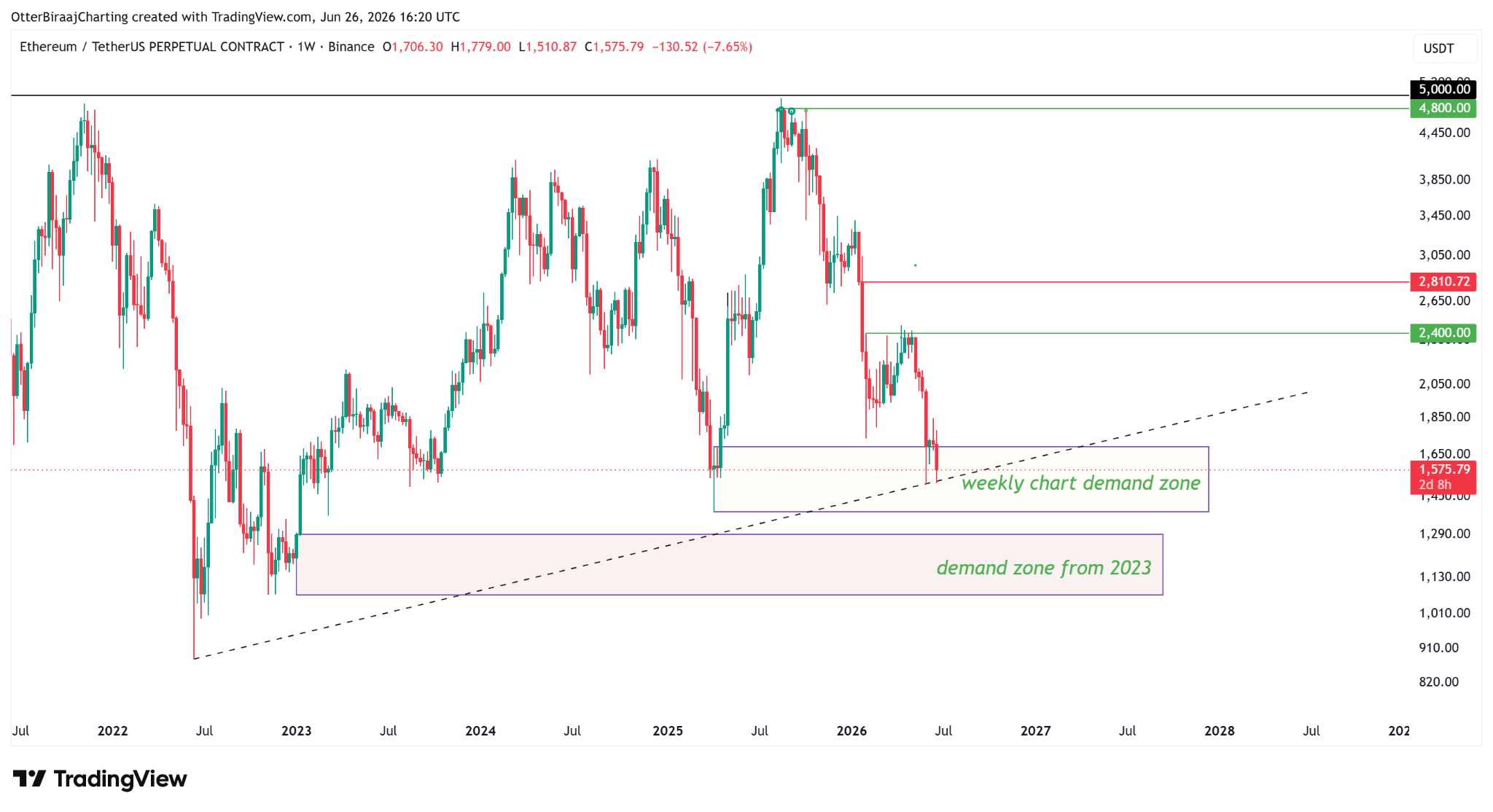
The transfers arrived in four transactions totaling 110,001 ETH: three batches of 40,000, 40,000, and 30,000 ETH, plus one of 1 ETH. The wallet had been inactive for more than three years before Friday’s movement. ETH was trading around $1,575 during the transfers, off roughly 10% over 24 hours.

“Joseph Lubin?”

The originating address carries the label “Joseph Lubin?” on Arkham Intelligence. Arkham also tags the address as a Genesis Block Address, meaning it received ETH in Ethereum’s original July 2015 distribution to early contributors.

Lookonchain flagged the transfer on X on June 6, framing it as a potential sell signal before the Sky vault destination became clear. Neither Lubin nor ConsenSys has made any public statement confirming or denying ownership of the address.

Attribution accuracy is relevant. Three days before this transfer, Lookonchain publicly attributed a 20 million LDO token sale to Lido co-founder Cobie, only to retract the claim after Cobie identified the wallets as belonging to Wintermute. On-chain labels can be wrong.

The Position: Three Sky Vaults, Three Liquidation Prices

The 110,000 ETH moved to three intermediate wallets, which then supplied collateral into three separate Sky (formerly MakerDAO) vaults. Following the deposit, total WETH backing the vaults stands at roughly 412,430 WETH, worth approximately $677 million at current ETH prices of $1,642 per CoinGecko, against the $259.05 million DAI debt load.

The three vault liquidation thresholds sit at $899, $1,020, and $1,056 per ETH. At $1,642, the position clears the closest liquidation price by about 55%. Before Friday’s deposit, with ETH down sharply on the week, that margin was considerably thinner.

A Sky vault operates as a collateralized debt position: the borrower locks ETH and mints DAI against it. If collateral value falls below the liquidation ratio, typically 130 to 145% for ETH-backed vaults, the vault becomes eligible for automated liquidation by keepers who repay the debt and collect a penalty. Adding collateral raises the liquidation price floor and extends the position’s runway during a downturn.

Ethena (ENA) lands Janus Henderson investment in token, USDe distribution

0

Ethena continues to deepen its ties with traditional finance, announcing a deal with asset manager Janus Henderson that includes a strategic investment in the protocol’s governance token.

Under the agreement, Ethena will allocate and help distribute Janus Henderson’s tokenized funds of collateralized loan obligations (CLO), the protocol said in a Tuesday X post.

Meanwhile, Janus Henderson, with $480 billion in assets under management, made a strategic investment in Ethena’s ENA token and plans to use USDe, Ethena’s yield-bearing synthetic dollar, as part of its treasury cash management strategy, according to a Thursday announcement.

The firms are also exploring ways to offer USDe to Janus Henderson clients through exchange-traded investment products.

ENA jumped 5% following the announcement before paring gains. It was down 8% over the past 24 hours as braoder crypto markets slipd

“We are really excited about the possibility here,” Nick Cherney, head of innovation at Janus Henderson Investors, told Coindesk in a message. “We believe very deeply that innovation in blockchain is being led by the defi community, and that we need to continue to forge partnerships with leading founders and protocols.”

The deal fits into the trend of traditional finance firms increasingly embracing and backing decentralized finance (DeFi) infrastructure. Earlier this year, BlackRock (BLK) expanded its tokenized money market fund through a partnership with Uniswap and also invested an undisclosed amount in the decentralized exchange’s UNI token, while Apollo Global Management (APO) stroke a deal with lending protocol Morpho to bring tokenized private credit assets onchain and investing in the protocol’s governance token.

Last week, Coinbase Ventures disclosed its first investment in Ethena and announced a partnership that will bring Ethena products to Coinbase’s more than 100 million users. Separately, Ethena expanded its relationship with crypto bank Anchorage Digital to support institutional lending activity through Anchorage’s Atlas collateral management platform.

Ethena has grown into one of the largest decentralized finance protocols by offering yield through its USDe token, which combines stablecoin demand with derivatives-based hedging strategies. After reaching roughly $15 billion in assets during last year’s market rally, the protocol currently manages about $5 billion as crypto markets continue to recover from a prolonged downturn.

“Ethena has proven that even now it is possible to innovate in the stablecoin arena, and we continue to see huge opportunity in their business,” Janus Henderson’s Cherney added.

New Documentary Captures Bitcoin’s Push Into The NBA

0

A new feature documentary is making the case that Bitcoin belongs in the boardrooms of professional basketball — and it has the access to back it up.

Bitcoin Season, directed by Mike Nicoll, follows Swan Bitcoin, a Bitcoin wealth services company, on its mission to establish Bitcoin-only partnerships inside the professional basketball industry. The film centers on Swan’s groundbreaking deal with the Cleveland Cavaliers — described as the first Bitcoin-only partnership with an NBA franchise — and a separate agreement with Klutch Sports Group, the player agency founded by Rich Paul that represents some of the biggest names in the sport.

The film frames Bitcoin not as a financial product but as a tool of player empowerment, arriving at a moment when athletes are increasingly asserting control over their careers, their brands, and their money. 

Former NBA guard Matthew Dellavedova, who appears in the film, called it “a blueprint” for franchises, leagues, and athletes looking to transform what they stand for beyond the balance sheet.

“[Bitcoin Season] shows franchises, leagues, and athletes that Bitcoin can transform more than a balance sheet, it can transform what you stand for and the legacy you leave. We’re in the player-empowerment era, and owning Bitcoin is part of that,” Dellavedova said.

Expert voices in the film include Michael Saylor, Lyn Alden, Adam Back, Max Keiser, Pierre Rochard, Greg Foss, and Natalie Brunell, alongside executives from the Cavs and Klutch organizations. 

The film’s central argument: as legacy financial models erode in the digital age, storing value in Bitcoin represents a winning strategy for athletes and institutions alike.

Nicoll is no stranger to basketball documentaries. His 2017 film At All Costs was acquired by Netflix and earned comparisons to Hoop Dreams from the LA Times. His follow-up, The Spoils: Selling the Future of American Basketball, premiered at the NBA Summer League Film Festival in June 2024 and drew praise from filmmaker Ken Burns. It is now available on Amazon Prime.

Bitcoin Season had its premiere on June 3, 2026, in San Clemente, California, hosted by Swan founder and CEO Cory Klippsten. A sneak peek is scheduled for the NBA Summer League in Las Vegas on July 18.

You can watch the trailer here.