Home Blog Page 150

Trad.Fi, W3 target $650 million in onchain private credit using AI evaluation

0

Trad.Fi, which lends money to companies buying heavy equipment, said it is working with W3, a developer of AI agents for enterprises, to deploy $650 million in private credit onchain over the next 48 months.

The program targets the heavily paper-based U.S. equipment distribution sector, focusing on manufacturing systems, industrial electrical infrastructure and residential solar installations. By using AI to evaluate risk, conduct due diligence and price loans, Trad.Fi aims to compress the typically monthslong financing timelines for small and mid-sized businesses into a single day.

“Small businesses lose deals waiting for financing, and the only way to fix that is to move the capital, the records and the workflow onto programmable rails,” Trad.Fi CEO Alexander Szul said in a statement. “This is what private credit looks like when it finally meets the speed of the real economy.”

Institutional capital is undergoing a structural shift as it interacts with digital asset infrastructure. The tokenization of real-world assets (RWAs), spanning commodities, equities, and private credit, is now a $25 billion market, having quadrupled from roughly $6.4 billion a year ago. It could become a $30 trillion industry by 2030, according to Security Token Market.

The $650 million figure represents Trad.Fi’s targeted equipment-financing origination pipeline over the next four years, the firm said.

In an initial phase, institutional capital from established, traditional private credit lenders will fund the bulk of the underlying equipment loans directly offchain. At the same time, the companies will work on the initial bridge technology, the ability to predict corporate stability and effect blockchain capital placement.

The long-term goal of the project is a fully programmable treasury in which 100% of senior and equity capital flows natively through the Avalanche blockchain.

A tokenized liquidity pool managed by an unidentified third-party operator will start up in the coming weeks. The pool provides eligible investors with direct onchain access to the equity portions of the private credit generated by the program.

Crypto tax bills a work-in-progress as U.S. House lawmakers pose concerns

0

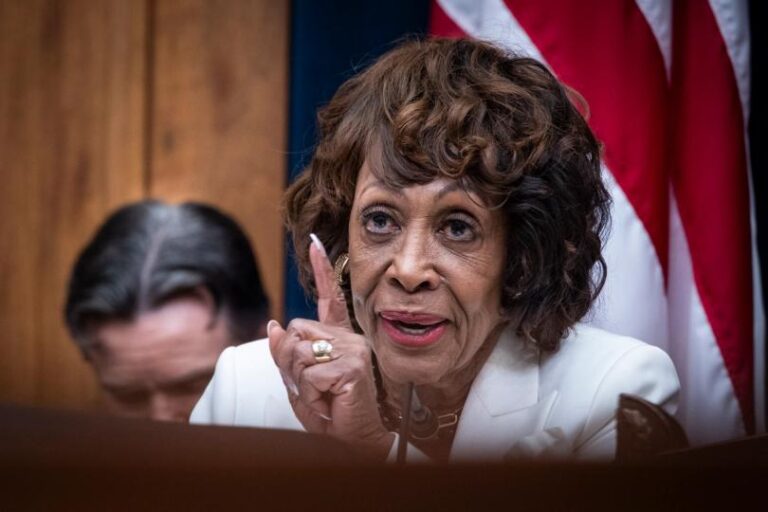
A package of several crypto tax bills may not be ready yet for prime time, as a U.S. House Ways and Means Committee hearing revealed potentially significant questions from lawmakers that suggested the panel hasn’t achieved a bipartisan embrace of the bills that would tailor a clearer tax code for digital asset gains.

The latest legislative drafts are meant to address tax-filing burdens from crypto users and investors, though House lawmakers — especially Democrats — raised pointed questions about the proposed tax treatments during a Tuesday hearing to discuss the bills, and some key members reportedly objected in advance of the session. This preliminary hearing is an opening step of a process that would typically proceed through revisions and markup before the bills could be considered by the wider House of Representatives, and committee Chairman Jason Smith indicated an intent for bipartisan progress.

“I’m aligned with that goal — eventually,” said Richard Neal, the committee’s ranking Democrat, during the hearing. “There’s healthy skepticism on both sides.”

Though the Digital Asset Market Clarity Act that’s slowly winding its way through the U.S. Senate represents the crypto industry’s top policy effort in Washington, a set of new crypto tax laws would rank second on the priority list. As the U.S. rules stand, the taxes on digital asset gains are difficult for investors to manage — especially those who benefit from mining, staking or who make a high number of transactions.

“The committee’s legislation addresses key gaps in the tax code, including parity in tax treatment with comparable traditional financial asset transactions, clarity for tax situations unique to digital assets, and reduction in paperwork burdens for digital asset owners and brokers,” the chairman, Smith, summarized in a statement before the hearing.

One of the bills would address the longtime industry request that small transactions with very minimal gains should be exempted from tax reporting, which could ease the accounting burdens on users as well as freeing up digital assets to be used for routine payments. Another bill would eliminate the double-taxed scenario for mining and staking proceeds, which are taxed upon receipt and when they’re sold.

“If Americans want to pay with a stablecoin instead of a credit card or cash, they should be able to without a pile of tax paperwork,” Smith said during the hearing.

Mining deferrals

But one of the hearing’s witnesses, Mike Kaercher, deputy director of the Tax Law Center at NYU Law, said the bills still contain pitfalls, including his own objection to the mining-and-staking provision that could be abused.

“The problem is that the bill then provides an election for stakers and miners to defer income paid in the form of newly minted coins until disposition,” he said, suggesting it could create a new tax subsidy. He argued that it “violates parity with traditional finance and the principle that income is taxed on receipt.”

“Despite some thoughtful guardrails in the bill, it may be possible for taxpayers to permanently escape tax by earning rewards through certain business structures,” he said.

That concept drew significant attention from the committee’s Democrats, concerned about abuse of such deferral.

It’s unclear whether there will be a viable window for major crypto tax legislation before the current session of Congress ends at the close of 2026. It’s late in that session, and the agenda is already crowded, including with the remaining work on the crypto Clarity Act.

“Regulatory clarity and tax clarity go hand in hand,” said Kevin Wysocki, Anchorage Digital’s head of policy, in a post on social media site X. “If we want innovation, investment, and jobs to stay in America, policymakers need rules that are clear, workable, and built for modern technology.

For its part, the U.S. Senate hasn’t made significant progress on crypto tax bills, though Senator Cynthia Lummis has sought to move similar legislation through Congress’ upper chamber — so far unsuccessfully. Both chambers would ultimately need to approve legislation before it could become law that governs U.S. crypto activity.

A potential reduction of burden on taxpayers in the newly unveiled bills would also be shared by the Internal Revenue Services, which has already been inundated this year with a new tax-reporting regime. The U.S. tax agency has cut a significant portion of its staff under the administration of President Donald Trump at the same time as getting a rapidly increasing influx of crypto filings.

“Millions of Americans own or use digital assets, yet much of the tax code still treats this technology as though it were a niche experiment rather than a growing part of the financial system,” said Coinbase’s vice president of tax, Lawrence Zlatkin. “The result has been confusion for taxpayers, compliance challenges for businesses and unnecessary burdens for the IRS.”

Read More: U.S. House tax committee weighs crypto bills, including relief for small transactions

Ether Eyes $1,500 Support After 25% Open-Interest Decline

0

The Ether (ETH) futures market saw its open interest (OI) on Gate.io fall by 45% to levels last seen in April 2025. At the same time, nearly 480,000 ETH left Binance, OKX, Gemini and Bitfinex over the past few days, reducing the exchange-held supply. 

The combined shift highlights a market with less leverage and declining exchange balances, placing greater focus on the $1,500 support zone, which some analysts view as critical to preventing a deeper move toward $1,000. 

Ether open interest falls across exchanges

Ether’s futures market has undergone a broad reset during the recent sell-off. Crypto analyst Amr Taha noted that total ETH open interest across exchanges has dropped 25%, to $12.6 billion from $16.6 billion in May, with several major trading platforms now at levels last seen in April 2025.

Ether open interest. Source: CryptoQuant

Gate.io recorded the largest decline. ETH open interest fell to $2.68 billion on June 9 from $4.84 billion on May 7, a drop of about 45%. The figure is now nearly identical to the $2.67 billion level recorded on April 11, 2025.

Bybit has followed a similar path. ETH OI currently stands near $805 million, close to the $795 million recorded in early April 2025. The move points to a significant reduction in leveraged positions that accumulated during the latter stages of 2025 and early 2026.

ETH open interest on multiple exchanges. Source: CryptoQuant

However, Binance presents a different picture. ETH open interest remains near $2.76 billion, holding within its recent range. The funding rates have also turned negative on the exchange, with the latest reading near -0.0047, showing short traders are paying a premium to maintain their positions.

ETH funding rate on Binance. Source: CryptoQuant

The divergence is notable. Gate.io and Bybit have already seen a major leverage reset. Futures traders on Binance remain active, but the negative funding points to a cautious sentiment. 

Related: Bitmine boosts Ethereum treasury to 5.54M ETH, nearing 5% supply target

ETH supply drop meets key support at $1,500

Ether exchange reserves also posted a notable decline in early June. Across Binance, OKX, Gemini and Bitfinex, tracked ETH balances fell by 480,000 ETH over the past few days. 

ETH multi-exchange reserve. Source: CryptoQuant

Binance reserves dropped to 3.65 million ETH on June 9 from 3.87 million ETH on June 4. Bitfinex holdings declined to 2.50 million ETH from 2.67 million ETH at the end of May. OKX recorded the sharpest percentage decline, with reserves falling from 424,000 ETH to about 336,000 ETH. Gemini balances also slipped to roughly 522,000 ETH.

Continued ETH outflows could reduce the amount of readily available supply on exchanges if buying demand starts to recover. 

Onchain data shows many ETH holders are still far from large profits. According to market commentator Gonza Goth, only 11% of Ethereum’s supply is currently sitting at a 3x or greater gain, the lowest level since February 2017. However, Goth said

“Historically, extreme pessimism has created the best opportunities.”

ETH: relative supply by profit and loss. Source: Glassnode

Meanwhile, traders are also watching the $1,500 level next. Investor Ash Crypto noted that Ether failed to hold every support level during the 2022 bear market, when the price eventually bottomed near $880. 

The analyst said a weekly close above $1,500 would keep ETH above a historically important support zone, while a break below it would shift attention toward the next major support area near $1,000.

ETH/USD, one-week chart analysis by Ash. Source: X

Related: ETH falls to 13-month low on Zcash bug, Bitcoin below $60K: Is $1.4K next?

BTC Price Nears $62,000 as Bitcoin Bear Market Support Failures Continue

0

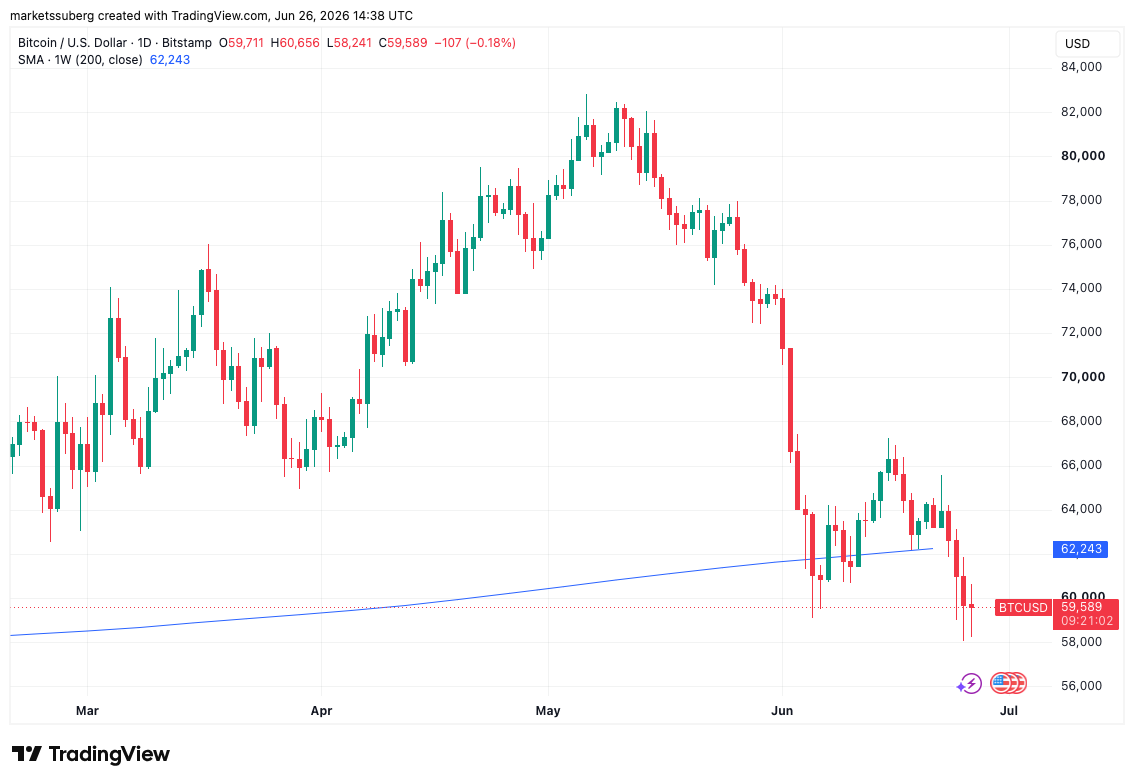
Bitcoin (BTC) hit week-to-date lows at Tuesday’s Wall Street open as analysis put $65,000 as bulls’ level to beat.

Key points:

  • Bitcoin needs to revisit $65,000 for bulls to take charge, says new BTC price analysis.
  • Bear market history continues to play out as BTC/USD loses key supports.
  • Iran peace hopes see oil fall below $88 for the first time this month.

Bitcoin price copies bear-market history with support losses

Data from TradingView tracked 1.2% BTC price downside on the day as sell-side pressure returned ahead of key US inflation data.

A double rejection at $64,200 put BTC/USD on course for another test of the key $60,000 support level.

BTC/USD one-hour chart. Source: Cointelegraph/TradingView

Commenting, trader and analyst Michaël van de Poppe said that for bulls to gain the upper hand, they would need to crack $65,000.

“Bitcoin is stalling beneath $65K as breaking that level would trigger a strong run to $72-74K,” he wrote in one of his latest posts on X

“The $65K support level was the previous level of support after the crash early in February and is now acting as the resistance to break through.”

BTC/USD one-day chart. Source: Michaël van de Poppe/X

Van de Poppe called into question the validity of Bitcoin’s latest macro lows, which took the market to $59,100 last week.

“I don’t think it will take long before the markets will be doing this, as the recent selloff was relatively irrational,” he added.

In an update on the bear market, trader and analyst Rekt Capital flagged two more key similarities between current BTC price action and the road to previous cycle lows.

BTC/USD, he noted, had lost both its 50-month exponential moving average (EMA) and the support of a triangle construction — just like in 2018 and 2022.

“Now Bitcoin needs to fully confirm this breakdown to enter additional Bearish Acceleration to the downside,” he told X followers.

BTC/USD one-month chart with 21, 50 EMA. Source: Rekt Capital/X

Oil falls to June lows on new Iran peace momentum

Bitcoin once again diverged from US stocks on the day, heading lower while both the S&P 500 and Nasdaq Composite Index opened up by nearly 1%.

Related: Bitcoin ‘normal’ 4-year cycle puts focus on $53K low before 2028 BTC price high

S&P 500 one-hour chart. Source: Cointelegraph/TradingView

This helped alleviate an initial drop at the start of the week after Asian markets came under pressure from a tech-stock rout.

Oil prices, meanwhile, also fell as hopes of a US-Iran peace deal steadily reemerged.

“It’ll be a total victory,” US President Donald Trump said in a telerally for Republican Senator Lindsey Graham on Monday, quoted by Al Jazeera and others. 

“It’ll happen very soon, and oil prices will come tumbling down.”

CFDs on US WTI crude oil one-hour chart. Source: Cointelegraph/TradingView

WTI crude dropped under $88 per barrel, reaching its lowest level since May 29.

Securitize CEO says tokenized stocks could unlock a $5 trillion crypto market

0

Securitize CEO Carlos Domingo said he believes tokenized equities and ETFs, not private credit or Treasury products, will be the asset class that ultimately drives the real-world asset (RWA) market into the trillions.

Speaking at a ETHConf panel in New York on Tuesday, Domingo argued that bringing stocks and exchange-traded funds onchain could unlock a market far larger than today’s roughly $30 billion tokenized asset sector.

“The entire equities and ETF market worldwide is probably like $150 trillion,” Domingo said. “Only if a small percentage of that, like 2% or 3%, moves onchain, it gets you very close to that $5 trillion.”

The comments come as Securitize prepares to go public and seeks to expand its role as one of the largest tokenization providers for institutions, including BlackRock.

While tokenized U.S. Treasuries have emerged as the dominant RWA category over the past two years, Domingo argued that tokenized stocks could become the industry’s next major growth engine. Securitize has announced partnerships with the New York Stock Exchange and transfer agent Computershare aimed at enabling on-chain trading and settlement of equities.

Domingo also drew a distinction between what he considers “real” tokenized equities and the growing number of blockchain-based stock products offered outside the U.S.

“A lot of people that today say that they tokenize equities, they’re not tokenizing equity,” he said, arguing that many offerings rely on derivatives or synthetic structures rather than direct ownership of the underlying shares.

According to Domingo, the long-term goal is for blockchain-based securities to offer the same investor rights as traditional shares while benefiting from instant settlement, 24/7 transferability and deeper integration with decentralized finance.

Domingo maintained that public blockchains, particularly Ethereum, remain the preferred infrastructure for institutional tokenization despite concerns around transparency and compliance. Securitize uses smart contracts to restrict ownership to approved investors while allowing assets to move on permissionless networks.

Looking ahead, Domingo said he expects blockchain-based markets to develop alongside existing financial infrastructure before gradually absorbing a larger share of activity.

“The traditional markets are going to stay,” he said. “We’re going to see a new market emerge in parallel that will run on blockchain rails and be much more efficient.”

Read more: BlackRock-backed tokenization firm Securitize clears key hurdle to go public on NYSE

Solana Institute urges CLARITY Act developer protections

Solana Institute CEO Kristin Smith is urging the US Senate to pass the CLARITY crypto market structure bill with developer protections intact, arguing that open-source developers and blockchain infrastructure providers should not be regulated as financial intermediaries.

In a thread on the X social media platform, Smith said the market structure legislation “has a real shot at passing the Senate,” making it critical for lawmakers to preserve protections for software developers.

Source: Kristin Smith on X.com

Smith said more than 60 crypto CEOs and founders, including Solana co-founder Anatoly Yakovenko, signed an open letter urging the Senate to maintain robust developer protections in the CLARITY Act.

She said that open-source developers, validators and non-custodial wallet providers do not control user funds or execute transactions and therefore should not be treated as brokers or custodians.

Smith pointed to the Blockchain Regulatory Certainty Act (BRCA), which would provide legal certainty for noncontrolling software developers and blockchain infrastructure providers that do not custody customer assets or control transactions.

Introduced in January by Senators Cynthia Lummis and Ron Wyden, the bipartisan BRCA aims to prevent open-source developers from being classified as “money transmitters” solely for publishing software code.

The CLARITY Act cleared the Senate Banking Committee in May and was recently placed on the Senate Legislative Calendar, setting the stage for a possible floor vote later this summer.

Related: CLARITY Act will help reshore US crypto industry, attorney says

Echoes SEC commissioner Peirce’s calls for developer protections

Smith’s comments echo recent remarks by US Securities and Exchange Commission Commissioner (SEC) Hester Peirce, who argued last week that publishing open-source blockchain code is protected speech and that developers should not be treated as financial intermediaries simply because others use their software.

Speaking at the IC3 Blockchain Camp at Princeton University, Peirce said that “many blockchain projects involve publishing open-source software, which is generally a protected activity under the First Amendment.”

Source: CoinMarketCap on X.com

The SEC’s mandate regarding digital assets has evolved significantly under current Chair Paul Atkins, who vowed to end the agency’s “regulation through enforcement” approach to the industry. 

Related: US lawmakers push back on Labor Department plans to include crypto in 401(k)s

Traditional Finance Is Rushing Into Crypto As Institutions Buy Bitcoin’s Dip: Axios

0

Traditional financial institutions are shedding their skepticism toward crypto, and the shift is accelerating in 2026.

Banks, brokerages, and exchanges are racing to offer crypto products as demand from retail investors, institutions, and wealthy clients reaches a tipping point. 

David Ripley, co-CEO of crypto exchange Kraken, told Axios that “nearly all traditional financial services companies are gonna offer crypto, bitcoin, ethereum to their customers” — a development he called “a big story of 2026.”

The turning point reflects a broader collision of mega-trends reshaping financial markets. Stablecoins, tokenization, AI, and extended-hours trading are converging to create a financial system that is more digital, more global, and increasingly around the clock.

Ripley said the rise of stablecoins — blockchain-based versions of traditional assets — has primed investors for what comes next: tokenized public equities. 

“The next most significant place where we see tokenized equity or tokenized assets will be public equities,” he said.

The stakes are high. Kraken recently announced plans to offer tokenized IPO shares to retail investors, targeting ordinary Americans who Ripley says have been “entirely locked out” of major wealth-creating companies until late in their growth cycles.

The IPO market itself is preparing for a historic wave. SpaceX is targeting a Nasdaq debut this week, seeking to raise about $75 billion at a $1.7 trillion valuation — which would make it the largest IPO on record. 

Nasdaq CFO Sarah Youngwood told Axios the U.S. market has the depth to absorb a pipeline of trillion-dollar offerings, including OpenAI and Anthropic, without structural changes.

Nasdaq is pushing into extended-hours trading, aligning with crypto markets that never close. 

Coinbase Executive: Institutions are buying

These comments to Axios come as bitcoin fights near $60,000, but its 50% decline from the all-time high have not deterred major institutional investors, according to Coinbase’s head of institutional strategy, John D’Agostino, who says sovereign wealth funds, family offices, and other large investors are actively buying the dip. 

Abu Dhabi’s sovereign wealth fund, Mubadala, increased its exposure to BlackRock’s Bitcoin ETF for a fourth consecutive quarter, while Bitcoin ETFs collectively still hold roughly $100 billion in assets despite the market downturn. 

D’Agostino attributed the selloff to a combination of macroeconomic uncertainty, elevated interest rates, regulatory delays, geopolitical tensions, and concerns sparked by Strategy’s sale of 32 BTC. Even so, he said institutions remain confident in Bitcoin’s long-term value, a view reinforced by Strategy’s subsequent purchase of 1,550 BTC for $101 million.

Bitcoin’s Correction May Be Canary In Coal Mine Moment for Macro

0

Bitcoin’s (BTC) recent performance may be less about crypto market weakness and more about its position at the front of the risk curve. Asset management firm Bitwise said that BTC often acts as a “canary in the macro coal mine,” responding to shifts in liquidity and financial conditions before traditional markets. With equities now showing similar signs of strain, the firm sees Bitcoin’s move as part of a wider risk-off adjustment. 

Global liquidity and interest rates stay in focus: Bitwise

Bitwise said that Bitcoin and Ether reached cycle lows of $58,000 and $1,507, respectively, as other global risk assets faced mounting pressure. The Nasdaq recorded its sharpest daily decline of 5% in months, and South Korea’s KOSPI (Korea Composite Stock Price Index), its benchmark stock index, triggered a temporary trading halt after a steep sell-off led by semiconductor stocks.

The shift followed stronger-than-expected US labor market data, which reduced expectations for near-term Federal Reserve easing. Higher-for-longer interest rate expectations kept the 10-year US Treasury yields higher and weighed on growth-sensitive assets. The US 10-year yield held near 4.53% on Tuesday after touching 4.68% last month, its highest level in a year.

Bitwise pointed to a recurring pattern in which Bitcoin weakens months before equities. Unlike traditional markets, BTC trades continuously and reacts quickly to changes in liquidity conditions.

BTC price, NASDAQ, and Global M2 liquidity. Source: Cointelegraph/TradingView

A chart comparing Bitcoin, the Nasdaq, and Global M2 liquidity highlights the divergence. Global M2 has climbed to roughly $122.6 trillion, up steadily over the past year, while Bitcoin has retraced sharply from its $126,000 highs.

If Bitcoin is acting as a macro canary, its correction may be telling a different story than a simple risk-off move. BTC has already undergone a significant repricing while global liquidity continues to expand. That leaves open the possibility that Bitcoin is further along in the adjustment process than equities, particularly if liquidity conditions improve later in the cycle. 

Related: Bitcoin price slips toward $62K local lows as bear-market history keeps repeating

Stablecoin reserves signal dry powder

Onchain data is offering a different perspective on crypto market liquidity. Independent market analyst Maartunn highlighted that the Stablecoin Supply Ratio (SSR) relative strength index (RSI) has dropped to an oversold reading of 13.

Stablecoin supply ratio (SSR) RSI. Source: CryptoQuant

The SSR measures Bitcoin’s market capitalization relative to the market value of major stablecoins such as Tether’s USDt (USDT) and Circle’s USD Coin (USDC). Lower readings indicate larger stablecoin balances relative to Bitcoin’s valuation, pointing to a substantial buying power sitting on the sidelines.

Historically, similar SSR RSI readings have appeared near accumulation zones and were followed by periods of stronger price performance once liquidity returned to the market.

All stablecoins exchange reserves. Source: CryptoQuant

Exchange reserve data also points to a sizeable liquidity pool. Combined reserves of major stablecoins on exchanges currently stand near $72 billion, led by $57.7 billion in USDT (USDT) and $12 billion in USDC. The total has eased from late-2025 peaks above $80 billion, though balances remain elevated by historical standards. That leaves a significant amount of capital positioned on exchanges as Bitcoin trades near the lower end of its recent range at $62,000.

Related: Bitcoin bottom? These four charts hint at BTC price dropping to $50K

BBB Advertising Watchdog Refers Kalshi to Regulators Over Influencer Inquiry

The Better Business Bureau’s (BBB) National Advertising Division (NAD) is referring prediction market platform Kalshi to regulatory authorities after the company declined to participate in an inquiry into its social media advertising practices, adding another layer of scrutiny to the fast-growing event trading platform.

In a statement published Monday, NAD said it will refer the matter to the appropriate regulatory authorities, including relevant state Attorneys General, for possible enforcement action.

The inquiry examined whether Kalshi’s influencers and affiliates clearly disclosed paid relationships in social media promotions and whether the company took adequate steps to comply with Federal Trade Commission endorsement guidelines.

According to the BBB, Kalshi declined to participate in NAD’s voluntary self-regulatory review of its advertising practices. As a result, the organization will also notify the social media platforms where the advertising appeared.

“At issue for NAD was whether material connections between Kalshi and influencers or affiliates were clearly and conspicuously disclosed in social media advertising,” BBB said.

Crypto influencer John Wang joined Kalshi in August.
Source: John Wang on X.com.

Kalshi’s advertising practices have also drawn scrutiny from Media Matters for America, a nonprofit media watchdog organization, which highlighted the platform’s viral marketing campaigns on TikTok and Instagram that promoted prediction trading as a “side hustle.”

Related: Kalshi joins Polymarket in sweeping user bans to head off insider trading

Prediction markets continue rapid growth despite regulatory scrutiny

Social media marketing has fueled Kalshi’s explosive growth, helping the platform attract new users and drive trading volumes tied to real-world events. 

A Kalshi spokesperson told Bloomberg that the company is on track for a $1.5 billion annualized revenue run rate, momentum that helped secure a $1 billion funding round valuing the company at $22 billion.

Kalshi is a leading centralized prediction market platform alongside decentralized rival Polymarket. Source: Bitget Wallet

Despite an ongoing jurisdictional dispute between state regulators and the Commodity Futures Trading Commission (CFTC) over event contracts, as well as allegations of insider trading, prediction markets continue to gain traction among retail and institutional participants.

A May research report from Bernstein argued that the sector is entering an “institutional” era, with analysts citing a block trade executed on Kalshi as evidence of improving liquidity and more efficient price discovery.

“We believe the introduction of block trading and bespoke contracts could expand participation from institutional investors seeking targeted exposure to event risks,” the Bernstein analysts wrote.

Related: Prediction markets legal battles heat up in Minnesota, Rhode Island

5 corruption gaps Congress must close in the Clarity Act

0

The Digital Asset Market Clarity Act, which cleared the Senate Banking Committee on May 14, will set the rules of the road for an industry that has grown faster than the laws meant to govern it.

Almost everyone agrees that crypto regulation is overdue. But as the bill moves toward a vote on the Senate floor, it contains five gaps that threaten to undermine the very structure and stability the legislation otherwise hopes to deliver.

The Decentralized Finance or “DeFi” gap

A platform or intermediary that moves, exchanges, conceals, or otherwise facilitates the transfer of value should not be able to avoid oversight simply by calling itself “decentralized.” North Korean hackers have repeatedly exploited mixers and other virtual asset laundering infrastructure to move stolen crypto and help fund the regime’s weapons programs. Treasury has found that Tornado Cash was used to launder more than $455 million stolen by the Lazarus Group, and U.N. experts have reported that North Korea later laundered another $147.5 million through the same platform. These are exactly the blind spots Congress needs to close: when a digital asset platform or intermediary performs financial functions, it should be subject to appropriate anti-money laundering and sanctions safeguards.

The so-called “Tornado Cash” loophole gap

Some crypto tools are designed to keep operating automatically, even when it becomes clear they are being used to launder money. When anti-money laundering rules attach to a person but evaporate the moment software performs the same task, the result is not a safeguard — it is a workaround written into the law. The urgency is not hypothetical. This past May, FinCEN warned U.S. banks that Iran’s Islamic Revolutionary Guard Corps had built a multi-jurisdictional shadow banking network — combining digital asset infrastructure with front companies and exchange houses — to launder oil proceeds and finance weapons procurement and terrorism. Congress should give the Treasury Department’s Office of Foreign Assets Control (OFAC) the explicit authority it needs to act against anonymizing tools used to evade sanctions.

The stablecoin gap

The GENIUS Act, passed earlier this year, established the core framework for stablecoin issuers, but allowed illicit actors to circumvent that framework via DeFi protocols, offshore platforms, mixers, or other services that move stablecoins without meaningful controls. Sanctioned Russian entities have already used stablecoins, including through platforms that impose no identity verification requirements, to move funds and sustain financial networks. The Clarity Act should require stablecoin issuers to implement reasonable ecosystem-wide monitoring to identify and report suspicious activity. Without that broader visibility, stablecoins risk becoming the preferred rail for sanctions evasion, fraud, ransomware, trafficking, and corruption-related money laundering.

The jurisdictional gap

A platform that serves American customers or routes activity through the U.S. financial system should not be able to shed its anti-money laundering and sanctions obligations simply by registering its headquarters abroad. The Justice Department recently charged a Venezuelan national with allegedly laundering approximately $1 billion through a network that used bank accounts, cryptocurrency exchange accounts, private wallets, shell companies, and transactions into and out of the United States. Cross-border flows like that are precisely what slip through the cracks when platforms get to pick the jurisdiction with the lightest scrutiny. If a platform or intermediary facilitates illicit finance, it should be cut off from the legitimate financial system.

The ethics and conflict of interest gap

Four days before the 2025 inauguration, a member of President Trump’s immediate family reportedly signed a deal to sell a 49% stake in their crypto venture, World Liberty Financial, to an Abu Dhabi-backed entity for half a billion dollars. According to The Wall Street Journal, the Trump Administration later approved giving the UAE access to 500,000 of the world’s most advanced AI chips, overcoming longstanding national security objections. The Clarity Act is now advancing under an administration whose family has direct financial stakes in the very same digital asset ventures that the bill would govern. No impartial crypto framework can be built on that foundation. The Clarity Act must bar public officials and their immediate family members from owning, promoting, sponsoring, endorsing, or soliciting investment in digital asset ventures while the official is in office.

These five gaps are not abstract concerns. Each one maps onto an activity that is already happening: sanctioned states moving money, foreign officials laundering bribes, hostile actors funding weapons programs, and a sitting president’s family selling stakes in the industry the legislation is meant to regulate. Congress has the opportunity to write rules that protect the integrity of the U.S. financial system. It also has the opportunity to write rules that quietly accommodate those who would exploit it. The version of the Clarity Act now moving toward the Senate floor does not yet distinguish clearly enough between the two.

The choice before the Senate is not whether to regulate crypto. It is whether the rules Congress writes will be strong enough to do what regulation is supposed to do: protect consumers, defend U.S. national security, and ensure that public office cannot be used for personal or family profit. Five gaps stand between this bill and that standard. They can and must be closed.