
Officials in the G20, under the US’ presidency, recognized that digital assets could support “broad-based economic growth” and called for improvements in cross-border transactions.

Officials in the G20, under the US’ presidency, recognized that digital assets could support “broad-based economic growth” and called for improvements in cross-border transactions.

New Jersey’s Attorney General and the state’s interim director for the Division of Gaming Enforcement have officially petitioned the US Supreme Court to hear a case aimed at resolving whether state authorities or federal agencies have jurisdiction over prediction market companies.
On Wednesday, Attorney General Jennifer Davenport and gaming enforcement interim director Mary Jo Flaherty filed a petition for a writ of certiorari to the US Supreme Court over New Jersey’s enforcement against prediction market platform Kalshi over sporting event contracts. Officials cited civil cases brought by gaming authorities in “at least 20 states,” seeking the highest court in the US to decide whether prediction market companies could be in compliance with the Commodity Futures Trading Commission (CFTC) while violating state laws.
“Companies like Kalshi claim to offer legal sports betting in all 50 States, but they refuse to follow the gambling laws of any State,” said Davenport. “These companies have no right to offer their sports bets without following state law, which is why dozens of States across the ideological spectrum have opposed them […] We’re calling on the Supreme Court to resolve this issue and recognize that Congress did not silently make the sports-betting industry immune from state law.”
Source: New Jersey Attorney General
Citing New Jersey’s enforcement against Kalshi, the petition presented the Supreme Court with the question of “whether the 2010 Dodd-Frank Wall Street Reform and Consumer Protection Act preempted States from regulating sports bets that occur within their jurisdictions if those bets are offered on markets registered with the [CFTC].” Cointelegraph reached out to the CFTC for comment but did not receive an immediate response.
Related: Kalshi issues first lifetime ban for Republican politician over insider bets
The petition challenges an April opinion from the US Court of Appeals for the Third Circuit, in which judges ruled 2-1 against New Jersey’s gaming authorities, saying Kalshi’s argument that the company had a ”reasonable chance of success” in claiming that the CFTC’s Commodity Exchange Act preempted state law. It specifically challenges the CFTC’s claim that sports bets on prediction market platforms amount to “swaps” under the agency’s purview and argued “federal law does not preempt state sports-gambling laws regardless.”
“Because federal law prohibits trading swaps off CFTC-registered markets, a victory for Kalshi would mean that all sports gambling off such CFTC-registered markets would seemingly become illegal even if state law allows it,” said the New Jersey AG’s announcement on the petition.
Kalshi spokesperson Dani Lever told Cointelegraph that the company disagreed with New Jersey’s decision to appeal to the Supreme Court, saying that it could not be “regulated by 50 different regulators.“
”We remain confident in the lower courts’ rulings, and nothing in New Jersey’s filing today changes our view,” said Lever.
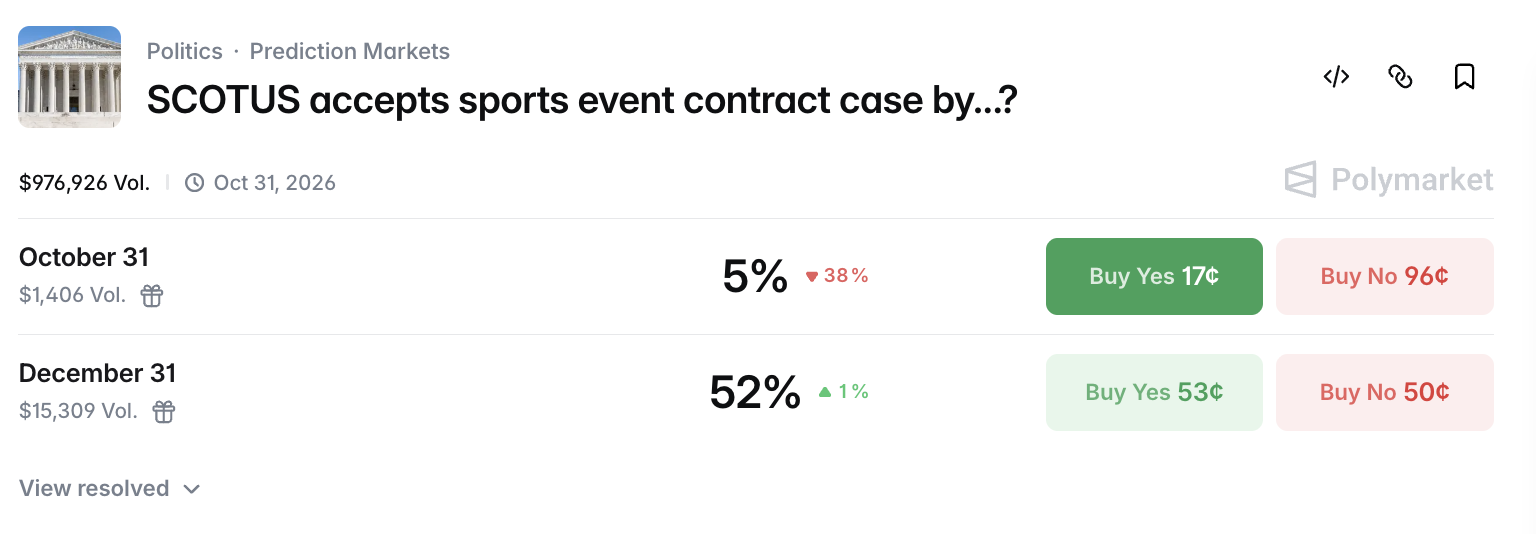
Event contract on when the US Supreme Court will hear a prediction markets case. Source: Polymarket
Whether the Supreme Court justices will take up the issue of prediction markets is unclear. Many experts have been speculating that the justices could weigh in on a case that went to the appellate court in Nevada. Whether the court chooses the Kalshi case in Nevada, the one in New Jersey or an enforcement action against a different company down the road, any potential decision could decide which authorities can regulate prediction markets.
Magazine: Who is legally liable when an AI agent goes rogue?

Federal law enforcement officials, working with cybersecurity technology company CrowdStrike, announced action against entities behind malware that enabled the theft of $150,000 in cryptocurrency.
In a Tuesday notice, the US Justice Department said it had disrupted the Sality botnet and malware in an international effort with Bulgarian, Hungarian and Romanian officials, as well as private sector partners CrowdStrike and the Shadowserver Foundation. US officials said that Sality was responsible for installing malware on compromised devices since 2003, resulting in crypto theft and cyberattacks.
CrowdStrike reported that in the previous eight years, the entities behind Sality used EggJagger, a “clipjacking tool that monitors the clipboard for cryptocurrency wallet addresses and silently replaces them with addresses controlled by the operator,” to steal at least 12.1 million rubles, or about $150,000, in cryptocurrency. According to the company, the value of the “never-spent” digital assets peaked at about $1.5 million in January 2025.
“When a victim copies a Bitcoin or Ethereum address to make a payment, the funds are redirected,” said CrowdStrike, explaining the technique behind the theft.
According to CrowdStrike, the criminals behind Sality “lost the ability to communicate with infected machines” as a result of authorities’ efforts to disrupt the network. US officials and the company said Sality was used to steal crypto, while about 15,000 infected computers formed part of a peer-to-peer botnet that checked whether its systems were online every 40 minutes.
Related: A fake crypto job interview nearly installed malware on my computer

After multiple appeals courts ruled differently about whether states can crack down on prediction markets’ sports products, New Jersey asked SCOTUS to step in.

The crypto exchange operator, which confidentially filed for a U.S. listing last November, had already put its IPO plans on hold amid difficult market conditions.

Ondo Finance is urging US regulators to bring perpetual futures tied to individual stocks onshore, arguing that the products can already operate under the country’s existing security futures framework without new rules.
In three Aug. 24 comment letters to the Securities and Exchange Commission (SEC) and Commodity Futures Trading Commission (CFTC), Ondo argued that existing rules can accommodate perpetual stock futures while also accounting for modern margining practices and onchain market data.
Ondo said its Panama-based affiliate already offers stablecoin-settled perpetual futures on individual US-listed stocks outside the United States, with the platform recording $8 billion in cumulative trading volume as of Aug. 14, around six weeks after its launch.
Ondo ranks fourth among tokenized RWA managers by distributed value. Source: RWA.xyz
The company argued that scheduled funding payments can keep perpetual contracts aligned with the price of their underlying stocks, performing a similar function to expiration in traditional futures.
“Nothing in the statutory definition of a security futures product requires a fixed expiration date,” Ondo said in its product-classification letter.
Ondo also noted that many of the stocks underlying offshore perpetuals are principally traded on US exchanges. “Bringing that activity back to the U.S. should not be an open question; it’s something both agencies should actively pursue,” the company said.
Ondo is among the largest managers of tokenized real-world assets, ranking fourth with about $2.6 billion in distributed value as of Wednesday, according to RWA.xyz data.
Related: Ondo shifts from layer-1 blockchain plan to offchain execution network
Ondo’s proposal comes as US regulators reconsider how existing market rules apply to onchain products, including perpetual futures and tokenized securities.
President Donald Trump said in August that CFTC Chair Michael Selig was working to bring Hyperliquid into the United States in a “fully compliant and legal fashion.” Hyperliquid is best known for its onchain perpetual futures market, though neither the CFTC nor Hyperliquid has publicly detailed how US access would work.
HYPE, the native token of Hyperliquid, jumped more than 20% following Trump’s comments and has gained nearly 49% over the past month to trade around $81 on Wednesday, according to CoinGecko data.
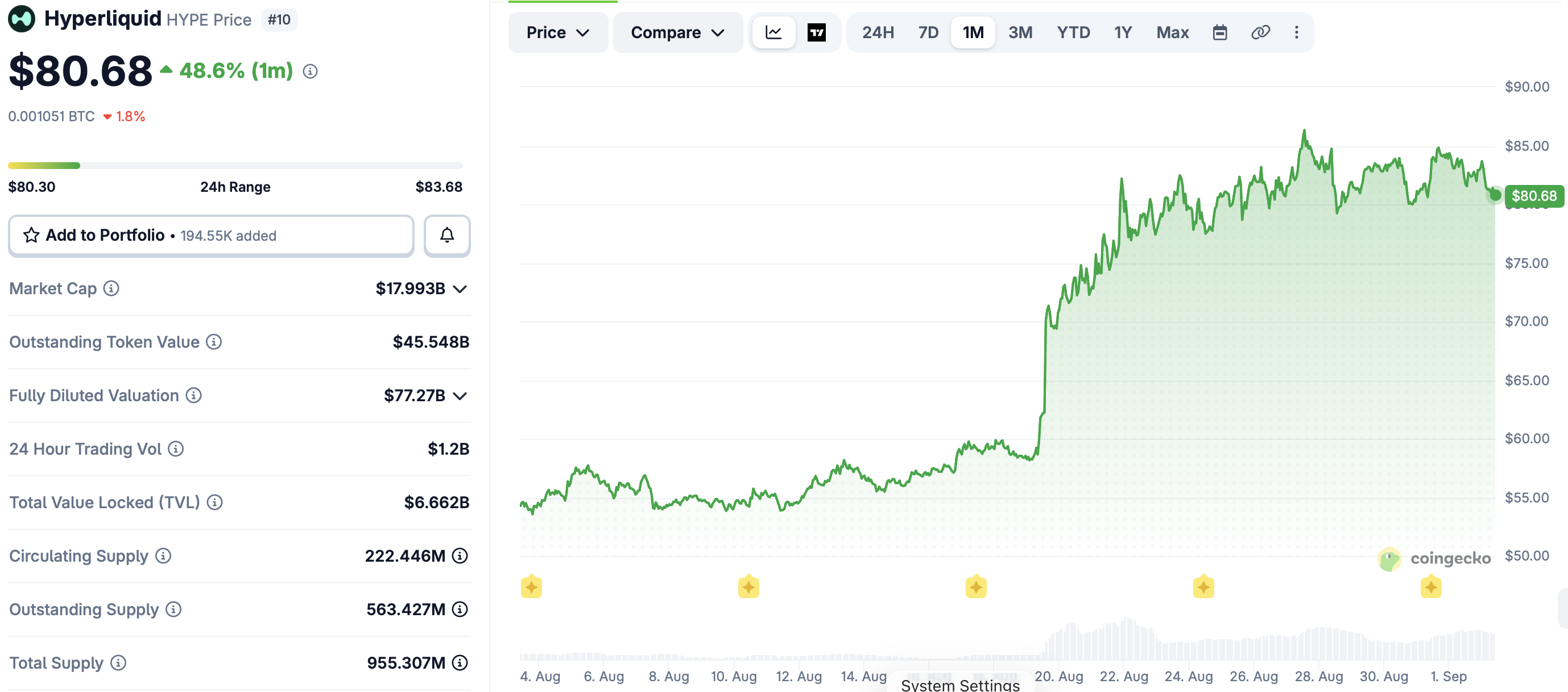
HYPE has gained nearly 49% over the past month. Source: CoinGecko
The SEC, which oversees securities markets, and the CFTC, which regulates US derivatives markets, have also stepped up coordination this year, signing a memorandum of understanding in March to harmonize oversight in areas where their jurisdictions overlap.
On Tuesday, the SEC proposed overhauling its decades-old transfer agent framework, citing growing demand for blockchain-native recordkeeping and tokenized securities in US markets as the agency reexamines rules built for older market infrastructure.
Magazine: BTC will hit $1M by 2030… but Arthur Hayes is buying ETH instead
Adding Massachusetts incumbent Auchincloss to the list of winning primary candidates Fairshake supported, the industry’s influence moves on to November.
Arbitrum DAO generated $6.19 million in income during the first half of 2026, as one of Ethereum’s largest scaling ecosystems increasingly looks beyond transaction fees for revenue.
The Arbitrum Foundation said the income came from four sources: Arbitrum One transaction fees, Timeboost, licensing under the Arbitrum Expansion Program and returns from the DAO treasury. Combined gross margins on protocol revenue exceeded 97%, up from more than 90% for full-year 2025, according to its biannual progress report for the first half of 2026.
The figures show how Arbitrum is trying to turn its blockchain technology into a broader infrastructure business as financial companies build dedicated networks using its software.
“The first half of 2026 shows the Arbitrum ecosystem’s financial profile broadening,” Brendan Ma, head of investment strategy at the Arbitrum Foundation, said in a statement shared with AlexaBlockchain. “It now looks like a diversified economic enterprise, with four income lines at a blended gross margin above 97%.”
That diversification accelerated after the reporting period ended.
Robinhood launched the public mainnet of Robinhood Chain on July 1. The Ethereum Layer 2 is built using Arbitrum technology and is designed to support tokenized assets, decentralized finance and other financial applications.
Under Arbitrum’s Expansion Program, chains that use its technology but settle outside Arbitrum One and Nova return 10% of their net protocol revenue to the ecosystem.
Robinhood Chain generated $360,000 in licensing fees for the ArbitrumDAO in July, according to the Foundation. That represented 35% of the DAO’s income for the month.
The contribution is significant because it gives Arbitrum a revenue model that does not depend solely on users transacting directly on Arbitrum One.
Robinhood Chain has also gained activity quickly. Robinhood said in August that the network had generated more than $18 billion in Dex trading volume and surpassed $840 million in total value locked since its July launch.
Activity on the broader Arbitrum ecosystem remained substantial during the first half.
Arbitrum-based networks processed 478 million transactions during the period, taking cumulative transactions to about 2.7 billion, according to the report.
The Foundation put what it calls “ecosystem GDP” — economic value generated by applications and protocols — at $206 million for the half and $1.7 billion since launch. An earlier update said cumulative chain GDP had risen about 45% from a year earlier.
Stablecoins have become another important part of that activity.
Average monthly stablecoin transfers exceeded $70 billion during the reporting period, according to the new report. The Foundation previously reported that Arbitrum had 10.5 million stablecoin holders and monthly transfers above $60 billion during the first half.
Traditional payment networks are also expanding onto the chain. Mastercard said in June that Arbitrum would be among the blockchain networks supported for settlement using regulated stablecoins including USDC, PYUSD and RLUSD.
Arbitrum is also positioning itself as infrastructure for financial assets moving onchain.
The network had more than 2,000 real-world asset deployments during the first half, with roughly $850 million in RWA assets under management, according to Foundation data.
Robinhood is central to that strategy. Its chain was designed specifically around financial applications and real-world assets, after the brokerage began offering tokenized US stocks and ETFs to European customers through Arbitrum in 2025.
The DAO also held about $125 million in non-ARB treasury assets at the end of June, according to the report.
The above article “Arbitrum DAO Income Hits $6.2M as Robinhood Chain Adds Revenue” was first published on AlexaBlockchain. Read the complete article here: https://alexablockchain.com/arbitrum-dao-income-hits-6-2m-as-robinhood-chain-adds-revenue/
Read Also: This is the First U.S.-Chartered Depository Bank to Offer Stablecoin Invoicing
Disclaimer: The information provided on AlexaBlockchain is for informational purposes only and does not constitute financial advice. Read complete disclaimer here.

Thailand is tightening oversight of crypto transfers, including transactions involving self-custodial wallets, as it moves to align with global Anti-Money Laundering (AML) standards.
Thailand’s Securities and Exchange Commission (SEC) issued new Travel Rule regulations requiring digital asset operators to collect information about parties involved in crypto transfers, the regulator announced Wednesday.
The rules will take effect on Feb. 27, 2027, giving crypto businesses nearly six months to develop systems for transmitting, receiving and monitoring transaction information.
Thailand joins a growing global push to track who sends and receives crypto, as the Financial Action Task Force (FATF) estimated that 83% of surveyed jurisdictions had passed Travel Rule legislation as of 2026.
Under the new framework, Thai digital asset operators must verify the ownership or control of self-hosted, or self-custodial, wallets when customers send crypto to or receive it from those wallets.
Unlike wallets managed by centralized exchanges (CEXs) or custodians, self-custodial wallets give users direct control over the private keys needed to access their crypto.
Operators must also retain information accompanying every digital asset transaction for at least five years and make the records available for regulatory examination.
The requirements put more responsibility on crypto companies to identify the parties behind transfers, including those involving self-custodial wallets. Pornanong Budsaratragoon, secretary-general of Thailand’s SEC, said the rules aim to “reduce the risk of digital asset operators being used for money laundering and terrorist financing.”
The final rules follow two rounds of public consultation this year, starting with proposed principles in March and a draft notification in June. The SEC said most stakeholders supported the proposals.
The Travel Rule comes as Thailand considers expanding access to other regulated crypto products. On Monday, the SEC proposed allowing intermediaries to offer retail investors access to certain crypto derivatives traded on regulated overseas exchanges.
Days earlier, the regulator advanced draft rules for spot Bitcoin and Ether exchange-traded funds (ETFs), while also seeking feedback on requirements for foreign digital asset custodians used by funds investing in crypto.
Magazine: Thailand’s 0% crypto tax. Bitcoin Red Team forced to use Chinese AI: Asia Express

Astra is the first OpenAI model to reach its “Critical” cybersecurity threshold, meaning it can find previously unknown vulnerabilities and develop ways to exploit them across hardened systems.