Strive, Inc. (NASDAQ: ASST) filed an 8-K with the SEC on June 29, 2026, disclosing its latest balance sheet snapshot: 19,864 in Bitcoin, $141.7 million in cash, and a $37.7 million fair-value position in Strategy’s Variable Rate Series A Perpetual Stretch Preferred Stock (STRC). The company made no Bitcoin purchases in the most recent reporting week.
The filing, signed by CEO Matthew Cole, covers the period ending June 26, 2026. Cash declined $2.8 million from $144.5 million on June 18, while the STRC position shed $7.1 million in fair value despite the share count holding at 505,000.
Bitcoin held remained flat at 19,864 BTC — the seventh-largest corporate Bitcoin holding in the world, a position Strive built from zero in under a year.
On X, Cole described the balance sheet as “built to move aggressively or wait patiently with deep reserves, no debt, no margin & no encumbered Bitcoin.” That structure, patient accumulation without leverage, has defined the company’s approach since it completed its merger with Semler Scientific in January 2026.
The most recent purchase came the week prior: 759 BTC acquired between June 15 and June 21 at an average cost of $65,850 per coin. That transaction, disclosed in a separate 8-K, cost $50 million.
Strive sits on a paper bitcoin loss
With Bitcoin trading near $59,000 today, the position sits below that acquisition price by about $6,000 per coin — a paper loss that Strive’s cash-heavy, debt-free structure is designed to absorb.
Cole has built the company around a single thesis: Bitcoin should serve as the hurdle rate for all capital allocation. Every investment Strive makes is benchmarked against Bitcoin’s performance. The company reported a Q1 2026 Bitcoin yield — a metric tracking per-share growth in BTC holdings — of over 15%, a figure that reflects the pace of its acquisition campaign.
Strive’s preferred stock instrument, SATA, began paying cash dividends on each business day starting June 16, 2026. The company bills it as the first listed security in U.S. capital markets history to distribute cash on every trading day.
To backstop that obligation through a potential downturn, Strive has extended its cash reserve runway to 18 months — calibrated against the depth of the 2022–2023 Bitcoin bear market.
The pause in accumulation this week leaves the treasury at 19,864 BTC. At current prices, that stack carries a market value near $1.19 billion. With $141.7 million in unencumbered cash and no margin exposure, the company sits in a position to scale or hold — both outcomes built into the structure from the start.
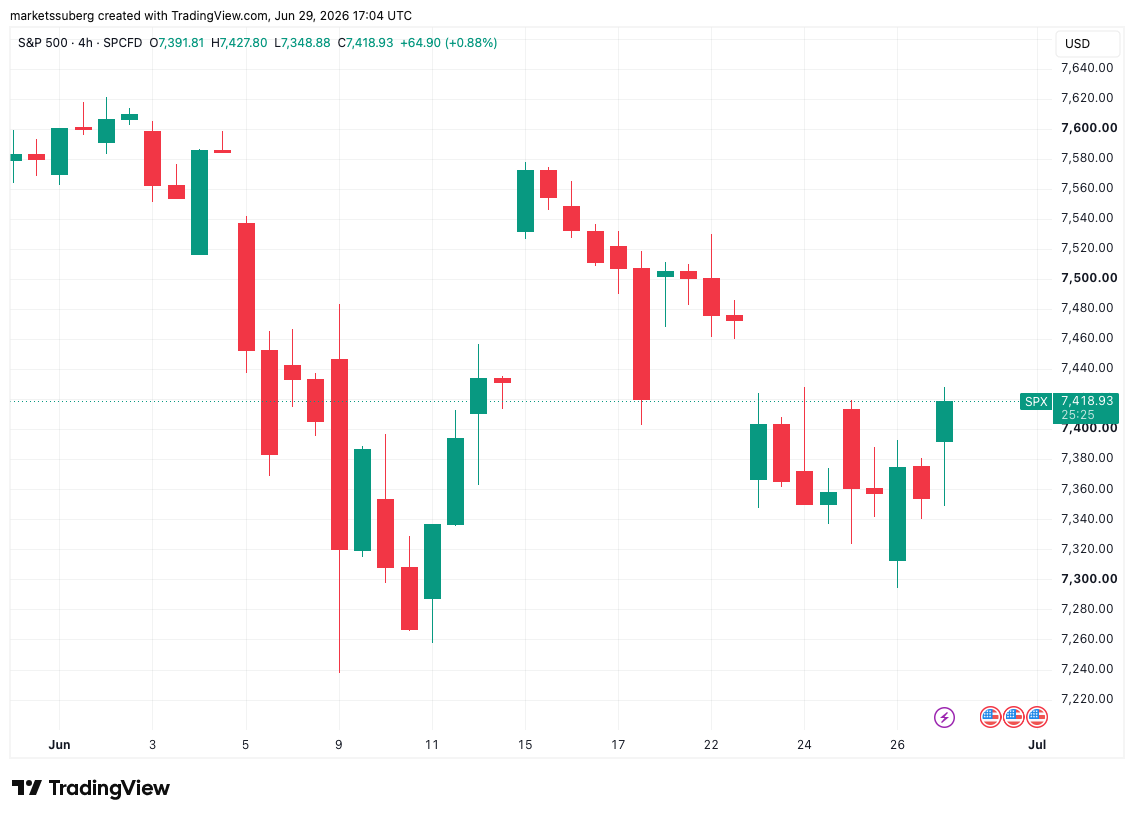
The S&P 500 and Nasdaq Composite Index both started the week in the green amid renewed optimism of rescuing the US-Iran peace deal.
In a post on Truth Social, US President Donald Trump wrote that Iran had “requested a meeting,” which would take place in Doha, United Arab Emirates, on Tuesday.
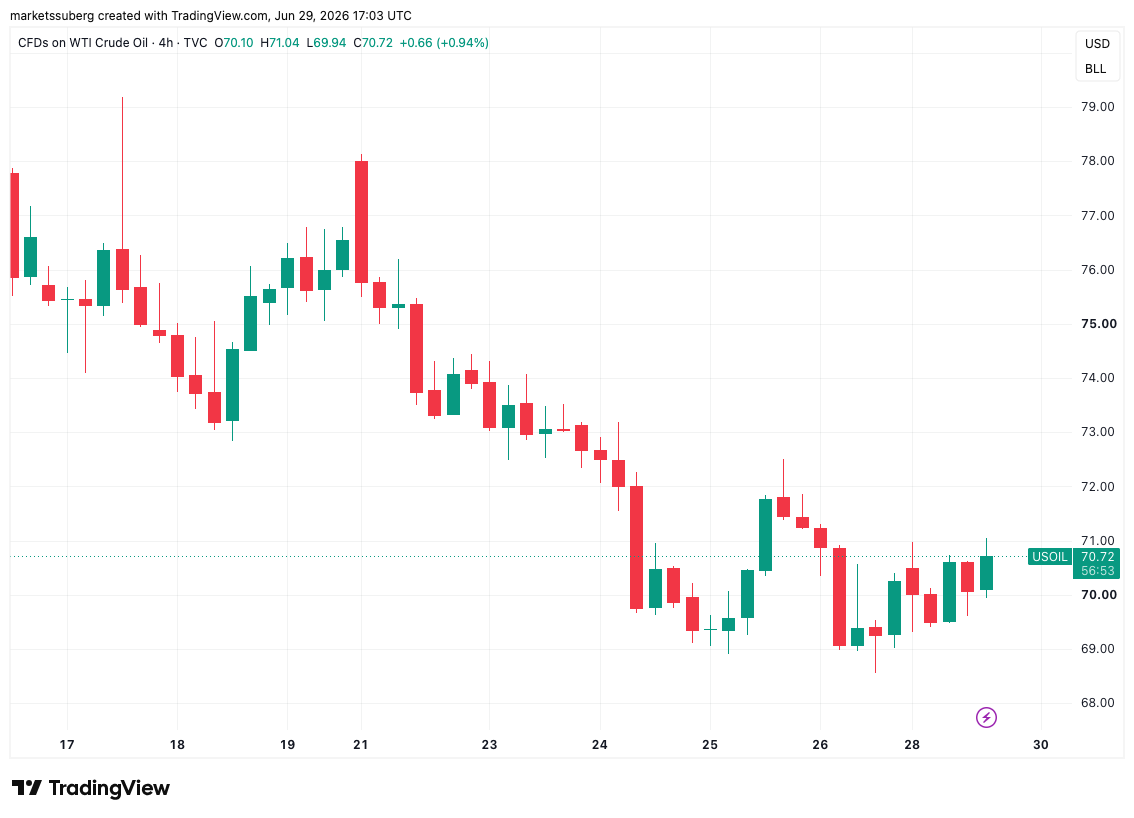
Commenting on the latest events, trading company QCP Capital nonetheless cautioned over the potential for oil prices to rebound — a key potential headwind for crypto.
“While both countries appear to have agreed to stand down for now, the situation remains uncertain. That said, oil prices have remained largely stable in the low $70s, suggesting cautious optimism that tensions may ease,” it wrote in its latest Market Color analysis.
“However, this relatively muted market reaction also leaves significant upside risk for oil prices should supply recovery prove slower than expected.”
CFDs on WTI crude oil four-hour chart. Source: Cointelegraph/TradingView
On Friday, WTI crude fell below $68 per barrel for the first time since early March, but was back above the $70 mark at the time of writing.
“U.S. markets are also set to be closed on Friday, while the situation between the U.S. and Iran remains fluid, leaving volatility likely to stay elevated, partly driven by thinner liquidity conditions, similar to what we saw over the past weekend,” QCP added.
Bitcoin needs more “conviction” from buyers
Bitcoin market participants thus sat on the sidelines as “choppy” price moves defined low-time-frame market action.
Related: BTC price RSI prints key 2026 signal: Five things to know in Bitcoin this week
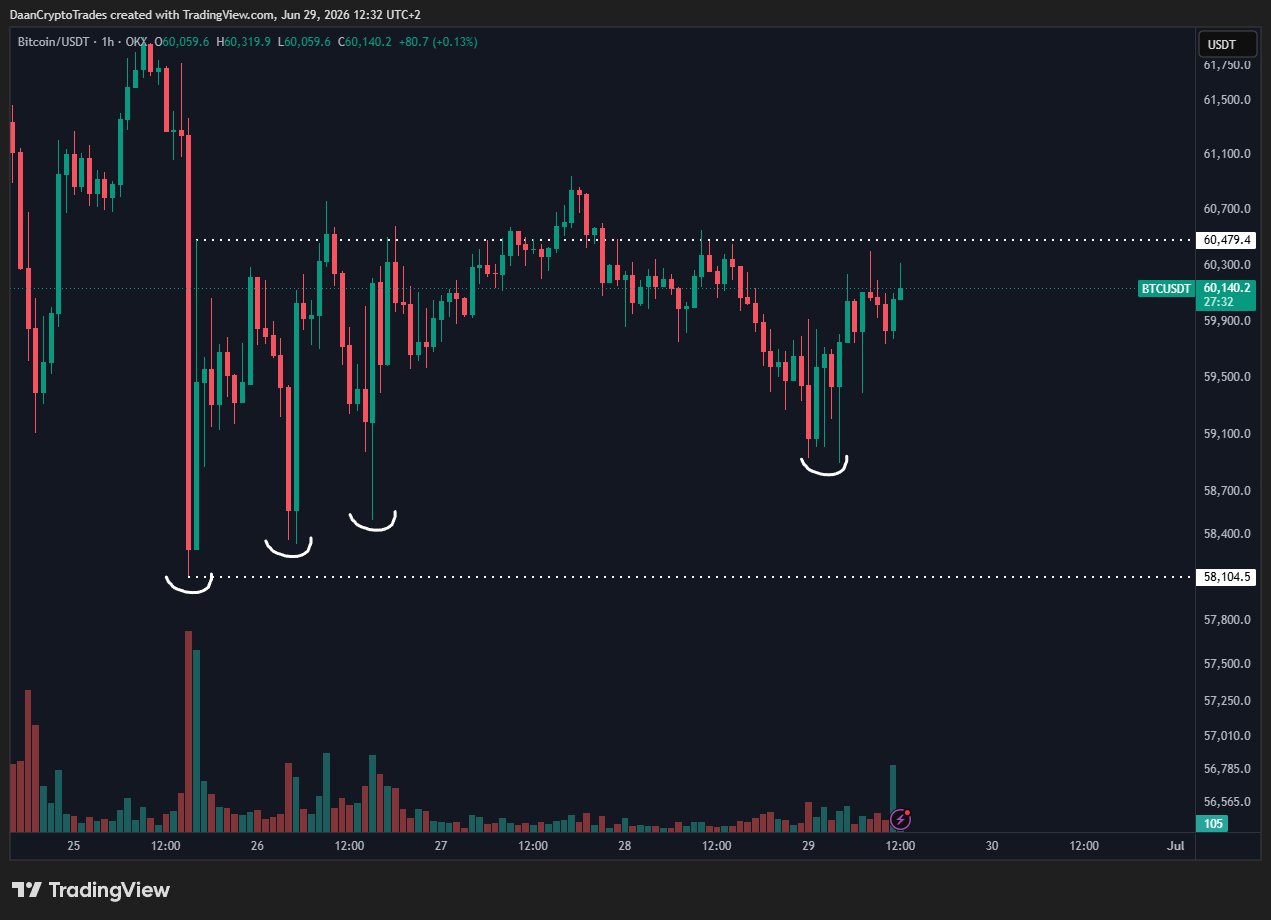
“Chopping around in this range at the previous June lows. The ~$60K region keeps capping price as we have some marginally higher low wicks below,” trader Daan Crypto Trades wrote in his latest X analysis.
“The longer price spends moving around in this region, the bigger the following move upon a range break will be. Eyes on $58K & $61K.”
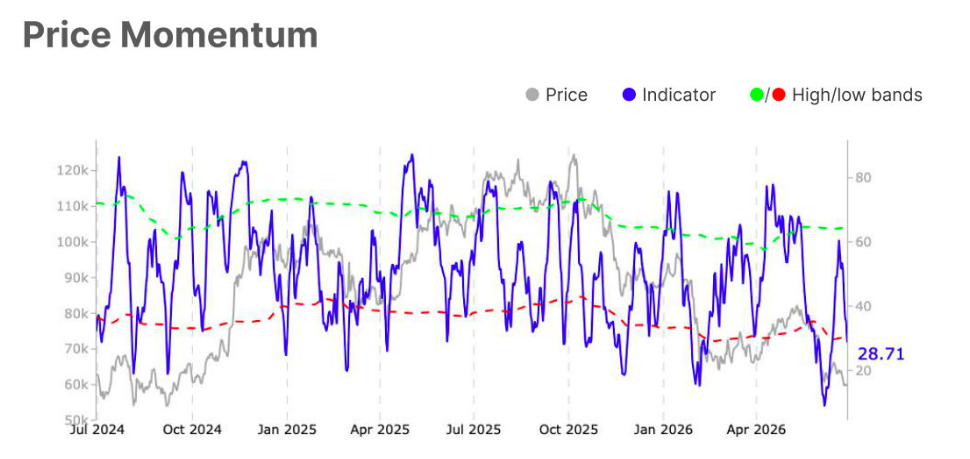
In its latest Market Pulse bulletin, onchain analytics platform Glassnode said that buyers “have so far lacked the conviction required to establish a sustained recovery, leaving price range-bound near local lows.”
“Beneath the surface, the market remains in a phase of structural adjustment as capital continues to contract and participants adopt a more defensive posture,” it reported.
“Spot markets are still experiencing persistent net selling despite an increase in trading activity, suggesting that available liquidity is being used primarily to distribute rather than accumulate Bitcoin at current prices.”
Bitcoin price momentum data (screenshot). Source: Glassnode
While noting “more balanced” onchain data, Glassnode added that a shift toward supply ownership by more speculative investors increased the potential for price volatility.
“Taken together, Bitcoin appears to be stabilizing around the $60K region, but with spot order flow, derivatives positioning, and institutional demand all remaining defensive, a sustained recovery is likely to require a meaningful return of buyer conviction,” it concluded.
Under the “yen carry trade” framework, a weak yen (USD/JPY rising) is supposed to be accompanied by rising BTC, just as it tends to support stocks. Extending that logic, a strengthening yen should trigger risk aversion in both stocks and cryptocurrencies.
That’s precisely what happened in late July/early August 2024, when the Bank of Japan hiked interest rates, sending the yen sharply higher. Risk assets had a meltdown, with BTC falling from roughly $65,000 to $50,000 in the following weeks.
Carry-unwind fears have resurfaced lately as the yen continues to slide, hitting four-decade lows this week. That’s raised hopes of more aggressive action by the BOJ to stem the yen’s slide.
However, if the latest correlation is anything to go by, potential BOJ action and a resulting rise in the yen could actually put a floor under BTC, working the opposite way from what carry-trade logic would predict.
A mirage?
Correlation doesn’t necessarily mean causation.
Neither BTC nor the yen may be driving the other directly. Instead, broad US dollar strength or weakness may be moving both assets independently, creating the appearance of a tight BTC-yen relationship.
That reading makes sense in context: markets have recently priced in at least one 25-basis-point interest rate hike from the Fed this year. That hawkish repricing, a sharp reversal from earlier hopes of rate cuts, has lifted the dollar broadly. The euro, the Australian dollar, the New Zealand dollar, gold and silver have all declined against the greenback over the same stretch.
On January 1, 2000, the world was supposed to end. As the date changed and the next millennium rolled in, computer systems programmed in the 1960s and 1970s were expected to crash. Storage space was very expensive back then. As a result, programmers often saved space by recording years with only two digits instead of four, omitting the century. Once the century changed, the logic would be lost, and systems would malfunction.
Massive IT projects were launched to fix the problem and prevent looming disasters, like nuclear power plants exploding. Alongside a booming tech industry, an even more booming survival industry emerged. Guidebooks were published on how to survive the impending catastrophe — hide under the table — while there was a healthy trade in bunkers and overpriced survival packs.
In a preemptive move, the U.S. Federal Reserve loosened monetary policy. The burgeoning internet and its early successes had brought technology to the masses. Together with loose financing conditions and growing public enthusiasm at the turn of the millennium, this ignited a unique boom on the stock markets, especially for tech and internet stocks.
The world did not come to an end. Instead, people started to wonder what would become of companies that had no chance of turning a profit and depended on continuous injections of investor funding. Doubts began to spread, share prices started to fall, and over the course of the year 2000, the dot-com bubble burst.
The final nail in the coffin of the 2000s bubble came on September 11, 2001. The terrorist attack on the World Trade Center in New York made it seem as though the world really was ending. Air traffic shut down, war broke out, and a recession followed. Stock markets plunged, and they just kept falling.
Once again, the U.S. Federal Reserve stepped in to save the economy and the financial markets. Interest rates were slashed, credit became cheap, and with this, the economic downturn was slowed. Starting in early 2003, the stock markets began to recover. Slowly at first, then faster. The exceptionally low interest rates stimulated economic activity, albeit not as intended. The burst tech bubble was soon replaced by a gigantic housing bubble, especially in the United States.
The film The Big Short begins with a quote from Mark Twain:
“It ain’t what you don’t know that gets you into trouble. It’s what you know for sure that just ain’t so.”
History provides us with many examples that show how stubbornly and for how long people, indeed entire societies, have clung to false beliefs. A good example is the geocentric worldview that many held in the Middle Ages: they believed that the universe revolved around the Earth. Galileo Galilei held an opposing belief and was threatened with death and excommunicated from the Church for it. The Church’s self-image and vested interests forbade such an inconvenient truth. But as it is with the truth, a point comes when it can no longer be denied.
The same was true of the financial crisis of 2007–2009. Behind many financial products on offer were mortgage-backed securities of little or no value. This truth, too, eventually could not be denied. The markets for these securities and the financial products built on them collapsed, along with a lot of the banks and financial institutions that held them. In the end, the entire financial system imploded. Major, well-known banks went bankrupt, financial markets dried up, and even healthy companies were put at risk of failure.
The terrifying yet fascinating part was the reaction of governments and central banks — through bailouts. With the exception of Lehman Brothers and a few others, virtually all the major institutions were saved. At the time, Chancellor Angela Merkel guaranteed the German public that their bank deposits were safe — a promise she likely could not have kept if it had been called out.
The central element of the bailouts was and still is the printing of money. Governments generously rescued important, systemically relevant banks and companies with the input of fresh money. Central banks financed and continue to finance this by purchasing government bonds, cutting interest rates, and providing very favorable financing conditions to banks.
This point is very important. When a central bank buys an outstanding government bond, that means it is increasing the money supply or printing money. In the film Oeconomia, Peter Praet, at that time the chief economist of the ECB, says this quite explicitly: “It is not physical money, but electronic.”
Printing money means increasing the amount of money in circulation. And that results in all of our money getting watered down. Ultimately, this makes it worth less since there’s more money but the same amount of goods.
When new money is created — that is, when money is inflated and then spent, no matter what it’s spent on — prices will eventually rise, and the money everyone else holds becomes less valuable. Put another way, when new money is created, everyone who already holds money is slightly dispossessed.
Only those who receive the new money first benefit, which is usually the banks, shareholders, and companies as well as borrowers and thus the government. Also benefiting are those who hold the goods or assets that are first purchased with the newly created money. This primarily includes real estate, stocks, and tangible assets in general.
Such inflation must be distinguished from individual price increases. If the demand for city-center locations suddenly rises because people are moving from the country to the city, property prices in city centers will rise, while they fall in the countryside. With inflation, prices rise almost everywhere. Price increases caused by rising demand or falling supply, such as after a poor harvest, are limited and are offset by a drop in prices elsewhere.
Inflation acts like a tax, but it isn’t perceived as such. The government could just as well take a small amount of money from every business and citizen to cover its spending instead of creating new money by issuing a government bond. In practice, it would be the same thing, only it wouldn’t be so easy, and many people would complain and might vote those politicians out in the next election.
Inflation is vague, and in public perception it’s not the government’s fault but rather that of others who are creating shortages of goods and profiting from rising prices. Political and public scapegoats for rising prices can always be found.
The former ECB chief economist, Peter Praet, states quite clearly that the functioning of today’s financial and economic system depends on the creation of more and more money — in other words, on continuous inflation. If the last financial crises have shown us anything, it’s the automatic reaction of governments: printing money. And crises will always keep coming for a variety of reasons: the ongoing climate crisis, pandemics, wars, migration, demographics, etc. Justification and excuses for printing money can always be found.
What does this have to do with Bitcoin?
A major and very valid criticism of a sound monetary system, in which money cannot be multiplied uncontrollably, is that it provides no way to intervene quickly by increasing the money supply in severe crises. That’s true. You would have to save beforehand, to set aside reserves.
And if there is one thing politicians cannot do, it’s save. There is always a good reason to spend money, whether it’s simply doing good, solving problems, winning over voters before an election, or even supporting a friendly entrepreneur in one’s own constituency.
The alternative would be to raise taxes in order to finance these unforeseen expenses. That would be politically and economically counterproductive. It would scare off voters and take away their purchasing power.
The crucial point is this: without the ability to print money at will, the boom that precedes a crisis wouldn’t arise in the first place, or at the very least would be much smaller. And the subsequent crises would also be a lot smaller. This is evident in the economic cycles of the 19th century, when a strict gold standard was in place.
Yes, there were numerous crises at the time. But they were short and less severe. And periods of falling prices certainly did not end in the dreaded deflationary spiral.
The ability to print unlimited amounts of money leads to correspondingly large misallocations, which then lead to correspondingly large corrections, and therefore, crises. These crises in turn trigger even more money-printing, and on it goes.
The greater the misallocations beforehand, the greater the corrections afterward. A healthy monetary system leads to sounder economic decisions, sustainable upturns, and brief downturns in which misallocations are corrected.
Money that cannot be arbitrarily multiplied limits misallocations during a boom, and accordingly, limits corrections during a downturn.
At the height of the financial crisis, on October 31, 2008, an anonymous person or group published the Bitcoin white paper — six weeks after Lehman Brothers, one of the largest banks in the U.S., filed for bankruptcy.
On January 3, 2009, Satoshi Nakamoto launched the Bitcoin blockchain. The very first block was mined. This first block contains the following message:
“The Times 03/Jan/2009 Chancellor on brink of second bailout for banks”
This was an explicit reference to a headline in The Times on January 3, 2009 — the repeated bailout of a financial system still teetering on the brink of collapse.
Bitcoin was, and still is, the answer to a fragile financial system: to uncontrolled money printing, to willful denial of reality, but also to the unfair and socially unjust expropriation that accompanies money creation.
The cap of 21 million bitcoin and the lack of central control make a policy of inflation impossible. Someone who holds bitcoin cannot be dispossessed by the uncontrolled printing of even more bitcoin.
Nor can they be dispossessed by banks that go bankrupt or deny access to bitcoin, provided they hold their bitcoin in a self-hosted wallet and thereby manage their own access. No central authority can revoke that access.
The timing of Bitcoin’s launch was no coincidence. It was the reaction to a financial system that would have collapsed had money not been printed in a pretty much uncontrolled manner.
Bitcoin is sound money — a response to a broken financial system. It is a system that is not imposed from above. Participation is voluntary and open to anyone. No one with a computer or smartphone and an internet connection can be excluded from it. For many, it’s a lifeline out of the fiat money system that is not sustainably viable.
In contrast to an inflationary and opaque system, Bitcoin is decentralized, transparent, and fundamentally honest.
Discover more in Bitcoin: The Honest Money! This excerpt is just the beginning. Dive deeper into how inflation devalues your money, your savings, and your time in Bitcoin: The Honest Money by Alex von Frankenberg, Ph.D. The paperback is available now.
J.P. Morgan’s Kinexys blockchain payments platform has processed more than $4 trillion in transactions since launch and expanded to eight currencies, adding the Australian dollar, Hong Kong dollar, Japanese yen, Chinese renminbi and Singapore dollar to serve institutional clients across Asia-Pacific.
J.P. Morgan’s Kinexys blockchain has crossed $4 trillion in cumulative transactions and added five Asia-Pacific currencies, extending 24/7 settlement to the region’s largest trade corridors.
The bank added the Australian dollar, Hong Kong dollar, Japanese yen, Chinese renminbi and Singapore dollar to its Blockchain Deposit Account network on Monday, bringing the total to eight currencies alongside the existing U.S. dollar, euro and British pound, according to CoinDesk. J.P. Morgan says Kinexys has processed more than $4 trillion in transactions since launch, with average daily volume exceeding $7 billion.
Permissioned Blockchain
Kinexys uses a permissioned blockchain to settle transfers between institutional clients around the clock. Clients hold deposits at J.P. Morgan that are represented digitally on-chain, allowing near-instant settlement without leaving the bank’s regulated infrastructure. The model is designed to remove the timezone constraints and correspondent-banking queues that slow conventional cross-border payments.
J.P. Morgan also offers JPM Coin, a deposit token issued on Base, Coinbase’s Ethereum Layer 2, for clients that want settlement on a public chain alongside the private permissioned network.
First APAC Clients
Payoneer, the cross-border payments fintech, is among the first customers using the Australian dollar service. JERA Global Markets, the commodity-trading joint venture of JERA and EDF Trading, is the first to use the Japanese yen account, citing round-the-clock cash access as an operational advantage for energy traders working across time zones.
Bank Rails vs. Public Chains
Kinexys reached $3 trillion in cumulative volume at $5 billion daily as of April 28, per a J.P. Morgan milestones update. Adding roughly $1 trillion in two months, alongside the APAC expansion, puts the platform at a scale few public-chain settlement networks have matched for institutional use cases.
The permissioned model serves only whitelisted counterparties inside J.P. Morgan’s compliance framework, distinguishing it from open stablecoins such as USDC or USDT. That structure is its selling point to regulated institutions: no new counterparty risk, no KYC gap, near-instant settlement inside a banking framework they already operate in. JPMorgan, Citi and Bank of America are also building a shared tokenized deposit network through The Clearing House targeting a 2027 launch, adding another lane for bank-issued digital money that competes with public-chain alternatives.
Stoked.bet is bringing a proven sportsbook into Web3 with an on-chain sports and prediction market ecosystem built around non-custodial infrastructure, transparent settlement, Marketplace utility, Heat rewards, and broader $STK participation.
Stoked.bet is backed by more than $30M in operating history, over 2,500 members, and years of experience running a private sportsbook. The rebrand brings that track record into a public-facing Web3 ecosystem built around user control, on-chain settlement verification, Marketplace utility, Heat rewards, and broader $STK participation.
Stoked.bet enters Web3 with real platform experience, an existing community, and a proven operating track record already behind it. The goal is to combine that credibility with crypto-native infrastructure that gives users more visibility, control, and ways to participate.
The platform’s Marketplace and Heat rewards system will serve as a core part of the ecosystem, giving users more reasons to engage beyond the initial platform experience. For audiences in the U.S. and other restricted regions, the Marketplace and broader ecosystem story will be a key entry point into Stoked.bet without leading with sportsbook-specific messaging.
A private beta is already underway, giving Stoked.bet early momentum as it prepares for broader public access.
This rebrand is the first step in Stoked.bet’s broader rollout, with future updates expected around public platform access, Marketplace activity, rewards engagement, and ecosystem growth.
About Stoked.bet Stoked.bet is a Web3 sports SocialFi and Marketplace ecosystem built around non-custodial infrastructure, on-chain transparency, Marketplace utility, Heat rewards, and $STK participation. Built on the operating team behind Steam22, Stoked.bet brings more than $30M in sportsbook history into a broader public-facing Web3 ecosystem.
Source: Stoked.bet
The above article “Stoked.bet Brings a Proven $30M+ Sports Betting OnChain” was first published on AlexaBlockchain. Read the complete article here: https://alexablockchain.com/stoked-bet-brings-a-proven-30m-sports-betting-onchain/
Submit Your Blockchain and Crypto Press Release here.
Disclaimer: This is a press release, provided by the company/ company representative. AlexaBlockchain does not endorse, guarantee, or accept responsibility for the content, accuracy, quality, advertising, products, or other materials presented in this publication. Readers are advised to conduct their own due diligence before taking any actions related to the company mentioned herein. AlexaBlockchain expressly disclaims any liability for damages or losses, whether direct or indirect, arising from or related to the use of or reliance on any content, goods, or services referenced in this press release.
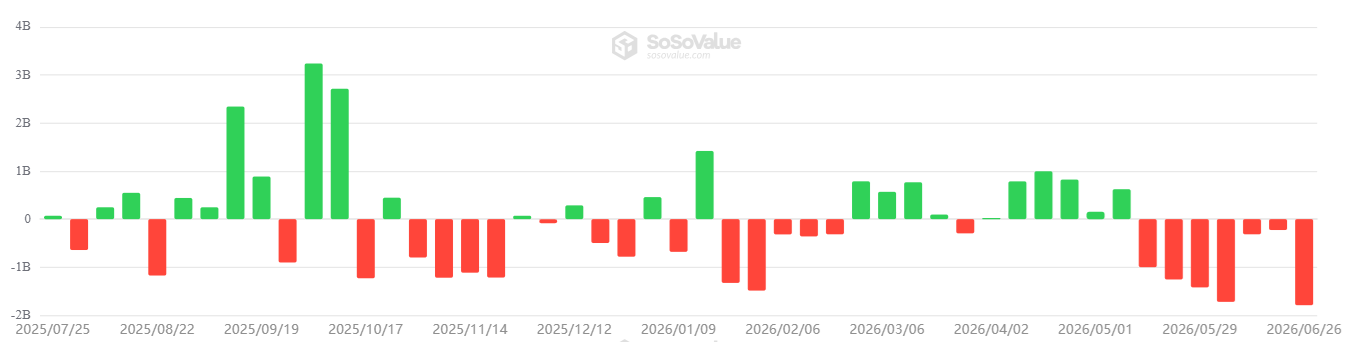
U.S. spot bitcoin ETFs lost a net $231 million on Monday, with BlackRock’s IBIT accounting for $300 million of outflows that other funds partly offset, including $50 million into ARKB and $35 million into GBTC, per SoSoValue data.
The outflow lands as risk appetite elsewhere is surging. Wall Street’s technology rally spread into Asia on Tuesday, with the MSCI Asia Pacific index up 1% on the year’s final trading day after a semiconductor rebound helped the S&P 500 snap a five-session losing streak. The Asian benchmark is on track for its biggest quarterly gain in almost 17 years.
South Korea’s Kospi, which crashed 10% in a single session earlier this month, climbed 2.1% to extend its lead as the world’s best-performing major benchmark this year. Samsung is up more than 100% this quarter, and SK Hynix has gained almost 240% since April. The yen slid to its weakest level against the dollar since 1986, a sign investors are funding the AI trade by borrowing in yen.
Bitcoin ETFs are not participating in that capital rotation, however. The same AI infrastructure spending fueling record quarters in Seoul and Tokyo is the trade competing for the dollars that might otherwise flow into bitcoin, a dynamic that has run through the month’s coverage of SpaceX, Anthropic and the chip sector.
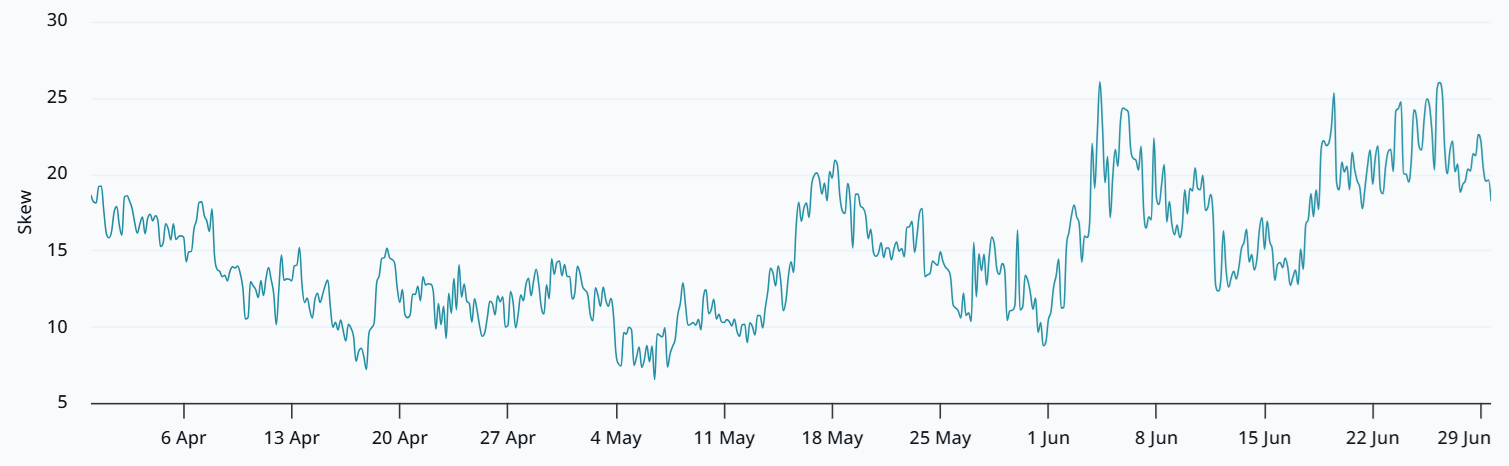
An extreme Bitcoin put-call options imbalance and a 19% delta skew reveal heavy hedging against downside price swings.
Strategy’s cash hoard eases short-term debt fears but does not hold back a broader capital rotation into tech stocks.
Bitcoin has failed to reclaim the $61,000 mark since Thursday, despite optimism fueled by lower crude oil prices following the US and Iran’s 60-day ceasefire agreement. Demand for downside Bitcoin price protection jumped to unusually high levels, prompting traders to question whether $55,000 is the next target.
The premium paid on Bitcoin put (sell) options on Deribit totaled $115 million on Friday, 7 times the $16 million paid on call (buy) options. The imbalance was the highest in over 12 months, signaling extremely low demand from bulls. However, such data does not necessarily signal conviction from bears.
Bitcoin 30-day options delta skew (put-call) at Deribit. Source: Laevitas
The Bitcoin options delta skew stood at 19% on Monday, meaning market makers are unwilling to hold downside price exposure. This setup hints at fear, although that has been the norm for the past 4 weeks. Data aligns with growing demand for bearish hedging as Bitcoin price struggles to sustain levels above $60,000.
Bitcoin’s weakness can be partially pinned to investors’ discomfort with MicroStrategy (MSTR US) ability to pay dividends and debt maturing in 2027. The company reacted on Monday by announcing an additional $1.2 billion in cash from recent share sales and setting aside $1.25 billion in Bitcoin for eventual sale.
The measures taken by Strategy ease some short-term concerns but also create anxiety about Bitcoin’s supply and demand dynamics. Even if no sales occur over the next couple of months, bears are more comfortable knowing that Strategy has no incentives to issue MSTR shares given the current 17 months of dividend coverage.
Related: Grayscale’s Pandl says Strategy should sell $3B Bitcoin to restore confidence
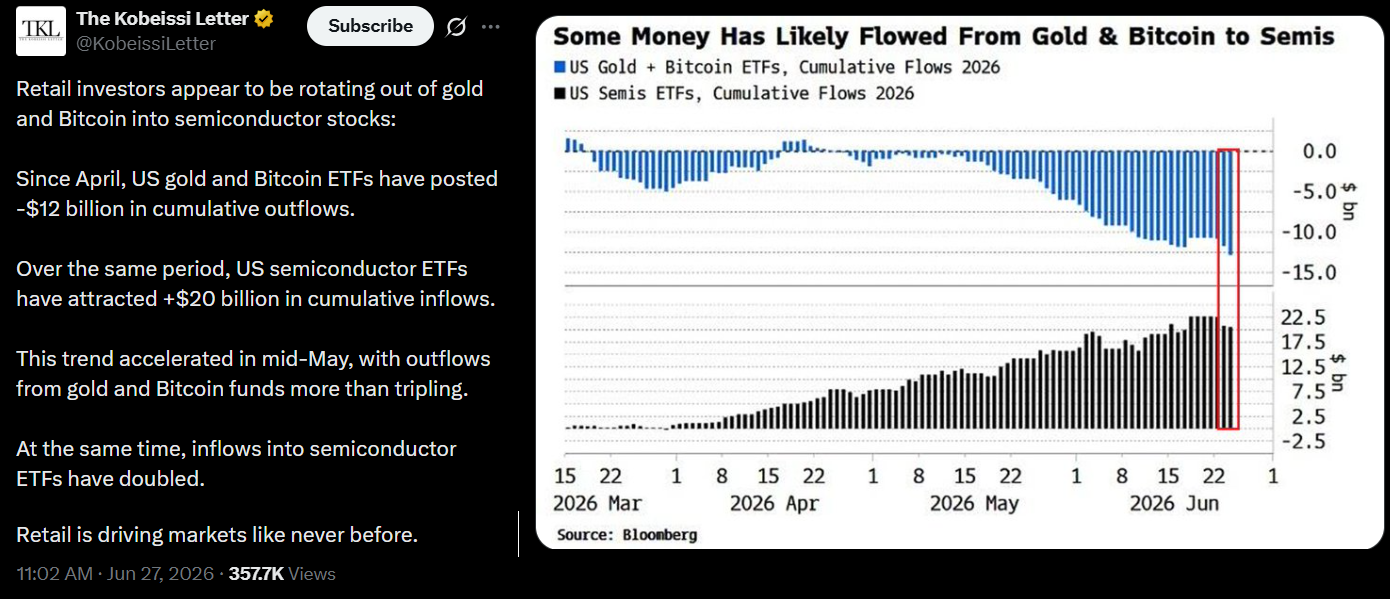
Rotation from Bitcoin and gold into semiconductor stocks
In contrast to Bitcoin investors’ pessimism, momentum in the US stock market has shifted favorably after inflationary pressure eased, with crude oil prices dropping to their lowest levels in 4 months. Additionally, a Goldman Sachs report projected 22% annual earnings growth for S&P 500 companies, easing concerns about excessive valuations.
Source: X/KobeissiLetter
Retail investors appear to be rotating out of gold and Bitcoin into semiconductor stocks, according to ‘The Kobeissi Letter’ analysis. Data collected by Bloomberg has shown over $20 billion in cumulative inflows in semiconductor exchange-traded funds (ETFs), triggering an 81% rally in iShares Semiconductor ETF (SOXX US) and 60% gains in VanEck Semiconductor ETF (SMH).
The 7 consecutive weeks of net outflows from the US-listed Bitcoin spot ETFs have shattered bulls’ hopes of a strong bounce from the $58,050 lows on June 25. Regardless of whether the sell-off can be attributed to the rotation into tech stocks, sentiment is unlikely to improve while Bitcoin spot ETFs continue to see strong net outflows.
A retest of $55,000 should not be dismissed, but the increased demand for downside hedging in Bitcoin options should not be interpreted as growing confidence among bears.
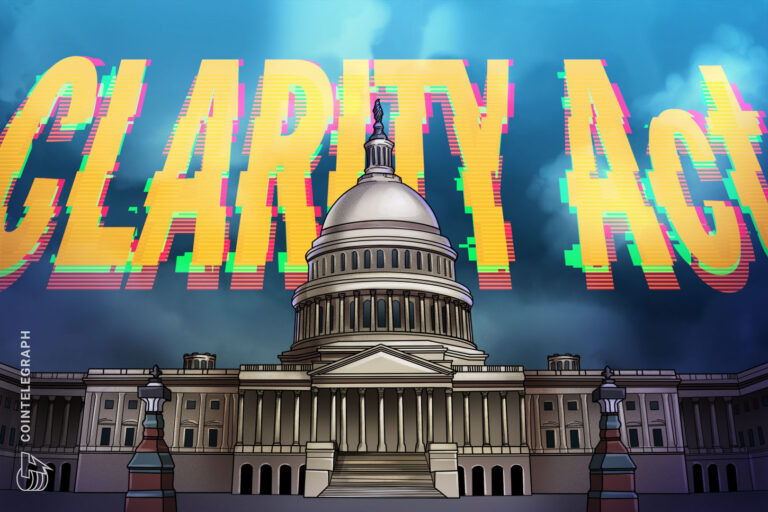
The path of the Digital Asset Market Clarity (CLARITY) Act, a bill intended to establish comprehensive guidelines for cryptocurrency regulation, remains uncertain with the US Congress set to break for another state work period in a matter of weeks.
Since passage in the US House of Representatives in July 2025, the CLARITY Act has faced several hurdles advancing in Congress, from industry pushback on stablecoin rewards to lawmakers’ concerns about ethics. The bill passed the Senate Agriculture Committee in January and the Senate Banking Committee in May along party lines, setting it up for consideration in the full chamber.
However, US President Donald Trump on Wednesday canceled the signing ceremony for the 21st Century ROAD to Housing Act, a housing bill that received bipartisan support in both chambers and contained a ban on a central bank digital currency (CBDC). Trump said that he would not sign the bill until Republicans in Congress passed the SAVE America Act, legislation requiring voters to provide proof of US citizenship in person to register, adding in March that he would “not sign other bills” until it was passed.
The move by the president leaves the future of the CLARITY Act in doubt despite earlier statements signaling he supported the bill. If Trump vetoes the legislation, Congress could override him with a two-thirds majority vote in both chambers. According to the US Constitution, if a president doesn’t sign or veto a bill within 10 days while Congress is in session, the bill automatically becomes law.
Related: Galaxy cuts CLARITY Act odds to 50% as Senate floor time narrows
On Monday, Republican leaders in the Senate, including banking committee chair Tim Scott and majority leader John Thune, said that they were pushing for the chamber to pass CLARITY in July. Lawmakers are scheduled to be out of Washington, DC and on state work periods until July 13, giving them four weeks to address the bill before a monthlong state work period in August.
Source: Senator Tim Scott
“We’ve been negotiating on the CLARITY Act hardcore since last Labor Day, and it’s been an arduous process,” said Senator Cynthia Lummis, one of the bill’s proponents, in a Fox Business interview last week, adding:
“We’re still working a little bit on DeFi, we’re working [on] illicit finance, we’re working a little bit on ethics [..] We’re finally to the point where we’re going to put out the text over the July 4th, and give people one last really thorough look at the bill, and then we’re moving in July.”
What happens if lawmakers face more delays on CLARITY?
Republicans hold a slim majority in the US Senate, where they will need some support from Democrats should they hold a vote on CLARITY next month. Many Democratic lawmakers have been pushing for ethics provisions in the bill, citing the Trump family’s ties to the crypto industry through the president’s memecoin and his sons’ involvement in the World Liberty Financial platform and a Bitcoin mining company.
Should Republicans not meet the 60-vote threshold in the Senate before August, many experts expect that lawmakers dealing with reelection campaigns could delay the passage of CLARITY, potentially pushing the legislation to the next session of Congress in 2027.
Magazine: AI is banking the unbanked in Africa… faster than crypto
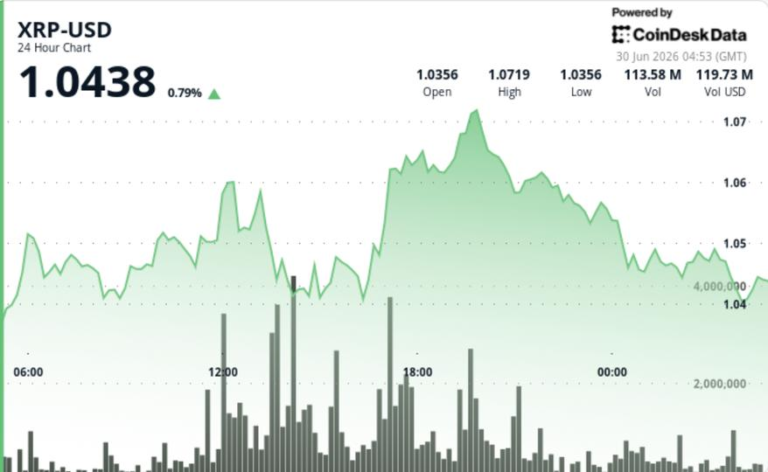
• The token traded in a $0.0435 range and continued to hold above the $1.00 psychological support level.
• The main burst of activity came on June 29 at 17:00, when volume reached 86.5 million XRP, about 67% above the 24-hour average.
• Price later consolidated between $1.03 and $1.06, leaving the market range-bound rather than in a confirmed recovery.
Technical Analysis
• The key development is that XRP continues to defend $1.00 even after a 19% monthly decline.
• The leverage reset improves the setup. Open interest has fallen sharply, funding has turned negative and forced long liquidations have cleared out crowded positioning.
• The on-chain picture is stronger than the chart. Active addresses are rising, ETF inflows are continuing and exchange reserves remain stable, but price is still below major moving averages.
• XRP remains capped by resistance near $1.10, with larger barriers near the 50-day EMA around $1.20 and the 100-day EMA around $1.31.
• The 4-hour RSI has recovered from oversold territory to 46, but momentum remains below the neutral 50 level.
What traders should watch
• $1.00 remains the key support level. A break below it would put $0.90-$0.87 back in focus.
• $1.06 is the first short-term resistance level, followed by $1.09-$1.10, where recent rallies have stalled.