With more institutions embracing stablecoins, the competition is increasingly shifting from issuing tokens to determining who controls the underlying infrastructure and network.
Unlike most existing stablecoins, Open USD will allow businesses to mint and redeem tokens without fees while returning reserve income to participating partners, less a management fee. Governance will also be shared among members rather than controlled by a single issuer.
The model targets one of the core economics of today’s stablecoin market. Issuers such as Circle earn revenue by investing reserves backing their tokens in short-term U.S. Treasuries and retaining most of the interest generated by those assets. Open USD instead plans to distribute that yield to participating businesses.
The approach resembles the Global Dollar Network (USDG), a stablecoin consortium led by Paxos that shares reserve income with participating firms. That network is backed by companies including Robinhood, Kraken and Galaxy Digital, and was designed to encourage broader adoption by aligning incentives between the issuer and distribution partners.
In Europe, a group of banks and payment providers launched Qivalis, a venture to develop a euro-denominated stablecoin as financial institutions seek to build shared digital payment infrastructure.
The breadth of Open USD’s backing reflects that shift. Beyond Stripe, Coinbase, Mastercard and Visa, launch partners include BNY, Standard Chartered, DBS, U.S. Bank, Shopify, Google, IBM, Mercado Pago, Fireblocks, Anchorage Digital, MetaMask, Aave, Solana, Polygon and Ripple.
A U.S. judge sentenced Chinese businessman Miles Guo, the billionaire behind the fraudulent crypto venture Himalaya Coin, to 30 years in prison, long after a trial jury found the well-connected defendant was guilty of several crimes in 2024.
Guo, 55, also known as Ho Wan Kwok and a number of other aliases, was a self-imposed exile from China who had a close relationship with Steve Bannon, the former strategist of President Donald Trump who has had his own legal entanglements. In 2021, Guo had pushed his fraudulent crypto token, known as H-Coin, telling prospective buyers that it was 20% backed by gold and that the operation would cover 100% of investment losses.
He was said to pull in $500 million in investments, which was just one element of what U.S. authorities called “interrelated fraud schemes” perpetrated over five years, leading to his conviction on counts including racketeering, fraud and money laundering.
Crypto exchange users in Australia will soon face stricter rules on all transfers as the country’s travel rule is set to come into force on Wednesday, aligning it with similar rules in the EU, US and UK.
From July, all crypto sent and received on locally-regulated crypto exchanges will require users to provide additional information, such as the name of the person the crypto is being sent to or received from, and the name of the platform.
Gabby Lewis, the head of fraud and financial crime at Swyftx, told Cointelegraph that for most exchange users, “the impact should be very limited. They’ll provide the required details once, and then these will be saved for future use.”
The rules are set to bring Australia in line with other countries that have implemented the travel rule for years, which the Financial Action Task Force, an international policy-making body, first extended to crypto in 2019.
Crypto users have long expressed concern that the rule would impact the anonymity of the technology and the risks of data linking crypto transfers to personal information being leaked.
However, Lewis said that the “travel rule isn’t crypto-specific. It already applies across financial services and has been implemented in areas including Singapore, the United States, New Zealand and the UK. Australia is now following suit.”
The rule aims to prevent money laundering, terrorist financing and scams by increasing the traceability of crypto transfers. It will be enforced by the Australian Transaction Reports and Analysis Centre (AUSTRAC), the country’s financial intelligence agency.
Transfers from a regulated crypto exchange to a self-custodial address, such as a cold storage wallet, will also prompt a user to verify and declare that they are the owner of that address.
“We’re generally talking about a quick confirmation that the wallet is theirs,” Lewis said. “The additional steps mainly come into force for transfers that involve another party or another exchange.”
Australia’s travel rule has no minimum value threshold, meaning a transfer of any size will require an exchange to gather information, aligning it with countries including France, the Netherlands and Japan that have no minimum.
Source: Sam Green
Other countries have set minimum reporting thresholds, such as the US, which only collects information on transfers starting at $3,000.
Some crypto exchanges operating in Australia have already begun to implement the travel rule, such as Kraken, which started on March 31, and CoinJar, which started on Tuesday.
Related: Australia passes digital asset bill bringing crypto platforms under licensing
Crypto users online have recently given mixed reactions to the rule, which the Australian parliament passed into law in 2024.
“With these new rules, you can forget about sending crypto anonymously,” a Reddit user wrote earlier this month.
“New travel rule is insane,” another Reddit user wrote earlier in June. “Thinking of moving everything to cold storage instead now.”
In response, one Reddit user said that “the regulated platforms were never anonymous.”
“This is less of a problem than you’re making it out to be unless you’re involved in activities the authorities would be interested in already,” another user wrote.
Magazine: Crypto scammers face death, Aussie CGT makes Asian hubs attractive: Asia Express
The Clarity Act is widely viewed as the crypto industry’s most important market structure bill because it would establish clear rules for when digital assets are regulated as securities by the Securities and Exchange Commission (SEC) or commodities by the Commodity Futures Trading Commission (CFTC), replacing years of regulatory uncertainty.
Supporters say that legal clarity would make it easier for banks, asset managers and other institutions to launch tokenized products, custody services and blockchain-based financial offerings, potentially unlocking broader institutional adoption and investment in the sector.
According to Jefferies, passage would provide the durable regulatory framework banks, asset managers and exchanges need to expand tokenization, custody, staking, lending and other blockchain-based services. The bank also expects it to accelerate tokenized securities, broaden crypto exchange-traded fund (ETF) offerings beyond bitcoin BTC$58,464.16 and ether (ETH), and revive the pipeline for crypto infrastructure IPOs.
A delay, however, would extend regulatory uncertainty. While recent SEC, CFTC and OCC guidance has improved the outlook, the report said agency actions can be reversed by future administrations, potentially prompting regulated financial institutions to slow blockchain initiatives while reassessing legal and compliance risks.
The bank’s analysts expect the legislative process to drive volatility in crypto-linked equities including Circle (CRCL), Coinbase (COIN) and CoinDesk’s owner Bullish (BLSH), as well as select crypto tokens.
A Michigan judge temporarily blocked prediction market Kalshi from allowing residents to place bets on sporting events, after the state’s attorney general accused the platform of violating gambling laws.
Kalshi was hit with a temporary restraining order from Ingham County Circuit Court Judge Rosemarie Aquilina, who said the platform would be fined $120,000 for each day it fails to comply with the order’s geolocation requirements, according to a Monday court filing. The order lasts for 14 days and expires on July 13.
Aquilina wrote that Michigan residents would suffer irreparable harm from being “exploited by Kalshi’s sports betting operation masquerading as an investment opportunity.”
The move adds to the growing regulatory scrutiny on prediction market sports betting. It makes Michigan the second US state to enact a court-ordered ban on Kalshi’s sports event contracts, after Nevada issued a temporary ban on Kalshi earlier in March.
On June 17, Kentucky sued five prediction market platforms, including Kalshi and Polymarket, accusing them of operating unlicensed sports betting platforms. More than a dozen other states have taken prediction market operators to court.
The US Commodity Futures Trading Commission (CFTC) has sued several states, arguing that federally regulated event contracts fall under its exclusive authority.
Cointelegraph has approached Kalshi for comment on how the platform will respond to the verdict.
State of Michigan vs. Kalshi, court filing. Source: Law360
Prediction market sports betting rises after the FIFA World Cup
Sports betting activity has been rising on prediction markets since the beginning of the FIFA World Cup.
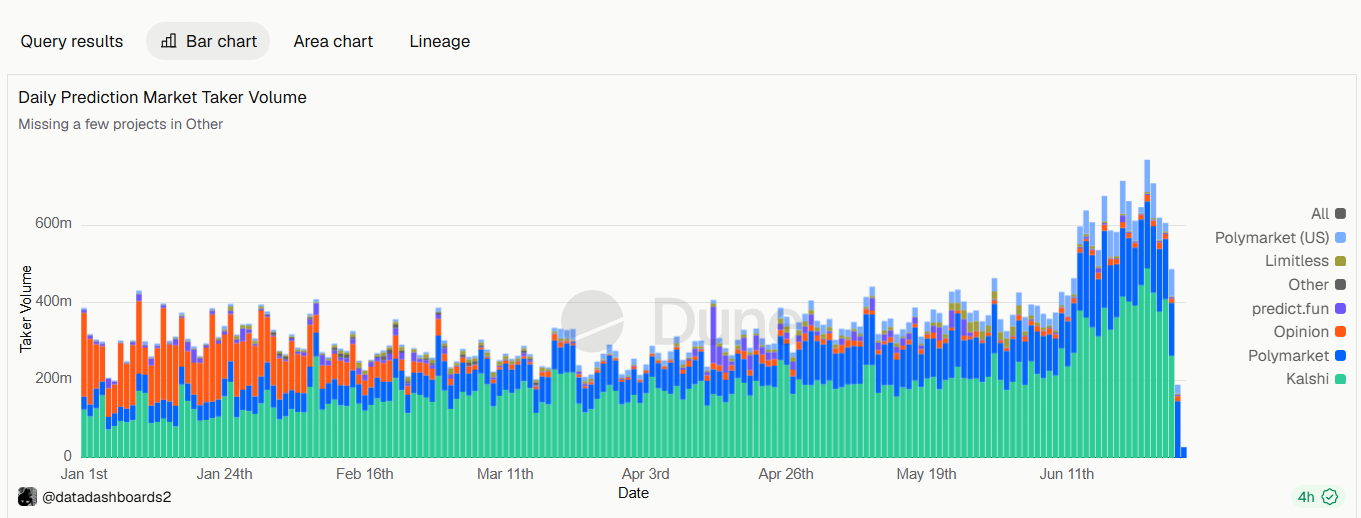
Daily taker volume, which measures contracts bought or sold by traders filling existing orders, reached a record $713 million on June 20, according to Dune data. The milestone came more than a week after the World Cup started on June 11.
Looking at monthly prediction market volume, sports betting was the leading category on the two largest prediction markets, rising 40% to $9.5 billion on Kalshi and 175% to $5.3 billion on Polymarket, Defirate data shows.
A June 11 Bernstein report predicted that the 2026 FIFA World Cup would generate more than $3 billion in incremental sports betting handle and between $5 billion and $10 billion in additional consumer prediction market volume.
Related: Kalshi in early IPO talks with investment banks: Report
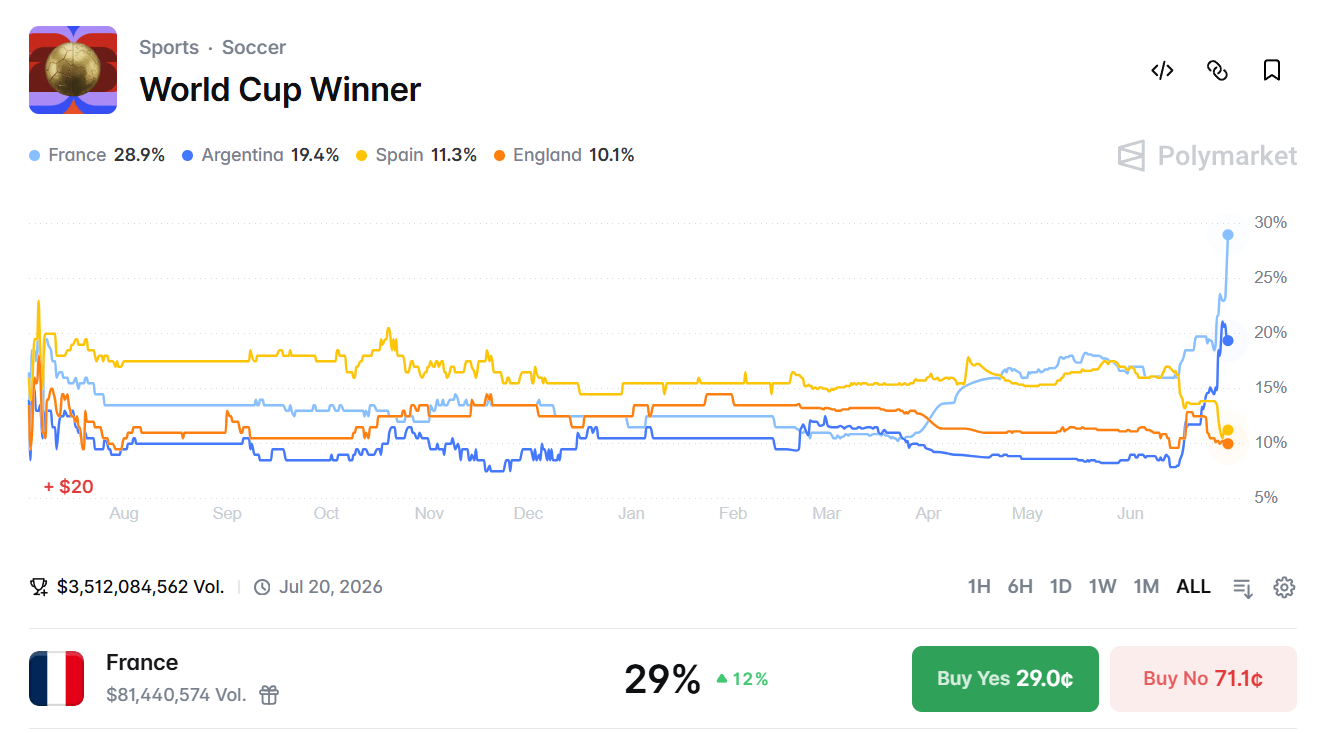
The World Cup winner contract alone has generated over $3.5 billion in trading volume on Polymarket, according to platform data.
World Cup Winner event contract. Source: Polymarket
The growing betting activity helped Polymarket emerge as an onboarding layer for new cryptocurrency users, as about 60% of World Cup bettors interacted with the blockchain for the first time during their prediction market entry, according to a Bitget Wallet study of 857,000 users, shared with Cointelegraph.
Magazine: How crypto laws changed in 2025 — and how they’ll change in 2026
European Union crypto clients should be served through a Markets in Crypto-Assets Regulation (MiCA)-authorized legal entity after the bloc’s July 1 transitional deadline, the European Securities and Markets Authority (ESMA) told Cointelegraph, adding to questions over how global exchanges can keep servicing users in the region.
Crypto asset service providers (CASPs) must hold MiCA authorization to serve clients across the EU and European Economic Area, an ESMA spokesperson told Cointelegraph on Monday.
“EU clients should be serviced through a MiCA-authorized entity,” the ESMA representative said, adding that MiCA protections apply only to the legal entity that is licensed in the EU.
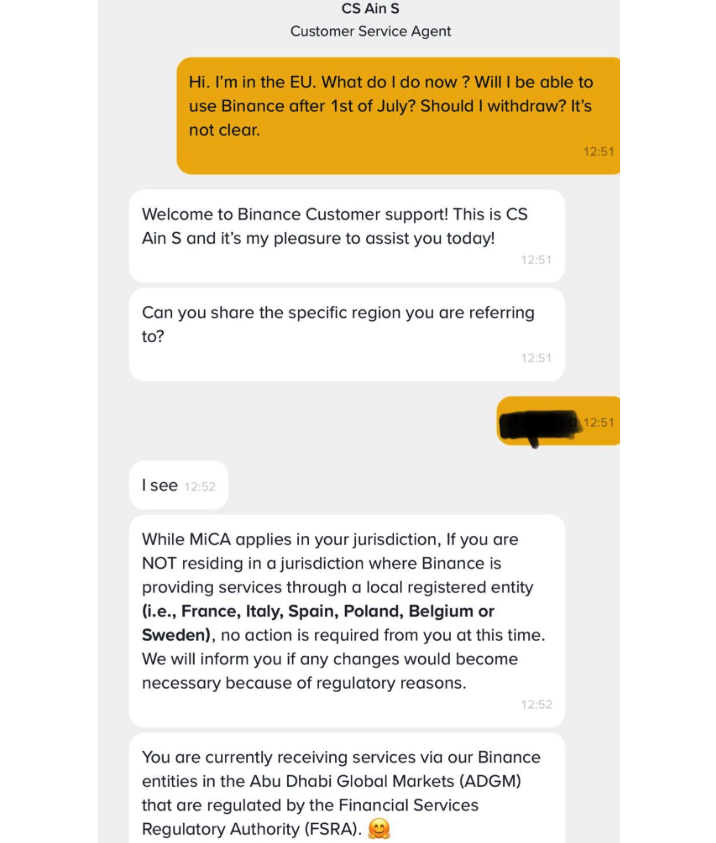
The clarification came shortly after Binance told its users it was adjusting services in certain EU countries, including Poland, France, Spain and Italy, as part of its MiCA transition. Binance said users in other countries would not need to take action if they were not based in a jurisdiction where the exchange operates through a local registered entity, saying in those cases that “no action is required at this time.”
ESMA cites “narrow exemption” for non-EU CASPs
The ESMA said CASPs based outside the EU cannot provide their services to local customers unless they fall under the “narrow exemption” of reverse solicitation provided by Article 61 of MiCA.
Article 61 allows a non-EU crypto company to serve an EU client without a MiCA license only when the client initiates the relationship entirely on their own, without any solicitation, marketing or promotion by the company.
However, the regulation makes clear that the exemption does not apply if a third-country company solicits clients in the EU.
“MiCA established that where a third-country firm solicits clients or prospective clients in the Union […] it shall not be deemed to be a service provided on the client’s own exclusive initiative,” an ESMA spokesperson told Cointelegraph.
Excerpt from ESMA’s list of examples of solicitation by third-country companies. Source: ESMA
The regulator also cited its official solicitation guidelines, which include activities such as operating websites, mobile apps, social media, online advertising, sponsorships and influencer campaigns targeting EU users.
Lawyer questions Binance’s Abu Dhabi servicing model
Screenshots of Binance customer support messages circulating on social media appeared to suggest that some EU users could be serviced through Binance’s Abu Dhabi Global Market entity.
Yuriy Brisov, a lawyer at Digital & Analogue Partners, said an Abu Dhabi license has no effect under MiCA because the jurisdiction is treated as a third country, alongside markets such as the United States or Singapore.
Source: Satoshi Club
“Being regulated in Abu Dhabi does nothing for Binance under MiCA,” Brisov said. “When Binance says some EU users are serviced through the ADGM entity, in MiCA terms that means a non-EU company is serving those users,” he added.
Brisov said that the reverse solicitation exemption was designed for isolated cases where an EU customer independently approaches a non-EU company, not for maintaining an existing customer base built through years of marketing.
Binance did not respond to repeated Cointelegraph requests for clarification on whether any EU users would be serviced through its ADGM entity after the MiCA deadline.
Magazine: How crypto laws changed in 2025 — and how they’ll change in 2026
Nasdaq is expanding the distribution of its market data into blockchain infrastructure, making one of its flagship equity data products available through the Pyth Network as financial firms increasingly build trading and settlement applications on blockchain rails.
The exchange operator said Tuesday it will publish its TotalView market data through the Pyth Data Marketplace, a platform that distributes institutional datasets to blockchain networks, financial applications and software developers. The move gives a wider range of users access to one of Nasdaq’s core market data offerings through a programmable interface rather than traditional market data delivery channels.
TotalView provides full depth-of-book data, showing buy and sell orders at every price level for securities trading on Nasdaq, including Nasdaq-, NYSE- and regional-listed stocks. The product also includes Nasdaq’s Net Order Imbalance Indicator, which offers a real-time view of buy and sell imbalances before the opening and closing auctions.
For Nasdaq, the partnership expands how its market data reaches customers as financial infrastructure evolves beyond trading terminals and dedicated market data feeds toward cloud-based software and blockchain-powered applications.
Bitcoin BTC$58,592.92 is trading in a narrow range between $59,000 and $60,000 for the fifth straight day, a quiet stretch that some analysts warn is more dangerous than it looks because of where it is happening.
The range itself is normal. Bitcoin spent much of 2024, from March to October, consolidating between $55,000 and $70,000 with occasional overshoots in both directions. What makes the current setup riskier is its location, said Alex Kuptsikevich, chief market analyst at FxPro, in an email to CoinDesk.
This band sits below the levels that sparked rebounds in February and early this month, as well as the 50-day and 200-day moving averages. Traders closely watch the two averages, and both are sloping downward right now, indicating a bearish bias.
And that is the signature of a downtrend rather than a market building a base to climb from.
“This is a rather dangerous consolidation for the bulls,” Kuptsikevich said, noting that the 2024 version formed in a rising market while this one is forming in a falling one. If the pattern breaks lower rather than resolving higher, he said, the next meaningful step down is around $40,000.
Some onchain indicators suggest the same. Pseudonymous CryptoQuant analyst Darkfost flagged signs that long-term holders are starting to capitulate, or selling at a loss. In past cycles, this phase has marked attractive entry points for buyers, even as it signals near-term pain.
The Commodity Futures Trading Commission is conducting a broad investigation into Polymarket covering staged trades and fake winning bets, Bloomberg reported Friday, advancing the agency’s scrutiny beyond the platform’s prior influencer scheme.
The Commodity Futures Trading Commission is conducting a broad investigation into Polymarket that reportedly covers staged trades and fabricated winning bets, Bloomberg reported Friday, extending federal scrutiny beyond the platform’s previously reported influencer scheme.
CNBC also reported Friday that the CFTC has an ongoing investigation into the platform. Bloomberg said the probe includes Polymarket’s social media activity, citing a person familiar with the matter. Together, the reports add a market-conduct dimension to what began as an advertising-disclosure inquiry. The CFTC has not issued any public filing or press release confirming the investigation or its scope.
Senate Pushes CFTC
The reporting follows a letter sent Thursday by Senators Adam Schiff (D-CA) and John Curtis (R-UT) to CFTC Chairman Michael Selig, asking whether the agency was examining Polymarket’s use of simulated trading websites, staged transactions, and undisclosed paid influencer campaigns. The senators set a July 10 deadline for a written response.
As The Defiant previously reported, the bipartisan letter cited a Wall Street Journal investigation that found Polymarket paid mostly college-aged creators between $2,000 and $3,000 a month to film fake trades on dummy websites built to mimic the live platform. The campaign covered more than 1,100 videos posted between December 2025 and mid-May 2026, per WSJ. Creators were instructed not to disclose their compensation, the senators’ letter said.
Across those videos, depicted wagers totaled roughly $1.9 million. None of the bets were placed on the live market. In 118 videos, creators celebrated approximately $900,000 in fabricated wins — positions that WSJ found would have lost more than $166,000 on the actual platform, per WSJ.
2022 Enforcement Backdrop
The CFTC has prior history with Polymarket. In January 2022, the agency settled charges against Blockratize Inc. — the entity doing business as Polymarket — for a $1.4 million civil monetary penalty for offering off-exchange event-based binary options contracts without registering as a designated contract market. The settlement also required the platform to block US users.
Schiff and Curtis challenged the CFTC’s capacity to act as a federal gaming regulator in their letter, questioning whether the agency has the authority and resources to deliver consumer protections traditionally handled by state and tribal gaming authorities. They also asked whether prediction market operators may lawfully use simulated trades or fake websites in promotional content.
State Court Battles
The probe arrives as the CFTC is simultaneously defending its jurisdiction over prediction markets in federal court. The agency has sued Kentucky and New Mexico, arguing that federal law gives it exclusive authority over event contracts as states moved against Polymarket and competing platform Kalshi.
Polymarket, following the WSJ report, said it would review its promotional practices. The platform has made no public statement on the broader CFTC probe. The senators’ July 10 deadline gives Selig roughly two weeks to respond on whether the agency is investigating.
Strategy Inc. (Nasdaq: MSTR), the world’s largest bitcoin treasury company, announced a sweeping capital management overhaul earlier today, introducing what it calls a Digital Credit Capital Framework. The announcement sent MSTR shares up 6% in pre-market trading and pushed bitcoin above $60,000.
The framework has five parts: a board-approved USD reserve policy, a dividend rate increase on one class of preferred stock, a $1 billion buyback program for digital credit securities, a $1 billion buyback program for common stock, and a bitcoin monetization program that authorizes the sale of BTC to fund company obligations.
Strategy’s bulked up USD Reserve
At the center of the framework is a $2.55 billion USD reserve, cash and cash equivalents held to cover dividend payments and interest expense on the company’s debt. Strategy carries roughly $1.76 billion in annual preferred dividend and interest obligations, which means the current reserve represents 17.4 months of coverage.
The board has set a floor: the reserve must stay at a minimum of 12 months of coverage at all times. Any reduction below that threshold requires explicit board authorization. The reserve can only be used for two purposes — paying preferred stock dividends and servicing interest on debt. Any other use of those funds also requires board approval.
Beyond the cash reserve, Strategy is counting its bitcoin monetization capacity as part of its liquidity cushion. Combined, the $2.55 billion reserve and $1.25 billion in authorized BTC monetization capacity give the company $3.80 billion in total coverage — the equivalent of 25.9 months of preferred dividend and interest obligations.
JUST IN: Michael Saylor’s Strategy announces a new framework to “preserve long-term Bitcoin exposure” with a “BTC monetization program” 👀 pic.twitter.com/d1EGpV4w3b
— Bitcoin Magazine (@BitcoinMagazine) June 29, 2026
STRC dividend increase
Strategy raised the dividend rate on its Variable Rate Series A Perpetual Stretch Preferred Stock, known as STRC, by 50 basis points to 12% per year. The increase takes effect for dividend periods with record dates on or after July 1, 2026. A basis point is one one-hundredth of a percentage point, so the increase moves the rate from 11.5% to 12%.
The company said its target is for STRC to trade between $99 and $100 over time, close to its $100 stated value. STRC has risen 9% on the news. Strategy said it will evaluate the STRC dividend rate on a monthly basis, taking into account trading levels, credit spreads, bitcoin price and volatility, and the overall state of its balance sheet.
Two buyback programs
The board authorized up to $1 billion in repurchases of its Digital Credit Securities — a category that includes STRC, STRF, STRK, and STRD, four series of preferred stock the company has issued. It also authorized up to $1 billion in buybacks of its Class A common stock.
Neither program obligates the company to purchase any specific amount of securities, and both can be modified, suspended, or canceled at any time. Repurchases under both programs can be made through open-market purchases, block trades, private negotiations, or tender offers.
CEO Phong Le framed the buyback programs as a shift in how Strategy operates. “Strategy is evolving from one-way capital issuance to active capital management,” he said. “We intend to move between issuing securities when capital is attractive and repurchasing securities when our instruments trade at levels that make buybacks accretive.”
Neither buyback program will draw from the USD reserve. If Strategy funds buybacks through bitcoin sales, those sales fall under the BTC Monetization Program.
The Bitcoin Monetization Program
The Bitcoin Monetization Program authorizes Strategy to sell BTC for three specific purposes: to build or replenish the USD reserve (up to $1.25 billion), to fund preferred dividends and interest payments when management judges BTC sales more favorable than issuing new stock, and to fund buybacks of preferred or common stock.
Any sale outside those three purposes requires a new board vote. The program does not obligate the company to sell any bitcoin.
CFO Andrew Kang said the program gives Strategy a tool to use part of its bitcoin reserve without abandoning its core thesis. “Bitcoin is capital,” Kang said. “This program gives Strategy the flexibility to use a portion of its BTC Reserve to strengthen Digital Credit, fund dividend payments and interest expense, and fund accretive repurchases when BTC monetization is more favorable than issuing common equity.”
Founder and Executive Chairman Michael Saylor said bitcoin remains the company’s primary treasury asset. “Digital Credit requires liquidity, discipline, and active capital management,” he said. “This framework is designed to strengthen credit quality and enable the Company to reduce expected preferred stock dividend payments when accretive.”