Home Blog Page 137

New York Life’s $800B asset manager makes tokenization debut with Centrifuge fund

0

The launch adds another blue-chip asset manager to Wall Street’s tokenization push. Firms including BlackRock, Franklin Templeton, Apollo and Janus Henderson have embraced onchain versions of traditional funds, betting the technology can modernize how assets are issued, transferred and settled. Supporters argue the technology can shorten settlement times, improve operational efficiency and allow assets to move more easily across blockchain-based financial applications.

For Centrifuge, the partnership adds another large asset manager to its platform. The company already tokenizes funds from Apollo, Janus Henderson, with those assets increasingly integrated into decentralized finance protocols such as Aave and Morpho. It is also the preferred tokenization partner of Coinbase, which made a strategic investment in the firm.

The tokenized real-world asset market has grown to more than $30 billion excluding stablecoins, according to rwa.xyz. Citi projects tokenized assets could reach $5.5 trillion by 2030, while Standard Chartered estimates the market could expand to $2 trillion by 2028 as blockchain-based finance gains wider adoption.

While early institutional efforts centered on tokenized U.S. Treasury funds, firms are increasingly expanding into other asset classes such as private credit, equities and corporate bonds.

Tokenized securities need competition, not gatekeepers

0

But familiar forms of market exposure, including brokerage-held securities, ETFs, depository receipts, structured notes, and other equity-linked instruments, are well-established parts of the market today. Tokenization alone does not make them more or less legitimate. Their economic and legal structures should dictate their regulatory treatment.

The third model is issuer-sponsored tokenization. A company and its transfer agent support tokenized ownership directly. This may be the right model for many issuers. It can connect tokenized records to shareholder systems and support familiar processes for corporate actions, recordkeeping and communications.

Brokerage held securities, depository receipts, structured notes, and direct registration all coexist in today’s market. They do not provide identical rights. Investors choose among them because they serve different needs. The important questions are whether the structure is clear, the risks are disclosed, the backing is real where promised, and the product does what it says it does.

That is the right standard for tokenized markets as well.

One wrong outcome of the current tokenization debate would be a market where products borrow the language of stocks without telling investors what they actually hold or misleading investors altogether. That would harm investors and undermine confidence in the technology.

Another wrong outcome would be a market where tokenization becomes a set of private walled gardens. That would convert a promising new technology into a tool that narrows competition before the market has had a chance to learn what works.

Germany Leads MiCA Crypto Licensing Race Across Europe

0

Update 2:00 pm UTC, June 29: Added comment from Germany’s Federal Financial Supervisory Authority (BaFin).

The European Union’s Markets in Crypto-Assets Regulation (MiCA) framework is producing uneven crypto licensing across member states and European Economic Area (EEA) jurisdictions, with Germany leading approvals under the new regime that takes effect on Wednesday.

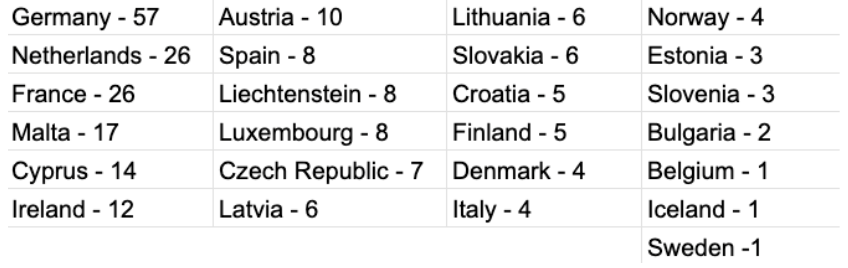
Data from the European Securities and Markets Authority (ESMA) interim register, compiled on Friday, shows Germany has 57 MiCA-authorized crypto-asset service providers (CASPs), accounting for about 23% of the 244 total licenses issued.

France follows with 26 companies, or roughly 11% of all approvals, placing it alongside the Netherlands as the bloc’s second-largest hub for MiCA licensing.

The pattern suggests that although MiCA is designed to create a single European crypto market, implementation remains fragmented across national regulators ahead of the July 1 transitional deadline.

France leads late-June approval wave

While Germany leads overall MiCA licensing, France has recently accelerated approvals, accounting for the largest share of last-minute authorizations.

According to ESMA interim data, France issued five CASP approvals between June 18 and June 22, the most during that window. In total, 11 approvals were issued across EU and EEA jurisdictions during the period, with Malta following France with two authorizations.

MiCA CASP licenses issued during the period from June 18-25, 2026. Source: ESMA

France’s authorizations include CASPs such as Bpifrance Investissement, RCUBE Asset Management, Paymium, Leonod and Meria.

Germany’s Federal Financial Supervisory Authority (BaFin) told Cointelegraph that the relatively high number of MiCA authorizations is partly driven by the country’s large financial sector, including a high number of credit institutions that can provide crypto asset services under MiCA.

It also pointed to Germany’s pre-existing national licensing regime, which allowed some CASPs to use simplified authorization pathways under MiCA transition rules, potentially accelerating approvals.

Related: Binance faces EU service limits next week as MiCA rules take effect

A spokesperson at BaFin also said it is difficult to predict whether Germany will maintain its dominant share of CASP authorizations as MiCA implementation progresses, noting that outcomes will depend on market developments, innovation trends and the volume of pending applications across member states. The representative added that approvals in other EU countries are expected to increase over time and broadly align with the size of national financial sectors.

Five EU states have not issued any MiCA licenses

Five EU member states, including Greece, Hungary, Poland, Portugal and Romania, have not issued any MiCA licenses as of June 26, according to ESMA interim register data.

Greece stands out after Binance applied for authorization in the country but later withdrew its application, shifting its eventually licensing plans to another MiCA jurisdiction.

European jurisdictions ranked by the number of approved CASPs under MiCA as of Friday. Source: ESMA

Poland is also notable, with delays in MiCA implementation legislation followed by three reported presidential vetoes, leaving the country without an active licensing framework by the time of the EU deadline.

In contrast, Italy dominated ESMA’s non-compliant CASP register as of Friday, accounting for an overwhelming majority of entries with 160 out of 162, while the Netherlands and Slovakia recorded one each, linked to MEXC and LWEX, respectively.

Additional reporting by Yohan Yun.

Magazine: AI is banking the unbanked in Africa… faster than crypto

Circle (CRCL) selloff may be ‘overreaction’ but Open USD faces adoption test

0

Still, he argued that the Circle’s 16% selloff on Tuesday went too far.

“I think it is an overreaction,” he told CoinDesk.

He pointed to Paxos’ Global Dollar Network (USDG), another consortium-backed stablecoin that shares reserve income with partners but has yet to gain significant market share. It has grown to a $3 billion supply since its launch in late 2024, lagging far behind USDC’s $73 billion and USDT’s $145 billion, according to CoinDesk data.

“The bigger question is how OUSD can convince consumers and end users to adopt them,” Lau said. “We don’t really know the answer until it is fully launched so that we can gauge the market cap and usage.”

Hadick also cautioned that building an industry consortium is rarely straightforward.

“Consortiums are hard and they break easily,” he said. “Incentives are broad and often misaligned.”

“So while the [Circle] stock selloff seems clearly reasonable, I also don’t expect this to be an easy or straightforward road for Open Standard and expect it to be harder to get to scale than expected,” Hadick added.

Details still missing

Others cautioned that the announcement left several important questions unanswered.

Noelle Acheson, author of the Crypto Is Macro Now newsletter, said Open Standard has assembled an impressive list of partners and is led by Bridge co-founder Zach Abrams, “who knows what he’s doing.”

Anchorage Digital And Binance Launch Off-Exchange Settlement For Institutional Crypto Trading

0

Anchorage Digital has announced an integration with Binance to bring off-exchange settlement to institutional crypto traders, giving clients access to the world’s largest crypto exchange by volume without surrendering custody of their assets.

The partnership, powered by Atlas — Anchorage Digital’s suite of settlement infrastructure — marks the first off-exchange settlement implementation within that platform. Under the arrangement, institutions can trade on Binance while their assets remain in segregated custody at Anchorage Digital Bank, the first federally chartered crypto bank in the United States.

The structure mirrors how institutional trading works in traditional financial markets, where custody and execution are kept separate. In those markets, assets are held with a custodian and transferred only at final settlement — never sitting on the balance sheet of the trading venue. Crypto has long lacked that separation, requiring institutions to pre-fund exchange accounts and accept counterparty exposure to the venue itself.

“Institutions need crypto market structure that reflects the standards they already rely on in traditional finance,” said Nathan McCauley, co-founder and CEO of Anchorage Digital in a note to Bitcoin Magazine. “Off-Exchange Settlement, powered by Atlas, is designed to separate custody from execution, helping institutions access exchange liquidity while keeping assets in secure custody.”

The arrangement also allows institutions to pledge both crypto assets and USD accounts as collateral, enabling capital deployment while satisfying trading margin requirements — an approach consistent with workflows at traditional financial firms.

Binance has been building out its institutional infrastructure over the past several years, expanding triparty banking and collateral management offerings for professional clients. The Anchorage Digital integration extends that effort.

“Working with Anchorage Digital gives institutional clients another way to access Binance liquidity while managing custody and collateral through a model that is more familiar to traditional financial markets,” said Catherine Chen, Head of VIP & Institutional at Binance.

Crypto adoption and off-exchange settlement

Atlas is designed to support a range of institutional workflows beyond off-exchange settlement, including trading, lending, collateral management, and other capital markets functions. 

Anchorage Digital says the platform is built for the current phase of institutional crypto adoption, where firms entering the market have compliance, custody, and operational requirements that earlier crypto infrastructure was not designed to meet.

Anchorage Digital is backed by Andreessen Horowitz, Goldman Sachs, KKR, GIC, and Visa, and carries a valuation of $4.2 billion. 

In addition to Anchorage Digital Bank N.A., the company operates through Anchorage Digital Singapore, licensed by the Monetary Authority of Singapore, and Anchorage Digital NY, which holds a BitLicense from the New York Department of Financial Services.

SEC giving novel ETFs a rethink as it opens comment period on overhauling U.S. rules

0

The current process allows ETFs that meet certain conditions to jump into the markets without requiring a complicated request for exemption from the regulator, and that approach has seen an explosive growth from $4 trillion in 2019 to $12 trillion in 2025.

“It is designed to build a record that could be used to justify policy changes in the future that would permit ETFs focused on a broader universe of assets,” said TD Cowen policy analyst Jaret Seiberg, in a note to clients. He said the broader range of ETFs could include “those based on event contracts, crypto assets and single-stock strategies.”

Atkins’ SEC has made it a priority to embrace new technologies, especially cryptocurrency, for which it’s working on major policies to allow for such innovations as tokenization of securities. In the meantime, its ETF stance may also get a rewrite.

“Market participants have raised questions regarding whether novel ETFs with a principal investment strategy to invest in assets that are not securities under the Investment Company Act are investment companies,” according to the SEC’s request, which posed a number of questions on that point. It also asked questions about the time period in which ETFs become effective and what must be disclosed during this process.

Crypto Companies Have Spent $189M So Far on 2026 US Election Cycle: Report

0

The US consumer advocacy group Public Citizen on Tuesday reported that the cryptocurrency industry had contributed $189 million toward the 2026 election cycle, following its 2024 playbook.

According to a report released Tuesday, the nonprofit organization said that about 37% of all corporate contributions in the 2026 US election cycle could be traced to crypto companies, totaling about $189 million so far, with more than four months until the November election.

While the watchdog group said that the crypto-aligned political action committee (PAC) Fairshake was responsible for spending more than $82 million so far, the MAGA Inc. Super PAC, largely backed by Crypto.com, had spent more than $56 million.

“These super PACs prioritize the interests of their business backers over either major political party or any candidate,” said Public Citizen. “Following the crypto playbook, they are set up to engage in both Democratic and Republican primaries and to support or attack candidates of either major party in the general election.”

Source: Public Citizen

Fairshake and its affiliates Defend American Jobs and Protect Progress are backed by cryptocurrency companies Coinbase and Ripple, and reported a $193 million war chest as of January. Entities aligning with industry interests have also been formed since 2024, including the Fellowship PAC backed by Cantor Fitzgerald.

Altogether, the PACs’ combined spending has already exceeded that in 2024, when companies contributed $170 million toward electing what it considered “pro-crypto” candidates to Congress.

Related: Senate leaders push for July passage of CLARITY Act

Cointelegraph reached out to a Fairshake spokesperson for a comment on the report but did not receive an immediate response.

Colorado primaries flush with crypto PAC cash

Colorado voters head to the polls today in primaries for Republican and Democratic candidates, with the state’s 8th congressional district potentially being influenced by crypto PAC spending.

The You Can Push Back Super PAC backed by Ripple Labs co-founder Chris Larsen reportedly spent $1 million on media to support Democrat Manny Rutinel. The committee’s last big bet — $3.3 million — was on Democrat Alex Bores in New York’s 12th Congressional District. He lost his primary last week to Micah Lasher, who had criticized Larsen’s involvement in the race.

Magazine: SBF will never get a pardon, Trump peace deal boosts Bitcoin: Hodlers Digest June 14-21

Cointelegraph is committed to independent, transparent journalism. This news article is produced in accordance with Cointelegraph’s Editorial Policy and aims to provide accurate and timely information. Readers are encouraged to verify information independently.

Magic Eden, Founders Sued by $ME Buyers Over Broken ‘Utility’ Promises

0

A nationwide class action in New York accuses the NFT marketplace and its four co-founders of marketing the token’s use cases, then delaying or abandoning them as $ME fell roughly 99% from launch

Three $ME token buyers sued Magic Eden and its four co-founders, alleging the company promoted the token’s use cases — multichain trading, governance, staking rewards, and revenue sharing — then delayed, diminished, or abandoned them, according to a class-action complaint filed in federal court in New York.

Jaime Pagan, Ariel Ruano and Chris Sadowski filed the suit on June 16 in the U.S. District Court for the Eastern District of New York against co-founders Jack Lu, Zhuoxun Yin, Sidney Zhang and Zhuojie Zhou, along with Euclid Labs Inc., which does business as Magic Eden, and the ME Foundation. The plaintiffs are represented by Max Burwick of Burwick Law, a firm that has brought several consumer class actions against crypto issuers.

$ME traded at about $0.056 on Tuesday, leaving it down roughly 99% from its post-launch high and giving it a market capitalization of about $34 million, according to CoinGecko data. The token slipped 3.8% over the prior 24 hours, compared with BTC’s 2.4% decline.

The complaint, which cites prices as of its filing date, says the token reached about $5.63 on Dec. 11, 2024 — excluding a launch-day spike on thin liquidity — and had fallen about 98%, to roughly $0.12, by mid-June.

The case is one of the first to test whether a token’s marketed “utility” can support consumer-protection claims rather than securities claims. The plaintiffs state plainly that they are not asking the court to decide whether $ME is a security. Instead, they bring claims under New York consumer-protection statutes and common law, arguing that the represented features — not any expectation of profit from a common enterprise — gave the token its value. A win would offer a template for token holders seeking recovery without wading into the securities-law fights that have defined most crypto litigation.

Magic Eden did not reply to a request for comment from The Defiant by press time.

The ‘Use Case’ Theory

The complaint’s core argument is that buyers were told why $ME would have value, not merely that it might rise. Holders received no equity, no contractual revenue rights and no enforceable governance power, the plaintiffs say, so the token’s value rested on whether its promised features would drive real demand.

“These were not vague aspirational statements or puffery,” the complaint says of the marketing. “They were specific operational claims about concrete use cases made to consumer audiences through promotional channels.”

The plaintiffs identify four features they say were represented and then not delivered as described. A multichain strategy spanning as many as ten blockchains was scaled back in February, when Lu announced Magic Eden would refocus on Solana and wind down its Bitcoin and Ethereum Virtual Machine marketplace operations. Governance through the ME DAO was not operational for about nine months after launch. A broad revenue-sharing and staking-reward model was announced in January and did not begin until Feb. 1, 2026. And a November buyback program was later changed and discontinued, according to the filing.

The suit ties the token’s economics to Magic Eden’s revenue. Lu disclosed in January that the company generated about $24 million in revenue in 2025, the plaintiffs note. The Defiant reported at the time that a 15% allocation to the $ME ecosystem would translate to roughly $3.6 million a year if revenue held. The complaint alleges the subsequent Solana retrenchment narrowed that revenue base.

Co-founders Named

The complaint names each co-founder individually and ties them to specific representations. It alleges Lu made or amplified the multichain and platform-growth claims and personally announced the Solana retrenchment. It says Yin made cross-chain strategy updates and points to his prior roles at dYdX and Coinbase. It alleges Zhang was responsible for the wallet’s technical architecture, and that Zhou made decisions on token infrastructure and smart-contract deployment.

The filing also raises a security concern, citing CoinDesk reporting that Magic Eden’s wallet stored recovery phrases and private keys with no route to delete them. The plaintiffs say users were funneled into the proprietary wallet to claim their airdrop and were not told of the deficiency before importing their credentials.

Magic Eden gained prominence as the largest Solana NFT marketplace before expanding across Bitcoin and Ethereum. The complaint says the company raised about $157 million from investors including Paradigm, Sequoia Capital, Electric Capital, Greylock and Lightspeed Venture Partners at a $1.6 billion valuation, and that its founders previously worked at companies including FTX, Google, Coinbase, Facebook and Uber. The Defiant covered the token’s launch in December 2024.

Jury Trial

The suit seeks class certification covering everyone in the U.S. who acquired $ME between the Dec. 10, 2024 launch and the filing date. It asks for damages under New York General Business Law Sections 349 and 350, compensatory damages for negligent misrepresentation, and restitution and disgorgement on an unjust-enrichment theory. It also seeks an injunction barring the defendants from moving traceable assets derived from the conduct alleged, plus attorney’s fees and interest. The plaintiffs demand a jury trial.

The allegations are untested. None has been proven, and Magic Eden has not yet responded in court.

The defendants will have an opportunity to respond, and a motion to dismiss is the typical first step in cases like this one.


Circle (CRCL) slides as Stripe, Coinbase (COIN) and BlackRock (BLK) back rival stablecoin network

0

With more institutions embracing stablecoins, the competition is increasingly shifting from issuing tokens to determining who controls the underlying infrastructure and network.

Unlike most existing stablecoins, Open USD will allow businesses to mint and redeem tokens without fees while returning reserve income to participating partners, less a management fee. Governance will also be shared among members rather than controlled by a single issuer.

The model targets one of the core economics of today’s stablecoin market. Issuers such as Circle earn revenue by investing reserves backing their tokens in short-term U.S. Treasuries and retaining most of the interest generated by those assets. Open USD instead plans to distribute that yield to participating businesses.

The approach resembles the Global Dollar Network (USDG), a stablecoin consortium led by Paxos that shares reserve income with participating firms. That network is backed by companies including Robinhood, Kraken and Galaxy Digital, and was designed to encourage broader adoption by aligning incentives between the issuer and distribution partners.

In Europe, a group of banks and payment providers launched Qivalis, a venture to develop a euro-denominated stablecoin as financial institutions seek to build shared digital payment infrastructure.

The breadth of Open USD’s backing reflects that shift. Beyond Stripe, Coinbase, Mastercard and Visa, launch partners include BNY, Standard Chartered, DBS, U.S. Bank, Shopify, Google, IBM, Mercado Pago, Fireblocks, Anchorage Digital, MetaMask, Aave, Solana, Polygon and Ripple.