Home Blog Page 1292

Could A Supreme Court Ruling Against Trump Crash Bitcoin?

0

Bitcoin is trading near $90,000, extending a fall-off after spending several days above $92,000. The crypto now faces a fresh macro test as markets brace for a U.S. Supreme Court decision that could land Friday on the legality of President Donald Trump’s global tariffs.

The case centers on tariffs imposed in early 2025 under the International Emergency Economic Powers Act, a 1977 statute typically used for sanctions during national emergencies. 

Trump used the law to justify “Liberation Day” tariffs ranging from 10% to 50% on global imports, alongside targeted duties on China, Canada, and Mexico tied to fentanyl trafficking concerns. 

His administration argued that persistent trade deficits and national security risks met the threshold for an emergency.

Lower courts disagreed. Both the U.S. Court of International Trade and a federal appeals court ruled that Trump exceeded his authority, emphasizing that Congress holds primary power over tariffs. 

The Supreme Court heard arguments in November, with skepticism voiced across ideological lines. While the court does not preannounce decisions, it has signaled rulings could be released on Jan. 9.

If the tariffs are struck down, the financial implications could be large. Reuters reported that more than $133.5 billion in duties could be subject to refunds, raising questions about timing, fiscal impact, and replacement policies. 

Trump has claimed the tariffs generated roughly $600 billion in revenue, a figure that has shaped market anxiety around refunds and Treasury financing.

The ruling’s impact on Bitcoin

All traders are watching this situation closely, not because tariffs directly affect Bitcoin’s network, but because macro shocks in all markets often ripple through risk assets. During prior trade escalations, Bitcoin tended to sell off alongside equities as liquidity tightened and risk appetite faded.

Warnings have grown louder on social media. Semi-popular trader Wimar.X called Friday “the worst day of 2026,” arguing that a negative ruling could force markets to price refund obligations, emergency policy responses, and retaliation risks at the same time. “That’s not clarity. That’s chaos,” he wrote.

Prediction markets reflect those concerns. 

On Polymarket, odds imply a strong chance (76%) the court invalidates the tariffs, suggesting traders see downside risk as under-appreciated. Still, not all expect a lasting selloff. 

For Bitcoin, the near-term risk appears tied to volatility rather than direction. The asset remains sensitive to shifts in yields, equities, and dollar liquidity. A sharp risk-off move could push prices lower, especially with Bitcoin still below key resistance near $94,000 to $95,000. A ruling that reduces uncertainty could also produce a brief relief rally.

The larger question is not whether Bitcoin crashes on a headline, but whether a court decision reshapes the macro backdrop for BTC. 

WisdomTree scraps plan to launch XRP ETF in the US

0

Key Takeaways

  • WisdomTree has decided to end its bid to launch an XRP exchange-traded fund (ETF) in the US.
  • The application withdrawal was made through a request filed to the Securities and Exchange Commission (SEC).

Share this article

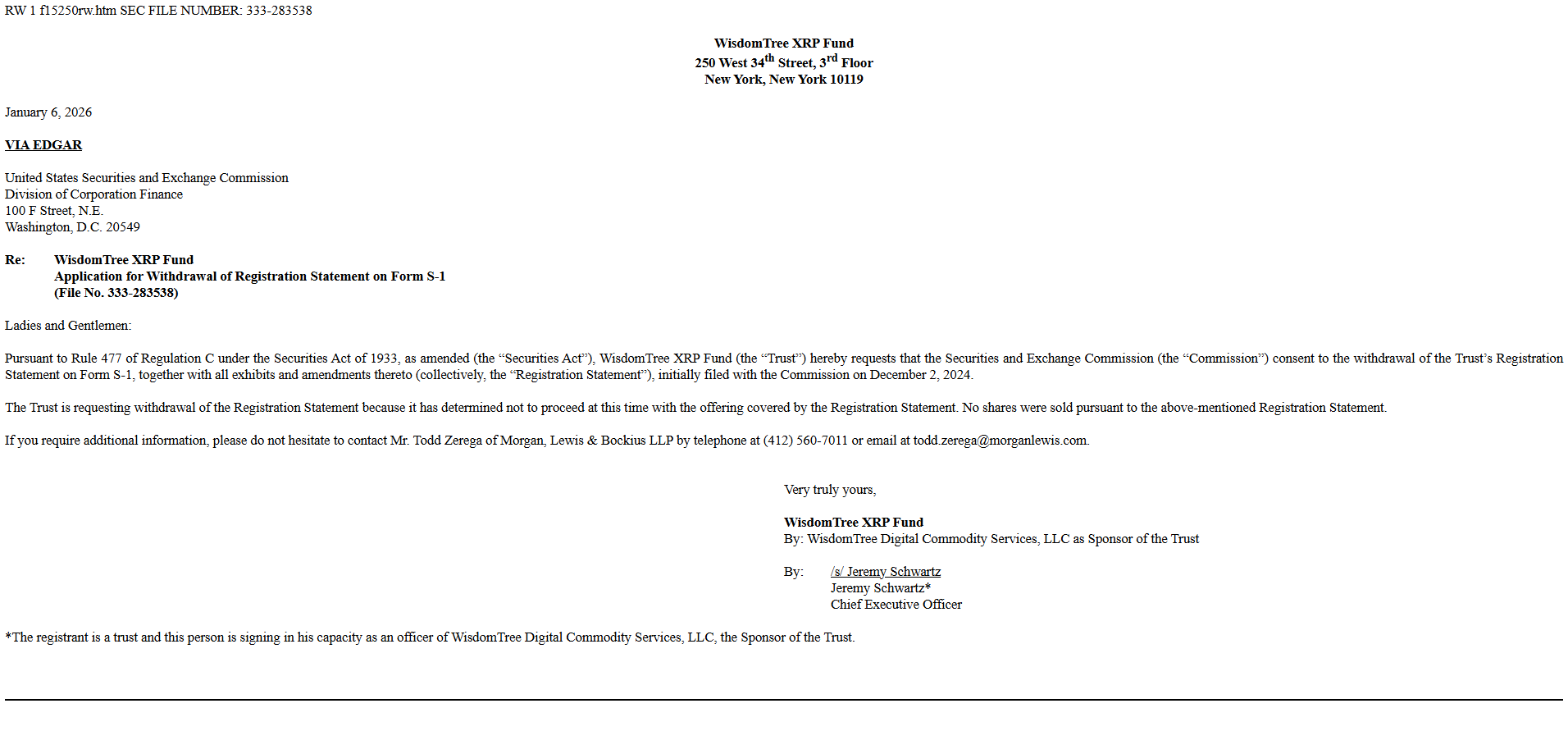
WisdomTree submitted a filing to the SEC this week seeking to withdraw its application to launch the WisdomTree XRP Fund, an exchange-traded fund tied to the fourth-largest digital asset.

The New York-based asset manager entered the US XRP ETF race in late 2024. Ahead of its SEC filing, the firm had already launched WisdomTree Physical XRP (XRPW) in Europe, where the product now trades on major venues including Deutsche Börse Xetra, the Swiss Exchange, and Euronext.

WisdomTree’s decision to halt its XRP ETF push follows a similar move by CoinShares, Europe’s largest digital asset investment firm, which filed to withdraw several US ETF proposals, including products tied to XRP, Solana, and Litecoin.

The decision comes as competition in the XRP ETF market, while limited in number, has already consolidated around early movers.

Since their debuts, US-listed XRP ETFs have drawn $1.2 billion in inflows and now hold nearly $1.5 billion in net assets, per SoSoValue. Canary Capital currently leads the group, with Bitwise, Franklin Templeton, and Grayscale not far behind.

XRP ETFs have continued to record steady inflows, but on a far smaller scale than Bitcoin, which remains the most liquid and institutionally demanded digital asset.

At the same time, subdued risk appetite has offered little support for the expansion of digital asset ETF products. This may prompt some sponsors to double down on established offerings rather than pursue incremental launches.

Despite challenging market conditions and soft investor demand, some big players appear willing to move ahead with crypto ETF plans. Morgan Stanley, which manages roughly $1.8 trillion in assets, recently filed with the SEC to launch ETFs linked to Bitcoin, Ether, and Solana.

Truebit Hack Wipes Out TRU in First Major Exploit of 2026

0

Security experts warned that most hacked projects never fully recover after major attacks.

Truebit suffered a roughly $26 million exploit on Thursday, Jan. 8, marking the first major crypto hack of 2026, as experts warn that projects hit by major breaches often never fully recover their value.

Blockchain security firms CertiK and PeckShield confirmed the attacker drained about 8,500 Ether (ETH), worth roughly $26.4 million, from a smart contract linked to the blockchain verification protocol. PeckShield said the stolen funds were sent to two wallet addresses and linked the same attacker to a smaller exploit involving Sparkle about 12 days earlier.

Truebit’s TRU token collapsed following the breach, falling 100% in 24 hours, according to CoinGecko. The token’s plunge wiped out almost all of its market value as CoinGecko flagged the project with an exploit warning.

TRU 7-day price chart. Source: CoinGecko

The incident adds to a growing list of crypto losses. Data from portfolio tracker defi shows the industry has lost over $90 billion to hacks and scams so far, with less than $7 billion recovered. Over $9 billion was lost this year alone, according to the platform.

the-defiant
Crypto losses from hacks, scams and exploits over all time. Source: defi

The Truebit hack underscores how quickly trust and value can disappear after a security failure. Moreover, beyond the immediate loss, hacks often cause lasting damage as users leave, liquidity dries up, and confidence breaks, experts say.

“Nearly 80% of hacked projects never really recover their full value after an exploit,” said Mitchell Amador, CEO of Immunefi, in comments shared with The Defiant. “That’s where the real damage happens. Long after headlines fade, projects are left contending with devaluation that stings worse than the initial loss.”

The breach comes after PeckShield reported that exploits fell by 60% in December 2025 compared with November 2025 – even as roughly 26 major crypto exploits were recorded during the month. Toward the end of last month, during the holidays, Trust Wallet confirmed about $7 million in customer funds had been stolen in an exploited browser extension update.

2025 hack losses were dominated by the exploit of top centralized exchange Bybit at the beginning of the year, which resulted in $1.5 billion in ETH being stolen — the largest single hack in crypto history.

World's largest custodial bank BNY to offer tokenized deposits for institutional investors

0

The initiative mirrors deposit balances on a private blockchain to speed up settlement and unlock liquidity.

Hyundai Reveals AI Robotics Roadmap at CES

0

South Korea’s Hyundai Motor Group used this year’s Consumer Electronics Show to unveil its broad-ranging physical AI roadmap.

While much of the attention focused on the unveil of a new humanoid robot, Atlas, produced by Boston Dynamics — of which Hyundai is a majority shareholder. The automaker also went into greater detail on its new AI robotics strategy. It also detailed three key partnerships, which it said will be key to delivering on its ambitions.

First, the company explained how it intends to step up collaboration between humans and coworker robots in manufacturing environments, with the latter increasingly being used to perform hazardous, repetitive and dangerous tasks.

Second, it pledged to make more use of its relationship with Boston Dynamics to develop what it describes as an end-to-end robotics value chain. The aim is to deliver more advanced AI robotics capabilities and enable faster scaling of production.

Third, it reaffirmed its commitment to partnering with more global leaders in AI, as evidenced by Boston Dynamics’ newly announced tie-up with Google DeepMind.

Specific highlights of the masterplan — part of a $26 billion investment in the U.S. over the next four years — include the establishment of a Robot Metaplant Application Center at the its new Metaplant in Bryan County, Georgia. The company hailed this as being the engine of Hyundai’s AI Robotics aspirations, where robots will undergo a training regime including mapping human movements such as lifts and turns that will ultimately enable them to execute complex tasks on the factory floor.

Related:Synopsys Targets Automotive With AI, Software Push at CES

“By 2028, RMAC-trained Atlas robots will be deployed for highly repetitive sequencing tasks, progressing to complex assembly work by 2030,” the company said in a press release. As many as 30,000 robots could be produced annually by 2028.

The strategy will also see an increase in the company’s software-designed factory approach, first seen at its manufacturing facility in Singapore. This integrates real-world production data to optimize robot learning and performance, enabling them to be continually updated and improved.

Meanwhile, away from the glamor of the CES stages and booths, Korean media reported that Hyundai executive chair Euisun Chung held a closed door meeting with Nvidia CEO Jensen Huang in Las Vegas.

The pair confirmed a strategic partnership at CES last year to accelerate the use of AI in Hyundai’s vehicles, and expanded their relationship in November that they would work together with the South Korean government to accelerate the country’s AI ecosystem development.

Related:Mobileye to Acquire Mentee Robotics in $900M Deal

While neither party has confirmed what the latest meeting concerned, the chip giant’s reveal of its new self-driving tech Nvidia Drive AV, based on Alpamayo open source models, was likely to have been on the agenda, given Hyundai’s desire to expand its own autonomous driving efforts.

The company’s desire to increase the level of automation it offers was underpinned at CES by a display that included a motorized platform that parks cars for owners and a robotic arm that charges an Ioniq 5.

2026 Could Be Make-or-Break Year For Crypto: Report

0

The U.S. is entering what may be the most favorable policy environment for crypto since the industry emerged, as President Donald Trump’s second term accelerates deregulation across financial markets and pulls digital assets closer to the center of the U.S. financial system, according to a new outlook from TD Cowen’s Washington Research Group.

The report, shared with Bitcoin Magazine, characterizes 2026 as a rare convergence of aligned regulators, political will, and market momentum, creating a short window in which crypto firms could secure lasting policy gains. 

Those gains, however, are not guaranteed to endure. TD Cowen repeatedly warned in its report that many initiatives could be revised or reversed by a future Democratic administration if they are not finalized, implemented, and legally defended before the next presidential transition in 2029.

Rather than sweeping crypto legislation, the firm expects change to arrive through exemptions, agency guidance, new charters, and targeted market-structure adjustments. The result is a regulatory strategy that emphasizes speed and durability over ambition.

TD Cowen describes the broader environment as a “golden age of deregulation” for financial services, housing, and crypto. 

The report says Trump has moved faster than prior presidents to assert control over financial regulators, installing leadership teams explicitly committed to lighter, more tailored oversight and a more permissive stance toward digital assets and tokenization.

The White House, Treasury Department, and market regulators are described as unusually aligned on the view that regulation should accommodate innovation rather than constrain it. 

Timing is critical for any crypto progress 

That alignment underpins many of the crypto initiatives expected to unfold in 2026, but TD Cowen cautions that timing is critical. Rules must be finalized this year to withstand court challenges and become harder to unwind if political control shifts after the 2028 election.

At the Securities and Exchange Commission, the report says Chair Paul Atkins is preparing to use exemptive relief to expand crypto-related activity within U.S. securities markets. The SEC is expected to issue so-called “innovation exemptions” as early as the first quarter of 2026, allowing brokerages and crypto platforms to offer tokenized stocks and bonds that settle instantly and operate outside certain elements of the National Market System.

TD Cowen expects early tokenized equity trading to focus on retail investors and benefit online brokerages and crypto-native exchanges. 

The SEC is likely to loosen best-price obligations for these products while leaving the core Order Protection Rule intact for traditional markets. 

The firm assigns the initiative a moderate sustainability rating, suggesting a future Democratic SEC would layer on investor protections rather than dismantle tokenization altogether.

The SEC is also expected to clarify how staking-as-a-service programs are treated under securities law. Fixed-return staking products would likely be classified as securities, while variable, profit-sharing arrangements could be treated as fee-for-service activities. 

TD Cowen sees growing bipartisan agreement that staking requires a clearer framework, even if the details remain contested.

On the banking side, regulators have begun opening the perimeter to crypto firms while maintaining formal limits on deposit-taking and lending. 

In December 2025, the Office of the Comptroller of the Currency granted national trust charters to several crypto firms, including Circle, Ripple, and Paxos, allowing them to hold stablecoin reserves under a single federal regime instead of navigating state-by-state oversight.

TD Cowen argues these charters deepen the integration between traditional banking and digital assets and could eventually pave the way for banks to issue and manage stablecoins themselves. 

While Democrats could tighten supervision if they regain power, the firm views outright revocation as unlikely.

The Federal Reserve is also moving to accommodate crypto-linked payments activity. The report highlights a proposal for “Payment Master Accounts” that would grant eligible crypto and payments firms limited, non-interest-bearing access to the Fed’s payment rails. 

These accounts would process transactions without providing overdrafts or discount-window access. TD Cowen sees the move as durable once implemented, despite concerns from banks about increased competition.

The CLARITY act is a centerpiece for crypto progress

On Capitol Hill, the centerpiece of the crypto agenda is a proposed market-structure bill known as the CLARITY Act. TD Cowen remains skeptical that Congress will deliver a second major legislative win after passing stablecoin legislation, but it says a narrow compromise remains possible on investor protection, custody standards, and anti–money laundering rules.

The largest obstacle is Democratic insistence on ethics provisions barring senior government officials and their families from owning crypto exchanges, issuing tokens, or operating stablecoins — language aimed at Trump’s ties to World Liberty Financial. 

TD Cowen warns there is no easy compromise on this issue, raising the risk that market-structure legislation slips into 2027 or collapses altogether.

Beyond trading and regulation, the report points to growing interest in tokenizing real-world records, including property deeds, mortgage documentation, and medical files. These projects are framed as efficiency upgrades rather than deregulatory flashpoints, making them more politically durable.

Bitcoin, Ethereum lie flat following negative ETF flows – DL News

0

  • Investors started January by pumping over $1.5 billion into US crypto ETFs.
  • But this week they redeemed over $1.3 billion from the products.
  • Bitcoin and Ethereum have now lost their gains.

It was all going so well.

Investors started 2026 by throwing over $1.5 billion in fresh cash at Bitcoin and Ethereum US exchange-traded funds over the space of two days.

The price of the two largest digital coins by market cap rose following the investment. But now, both assets are both lying flat after investors this week pulled $1.3 billion out of the Bitcoin funds and $351 million from their Ethereum counterparts, according to data from Farside Investors.

Bitcoin was recently priced at nearly $90,623, up 1% over the past week. Ethereum was trading for $3,093, unmoved over a seven-day period. It traded as high as $3,293 mid-week.

Bitcoin is lying flat. Source: CoinGecko.

The ETF redemptions come after a good start to the year following weeks of negative flows.

Crypto markets ended 2025 in the red after struggling to recover from a massive October sell-off when over $19 billion in leveraged positions were liquidated — the largest such liquidation event in the history of digital assets.

Despite notching new highs in 2025 off the back of pro-crypto US President Donald Trump’s victory and subsequent digital asset legislation, both Bitcoin and Ethereum are now trading well below their records.

Still, investors need to pay attention to the bigger picture, market observers this week told DL News, with the debasement trade — a strategy to hedge against weakening currencies — likely to still be in play this year.

Investors were particularly focused on Bitcoin along with gold and other precious metals as part of the trade in 2025. Experts have said the move is likely to be a long-term strategy as the US and other major economies take on more debt.

Investors in the US can now easily buy exposure to crypto via the ETFs, approved by the Securities and Exchange Commission in 2024, and managed by major asset managers like BlackRock, Fidelity and Grayscale.

Other major digital assets such as XRP and Solana were up 4% over a seven-day period, trading for $2.09 and $136, respectively.

Mathew Di Salvo is a news correspondent with DL News. Got a tip? Email at mdisalvo@dlnews.com.

Crypto crowd could still walk away from U.S. market structure bill if DeFi needs unmet

0

There are red-line demands from decentralized finance — and backed by the rest of crypto — that remain unknowns as senators finish the draft they’ll vote on.

CredAble and Citi Partner to Digitise Trade Finance with DPI-Led Invoice Validation

0

CredAble, a global working capital technology platform, has entered into a strategic technology partnership with Citi to digitise trade finance controls and strengthen post-disbursement invoice validation across global markets.

The collaboration centers on a white-labelled solution, powered by CredAble, which integrates a verification layer directly into Citi’s digital trade loan journey. The platform is designed to validate invoices against government-backed digital public infrastructure (DPI), helping to detect inconsistencies by verifying over 10 critical fields, including invoice numbers, dates, values, and transport data.

Moving from retrospective to real-time
Ram Kewalramani, co-founder and managing director of CredAble

The partnership addresses a structurally under-digitised layer of the trade lifecycle: post-disbursement verification. By automating these checks, the solution aims to move the industry away from retrospective audits toward real-time assurance.

For corporate clients and suppliers, the integration offers a unified digital flow from invoice submission to verification. The platform provides a single administrative view that reduces manual follow-ups and improves the quality of financed invoices, ultimately leading to faster and more predictable capital flows.

Ram Kewalramani, co-founder and managing director of CredAble, commented on the strategic alignment: “This partnership goes beyond product innovation. It reflects our joint vision of making trade finance smarter, more secure, and aligned with the digital expectations of global businesses. We are proud to be Citi’s fintech partner and elevate the standard for invoice verification and supplier financing”.

Strengthening global supply chains
Mayank Gupta, head of Asia South and Indian subcontinent, Trade and Working Capital Solutions at Citi

As supply chains become increasingly complex, the need for robust digital controls has grown. Mayank Gupta, head of Asia South and Indian subcontinent, Trade and Working Capital Solutions at Citi, stated: “As supply chains become more global and complex, digitisation is essential to deliver control and confidence at scale. Our collaboration with CredAble supports our vision of modernising trade with technology that is secure, user-centric, and built for widespread adoption”.

The platform has been engineered to meet Citi’s rigorous standards for regulatory compliance and user experience. It represents a significant step in utilizing Digital Public Infrastructure as a foundation for global trade finance, enhancing transparency and audit readiness for enterprises worldwide.

Bitcoin Could Hit $2.9 Million By 2050, New Report Says

0

VanEck released a new report on Bitcoin’s long-term capital market assumptions today, projecting strong growth over the next several decades and outlining how institutional investors might use the asset in diversified portfolios.

The report, authored by VanEck’s Head of Digital Assets Research Matthew Sigel and Senior Analyst Patrick Bush, models BTC reaching $2.9 million per coin by 2050 under a base-case scenario. 

This represents a 15% compound annual growth rate (CAGR) from today’s prices. The model assumes BTC captures 5–10% of global trade and becomes a reserve asset making up 2.5% of central bank balance sheets.

Bitcoin at $53.4 million per coin in 2050

VanEck also provided a range of outcomes. In a conservative “bear” scenario, Bitcoin grows at just 2% per year, reaching around $130,000 per coin. 

In a bullish “hyper-bitcoinization” scenario, where BTC captures 20% of global trade and 10% of domestic GDP, the asset could theoretically reach $53.4 million per coin, a 29% CAGR.

The report emphasizes Bitcoin’s potential as a strategic, low-correlation asset for institutional portfolios.

VanEck recommends a 1–3% allocation for most diversified portfolios. For higher risk-tolerant investors, allocations up to 20% historically optimize returns, according to their analysis.

VanEck argues that BTC’s role is becoming more than speculative. It could function as a reserve asset and hedge against monetary debasement, particularly as developed markets face high sovereign debt. 

“The risk of zero exposure to the most established non-sovereign reserve asset may now exceed the volatility risk of the position itself,” the report notes.

The firm’s research also addresses volatility and market structure. Annualized BTC volatility is modeled at 40–70%, comparable to frontier equities or early-stage tech, though realized volatility recently hit multi-year lows near 27%. 

VanEck attributes much of Bitcoin’s short-term price swings to futures leverage and derivatives, rather than fundamental adoption issues. They also highlight BTC’s historically low correlation to stocks, bonds, and gold, with a long-term negative correlation to the U.S. dollar.

For tactical investors, VanEck tracks blockchain metrics such as the Relative Unrealized Profit (RUP). As of December 31, 2025, Bitcoin’s RUP was 0.43 — mid-cycle — suggesting room for further gains before a market peak. 

Futures funding rates remain moderate at 4.9%, below levels that typically signal market tops.

On portfolio impact, VanEck’s simulations show that even small BTC allocations can improve efficiency. In a traditional 60/40 equity-bond portfolio, replacing 1–3% with Bitcoin increased the Sharpe Ratio, capturing the asset’s “convex return” without adding proportional risk.

A 3% allocation historically yielded the highest return per unit of risk in their analysis.

At the time of writing, Bitcoin is near $91,000.