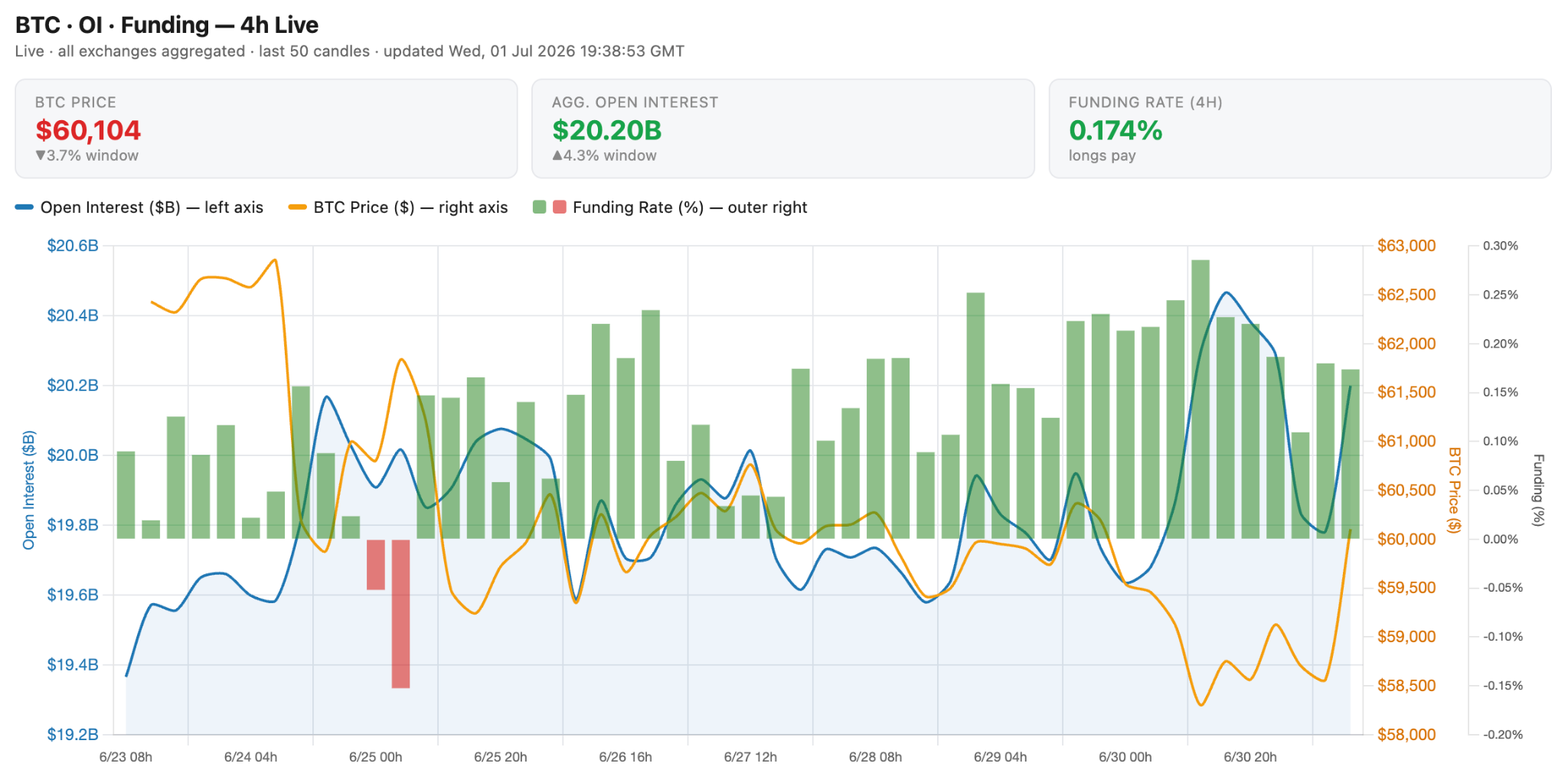
Standard Chartered expects assets locked in decentralized finance (DeFi) to grow 37-fold to $2.7 trillion by the end of 2030.
The expansion would be driven by both tokenized real-world assets (RWAs) and crypto-native assets moving through onchain protocols, Geoff Kendrick, head of digital assets research at Standard Chartered, said in a research note on Monday.
“I think the next opportunity for generational wealth in digital assets is going to come via the DeFi protocols,” Kendrick said. “I estimate that the amount of tokenized assets active in DeFi will 37x by the end of 2030.”
According to Kendrick, only 3% of stablecoins and 10% of tokenized RWAs are currently used in DeFi. He projected the share of tokenized assets used in DeFi to rise to 30% by the end of 2030, from about 3.5% today.
The forecast underscores growing institutional expectations that tokenization could channel more capital into DeFi. However, reaching $2.7 trillion would require onchain assets to grow rapidly and the share of tokenized value used in DeFi protocols to rise nearly ninefold.
Decentralized finance’s total value locked. Source: DefiLlama
Standard Chartered previously forecast that non-stablecoin tokenized RWAs would grow to $2 trillion by the end of 2028, with tokenized money-market funds and US equities accounting for most of the projected market.
While Standard Chartered expects tokenized assets to drive significantly more activity into DeFi, some researchers have cautioned that tokenization does not guarantee deep or unified markets.
Axis CEO Chris Kim previously told Cointelegraph that issuing the same asset across multiple blockchains and formats can create siloed liquidity, pricing gaps and higher costs, limiting how easily tokenized assets can be traded even as their overall market value grows.
Oya Celiktemur, Ondo Finance’s sales director for Europe, the Middle East and Africa, also said at Paris Blockchain Week in April that tokenizing an illiquid asset does not “magically” make it liquid.
Uniswap seen as a potential hub for tokenized markets
Kendrick said Uniswap could emerge as a key trading venue as more tokenized assets move onchain. He highlighted the decentralized exchange’s scale, brand and history of operating through multiple crypto cycles.
Related: Botanix to shut down after 4 years, cites weak demand for Bitcoin DeFi
Kendrick added that those attributes could be particularly important to traditional financial institutions, which are likely to prioritize security and reliability when bringing tokenized RWAs to DeFi.
“If Uniswap can commercialise enough and create significant enough TradFi partnerships to scale, its market cap-to transaction fees multiple is likely to increase, narrowing the gap with Coinbase,” he wrote.
Magazine: Does ‘Paper Bitcoin’ mean there’s an unlimited supply of BTC?
Global, June 15, 2026— Bitget, the world’s largest Universal Exchange (UEX), today released a joint report with Block Scholes examining liquidity conditions across its real-world asset (RWA) perpetual futures markets. The research finds that tokenized equity and commodity markets on Bitget have continued to mature throughout 2026, with liquidity levels increasingly approaching those of major crypto trading pairs.
Among the report’s findings, NVDA-USDT reached approximately $4.1 million in resting liquidity within 2% of the mid-price by mid-May, representing roughly three-quarters of the market depth observed in Bitget’s BTC/USDT spot market. The report suggests that tokenized markets are increasingly developing the market quality required to support active trading, hedging, and cross-market positioning.
The research also explored how Bitget’s RWA perpetual markets performed during periods of elevated volatility, including the onset of the US-Iran conflict in February 2026. While spreads widened briefly following the initial announcement, liquidity recovered quickly and market depth returned to typical levels within days, highlighting the resilience of tokenized markets during geopolitical uncertainty.
“Access alone is no longer enough and the conversation around tokenization has moved beyond access,” said Gracy Chen, CEO of Bitget. “What matters now is whether users can move capital efficiently between markets without sacrificing liquidity. Whether someone is trading crypto, equities, gold, or tokenized assets, they expect the same depth and speed. That’s why liquidity is becoming one of the most important measures of success for tokenized markets. As these markets mature, we’re getting closer to a future where the distinction between traditional and digital assets matters less than the opportunities they provide.”
The report forms part of Bitget’s broader effort to understand how tokenized financial markets are evolving as traders increasingly seek access to both digital assets and traditional market exposures through a single trading environment. The findings support the company’s Universal Exchange strategy, which brings together crypto assets, commodities, equities, and tokenized financial instruments within a unified platform experience.
View the full report, Liquidity Conditions in Bitget’s Real World Asset Perpetual Markets, here.
About Bitget
Bitget is the world’s largest Universal Exchange (UEX), serving over 125 million users and offering access to over 2M crypto tokens, 100+ tokenized stocks, ETFs, commodities, FX, and precious metals such as gold. The ecosystem is committed to helping users trade smarter with its AI agent, which co-pilots trade execution. Bitget is driving crypto adoption through strategic partnerships with LALIGA and MotoGP™. Aligned with its global impact strategy, Bitget has joined hands with UNICEF to support blockchain education for 1.1 million people by 2027. Bitget currently leads in the tokenized TradFi market, providing the industry’s lowest fees and highest liquidity across 150 regions worldwide.
For more information, visit:Website |Twitter | Telegram | LinkedIn | Discord
Risk Warning: Digital asset prices are subject to fluctuation and may experience significant volatility. Investors are advised to only allocate funds they can afford to lose. The value of any investment may be impacted, and there is a possibility that financial objectives may not be met, nor the principal investment recovered. Independent financial advice should always be sought, and personal financial experience and standing carefully considered. Past performance is not a reliable indicator of future results. Bitget accepts no liability for any potential losses incurred. Nothing contained herein should be construed as financial advice. For further information, please refer to ourTerms of Use.
Source: Bitget
The above article “Tokenized RWA Markets Remained Resilient During US-Iran Conflict – Bitget-Block Scholes Report” was first published on AlexaBlockchain. Read the complete article here: https://alexablockchain.com/tokenized-rwa-markets-remained-resilient-during-us-iran-conflict/
Submit Your Blockchain and Crypto Press Release here.
Disclaimer: This is a press release, provided by the company/ company representative. AlexaBlockchain does not endorse, guarantee, or accept responsibility for the content, accuracy, quality, advertising, products, or other materials presented in this publication. Readers are advised to conduct their own due diligence before taking any actions related to the company mentioned herein. AlexaBlockchain expressly disclaims any liability for damages or losses, whether direct or indirect, arising from or related to the use of or reliance on any content, goods, or services referenced in this press release.
Bitcoin (BTC) starts the third week of June with a spring in its step as the US-Iran peace deal sends risk assets higher.
Key points:
Bitcoin price action targets $66,000 as US stock futures soar and oil approaches its lowest levels since early March.
Traders see $69,000 as a likely short-term BTC price target.
The Federal Reserve interest-rate decision is under the microscope thanks to new Chair Kevin Warsh.
Bitcoin whales have reversed their selling mentality, putting in a “rock-solid floor” near $60,000.
Overall demand weakness raises questions over a bull-market comeback.
Oil price drops below $80 as Iran peace countdown begins
The US-Iran war is again the center of attention for traders this week as a peace deal appears closer than ever.
Developments over the weekend initially included a Sunday deadline for signing off on a ceasefire, but this subsequently became Friday.
Multiple sources then confirmed that the US and Iran would sign an agreement for a 60-day pause in hostilities, along with various other measures, in Switzerland on Friday.
In a post on Truth Social, US President Donald Trump confirmed that the deal would include the reopening of the Strait of Hormuz — a key global oil route.
“With the opening of the Strait upon the signing of the Deal on Friday, for purposes of mine removal, oil will flow on both ends again for the Region, and the World!” he wrote.
Source: Truth Social
US stock futures surged as a result, with risk assets moving higher across the board — including Bitcoin and crypto.
Oil, by contrast, fell immediately, with WTI crude trading below $80 per barrel for the first time since mid-April.
CFDs on US WTI crude oil one-day chart. Source: Cointelegraph/TradingView
Reacting, portfolio manager Danny Dayan described the deal as the “biggest and worst TACO of all time,” referring to the Trump administration’s approach to various geopolitical and macroeconomic conflicts.
“Overheat, higher core inflation, and higher neutral rate, will be the macro considerations ahead,” he told X followers, seeing a pivot away from oil as a market mover.
Throughout the conflict, oil price strength has been a headwind for Bitcoin, even as stocks see repeated new all-time highs.
BTC/USD is now back at the exact level it traded when it began on Feb. 28.
Bitcoin traders see $69,000 short squeeze
News of a US-Iran peace deal helped propel BTC price action toward two-week highs into Sunday’s weekly candle close.
Data from TradingView captured local highs of $65,988 as the new week began.
With both $60,000 and Bitcoin’s 200-week simple moving average (SMA) at $62,000 holding as support, traders’ short-term outlook began to improve.
“Closed near the highs with almost no upper wick, favoring a push higher this week,” trader SuperBro wrote in his latest analysis on X.
SuperBro eyed the 200-week exponential moving average (EMA) as a potential target for a short squeeze.
“There are a lot of leveraged shorts up to the 200 EMA around $69K. Good chance that is where this is headed,” he added.
“Q2 closes in just 2 weeks. Let’s see if bulls can keep the heat on.”
BTC/USD one-week chart. Source: SuperBro/X
Trader CrypNuevo also had the area just below the $70,000 boundary in sight for the week.
“Still seeing a recovery to the mid-range $69k,” he wrote in his X analysis.
CrypNuevo warned that BTC/USD could still return to local lows as part of range-bound trading.
BTC/USDT one-day chart. Source: CrypNuevo/X
Trader and analyst Rekt Capital agreed, stressing that price rebounds tend to become weaker as bear markets progress, along with key support — in this case the $60,000 mark.
BTC/USD one-week chart. Source: Rekt Capital/X
New Fed chair under pressure on rate cut
Against the backdrop of serious geopolitical flux, “all eyes” nonetheless remain on the US Federal Reserve.
On Wednesday, the Fed’s new chair, Kevin Warsh, will lead his first meeting to decide on interest-rate changes.
Given the inflationary catalyst that the Iran war has become, markets see barely any chance of Warsh cutting rates — but Trump has repeatedly called for that very outcome.
In an interview in April, Trump told mainstream media that he “would” be disappointed if Warsh did not deliver a cut at the first opportunity.
“All eyes are on the Fed this week,” trading resource The Kobeissi Letter summarized in its latest X analysis.
Fed target rate probabilities for Wednesday FOMC meeting (screenshot). Source: CME Group
The latest data from CME Group’s FedWatch Tool puts the odds of a minimal 0.25% cut at just 3.4%.
Reacting, commentators overwhelmingly see rates remaining at current levels.
In analysis on Sunday, Dayan described Warsh as “trapped no matter what he does.”
“If he is hawkish, he will be breaking promises made to Trump,” he wrote.
“On the other hand, if he uses the recent decline in oil prices as a reason for a wait and see stance, I think he is raising the odds we will see a panic hike in the second half of the year as the economy overheats.”
US markets will have a shorter four-day week, with Wall Street closed Friday for the Juneteenth holiday.
Whales deliver “rock-solid floor”
In a boost for Bitcoin bulls, new analysis reveals a potential sea change in large-volume investor mentality in recent days.
Bitcoin whales, according to onchain analytics platform CryptoQuant, have become buyers again.
Looking at exchange inflows from whale wallets, CryptoQuant data shows that coin days destroyed (CDD) — the number of days funds spent dormant after last moving — have significantly cooled.
“Inflow CDD plunged from 2.16M to near-zero (33K), showing long-term whale dumping has completely stopped,” contributor Woo Minkyu wrote in a Quicktake blog post on Monday.
Bitcoin whale data (screenshot). Source: CryptoQuant
Woo described whales as putting in an “aggressive bottom buy” at around $61,000, absorbing “all” coins panic sold by other investor cohorts.
“The wealth transfer from weak hands to strong hands is complete,” he concluded.
“Whales have locked in the $60,000–$61,500 range as a rock-solid floor. With exchange reserves depleted, the path of least resistance for Bitcoin is now firmly upward.”
Earlier, Cointelegraph reported that three key conditions for a BTC price rebound were almost satisfied. Whales on Hyperliquid and Bitfinex, analysis said at the time, were already positioned for a bounce.
Bitcoin apparent demand stays negative
When it comes to a full bull-market rebound, CryptoQuant remains cautious in light of current onchain data.
Related: Bitcoin miner ‘capitulation’ comes as trader sees later 2026 bear-market bottom
Apparent demand, contributor XWIN Japan notes, is still negative — something that has always coincided with bear markets in the past.
Apparent demand is the difference between Bitcoin’s issuance — or newly mined coins — and the supply inactive for over a year.
“If the decrease in inventory exceeds production, demand is increasing, and vice versa,” CryptoQuant head of research Julio Moreno explains.
Accordingly, current negative values signal a broad lack of interest in BTC exposure and may even override the four-year cycle theory to dictate future price action, XWIN says.
“This suggests that Bitcoin may not be declining simply because ‘the cycle says so.’ Instead, demand growth has slowed,” it wrote this weekend.
Bitbank, one of Japan’s largest cryptocurrency exchanges, warned users that transactions linked to prediction market platforms such as Polymarket could result in account suspensions due to potential conflicts with the country’s gambling laws.
In a notice published on Monday, Bitbank said it may restrict accounts making deposits or withdrawals connected to prediction market services.
The warning highlights the regulatory uncertainty surrounding prediction markets in Japan, where local gambling laws may complicate Polymarket’s previously stated interest in expanding into the country.
Bitbank warns of sweeping account restrictions
Bitbank said users whose accounts are suspended would lose access to a wide range of services, including account logins, deposits and withdrawals, as well as crypto trading.
“We will not be liable for any damages incurred by our customers as a result of the account suspension measures,” the exchange added.
Source: Bitbank (translated by Google)
The announcement urged customers to exercise caution when using external services and avoid becoming involved in criminal activity or legal disputes.
Bitbank did not cite any specific regulatory action or government directive behind the warning. It said prediction market platforms that allow users to bet on election results, sports outcomes and other future events could be considered gambling under Japanese law when used for financial gain.
Cointelegraph asked Bitbank what prompted the notice but had not received a response by publication.
Questions emerge as Polymarket eyes expansion
Bitbank’s notice comes as prediction markets face growing scrutiny globally, with regulators in multiple jurisdictions taking action against Polymarket and Kalshi over gambling concerns.
Polymarket currently lists Japan among 35 restricted jurisdictions in its access policy. The company signaled in May that it was exploring expansion in Japan, raising questions about how it may navigate potential conflicts with local gambling laws.
Source: Bitbank
Japan has not issued formal guidance specifically on prediction markets, but Bitbank’s warning indicates that at least some crypto companies are taking a more cautious approach to services that could be classified as gambling.
Magazine: Should users be allowed to bet on war and death in prediction markets?
Cointelegraph is committed to independent, transparent journalism. This news article is produced in accordance with Cointelegraph’s Editorial Policy and aims to provide accurate and timely information. Readers are encouraged to verify information independently.
Aztec Connect, a deprecated decentralized finance platform, was drained of around $2.1 million in crypto on Sunday after an attacker exploited its verification function.
Aztec Labs posted to X on Sunday that it was “investigating a potential exploit affecting Aztec Connect,” adding that around $2.1 million was transferred from the platform’s smart contract, which did not affect users or assets on the current Aztec network.
The exploit is the latest in the $44 million worth of crypto that has been stolen so far this month from at least 12 other exploits, according to DeFiLlama.
A private key compromise on the Humanity Protocol has been the largest so far in June, with $30 million lost on June 8, followed by the Syscoin Bridge, which saw $8 million swiped in a fake proof exploit the previous day.
Crypto security firm BlockSec said that an attacker exploited a mismatch in how the platform verified transactions and settled them on Ethereum.
It said that verified transactions on Aztec Connect’s contract were “not effectively bound to the transaction set enforced by the ZK proof,” allowing its verification path and settlement logic on Ethereum “to interpret the transaction list differently.”
The attacker could then place transactions where the contract credited value without validating it on Ethereum, which created unbacked balances that could then be withdrawn. The attacker did this seven times across seven different assets.
The attacker made off with 909 Ether (ETH), 270,000 Dai (DAI), 167 of wrapped staked ETH and a handful of other cryptocurrencies.
Some of the assets stolen in the exploit. Source: CertiK
Aztec Network is a privacy-focused layer-2 zero-knowledge (ZK) rollup on Ethereum. Aztec Connect was the previous version of the platform that launched in 2022 as a DeFi bridge.
Related: Crypto exploit losses in May fall 90% over month to $68M: CertiK
Aztec Connect was deprecated in March 2023, with deposits halted and the team shifting resources to the next-generation Aztec Network.
“Aztec Labs holds no admin keys or control over the system; it cannot be paused or upgraded by us,” the team said.
Crypto developer “Param” said Aztec Connect’s smart contracts became “fully immutable” and could no longer be upgraded or paused.
“The incident is another reminder that abandoned DeFi contracts can still become targets years later,” they said.
Magazine: OpenAI files for IPO, SEC scraps 611 rule and Hungary overhauls crypto: Hodlers Digest
The borrowing pushed the USD1 pool to 93% utilization, meaning retail depositors who had lent USD1 to the pool expecting to withdraw at will could not do so until the loans were repaid. WLFI repaid $25 million of the position, then minted $25 million in fresh USD1 days later, actively managing the token’s supply through April. World Liberty Financial did not respond to a request for comment on the report.
World Liberty is also in litigation with Justin Sun, the crypto tycoon and early buyer of WLFI governance tokens, who sued the company, alleging it improperly froze his holdings. WLFI countersued for defamation.
Some observers said the commercial impact of Sunday’s event is straightforward.
“Paying the fighters in the USD1 stablecoin would have the same economic function as writing them a check,” Todd Phillips, a crypto expert at the Klaros Group, told The Guardian. “Announcing to the world they are doing it in USD1 sounds like they are advertising to the world that USD1 is out there and that it is connected to the UFC and the White House.”
USD1’s circulating supply has grown to around $4.6 billion from $3.3 billion on Jan. 1.
The company has also applied for a banking license from the Office of the Comptroller of the Currency.
Bitcoin came just shy of $66,000 during Monday morning trading after US President Trump claimed that the US had brokered a peace deal with Iran that would reopen the Strait of Hormuz.
“The deal with the Islamic Republic of Iran is now complete. Congratulations to all!” Trump posted on his Truth Social platform late on Sunday.
“I hereby fully authorize the toll-free opening of the Strait of Hormuz, and, simultaneously herewith, authorize the immediate removal of the United States Naval blockade,” Trump said. “Ships of the World, start your engines. Let the oil flow!”
“With the opening of the Strait upon the signing of the deal on Friday […] oil will flow on both ends again for the region, and the World!” he said in a separate post.
Source: Donald Trump
Trump has claimed dozens of times over the last two months that a deal to end the war was near, and the crypto markets have traded on news of the Iran war since it started in February with US-Israeli strikes.
Markets reacted positively to Trump’s latest claim, with Bitcoin (BTC) reaching $65,881 on Coinbase on Monday morning, according to TradingView. It is the highest the asset has traded over the last 12 days, having not been over $66,000 since June 3.
Andri Fauzan Adziima, the research lead at Bitrue Research Institute, told Cointelegraph that the potential deal “removes a major geopolitical risk premium, triggering a clear risk-on move as uncertainty fades.”
“Bitcoin has broken above $65,000, fueled by traders rotating back into crypto amid lower oil pressure and a broader stability narrative under a pro-crypto administration,” he added, but cautioned that there could be “last-minute signing issues” with the deal.
The details of the deal between the US and Iran were not immediately available, and it would not be implemented until Iran signs, which is expected on Friday under mediation by Pakistan, the Associated Press reported.
Related: Trump says Iran peace deal to be signed Sunday, contradicting Tehran
Iran’s deputy foreign minister, Kazem Gharibabadi, confirmed the agreement on state television while the secretariat of Iran’s Supreme National Security Council said the war on all fronts “will end immediately and permanently beginning tonight” and that the US blockade “will be terminated immediately and in full.”
Bitcoin has been gradually trending up since it fell below $60,000 briefly on June 6; however, it remains 48% down from its peak of over $126,000 in October.
The broader crypto market also gained 2% in total capitalization on the day, with several altcoins, including Hyperliquid (HYPE), Zcash (ZEC) and Near Protocol (NEAR) were outperforming, some with double-digit percentage gains.
There was also movement in crude oil prices, with WTI Crude falling 5% to its lowest level since early March at just over $80 per barrel, while Brent Crude mirrored the move, dropping 4.6% to $83.30.
More volatility may be ahead
Wednesday could add more volatility to crypto markets as the Federal Reserve is scheduled to make its interest rate decision, the first under new chair Kevin Warsh.
The new central bank chair appears more receptive to cuts, but increasing inflation, which has topped 4% again, strengthens the case for rate increases.
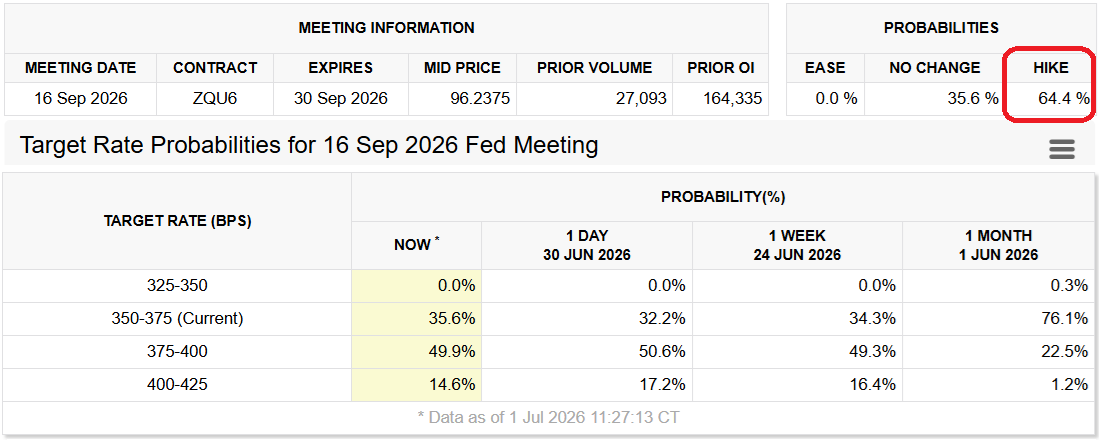
The CME Fed Watch tool currently predicts a 96.6% probability that rates will remain unchanged at 3.5% to 3.75%
Magazine: OpenAI files for IPO, SEC scraps 611 rule and Hungary overhauls crypto: Hodlers Digest
New Mexico is the latest US state to be pulled into the Commodity Futures Trading Commission’s legal fight for its jurisdiction over prediction markets after the state sued Kalshi for allegedly offering illegal sports betting.
The CFTC said on Friday that it sued New Mexico Governor Michelle Lujan Grisham, state Attorney General Raúl Torrez, and members of the New Mexico Gaming Control Board in federal court “to block the state’s efforts to apply state gaming laws against CFTC-registered contract markets.”
New Mexico sued Kalshi on June 4, arguing the company is offering sports betting to residents without a license and that its sports event contracts function the same as traditional sports bets.
The state also claimed Kalshi allowed those aged between 18 and 20 to use the platform, below New Mexico’s minimum gaming age of 21.
New Mexico is the eighth state that the CFTC has sued after state authorities had taken enforcement action against prediction market platforms, with Rhode Island, Wisconsin, Minnesota, New York, Arizona, Connecticut and Illinois also facing lawsuits from the regulator.
In its complaint against New Mexico, the CFTC claimed that event contracts are “swaps” under federal commodities laws, and Kalshi is a Designated Contract Market (DCM) under the “exclusive jurisdiction” of the CFTC.
“New Mexico’s attempt to prevent a CFTC-regulated DCM from offering CFTC-approved financial products intrudes on the exclusive federal scheme Congress designed to oversee United States commodity derivatives markets,” the CFTC argued.
“New Mexico is the latest state seeking to nullify black letter law and decades of judicial precedent by imposing state gaming laws on federally regulated derivatives exchanges subject to the CFTC’s exclusive jurisdiction,” CFTC Chairman Mike Selig said in a statement.
Source: Mike Selig
“The CFTC has the expertise and responsibility to protect its exclusive jurisdiction over commodity derivatives, and that’s exactly what we’ll continue to do,” he said.
The CFTC asked the court to rule that New Mexico state laws that would apply to transactions on CFTC-regulated DCMs are invalid and for a permanent injunction prohibiting the state from taking action against prediction market platforms.
Gary Gensler doubts CFTC claim over sports bets
Gary Gensler, a former chair of the Securities and Exchange Commission and the CFTC, also weighed in on the CFTC’s legal battle with the states, casting doubt on the federal regulator’s claim that it has authority over sports event contracts.
In an amicus brief filed to the Sixth Circuit on Thursday in Kalshi’s fight with Ohio’s authorities, Gensler argued that the Dodd-Frank Act, passed in 2010 in response to the 2008 financial crisis to regulate swaps, was not meant to encompass sports event contracts.
Related: CFTC proposes framework favoring sports event contracts over gambling
“Congress did not include sports betting contracts within the statutory Dodd-Frank definition of swap,” Gensler argued. He added that sports event contracts do not fit the purpose or language defining a swap under commodities laws, “which focus on hedging economic risk.”
Gary Gensler appearing on CNBC to discuss his amicus brief. Source: YouTube
“Sports bets are very rarely, if ever, about hedging,” Gensler argued.
Gensler told CNBC on Thursday that the question “at the core of this issue is did Congress in 2010 say, ‘No, none of the states can regulate this’ — it’s going to this little small agency that I once was proud to run — and the answer is categorically ‘No.’”
Magazine: Should users be allowed to bet on war and death in prediction markets?
XRP’s rebound is starting to look less like a dead-cat bounce and more like a market trying to build a base.
Buyers pushed the token through $1.14 and then $1.18 on the strongest volume seen since the selloff began, forcing traders to focus on whether the recovery can carry into the $1.20-$1.30 resistance zone that has capped previous rallies.
News Background
• XRP-linked ETFs have attracted roughly $1.4 billion in cumulative inflows since launching, with May marking the strongest month of institutional demand so far.
• More than 25 million XRP recently left exchanges, extending a trend that suggests long-term holders are accumulating despite the broader market weakness.
• Whale addresses holding significant XRP balances climbed to a record high, reinforcing the view that larger investors have been adding exposure during the correction.
Price Action Summary
• XRP rose from $1.1503 to $1.1866 during the 24-hour session, gaining more than 3%.
• The key move came during the June 14 21:00 UTC session, when volume surged to 107.6 million XRP, more than four times the daily average, pushing price through resistance near $1.14.
• Momentum carried into the close, with XRP briefly reaching $1.1928 before consolidating above $1.18.
Technical Analysis
• The most important development was the reclaim of the $1.14-$1.15 area. That zone acted as resistance throughout the recent decline and has now flipped into support.
The US and Iran reached an interim deal to halt the war and reopen the Strait of Hormuz, removing the macro weight that has pressed on crypto for weeks. Oil fell hard and equities jumped, while bitcoin moved only a little.
Brent crude dropped more than 4% toward $83, a three-month low, with the strait that carries about a fifth of the world’s oil set to reopen on June 19. Asian shares climbed more than 3%, and Japan’s Nikkei headed for a record close. Bitcoin trades near $65,000, up modestly over the weekend and still inside its recent $63,000 to $65,000 range, per CoinDesk data.
Traders may remember that bitcoin has been here before. A ceasefire in April fell apart, and US strikes broke another truce on June 9, each time clawing back the relief rally.
Traders are not pricing a permanent deal until the June 19 signing in Switzerland holds. The deal is interim, as sanctions are unresolved and Trump has said he could restart strikes if nuclear talks fail.
The bigger channel for crypto runs through inflation, not the headline.
Cheaper oil eases the price pressure that pushed central banks toward tighter policy. Meanwhile the Bank of Japan decides tomorrow, and a softer inflation backdrop could blunt the hawkish tilt that revived the yen carry-trade risk.
That is the path that would actually pull liquidity back toward crypto.