UK regulators are calling for tokenization and “new forms of digital money” to be part of the core infrastructure of the country’s future retail payment ecosystem.
In a Thursday update to the government’s roadmap for modernizing retail payment systems, HM Treasury on behalf of the Payments Vision Delivery Committee said that including tokenization and digital money would advance its efforts to create a “diverse multi-money ecosystem.”
“Programmable payments, including those that rely on tokenization,” were named as potential “product-level arrangements” that may support payment innovation in the country, the agency update said.
The update of November’s National Payments Vision document calls for infrastructure that enables emerging forms of digital money to interact with traditional payment systems.
The UK’s Financial Conduct Authority (FCA) earlier this week published its landmark crypto regulatory framework and said that the licensing window for crypto companies will open from September until Feb. 28, 2027, before the regime goes live on Oct. 25, 2027.
Under that framework, cryptocurrency firms, including trading platforms, custodians, stablecoin issuers, staking companies and other intermediaries, must obtain FCA authorization to operate in the UK under the new framework.
Illustrative diagram of roles and responsibilities outlined in Payments Vision Delivery Committee update. Source: HM Treasury
UK plans payments overhaul to support tokenization, stablecoins
In April, the UK government said it would revisit its payments rulebook to support the adoption of new payment technologies, including stablecoins and tokenization.
It said that would include a consultation on reforms for payment services and electronic money rules to create a single framework for traditional and tokenized payments, including stablecoins and tokenized deposits, according to an April 21 announcement by HM Treasury and Economic Secretary to the Treasury Lucy Rigby.
Related: Aave Labs’ Push gains UK FCA crypto registration
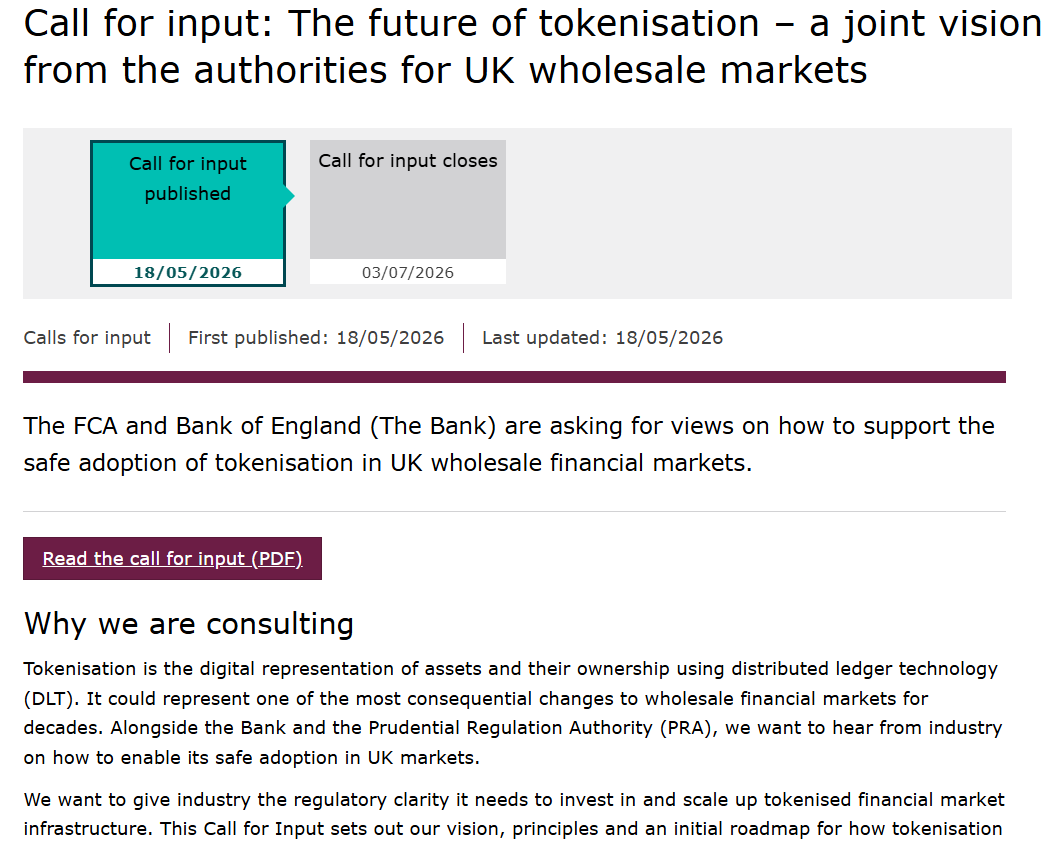
The following month, the Bank of England (BoE) proposed extending operating hours for its core settlement infrastructure toward near-24/7 availability, as part of a broader push with the FCA to prepare UK wholesale markets for tokenized finance.
The BoE said the expanded operating hours would support cross-border payments and new payment and settlement models as tokenization develops. The central bank is seeking public feedback on the proposal until July 3 and plans to publish a feedback statement in the summer.
Call for input on the future of tokenization in UK wholesale markets. Source: FCA
The FCA said just days earlier that tokenization and distributed ledger technologies could make fund management more efficient and support the innovation of the UK asset management sector.
Magazine: How crypto laws changed in 2025 — and how they’ll change in 2026
dYdX Labs founder Antonio Juliano launched Arcus, a new DEX combining tokenized stock trading with perpetual futures, built jointly with Robinhood Crypto on Robinhood Chain.
dYdX Labs launched Arcus on Wednesday, a decentralized exchange that combines tokenized stock trading with perpetual futures. Founder Antonio Juliano announced the launch on X, built jointly with Robinhood Crypto.
Arcus runs on Robinhood Chain, the EVM-compatible layer 2 that Robinhood opened to the public earlier the same day. Spot trading across 95 stock tokens is live now, letting users trade tokenized equities around the clock instead of only during market hours. Perpetuals covering 35 real-world-asset markets remain in a waitlist phase, dYdX said in its launch post.
Eddie Zhang, whose trading startup Pocket Protector was acquired by dYdX Labs, runs Arcus as chief executive. Juliano is joining its board, according to the dYdX blog post announcing the launch. The stock tokens give holders contractual economic exposure to the underlying equity rather than direct share ownership, the post said, the same tokenization structure Robinhood uses across the rest of Robinhood Chain.
dYdX, the decentralized perpetuals exchange that runs its own Cosmos-based appchain, holds $92.4 million in total value locked, per DefiLlama. Its DYDX token traded around $0.1451, according to CoinGecko. dYdX Chain v4 keeps operating alongside Arcus, with existing funds and positions unaffected, the blog post said.
Robinhood Crypto supplies the trading infrastructure and distribution to Robinhood’s user base for Arcus, but the brokerage has not issued its own statement naming Arcus or dYdX as of publication.
dYdX said a future Arcus token will reserve allocation for people who traded, staked or validated on dYdX, prioritizing the existing dYdX community over new entrants when the token launches. No launch date for that token or for the Arcus perpetuals waitlist has been set.
SBI Crypto has announced it will shut down its mining pool on July 31, ending a service tied to one of Japan’s largest financial groups and giving miners less than a month to redirect their hashrate.
The pool will stop accepting mining shares, which represent a miner’s contributions in the pool, on the cutoff date, according to SBI Crypto. Shares submitted after that cutoff will not be accepted, and the firm said the pool is expected to operate normally until the shutdown date.
The company urged customers to keep mining with the pool until the cutoff so eligible shares are included in the final payout calculation.
SBI Crypto’s mining pool, according to data from Hashrateindex, accounts for roughly 2% of the Bitcoin network’s total hashrate. The firm did not disclose a reason for the closure in its shutdown notice, and it did not provide current hashrate figures for the pool.
SBI Crypto operates under SBI Group, the Japanese financial conglomerate. The mining pool opened to the public in 2021, with SBI saying at the time that it would support the pool with roughly 1.1 EH/s of its own mining power.
Bitcoin (BTC) has delivered a key trend change setup in the latest sign that the macro downtrend could soon reverse.
Key points:
Bitcoin is seeing its first “perfected” TD9 indicator downtrend setup on monthly time frames since mid-2022.
While not a “buy signal” on its own, the move marks a key inflection phase in the bear market, analysis suggests.
RSI divergences continue to gain sway among those eyeing the final stages of the 2026 market downturn.
BTC price “perfected” TD9 setup echoes final bear-market stages
In an X post on Tuesday, analyst Tony Severino flagged a “perfected” buy signal on the TD9 indicator.
TD9 is a derivative of the Tom DeMark Sequential market timing indicator, which alerts traders to potential trend changes. Here, price triggers a notable signal when nine candles in a row close higher (in an uptrend) or lower (in a downtrend) than the closing price four candles prior.
“Bitcoin has ‘perfected’ a TD9 buy setup on the monthly,” Severino commented alongside data from TradingView.
BTC/USD one-month chart with TD9 indicator data. Source: Cointelegraph/TradingView
The setup is Bitcoin’s first in several years on monthly time frames, with the last TD9 downtrend signal coming in July 2022.
At the time, BTC/USD spent another five months ironing out its bear-market bottom, and as Severino notes, a completed TD9 setup does not “necessarily mean that the bottom is in.”
“Not a buy signal by itself. But if it holds into the close, it’s the kind of thing you pay attention to,” Tony Carrera, host of the Proof of Pain podcast, wrote in a further X post.
“TD 9s are where you stop chasing fear, zoom out, and ask: Is this where $BTC reminds everyone what happens when they think it’s dead?”
RSI divergences spark “good odds” for Bitcoin’s bullish comeback
As Cointelegraph reported, consensus among market participants still favors new macro lows coming before the bear market truly reverses.
Related: Bitcoin just $5K away from ‘best investment opportunity’ of bear market
Targets differ, with $55,000 now popular, while BTC price cycle comparisons put the current bear market at just over two-thirds complete.
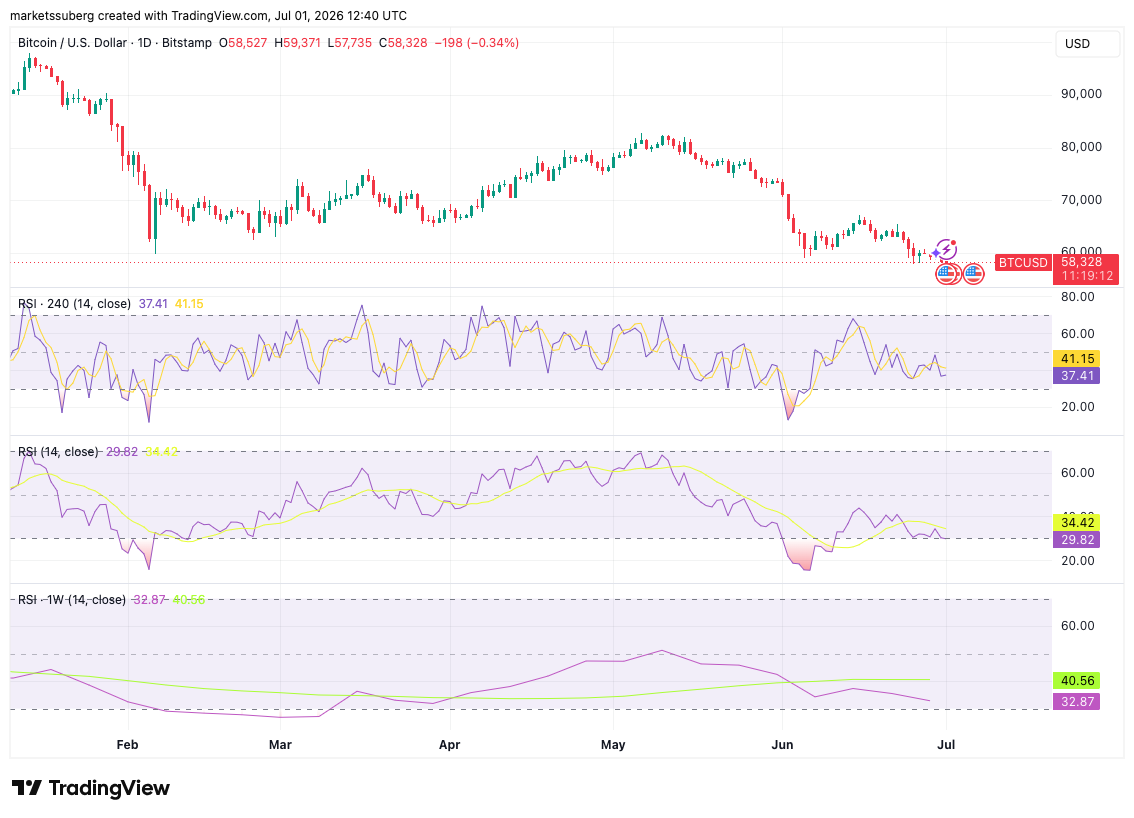
By contrast, bullish divergences across multiple time frames are locking in on the relative strength index (RSI) — a classic hint that trend change is due.
“Not sure I have ever seen more confirmed and potential bullish divergence with oversold RSI on more time frames, ever,” trader, analyst and podcast host Scott Melker told X followers on Wednesday.
“Divs building over multiple time frames is my favorite signal. Good odds.”
The U.S. Treasury’s Office of Foreign Assets Control (OFAC) added 134 crypto wallet addresses to its ISIS-Khorasan (ISIS-K) sanctions entry on Wednesday, including 131 Tron addresses and 3 Monero addresses.
The TRON wallets received more than $1.4 million since 2023 and sent more than $880,000, according to Chainalysis. Tether froze balances on all 131 Tron addresses.
ISIS-K, the Islamic State affiliate active across Afghanistan, Pakistan and parts of Central Asia, has used its media arm al-Azaim Media Foundation to solicit crypto donations through websites and messaging platforms, Chainalysis said.
Chainalysis said it identified historical donation addresses tied to the group on the Tron, Monero and Bitcoin networks.
The freeze reinforces the role of centralized stablecoin issuers in sanctions enforcement. Tether froze more than $182 million in USDT across five Tron wallets in January under its sanctions compliance policy.
OFAC also sanctioned a Brazil-linked network tied to Primeiro Comando da Capital, or PCC, which Treasury described as Latin America’s largest criminal gang.
The network laundered more than $30 million in U.S.-generated illicit proceeds and used crypto to move funds back to Brazil, according to the Treasury.
Most crypto investors still obsess over price charts. But in 2026, a growing share of attention is shifting back to improving the fundamentals of the protocols.
Ethereum, Solana and Avalanche are preparing some of their largest protocol upgrades in years, while Coinbase’s Base network rolled out its Beryl hard fork last Friday in a bid to streamline the network, with a native token standard and shorter withdrawal windows.
Bitcoin development however, remains frozen, with developers still arguing over controversial covenant proposals and post-quantum computing upgrades.
Tim Sun, a senior researcher at Hong Kong-based asset manager HashKey Group, told Cointelegraph that protocol upgrades have historically focused on adding features, speed and throughput.
However, in 2026, he said the emphasis is shifting toward reliability, predictable governance, and institutional-grade infrastructure that can support large-scale financial use cases.
Here are the top five major blockchain upgrades to watch in the second half of 2026.
Ethereum: Glamsterdam
Glamsterdam is arguably the most consequential upgrade this year, and its already being tested on devnets. According to Ethereum’s public roadmap, Glamsterdam is designed to improve scalability, harden the layer-1, and make the network easier to use, with a mainnet launch expected sometime in the second half of 2026.
Sun said the upgrade should improve processing speeds by allowing more transactions to be processed simultaneously, expand capacity so Ethereum can handle more data at higher throughput, and reduce database bloat. Those changes should make the chain better suited for stablecoin settlement and real-world asset use cases, he said.
Related: Ethereum’s much-hated staking ‘tax’ may already be obsolete
Holly Atkinson, chief product and technology officer at 1inch, told Cointelegraph that Glamsterdam is viewed by many as Ethereum’s most significant upgrade since The Merge in September 2022, which transitioned the blockchain from proof-of-work to proof-of-stake.
Glamsterdam. Source: Ethereum.org
She said enshrined proposer-builder separation (ePBS) is a key change because most validators still depend on a small set of specialized builders and relays, which concentrates control over transaction ordering.
That setup amplifies maximal extractable value (MEV), censorship and centralization risks, she said. ePBS is designed to pull block building and proposing back into the protocol and make the process more transparent and accountable.
Pavan Kaur is a Solana Foundation judge and founder of RuleSpark, a compliance engine for digital asset marketing. She told Cointelegraph that ePBS is better understood as one step in Ethereum’s broader roadmap and does not eliminate MEV or fully solve builder centralization. “Practices like sandwich attacks may therefore migrate rather than disappear,” she said.
Solana: Alpenglow
Solana’s biggest change this year is Alpenglow, a consensus upgrade that reworks the network’s core protocol. Alpenglow has been billed by many, including Solana ecosystem lead David Liang, as the chain’s “most significant consensus upgrade yet.”
After being overwhelmingly approved through a governance process in September 2025, Alpenglow remains under development but is expected to ship alongside the Agave 4.1 validator client release later in 2026.
Arun Krishnakumar, vice president of institutional capital at R3 enterprise software firm, told Cointelegraph that Alpenglow will be a major tailwind that will reinforce the ‘internet capital markets’ thesis even more strongly.
Solana Network Updrades. Source: Solana
At its core, Alpenglow is designed to dramatically speed up how quickly the network reaches finality. Instead of relying on Solana’s existing TowerBFT-based consensus mechanism, it introduces a redesigned system built around a new voting component called Votor.
The practical impact is a major reduction in confirmation times, with finality targeted at roughly 100-150 milliseconds in optimal conditions, compared to around 12.8 seconds today.
Beyond speed, the upgrade also removes onchain vote transactions, which currently account for a significant portion of network activity. By streamlining how validators communicate and agree on the state of the chain, Alpenglow is intended to make Solana both lighter and more efficient under load.
Hadley Stern, board director, DeFi Development Corp, told Cointelegraph that removing onchain vote transactions is the “real story” for institutional allocators because it “cleans up validator economics and gives you honest telemetry, which matters when you’re underwriting SOL as a treasury asset.”
He said that a network that can migrate its consensus layer as cleanly as is planned, would show the kind of “governed adaptability legacy financial infrastructure can’t match.”
Base: Beryl
Base’s Beryl hard fork went live on Friday, following a short sequencer-related outage, when block production stalled for around two hours following an invalid block that triggered a temporary consensus failure.
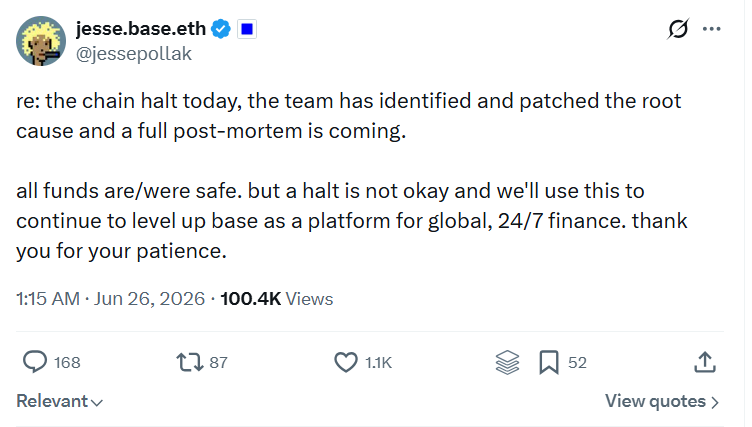
Base co-founder Jesse Pollak said user funds were unaffected during the incident. While he stressed that “all funds are safe,” he added that “a halt is not okay” and said that lessons learned from the episode will be used to further strengthen Base as a platform for “global, 24/7 finance.”
Jesse Pollak speaks about the chain halt. Source: Jesse Pollak
According to Base’s documentation, Beryl introduces a set of changes aimed at tightening the network’s performance and reducing friction at the edges. These include the B20 native token standard, a shortening of withdrawal finality from seven days to five, and integration with Reth V2, which is expected to reduce node storage requirements while improving execution efficiency.
Related: Coinbase’s Base resumes block production after 2-hour outage
Sun said Base has been moving toward a more unified “stack” approach, giving it greater control over how the network is built and upgraded, and allowing changes to ship more quickly than under the earlier Optimism Superchain model.
The trade-off, he said, is that liquidity, which once moved more freely across the broader Superchain ecosystem, may become more fragmented, even as Base deepens its integration with Coinbase’s wider user base.
Avalanche: Octane
Avalanche’s next chapter is less about a single branded hard fork than a broader push to improve performance while courting institutions and tokenized asset issuers.
Sun told Cointelegraph that Avalanche’s recent Etna hard fork replaced the old subnet model with sovereign Avalanche L1s, cutting the cost of launching a dedicated blockchain by more than 99% and making the network more attractive to institutional players.
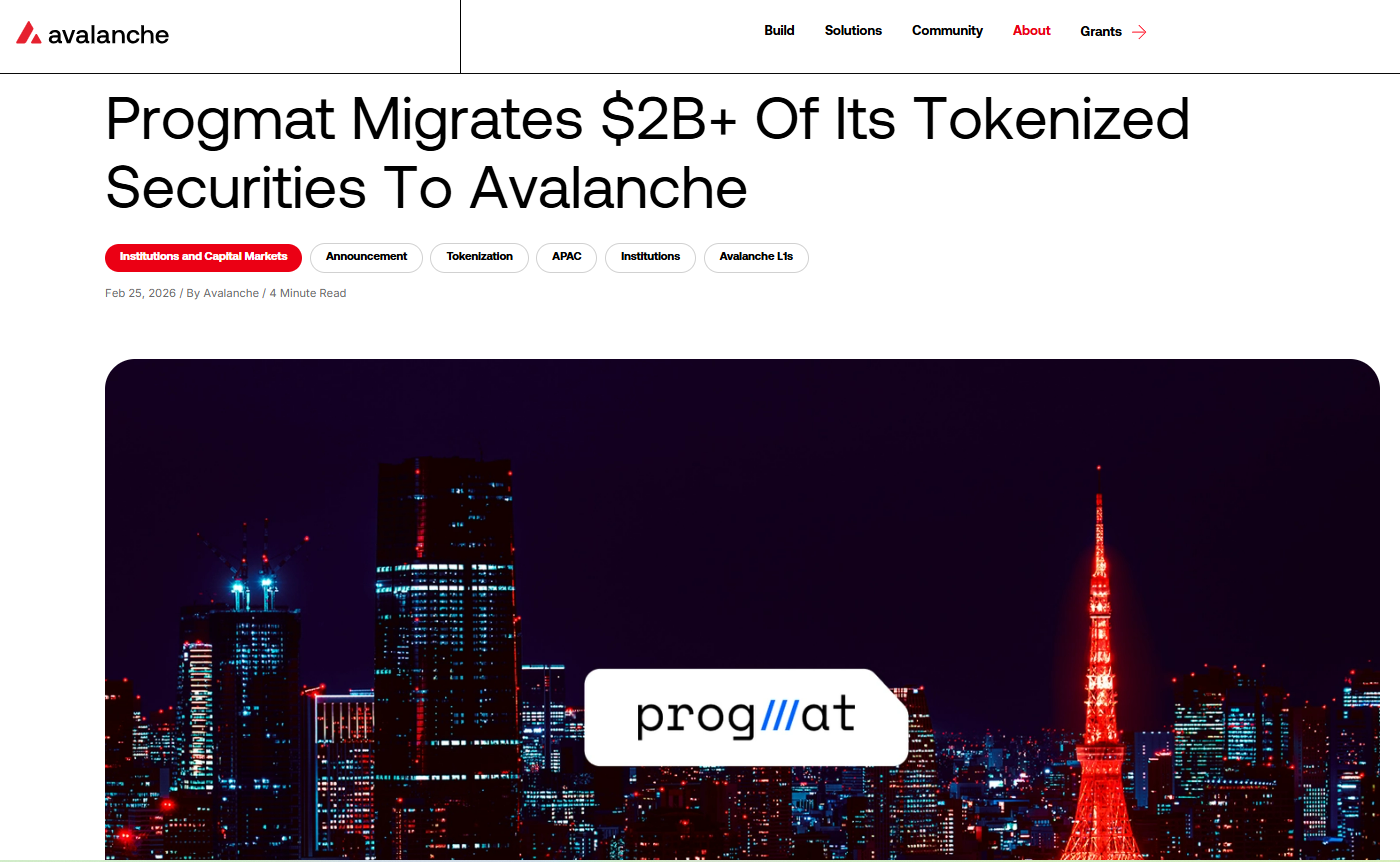
It’s already seen success in this regard. Sun pointed to Progmat, which he said accounts for roughly 63% of Japan’s national security token market, which migrated more than $2 billion in tokenized assets to a dedicated Avalanche L1, as well as the Avalanche Payments Collective backed by firms including Franklin Templeton, VanEck and WisdomTree.
Progmat Migrates $2B+ of its Tokenized Securities to Avalanche. Source: Avalanche
Atkinson said Avalanche is also pushing two upgrades aimed at making its C-Chain one of the fastest Ethereum Virtual Machine (EVM) environments.
Related: Avalanche Treasury falls 16% as it debuts on Nasdaq
She described Streaming Asynchronous Execution as a way to separate transaction execution from consensus so the chain can run more continuously and size capacity closer to normal demand. For users, she said, the practical effect should be higher throughput and lower, steadier fees during periods of heavy activity.
Bitcoin: OP_CAT
Bitcoin is the outlier here because its biggest developments in 2026 are not scheduled upgrades but a continuation of passionate debates over whether the protocol should become more programmable and how urgently it should be hardened against quantum threats.
Bitcoin has not activated a major soft fork since Taproot in 2020, which upgraded Bitcoin’s scripting to make transactions more flexible and improve privacy.
Since then, discussion around covenant-related proposals such as OP_CAT, CheckTemplateVerify (CTV) and Lightning-focused ideas like LNHANCE has intensified. None of these changes has an agreed path to activation.
Researchers have also been debating BIP-360 and related proposals as ways to make it easier to migrate coins into quantum-resistant spending paths, if and when the quantum computing threat becomes real.
Atkinson described Bitcoin as the wildcard of the group. She said covenant proposals could unlock safer storage and richer scripting, but the subject remains divisive and subject to much debate.
Sun said those proposals could improve self-custody security, fee management and protocols such as Lightning and Ark, while giving institutions more programmable custody logic directly on the L1.
Bitcoin development is infamously slow, and any change to the protocol is pored over from every angle. There is general agreement that no covenant opcode is on track for activation this year, and reaching consensus on proposals like OP_CAT or CTV is still some distance away.
On the post-quantum side, BIP-360’s authors estimate that a full migration to quantum-resistant addresses and signatures would take years even under optimistic assumptions. It seems unlikely at this point that a quantum-resistance upgrade will be implemented before the end of 2026.
Magazine: How AI just dramatically sped up the quantum risk for Bitcoin
“Today’s milestone shows we can tokenize securities in ways that meet both market and regulatory requirements, for U.S. and global investors and provides a strong foundation for our expanding access to onchain investments for more U.S. investors,” he added.
Tokenization, or the process of representing traditional assets as blockchain-based tokens, has emerged as one of the fastest-growing areas blurring digital assets and traditional finance. Supporters say it can modernize capital markets through faster settlement, around-the-clock trading and easier movement of assets across financial platforms. A report by Citi projected that tokenized securities could reach $5.5 trillion market size by 2030.
Debate around tokenization models
The launch follows the SEC’s January staff statement on tokenized securities, which outlined how a third-party custodial model could comply with existing securities laws. SEC staff statements don’t have the full weight of formal guidance approved by the agency’s commissioners, but do indicate how the regulator is thinking about issues like tokenization.
Under that approach, a regulated intermediary holds conventional shares in custody and issues blockchain-based tokens representing a holder’s entitlement to those assets. That’s an alternative approach to the issuer-sponsored tokenization, where the issuer of the underlying security is involved in the process.
The agency’s guidance coincided with a growing debate over whether tokenized stocks issued without issuer involvement confer the same rights as traditional shares. The topic drew broader attention when OpenAI said last year it did not authorize Robinhood’s tokenized offering tied to its shares and warned the tokens did not represent equity in the company.
U.S. jobs growth disappointed last month, with the data likely to set back market expectations of a Federal Reserve rate hike as soon as this summer or early Fall.
The U.S. added 57,000 jobs in June, according to the government’s Nonfarm Payrolls Report released Thursday morning. That’s lower than the 110,000 forecasted by economists and significantly below May’s 129,000 gain (revised from an originally reported 172,000).
The unemployment rate came in at 4.2% versus an expected 4.3% and May’s 4.3%. The drop in the UE rate, even as hiring slowed, was due to the Labor Force Participation rate declining to 61.5% from 61.8%.
Up strongly ahead of the report, bitcoin BTC$61,808.83 held above $61,000, higher by 4% over the past 24 hours.
U.S. stocks are liking the data, Nasdaq 100 futures moving to a 0.7% gain from about flat ahead of the report. The 10-year Treasury yield has dipped four basis points to 4.46%
Strategy has become one of the largest corporate holders and buyers of bitcoin, with 847,363 BTC on its balance sheet. Its aggressive accumulation strategy has made the company a major source of demand for the cryptocurrency, meaning any shift toward selling the digital asset, even occasionally, could influence market liquidity, price dynamics and investor sentiment by introducing a new source of supply.
Demand for U.S. spot bitcoin exchange-traded funds (ETFs), the largest source of institutional crypto buying since their 2024 debut, has weakened sharply in recent months. The funds saw a record $4 billion in net outflows in June after a 13-day redemption streak pushed year-to-date flows into negative territory for the first time.
The bank said bitcoin came under pressure in late May and early June after Strategy disclosed in a June 1 regulatory filing that it sold 32 BTC between May 26 and May 31 to fund dividend payments. The sales compounded pressure from a broader repricing of Federal Reserve interest-rate expectations that had already weighed on bitcoin and gold.
JPMorgan noted that Michael Saylor’s Strategy has become one of bitcoin’s largest buyers, purchasing roughly $13.7 billion worth of the cryptocurrency year to date, about 70% of the bank’s estimate for total net digital asset inflows. The company holds around 4% of bitcoin’s total supply.
Aave has deployed V3 on Monad, bringing lending, borrowing and its GHO stablecoin to the high-performance Ethereum-compatible blockchain.
The launch gives Monad a core DeFi liquidity layer as it seeks to attract institutional and real-time financial applications.
Aave has deployed its V3 lending protocol on Monad, giving the high-performance Ethereum-compatible blockchain one of DeFi’s largest credit markets at launch.
The move brings lending, borrowing and Aave’s GHO stablecoin to Monad for the first time. It also positions Aave as a core liquidity layer for an ecosystem trying to attract institutional DeFi, fintech and real-time financial applications.
The deployment follows months of Aave governance discussion.
A February temperature check framed Monad as a network built for high-frequency DeFi, citing 400-millisecond block times, 800-millisecond finality and full Ethereum compatibility. A later May governance proposal advanced the deployment of Aave Protocol V3.7 on Monad and described Aave as a potential “core liquidity engine” for the chain.
Monad is a Layer-1 blockchain built to run Ethereum-style applications with higher throughput.
Its public mainnet launched on Nov. 24, 2025, according to Monad’s documentation. Aave Labs’ technical review said Monad targets 10,000 transactions per second with sub-second finality through optimistic parallel execution, decoupled consensus and execution, MonadBFT and a custom database layer called MonadDB. That performance claim is central to the Aave deployment.
“The next generation of blockchain applications depends on fast execution and deep, reliable liquidity,” said Stani Kulechov, founder of Aave Labs. “Deploying on Monad extends Aave’s lending markets and GHO to a new high-performance ecosystem advancing the EVM, giving more users access to decentralized finance.”
The initial Aave market on Monad supports USDT0, USDC, GHO, USDe, mUSD, AUSD, WETH, cbBTC, wstETH, weETH, syrupUSDC and sUSDe.
Users can supply assets, borrow against collateral and access decentralized liquidity on the network. The governance proposal listed USDT0, USDC, GHO, USDe, mUSD and AUSD as borrowable assets, while USDT0, USDC, GHO, WETH and cbBTC were among assets enabled as collateral.
For Monad, the listing gives builders access to an established lending primitive.
For Aave, it extends a multichain strategy that has already taken V3 to networks including Celo, Sonic, Linea, Plasma and Ink. Aave’s documentation lists those deployments across 2025, showing how the protocol has used V3 to follow liquidity across Ethereum-compatible ecosystems.
The broader issue is whether new blockchains can attract useful liquidity, not just throughput claims.
Aave’s governance discussion said Monad Foundation would provide $15 million in incentives in the first 12 months after activation and acquire 10 million units of GHO to retain for more than six months. The Aave DAO also proposed 500,000 units of GHO incentives to support growth on Monad.
That matters because lending markets often become infrastructure for other applications.
A mature lending pool can support leverage, treasury management, stablecoin liquidity, collateralized borrowing and embedded credit products. Without deep liquidity, even technically fast chains can struggle to support financial applications beyond trading and incentives.
Keone Hon, co-founder and general manager of the Monad Foundation, said Aave’s arrival brings an institutional standard to the network.
“Aave is a lending standard that institutions trust and bringing it to Monad means that the Monad ecosystem now runs on the same liquidity primitives as Ethereum, at 10,000 TPS and 800ms finality,” Hon said. “Monad is built for institutional DeFi: the protocols that matter, running where performance actually clears, and extending the use cases unlocked by composability.”
The deployment also marks another step in GHO’s expansion beyond Ethereum mainnet.
Aave says GHO was initially available only on Ethereum but was designed as a multichain stablecoin. Its help documentation says expansion beyond Ethereum is intended to improve accessibility, lower transaction costs, improve user experience and deepen liquidity.
Chainlink is also part of the Monad setup.
Aave said Chainlink Price Feeds will secure price data, while cross-chain interoperability will be supported through Chainlink infrastructure. Monad joined Chainlink Scale in April 2025, a move that brought Chainlink Data Feeds, Data Streams and CCIP to the network’s developer ecosystem.
The Monad deployment also includes day-one support for Chainlink Smart Value Recapture, or SVR.
That is significant for protocol economics. LlamaRisk has described SVR as a way for Aave to recapture oracle extractable value that would otherwise go to MEV extractors, while also warning that the mechanism adds timing and synchronization risks during volatile liquidation events.
The deployment is not without caveats.
Aave Labs’ April technical assessment said Monad appeared technically viable for Aave V3.6 and found no hard technical blockers. But it also said Monad is a newer independent Layer-1 with a shorter production record than more established networks, and that its validator breadth, execution model and long-term operating characteristics still require scrutiny.
That makes the Aave launch an early test of Monad’s institutional DeFi pitch.
If liquidity grows, Monad could gain more than another application. It could get a base money market that other protocols, wallets and fintech-style products can build around.
The calculation is same for Aave.
The protocol already ranks among DeFi’s largest lending markets, with DefiLlama showing roughly $10.18 billion in active loans on Aave. The Monad deployment gives it a new venue for deposits, borrowing demand and GHO distribution at a time when lending protocols are competing to become the default credit layer across multiple chains.
The news value is therefore less about one more chain integration and more about market structure.
Monad is trying to prove that a faster EVM chain can host real financial activity. Aave is testing whether its lending markets and stablecoin can become default infrastructure wherever that activity moves next.
The above article “Aave Deploys V3 on Monad as High-Speed EVM Chain Seeks Core DeFi Liquidity” was first published on AlexaBlockchain. Read the complete article here: https://alexablockchain.com/aave-deploys-v3-on-monad/
Read Also: Polygon’s 5,000 TPS Upgrade Could Make Stablecoin Payments Viable for Payroll, Remittances and B2B Settlement
Disclaimer: The information provided on AlexaBlockchain is for informational purposes only and does not constitute financial advice. Read complete disclaimer here.