
Home Blog Page 1284

Five Bitcoin Narratives Analysts Are Watching Beyond Price in 2026

0

Key takeaways

  • ETF flows reveal real institutional demand beyond short-term price moves.

  • Bitcoin treasury stocks can turn BTC exposure into an equity risk shaped by index rules.

  • Low fees are reviving questions about how Bitcoin may pay for its long-term security.

  • Scaling now means choosing between Lightning, L2 designs and protocol upgrades.

Everyone’s watching Bitcoin’s (BTC) price, but in 2026, it’s often not the most informative signal.

That’s why it helps to understand what analysts look at when the chart isn’t explaining why the market is moving or where it may move next.

The focus shifts to factors that can quietly reshape Bitcoin’s demand, liquidity and long-term narrative: Who’s buying through exchange-traded funds (ETFs), how “Bitcoin treasury” stocks are treated by indexes, whether miners are earning enough to secure the network, what scaling actually looks like today and how regulation is shaping mainstream access.

Here are five Bitcoin narratives worth watching beyond price in 2026.

1. Reading institutional demand through ETFs

ETF flows may be one of the clearest institutional signals of demand because they reflect real allocation decisions by wealth platforms, registered investment advisors (RIAs) and discretionary desks, not just leverage bouncing around on crypto exchanges.

This idea comes straight from mainstream market reporting and flow data. Reuters framed Bitcoin’s mid-2025 breakout as being “fuelled by strong flows into Bitcoin ETFs” and said the rally looked “more stable and lasting” than earlier, speculation-heavy runs.

Reuters also quoted Aether Holdings’ Nicolas Lin on why this matters for the longer term: “It’s the start of crypto becoming a permanent fixture in diversified portfolios.”

The flip side is also worth noting. Bloomberg highlighted how quickly sentiment can turn when the ETF pipeline reverses, with investors “yanking nearly $1 billion” in a single session, one of the largest daily outflows on record for the group.

Did you know? In February 2021, the Canadian Purpose Investments Bitcoin ETF (BTCC) became the world’s first physically settled Bitcoin ETF, allowing investors to gain direct BTC exposure through a regulated stock exchange, nearly three years before US spot Bitcoin ETFs were approved.

2. BTC as equity products

A growing group of public companies is effectively saying this: Instead of buying Bitcoin directly, buy our stock, and we will hold the BTC on the balance sheet for you.

Naturally, Strategy has been the poster child since 2020. The 2026 narrative, however, is that these types of products are moving into the crosshairs of index providers.

Reuters describes these “digital asset treasury companies” (DATCOs) as companies that “began holding crypto tokens such as Bitcoin and ether as their main treasury assets,” giving investors “a proxy for direct exposure.” The problem is straightforward: If a company is mostly a pile of BTC in a corporate shell, is it an operating business or something closer to an investment vehicle?

That question became a real market risk in early January 2026, when MSCI backed off a plan that could have pushed some of these firms out of major indexes. MSCI said investors were concerned that some DATCOs “share characteristics with investment funds” and that separating true operating companies from “companies that hold non-operating assets… rather than for investment purposes requires further research.”

Barron’s noted that JPMorgan estimated potential selling pressure could have reached about $2.8 billion if MSCI had gone ahead and more if other index providers followed.

Reuters quoted Clear Street’s Owen Lau, who called MSCI’s delay the removal of a “material near-term technical risk” for these stocks that act as “proxies for Bitcoin/crypto exposure.”

Mike O’Rourke of JonesTrading was blunter. Exclusion may simply be “postponed until later in the year.”

If ETF flows are the clean spot-demand story, treasury stocks are the messier cousin. They can amplify Bitcoin through equity mechanics, index rules and balance-sheet optics, even when the BTC chart looks boring.

Did you know? Index providers are companies that decide what stocks qualify for inclusion in major stock market indexes and how those stocks are classified.

3. The security budget question is back

After the 2024 halving, it has become more apparent that Bitcoin’s long-term security story is increasingly linked to transaction fees.

Galaxy put it plainly, “Bitcoin fee pressure has collapsed.” It estimated that “as of August 2025, ~15% of daily blocks are ‘free blocks,’” with the mempool often being empty.

That’s great for users who want cheap transfers. For cryptocurrency miners, it reopens the big question: What pays for security as the subsidy keeps shrinking?

CoinShares made the same point from the mining side, saying transaction fees “have fallen to historic lows,” sitting at “less than 1% of total block rewards” during parts of 2025.

By early January 2026, JPMorgan-linked reporting flagged real stress. Monthly average hashrate fell 3% in December, while “daily block reward revenue” dropped 7% month-on-month and 32% year-on-year, reaching “the lowest on record.”

VanEck also described “a tough structural squeeze” for miners as subsidy cuts collide with rising competition.

With this in mind, analysts are increasingly watching the fee share of miner revenue, hash price and profitability, and whether onchain demand can return without relying on a hype cycle to push fees higher.

4. Lightning, Bitcoin L2s and upgrade politics

Analysts are now watching the full stack when it comes to scaling.

First, Lightning Network remains a primary payments-focused layer, and capacity is rising again. In mid-December 2025, Lightning capacity was reported at a new high of 5,637 BTC. More important than the headline number is who is adding liquidity. Amboss framed it this way: “It’s not just one company … it’s across the board.”

Second, the “Bitcoin L2 / BTCFi” push is receiving institutional research attention. Galaxy counts Bitcoin L2 projects rising “over sevenfold from 10 to 75” since 2021 and argues that meaningful BTC liquidity could move into layer-2 (L2) environments over time. It estimates that “over $47bn of BTC could be bridged into Bitcoin L2s by 2030.” Whether that happens remains the central debate.

Third, Bitcoin’s upgrade debate is back on the table as L2 builders push for better base-layer primitives. OP_CAT “was disabled in 2010” and is now “frequently proposed… using a soft fork.”

Galaxy’s view is that proposals such as OP_CAT and OP_CTV matter because they could support features like “trustless bridges” and “improvements to the Lightning Network.” Ecosystem commentary is now putting timelines on these ideas. Hiro says there is “a good chance” of a covenant-related soft fork “as early as 2026.”

In short, analysts are watching three things: Lightning capacity and liquidity trends, whether Bitcoin L2s attract real BTC rather than incentive-driven capital and whether the soft-fork conversation turns into an actual activation plan.

5. Regulation is deciding who gets access

In 2026, regulation will increasingly shape who gets access to Bitcoin, through which products and on what terms.

In the US, a change in tone is visible at the top. A federal executive order states, “It is the policy of the United States to establish a Strategic Bitcoin Reserve.”

It also says that government BTC in that reserve “shall not be sold.” This language frames Bitcoin as a strategic asset in policy terms.

Stablecoin rules are also key because they shape the infrastructure around crypto markets.

A legal breakdown of the GENIUS Act calls it “the first major crypto legislation” in the United States and noted that it creates licensing requirements for payment stablecoin issuers.

Meanwhile, large asset managers are already warning about second-order effects. Amundi’s chief investment officer said mass stablecoin uptake could turn them into “quasi-banks” and “potentially destabilise the global payment system.”

In the EU, Markets in Crypto-Assets (MiCA) acts as a portcullis. Regulators said, “Only firms authorised … are allowed to provide crypto-asset services in the EU,” with a transition window in some countries running until July 1, 2026.

When it comes to regulation, it is important to watch authorization lists and deadlines in the EU, enforcement posture and whether “strategic reserve” language turns into durable policy in the US.

Did you know? One of the biggest crypto rules many are still waiting on in 2026 is a US market-structure law that would finally spell out who regulates what, ending years of overlap between the Securities and Exchange Commission and the Commodity Futures Trading Commission, and setting clear rules for exchanges and brokers.

Where to look when the chart goes quiet

Bitcoin in 2026 appears less driven by hype cycles alone. Instead, attention is shifting to a few pipes and pressure points:

  • ETF flows show who is allocating and how sticky that demand might be.

  • Treasury-heavy public companies reveal how Bitcoin exposure is being repackaged for equity markets and how index rules can suddenly matter as much as onchain data.

  • The security budget debate reminds us that network health depends on incentives.

  • Scaling discussions have moved from abstract arguments to concrete trade-offs between Lightning, L2 designs and protocol upgrades.

  • Regulation now determines which doors are open and which stay shut for mainstream capital.

None of these forces moves in a straight line, and none shows up cleanly on a price chart. Taken together, they explain why Bitcoin can look quiet on the surface while something important is changing underneath. For analysts, that is where the data increasingly lives.

Cointelegraph maintains full editorial independence. The selection, commissioning and publication of Features and Magazine content are not influenced by advertisers, partners or commercial relationships.
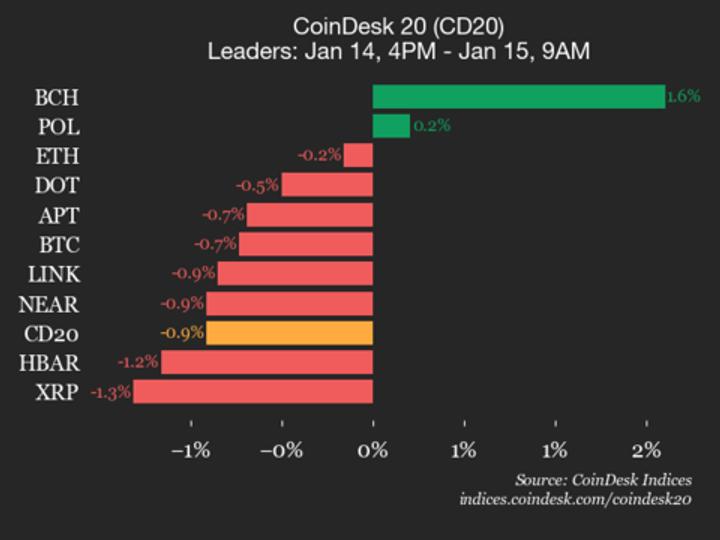
CoinDesk 20 Performance Update: Uniswap (UNI) Drops 4.6%, Leading Index Lower

0

Litecoin (LTC) was also an underperformer, down 2.1% from Wednesday.

Bitcoin Nears $97K as Broad Crypto Rally Extends for Second Day

0

Risk appetite is improving across crypto as spot Bitcoin ETFs see their largest daily inflows in three months and traders weigh macro risks tied to U.S. tariff rulings.

Crypto markets extended gains on Wednesday, Jan. 14, marking the second straight day of positive momentum after a fairly flat holiday season.

As of press time, Bitcoin (BTC) traded around $96,880, up about 4.4% over the past 24 hours, and marking a multi-month high. Total crypto market capitalization climbed to roughly $3.38 trillion, a 3.4% increase today.

BTC 24-hour price chart. Source: CoinGecko

All of the top-10 cryptocurrencies by market capitalization are trading higher today, with most posting 3%-6% gains. Ethereum (ETH) is leading large-cap gains, rising 7% to around $3,353, while TRON (TRX) is the only flat asset among the top-10 today.

Overhead Supply Zone

Glassnode analysts flagged in an X post on Tuesday, Jan. 13, that a key technical zone is forming overhead for Bitcoin, noting that the cryptocurrency’s long-term holder supply distribution heatmap shows a dense cost-basis cluster between $93,000 and $109,000.

the-defiant
BTC long-term holder cost basis distribution. Source: glassnode

According to the analysts, that cluster has formed a “substantial overhead supply zone,” adding that any sustained move higher would need to absorb that supply first.

Analysts at QCP Capital suggested in today’s research note that Bitcoin is finally starting to catch up after pushing past the $95,000 level that had capped gains since November. As of Wednesday morning, the Crypto Fear & Greed Index has transitioned toward the “neutral” zone for the first time in weeks, after it spent much of December in “extreme fear.”

Big Movers and Liquidations

Looking at the top-100 assets by market cap, privacy-focused crypto Dash (DASH) is leading gains today, up over 40%, while Internet Computer (ICP) followed with 12% jump.

On the downside, losses were relatively contained as Bitfinex’s Leo Token (LEO) fell 7%, and the relatively new TradFi darling Canton (CC) slipped 5.1%.

Crypto derivatives markets saw heavy activity over the past 24 hours. Total liquidations reached over $820 million, according to Coinglass data. Short positions accounted for the bulk of the damage at nearly $722 million as markets rallied, compared with about $105 million in long liquidations.

Bitcoin liquidations totaled roughly $398 million, followed by Ethereum at $250 million and Solana at $32 million. As glassnode analysts noted in an X post today, the latest move triggered the largest liquidated short event across the top-500 crypto assets since the Oct. 10 crash, which wiped out a daily record of nearly $20 billion in crypto leverage.

the-defiant
Short liquidation volume. Source: glassnode

ETFs and Macro Conditions

Spot Bitcoin ETFs recorded their largest daily net inflows in nearly three months on Tuesday, Jan. 13, pulling in $753.7 million, according to Coinglass. Spot Ethereum ETFs also saw a sharp pickup, posting net inflows of about $130 million on the day.

On the macro front, attention is now turned to Washington, where the U.S. Supreme Court is expected to issue rulings later today in cases already argued before the justices.

One of the pending cases challenges the legality of President Donald Trump’s global tariffs. The court was set to issue rulings around 10 a.m. ET, but it doesn’t say ahead of time which cases it will decide, Reuters notes.

How Infrastructural Resilience Will Define Readiness

0

In this Predict 2026 interview, Siobhan Byron, Exeuctive Vice President, Universal Banking, Finastra gave an overview of the headline changes present in 2025, from AI to Quantum to Stablecoin. With this context, Byron explains how regulation changes are inevitable and is merely a sign of maturity, and infrastructural resilience will be a key undercurrent to success. Elaborating on the importance of infrastructure, Byron tells businesses to ask themselves two simple questions: What are you trying to achieve and where are you today? Resilience, she believes, defines the ability to enable true growth.

Tom Lee's Bitmine Immersion invests $200 million in YouTube star MrBeast’s company

0

The investment gives Bitmine a stake in a brand with strong Gen Z and millennial appeal, reaching over 450 million subscribers across its YouTube channels.

Dogecoin Founder Crashes Bullish Bitcoin Hopes, Casts Doubts On All-Time High Predictions

0

Trusted Editorial content, reviewed by leading industry experts and seasoned editors. Ad Disclosure

Dogecoin is part of those receiving inflows with the current inflows into the Bitcoin and crypto industry. However, Billy Markus, best known as the co-creator of Dogecoin, shared a blunt take on the current state of digital assets. 

Taking to the social platform X, Markus acknowledged the general strength of the market but made it clear he isn’t interested until he sees cryptocurrencies breaking past their previous peak price levels. His message came at a moment when markets have shown gains and following Bitcoin’s return above $96,000.

Doubts On All-Time High Predictions

The entire crypto market cap is currently sitting at $3.344 trillion at the time of writing. When compared to the $3.047 trillion recorded on January 1, this represents an increase of about 9.7%, meaning close to $300 billion has flowed back into digital assets over the past few weeks. That rise has helped restore some confidence across the market after a period of choppy and indecisive price action in late 2025.

Things are going well for Bitcoin, Ethereum, and other large market-cap cryptos, and bullish momentum is starting to creep in steadily. However, Billy Markus, the co-creator of Dogecoin, specifically mentioned the need for big benchmark breaks to actually happen before believing the optimism that’s creeping in.

In a short message addressed to his millions of followers, Markus remarked that while “crypto is doing good and all,” he would rather be woken up when all-time highs are actually being broken. The comment struck a chord across the community and quickly drew a range of reactions, with some noting new all-time highs feel like a myth at this point, and others noting that new price highs are certainly coming.

Although Markus and his co-creators created Dogecoin as a joke, he holds a selective view of the different assets in the crypto industry. Over the years, he has expressed respect for a small group of networks he views as meaningful or resilient, including Bitcoin, Ethereum, Dogecoin, and Solana.

Where Crypto Stands Now

Billy Markus’ comment shows a larger divide between perspectives in the crypto community based on the current price action of major cryptocurrencies. On one hand, prices have recovered meaningfully from recent pullbacks, but on the other, the major benchmarks many traders are watching have yet to be reclaimed.

Bitcoin is currently trading in the mid-$90,000 range $96,240 after retreating from its October peak above $126,000. This price uptick is yet to reclaim $100,000, and it might not be until this happens that a full bullish momentum rolls in.

Dogecoin’s performance corresponds to the broader market’s mixed signals. The meme token is now back to making daily closes above $0.14 as selling pressure eases and traders are on high alert. However, technical analysis of Dogecoin’s price action shows that the real test is at $0.157, and traders should not celebrate early until this level falls.

Dogecoin price chart from Tradingview.com
DOGE price trends low | Source: DOGEUSDT on Tradingview.com

Featured image created with Dall.E, chart from Tradingview.com

Editorial Process for bitcoinist is centered on delivering thoroughly researched, accurate, and unbiased content. We uphold strict sourcing standards, and each page undergoes diligent review by our team of top technology experts and seasoned editors. This process ensures the integrity, relevance, and value of our content for our readers.

Solana ETFs Draw in $23.6M, Hitting a Four-Week High

0

In brief

  • U.S. spot Solana ETFs saw inflows of $23.57 million Wednesday, their highest in four weeks.
  • While a positive signal, the inflows represent less than 1% of Solana’s daily trading volume—limiting their immediate price impact.
  • Key network metrics like DEX volume and total app revenue have declined in recent months, indicating broader pressure.

U.S. spot Solana exchange-traded funds saw inflows of $23.57 million on Wednesday, their highest in four weeks, per SoSoValue data.

The positive netflow comes as Bitcoin trades near $97,000, accompanied by improving investor sentiment. Solana is currently trading at around $145, flat on the past day but up 8% over the past week, according to CoinGecko data.

Wednesday’s netflow provides “substantial momentum to potentially break Solana’s recently subdued trend,” Lacie Zhang, market analyst at Bitget Wallet, told Decrypt, adding that it “coincides with broader market recovery and could propel prices toward $150 if sustained.”

Sustained ETF demand would signal increasing institutional confidence in Solana’s robust ecosystem, she added, highlighting the project’s scalability and real-world utility.

A muted outlook for altcoins

However, the overall outlook among major altcoins like Solana, XRP, and BNB remains subdued, with rallies largely confined to select narrative-driven sectors like privacy coins and meme tokens.

The scale of the ETF demand itself may be insufficient for a major breakout. “The current demand is not strong enough to sustain bullish momentum or trigger a clear trend change,” Illia Otychenko, Lead Analyst at CEX.IO, told Decrypt. “Solana ETF total net assets account for only about 1.5% of SOL’s market capitalization, and their daily trading volume is less than 1% of total Solana spot volume.”

Traders on prediction market Myriad reflect this hesitation, assigning just a 17% chance that an ‘alt season’ begins in Q1 2026, up from 16% at the start of the week. (Disclaimer: Myriad is owned by Dastan, Decrypt‘s parent company.)

Solana’s fundamentals

Despite this, Solana’s fundamentals show pockets of strength. Nine of the 22 fastest-growing companies to reach $100 million in revenue are built on Solana, according to investment firm FrictionlessVC.

Additionally, Pump.fun, a Solana-based meme platform, has doubled its active addresses over the past week, with daily token creation surging to nearly 31,000, per Dune analytics data.

Yet Otychenko cautions that these bright spots exist against a backdrop of broader network pressure.

He highlighted declines in Solana’s overall DEX trading volume, transaction activity, and total app revenue in recent months. “As a result, while certain applications are growing, the network as a whole remains under pressure.”

Considering the crypto market’s recent growth, Zhang noted that “any perceived lag may stem from temporary market volatility; this disconnect often precedes bullish breakouts, underscoring the network’s undervalued potential for future gains.”

Daily Debrief Newsletter

Start every day with the top news stories right now, plus original features, a podcast, videos and more.

DeFi Becomes Preferred Laundering Route For Impersonation Scams: Chainalysis

0

Crypto scammers are increasingly using DeFi protocols, with total losses exceeding $17 billion in 2025.

Crypto scams are becoming harder to track as criminals move deeper into decentralized finance (DeFi) to launder stolen funds. Blockchain forensics firm Chainalysis estimates more than $17 billion was stolen through crypto fraud in 2025, with impersonation scams driving much of the growth.

In a blog post, the New York-headquartered firm revealed that impersonation scams, which involve fraudsters posing as trusted entities, grew more than 1,400% year over year (YoY). But unlike earlier scam waves, these operations are now relying less on centralized exchanges and more on DeFi infrastructure to move funds.

Impersonation scams and laundering tactics. Source: Chainalysis

“In 2024, these scams saw spikes associated with laundering via smart contracts and token smart contracts. In 2025, these pronounced volumes subsided in lieu of alternating waves associated with bridge use (early-to-mid 2025) and DEX use (second half of 2025),” Chainalysis said.

Chainalysis says the data shows scammers continuing to adapt and innovate, with the average scam payment increasing from $782 in 2024 to $2,764 in 2025, a 253% YoY growth.

As The Defiant reported earlier, losses from crypto-related hacks and exploits fell sharply in December 2025, even as the number of incidents remained elevated.

According to data from blockchain security firm PeckShield, December recorded around 26 major crypto exploits, resulting in total losses of about $76 million. While the figure remains substantial, it marked a roughly 60% decline from November’s $194 million, representing one of the steepest month-over-month drops in 2025.

Short Squeeze Hits Top 500 Cryptos, Traders Unwind Bearish Bets

0

Cryptocurrency markets staged their largest short squeeze since the sharp selloff in early October, as a rebound in prices forced bearish traders to unwind positions and fueled hopes of a broader recovery.

Short liquidations across crypto futures and perpetual contracts climbed to about $200 million on Wednesday, the highest level since roughly $1 billion in short positions were wiped out during the October market crash, according to data shared by analytics firm Glassnode. The firm said it was the biggest short liquidation event across the 500 largest cryptocurrencies since the Oct. 10 selloff.

The rebound follows a significant recovery in investor sentiment, which flipped from fear to greed for the first time since early October, Cointelegraph reported earlier on Thursday.

Some analysts say the short squeeze and sentiment improvement is a signal for improving market conditions preceding a wider market recovery. A short squeeze occurs when the price of an asset makes a sharp increase, forcing short sellers to buy the asset to avoid greater losses.

Source: Glassnode

Bitcoin (BTC) accounted for the largest share of liquidations, with $71 million in shorts liquidated in the past 24 hours. Ether (ETH) followed with $43 million, and privacy token Dash (DASH) had $24 million in shorts liquidated, according to Glasnode’s dashboard.

Related: Bitcoin ETFs on rollercoaster as traditional funds pull in $46B in 2026

Geopolitics add fuel to recovery

Other analysts are pointing to early signs of a market recovery as Bitcoin starts to outperform the US dollar amid heightened uncertainty around the Federal Reserve’s independence and growing geopolitical concerns after the US capture of Venezuelan President Nicolás Maduro on Jan. 3.

”One structural tailwind for Bitcoin as a reserve asset is the rise in geopolitical volatility, which has so far been a headwind for the US dollar,” Nicolai Sondergaard, research analyst at crypto intelligence platform Nansen, told Cointelegraph.

”While precious metals remain the primary beneficiaries in this environment, Bitcoin is increasingly part of the conversation as an alternative reserve asset and could benefit from this trend, even if to a lesser extent,” he added.

Related: 2025 crypto bear market was ‘repricing’ year for institutional capital: Analyst

BTC&DXY, year-to-date chart. Source: Cointelegraph/TradingView

Bitcoin’s price rose 10.6% year-to-date, while the US Dollar Index (DXY) rose 0.75% during the same period, according to TradingView.

Bitcoin may also benefit from other fundamental tailwinds, including the criminal investigation into US Federal Reserve Chair Jerome Powell. Which may introduce a ”risk premia” for BTC, analysts from crypto exchange Bitunix said on Monday.

Magazine: If the crypto bull run is ending… it’s time to buy a Ferrari — Crypto Kid