With bitcoin BTC$62,011.07 and the broader crypto market showing signs of life, defensive positioning in the market has eased, not disappeared, a sign of continued caution.
This is evident from the BTC and ether (ETH) options markets listed on Deribit, where put options, derivative contracts offering protection against price slides, continue to trade at a premium to calls, or bullish contracts.
Bitcoin’s one-week, 25-delta put-call skew, which measures the difference in volatility for puts relative to calls, was around 16%. It showed puts outpacing demand by a 16% vol point premium. That’s still notably elevated, though significantly lower than the 25% of 10 days ago, according to data source Velo.
The one-, three-, and six-month skews also show put premiums of around 10% or more. The same is true for ether.
The message is clear. Downside fears persist, keeping demand for insurance against price declines intact even though BTC long-term holders and ETF investors appear to have returned to accumulation.
Bitcoin (BTC) has added another bear-market bottom signal this month as analysis draws comparisons to November 2022.
Key points:
Bitcoin adds to its list of bear-market bottom signals with a key supply ratio “buy” trigger.
A bear-market floor could still be some time off, analysis says, with supply held at a loss still relatively low.
Demand is the missing piece of the puzzle to shore up a bullish rebound.
Bitcoin profit metric echoes 2022 bear-market bottom zone
In a blog post on Friday, crypto analyst Axel Adler Jr., a contributor to onchain analytics platform CryptoQuant, confirmed the return of a key Bitcoin buy signal.
Advanced Net UTXO Supply Ratio, which measures the proportion of the BTC supply which last moved in profit or loss, is back in negative territory for the first time in nearly four years.
“The ratio dropped into deeply negative territory and then crossed back above the signal threshold on the rebound, which caused the model to print BUY on several sessions in late June and early July,” Adler wrote.
“This is the first buy trigger since November 2022, which was the bottom of the previous bear cycle.”
Bitcoin Advanced Net UTXO Supply Ratio. Source: CryptoQuant
UTXO Supply Ratio cues do not imply that a macro bottom has arrived, but occur “near cyclical lows.”
“Confirmation would be the ratio holding above zero together with rising price. The negative scenario is a move back into negative territory without price support,” Adler explained.
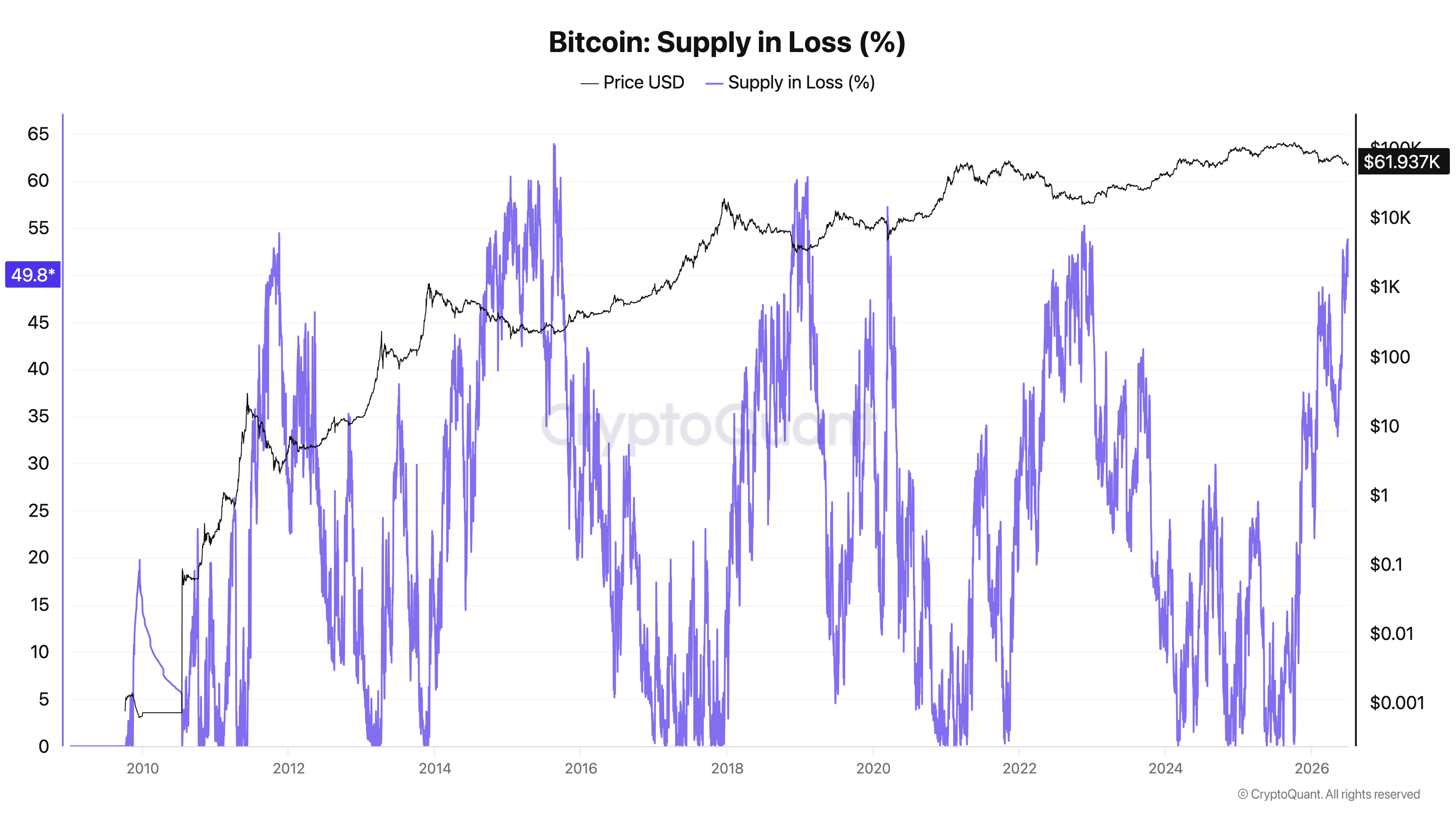
A missing piece of the puzzle involves supply being held at a loss, which has not yet reached the levels seen during previous bear markets.
Adler forecast that the 90-day simple moving average (SMA) of supply in loss should hit its bear-market reversal target within two months.
“Until then, it is more accurate to treat capitulation as a process rather than a completed fact,” he continued.
Bitcoin supply in loss. Source: CryptoQuant
Signals will not “stop BTC from going lower”
On the topic of UTXO Supply, fellow CryptoQuant contributor Darkfost also eyed a potential market inflection point this week.
Related: Bitcoin bear market ‘dead’ after first TD9 reversal signal since July 2022 fires
“Since it depends on the profit and loss of UTXOs, it can very well signal something during either a sharp drop or a sharp rise. That said, in terms of cyclicality, it wouldn’t be inconsistent to think that the end of this bear market could be approaching,” he wrote in a Quicktake blog post on Wednesday.
“This won’t stop BTC from going lower, but we now have several signals pointing to seller exhaustion. The next step is a renewal of demand, and that could take some time.”
As Cointelegraph reported, BTC price expectations tend to favor a bear-market bottom coming in Q3 or later.
President Donald Trump said there is ‘nothing wrong’ with the money his family has made in crypto, responding to financial disclosures that showed he earned at least $1.4 billion from the industry last year.
Asked in a CNBC interview on Thursday at the White House whether he knew about the ventures, Trump said “I could know about it. I didn’t.” He said that there was nothing illegal about his involvement and that his goal was for the U.S. to lead in crypto.
Trump handed day-to-day control of his businesses to his two eldest sons before taking office, and did not divest his assets.
The disclosure, released this week by the federal Office of Government Ethics, made Trump the largest crypto earner in U.S. politics.
It showed about $636 million tied to his eponymous memecoin, which was launched on the eve of his return to office, roughly $594 million from World Liberty Financial, the crypto firm he co-founded with his sons and nearly $197 million from a stablecoin venture.
Large bitcoin holders bought more than 270,000 bitcoin BTC$61,954.71 ($16.7 billion) over the past two weeks, stepping in as U.S. institutions pulled money out at a record pace.
U.S. spot bitcoin exchange-traded funds (ETFs) shed $4.06 billion in June, their worst month since listing, past the previous record of $3.56 billion set in February 2025.
The outflows pushed the funds into the red for 2026 as a whole for the first time, and these products finally recorded a $221 million inflow on Thursday.
Large wallets, often called whales, went the other way, analysts at crypto exchange Bitfinex shared with CoinDesk in a Friday note. They added more than 270,000 BTC over two weeks while the spot premium, a gauge of how hard U.S. buyers are bidding, stayed negative, meaning the buying was not coming from spot desks.
Institutions selling and large holders accumulating at the same time is the pattern that has shown up near past cycle lows, where long-term holders take coins off sellers before any recovery reaches the price.
The working group’s final term committed $450,000 in USDC and 72.5 ETH to Ethereum infrastructure projects including Vyper, Argot Collective and Remix Labs before it was wound down.
The ENS DAO Public Goods Working Group has been sunset after four and a half years of funding Ethereum infrastructure, working group lead Simona Pop said on X Thursday morning.
The group’s final term committed $450,000 in USDC and 72.5 ETH, worth roughly $123,000 at current prices, across Builder Grants, Strategic Grants and advocacy work, according to Pop and the working group’s term 6 report posted to the ENS governance forum. Strategic Grants alone totaled $375,000 USDC in the term, co-funded with the Ethereum Foundation at roughly a 1-to-1.2 ratio.
Recipients included Vyper, the alternate smart-contract language whose deployments secure $2.3 billion in TVL across 23 chains, Argot Collective, the group of 25 former Ethereum Foundation employees now independently maintaining Solidity and Sourcify, and Remix Labs, the team behind the Remix IDE used to deploy more than 12 million contracts.
Pop credited BuidlGuidl founder Austin Griffith with building the rolling, milestone-based platform that let Builder Grants run continuously rather than in seasonal rounds. She framed the closure against ENS’s own origin: ENS founder Nick Johnson secured a $1 million grant from the Ethereum Foundation in 2018 to build what became ENS, work that spun out into True Names Ltd.
Pop argued the DAO is walking away from a larger opportunity. ENS holds one of the largest treasuries in crypto and was positioned to become one of the ecosystem’s “other heroes,” a term Ethereum co-founder Vitalik Buterin has used, she wrote.
The sunset lands amid a broader restructuring of ENS DAO’s governance and treasury. The DAO recently opened a temp-check vote on handing treasury and day-to-day authority to the ENS Foundation, following delegate disputes over a separate foundation proposal and a push to dissolve the DAO after Johnson blocked a security council renewal.
No new funding round has been announced to replace the working group’s grants pipeline.
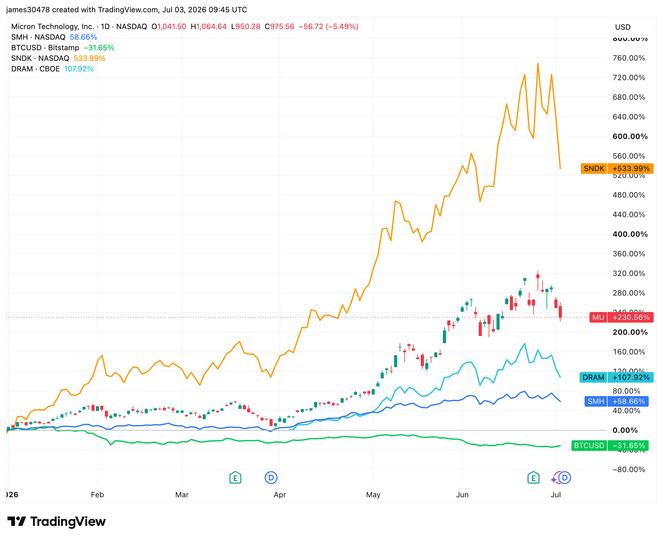
In recent days, there have been signs of a reevaluation.
The Roundhill Memory ETF has fallen roughly 25% from its June 22 record high, while VanEck Semiconductor ETF has dropped 12%. Bitcoin, which dipped below $58,000 on July 1, is back trading above $61,000.
The AI-related selling pressure accelerated on Wednesday after Bloomberg reported that Meta Platforms (META) is creating a business unit called Meta Compute, which will sell excess GPU (graphic processing unit) computing capacity to third parties.
The news rattled companies that have benefited from the AI compute boom, particularly “neocloud” providers that lease GPU infrastructure to AI developers. That includes former bitcoin miners that have pivoted their computing resources to support the emerging industry with high-performance computing (HPC) and GPU hosting services. IREN (IREN), Cipher Digital (CIFR) and TerraWulf (WULF) have each fallen at least 20% from their all-time highs.
It is too early to call the move a sustained rotation, but after months of capital flowing into AI infrastructure at the expense of crypto, the recent pullback in semiconductor leaders alongside bitcoin’s rebound could be the first indication that investors are beginning to rebalance risk back towards digital assets.
The Reserve Bank of India (RBI) reportedly backed a containment strategy for digital assets to shield banks and other financial institutions from exposure to crypto and privately issued stablecoins, as lawmakers prepare a report on the country’s digital asset policy.
According to a report by The Economic Times, RBI Deputy Governor Rohit Jain and Executive Director P. Vasudevan presented the central bank’s position to the Parliamentary Standing Committee on Finance on Thursday.
In a background note submitted to the panel, the RBI reportedly said prohibition remained a recognized policy option and recommended preventing the use of crypto in payments and settlements while restricting banking-sector exposure.
The central bank reportedly warned that applying traditional regulation to crypto could legitimize speculative assets and create a false perception of safety among users. However, it urged policymakers to distinguish crypto from tokenized government securities, corporate bonds and other regulated financial instruments so that restrictions would not hinder tokenization.
Chainalysis’ 2025 Global Crypto Adoption Index. Source: Chainalysis
India ranked first in Chainalysis’ 2025 Global Crypto Adoption Index, although the RBI reportedly challenged the methodology behind private-sector adoption rankings.
RBI renews push to isolate crypto from banking
The RBI’s latest reported proposal echoes an approach it took in 2018, when the central bank directed regulated financial institutions to stop dealing in crypto or providing services to individuals and businesses involved in them.
The approach effectively cut off crypto exchanges from India’s banking system without prohibiting individuals from owning or trading crypto.
India’s Supreme Court overturned the circular in March 2020, following a challenge brought by exchanges and the Internet Mobile Association of India. The court recognized the RBI’s authority to take preventive action but found that the measure failed the test of proportionality, noting that the central bank had not shown harm suffered by entities it regulated.
Related: India arrests Darwin Labs co-founder in GainBitcoin scam probe
In May 2021, the RBI clarified that banks could no longer cite the invalidated circular when cautioning customers against crypto transactions. However, it said regulated institutions could continue applying know-your-customer, anti-money laundering and foreign-exchange compliance requirements.
Cointelegraph is committed to independent, transparent journalism. This news article is produced in accordance with Cointelegraph’s Editorial Policy and aims to provide accurate and timely information. Readers are encouraged to verify information independently.
The HCMC did not immediately respond to a CoinDesk request for comment regarding Binance’s MiCA licensing process.
“As the person who led the license application, there’s nothing that I have been made aware of that there was any issue with the application,” Lynch added. “In fact, I was told the complete opposite.”
Lynch also argued that Europe’s crypto market loses more than just its largest exchange if Binance remains outside the MiCA framework. She said Binance provides liquidity and market infrastructure that benefit the wider crypto ecosystem, adding that regulation should strengthen the industry rather than exclude companies that have invested heavily to meet its standards.
Lynch declined to speculate on reports that political intervention played a role in the delays. Instead, she said the focus is now on helping users through the transition period while preparing a new licensing strategy.
“We’re very committed to being in Europe and very committed to being regulated,” she said.
Despite Binance’s experience, Lynch described MiCA as a positive step for the industry. She said the regulation has helped bring crypto into the financial services system by providing firms with clear rules and consumers with greater protection.
“I fundamentally believe the crypto industry is maturing. Regulation brings maturity,” she said. “The industry is here to stay, and it’s part of the financial services ecosystem.”
Roughly 10.83 million BTC are currently held at a loss, meaning their holders paid more than today’s price, against 9.22 million still in profit, according to Glassnode data. It is the first time loss-making supply has overtaken profitable supply since the current cycle began and reflects how deep the correction from bitcoin’s $109,000 January peak has cut.
Historically, these crossovers have landed near periods of peak financial stress and capitulation among newer buyers. They have also marked the point at which coins migrate from weaker hands to stronger ones, since only holders with high conviction tend to sit on losses rather than sell. Long-term holder accumulation and rising wallet-cohort balances across several size brackets have run alongside this latest deterioration in profitability.
Bitcoin traded at $61,361 on Thursday, up 0.7% on the day and 2.5% on the week, still roughly 44% below January’s all-time high, per CoinDesk data. Ether added 4.2% to $1,702, and Solana led the majors at 18.6% on the week to $80.44, with volume running above $3.6 billion.
Whether the supply crossover marks a bottom depends on what follows. In 2018-19 and 2022, similar readings preceded months of basing before a sustained recovery. The chart does not resolve on its own. ETF flows returning and macro pressure easing are what convert the accumulation signal into a price signal.
Erik Voorhees pushed back on X against critics who said Venice’s $65M Series A undervalued VVV tokens, saying the deal could bring in $131M for 6.5 million tokens locked four years.
Erik Voorhees defended the token terms behind Venice’s $65 million Series A on Thursday, telling critics on X that investors could ultimately pay $131 million for 6.5 million locked VVV tokens if they exercise an attached option. The founder pushed back a day after announcing the round at a $1 billion equity valuation.
Series A backers received a vesting grant of 1.5 million VVV plus an option to buy 5 million more, all locked for four years, according to Voorhees’ original thread. Exercising the option would cost investors an additional $66.5 million, bringing potential total proceeds to roughly $131 million, a figure Voorhees reiterated in a reply to a critic who argued the structure undervalued the tokens.
Napkin Math
The critic had suggested Venice could have raised the same $65 million by selling 8.1 million tokens at around $8 each rather than locking up equity and token warrants. Voorhees rejected that framing, writing on X that “we would never offer such a thing,” and that the actual deal nets Venice up to $131 million for 6.5 million tokens if fully exercised, not $65 million for roughly 8 million.
He argued the OTC buyers are taking on illiquidity risk that no existing VVV holder carries, since both their equity and token allocations remain locked while the token trades openly on exchanges. VVV was changing hands around $13.48 on Thursday, down 1.2% over the previous 24 hours, while BTC gained 2.5%, according to CoinGecko.
Locked Up Twice
In a separate reply, Voorhees clarified that the 5 million optioned tokens are not sold until investors actually exercise and pay Venice the $66.5 million, at which point the shares vest over four years. “So if they exercise and pay Venice then yes they will have been sold,” he wrote, addressing a separate question about whether the option counts as a completed sale.
The Series A, announced Wednesday with Dragonfly leading, marked Venice’s first outside capital since the AI platform launched in May 2025. Voorhees said the company, which he also founded after leaving crypto exchange ShapeShift, hit profitability in the first quarter and holds more than 30 million of the roughly 80 million VVV tokens in circulation.
Any VVV granted or optioned to Series A investors stays locked for a year before unlocking linearly over three additional years, meaning the earliest tokens would not reach the market until roughly two years after Venice’s token launch. Voorhees has framed the sequencing, selling equity and token warrants after 18 months of open VVV trading, as the reverse of the pre-sale model used by most crypto projects.