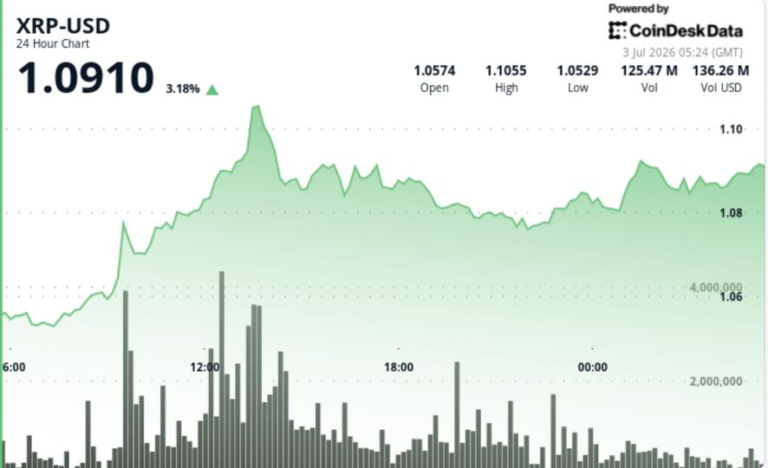
XRP is starting to build a higher base above $1 following last week’s sell-off. The token edged higher through the U.S. session, held $1.08 on repeated tests and pushed toward $1.10 before sellers slowed the move. That keeps the setup constructive, but still unfinished, with traders watching whether the latest accumulation turns into a clean breakout.
News Background
• XRP wallet creation rose to 4,941 daily addresses, the strongest single-day growth in 14 weeks.
• Bullish social sentiment reached a three-month high, with positive comments outnumbering bearish ones by 3.7 to 1.
• Ripple completed its scheduled 1 billion XRP escrow unlock without a meaningful price shock.
• XRP’s move tracked the broader crypto market closely, with idiosyncratic variance against CD5 staying well below the level that would suggest a major asset-specific catalyst.
Price Action Summary
• XRP rose from $1.0611 to $1.0894 during the 24-hour session, gaining 0.62%.
• The token established higher lows at $1.0552, $1.0589 and $1.0799, showing buyers stepped in at progressively higher levels.
• Volume rose 26.92% above the seven-day average, pointing to steady participation around the move.
• The strongest push came at 13:00 UTC, when volume reached 117.5 million XRP, about 142% above the 24-hour average.
The U.S.-listed bitcoin BTC$62,122.90 ETFs pulled in $221.7 million on Thursday, their largest inflow in two months, according to SoSoValue.
Fidelity’s FBTC led the charge with a hefty $165.96 million inflow, followed by ARKB at $91.84 million and HODL at $4.35 million. BlackRock’s IBIT, the world’s largest Bitcoin ETF, was the outlier with a $40.43 million outflow.
The cumulative inflow ends a painful 10-day outflow streak that saw investors pull $2.73 billion from the funds. Even so, the year-to-date picture remains ugly, with net outflows still sitting at a hefty $5.4 billion.
Thursday’s bounce is therefore a drop in the ocean compared to the selling we’ve seen this year. Still, it’s a welcome sigh of relief for the bulls. At the very least, it helps validate bitcoin’s rebound to around $61,700 after hitting 21-month lows under $58,000 earlier this week.
For a real recovery, though, these inflows need to turn into a consistent trend. Historically, steady money flowing into Bitcoin ETFs has been a hallmark of bull runs.
Read: Bitcoin’s long-term holders have returned to accumulation
There are other advantages too. Tokenization enables different forms of digital money, such as tokenized bank deposits, fiat-pegged stablecoins, and tokenized central bank reserves to function seamlessly as settlement assets on the same ledger.
It also allows high-quality assets to be quickly deployed across platforms as collateral.
But all this is not without risk.
The hidden danger
The delays that tokenization eliminates aren’t just inefficiencies, Adrian wrote. They also give banks, regulators and risk managers time to catch problems before they spread.
Remove this buffer, and a market shock, a coding error, or a sudden wave of automated selling could ripple through the system before anyone can intervene.
“Liquidity demands materialize in real time, collateral calls can be automated, and failures can propagate faster than institutions or supervisors can respond,” he wrote. “Risk [sic] that once were borne by the balance sheet of individual institutions behind a transaction become increasingly concentrated in the platforms and code that govern these transactions.”
Adrian also flagged concentration risk. Tokenization tends to funnel activity onto fewer, larger platforms. “When infrastructure becomes the central hub,” he warned, “governance failures become systemic events.”
On cybersecurity, he warned that consolidation onto shared ledgers “amplifies the importance of operational resilience, cybersecurity, and crisis management.”
US markets were closed for the Independence Day holiday, with the Dow Jones closing at record highs the day prior. As noted by trading resource The Kobeissi Letter, the global stock market cap also hit new all-time highs.
“Global equities are in the midst of one of the most powerful rallies in history,” it wrote in a post on X.
Source: The Kobeissi Letter/X
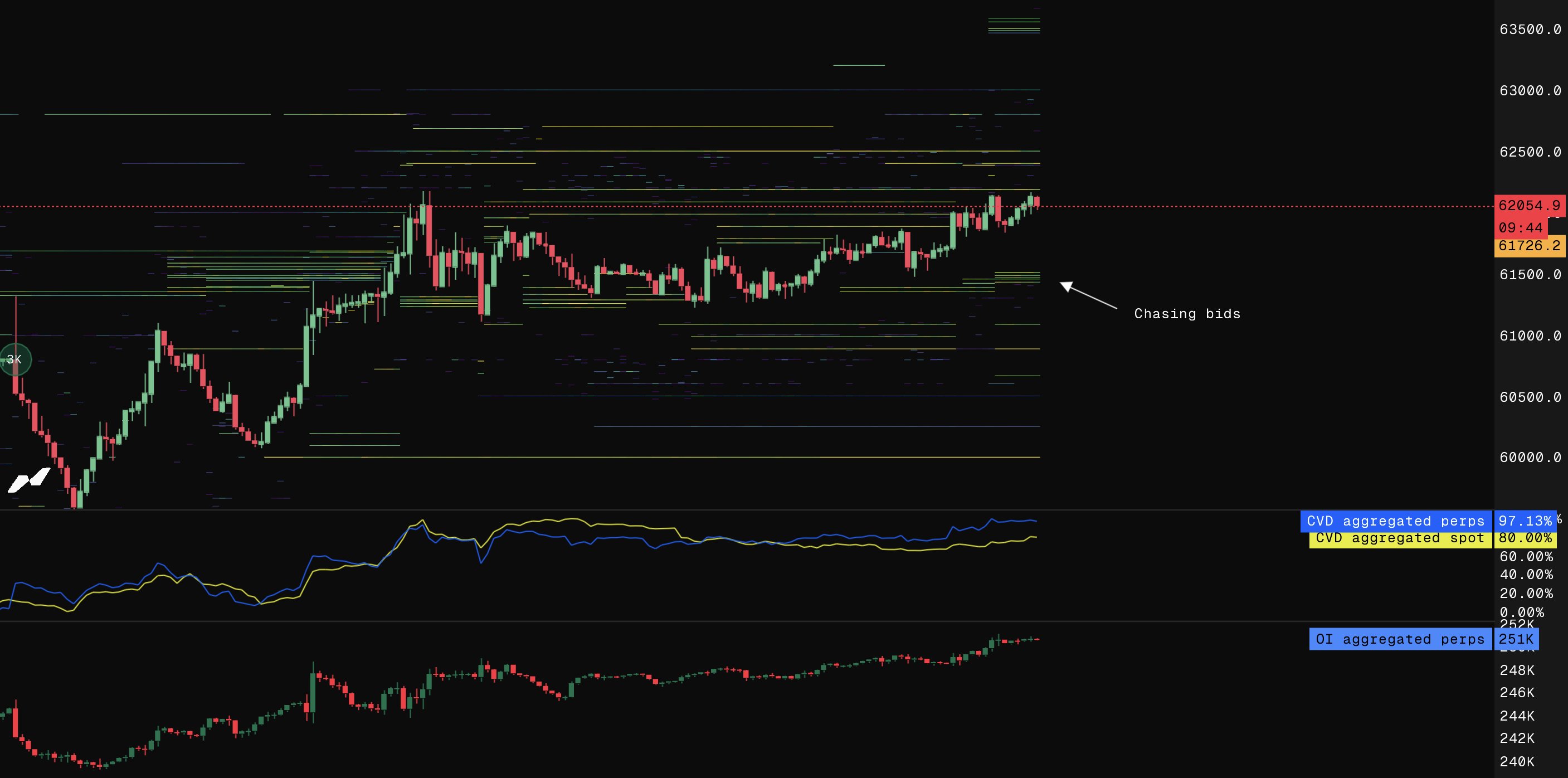
Commenting on the latest BTC price action, X commentator Exitpump eyed “controlled slow buying” on exchanges.
“Looks good for continuation higher, although keeping in mind 62K – 62.5K as a strong resistance area,” they told X followers.
BTC/USD order-book data. Source: Exitpump/X
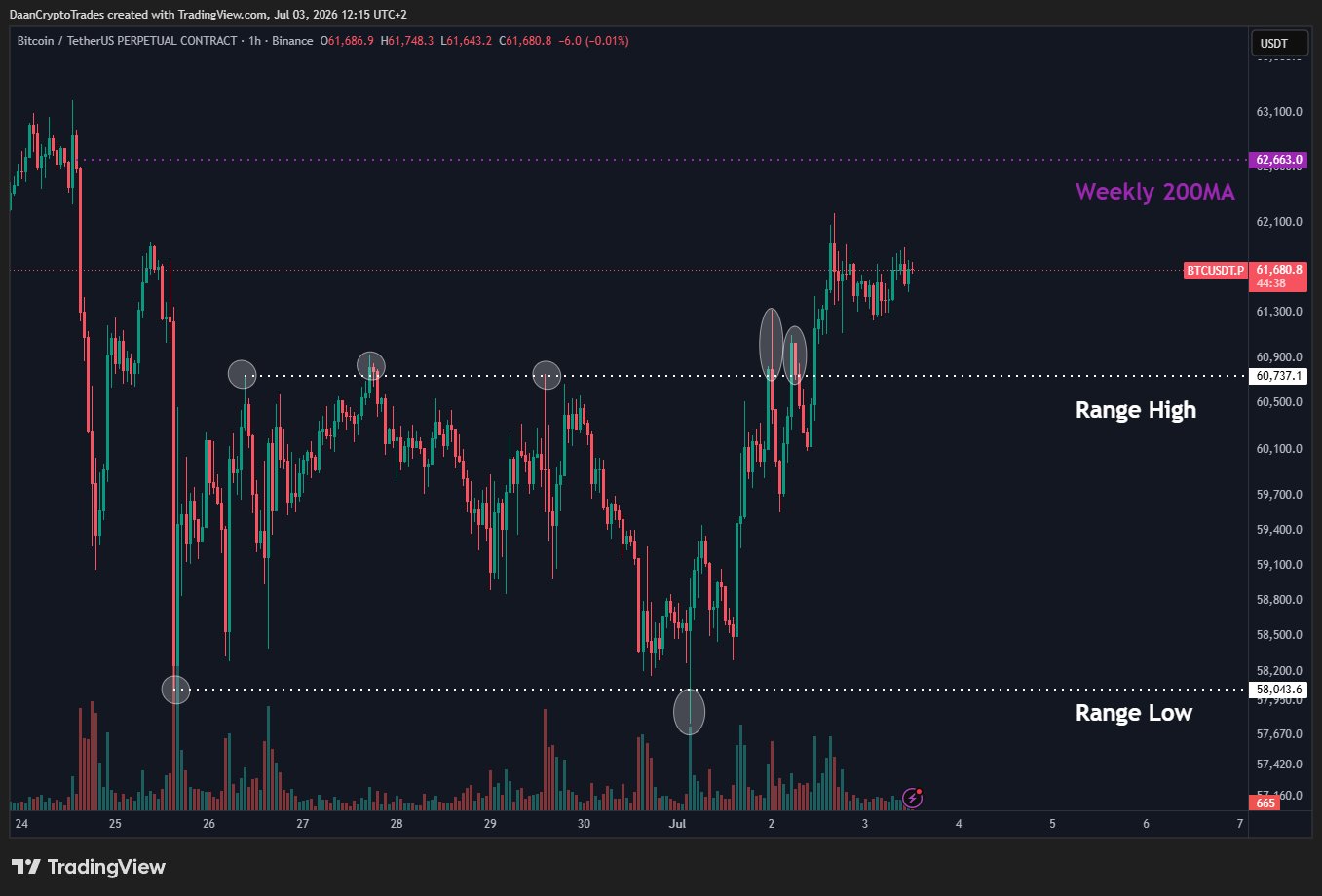
Trader Daan Crypto Trades focused on the 200-week simple moving average (SMA), currently at $62,652, for the weekly candle close.
“It is key for BTC now to hold this breakout and maintain its low timeframe bullish market structure,” he commented, calling the current trading zone “important.”
On the back of weak US nonfarm payrolls data, which helped fuel the crypto rebound, trading resource Mosaic Asset Company noted that expectations for Federal Reserve policy remained conservative.
Related: Bitcoin supply metric prints first ‘buy’ signal since late 2022 as bear market continues
“The knee-jerk reaction from investors was to push stock index futures higher, signaling a regime where bad economic news is good for stocks due to the impact on the rate outlook,” it wrote in its latest Mosaic Chart Alerts update.
Mosaic referred to interest-rate changes from the Fed, with potential hikes forming a headwind for crypto and risk assets.
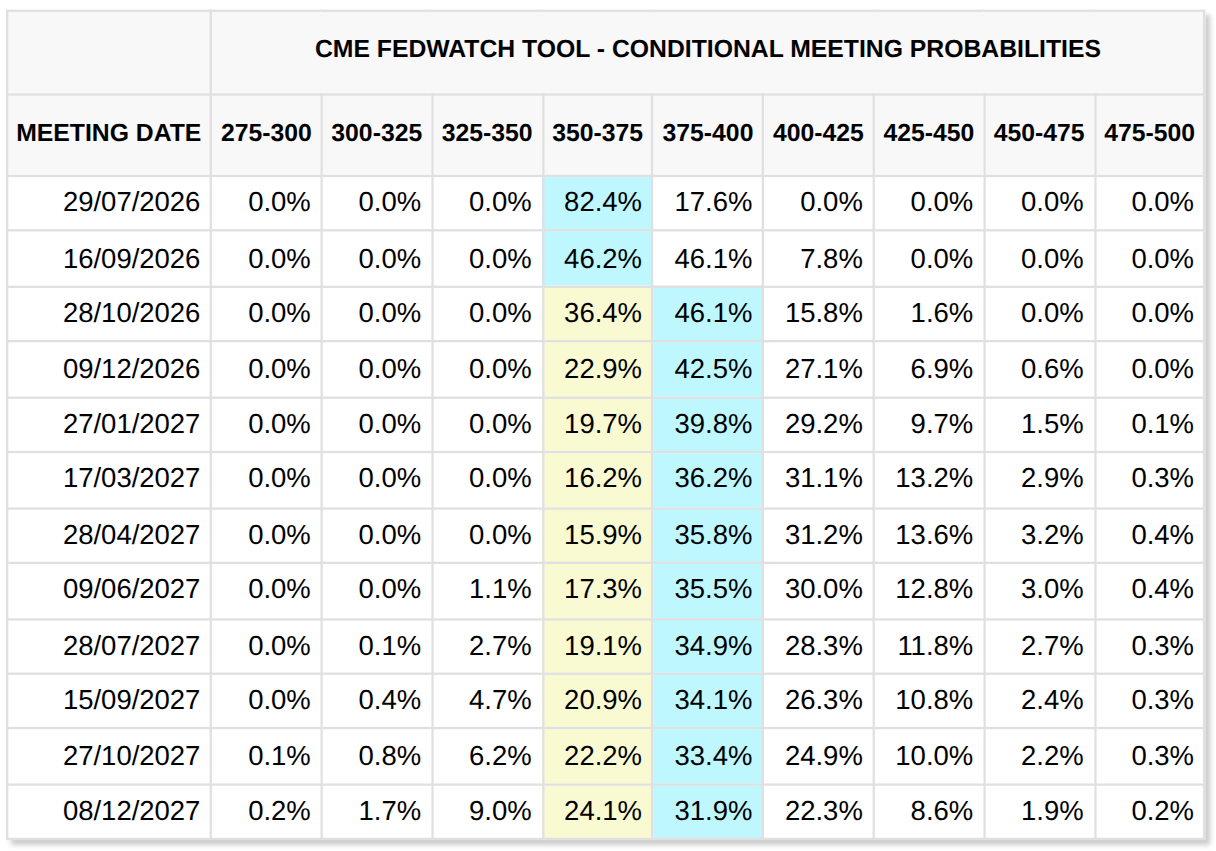
The latest data from CME Group’s FedWatch Tool showed roughly equal odds of a pause or hike at the Fed’s September meeting, with rates staying at current levels until then.
Fed target rate probabilities (screenshot). Source: CME Group
“The reality is that the payrolls report reflects a “Goldilocks” figure for the average stock, which isn’t too cold to stoke growth fears and not too hot to pull additional rate hikes forward,” it summarized about the jobs figures.
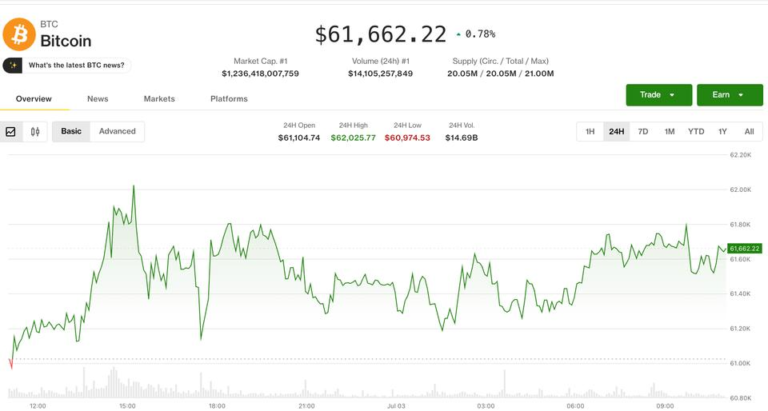
The crypto market is ending the week in a healthier position than where it started, with bitcoin BTC$61,943.20 trading at $61,600 after having risen by 6.5% from Tuesday’s almost two-year low of $57,750.
Still, the largest cryptocurrency’s gains on Friday were muted in comparison with Thursday’s 2.6% advance, which benefited from weak U.S. job data that lowered expectations for a Federal Reserve interest-rate increase.
The interest-rate outlook echoed for a second day as the U.S. entered a long weekend with stock markets closed. Ether (ETH) rose for a third straight day to add 11.5% since Tuesday and 2.6% on Friday alone. Other altcoins also advanced, with ADA$0.1711, zcash (ZEC) and dash (DASH) all gaining between 2.2% and 3.1%.
Still, the broader market structure remains bearish across the majority of crypto tokens following a succession of lower highs and lower lows. For bitcoin to reverse the downtrend, it needs to trade back above $67,000 and then take out $81,000, which was the local high in May.
Derivatives positioning
Ether replaced bitcoin as the biggest token for 24-hour liquidations. A total of $417 million worth of crypto futures bets were liquidated in 24 hours, of which $160.80 million are from the ether market. BTC, a distant second, notched $97 million. This shows just how bearish positioning on ether was.
Ether futures’ open interest (OI) still stood at 14.31 million, the most since June 10, with annualized funding rates of nearly 10% and the highest 24-hour cumulative volume delta (CVD) among majors. The combination points to growing demand for bullish exposure in the market, a sign traders are anticipating continued price gains.
OI in DOGE futures tallied 14.13 billion tokens, the highest since May 16. The number has been growing since June 28, a sign of renewed demand for leverage. The DOGE situation is similar to ether’s bullish picture.
While ETH and DOGE have led OI growth over 24 hours, futures tied to HBAR and ZEC have seen the opposite. HBAR has the most negative 24-hour CVD among majors, a sign bears are becoming more aggressive in shorting at market orders than passive limit orders.
Most tokens have positive CVD, a sign of bulls’ leadership in the market.
Both bitcoin and ether 30-day implied volatility indexes continue to slide, reversing the June pop, signaling market calm and potential for continued bullish price action.
On Deribit, the most traded BTC options of 24 hours are calls at strikes ranging from $60,000 to $70,000. Call options represent a bullish bet on the market. Ether options show a similar bullish mood, with the $2,500 call seeing the most activity.
Block flows featured a large BTC long call condor, a strategy betting on a range play between $66,000 and $68,000 till July 17.
Token talk
Uniswap (UNI) led gains in altcoins following Thursday’s announcement confirming that it will be the primary automated market maker (AMM) for the Robinhood layer-2 blockchain.
UNI is up by more than 11% in the past 24 hours with daily trading volume doubling to $320 million, still reaping the benefits of its tie-up with Robinhood announced July 1.
AI tokens FET, RENDER and TAO also demonstrated positive signs on Friday, rising by between 1.5% and 2.3% since midnight UTC after weeks of sell pressure.
CoinMarketCap’s “Altcoin Season” indicator is at 46/100, still firmly in the neutral zone it has occupied for the past month as the market awaits a return to risk-on sentiment.
Solana (SOL) is leading the rally among crypto majors. It has now surged by more than 17% over the past week, trading at $80 after dropping to as low as $68 the week before.
Wavespace, a Bitcoin neobank serving the Eurozone, has announced MiCA compliance of its ‘self-custodial’ debit card. The young fintech company is at the cutting edge of Bitcoin payments technology in Europe, with support for the Lightning Network, and auto DCA to self-custody.
Debit cards in the Bitcoin and broader crypto industry have traditionally worked by preloading custodial accounts with bitcoin or stablecoins. The process of preloading was usually on-chain, taking time to settle and requiring manual input from the user to send from self-custody wallets or cold storage. If the preloaded balance ran out on the card, spending would not be possible.
Wavespace’s self-custody debit card solves these problems with a novel Bitcoin technology called Nostr Wallet Connect, or NWC for short. This protocol, documented in NIP-47, allows users to connect a service like this debit card to a self-hosted Lightning node. The user sets a minimum balance, say $200 and every time the user spends from the card via the VISA network, Wavespace pulls sats from the user’s self-custodial wallet to top up the card. This process minimizes custodial exchange risk while maximizing user exposure to the asset and automating away the friction to spend bitcoin.
NWC is a technology developed by the Nostr ecosystem, a high-tech niche within the Bitcoin industry that is branching out into social media and other communication protocols.
The Wavespace Neobank
As a high-tech neobank, Wavespace gives users a personal IBAN account, which they can send fiat to, to purchase Bitcoin. Their automated DCA services can be set to withdraw bitcoin upon purchase to a selected Bitcoin address.
The company is MiCA compliant, making it one of the few surviving Bitcoin exchanges in Europe, as the complicated crypto regulations came online.
On the privacy front, the deep Lightning network integration of Wavespace lets user get access to the banking system in a clear and compliant manner, without exposing all their payment data on the Bitcoin blockchain. Since Lightning payments are off-chain, there is no single public record that leaks user data; instead, transactions move through payment channels between various user services, leaving no obvious public trace. The result is a growing compromise between the high privacy, cypherpunk values that created the Bitcoin and crypto industry, while also unlocking access to the legacy financial system, and compliant integration with regulation-heavy areas like Europe.
In an interview with Bitcoin Magazine, Eivydas Račkauskas, Chief Orange Pill Giver at Wavespace, said that 70% of the payments made on the platform use the Lightning Network and that the company is looking into the ARK protocol for further self-custody-oriented payments integrations. He also revealed that the company is integrated with Lightspark and is ready for an expansion into the USA, though he did not reveal further details on the matter.
Wavespace has been almost entirely bootstrapped and self-funded, according to Račkauskas, except for an early Relai angel investor who supported them in 2025. They are currently in the middle of another fundraising round.
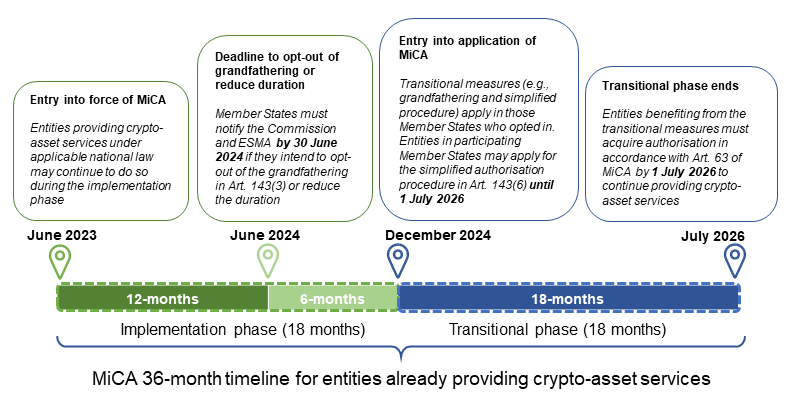
The European Union’s cryptocurrency industry has entered a new enforcement phase as the transition period under the Markets in Crypto-Assets (MiCA) regulation came to an end.
The end of the transition means crypto companies without MiCA authorization can no longer legally serve EU clients and are expected to wind down operations or face multimillion-euro fines and other enforcement action.
Industry executives and lawyers told Cointelegraph the next challenge is ensuring national regulators apply the bloc’s single rulebook consistently, even as supervisory approaches are expected to vary across member states.
The transition marks MiCA’s first major enforcement test as regulators begin applying the EU’s crypto rulebook.
MiCA compliance costs versus fines
Although complying with MiCA can cost hundreds of thousands or, in some cases, millions of euros, experts say operating without authorization carries far greater financial and regulatory risks.
Nicola Massella, partner at Storm Partners, estimated MiCA implementation costs for many cryptocurrency companies at 350,000 euros ($400,000) to 600,000 euros ($690,000), while Brickken CEO Edwin Mata said costs can reach 2 million euros ($2.3 million) depending on a company’s size, services and compliance readiness.
On penalties, Eckehard Stolz, managing director of Amina EU, said MiCA penalties start at 5 million euros or 5% of annual turnover for some violations.
Source: EBA
Massella added that the European Banking Authority (EBA) proposed on June 26 increasing penalties under certain regulatory regimes, including as much as 12.5% of annual turnover for some stablecoin-related breaches.
Who enforces MiCA?
While MiCA creates a single EU rulebook, day-to-day supervision is handled by national competent authorities (NCAs), which authorize, supervise and enforce the rules for crypto companies.
The European Securities and Markets Authority (ESMA) coordinates supervision across member states and maintains the public register of authorized crypto-asset service providers, and the EBA directly oversees significant stablecoin issuers.
Source: ESMA
“At the EU level, ESMA plays an important coordination and supervisory-convergence role, especially to avoid regulatory arbitrage between member states,” Ivo Grlica, founder of GrlicaLaw and G Lab Advisors, told Cointelegraph.
“National regulators are only the first line of MiCA enforcement, but the legal consequences can spread into national courts and criminal-law systems if the underlying conduct causes harm,” he added.
Enforcement unlikely to be uniform at first
MiCA enforcement is unlikely to be uniform in its early stages because NCAs differ in resources, experience and supervisory priorities.
“ESMA made clear it expects NCAs to act against unauthorized providers from July 1,” Stolz said, adding that how aggressively each regulator moves “will depend on local resourcing and priorities.”
Peter Bidewell, vice president of institutional product adoption at Parfin, said differing supervisory approaches could create opportunities for regulatory arbitrage despite MiCA’s goal of harmonizing crypto rules across the EU.
Related: StanChart joins ESMA’s first MiCA register update since deadline
Grlica said he expects enforcement to become more systematic over time as regulators identify unauthorized providers and share information across member states, making it increasingly difficult for companies with a history of non-compliance to obtain MiCA authorization later.
Several EU regulators, including authorities in the Czech Republic, Bulgaria, Luxembourg and Italy, have issued notices reminding crypto companies that the MiCA transition period has ended and urging providers without authorization to wind down their operations.
The Czech National Bank told Cointelegraph that the country’s Financial Market Digitization Act gives it the authority to impose sanctions for MiCA-related violations, including operating without authorization, unlawful token offerings and failing to cooperate with supervisors. The law allows the central bank to fine companies providing crypto services without authorization up to 118.5 million Czech koruna (about $5.6 million), 5% of annual turnover if higher, or twice the unlawful benefit obtained, whichever is greater.
Cointelegraph contacted France’s Autorité des marchés financiers (AMF), the Netherlands’ Authority for the Financial Markets (AFM) and Germany’s Federal Financial Supervisory Authority (BaFin) to ask how they plan to enforce MiCA following the transition deadline. None had responded by publication.
Magazine: How crypto laws changed in 2025 — and how they’ll change in 2026
Phong Le acquired the Series A Perpetual Stretch Preferred Stock at a weighted average price of $90.796 per share on June 22, an SEC filing shows, after weeks of pressure on the security.
Strategy President and CEO Phong Le acquired 11,000 shares of the company’s Series A Perpetual Stretch Preferred Stock, known by its ticker STRC, on June 22, according to a Form 4 filed with the Securities and Exchange Commission. The purchase was made through the Phong Le Revocable Trust, of which Le is trustee and beneficiary.
Le paid a weighted average price of $90.796 per share, with individual trades executed between $90.66 and $90.87, the filing shows. The purchase totals roughly $999,000. STRC is one of five Nasdaq-listed securities issued by Strategy, the Bitcoin treasury company run by chairman Michael Saylor, alongside common stock MSTR and preferred stocks STRK, STRF and STRD.
Buying Into Weakness
The purchase lands after a rough stretch for STRC. The Defiant reported the preferred stock hit record lows in June and slipped below its $100 par value as a broader leverage cascade weighed on Strategy’s capital structure. Company executives had already moved to reassure investors, issuing coordinated statements as the stock fell.
Following the June 22 purchase, Le directly holds 8,009 STRC shares, per the filing, in addition to the 11,000 shares now held indirectly through his trust. He also holds 126,323 shares of Strategy’s Class A common stock, 6,000 shares of the 10% Series A Perpetual Strife Preferred Stock (STRF) and 4,500 shares of the Series A Perpetual Stride Preferred Stock (STRD), the filing shows. Smaller STRC positions are held indirectly through trusts for his three minor children.
What STRC Pays
STRC carries a variable dividend rate and ranks among Strategy’s suite of preferred instruments the company has used to fund its Bitcoin accumulation without issuing more common stock. The $100-par security pays dividends the company can defer under certain conditions, a feature that has drawn scrutiny as the stock traded below that par value in recent weeks.
Strategy has leaned heavily on preferred stock issuance in 2026, including a €620 million STRE offering priced in November carrying a 10% dividend rate. The company has also sold Bitcoin to cover preferred dividend obligations, including a rare 32 BTC sale in June, its first such sale since 2022.
Le’s purchase was disclosed the same day it occurred, filed with the SEC on June 22 at 3:57 p.m. ET.
CryptoQuant’s weekly report, “Incoming Volatility?”, makes a clean, data-backed case that something is about to break.
Bitcoin exchange inflows spiked to roughly 49,000 BTC on June 30 — an extreme reading seen only four other times in 2026. Ethereum inflows blew past 1.25 million ETH the same week. Altcoin deposit transactions hit nearly 45,000 a day, the highest in two months and the exact pattern that front-ran Bitcoin’s slide from $82K in early May to below $58K in late June.
Every one of those signals has historically preceded a directional move, usually down.
And yet, as of Thursday morning, Bitcoin is trading around $61,600 — back above the $60K support the report frames as the line in the sand, and up several thousand dollars from Wednesday’s print near $58,600. The chain is screaming risk-off but the price just shrugged it off.
The most bearish detail in the report isn’t the raw inflow volume — it’s the composition. The average deposit size doubled from 1 BTC to 2 BTC. That’s not retail panic-selling in dribs and drabs; that’s whales and institutions deliberately repositioning coins onto exchanges.
As CryptoQuant’s Julio Moreno notes, a jump in average deposit size is a more bearish tell than high volume alone, because it signals intent rather than noise. When large holders queue up to sell, they usually know something, or think they do.
So why did price go the other way? Because the flows aren’t happening in a vacuum. Bitcoin’s June bleed had less to do with anything crypto-native than with capital rotating out of digital assets and into the semiconductor trade, U.S.-Iran tensions stoking inflation fears, and Strategy trimming its stack.
Mt. Gox moving 10,422 BTC last month revived creditor-selling anxiety ahead of the October repayment deadline. Spot Bitcoin ETFs, meanwhile, have bled billions across a double-digit streak of outflow sessions.
The whales moving coins to exchanges may simply be positioning for that same macro storm and not really causing it.
Thursday’s bounce came courtesy of dovish Fed commentary that eased rate-cut fears. That’s the tell within the tell: in this market, macro is the dog and on-chain flows are the tail.
Bitcoin price action
At the time of writing, Bitcoin is trading at $61,469.98, up $1,322.54 (+2.2%) on the day after bouncing off a 24-hour low of $59,520 and peaking near $62,148 around 10 a.m.
The recovery back above $60,000 — with $32.49B in daily volume and a $1.23T market cap — lines up with the report’s read that $60K is the battleground level, and today the bulls are holding it.
The European Securities and Markets Authority (ESMA) has published the first update to its register of crypto companies under the European Union’s Markets in Crypto-Assets Regulation (MiCA) after the transitional period ended Wednesday.
Friday’s update to the register added 37 licensed crypto-asset service providers (CASPs), including global banking group Standard Chartered, which secured MiCA authorization from Luxembourg regulators on June 25.
Among the new CASPs are digital asset prime brokerage FalconX, Sygnum Europe and Ronin EM, while the register of electronic money tokens (EMTs) has added Crédit Agricole’s CACEIS.
ESMA’s interim MiCA register now lists 280 CASPs, up from 243 in the previous update published June 26.
Standard Chartered advances crypto strategy in Europe with MiCA and EMI licenses
In addition to securing MiCA authorization, Standard Chartered was also granted an Electronic Money Institution (EMI) license, allowing it to issue electronic money and provide payment services, the bank announced on Monday.
“Securing our MiCA and EMI licences is a key step in progressing our digital asset journey in Europe,” Standard Chartered’s global head of financing, Margaret Harwood-Jones, said.
Related: Standard Chartered, Circle bring USDC minting onto banking rails
The bank said the approvals build on recent milestones, including the launch of digital asset custody services in Asia and the Middle East, and support growing client demand for regulated access to digital assets in Europe.
Cyprus leads new MiCA authorizations
Cyprus led the latest wave of MiCA authorizations, accounting for six of the newly listed crypto-asset service providers (CASPs), the highest share among EU jurisdictions.
France followed with five entries, alongside Italy and Malta, which also recorded five newly authorized CASPs. The Czech Republic and Spain added four CASPs each, while Luxembourg accounted for three listings and the Netherlands added two. Germany, Liechtenstein and Latvia each recorded one new entry.
37 newly approved CASPs in the MiCA register update on July 3, 2026. Source: ESMA
The approvals bring the total number of MiCA authorizations granted by the Cyprus Securities and Exchange Commission (CySEC) to 21, while Germany’s Federal Financial Supervisory Authority (BaFin) remains the EU authority with the most MiCA authorizations at 58.
The latest update included no changes to the register of asset-referenced tokens (ARTs), which continued to show no approved issuers, or to the list of non-compliant entities, which remained at 162.
Magazine: How crypto laws changed in 2025 — and how they’ll change in 2026