A Tennessee federal judge has temporarily stopped state regulators from taking action against the prediction markets platform Kalshi, which had sued the state after being ordered to cease offering sports event contracts.
In an order on Monday, Judge Aleta Trauger supported Kalshi’s earlier motion for a preliminary injunction and temporary restraining order against the Tennessee Sports Wagering Council and the state’s attorney general while the court case moves ahead.
The judge said Kalshi “will suffer irreparable injury and loss” by the regulator’s actions, and the company “is likely to succeed on the merits of its claims and its rights will likely be violated” unless the regulator is restrained.
The Tennessee Sports Wagering Council sent Kalshi, Polymarket and Crypto.com cease-and-desist letters on Friday, ordering them to stop offering sports event contracts in the state.
Source: Daniel Wallach
The regulator accused all three of offering sports wagering products without a license. It ordered them to stop offering the products in Tennessee, void all contracts, and refund all users in the state by Jan. 31, threatening fines of up to $25,000 per offense.
Kalshi sues Tennessee, arguing it overstepped
Shortly after receiving the letter, Kalshi sued the Sports Wagering Council; its chair, William Orgen; and its executive director, Mary Beth Thomas, along with state attorney general Jonathan Skrmetti.
The company argued that, as a federally designated derivatives exchange, it is subject to the “exclusive jurisdiction” of the Commodity Futures Trading Commission.
“Tennessee’s intent to regulate Kalshi intrudes upon the federal regulatory framework that Congress established for regulating derivatives on designated exchanges,” Kalshi said.
Related: CFTC issues no-action letter to Bitnomial, clearing way for event contracts
Kalshi has made similar arguments in lawsuits it has launched against other state regulators, which had also issued the company and some of its rivals with cease-and-desist letters, arguing that prediction market platforms must be licensed at the state level.
Courts in Nevada and New Jersey have sided with Kalshi to block state regulators from taking action while the company’s lawsuits play out, but a judge in Maryland denied Kalshi’s request for a temporary block.
Tennessee’s action against Kalshi is frozen until a preliminary injunction hearing slated for Jan. 26, and the platform is free to continue operating in the state.
Magazine: Meet the onchain crypto detectives fighting crime better than the cops
Cointelegraph is committed to independent, transparent journalism. This news article is produced in accordance with Cointelegraph’s Editorial Policy and aims to provide accurate and timely information. Readers are encouraged to verify information independently. Read our Editorial Policy https://cointelegraph.com/editorial-policy
H100 Group AB, a Swedish health technology and Bitcoin treasury company, has signed a letter of intent to acquire Future Holdings AG, a Zurich-based bitcoin treasury firm.
The agreement, announced today to Bitcoin Magazine, would give H100 full ownership of Future and mark its first major expansion outside of the Nordic region.
The proposed acquisition aligns with the company’s goal to strengthen its Bitcoin treasury capabilities and engage more directly with European institutional investors.
Switzerland is seen as a strategic market, known for its strong currency, deep capital markets expertise, and sophisticated fixed-income investor base.
Adam Back became involved with H100 through an investment agreement last year, providing a SEK 21 million convertible loan with the option to expand to SEK 277 million to support the company’s Bitcoin treasury strategy.
In recent years, low interest rates have driven institutional investors to explore alternative treasury strategies, including digital assets like Bitcoin.
Future Holdings has carved out a niche in Switzerland for institutional Bitcoin treasury management. The company’s governance structures and capital market experience are tailored to local regulations, and it has previously explored a public listing.
While that process did not move forward, the company said combining Future with its listed Swedish platform creates a new opportunity for regulatory and operational alignment, potentially appealing to institutional investors seeking transparent exposure to Bitcoin.
H100’s deal terms and timeline
Under the terms outlined in the letter of intent, H100 would acquire 100% of Future’s shares for CHF 375,000 plus the company’s cash balance, currently bringing the total to approximately CHF 600,000.
The purchase price is expected to be paid through newly issued H100 shares, priced based on the most recent trading day prior to signing. Completion remains subject to due diligence, regulatory approvals, and final transaction agreements, with both parties anticipating simultaneous signing and closing in January 2026.
H100 holds 1,046 BTC on its balance sheet, according to the company, making it the largest Bitcoin treasury company in the Nordics. The company also operates in the health technology sector, offering AI-driven solutions and platform tools for health and lifestyle providers.
The acquisition of Future is intended to broaden H100’s public-market footprint while deepening its institutional expertise in Bitcoin treasury strategies.
Sander Andersen, H100’s chairman, touched on the strategic importance of Switzerland and Future’s local experience. “This transaction supports H100’s expansion into Switzerland. Future brings relevant local experience, and we see Switzerland as a key market as institutional investors continue to evaluate new approaches to capital allocation,” Andersen said.
Richard Byworth, chairman of Future, emphasized the value of combining the two companies’ capabilities. “Combining Future with H100 creates a public-market platform and governance framework that we believe is essential for building long-term institutional credibility in the Swiss market,” he said.
Former New York City Mayor Eric Adams launched the NYC token, claiming it would fund charitable causes.
The token surged to a nearly $600 million market cap before crashing to over $1oo million.
A wallet linked to the token deployer removed $2.43 million in USDC liquidity, added back $1.5 million, leaving $932,000 unaccounted for.
A wallet linked to former New York City Mayor Eric Adams’ newly launched crypto token allegedly pocketed nearly $1 million through suspicious manipulation of a liquidity pool on Monday.
The creator of the NYC token sent 80 million coins to an account that added the tokens as liquidity on a decentralized exchange.
That account then removed $2.43 million in USDC before adding back $1.5 million, leaving approximately $932,000 in unaccounted-for USDC liquidity, on-chain analytics platform Bubblemaps confirmed to Decrypt on Monday.
The episode comes amid growing scrutiny of politician-backed cryptocurrencies, including meme coins, following last year’s collapse of the LIBRA token promoted by Argentine President Javier Milei, which led to fraud and racketeering class-action lawsuits.
Bubblemaps also identified the suspicious activity, reporting that wallet 9Ty4M, associated with the NYC token deployer, created one-sided liquidity pools on Meteora.
“This wallet then: removed ~$2.5M USDC at the peak, added back ~$1.5M USDC after a -60% drop,” Bubblemaps reported.
“There has been no explanation for these liquidity moves,” Bubblemaps tweeted. “This is unfortunately reminiscent of the $LIBRA launch, where liquidity was also heavily manipulated.”
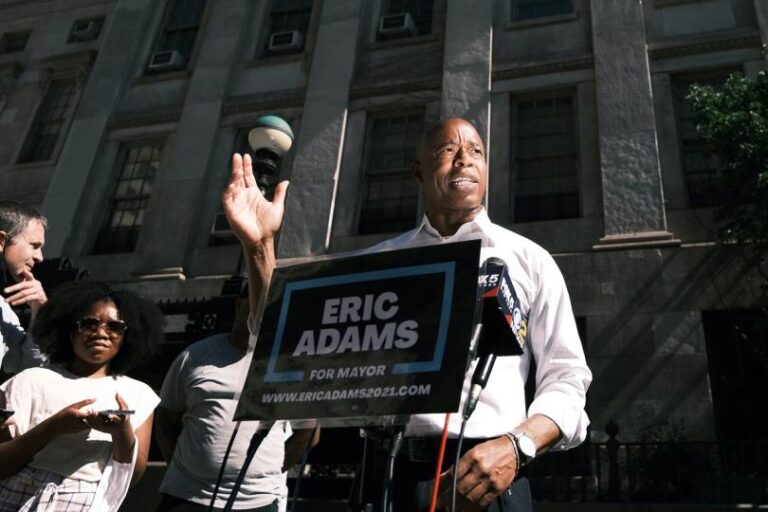
The former mayor announced the token at a Times Square press conference on Monday, saying the project would address “antisemitism and anti-Americanism” using revenue generated by the token, while also teaching children “how to embrace the blockchain technology.”
The NYC token has a maximum supply of 1 billion tokens, with it representing “the spirit of New York City—innovation, diversity, and the drive to succeed,” according to the token’s official website.
NYC surged to a $600 million market cap before crashing to around $110 million, according to Solscan data. The token’s price has fallen by more than 81% from a peak of around $0.58 to just $0.11, data shows.
Decrypt has reached out to Eric Adams for comment.
Political disasters
President Milei’s LIBRA token scandal led to frozen assets, investigations into fraud, and class-action lawsuits.
Only 14% of LIBRA investors turned a profit, while 86% of those who invested in the token lost a combined $251 million, according to a report by Nansen.
Court filings in a U.S. class action lawsuit later named Meteora co-founder Benjamin Chow as the mastermind behind at least 15 token launches following an “identical blueprint,” including the high-profile MELANIA and LIBRA tokens.
The lawsuit alleges that First Lady Melania Trump and President Milei were used as “props to legitimize” what prosecutors describe as coordinated liquidity traps.
The MELANIA token, promoted by the First Lady just two days after President Trump’s own meme coin debut in January, surged to a near-$7 billion market cap before collapsing by 99% to $80 million over the following months.
In November, an Argentine judge froze assets relating to the LIBRAsc andal after investigators discovered potential “indirect payments to public officials” by Kelsier Ventures CEO Hayden Davis.
Bubblemaps linked wallets used to launch MELANIA and LIBRA, revealing a pattern of coordinated manipulation.
Daily Debrief Newsletter
Start every day with the top news stories right now, plus original features, a podcast, videos and more.
Open banking in the UK has reached its eighth anniversary, with more than 16.5 million user connections live across the UK.
Editorial
This content has been selected, created and edited by the Finextra editorial team based upon its relevance and interest to our community.
The milestone comes as the FCA, in a recent letter to the Prime Minister, identified open banking as a key initiative to drive national growth and unlock new use cases, particularly SME lending.
Since its launch in January 2018, open banking has evolved from a regulatory initiative, instigated under the Competition and Markets Authority’s Retail Banking Market Investigation Order 2017, into a core part of the UK’s financial infrastructure.
The open banking ecosystem now comprises 145 authorised third-party providers, with account-to-account payments growing rapidly as businesses and consumers switch from costly credit card payments to pay-by-bank options.
The infrastructure, standards and lessons developed through open banking are forming the basis for open finance, supporting new data-sharing services across areas such as pensions, investments, insurance, energy, telecoms, and housing.
Commenting on the anniversary, Henk van Hulle, CEO of Open Banking Limited, says: “In just eight years, Open Banking Limited has helped build an ecosystem that people and businesses across the UK now use as part of everyday financial life, sometimes without even realising. The UK has created something genuinely world-leading; the priority now is to put the right long-term structures in place so that advantage is protected and can continue to grow to support as many businesses and consumers as possible to better engage with, and make the most of, their finances.”
A partial draft of the Senate’s legislation shows the bill remains blank on stablecoin rewards and has some protections for decentralized finance, but they’re weaker than before.
U.S. Fed Chair Powell called out political pressure and threats from the Trump administration in a statement Sunday, weighing on global risk sentiment.
Bitcoin, alongside the wider crypto market, traded sideways on Monday, Jan. 12, amid rising political turbulence in Washington and uncertainty over U.S. monetary policy. Meanwhile, traditional safe-haven assets like gold and silver rallied sharply.
As of press time, Bitcoin (BTC) hovered near $91,400, up about 0.5% today, still down about 2.5% on the week. Total crypto market capitalization stood at roughly $3.2 trillion, also up slightly on the day.
BTC 7-day price chart. Source: CoinGecko
Ethereum (ETH) slipped 0.5% to around $3,100, also recording weekly losses of 2.5%. Despite the price stagnation, Standard Chartered analysts wrote in a research note to subscribers Monday morning that they’ve lifted their long-term ETH forecast, expecting it could reach $40,000 by the end of 2030, while the analysts forecast Bitcoin to $500,000 over the same period.
BTC and ETH price forecasts. Source: Standard Chartered
As the analysts explained, ETH could outperform thanks to continued buying from Tom Lee’s crypto treasury firm Bitmine, alongside dominance in stablecoins, tokenized real-world assets, and DeFi.
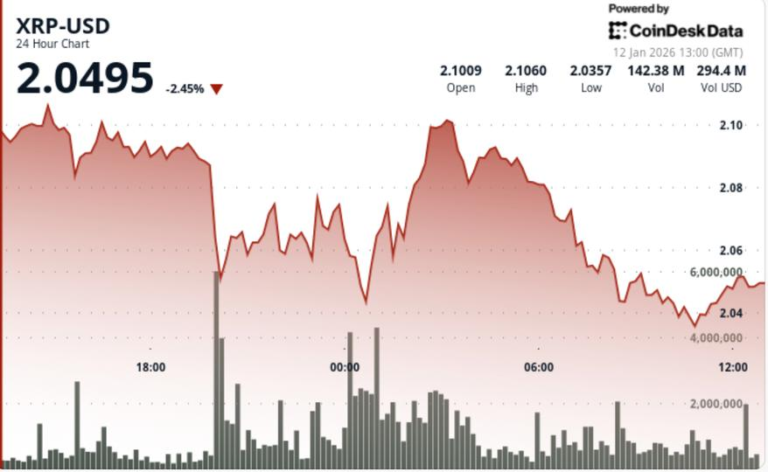
Most of the top ten cryptocurrencies are slightly down today, with the exception of Solana (SOL), up 2.2% to $142. XRP fell 0.7% to $2.07, while BNB declined 0.3% to about $903, and Dogecoin (DOGE) was flat around $0.138.
Market Absorbs Long-Held Supply
Analysts at glassnode noted in an X post today that long-term Bitcoin holder distribution has slowed, with net outflows easing from extreme levels, a sign the market may be absorbing older supply and working through overhead selling pressure.
Bitcoin long-term holder net position change. Source: glassnode
“Long-term $BTC holder distribution has decelerated. Net outflows have rolled over from extreme levels, indicating that the market is progressively absorbing long-held supply and that a large portion of overhead supply may now be largely worked through,” the analysts wrote.
Meanwhile, researchers at Keyrock said in a report today that markets continue to trade without conviction, with investors cautious ahead of macro catalysts and policy clarity, leaving positioning light across risk assets. The analysts wrote:
“With uncertainty lingering and positioning light, the upcoming earnings season may prove decisive in breaking the current stalemate and restoring directional clarity across risk assets.”
Crypto Fear and Greed Index. Source: alternativeme
As of Monday morning, the Crypto Fear & Greed Index remains in the “fear” zone after several weeks of extreme fear, indicating that investor sentiment has softened but is still cautious and the market may be undervalued.
Big Movers and Liquidations
Looking at the top-100 assets by market cap, Monero led gains, jumping over 16% and hitting a new all-time high for the first time since 2018. Tether Gold and other gold-pegged altcoins also notably edged higher today as spot gold rallied, seemingly over geopolitical and Fed independence concerns.
On the downside, POL (ex-MATIC) led losses, sliding nearly 10% and reversing last week’s rally. Cardano-linked asset Midnight (NIGHT) was the second biggest loser today, down 7%.
Volatility triggered $257 million in crypto liquidations over the past 24 hours, Coinglass data shows. Long positions accounted for about $158 million, while short liquidations totaled roughly $99 million. Bitcoin saw the largest share at $62 million, followed by Ethereum with $53 million.
ETFs and Macro Conditions
Last week, spot Bitcoin ETFs recorded net outflows of $681 million, bringing cumulative inflows to $56.4 billion, according to SoSoValue. Meanwhile, spot Ethereum ETFs saw $68.6 million in weekly net outflows, while cumulative inflows stood above $12.4 billion.
On the macro front, risk sentiment deteriorated after Federal Reserve Chair Jerome Powell disclosed on Sunday, Jan. 11, that the Justice Department had issued subpoenas linked to his past Senate testimony, framing the move as political pressure.
“I have deep respect for the rule of law and for accountability in our democracy. No one — certainly not the chair of the Federal Reserve — is above the law. But this unprecedented action should be seen in the broader context of the administration’s threats and ongoing pressure,” Powell said.
President Donald Trump denied knowledge of the investigation, saying in a brief interview with NBC News on Sunday night that Powell is “certainly not very good at the Fed, and he’s not very good at building buildings.”
U.S. stocks, bonds, and the dollar sold off Monday morning, reviving the so-called “Sell America” trade, CNN reports.
Precious metals, however, rallied sharply. Gold hit a new record high above $4,600 per ounce, while silver also reached a new all-time high of $85.70 as investors apparently seek safe harbors amid the subpoena news, as well as heightened geopolitical uncertainty globally, including escalating civil unrest and government crackdowns on protestors in Iran.
Analysts at QCP Capital said in a Monday update that near-term volatility risks “should remain elevated.” They added that markets will be sensitive to U.S. consumer price index (CPI) data set to come out tomorrow, Jan. 13, followed by the U.S. Supreme Court’s tariff ruling on Wednesday.
Bitmine Immersion Technologies expanded its Ether holdings over the past week as its chairman urged shareholders to approve a proposal that would allow the company to further build its crypto treasury and staking operations.
The company said it purchased 24,266 Ether (ETH) over the past week, lifting its total crypto holdings to about 4.17 million ETH, or 3.4% of the token’s circulating supply.
According to Monday’s announcement, the company reported about $14 billion in combined crypto and cash holdings, including $988 million in cash. In addition to ETH, it holds 193 Bitcoin (BTC) and a $23 million stake in Eightco Holdings.
Bitmine also expanded its staking activity, with about 1.26 million ETH currently staked, up 596,864 ETH from the prior week. Staking involves locking cryptocurrency to help run a blockchain network in return for yield. Bitmine is working on its own staking platform, with plans to deploy it in early 2026.
The update also brought renewed calls from Tom Lee for shareholder approval of an increase in authorized shares, which the company says is needed to support its strategy, ahead of its annual meeting scheduled for Thursday in Las Vegas.
Lee said the company’s charter requires approval from a majority of outstanding shares and warned that without additional authorization, Bitmine’s ability to continue acquiring Ether could be limited.
Bitmine shares were up 3% in early trading, according to Yahoo Finance data, while Ether (ETH) was trading near $3,100, down 3.3% over the past seven days.
Source: Yahoo Finance
Related: Ethereum treasury company BitMine crosses 1 million staked ETH milestone
Bitmine, Strategy dominate digital asset treasury companies
2025 saw a wave of digital asset treasury companies emerge, as entities adopted strategies centered on holding Bitcoin, Ether and other cryptocurrencies on their balance sheets. While hundreds of companies have entered the space with varying approaches, treasury holdings have become highly concentrated.
According to data from CoinGecko, Bitmine has established itself as the largest Ether treasury company by a wide margin, holding 4,167,768 ETH valued at nearly $13 billion, compared with Sharplink, the second-largest holder, which reports 864,840 ETH and The Ether Machine, which holds just under 500,000 ETH.
Top five Ether treasury companies. Source: CoinGecko
On the Bitcoin side, Strategy, led by Michael Saylor, continues to dwarf other corporate holders after pioneering the Bitcoin treasury model in 2020. The company holds 687,410 BTC, according to BitcoinTreasuries.NET, far ahead of Mara Holdings Inc. with 53,250 BTC and Twenty One Capital with 43,514 BTC.
Top five Bitcoin treasury companies. BitcoinTreasuries.NET
Neither company has shown any signs of slowing down. Last week, Strategy added 13,627 BTC to its balance sheet at a cost of $1.25 billion, marking its largest Bitcoin purchase since July. Bitmine has said it is targeting ownership of 5% of Ether’s total supply, or about 6 million ETH.
Magazine: Bitget’s Gracy Chen is looking for ‘entrepreneurs, not wantrepreneurs’
Cointelegraph is committed to independent, transparent journalism. This news article is produced in accordance with Cointelegraph’s Editorial Policy and aims to provide accurate and timely information. Readers are encouraged to verify information independently. Read our Editorial Policy https://cointelegraph.com/editorial-policy