

From Braintree to Project Blueprint, Bryan Johnson views crypto and longevity as a unified war against systemic decay.
Payments Association calls for Bank of England to stop stifling stablecoin progress
Previously the Emerging Payments Association or EPA, The Payments Association aims to empower influencers in the payments industry to connect, collaborate and learn. The organisation also works closely with stakeholders such as the Bank of England, the FCA, HM Treasury, the PSR, Pay.UK, UK Finance and Innovate Finance.
Editorial
This content has been selected, created and edited by the Finextra editorial team based upon its relevance and interest to our community.
The Payments Association’s manifesto, ‘Making Britain a Payments Powerhouse’, describes 77 policies recommended by over 150 payments professionals working across regulation, financial crime, digital currencies, financial inclusion, open banking, ESG, merchant payments and cross-border payments.
The manifesto launch took place at the House of Commons, Terrace Pavilion, hosted on behalf of The Payments Association by David Burton Sampson MP, co-chair of the APPG Open Finance and Payments, with Economic Secretary to the Treasury, Lucy Rigby KC, MP speaking at the event.
Stablecoins and digital currencies are a focal point in the report and are supportive of the UK Government’s drive for a safe and effective regime for crypto assets. However, The Payments Association believes that the current frameworks and procedures in place today are stifling progress.
The organisation is calling for the central bank to remove holding limits on systemic stablecoins, improve the backing assets ratio and removing the wholesale ban. With these changes, The Payments Association believes the UK will be equipped to thrive in the digital finance economy and remain competitive globally.
Emphasis is also placed on support for UK merchants – namely SMEs – that regularly face regulatory burdens but lack a voice in regulatory decision-making. These companies must also be well equipped to innovate, adapt to modern payment methods and manage risk, according to The Payments Association.
Other core themes that the Payments Association will continue to champion include advancing financial inclusion; tackling financial crime and; accelerating the UK’s adoption of open banking, open finance, and open data.
Ben Agnew, CEO of The Payments Association, says: “The Manifesto asks for confidence, clarity and collaboration – so that together we can turn policy into progress. If the UK wants growth, resilience and global leadership, payments must be treated as strategic national infrastructure. We have an opportunity to create a payments infrastructure and outcome-focused regulation that drives UK growth; champions fair access and ensures the UK keeps pace with bold moves in the EU, US and Asia. Making it the most attractive place in the world to build and scale a payments business.”
David Burton-Sampson MP adds: “I am delighted to continue working alongside The Payments Association who are fantastic advocates for connecting and representing the payments industry. I also congratulate them on the launch of their 2026 Payments Manifesto. We enter this year at a key juncture for the industry, with the Labour Government having set out clear direction on the future of payments through the National Payments Vision and further guidance through the Financial Inclusion Strategy. Additionally, the new National Fraud Strategy is due to be published imminently. It’s time to embrace the future and for industry to work closely with government, the Bank of England and the Regulator to ensure greater alignment and pace so we can benefit from the opportunity that is laid before us. The Payments Manifesto 2026 should be used as a guide to accelerate positive progress.”
Bitcoin spikes to $92,500 as U.S. December consumer prices rise 0.3%

The U.S. Consumer Price Index came in roughly in line with expectations as market participants largely expects the Fed to leave interest rates unchanged at the January meeting.
CoinDesk 20 Performance Update: Internet Computer (ICP) Gains 7.4%
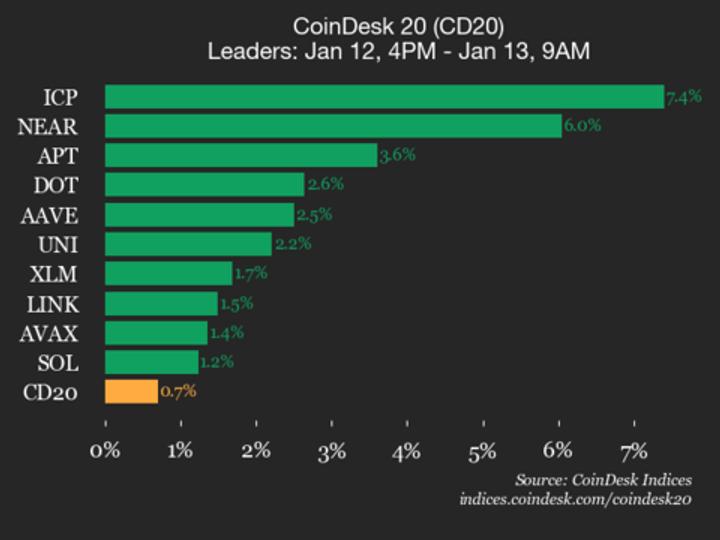
NEAR Protocol (NEAR) was also a top performer, rising 6% from Monday.
SOL Eyes $190 as Key Trend Flips Bullish

Steady ETF inflows, a bullish cup and handle chart pattern and improving sentiment across the total crypto market could propel Solana price to $190.
Solana (SOL) is getting more attention from traders now that its price structure is tightening beneath a key resistance zone. After months of consolidation, analysts suggest the altcoin may be preparing for a decisive trend break.
Key takeaways:
-
Solana has formed a high-time-frame cup and handle pattern, with a breakout target around $180 to $190.
-
SOL has reclaimed and held above its 50-day moving average for the first time since September 2025.
-
Spot SOL ETF inflows remain consistently positive in 2026, reinforcing demand despite near-term liquidation risks.
SOL bulls might be back
Since November 14, 2025, Solana has consolidated in a tight $120 to $145 range, carving out a cup and handle pattern on the daily chart. On higher time frames, this formation is widely viewed as a continuation signal, reflecting gradual accumulation followed by a controlled pullback that compresses volatility before expansion.
The $145 resistance has capped SOL rallies four times over the past three months, increasing the likelihood that a break above it could trigger a follow-through rally. A confirmed breakout from the pattern could fast-track SOL toward its immediate measured target near $180, roughly a 25% upside from current levels.
Adding to the bullish case, SOL has reclaimed its 50-day moving average and sustained acceptance above it for the first time since late September 2025. Historically, holding above this trendline has marked transitions from corrective phases into trending markets, suggesting sellers are losing control of the broader structure.
Crypto trader NekoZ also noted the bullish setup and said,
“The $SOL rounding bottom is painting a masterpiece. Massive breakout on the daily chart. While everyone was bearish at $120, the smart money was accumulating. Next stop: $190+. Don’t short a trend reversal this clean.”

Related: Solana Policy Institute urges SEC to exempt DeFi developers from exchange rules
SOL liquidity zones and ETF flows frame the risk
Data from CoinGlass highlighted key inflection points for Solana. Liquidation heatmaps show cumulative long liquidations exceeding $1 billion on a $15 downside move toward $130, indicating vulnerability if support fails.
In contrast, short liquidations cluster near $160, where roughly $520 million could be forced to unwind, potentially accelerating upside momentum if resistance breaks. Thus, the likelihood of a small dip remains high based on higher liquidity near the $130 support.

Spot SOL exchange-traded funds (ETFs) flows continue to provide structural support. US spot ETFs recorded $10.7 million in net inflows in the latest session, led by Bitwise’s BSOL with $8.6 million.
Year-to-date cumulative net inflows have climbed from $1.02 billion to $1.14 billion, underscoring steady demand with no recorded outflows, a backdrop that may help absorb volatility during a breakout attempt.
Related: Three ETH price charts suggest a move toward $4K may be brewing
This article does not contain investment advice or recommendations. Every investment and trading move involves risk, and readers should conduct their own research when making a decision. While we strive to provide accurate and timely information, Cointelegraph does not guarantee the accuracy, completeness, or reliability of any information in this article. This article may contain forward-looking statements that are subject to risks and uncertainties. Cointelegraph will not be liable for any loss or damage arising from your reliance on this information.
As America nears 250, financial freedom shouldn’t be up for debate
The banking lobby’s efforts to revisit or reinterpret Congress’ decisions regarding stablecoin rewards are driven by attempts to re-litigate settled law and blunt competition after the fact, argues Blockchain Association’s Summer Mersinger.
Franklin Templeton turns money market fund into stablecoin reserve vehicle

The LUIXX fund has been modified to hold short-term US Treasuries and meet stablecoin reserve standards. The DIGXX fund now offers an onchain share class.
Cross River Selected as Initial Banking Partner for Visa’s Stablecoin Settlement Pilot

Cross River Bank has become one of the first regulated U.S. banks to join Visa’s stablecoin settlement pilot program. In partnership with Highnote, the technology infrastructure provider will begin settling transactions with Visa using Circle’s USDC stablecoin over the Solana blockchain.
The initiative aims to move stablecoin settlement from theoretical concepts into a live production environment. By leveraging Cross River’s unified banking infrastructure, the partnership enables card issuers to settle network activity seven days a week, effectively removing the constraints of traditional banking cut-offs such as weekends and holidays.
Solving the liquidity crunch for SMBs
For small businesses and marketplaces, the integration promises significant improvements in cash flow management. The pilot introduces a settlement window that remains open continuously, allowing merchants to access funds faster regardless of when a consumer purchase takes place.
“Stablecoin settlement matters when it delivers practical advantages in real payment settings that benefit customers,” said John MacIlwaine, CEO of Highnote. “The future of payment operations is faster, simpler, and always on. Offering this capability at Highnote moves us toward that reality by enabling continuous value movement with more efficient reconciliation.”
Bridging legacy and blockchain rails

The pilot utilises Cross River’s proprietary infrastructure to create interoperability between traditional fiat systems and blockchain networks. The system ensures that stablecoin pay-ins are recorded on the ledger as fiat, while payouts can convert fiat into stablecoins within the same transaction flow.
Luca Cosentino, head of crypto at Cross River, highlighted the importance of this hybrid approach: “For stablecoins to realize their full potential they must operate within unified systems. Cross River’s infrastructure is built to bring onchain settlement safely into mainstream financial services. Our collaboration with Visa and Highnote will enable card issuers to settle network activity seven days a week, demonstrating how this innovation can be implemented effectively in real-world environments.”
The program enables U.S. issuer and acquirer partners to settle with Visa in USDC for the first time, offering near-instant fund movements without altering the consumer card experience. The settlement capability is being launched through a structured framework designed to evaluate how stablecoins can support improved treasury management and faster settlement cycles.
Bitcoin And Gold ETP Launches On London Stock Exchange

21Shares today launched its Bitcoin and gold exchange-traded product, the 21Shares Bitcoin Gold ETP (BOLD), on the London Stock Exchange, expanding the range of crypto-linked investment products available to UK retail investors.
BOLD is the fifth cryptocurrency product from 21Shares to receive prospectus approval from the UK Financial Conduct Authority. It follows the firm’s existing Bitcoin and Ethereum offerings and comes as demand grows for regulated exposure to digital assets through traditional market infrastructure.
The product trades on the LSE in pounds sterling under the ticker BOLD and carries a 0.65% annual management fee, the company said.
It is fully physically backed by its underlying assets, with Bitcoin and gold held in institutional-grade custody and stored offline, a structure intended to reduce counterparty and custody risk compared to many retail investment options.
Bitcoin and gold as a means of risk management
Developed in partnership with ByteTree Asset Management, BOLD combines Bitcoin and gold into a single vehicle designed around risk management rather than fixed allocations.
The ETP rebalances monthly using inverse historical volatility, allocating more weight to the less volatile asset at each rebalance. The aim is to achieve roughly equal risk contribution from both Bitcoin and gold, rather than a simple 50/50 capital split.
This structure is happening as gold surges to new highs. Gold’s long-standing role as a store of value is intended to offset Bitcoin’s sharper price swings, particularly during risk-off environments, the company said.
As of January 12, 2026, BOLD had $40.1 million in assets under management and reported a three-year Sharpe ratio of 1.79, according to 21Shares. The product adjusts its holdings each month to stay aligned with its volatility-based framework, trimming the stronger asset and adding to the weaker one.
Russell Barlow, CEO of 21Shares, said the London listing reflects the firm’s push to broaden access to regulated crypto products in the UK.
“BOLD aims to give investors exposure to Bitcoin’s growth potential while retaining the relative stability of gold,” Barlow said, adding that the product is positioned as a potential hedge against inflation.
Charles Morris, founder and chief investment officer of ByteTree Asset Management, described Bitcoin and gold as increasingly complementary assets. He said BOLD applies a rules-based process to combine them in a transparent structure designed for investors navigating persistent inflation and monetary uncertainty.
Back in October 2025, the U.K.’s Financial Conduct Authority lifted its four-year ban on retail access to bitcoin and crypto exchange-traded notes, allowing firms to offer cETNs on FCA-approved exchanges such as the London Stock Exchange and Cboe UK.
The move followed months of consultation and signaled a more open—though still cautious—approach to crypto regulation.
FCA digital finance executive David Geale said the decision reflected a more mature and better-understood market, while maintaining investor protections.
Unlike ETFs, ETNs are debt instruments that track the price of assets like bitcoin without requiring investors to hold the underlying crypto.
Bakkt to Acquire Stablecoin Payments Builder DTR as ICE Backs Vote
- Bakkt Holdings has agreed to acquire stablecoin payment infrastructure provider Distributed Technologies Research Ltd. (DTR).
- Bakkt says bringing DTR in-house should accelerate time-to-market for stablecoin settlement, reduce third-party dependency, and support future revenue in payments and banking use cases.
Bakkt Holdings Inc. has agreed to acquire Distributed Technologies Research Ltd., a stablecoin payments infrastructure provider, in an all-stock deal. It is expected to deepen the company’s push into onchain settlement as mainstream finance and payments firms experiment with tokenized cash.
Shares of Bakkt (NYSE: BKKT) rose over 18% in U.S. trading Monday, ending at about $19.25, up roughly $2.97 from the prior close.
Under the definitive agreement, Bakkt will issue Class A shares equal to 31.5% of a contractually defined “Bakkt Share Number” tied to a cooperation agreement the companies signed in March 2025, when they began integrating DTR’s technology into Bakkt’s platform.
Based on the share number referenced in Bakkt’s announcement, the issuance would be about 9.13 million Class A shares to DTR shareholders, including DTR’s chief executive and principal owner, Akshay Naheta, though the final count may change before closing.
The transaction is subject to customary closing conditions, including regulatory clearances and approval by Bakkt stockholders. Intercontinental Exchange Inc., the exchange operator that incubated Bakkt and remains one of its largest shareholders, said it would vote its roughly 31% stake in favor of the acquisition.
Bakkt said its board formed an independent special committee—directors Colleen Brown and Mike Alfred—to negotiate and evaluate the deal, a governance step companies sometimes use in transactions involving insiders or potential conflicts. Naheta is both the founder of DTR and Bakkt’s co-chief executive officer.
From partnership to purchase
The acquisition formalizes a relationship that started last year. In filings, Bakkt described the March 19, 2025 cooperation agreement as providing it with payment-processing technology, APIs and infrastructure from DTR for global payments enablement in jurisdictions where Bakkt or affiliates operate.
Naheta joined Bakkt’s leadership in 2025 after building DTR as a payments-focused fintech bridging traditional rails and blockchain-based settlement, following senior roles at SoftBank where he worked on large technology investments.
In a press release shared with AlexaBlockchain, Bakkt framed the deal as a way to accelerate its “stablecoin settlement” roadmap, reduce reliance on third parties and expand revenue opportunities across payments and banking use cases.
Stablecoin settlement as a payments battleground
Bakkt’s move lands as stablecoins increasingly show up in corporate pilots and cross-border payment discussions, driven by the promise of faster settlement and reduced complexity versus correspondent-banking chains. Consulting firm McKinsey described 2025 as a potential inflection point for tokenized cash in payments, while also noting risks and operational hurdles that financial institutions must manage.
DTR has marketed its platform as infrastructure that connects national payment systems with stablecoin/fiat rails for business payments.
What changes at Bakkt
Alongside the deal, Bakkt said it intends to change its corporate name to “Bakkt, Inc.” effective Jan. 22, 2026, while keeping its New York Stock Exchange listing and “BKKT” ticker.
The company also announced plans to host an Investor Day on March 17, 2026, signaling it expects to provide more detail on strategy and integration timelines in the coming months.
Bakkt has undergone multiple strategic pivots since it was formed within ICE and later taken public via a merger with a blank-check company in 2021. In recent quarters, the company has emphasized infrastructure and partnerships rather than operating as a consumer-facing crypto brand—an approach that aligns with the economics of payments, where distribution and compliance often matter as much as technology.
Deal mechanics and dilution
Because consideration is paid in stock, existing Bakkt shareholders will be diluted if the transaction closes. The 31.5% issuance is calculated off a fully diluted Class A base immediately prior to closing, per Bakkt’s SEC filing.
The 8-K describing the purchase agreement also outlines termination provisions, including a potential termination fee in certain scenarios, underscoring that the transaction remains subject to board and shareholder processes.
The acquisition is a bet that owning core settlement plumbing will help it compete in a crowded market of crypto-native payment firms and bank-adjacent infrastructure providers trying to make stablecoins usable in everyday business workflows.
Read Also:
Disclaimer: The information provided on AlexaBlockchain is for informational purposes only and does not constitute financial advice. Read complete disclaimer here.