

Institutions are increasingly betting on bitcoin’s bullish moves and moving away from sophisticated ‘arbitrage’ bets.
Large bitcoin holders buy the most coins since the FTX collapse of 2022
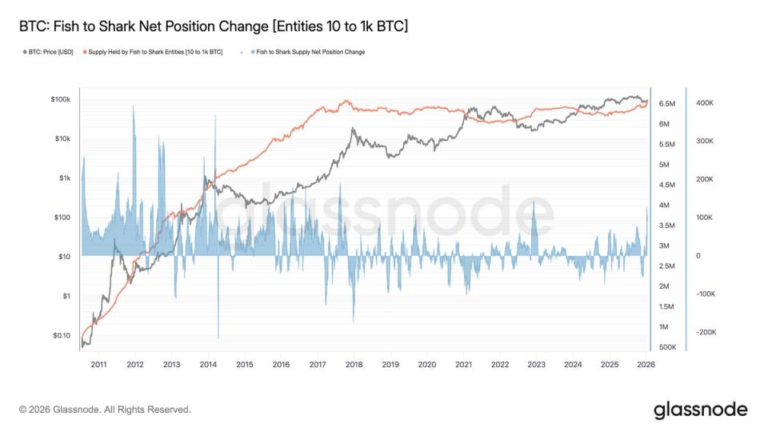
The so-called Fish-to-Shark cohort added 110,000 BTC over the past 30 days, according to Glassnode.
Google Play Drops International Crypto Exchange Apps In South Korea

Trusted Editorial content, reviewed by leading industry experts and seasoned editors. Ad Disclosure
Starting January 28, 2026, Google Play will stop allowing downloads and updates of overseas crypto exchange and wallet apps in South Korea unless those platforms prove they are registered with the country’s Financial Intelligence Unit (FIU).
Registration Proof Must Be Uploaded
According to Google’s new rule, developers listing crypto exchange or custodial wallet apps must upload evidence that their VASP registration has been accepted by the FIU through the developer console. This is not a technical tweak — it ties app distribution directly to local regulatory approval.
The result is immediate and practical. For Android users in Korea, apps from major overseas platforms will no longer be available for new installs or for updates through Google Play. Existing installations might keep working for a while, but they will not receive app updates or security fixes via the official store.
Local Crypto Platforms Lead Compliance
Based on reports, 27 domestic platforms have completed FIU registration, including well-known names such as Upbit and Bithumb. That leaves several major international exchanges without the needed paperwork, pushing them outside Google Play’s Korean marketplace.
For many users, this change will be felt quickly. If you rely on an overseas app to manage positions or move funds, the inability to download updates may make routine tasks harder and raise security risks. Web access to exchanges will remain an option, but it’s less convenient and sometimes less secure than using an official app.
Foreign exchanges face several demands to gain FIU acceptance. They often must set up a local legal entity, put in place anti-money-laundering systems, and obtain national information security certifications before their VASP filings are accepted. These steps can be costly and time consuming.
How The Market Might Shift
Some analysts say the move will push more trading volume toward Korea-registered firms. Others warn that it could encourage risky workarounds — such as downloading APKs from third-party sites or using VPNs — which expose users to fraud and malware. Reports say that upgrades to app-store rules follow earlier enforcement moves and aim to close gaps in oversight.
App availability will be tied to regulatory paperwork. If a platform shows FIU acceptance in Google’s console, its app can stay listed and updated. If not, the app will be removed or blocked from being updated in Korea’s Play Store.
Featured image from Unsplash, chart from TradingView

Editorial Process for bitcoinist is centered on delivering thoroughly researched, accurate, and unbiased content. We uphold strict sourcing standards, and each page undergoes diligent review by our team of top technology experts and seasoned editors. This process ensures the integrity, relevance, and value of our content for our readers.
ZachXBT uncovers $282M BTC and LTC theft laundered through Monero

Key Takeaways
- A victim lost more than $282 million in Bitcoin and Litecoin in a hardware wallet social engineering attack.
- The stolen funds were laundered via Monero, which reached a new all time high near $800 during the week, a few days after the incident.
Share this article
A victim lost more than $282 million in Bitcoin and Litecoin on January 10 due to a hardware wallet social engineering scam, according to blockchain investigator ZachXBT via his official Telegram channel.
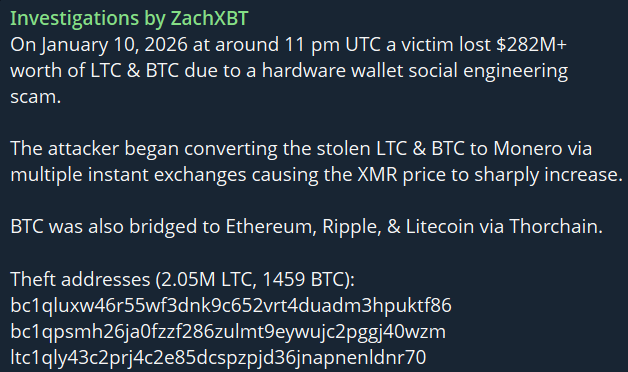
The attacker gained control of the victim’s wallet and began rapidly moving the stolen assets across multiple networks. The compromised addresses held approximately 2.05 million Litecoin and 1,459 Bitcoin at the time of the theft.
Shortly after the funds were moved, the attacker began converting large portions of the stolen Bitcoin and Litecoin into Monero using multiple instant exchanges. The sudden surge in conversion activity caused Monero’s price to spike sharply, according to ZachXBT.
Since the incident, Monero rose to a new all-time high near $800 earlier in the week, marking a 74% increase. At press time, Monero had pulled back to around $670, but remained up roughly 46% since the incident.
In parallel, portions of the stolen Bitcoin were bridged across multiple networks using THORChain, with funds routed into Ethereum, Ripple, and Litecoin.
South Korea Tightens Crypto Access as Google Play Blocks Unregistered Exchanges

In brief
Pre-emptive enforcement?
Daily Debrief Newsletter
Start every day with the top news stories right now, plus original features, a podcast, videos and more.
Digital wallets become the fastest-growing payment method in Brazilian e-commerce in 2025, PCMI/EBANX reports
CURITIBA, BRAZIL, January 15, 2026 – Digital wallet usage in Brazilian e-commerce surged 20% last year, making it the country’s fastest-growing payment method in 2025, according to an EBANX analysis of Payments and Commerce Market Intelligence (PCMI) data. The Year-over-Year 2024–2025 increase exceeded Pix’s. Brazil’s flagship instant payment system grew 18% over the same period.
This acceleration pushed digital wallets past traditional bank slips to become the third most popular payment method among digital consumers in the country, accounting for 9% of total transaction volume in 2025. Pix leads Brazilian e-commerce with a 42% share, followed by credit cards at 41%.
EBANX projects that digital wallets will continue expanding 13% per year in Brazil through 2028 (CAGR 2024-2028). In the country, the digital wallet with the largest share of e-commerce transaction value is Mercado Pago, accounting for 40%, according to PCMI. Launched in 2004, the platform has over 72 million users across eight Latin American countries. NuPay, launched in 2022, has been growing rapidly and is available to all clients of the Brazilian digital bank Nubank, over 100 million people.
“By providing a seamless, digital-first alternative to traditional credit cards, wallets are democratizing access to the global digital economy and driving financial inclusion across emerging markets,” explained Eduardo de Abreu, VP of Product at EBANX.
Unlike their global counterparts, which serve primarily as payment vehicles, Brazilian digital wallets offer more than traditional banking provides, including low-cost accounts, instant payments, recurring transactions, installment options, loyalty programs, loans, savings, interoperability capabilities, integration with other systems, and credit cards.
“Turning the cell phone, which is already part of people’s daily lives, into a true digital wallet has given this solution scale and accelerated adoption,” Abreu noted. According to GSMA, 88% of Brazilians own smartphones, a figure expected to reach 95% by 2030. That penetration exceeds credit cards, used by roughly 70% of the population, according to the Central Bank of Brazil.
Impact on digital commerce
Like Pix, digital wallets serve as an entry point to e-commerce for millions of Brazilians. However, they distinguish themselves by offering native credit and installment features. This makes them a critical driver of business growth, particularly for high-ticket items where flexible payment options are essential.
Internal EBANX data confirms this impact. A global travel company operating in Brazil saw average daily revenue jump 47% over six months after adding digital wallets as a payment option through EBANX. Just over a year later, this method became its customers’ top choice, representing 80% of its total Latin American revenue.
“We’re seeing this across all sectors, including retail. Subscription-based businesses, such as streaming platforms, gaming, and software-as-a-service (SaaS), are also experiencing significant customer growth through digital wallets, which enable recurring payments without requiring a credit card,” Abreu analyzed.
Scam coin victims fume after court hands $5m fraudsters ‘lenient sentences’ – DL News

- One mastermind jailed for just 18 months, lawyer explains.
- 150 victims lost money to scam coin proponents, court hears.
- Crypto-related fraud and crime are rising fast in South Korea.
The victims of a $5.4 million South Korean crypto scam say they’re unhappy that the fraudsters who duped them out of their money have escaped with a “slap on the wrist.”
The victims spoke out through a lawyer after the Incheon District Court found the scam’s two masterminds guilty of fraud and organized crime, jailing one for four years and the other for 18 months. The same court handed out shorter jail sentences, some suspended, and probation orders to 28 other members of the crypto scam network, the South Korean newspaper Joongboo Ilbo reported.
“It is hard to understand why the gang members were sentenced in this way, with some even receiving suspended sentences,” said Kim Kyung-nam, the lawyer representing most of the scam’s 150 victims, and the head of For You Law Firm. “The victims are still unable to lead normal economic lives as a result of these crimes.”
Crypto-related fraud and crypto crime are on the rise in South Korea. In September, the country’s financial regulators reported crypto service providers filed 36,684 suspicious transaction reports in the first eight months of 2025. That figure exceeded the combined total for the past two years and marked a record high.
Scam coin fraud
“Considering the circumstances, we believe the perpetrators should be sentenced to at least four to seven years in prison,” Kim said. “These crimes were highly organized in nature.”
Prosecutors told the court the group “systematically committed crimes using so-called scam coins.”
In South Korea, this term typically refers to fake coins or extremely low-cap, unlisted altcoins.
The prosecution explained that the group duped victims into buying “worthless coins” and “promising to resell them at a higher price later.” After receiving payment, the group then cut off contact with their victims before laundering the latter’s money.
The group targeted residents of Incheon’s Namdong District between August 2022 and May 2023.
Kim hit out at the court for its decision to hand out 18-month suspended sentences to two unnamed individuals in particular.
The court found the duo guilty of embezzling over $6 million worth of the victims’ money. But, under the terms of the court’s order, neither of the pair will spend time in jail if they do not reoffend in the near future.
Kim also said that the court only issued a four-year jail term to one of the masterminds because that individual had prior convictions.
The court, however, explained its reasoning in sentencing, claiming that most of the gang’s members had “joined the criminal group without knowing the full extent of the crimes.”
“It appears to the court that they were coerced into criminality by the ringleaders after recognising the illegality of what they were doing,” the presiding judge said.
The names of the defendants and the coins involved were withheld for legal reasons.
Tim Alper is a News Correspondent at DL News. Got a tip? Email him at tdalper@dlnews.com.
Battle at $95K: Can Bitcoin Bulls Hold the Line?

With bitcoin priced at $95,101 on Sunday, its market cap holding strong at $1.89 trillion, and a 24-hour trading volume humming at $19.02 billion, traders are watching a tight intraday range between $94,869 and $95,543 like hawks. The mood? Restless. The charts are calling out indecision with the subtlety of a marching band. Bitcoin Chart […]
Bitcoin to $180,000, stablecoins to soar in 2026, investor Dan Tapiero predicts

From macro tailwinds to trillion-dollar rails, the 50T Funds founder sees real-world adoption reshaping the crypto landscape.
Bitcoin and Ethereum Waver–Why Did Trading Volume Drop?
In brief
Daily Debrief Newsletter
Start every day with the top news stories right now, plus original features, a podcast, videos and more.