Home Blog Page 1143

Trump’s Fed chair nominee’s return sparks bitcoin jitters over rates, balance sheet cuts

0

The market was initially jolted by the sudden news of President Donald Trump naming Kevin Warsh as his choice for the next Federal Reserve chair, ending a month-long saga of guessing game.

The U.S. dollar rallied, bitcoin fell, and the equity market became volatile when the news broke; while the market might have stabilized a bit for now, the uncertainty is still gripping the traders across all asset classes.

So who is Kevin Warsh, and more importantly, how will his leadership shape the future of monetary policy and crypto?

Former Fed governor

Kevin Maxwell Warsh is a former U.S. Federal Reserve governor who served from 2006 to 2011 and played a senior role during the 2008 global financial crisis, including acting as a key liaison between the Fed and financial markets.

Before joining the central bank, Warsh worked at Morgan Stanley and served in the George W. Bush administration as Special Assistant to the President for Economic Policy and Executive Secretary of the National Economic Council, giving him experience spanning Wall Street and Washington.

After leaving the Fed, Warsh became a visiting fellow at Stanford University’s Hoover Institution, where he has written extensively on monetary policy, central bank credibility and what he views as the long-term risks of prolonged balance-sheet expansion by central banks.

It’s worth noting here that while the nomination spooked the market and bitcoin, Federal Reserve Chair Jerome Powell — whose second four-year term expires on May 15, 2026 — is eligible to remain on the Fed’s Board of Governors until Jan. 31, 2028. Warsh must still be confirmed by the Senate before assuming the role, but a vacancy created by Governor Stephen Miran’s expiring temporary term on Jan. 31, 2026 could allow him to join the board ahead of May.

The bitcoin view

Warsh’s appointment has drawn particular scrutiny from digital-asset investors — at least initially — given his long-held views on monetary discipline and skepticism toward bitcoin’s role as money.

While the concern is not with Warsh personally, his background has led many market participants to view him as potentially bearish for bitcoin and other risk assets. He is broadly viewed as favoring monetary discipline, higher real rates, and a smaller Fed balance sheet, all of which oppose a liquidity-heavy environment that has historically backed risk assets.

So what are his ties to crypto?

First, let’s take a look at what he said about bitcoin previously.

In public commentary in 2015, Warsh approached bitcoin and cryptocurrencies primarily through a monetary-policy lens, expressing skepticism about their use as stable mediums of exchange while acknowledging the potential of blockchain technology.

“The underlying technology in that white paper, it’s just software,” Warsh said during a video conversation with Stanley Drukenmiller. “It’s just the newest, coolest software that will provide us the opportunity to do things we could never have done before.”

While acknowledging all software can be used for good and for evil, Warsh said that by building it here in the US, that gives us the opportunity to be more productive and create something very special over the next decade…”

At one point in the conversation with the billionaire hedge fund manager and his former colleague, Warsh told Drukenmiller, “You made reference to Bitcoin and I thought I heard a little condescension in your voice, that people are buying bitcoin.”

He went on to make a case in favour of bitcoin, saying “it could provide market discipline, it could tell the world that things need to be fixed.” He also said he thinks of “bitcoin as a lot of things, but certainly with every passing day it’s getting new life as an alternative currency.”

While the interview is from 2015, when bitcoin was still seen as dangerous and mostly used for illegal activities, a lot has changed in the last eleven years. Now, the U.S. has a pro-crypto government, there is legislation in the works to create a legal framework for digital assets, and, most importantly, crypto has become too big to ignore, even for Wall Street giants.

The potential future Fed chair has argued that central banks must engage with digital money, including considering a U.S. central bank digital currency (CBDC) to counter bitcoin and rival China’s digital yuan. Worth noting that CBDC is a hotly debated topic in the crypto community due to privacy concerns.

He also said cryptocurrency was nothing more than “software pretending to be money.” He categorized cryptocurrencies as a symptom of “speculative excess” driven by loose monetary policy and argued that Bitcoin’s rise was largely a derivative of the “global dollar flood” and that, as liquidity tightens, such assets are likely to lose their appeal.

‘Not hostile to crypto’

Warsh also had close ties with crypto in general.

Warsh has drawn attention in crypto circles for his early involvement with digital-asset firms, including Bitwise Asset Management, a crypto index fund provider. Warsh was an investor in a cryptocurrency project called Basis, an algorithmic central bank. He also served as an adviser for Electric Capital, a VC firm focused on crypto, blockchain and fintech.

Market analysts covering crypto have said Warsh’s policy outlook, which emphasizes institutional credibility and monetary discipline, could matter for liquidity conditions affecting risk assets such as bitcoin.

Warsh is not a crypto evangelist, but has expressed a nuanced, pragmatic stance on innovation and regulation. Analysts view him as cautious about private crypto volatility and as more focused on systemic financial stability than on championing unregulated markets.

While criticizing its use as money, Warsh has conceded that bitcoin could potentially serve as a “sustainable store of value, like gold.” However, he maintains that its boom-and-bust cycles are speculative and may foretell “heightened market volatility” across broader financial assets.

“Warsh is not viewed as hostile to crypto, and the prospect of a new Fed Chair perceived as more inclined toward rate cuts could trigger a short-term relief rally across risk assets,” Market analyst and Adlunam founder Jason Fernandes said.

“However, without a genuine macroeconomic justification for easing, any such move will be met with skepticism and sold into,” Fernandes added.
XRP’s Rich List Shows How Much The Top Wallets Control

0

Trusted Editorial content, reviewed by leading industry experts and seasoned editors. Ad Disclosure

XRP’s wealth distribution is under the spotlight as new data reveals how much power is concentrated among its largest holders. A crypto analyst has unveiled fresh insights from the XRP rich list, showing the percentage of supply controlled by top wallets and what this could mean for price action. 

XRP Rich List Data Unveiled

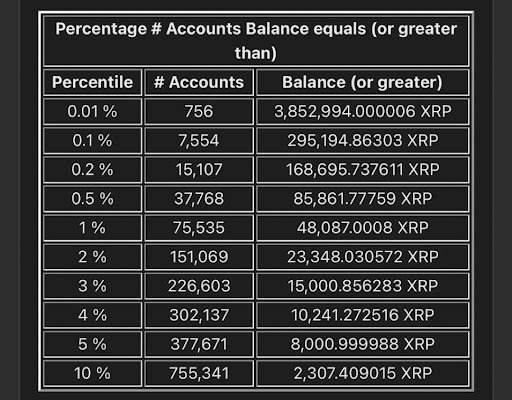
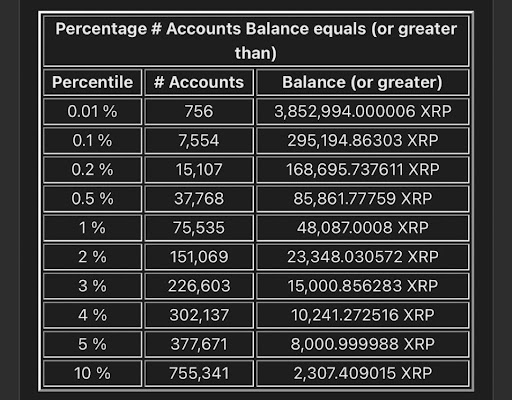
XRP’s rich list data has been exposed by market expert KKapon, who shared a breakdown of wallet balances that challenge common assumptions about token concentration. The figures show that the top 10% of wallets hold at least 2,307 XRP, the top 5% start at 8,000 XRP, and the top 1% begin around 48,087 XRP. This shifts the focus away from price talk and toward who controls liquidity in the network.

KKapon argued that most people misunderstand XRP’s distribution because they have not reviewed the data and done the math. He emphasized that his analysis is not centered on market value, since price is only an output of deeper structural factors. Instead, he focuses on who has liquidity, who does not, and who will need it when demand increases. 

XRP
Source: Chart from KKapon on X

He shared a table showing the number of accounts and XRP balances for wallet holders in the top 0.01% to the top 10%. The data shows that the top 0.01% of accounts hold at least 3,852,994 XRP, representing just 756 wallets with multi-million-token balances. This concentration illustrates just how liquidity is clustered at the very top of the holder base. 

Moving slightly down the distribution curve, the top 0.1% of wallets control balances of 295,194 XRP or more across 7,554 accounts. The top 0.5% threshold sits at 85,861 XRP, covering 37,768 wallets. These figures show that tens of thousands of accounts currently control a significant portion of XRP’s supply and can influence market liquidity during periods of high demand.

According to the table, the 1% tier begins at 48,087 XRP, corresponding to 75,535 wallets. At the 2% level, balances drop to 23,348 XRP across more than 151,000 accounts, while the 3% tier holds at least 15,000 XRP in over 260,000 wallet addresses. Lower distribution levels still reveal significant control among a relatively small segment of holders. The top 5% of wallets each hold at least 8,000 XRP, totaling about 377,671 accounts, while the top 10% begins at 2,307 XRP across more than 755,000 wallets. 

Who Controls XRP Rich List Wallets

KKapon noted that the rich list in his analysis mostly shows retail wallets and does not capture how institutions hold XRP. He explained that, unlike individual users, institutional investors keep their XRP in personal on-chain wallets. They also gain exposure through custodians, funds, or derivative products. This means the rich list data only shows how XRP is distributed across wallets, not who owns the balances or has economic control over them.

XRP
XRP trading at $1.74 on the 1D chart | Source: XRPUSDT on Tradingview.com

Featured image from Shutterstock, chart from Tradingview.com

Editorial Process for bitcoinist is centered on delivering thoroughly researched, accurate, and unbiased content. We uphold strict sourcing standards, and each page undergoes diligent review by our team of top technology experts and seasoned editors. This process ensures the integrity, relevance, and value of our content for our readers.

XRP Slumps as Risk-off Wave Fuels Broad Selling Across Crypto Markets

0

XRP slid sharply as a global risk-off shock sparked a broad crypto unwind, with hawkish U.S. policy signals, geopolitical stress, and record ETF outflows driving heavy selling before losses began to stabilize. XRP Hit Hard as Risk-off Shock Triggers Broad Crypto Unwind At 9:02 a.m. on Jan. 30, XRP is trading at $1.75375, stabilizing after […]

Trump’s Fed Chairman Pick Revealed: Kevin Warsh to Succeed Jerome Powell

0

President Donald Trump has revealed that Kevin Warsh, who served on the Fed’s Board of Governors from 2006 to 2011, is his pick to become Chairman of the Federal Reserve. His nomination is considered bearish for crypto as he might promote monetary discipline and reduce liquidity. Kevin Warsh Emerges As Trump’s Nominee To Become Fed’s […]

How These 3 ‘New’ UK Labour Laws Impact Average Working People

0

If you have been keeping up with politics as of late, then you know all about the Racheal Reeves budget and the uproar it has caused for middle-class people, working people, business owners and beyond. But with the vast majority of the UK population being working-class people living paycheck to paycheck, it’s so important for us to understand how political changes can impact our daily lives for better or worse.

Working people are the cornerstone of the UK economy; they ensure that everyday jobs are filled, whether it’s a bus driver, retail worker or very small business owner, they pay their way, abide by the rules and regulations, all the while trying to live a good life. That’s why it’s so important that we look after our working-class people, because if you push them too far, they will refuse and, in some cases, give up entirely, which puts a strain on other working-class people.

What 3 Labour Laws Are Going To Impact Working People

With regards to the budget and beyond what labour has done since their election win, we are going to discuss how the 3 have and are going to continue to impact working people in the 2026/27 and potentially beyond.

Benefit Funds

While the vast majority of working people are happy for their tax contributions to go towards helping disabled people live their lives out of poverty, aswell as children. However, it was announced during the budget reveal that benefits will increase by 3.8% alongside the 2-child benefit cap being lifted (while they are discussing again to not go through with this change, but we will see). While it’s positive to see that the government is addressing child poverty and encouraging people to have children by providing support, they’ve gone about it in a way that makes working-class people worse off.

The policy should include an incentive for people to work and not stop working to then get the exact same, and in some cases thousands of pounds more if they aren’t working. Research has suggested that a mother of 3 children will need to make £71,000 a year to keep up with someone on benefits with the same number of children and not working.

There is also no way for them to ensure that these additional benefits given are being spent on the children. In order to ensure that child benefits and the additional pay increase for people benefits are being spent on the things they need should include monthly virtual gift cards to be spent on electricity, gas, food stamps or gift cards for supermarkets excluding alcohol, cigarettes and other non-child-friendly goods.

If this were done without the pay rise, we would see a lot more children out of poverty, as parents are forced to spend it on them and not recreationally or irresponsibly. In addition, in order to be eligible for some of the additional benefits, parents should be working at least 16 hours a week.

Tax Freeze

Labour has extended the tax freeze on income tax and national insurance contributions thresholds until April 2031. This was initially introduced by the conservatives, but according to the Labour manifesto, they said they wouldn’t increase taxes for the working class and would actually work on reducing them to help working families during inflation.

However, a tax freeze, also referred to as a stealth tax or a fiscal drag, is actually putting working-class people in a worse position. As your wages will increase with inflation, so will your tax; it actually encourages fewer people to want a pay rise as the vast majority of it will be taken from you. Even if you are typically a higher earner, the tax margin pushes you back down to the working class. This isn’t good for several reasons; it not only prevents people from working hard, prevents people from contributing as much to the economy, which makes us worse off, and also is another negative incentive for working-class people not to bother, as you are essentially being punished for working.

It’s clear that Labour are trying to go for a socialist working economy, but we are already seeing the backlash, as people don’t want to have to pay for lazy people’s lives and government spending that isn’t going back into the community or spent on our public services.

Immigration

While this has been a very big topic and while it’s always been a discussion, with changes to labour policies, it’s becoming more prevalent that it’s becoming a cause of concern for some working people, for the right reasons. There has been more money and an estimated of 5 billion on foreign aid and on illegal migration this year the UK is looking to spend 15.3 billion, is has increased from 5.4 billion in 2023/24 which an insane increase.

There is discussion in the media that seeking asylum and entering the country illegally are jumping the queues for healthcare from NHS visits, dental care and so forth, aswell as being given free travel so they can go to their appointments. They are also being given homes and spaces to live rent-free with weekly money to spend on food per person.

The issue people are having with this is that working-class people pay their national insurance but are struggling to see an NHS dentist, get an appointment and struggling to afford travel, not only to and from work but also missing work to then attend health appointments that they then still have to pay for in some cases.

It’s important to disclose that people fleeing from war countries they it heartbreaking and finding safety is important; however, it’s important that we ensure that people coming here are here for those reasons and not because they just can be. Ensuring that British and those who have come legally, whether they be on a working visa or indefinite leave to remain, individuals are tended to first and those second, as it appears that the Government cares more for the well-being of strangers than people who have paid into this economy. Check our the services of Immigration Lawyers in London.


Lido’s new stVaults will let L2s create their own rules for Ethereum staking

0

The Lido Labs Foundation unveiled stVaults on the Ethereum mainnet on Friday.

stVaults marks a shift from a single-product model toward shared staking on the protocol through opening its infrastructure to external builders.

In simple terms, stVaults let other teams plug into Lido’s staking system instead of building their own from scratch. Until now, developing an Ethereum staking product typically meant setting up validators, integrations and liquidity independently, which can be a costly and complex process. stVaults aim to lower that barrier by letting builders use Lido’s existing plumbing while customizing how staking works for their users.

stVaults are isolated staking environments that allow teams to run custom validator configurations and optionally mint stETH, while remaining connected to Lido’s liquidity and DeFi integrations. Lido said its core staking protocol remains unchanged, with stVaults operating alongside it.

The rollout comes as Ethereum staking moves beyond one-size-fits-all products toward more specialized setups. These include institutional-grade staking with stricter controls, application-specific staking products and layer-2 networks embedding staking directly into their infrastructure, all without fragmenting liquidity across competing pools.

Initial deployments include Consensys’ layer-2 network Linea, which is using stVaults to stake a portion of bridged ETH and redirect rewards toward liquidity providers and ecosystem incentives. Blockchain analytics firm Nansen is also using stVaults to launch its first Ethereum staking product.

“stVaults show how Ethereum staking is evolving. Different users now need different setups,” said Isidoros Passadis, the chief of staking at the Lido Labs Foundation. “With stVaults, the Lido protocol can support these needs within a single framework while maintaining the liquidity and transparency that stETH is known for.”

Read more: Lido Goes Modular With Vault-Based ‘V3’ Upgrade

Bitcoin More ‘Undervalued’ Than During All Previous Bear Markets, Data Says

0

Bitcoin’s MVRV Z-score printed record lows on a rolling two-year basis, making BTC price more “undervalued” than at the pit of past bear markets.

Bitcoin (BTC) may be “close to the end” of its correction as a classic BTC price metric beats records.

Key points:

  • Bitcoin’s MVRV Z-score is at record lows on two-year rolling time frames.

  • The “wild” data is leading to predictions of an imminent BTC price recovery.

  • Analysis says that the precious metals rally is “done for now.”

MVRV Z-score says Bitcoin is “undervalued”

In an X post Friday, crypto trader, analyst and entrepreneur Michaël van de Poppe confirmed the lowest-ever readings for Bitcoin’s MVRV Z-score.

“This is a phenomenal chart,” he told followers about the data, sourced from crypto analyst James Easton.

Easton agreed that the chart now looks “wild,” having fallen to the lowest levels ever recorded.

MVRV refers to market value versus realized value, and measures the price at which the BTC supply last moved (realized cap) relative to the value of all BTC in existence (market cap). 

The Z-score divides that ratio by the standard deviation of market cap, giving clear “overvalued” and “undervalued” ranges for Bitcoin at a given point in time.

“The current Z-Score of $BTC is lower than during the bear market bottom in 2015, 2018, COVID crash 2020 and 2022,” Van de Poppe noted about rolling two-year time frames.

“That’s how deep we’re in the bear market, and yes, we’re close to the end of it.”

Bitcoin MVRV Z-Score. Source: Glassnode

Raw data from onchain analytics platform Glassnode puts the Z-score at its lowest levels since October 2023. At the time, BTC/USD traded at around $30,000.

The last time that the “live” Z-score dipped into its green “undervalued” zone was at the end of the last bear market in 2022.

Precious metals prep key BTC price “trigger”

Bitcoin price action fell to new two-month lows this week amid a sudden sell-off across risk assets and precious metals.

Related: Bitcoin trend line cross mimics 2022 amid ‘insane’ BTC vs. silver breakdown

BTC/USD hit $81,040, per data from TradingView, and at the time of writing was still down nearly 2% versus the daily open.

BTC/USD one-hour chart. Source: Cointelegraph/TradingView

Earlier, Cointelegraph reported on a prediction that the period around the January monthly close would see Bitcoin put in a long-term floor, similar to the end of previous bear markets.

Reacting, Van de Poppe said that both gold and silver were “done for now.”

“The markets are dropping massively, as they are down 10-15% the past 24 hours,” he wrote on X. 

“I’m not saying: the bull is over. No, far from it. But it will consolidate, and that’s also the trigger you’d like to see for Bitcoin.”