

Binance’s U.S. comeback is increasingly seen as inevitable, with Ripple CEO Brad Garlinghouse stating that its return could intensify competition, lower prices, and reshape the regulatory and market balance across the American crypto economy. Ripple Signals Binance’s US Comeback Could Ignite the Next Crypto Growth Wave Ripple CEO Brad Garlinghouse weighed in on shifting dynamics […]
Finalists Revealed for Inaugural Challenge Lab at ITC London 2026

ITC London has selected five finalists for its first-ever Challenge Lab, a new competition platform designed to connect startups with industry leaders to solve urgent environmental and social challenges.
Sponsored by Generali, the initiative will see the selected startups pitch live on the main stage at ITC London 2026, taking place at The Brewery on 26-27 January. The finalists will present their solutions under the theme “Protecting People, Empowering Planet,” competing for the chance to secure strategic partnerships and industry recognition.
The five startups selected to pitch are:
- Betterfly: The social impact unicorn that combines wellbeing, insurance, and social purpose.
- Ledgertech: A provider of low-code digital insurance platforms.
- Senen: A software provider optimizing the operation of renewable energy assets.
- MyVal
- Innovatrix
Insurance as a force for good

The Challenge Lab invited startups to submit solutions that go beyond traditional risk transfer, focusing instead on how insurance can accelerate the transition to a sustainable, low-carbon economy. The challenge focused on key areas including Climate Risk Intelligence, Sustainable Incentives, and Social Impact.

Danilo Raponi, group head of innovation at Generali, commented on the significance of the initiative: “We’re proud to support the Challenge Lab at ITC London 2026 – it’s exactly the kind of bold, creative problem-solving the industry needs. Insurance has the power to shape behaviour and allocate capital. By aligning risk protection with sustainability goals, our industry can become a true catalyst for climate resilience and social equity.”
Ian Carpenter, portfolio director for ITC London, added: “This initiative represents everything we stand for—bringing together visionary startups and forward-thinking insurers to drive real change.”
The finalists will pitch to a panel of judges including Generali executives and industry experts on 27 January. The winner will receive a speaking slot at ITC Europe in Barcelona and potential partnership opportunities with Generali.
ETH Flashes Negative Funding Rate But Is Sub $3K ETH Discounted?

Key takeaway:
-
ETH faces selling pressure as $480 million in liquidations and falling network fees impact investor confidence.
-
ETH’s negative funding rate may play a role in a potential rebound rally.
Ether (ETH) price faced a three-day 13.8% correction, retesting the $2,900 support on Wednesday for the first time in four weeks. The movement followed a sharp decline across the cryptocurrency market as traders turned risk-averse amid a worsening socio-economic environment.
ETH reclaimed the $3,000 level after US President Donald Trump called off import tariff hikes on various European Union countries. However, traders fear further downside after $480 million in bullish leveraged positions were liquidated in two days.
The funding rate on ETH perpetual futures briefly turned negative on Wednesday, meaning shorts (sellers) had to pay to keep their positions open. Under neutral circumstances, this indicator should range between 6% and 12%, with longs (buyers) paying for leverage. Still, a lack of confidence is not necessarily a sign of bearishness.
Traders fear that institutional interest in Ethereum has faded following recent outflows from Ether spot exchange-traded funds (ETFs). These investment instruments currently hold over $17 billion worth of ETH, representing a significant market overhang.

The US-listed Ether ETFs saw $230 million in net outflows on Friday, reversing the previous week’s trend of $96 million in average net inflows. More concerningly, companies that focused on accumulating ETH as a reserve strategy face heavy accounting losses, including Bitmine Immersion (BMNR US) and Sharplink (SBET US).
ETH traders pay more for downside price protection: Are bears in charge?
To confirm if professional traders have flipped bearish, one should assess the demand for ETH options. When whales and market makers fear further downside, the skew metric moves above 8% as put (sell) options trade at a premium relative to equivalent call (buy) instruments. In contrast, bullish markets are usually followed by a skew indicator below -8%.

According to the ETH options skew, traders are currently demanding an 11% premium to hold downside exposure, the highest level in seven weeks. Far from being an indication of bearish bets, the indicator reflects traders’ discomfort following multiple ETH price rejections at $3,400 over the past 10 weeks amid declining Ethereum network onchain metrics.

Ethereum network fees declined 20% from their baseline over the past week, according to Nansen. Meanwhile, competitor Solana experienced 36% higher fees, and BNB Chain gathered 27% higher fees. More importantly, Solana’s leadership in transaction volume remains undisputed, as the sum of the Ethereum base layer and scaling solutions stood below 570 million over seven days.
Related: ETH whales bought the dip, but will accumulators prevent a drop to $2.7K?
Ether’s path to reclaim $3,400 depends heavily on economic visibility, which includes the returns on the artificial intelligence infrastructure and the resolution of economic and geopolitical conflict.
Given the lack of demand for leveraged bullish ETH positions and increased competition in decentralized applications data processing, the odds of a sustainable Ether price rally in the near term remain slim.
This article does not contain investment advice or recommendations. Every investment and trading move involves risk, and readers should conduct their own research when making a decision. While we strive to provide accurate and timely information, Cointelegraph does not guarantee the accuracy, completeness, or reliability of any information in this article. This article may contain forward-looking statements that are subject to risks and uncertainties. Cointelegraph will not be liable for any loss or damage arising from your reliance on this information.
Crypto Bill Delayed as Senate Shifts to Affordability: Report
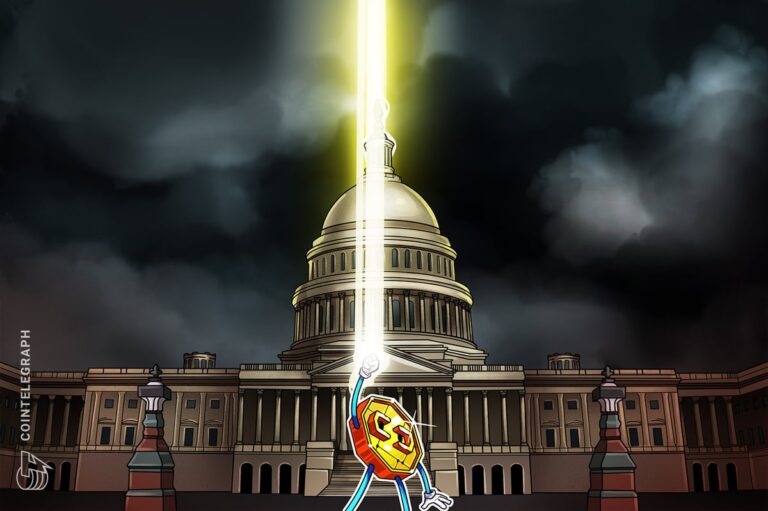
The Senate Banking Committee is backing Donald Trump’s move to bar institutions from buying family homes, which could delay the market structure bill, Bloomberg reports.
Crypto market structure legislation could be delayed by several weeks as the Senate Banking Committee is shifting focus to US President Donald Trump’s affordability agenda, according to a report from Bloomberg, citing people familiar with the matter.
On Tuesday, Trump signed an executive order barring Wall Street investors from buying single-family homes.
The move was seen as part of the Trump administration’s attempt to push down costs before the US midterm election in November.
Bloomberg reported on Wednesday that the committee is likely to switch focus away from the crypto bill in order to implement the executive order.
It could potentially be the Senate’s latest delay to the crypto bill, which has seen two key committees postpone scheduled markups for the legislation to garner bipartisan support.
Coinbase, a major lobbyist, has also pulled support for the bill over disagreements with provisions regarding stablecoins and decentralized platforms.
Republicans are pushing to get policy wins to take into the midterm elections in November, as the latest polling and Polymarket odds show Democrats ahead with a nearly 80% chance of winning a majority in the House, which could derail Trump’s agenda.
The Trump administration has prioritized crypto policy in its first year, but the soaring cost of living has voters putting affordability as a top concern heading into the elections.
Magazine: How crypto laws changed in 2025 — and how they’ll change in 2026
This is a developing story, and further information will be added as it becomes available.
Cointelegraph is committed to independent, transparent journalism. This news article is produced in accordance with Cointelegraph’s Editorial Policy and aims to provide accurate and timely information. Readers are encouraged to verify information independently. Read our Editorial Policy https://cointelegraph.com/editorial-policy
Coinbase CEO Brian Armstrong spars with France’s Central Bank chief at Davos over yield and ‘bitcoin standard’

Ripple’s Brad Garlinghouse called the WEF panel ‘spirited’ as Coinbase’s CEO defended bitcoin and stablecoins, while Villeroy warned of threats to monetary sovereignty and financial stability.
Bitcoin’s quantum threat sparks concern on Wall Street – DL News

- UBS CEO Sergio Ermotti said at Davos this week that Bitcoin needs to overcome the quantum computing threat.
- Ermotti joins a growing chorus of concerned financiers that includes Jefferies’ head of equity strategy Christopher Wood, who removed Bitcoin from a recommended pension portfolio last week.
- Bitcoin developers are in denial, crypto venture capitalist Nic Carter told DL News.
Bitcoin’s quantum computing threat has reached the upper echelons of finance.
And Sergio Ermotti, CEO of $5 trillion Swiss bank UBS, is the latest Wall Street leader to sound the alarm.
“The potential effect of quantum computing on the safety of [cryptocurrencies] still needs to be proved,” Ermotti told CNBC on Thursday at the World Economic Forum in Davos, Switzerland.
Ermotti joins a growing chorus that includes the likes of Ray Dalio, BlackRock, and Christopher Wood, the global head of equity strategy at Jefferies’ Financial Group.
Wood removed Bitcoin from his recommended long-term pension portfolio last week, citing the growing threat of quantum computers.
The store of value concept is clearly on less solid foundation.
— Christopher Wood
Watching large financial institutions fret over quantum computing raises agonising questions: how secure is Bitcoin? How should developers protect the network? And when do they have to act?
Indeed, Bitcoin developers have been caught in a heated debate over how to address the threat of quantum computers, a theoretical but rapidly advancing technology that could break the encryption that undergirds the Bitcoin network.
Wood cited research from Chaincode Labs, which found that 20% to 50% of all Bitcoins could be stolen by thieves armed with quantum computers. That could amount to anywhere between $400 billion to $900 billion in Bitcoin.
‘Quietly concerned’
Crypto venture capitalist Nic Carter has been a vocal advocate of moving quickly to address the potential quantum threat.
He recently led a $20 million investment in Project Eleven, a startup attempting to address the threat that quantum computers pose to cryptocurrencies.
“In the world of institutional allocation, virtually everyone I have talked to is quietly concerned about Bitcoin,” Carter, a general partner at Castle Island Ventures, told DL News.
“I have yet to encounter a single individual who has carefully considered the risk and dismissed it entirely.”
But what is that risk, exactly?
Bitcoin uses the Elliptic Curve Digital Signature Algorithm, which ensures that only the owner of a private key can authorise a transaction. While current computers need trillions of years to derive private keys from exposed public keys, quantum computers could do so in hours or days.
Doing so would allow malicious actors to drain Bitcoin out of vulnerable wallets. Given the vast number of endangered coins, quantum computers could have a massive impact on the $1.7 trillion Bitcoin network.
Dalio, Ermotti, and Woods aside, most institutional concern hasn’t led to public warnings because the requisite analysis takes time and allocators don’t want to spook their clients, according to Carter.
“Many of them are in ‘wait and see’ mode to see if Bitcoin developers actually meaningfully respond to the threat,” he said.
But that patience is running out.
“I firmly believe that this year, if the Bitcoin developers don’t demonstrate any actual urgency, institutional allocators will start to make noise about it,” Carter told DL News.
They won’t publicly pressure development teams, however. Instead, they’ll act through capital deployment.
“They will simply, quietly downgrade and re-weight Bitcoin in their portfolios, or inform their clients they think there’s a 5% risk of Bitcoin going to 0 within 10 years,” Carter said.
Greed & Fear
Wood did just that in his long-running Greed & Fear newsletter last week, a copy of which was shared with DL News.
Wood said he believes Bitcoin developers will eventually act, burning vulnerable coins rather than letting hackers steal them.
While that could boost the value of the remaining coins, uncertainty over the quantum question has undermined Bitcoin’s claim to being a digital alternative to gold, the researcher noted.
“While GREED & fear does not believe that the quantum issue is about to hit the Bitcoin price dramatically in the near term, the store of value concept is clearly on less solid foundation from the standpoint of a long-term pension portfolio,” Wood wrote.
Previously, Wood had recommended that investors put 10% of their long-term pension portfolio in Bitcoin. Now, he suggests they put half that in gold, and the other half in gold mining stocks.
Gold has been on a tear, up 76% in the past year. The precious metal traded at $4,830 on Wednesday, according to Yahoo Finance.
Real or overblown?
To be sure, researchers disagree on when quantum computers will become powerful and stable enough to crack blockchains’ cryptography.
Pierre-Luc Dallaire-Demers, founder of Pauli Group, previously told DL News that quantum computers could crack Bitcoin’s encryption within four to five years.
“Google just keeps delivering milestones on schedule and that’s how the threat for Bitcoin will become increasingly more real,” Dallaire-Demers said.
Ethereum co-founder Vitalik Buterin sees the technology progressing even quicker. He warned in November that quantum computers could break Ethereum’s underlying security model before the next US presidential election in 2028.
Paulo Viana, another researcher, estimates eight years.
“Considering how complicated it is to transition to a quantum resistant option, eight years seems to be concerning,” he said.
‘Denial and complacency’
Carter’s frustration centres on the Bitcoin developer community.
“So far I have only seen denial and complacency from the developers,” Carter told DL News.
Indeed, many have brushed off the fear.
“My critique has been of people trying to trigger panic, using unrealistic short time-frames,” Bitcoin developer Adam Back wrote in December.
Bitcoin evangelist Michael Saylor has also been dismissive of the threat.
“I don’t worry about it,” he told Bloomberg News last year.
“Microsoft and Google market their quantum projects, but they would never sell a quantum computer that cracked cryptography as it would destroy their own companies.”
Perhaps one problem is that there’s no single solution. Bitcoin would need a package of half a dozen Bitcoin Improvement Proposals, or BIPs, to protect itself from quantum computing, Carter argued.
And even then, it could take years, given the notoriously sluggish process that BIPs have to go through to get approved.
Carter also believes that institutional quantum concerns are already affecting Bitcoin’s price.
“This is already resulting in a price headwind in my opinion, and I think it will only get worse this year, unless developers adopt a radically different outlook,” Carter said.
Pedro Solimano is a DL News markets correspondent based in Buenos Aires. Aleks Gilbert is a DL News DeFi correspondent based in New York City . Got a tip? Email them at psolimano@dlnews.com and aleks@dlnews.com.
Gen Z Plans to Increase Crypto Trading in 2026: OKX

The survey found younger Americans are far more likely than baby boomers to boost crypto activity this year.
Gen Z is much more likely than baby boomers to trade more crypto in 2026, according to a new OKX survey.
A January 2026 survey of 1,000 Americans found that 40% of Gen Z plan to increase their crypto trading this year. That compares with 36% of millennials and 11% of baby boomers, OKX said.
Younger users also said they trust crypto platforms more, with OKX finding that 40% of Gen Z and 41% of millennials gave crypto platforms high trust scores, compared with 9% of boomers.
“Tokenization can make markets more open and efficient,” an OKX spokesperson told The Defiant. “You can lower minimums, fractionalize exposure to things like funds or Treasuries, and make assets available 24/7 on global rails instead of inside a local branch. If designed well, it can reduce friction and expand participation.”
In contrast, older users were more positive about traditional banks: 74% of boomers gave banks high trust scores, while 22% of Gen Z and 21% of millennials reported low trust in banks.
The survey also shows that younger Americans are more bullish on crypto long-term. OKX found that 52% of Gen Z and 50% of millennials believe crypto could one day match or beat traditional finance. Only 28% of boomers agreed. Meanwhile, 71% of boomers said banks will stay the main part of the financial system.
The report said that different age groups focus on different factors when it comes to trust, with security being the top priority for Gen Z, millennials, and Gen X. Boomers, on the other hand, most valued regulation and legal protection.
“Regulation matters more to boomers because their trust model is strongly tied to oversight and institutional legitimacy,” the OKX spokesperson said. They added that clearer rules could address concerns about consumer protection and custody.
Still, the spokesperson explained that trust depends on how platforms perform over time. “Trust ultimately sticks when platforms prove safety, reliability, and transparency in everyday user experiences,” they said.
OKX also found that boomers were more likely to say crypto does not offer real benefits. Nearly half of boomers said crypto solves “none” of the problems in traditional finance, compared with 6% of Gen Z.
The findings come as crypto continues to move further into the mainstream, with more trading platforms, investment products, and major companies offering access to digital assets.
Senate Agriculture publishes own version of market structure bill without bipartisan support
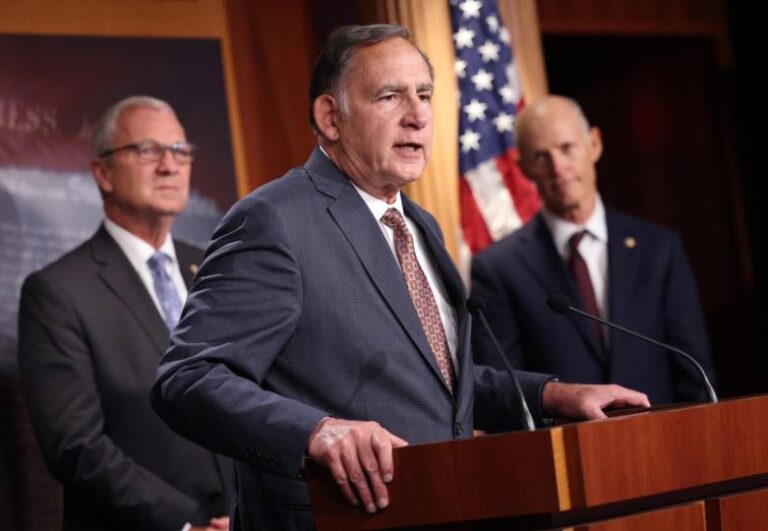
The industry’s great legislative hope is shifting to the U.S. Senate’s Agriculture Committee, which released its own draft of the contentious oversight effort.
Crypto bill likely delayed for weeks by Banking Committee after Coinbase pulled its support

The momentum for new crypto rules in Washington has slowed to a crawl and and it is not expected to resume for at least several weeks.
Trump Tariffs Fuel Bitcoin’s Risk-Off Correction: Exchange Netflows Hint At Short-Term Selling

Trusted Editorial content, reviewed by leading industry experts and seasoned editors. Ad Disclosure
Bitcoin slipped below the $90,000 level as global markets reacted to rising macroeconomic tension between the United States and the European Union. Investors are closely watching the latest trade headlines, as renewed tariff threats increase uncertainty around global growth, corporate earnings, and inflation dynamics. When friction between major economies escalates, risk appetite typically fades, and crypto tends to feel the impact fast as traders reduce exposure and cut leverage.
According to an analysis by XWIN Research Japan, Bitcoin’s recent weakness fits a broader pattern that has been developing since 2025. The report argues that the Trump administration’s renewed tariff push has acted as a consistent downside pressure for BTC, mainly because tariffs influence multiple pillars of the macro environment at once. Higher tariffs can squeeze company margins, disrupt supply chains, and push inflation expectations higher, which complicates the outlook for interest rates and monetary policy.
In this environment, Bitcoin has continued to behave more like a macro-sensitive risk asset than a defensive hedge. Instead of attracting safe-haven flows, BTC has often moved in sync with equities during trade-driven risk-off waves. As a result, even brief bursts of bullish momentum have struggled to hold when economic uncertainty rises and capital rotates into safer positioning.
Tariff Risk Keeps Bitcoin Tied to Macro Conditions
The XWIN Research Japan report explains that several Bitcoin pullbacks between 2025 and 2026 aligned with periods of rising economic uncertainty driven by tariff hikes and trade frictions. During these episodes, BTC declined alongside equities, reinforcing that the market still treats Bitcoin as a macro-sensitive risk asset rather than a defensive hedge. Instead of decoupling during stress, Bitcoin often reacts like a high-beta instrument when traders rush to reduce volatility in their portfolios.

Economic risk tends to hit Bitcoin quickly because investor behavior adjusts fast. As uncertainty around growth and interest rates increases, capital typically shifts toward short-term protection. In that process, Bitcoin is frequently viewed as a liquid asset that can be sold temporarily to lower portfolio risk, rather than a long-term store of value that benefits from risk-off flows. This dynamic can amplify downside moves even when long-term fundamentals remain intact.
Exchange Netflow provides a supplementary layer of evidence. During correction phases, brief spikes in exchange inflows often appear, consistent with tactical repositioning and short-term profit protection. However, these inflows have not persisted, suggesting the absence of sustained structural selling pressure.
For now, the base scenario remains that tariff-driven economic risk is weighing on Bitcoin. If exchange inflows become sustained and supply-demand conditions weaken further, that assessment would need to be reassessed.
BTC Holds Its Ground After Breaking Below $90K
Bitcoin is trading around $88,800 on the weekly chart after a sharp selloff that briefly pushed price below the $90,000 psychological level. This drop marks a clear shift in momentum, as BTC failed to hold the mid-range structure that supported price action throughout the late-2025 consolidation phase. The weekly candle shows heavy downside pressure, with sellers rejecting attempts to stabilize above $92,000 and forcing a retest of lower demand.
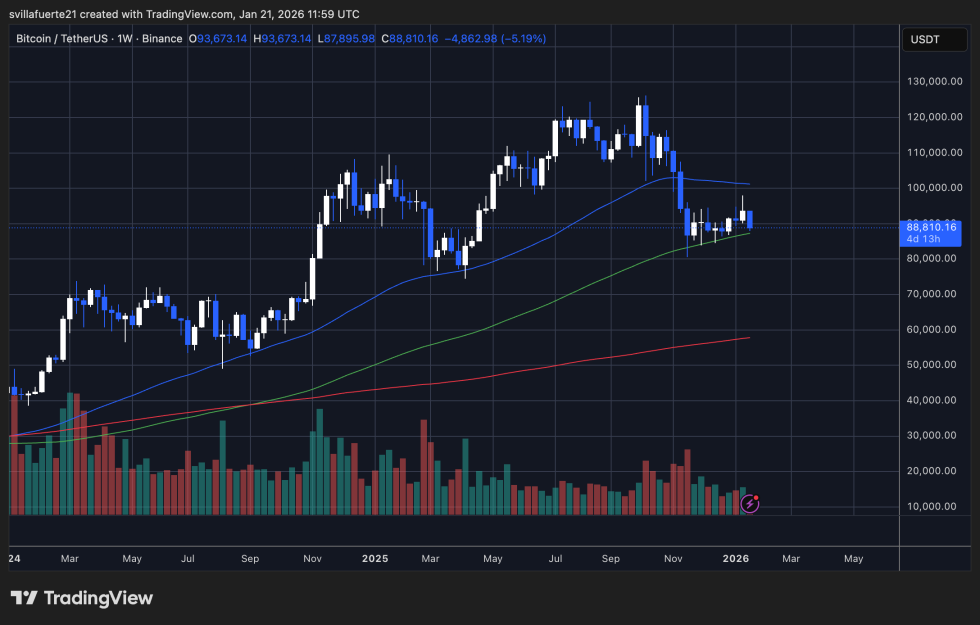
Technically, Bitcoin remains trapped between key moving averages. Price is still below the blue long-term trend line, which has acted as dynamic resistance since the breakdown from the $100,000+ region. At the same time, BTC is holding above the green moving average, suggesting that while the market is weak, longer-term buyers are still defending the broader uptrend structure.
This creates a fragile equilibrium: as long as Bitcoin holds above the current support zone, bulls can attempt to rebuild a base and reclaim $90,000-$92,000. However, if volatility expands and the market loses the green trend line, it would expose BTC to a deeper correction toward the mid-$80,000s, where previous demand briefly stepped in during the prior drawdown.
Featured image from ChatGPT, chart from TradingView.com

Editorial Process for bitcoinist is centered on delivering thoroughly researched, accurate, and unbiased content. We uphold strict sourcing standards, and each page undergoes diligent review by our team of top technology experts and seasoned editors. This process ensures the integrity, relevance, and value of our content for our readers.