European Union officials are reportedly planning to revise the Markets in Crypto-Assets (MiCA) framework amid the implementation of a US law on stablecoins.
According to a Wednesday report from Euronews, EU officials planned to revisit proposed changes to MiCA to broaden the framework’s scope, specifically regarding non-EU companies issuing stablecoins.
The revised rules, which authorities will reportedly consider in 2027, were in response to the US government’s Guiding and Establishing National Innovation for US Stablecoins, or GENIUS, Act, putting pressure on EU officials to clarify how US stablecoin issuers could be regulated in member states. Officials will also reportedly consider expanding MiCA to include rules on tokenized payments and deposits.
Under MiCA, crypto companies offering services to EU-based users across 27 member states must now be licensed as Crypto-Asset Service Providers (CASPs) by a regulator in one of the member states. Although the licensing requirement took effect on July 1, European Commission officials had already opened a comment period for potentially revising the framework, including provisions on decentralized finance (DeFi) and stablecoins.
Related: Stablecoin-settled TradFi perpetual trading tops $1.1T: Binance Research
The proposed framework, which some have dubbed “MiCA 2.0,” will remain open for comments until Aug. 31. However, Miroslav Durić, a senior associate at Taylor Wessing, told Cointelegraph in June that it was unlikely that “any concrete legislative proposals will be adopted before 2028.”
In addition to the GENIUS Act, US lawmakers are reportedly continuing discussions to advance their own version of market structure called the Digital Asset Market Clarity (CLARITY) Act. The bill, advanced by two key committees in the previous 12 months, is expected to head to a vote in the Senate in July before the chamber breaks for month-long state work periods.
EU regulators reviewing crypto custody risks
The European Securities and Markets Authority, one of the regulators supporting the implementation of MiCA, announced on Wednesday that it planned to review the operational resilience of CASPs licensed under the recently enacted framework. From July through the first half of 2027, EU regulators will examine how crypto companies handle custody-related operational risks.
Magazine: Why stablecoins and SWIFT may have to coexist
Cointelegraph is committed to independent, transparent journalism. This news article is produced in accordance with Cointelegraph’s Editorial Policy and aims to provide accurate and timely information. Readers are encouraged to verify information independently.
In bitcoin BTC$62,129.74’s 4-year cycles, there has always been a distinct driver of selling pressure. In 2018, we saw the promise of crypto running ahead of its skis; the market drove up valuations of crypto projects far beyond their nascent stages of development that led to selling once participants understood the reality. In 2022, leveraged blow ups brought several forced sellers, such as Celsius and FTX, which pressured crypto prices. The most recent overhang on the market has been Strategy (MSTR), whose evolving capital structure drove concerns of potential BTC sales to meet dividend obligations. The good news is that MSTR took concrete steps to placate said concerns, shoring up its USD reserve and updating its capital allocation strategy, buying time for BTC to recover. The market can now look past this and evaluate BTC on its own merits.
The BTC story remains relevant as ever
BTC’s role as sound money resonates as the money supply continues to increase, surpassing $23 trillion for the first time in May. What’s notable is that the month-over-month jump was over 1% and the highest since 2021, a marked acceleration from prior months. Bitcoin remains a solution to rapid expansion of the money supply. While attention has drifted away from this to the Iran conflict and AI, BTC is poised to swing back to this dynamic.
Unlike its peer store of value asset, gold, BTC was designed to be easily divisible and portable. And its fixed supply of 21 million BTC still holds. There is value in this kind of neutral asset and allocators should continue to take note.
Polymarket, which began its return to the U.S. after a four-year ban with the acquisition of QCEX a year ago and the introduction of a mobile trading app in December, has started a campaign to persuade policymakers, regulators and potential users that it is trustworthy, Associated Press reported on Wednesday.
According to AP, Polymarket is working with social media influencers to produce viral marketing on TikTok and other platforms and has signed partnership agreements with major sports teams and Major League Baseball as well as news outlets including CNBC and CNN.
The steps Polymarket is taking in the U.S. will help legitimize it despite the issues it has faced in the past, Dan Lee, head of U.S. operations, said in an interview with AP on Wednesday.
“I think having the international business being the bulk of the volume, it often sort of masks the progress we are making here in the U.S. to broaden Polymarket’s acceptance,” Lee said.
The company’s X account now has 1.7 million followers and posts about current events several times a day. Rival platform Kalshi, which has been operating under the supervision of the Commodity Futures Trading Commission (CFTC) since 2020, has 431,400.
Bull Bitcoin exchange, recently licensed under MiCA, is challenging the European directive in French courts that sets up a mass surveillance database, putting millions of crypto users at risk.
Bull Bitcoin, the world’s oldest Bitcoin-only and non-custodial exchange, recently licensed under MiCA by France’s financial markets regulator AMF, has filed a legal challenge before the Conseil d’État, France’s supreme administrative court. The challenge seeks to annul Decree No. 2025-1276, the main measure transposing the European DAC8 directive into French law, on the grounds that it creates a massive surveillance grid and database that institutions can not secure from leaks and data hacks, ultimately putting civilians at risk of kidnapping and physical harm.
Alongside the legal action, the company is making dac8.com public: “a complete, fully sourced resource for citizens, journalists and policymakers,” according to a press release shared with Bitcoin Magazine.
In recent years, there has been an alarming rise in kidnappings and physical attacks on crypto users, most concentrated in Europe, with France being an epicenter. Organized crime seems to be exploiting poor data reporting laws of law-abiding crypto users who, by paying their taxes, expose their ownership of crypto assets. Given that Bitcoin and other cryptocurrencies are not reversible and can be transferred internationally with ease, criminals are hunting down crypto users. France has had the second most physical attacks on crypto users after the USA, which has a much larger population, according to Gart, a company dedicated to protecting users from this rising threat.
High-profile figures in the Bitcoin and broader crypto industry have been targeted in recent years, such as Binance France CEO David Prinçay and Ledger co-founder David Balland, who lost a finger during the incident, among many others. Jameson Lopp, co-founder of Casa, a high-security Bitcoin and Ethereum wallet company, has organized ‘wrench attack’ data for years in a database on GitHub showing an accelerating trend of attacks.
Bull Bitcoin argues in its legal challenge to the DAC8 that further consolidation and sharing of crypto user data will only perpetuate this trend of physical attacks. However, they also argue that these personal security risks created by the DAC8 are also working against the stated intentions of the regulations. They argue that users will simply find legal alternatives to centralized, regulated exchanges, opting to purchase the assets off the grid via peer-to-peer exchanges, home mining or offshore unregulated alternatives, making tax collection even more difficult.
User Data Honey Pots
DAC8 turns the natural incentive a company has to protect its users’ data into a valuable multinational database with many entry points, which cybersecurity experts have for a long time called a honey pot. Bull Bitcoin points out that regulated crypto-asset service providers (CASPs) under MiCA, DORA and the GDPR are supervised, sanctionable professionals with financial incentives to protect their customers. DAC8, in turn, does the opposite: it moves data into administrative reporting networks where access is broader, and accountability is harder for users to assess. The security of the whole — Bull Bitcoin concludes — is then only as strong as its weakest link.
The history of data security over the past decades shows that amassing user data and keeping it safe over time is very difficult. Just this year, the French National Agency for Secure Credentials (ANTS, also known as France Titres) suffered a major breach detected on April 15, 2026, exposing data from up to 11.7–19 million accounts. Compromised information included login IDs, full names, email addresses, dates of birth, account identifiers, and, in some cases, postal addresses, places of birth, and phone numbers.
Months earlier, the French National Bank account registry also suffered a major hack, exposing data tied to approximately 1.2 million accounts. The compromised information included IBANs, account holder names, addresses, and, in some cases, tax identification numbers, though officials stated the attacker could not view balances or conduct transactions.
In the United States, the situation is not much better. The Equifax Data Breach in 2017 affected 147 million Americans, and the National Public Data Breach of 2024 affected over 200 million Americans, leading to leaks of social security numbers among other critical information. And back in 2015, the Office of Personal Management of the U.S. government was also breached, compromising a large number of U.S. Government officials. The data stolen included everything from social security numbers to medical records.
The list of such breaches is long, and the only logical conclusion to draw from it is that the less user information that ends up in these honeypots, the better, as ultimately all of these hacks put civilians at risk either from physical attacks or from identity-theft related fraud.
Families On the Front Lines
Of the many issues identified by Bull Bitcoin and documented on the DAC8 website, the most alarming one might be how even individuals who have not purchased crypto might end up harmed by this concentration of data, just by familial association with a Bitcoiner or crypto user.
Citing data by Certik, Bull Bitcoin highlights that more than half of the violent incidents recorded in 2026 against crypto owners targeted a family member — spouse, child, elderly parent — as a direct victim or as a pressure lever over the key holder. On the topic, Bull Bitcoin assets that “DAC8 therefore exposes not only crypto-asset holders, but their entire close family circle: between 40 and 135 million Europeans fall into a physical-risk zone, without any of them ever having consented.”
Francis Pouliot, CEO of Bull Bitcoin considers this overreach into the privacy of Euroeans to be potentially catastrophic for the prosperity of the continent, he minced no words in the press release saying that “DAC8 has transformed the concept of Know Your Customer into Kill Your Customer.” He added, “We cannot let the very foundations of civilization be shattered by this attack on privacy rights. We must draw a line in the sand and refuse to cede any more territory before we have nothing left. Someone must take a stand. It appears that no one else is willing and able to do so. Therefore, it falls to BULL to lead this fight.”
The DAC8.com is rich with facts, figures, official sources (EUR-Lex, OECD, Legifrance) and analysis, in French, English and other European languages for those interested in reviewing it and freely using it.
Commodity Futures Trading Commission Chairman Michael Selig said the Clarity Act remains within reach, days after Congress missed its July 4 target to pass the crypto market-structure bill. “We’re so close. We have to get this done,” Selig told Fox Business host Maria Bartiromo.
Some analysts give the measure even odds of passage before the August 7 recess.
The bill would divide oversight of digital assets between the CFTC and the Securities and Exchange Commission, a split the industry has sought for years. The House passed the legislation last summer. The Senate has yet to hold a floor vote.
Selig, a Trump appointee confirmed in December, backed the Clarity Act effort as a matter of national competitiveness. He backed the effort as a matter of national competitiveness.
“It’s critical that we have a federal standard for crypto assets,” he said, pointing to a patchwork of state laws that, in his account, has hurt U.S. business. He described the goal as certainty, clarity, and consumer protection, and called the measure bipartisan. “We have to get it across the line,” he said.
Asked about the holdup, Selig pointed to scope. Democrats have pressed for ethics language addressing President Trump, his family, and their crypto ventures, a demand he characterized as a distraction.
“There’s a little bit of creep into ethics and other issues, and they’re just derailing the real opportunity to have a bipartisan bill,” he said.
Democrats have framed the Clarity Act provisions as consumer protection. The bill has also drawn disputes over illicit-finance rules and over a reopened piece of the GENIUS Act, the stablecoin law, that concerns whether exchanges may pay yield on stablecoin balances.
Senator Cynthia Lummis, who leads the Senate Banking Committee’s digital assets subcommittee, has said negotiators aim to release bill text and hold a vote this month.
The committee advanced the measure in a 15-9 vote, with two Democrats joining Republicans. Lawmakers have warned that a failure to act before the recess could delay the next opening for years.
Selig on prediction markets, Iran beyond Clarity Act
Bartiromo also asked Selig about prediction markets, where Kalshi and Polymarket processed a combined $24 billion in volume over the past year.
Selig said the CFTC has proposed rules for the sector and has sued nine states in a fight over jurisdiction. On markets during the U.S. strikes on Iran near the Strait of Hormuz, he said crypto held its ground and served as a hedge, while the agency worked to keep oil and derivatives markets orderly.
For now, the Clarity Act’s fate rests on released text, a Senate vote, and a calendar that leaves a few weeks before the August recess.
Bank of England Governor Andrew Bailey has reportedly denied that lobbying efforts by Nigel Farage influenced the central bank’s approach to a potential central bank digital currency (CBDC), saying policy decisions were made independently.
According to a Wednesday report by The Guardian, which obtained a letter written by Bailey, the governor said the BoE is “able to spot” attempts to influence its policymaking. The letter followed a meeting with Farage, during which the two discussed several issues, including cryptocurrencies.
“Following our meeting, Mr. Farage spoke with the press outlining that we had discussed a range of topics, including cryptocurrencies,” Bailey reportedly wrote in the letter. “I am happy to confirm that no policy changes have taken place as a result of interventions by Mr. Farage.”
Farage, the leader of the UK’s Reform Party and one of the most prominent supporters of Brexit, resigned his parliamentary seat this week amid reports that he accepted “gifts” from individuals with ties to the crypto industry. He has been an outspoken critic of CBDCs, saying he would “rather go to prison” than live under what he described as a system of financial surveillance.
Despite his resignation, Farage maintained his innocence, stating in an X livestream that he has “not broken the law in any way at all.”
Source: Nigel Farage
Amid the investigations involving Farage, The Guardian also reported Wednesday that the UK’s National Crime Agency is investigating several transactions involving other senior Reform UK figures over suspected money laundering.
Related: Nigel Farage accepted gifts from crypto-linked fraudster: Report
BoE presses ahead with digital pound research
The Bank of England continues to explore a potential central bank digital currency, the proposed “digital pound,” which remains in the design phase as policymakers assess its role in an increasingly digital economy.
“No decision has been made on whether to introduce a digital pound,” the central bank said in a recent update, emphasizing that any launch would require further analysis and public consultation.
Earlier this year, the Bank launched a six-month pilot to explore how tokenized assets could be settled using central bank money. The project, involving 18 companies, is part of the central bank’s broader effort to modernize the UK’s financial infrastructure.
Related: The 5 types of real world assets being tokenized fastest onchain
“To me, I think it’s over,” Trump said about the ceasefire during a press conference at the NATO summit in Ankara, Turkey.
Additional reports claimed that both the US and Iran were considering reimposing a blockade of the Strait of Hormuz oil route.
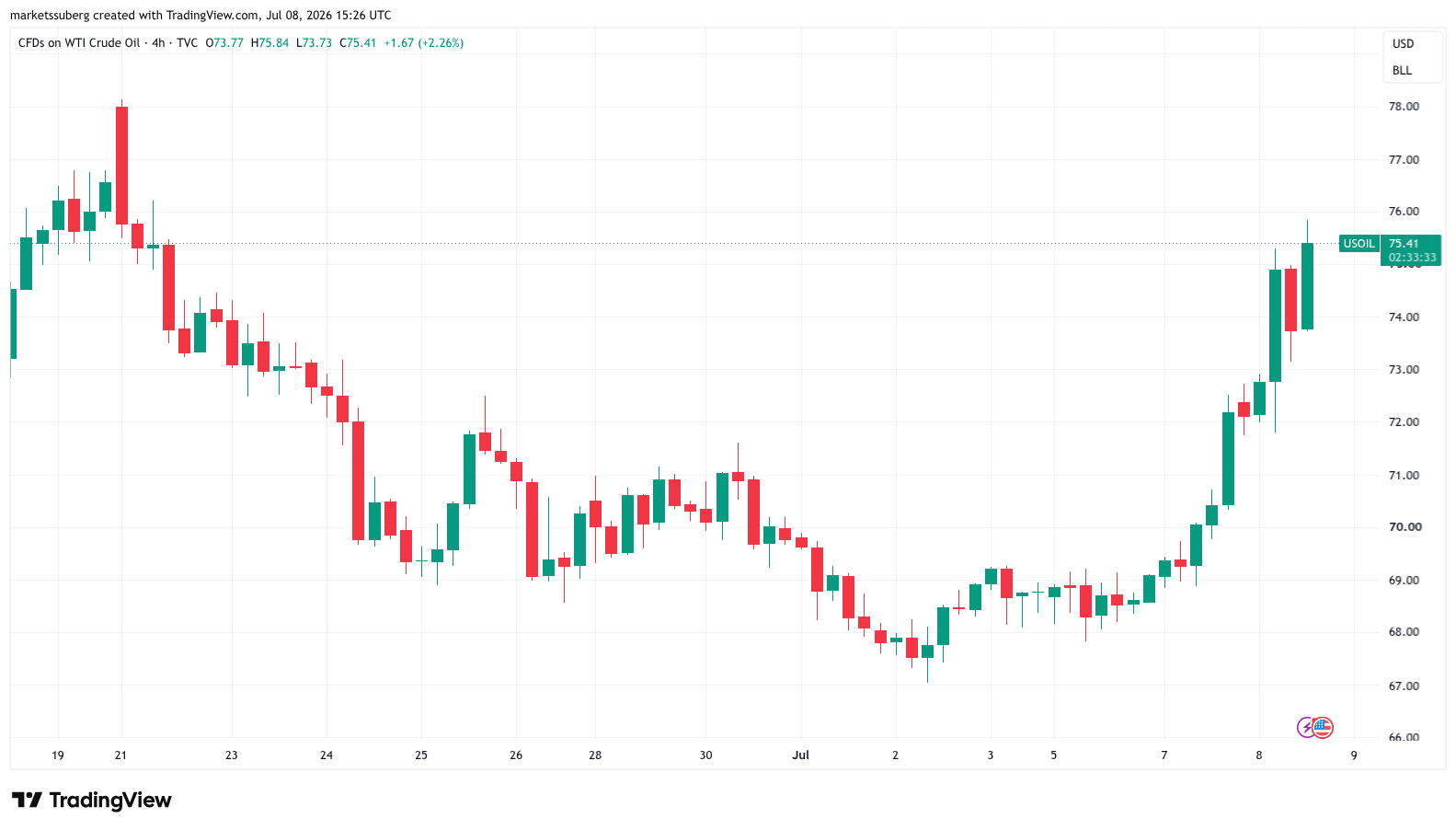
US WTI crude oil passed $75 per barrel on the day, reaching its highest levels since June 22.
CFDs on US WTI crude oil four-hour chart. Source: Cointelegraph/TradingView
The latest events had an instant impact on expectations over financial policy moves by the US Federal Reserve.
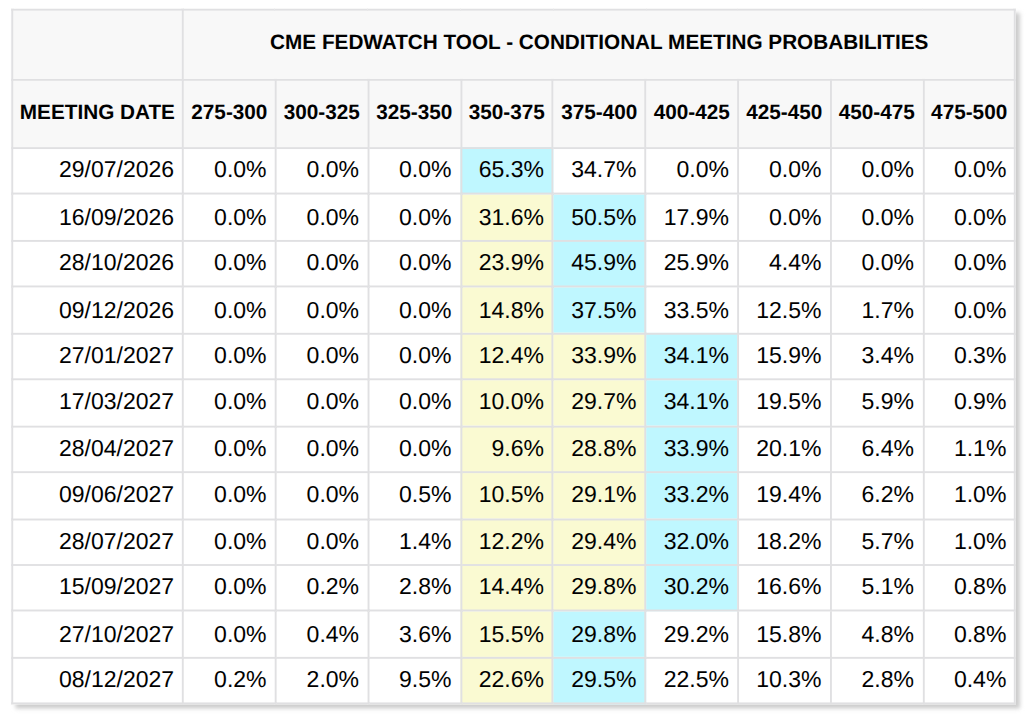
The latest data from CME Group’s FedWatch Tool showed increasing odds of an interest-rate hike coming at the Fed’s September meeting, with July’s still tipped to see rates stay at current levels.
Fed target rate probabilities (screenshot). Source: CME Group
Users on prediction service Kalshi, meanwhile, put the odds of a hike in 2026 at 55%.
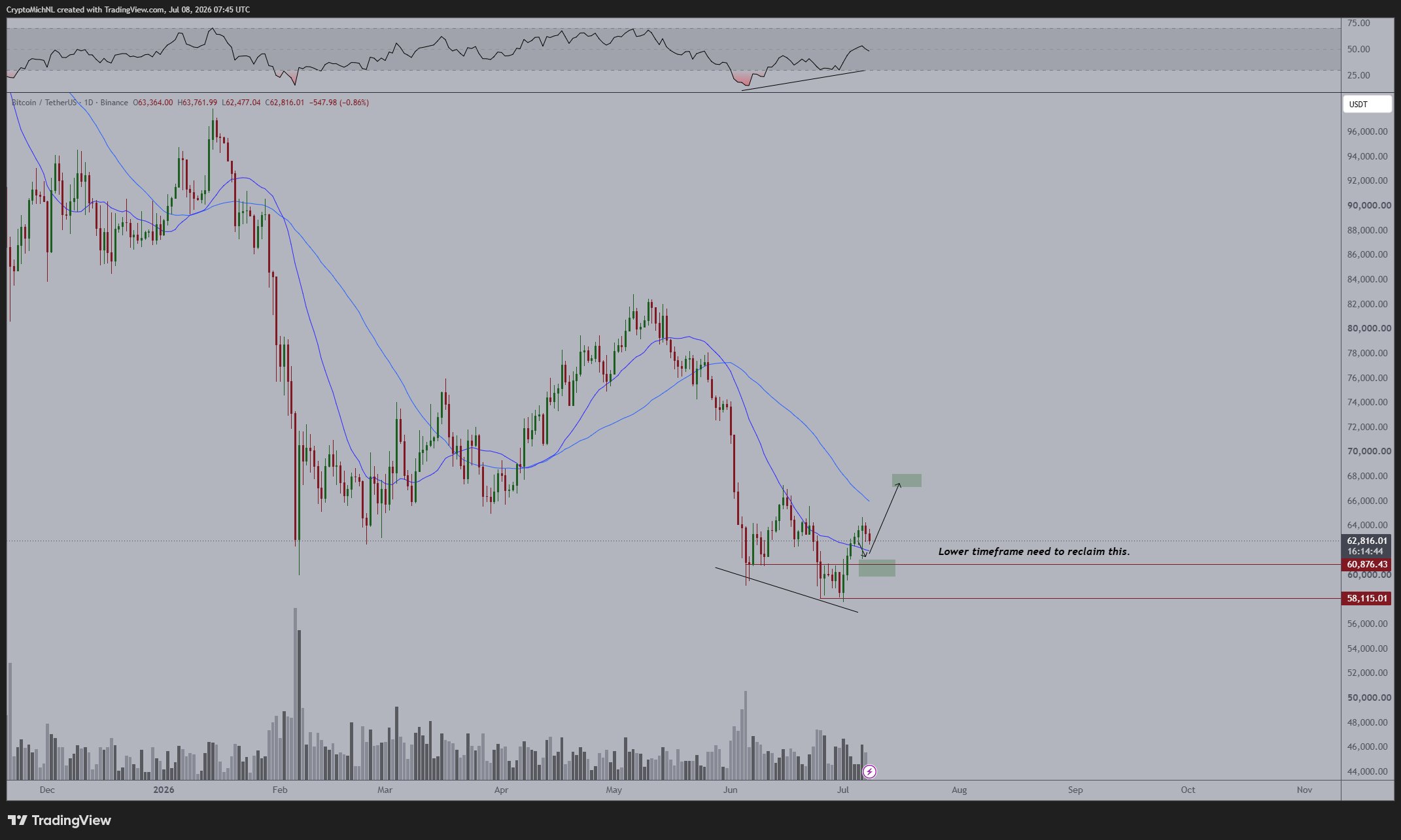
Trader names $61,000 as “crucial” BTC price level
Commenting, crypto trader and analyst Michaël Van de Poppe predicted a retest of $61,000 for Bitcoin.
Related: BTC speculators in focus as analysis says ‘textbook Bitcoin bottom’ is underway
“This to happen, and then 1-2 days later; we’re in talks again. And the markets reverse,” he wrote in a post on X.
Earlier, Van de Poppe said that there was “no problem” visible in BTC price action.
“Price remains hovering above $60,000, despite the fact that the Middle East has reactivated the War again. Other than that, as long as it remains a relatively shallow correction, I don’t think we’ll start to see lower levels in the markets,” he wrote.
“The crucial level for me is the $61,000 area.”
BTC/USDT one-day chart. Source: Michaël Van de Poppe/X
Among traders, anticipation was building over a trip to new local lows.
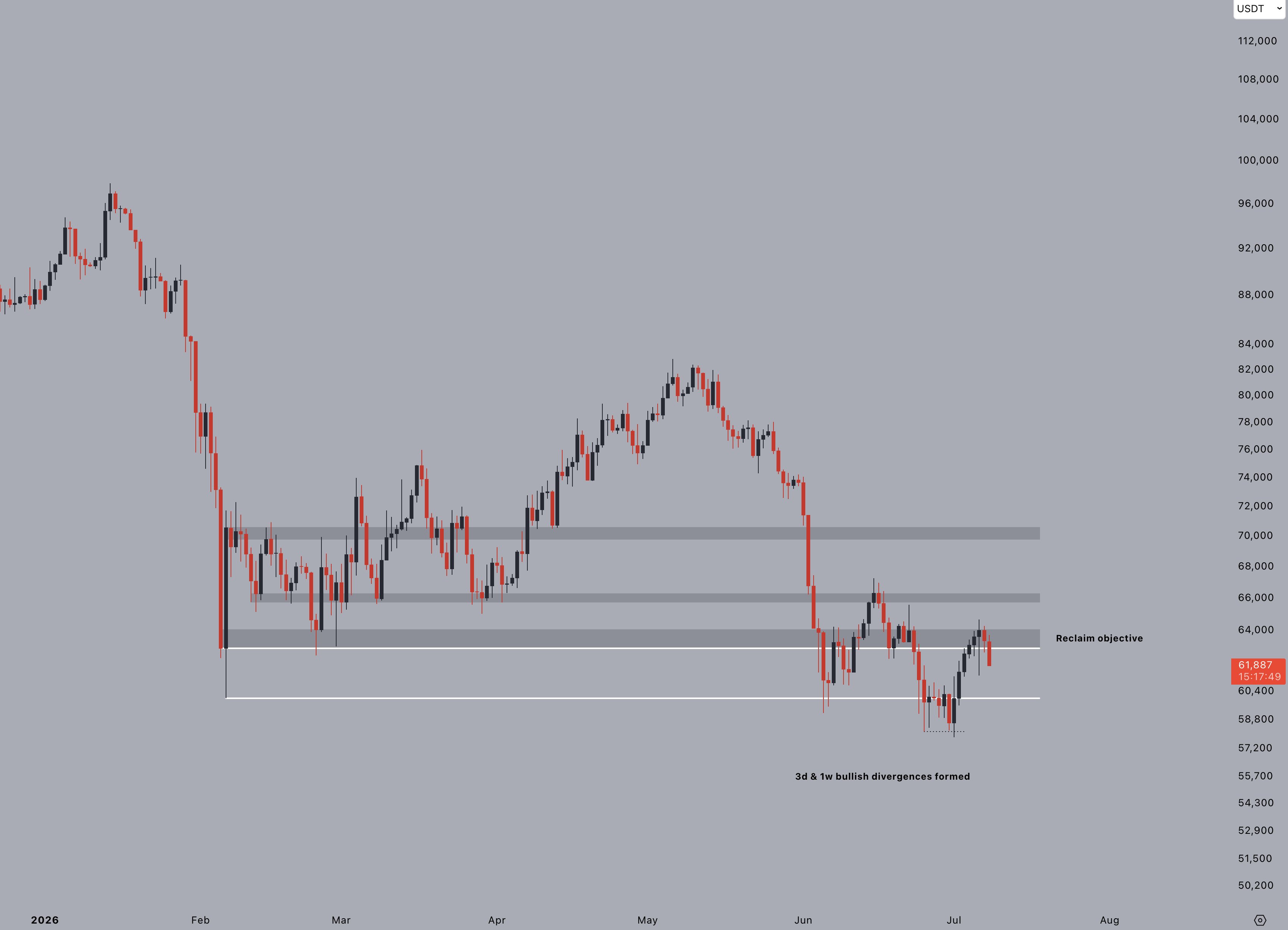
“Tensions with Iran flaring up again just as $BTC tried to reclaim the previous range lows. Starting to look like we’re getting those cheaper accumulation opportunities we were hoping for,” trader Jelle told X followers.
India’s tax department reportedly found widespread gaps in crypto tax reporting, warning that offshore exchanges, private wallets and peer-to-peer (P2P) trades are making crypto activity harder to track.
Reuters on Wednesday reported government documents showed that fewer than a quarter of 645,000 individuals who made crypto transactions in the year ending in March 2023 reported the trades on their tax returns. The department also reportedly estimated that India had about 39 million crypto traders holding over $2.1 billion in crypto at the end of May.
The findings add a tax-enforcement factor to the country’s long-running digital asset policy debate, moving the issue beyond the central bank’s financial-stability concerns and into questions on offshore trading and recoverable tax revenue. India was ranked first in Chainalysis’ 2025 Global Crypto Adoption Index.
The report comes days after the Reserve Bank of India (RBI) backed a containment strategy for crypto assets. On July 3, the central bank urged lawmakers to keep banks and financial institutions insulated from cryptocurrencies and privately issued stablecoins. The RBI reportedly said prohibition remained a recognized policy option and recommended preventing digital asset use in payments and settlements.
Cointelegraph sought comment from India’s Central Board of Direct Taxes but had not received a response by publication.
Crypto tax enforcement remains a global challenge
India is not the only jurisdiction struggling to bring crypto activity into the tax net. In Israel, a voluntary disclosure program aimed at crypto profits fell short of expectations, according to a June 3 report by local business outlet Globes.
The Israel Tax Authority (ITA) reportedly expected to collect 2 billion to 3 billion Israeli shekels (about $650 million to $986 million) from the process, which offered criminal immunity to taxpayers who would disclose previously hidden capital.
Related: Petition to scrap South Korea’s crypto tax reaches 50K threshold
Despite this, only 289 disclosure requests had been submitted since the program was launched in August 2025, with reported capital totaling 676.5 million shekels and estimated tax due of 40.9 million shekels. The figure was a sharp miss compared with the expectations and with the estimated crypto tax gap.
Globes cited tax experts who said the program’s lack of an anonymous disclosure track had weakened the incentive for crypto holders to come forward.
Magazine: Has Bitcoin bottomed for this cycle? Analysts say ‘not yet’
Cointelegraph is committed to independent, transparent journalism. This news article is produced in accordance with Cointelegraph’s Editorial Policy and aims to provide accurate and timely information. Readers are encouraged to verify information independently.
Strategy remains under pressure as Bitcoin hovers near $60,000, but recent capital moves have bought the company time, according to Jim Ferraioli, director of crypto research and strategy at the Schwab Center for Financial Research.
Speaking on Morning Trade Live at the New York Stock Exchange, Ferraioli said the firm led by Michael Saylor faces scrutiny while the price of Bitcoin sits 50% below its peak. Strategy, the largest corporate holder of Bitcoin, has funded much of its buying through preferred equity, including its variable-rate Stretch preferred stock, known as STRC.
That product fell near $70 from its $100 par value before a rebound. To defend the peg, Strategy raised the STRC dividend to 12% and authorized $2 billion in buybacks while unlocking further Bitcoin sales. The stock has since started climbing back toward par.
“The market is supportive of these actions,” Ferraioli said, describing the response as a check on fears of cascading liquidations.
The shift marks a change in tone for a company known for a “never sell” stance.
“We went from never sell Bitcoin to strategically sell Bitcoin,” Ferraioli said, acknowledging fair criticism. He cautioned that a lower multiple could limit Strategy’s capacity to issue shares and buy more Bitcoin in the second half of the year.
Schwab’s perspective on Bitcoin’s slump
Ferraioli weighed in on a market bump that followed comments from President Trump, who signaled openness to holding Bitcoin in the new Trump Accounts savings program.
Ferraioli read the move as a sign of one more potential class of buyer, alongside mainstream investors who entered through spot ETFs.
“The crypto market loves narratives,” he said, calling the asset momentum-driven.
On correlations, Ferraioli described Bitcoin as a low-correlation asset, a trait he traced to the four-year halving that cuts new supply. Past ties to tech stocks have broken down, and a historic inverse relationship with the dollar has wavered; Bitcoin has rallied during periods of dollar strength this year.
“Starting points matter,” he said, noting that Bitcoin rose during the Iran conflict as the dollar gained.
He addressed the dollar-yen rate, which trades near 40-year lows. A stronger yen could unwind the carry trade, in which investors sell the yen to buy growth assets. Ferraioli framed a yen rebound as a possible headwind for risk assets, though not a primary near-term risk for Bitcoin.
On the debasement trade, Ferraioli pushed back on the idea that last year’s gold rally, set against a halving of Bitcoin’s market cap, disproved the store-of-value case.
He attributed the gold move to supply constraints and momentum rather than fiscal fear. The federal budget deficit has narrowed from 8-9% of GDP to 5%, near the median across Bitcoin’s life.
“It’s not an endorsement of the fiscal health,” he said, “but it helps put that narrative in check.”
Adam Back’s Bitcoin Standard Treasury Company (BSTR), the bitcoin treasury company backed by the Blockstream CEO and bitcoin pioneer, is renegotiating the terms of its planned public listing through a merger with Cantor Equity Partners I (CEPO), with the parties abandoning the original structure agreed last year in an effort to better reflect current market conditions.
The companies said Wednesday they will not complete the transaction under the terms of the July 2025 business combination agreement. Instead, they are discussing a revised structure, with further details expected in future filings with the U.S. Securities and Exchange Commission.
As part of the changes, the previously announced private placement financing tied to the merger will no longer be required to close. CEPO also indefinitely postponed its shareholder meeting, which had been scheduled for July 10. Any redemption requests submitted by CEPO shareholders will be cancelled and shares returned, with no action required from investors.
The announcement follows a series of delays. In June, CEPO postponed its shareholder meeting to allow additional time and extend the redemption deadline. The meeting was subsequently pushed back to July 10 before being postponed indefinitely.