Home Blog Page 109

CME Group to Sue CFTC Over Perpetual Futures Approval, Citing Dodd-Frank Swaps Definition

0

The world’s largest derivatives exchange operator said Wednesday it will sue the CFTC over the agency’s approval of Kalshi’s bitcoin perpetual futures, arguing the contracts should be classified as swaps under the Dodd-Frank Act.

CME Group plans to sue the Commodity Futures Trading Commission over the agency’s approval of crypto perpetual futures, the world’s largest derivatives exchange operator announced Wednesday evening on CNBC. Outgoing Chief Executive Terrence Duffy said the case would be filed as soon as Thursday and would argue the contracts should be regulated as swaps under the Dodd-Frank Act.

Duffy disclosed the plan in a Fast Money interview on Wednesday and said CME had spent eight months preparing the challenge with its board. The suit targets the CFTC’s late-May approval of Kalshi’s BTCPERP contract and a parallel action clearing Coinbase to route US customers to its offshore Deribit affiliate. CME later confirmed the filing plan to CNBC. A CFTC spokesperson called the planned action “frivolous.”

The statutory theory turns on a definitional line drawn in the Dodd-Frank Act. The Commodity Exchange Act defines a futures contract by reference to a delivery or expiration date. Perpetual contracts have neither; the two sides exchange periodic funding payments to keep the contract price tethered to spot.

“Under the Dodd-Frank Act, it clearly defines what a swap is and what a future is, and when there’s two parties exchanging payments to each other, that’s deemed a swap,” Duffy said on the broadcast. He said the funding-rate mechanism brings perpetuals inside the swap definition.

Swaps and Futures Distinction

That distinction is not cosmetic. Swaps and futures sit under different sections of the Commodity Exchange Act, with different clearing, reporting, and margin regimes. Federal margin rules require a five-day margin period of risk for cleared swaps and a one-day window for futures, a gap that determines collateral economics for any venue listing the product.

Christopher Perkins, CEO of Coinbase Asset Management, posted on X that a swap designation would likely keep perpetuals offshore because more than twice the margin would be required for basic compliance. He has called the suit incumbent defense.

The procedural attack is narrower. The CFTC cleared Kalshi’s BTCPERP on May 29 under Section 40.2 self-certification, a rule that lets a designated contract market list a new product on one business day’s notice. Duffy says the longer Section 40.3 review, which opens a public-comment window, applies to novel and complex products.

“They did the review in less than 24 hours, which is a 40.2 self-certification for a novel and complex product, which troubled me,” Duffy said at the Piper Sandler Global Exchange and Trading Conference on June 4, per a Markets Media account. The suit is expected to challenge the agency’s use of the faster track.

CFTC Chair Michael Selig has defended both approvals. “It’s time to approve regulated futures contracts that have no expiration date,” he told CNBC’s Fast Money earlier this week, per a Bitcoin Magazine account of the broadcast. The agency followed the May approval with a June 13 no-action letter giving designated contract markets a path to convert existing perpetual-style futures into true perpetuals.

The competitive stakes for CME are direct. CME runs the dominant US crypto futures complex, with bitcoin and ether contracts capped at roughly 5-to-1 leverage and dated quarterly settlement. Kalshi’s BTCPERP and Coinbase’s routing arrangement open onshore access to a product that has driven the bulk of offshore crypto trading for years, often at 20-to-50 times leverage in regulated venues and higher elsewhere.

Exclusive Licenses

Duffy said CME holds exclusive licenses on the crypto-market benchmarks that competing contracts would reference. “All of these would have to go through CME regardless of the perpetual,” he said. Kalshi’s contract is now live, and the prediction-market venue filed in early June to add perpetuals on 12 altcoins beyond bitcoin.

A court ruling reclassifying the products as swaps would force the venue and its competitors into a different rulebook mid-rollout, with new compliance costs and the possibility of temporary delisting while the regime is rewritten. Such an outcome would also reach Coinbase’s Deribit-routed offering and any DCM that converts under the June no-action path.

The litigation lands in a term already marked by venue fights at the CFTC. A federal judge in the Western District of Michigan on Wednesday denied Polymarket a preliminary injunction against state regulators and ruled that sports-related prediction-market wagers are not swaps and fall outside CFTC jurisdiction.

Judge Paul L. Maloney wrote that the agency’s interpretation of its own authority was “so vast that it would encompass vast swaths of activity never understood to be associated with the financial industry.” The language lands awkwardly for the agency as it heads into a separate swaps-classification fight with its largest registered exchange.

CME Succession

The timing also threads through CME’s own succession. The same day Duffy announced the suit, the company named CFO Lynne Fitzpatrick as his successor. Duffy hands over the chief executive role on March 1, 2027 and stays on as executive chairman. That puts the lawsuit in Fitzpatrick’s inbox before she takes the chair.

Duffy’s earlier critique of US-regulated perpetuals as “a disaster waiting to happen” framed the venue’s policy posture; the filing converts that posture into a legal claim. Katherine Kirkpatrick Bos, general counsel of Starkware, wrote on X that the CFTC’s position on perpetuals is sound and that she did not expect CME to prevail.

Court venue and named defendants will publish with the filing itself. CME has not disclosed which district it intends to file in, the named CFTC officers, or whether the action will be a direct petition for review of the agency’s order or a broader administrative-procedure challenge.

Sonic Labs Founders Including Andre Cronje Quit Board as New CEO Pledges to Get ‘1% Better’ Daily

0

Andre Cronje, Michael Kong and David Richardson are stepping down from the board of the Layer 1 blockchain, whose token has fallen about 97% from its peak, as Matt Visser takes over as CEO

Sonic Labs said its three founding board members — Andre Cronje, Michael Kong and David Richardson — are resigning from the board, and named Matt Visser as chief executive officer and Kosta Kourkoumelis as chief operating officer, in a leadership overhaul at the blockchain network whose token and onchain activity have collapsed over the past year. The company disclosed the changes in a post on X.

Sonic’s S token traded at about $0.031, near a fully diluted valuation of $120 million, down roughly 97% from its January 2025 record of $1.03, according to CoinGecko data. The token fell about 30% over the past 30 days, compared with a 19% decline in Bitcoin over the same period. Total value locked on Sonic, a measure of the assets deposited in its DeFi protocols, stood at about $20 million, down some 98% from a peak of $1.14 billion in May 2025, according to DefiLlama.

The reshuffle removes from business decision-making the figures who built the network — Cronje, the DeFi developer behind Yearn Finance who steered Fantom’s rebrand into Sonic, chief among them — and pairs that exit with public commitments to transparency, compliance and rebuilding holder trust. It caps a leadership unwind that has run for more than a year at a network that once ranked among the larger Layer 1 ecosystems by deposits.

A board-led structure unravels

Cronje, Kong and Richardson “remain invested in Sonic’s success” and are handing off their responsibilities in full, the company said, adding that the three “will no longer make business decisions for the organization.”

The departures complete a turnover that began in late 2025. Sonic Labs, formerly the Fantom Foundation, appointed Mitchell Demeter as CEO in September 2025, with Kong moving to chief information officer and Cronje serving as chief technology officer. Demeter and business head Evan Owens resigned in February 2026, after which the board — including Cronje and Kong — took over operations directly. Visser and Kourkoumelis now replace that board-led structure.

Visser said his priority is “operational discipline and earning back trust, in that order,” rather than a roadmap reveal.

“I am not here to promise an instant turnaround,” Visser said in the announcement. “I am here to make Sonic 1% better every single day and let that compound.”

Acknowledging the slide

The company did not frame the changes as a recovery, instead stating plainly that “the token is down” and “community sentiment is down,” and saying it would not spin the position.

Sonic laid out four commitments: publishing decisions and the reasoning behind them; standing up a dedicated risk and compliance committee; treating S holders as stakeholders rather than “a vanity metric”; and cutting back on announcements in favor of plainer updates. It directed disclosures and concerns to a dedicated email address.

Sonic said its engineering output did not slow through the leadership changes. The company reported 400 pull requests merged into its main GitHub branch so far in 2026, two official releases shipped, a 2.2.0 release in active development with six release candidates, and a private testnet under testing.

Cronje remains tied to the ecosystem through Flying Tulip, the DeFi exchange he is building on Sonic, which raised capital at a $1 billion valuation earlier this year even as the S token slid — a split between his new venture’s valuation and the network’s that the board change does not resolve.

Visser and Kourkoumelis are largely untested in public-facing leadership of a network this size, and the “1% better” framing sets no measurable near-term targets against which holders can judge progress.

Sonic said it would be judged as a team over the next 100 days. Whether onchain deposits and token holders return will be the clearest test of whether the new leadership’s pledges translate into activity.

Bitcoin and ether ETFs lost $111 million combined as rate-cut hopes died

0

US spot bitcoin and ether ETFs both turned to outflows on Wednesday in a sign the recovery rally has lost its institutional bid.

Bitcoin funds lost $82 million and ether funds $29 million, SoSoValue data shows. The bitcoin outflow was broad this time, with even BlackRock’s IBIT shedding $31 million and ARKB down $44 million, while every ether fund finished in the red.

The trigger was the Federal Reserve. Kevin Warsh’s first meeting as chair held rates at 3.50% to 3.75% on Wednesday, as expected, but the projections turned hawkish.

The median forecast now sees the policy rate ending 2026 at 3.8%, up from 3.4% in March, and nine of 18 officials penciled in a hike this year. Markets put the odds of an increase as soon as October near 60%. The rate cuts that helped power the bounce are gone.

The price tape stalled with the flows. Total crypto market value has held flat near $2.26 trillion since Tuesday’s close, and bitcoin has eased to about $63,800, mid-range of the climb it built over the past 11 days, per CoinDesk data.

The macro backdrop has flipped. The peace deal that drove the recovery eased inflation fears, but a Fed now leaning toward hikes has replaced the cut bets crypto was counting on.

The next tests are October hike odds and whether the ETF bid returns.

WhiteBIT Gains MiCA Approval in Austria, Expands Access Across Europe

0

Crypto exchange WhiteBIT has obtained authorization under the European Union’s Markets in Crypto-Assets Regulation (MiCA) from Austria’s Financial Market Authority, allowing the company to offer regulated crypto services across the European Economic Area through a single license.

Under MiCA, crypto companies authorized in one European Union member state can passport their services across the European Economic Area without obtaining separate licenses in each jurisdiction. WhiteBIT said the authorization will support the launch of a dedicated European platform, whitebit.eu.

WhiteBIT said W Group, its parent company, serves more than 35 million customers globally. Founded in 2018, the exchange has partnerships with Visa, FACEIT, FC Barcelona, Juventus and Ukraine’s national football team.

Austria did not extend grandfathering provisions for virtual asset service providers beyond Dec. 31, 2025, making it one of the first European Union jurisdictions to fully transition to the MiCA framework. 

According to comments previously provided to Cointelegraph by Austria’s Financial Market Authority, the regulator has licensed nine crypto-asset service providers under MiCA and described application volume as “significant.”

Related: Polish president vetoes crypto bill for third time ahead of MiCA deadline

MiCA deadline approaches for crypto firms

WhiteBIT’s approval comes less than two weeks before the European Union’s MiCA transition period expires on July 1. After that date, crypto companies operating under legacy national registrations must either hold a MiCA license or stop serving clients in the bloc.

The approaching deadline has increased scrutiny on exchanges that have yet to secure authorization. Earlier this week, Reuters reported that Greece’s market regulator was preparing to reject Binance’s MiCA application, while The Big Whale said France may be the exchange’s last remaining path to a MiCA license before the deadline.

Data shared with Cointelegraph by OKX Europe suggests the MiCA transition could affect a meaningful share of Europe’s crypto market. The company found that roughly 7.6 million of the 18.5 million crypto app downloads recorded in Europe between May 2025 and May 2026 were linked to exchanges that were not listed on public MiCA authorization registers.

Statement on the end of transitional periods. Source: ESMA

The European Securities and Markets Authority has said companies that remain unauthorized after July 1 should implement wind-down and client migration plans rather than continue operating while applications remain under review.

Magazine: The end of anon? AI could unmask crypto’s hidden identities

Crypto market positioning is ‘defensive and thin’ after Fed rate meeting, Marex  analysts say

0

The crypto market slipped a day after the Federal Reserve raised expectations that U.S. interest rates are headed higher.

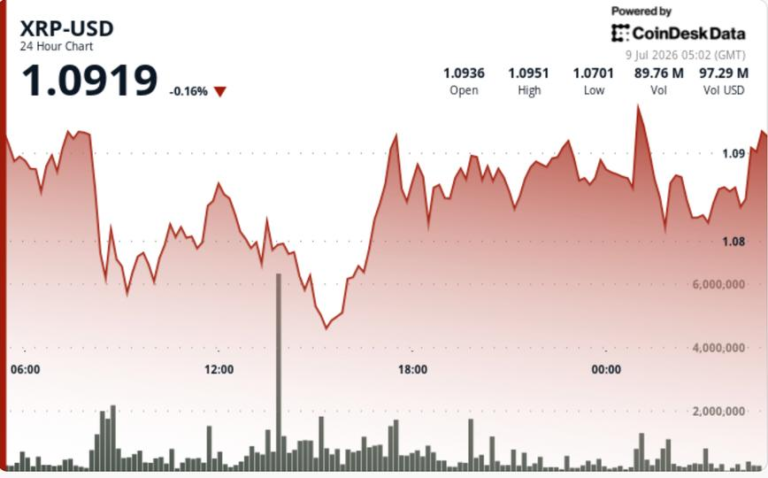
Bitcoin , the largest cryptocurrency by market capitalization, was changing hands near $63,900, down more than 1% over the past 24 hours. Other major tokens, including XRP (XRP), ether (ETH), BNB coin and solana (SOL), posted similar losses.

The CoinDesk 20 Index (CD20) fell more than 1.2% in the same period. The DeFi Select Index (DFX) slid 5%, the largest drop among all the CoinDesk benchmarks.

Still, there were pockets of strength. For instance, Provenance Blockchain’s HASH token surged 15%, alongside a gain of almost 10% gain in Stellar’s lumen (XLM).

“Sentiment is washed out, the fear gauge has plunged into extreme fear and BTC is now about 48% off its $126k high from last October. Contrarian fuel if you have the patience, but a clear tell that positioning is defensive and conviction is thin,” analysts at Marex said.

Derivatives positioning

  • Crypto futures bets worth over $440 million have been liquidated across exchanges in the past 24 hours. Most were bullish long positions, indicating that traders had positioned for a recovery rally following Wednesday’s Federal Reserve interest-rate decision.
  • BTC’s futures open interest (OI) has pulled back to 730K BTC from Tuesday’s high of 742K BTC, signaling renewed risk aversion. The same applies to ether’s OI.
  • XRP’s OI is hovering at 2.30 billion tokens, the highest level since October, topping the recent peak of 2.29 billion tokens. This is not necessarily bullish because both perpetual funding rates and 24-hour cumulative volume delta (CVD) are negative, pointing to bearish dominance in the market.
  • Broadly speaking, most of the top 25 tokens, excluding TRX and SOL, recorded negative 24-hour CVD, a sign that bears are aggressively hitting market orders rather than placing passive limit orders.
  • Against this backdrop, the annualized 30-day implied volatility indexes for bitcoin and ether continue to signal calm. Bitcoin’s BVIV index is hovering near 41%, having reversed an early-month spike to nearly 59%.
  • In the options market, flows tracked by Laevitas show increased demand for put options expiring on June 21, a clear indication that traders are seeking protection against downside volatility heading into the weekend.

Token talk

  • Hyperliquid’s token keeps ripping higher, but its app layer is not. HYPE is up 34% on the week and its core perpetuals exchange is posting record volume, yet HyperEVM, the general-purpose layer meant to attract outside developers, hasn’t produced a breakout app.
  • A critique circulating in the Hyperliquid community argues the builder side has stalled, pointing to projects that have shut down or lost momentum and to activity concentrating in just a few hands.
  • The data backs the gap. HyperEVM holds about $1.5 billion in total value locked (TVL), the money parked in its apps, compared with the core exchange’s $5 billion-plus in daily volume. More than 175 teams have deployed, few have meaningful traction.
  • What traction exists is concentrated. Unit is the main deployer of HIP-3 markets, Hyperliquid’s permissionless system for listing new perpetuals, and Kinetiq leads in liquid staking. Relying on one or two builders is risky, in case either pulls back.
  • The disincentives look structural. Builders hesitate because a winning idea may simply get built by Hyperliquid itself, and an app that is unlikely to reward early users with an airdrop, and may not survive the year, gives traders little reason to lock up capital there.
  • The tension is that Hyperliquid says attracting builders matters to it. The token and the trading engine are among the strongest in crypto, while the layer meant to widen the ecosystem has yet to find its breakout moment the way Solana or Ethereum did.

Aster (ASTER) popped over 10% on radical ‘buyback and burn’ upgrade. But gains were short-lived

0

The upgrade marks a shift away from the protocol’s previous linear vesting model, in which tokens were auto-released to market regardless of demand, and it concluded earlier this year, in January 2026.

“Aster’s tokenomics upgrade puts the platform’s own activity to work,” the protocol noted, highlighting that the new rewards are settled on-chain with “no discretionary reserve.”

The token’s bullish price action, however, was short-lived as the Federal Reserve’s hawkish turn sent the dollar higher and weighed on risk assets, including cryptocurrencies.

As of writing, ASTER traded near 68 cents, down 5% on the day.

Bitcoin Traders Eye New Price Lows But Warn Against Being Too Bearish

0

Bitcoin (BTC) is once again approaching its yearly low near $59,000 after a failed recovery attempt left bulls unable to reclaim key resistance levels. BTC traders are now anticipating new lows for 2026 as the price drifts back toward a major support zone.

However, exchange inflows from mid-sized investors across Binance and Coinbase recently dropped to their lowest levels since April 4, easing further selling pressure.

Liquidation data also shows more than $4 billion in leveraged positions concentrated near the $59,000 level, a setup that may lead to a downside liquidity sweep before a recovery rally towards the $68,000 range.

Bitcoin traders target liquidity pocket below $59,000

Bitcoin’s recovery attempt stalled before reaching the daily fair-value gap between $67,500 and $70,500. The sellers regained control near the 50-day and 100-day exponential moving averages, which continue to act as overhead resistance.

The rejection pushed BTC below an ascending channel, confirming a bearish break of structure on the four-hour chart. The price is currently trading below the channel range, with internal liquidity support near $60,700 as the next area of interest, followed by the yearly low at $59,000.

BTC/USD, four-hour chart. Source: Cointelegraph/TradingView

The liquidation data adds weight to that zone. Around $4 billion in cumulative leveraged long positions is concentrated near $59,000. A move into that area could trigger forced selling and flush out late long positions. Beyond that level, the next major liquidity concentration is near $68,000, where more than $4.75 billion in cumulative positions are clustered.

The momentum conditions are also approaching an extreme. The relative strength index (RSI) is hovering near oversold territory. Another push toward yearly lows would likely drive the indicator below 30, a level that may precede a sharp relief bounce after liquidations.

Crypto analyst Killa said Bitcoin could still front-run the liquidity pool below $60,000 rather than fully sweeping it. The trader argued that markets often move in the opposite direction of levels that attract widespread attention, similar to how Bitcoin front-ran liquidity above $140,000 in October 2025. 

BTC trader LP also warned against becoming “too bearish here” in the short term, pointing to a potential bottom forming toward late June.

BTC/USD, one-day chart analysis by LP. Source: X

Related: Bitcoin’s deeply discounted versus AI-stocks, but hawkish Fed risk lingers: Bitwise

BTC exchange inflows continue to decline

According to CryptoQuant analyst Amr Taha, inflows from mid-sized Bitcoin investors declined simultaneously across Binance, Coinbase, and Coinbase Prime on June 19. Binance recorded roughly 3,500 BTC in inflows, Coinbase nearly 3,000 BTC, and Coinbase Prime about 1,700 BTC, the lowest readings since April 4.

BTC exchange inflow structure by mid-size investors. Source: CryptoQuant

Exchange inflows are commonly tracked as a measure of potential selling intent. Lower deposits mean fewer coins are being positioned for immediate sale. This indicates one source of near-term sell pressure has eased.

The trend does not signal new demand on its own. It shows that mid-sized holders are reducing transfers to trading venues as Bitcoin trades near $62,000. For now, the flow data points to lighter exchange-side pressure even as price tests a major liquidity concentration near yearly lows.

Related: Bitcoin tipped for Q3 ‘macro bottom’ near $50K as major liquidity grab looms

Bitcoin’s $13B Options Expire May Push Price To New Lows

0

Key takeaways:

  • Puts (sell) options dominate the June 26 expiry with net advantages of $1B to $3.4B, leaving bulls exposed.
  • Despite Strategy buying BTC again, heavy call (buy) positioning above $72,000 will likely reinforce bearish momentum.

$13 billion in Bitcoin (BTC) options open interest is set to expire on June 26, potentially giving bears fresh ammunition for more downside pressure on BTC price. Bitcoin’s 14% price drop in June so far has caught bulls flat-footed, since most call (buy) options were stacked at $68,000 or higher. Will this monthly expiry open the door for a July recovery?

Deribit options dominate the scene with $10.4 billion in open interest, representing a 79% market share. OKX sits in second at 6%, followed by Binance and CME at 5% each, and Bybit with 4%. It’s worth digging into how Deribit traders are positioned ahead of the monthly expiry.

Bitcoin June 26 options open interest at Deribit, BTC. Source: Deribit

Total call options open interest at Deribit hit $6 billion, but 78% of that sits at $72,000 or higher. With less than a week to go, the effective open interest will likely shrink fast. In contrast, out of the $4.5 billion in put (sell) options open interest, only 28% hinge on Bitcoin falling to $57,000 or below. This setup makes matters significantly worse for bulls overall.

Bitcoin bulls made the wrong call on Strategy and US regulation

Some of the bulls’ over-the-top optimism traces back to Strategy’s (MSTR US) aggressive BTC buying spree in April and May. The firm added 62,841 BTC in just four weeks, helping push prices above $73,000 in May. But sentiment soured as US-listed spot Bitcoin ETFs saw outflows kick off in mid-May.

US-listed spot Bitcoin ETFs weekly net flows, USD. Source: SoSoValue

Hopes for quick passage of the Digital Asset PARITY Act in the United States also faded. The bill would have spared mining and staking rewards from taxes until sold. The market took another hit from Strategy’s sale of 32 BTC and the resulting ETF outflows, even as excitement around tech stocks grew after Google (GOOG US) and Nvidia’s (NVDA US) cash raises.

Related: Bitcoin decouples from tech stocks–Is $60K BTC’s next stop?

Bulls still have time to cut losses, but puts clearly hold the stronger hand right now. Here are four likely scenarios for Friday’s BTC options expiry at Deribit based on current price trends:

  • Between $57,000 and $61,000: The net result favors the put (sell) instruments by $3.4 billion.
  • Between $61,001 and $65,000: The net result favors the put (sell) instruments by $2.7 billion.
  • Between $65,001 and $69,000: The net result favors the put (sell) instruments by $1.7 billion.
  • Between $69,001 and $71,000: The net result favors the put (sell) instruments by $1 billion.

Even a 12% rally from the current $63,000 level won’t flip the June expiry in favor of calls. While this doesn’t lock in bear control for July, the expiry outcome will probably weigh on bullish sentiment heading into the new month.

Tom Lee Says ‘Zero Chance’ of Ethereum Funding Crisis as Insider Warns of $30M Gap

0

The chairman of BitMine, the largest corporate holder of Ether, brushed off a former Ethereum Foundation contributor’s warning that core development could run short of money within nine months.

Tom Lee, chairman of BitMine Immersion Technologies, the largest corporate holder of Ether, dismissed a warning from a former Ethereum Foundation contributor that the network’s core development faces a funding crisis, saying there is “zero chance” of a shortfall.

“In my opinion, zero chance of this ‘crisis’ happening for $ETH,” Lee wrote on X, adding “zero” and the line “Funding secured.”

Lee was responding to Trent Van Epps, who coordinated core protocol development and the Protocol Guild funding effort at the Ethereum Foundation from 2021 until April 2026. In an article published Thursday, Van Epps warned that Ethereum’s core development could slide into a “slow-burning funding crisis” within three to nine months. He estimated that sustaining the network’s more than 10 client teams, researchers and coordination groups costs roughly $30 million a year, and said the main sources covering that bill are tightening at once with no replacement in place.

The concerns Van Epps raised also echo turmoil inside the Foundation. On the same day Van Epps published, Hsiao-Wei Wang stepped down as co-executive director and board member, leaving Bastian Aue as effectively the sole executive director. Her exit followed at least eight senior researcher and contributor departures in 2026, including Van Epps’ own, and the February resignation of co-executive director Tomasz StaÅ„czak. The Foundation has said its treasury plan keeps it solvent for the medium term.

Largest ETH Corporate Treasury

BitMine holds about 5.4 million ETH, or roughly 4.5% of the circulating supply, the largest corporate Ethereum position tracked by CoinGecko. The company has staked about 85% of that stash through its own validator network and projects annualized staking rewards of more than $230 million, giving Lee a direct financial stake in the network whose health he was defending.

The exchange distills the central tension in Ethereum’s funding model. The Ethereum Foundation, the nonprofit that has bankrolled protocol work for a decade, is deliberately shrinking its role under a philosophy it calls “Subtraction.”

Van Epps argues the institutions meant to replace it have not been built or scaled. Lee’s bet is that corporate validators like BitMine are already filling the gap. Which view holds will shape who pays to maintain Ethereum, the second-largest blockchain by market value, as it readies its biggest upgrade since the 2022 Merge.

Client Incentive Program Ends

Van Epps pointed to two converging pressures. The Client Incentive Program, a four-year effort that paid client teams through staking rewards, expired in April 2026 with no successor announced. At the same time, the Foundation has begun executing a treasury plan, announced in June 2025, that charts a path from spending 15% of its treasury a year toward a 5% endowment-style baseline by 2030.

He framed the gap as a symptom of deeper structural problems rather than a one-off episode. Without steady funding, Van Epps wrote, Ethereum risks losing “people with critical context built up over years,” falling behind on challenges such as quantum computing and scaling, and ultimately denting the mainnet’s reputation for reliability.

Ethereum’s Glamsterdam upgrade, its largest since the Merge, is in final testing. It introduces enshrined proposer-builder separation and block-level access lists and is expected to raise the network’s gas limit, work that demands experienced engineers to ship and audit safely.

‘Funding Secured’

Lee’s “Funding secured” jab echoed Elon Musk’s 2018 post about taking Tesla private, and doubled as a nod to his own thesis: that profit-seeking corporate stakers, not the Foundation, will underwrite Ethereum’s future. He has called the wave of Foundation departures “short-term noise” and argued the network is maintained by dozens of independent client teams beyond the EF payroll.

Lee has put that thesis to work. BitMine bought 126,971 ETH in June and has built much of its position through open-market and over-the-counter purchases. The Foundation has itself sold treasury ETH over the counter to fund operations. Lee, a co-founder and head of research at Fundstrat Global Advisors, has set a long-term price target of $250,000 for ETH.

The ‘Subtraction’ Bet

Much of Van Epps’ article traced the Foundation’s Subtraction policy, which dates to at least 2019 and holds that the EF should resist accumulating value and influence so that the broader ecosystem can grow instead. The Foundation’s March 2026 Mandate restated the goal as reducing its relative influence over time so Ethereum can “outgrow and outlast” it.

That aim has support at the top. Van Epps cited a recent post by Ethereum co-founder Vitalik Buterin, who wrote that the EF was designed to complete a limited scope of work, finished in 2022, and “was not designed to be an eternal steward.” Van Epps’ point is that the policy succeeded in signaling the EF would not be the sole center of power, but left unresolved who funds the shared work once the Foundation pulls back.

The warning did little to move the market. ETH was little changed over the 24 hours after Van Epps’ post, tracking a roughly flat Bitcoin, according to data from CoinGecko. The token is down about 20% over the past 30 days, a slide that gives the funding question added weight.

Bitcoin’s (BTC) nemesis, the Dollar Index (DXY), is on the verge of a major breakout: Daybook: Crypto Daily

0

Bitcoin and the Dollar Index (DXY) are moving in opposite directions, with the latter on the verge of a major move that may embolden crypto bears.

The largest cryptocurrency is under pressure for a third straight day, trading near $63,900 and down nearly 1% since midnight UTC. The broader market is mostly showing similar losses, with the exception of a few tokens such as HASH, XLM and ENA, which gained 7% or more.

The Dollar Index, which tracks the U.S. currency’s value against major fiat currencies, has gained 0.26% to 100.66, extending Wednesday’s 0.8% rise. What’s notable is that the index is now on the verge of firmly breaking out of a 13-month-long trading range.

This type of setup usually leads to more momentum chasing by traders, resulting in further gains. Strength in the greenback typically weighs on dollar-denominated assets such as bitcoin.

BTC has historically tended to move in the opposite direction to the dollar. Its 90-day correlation coefficient with the DXY was recently minus 0.82.