Home Blog Page 1090

‘It’s a bit like truffle hunting’ – DL News

0

  • DefiLlama has acquired OTC data provider Bulletin.
  • Over-the-counter deals allow early investors to cash out before a company goes public.
  • “It’s a bit like truffle hunting,” Bulletin’s founder said. “Even one ask or bid is quite precious.”

DefiLlama has acquired Bulletin, a data provider specialising in the obscure world of over-the-counter dealmaking.

The acquisition will allow blockchain data aggregator DefiLlama to provide more granular data on the valuation of private crypto companies, the team involved in the deal told DL News.

Patrick Scott, head of revenue and growth at DefiLlama, said Bulletin’s data would complement existing DefiLlama data on the amount of money raised by crypto startups.

“Bringing in OTC deals actually gives some color to what the valuations of private companies are in the secondary market,” Scott told DL News, a DefiLlama sister company.

It is DefiLlama’s first acquisition, said pseudonymous DefiLlama head 0xngmi.

“In terms of total additional data, it’s not that much,” 0xngmi said. “But the big difference will be that this introduces proprietary data, which we didn’t have before.”

It’s a bit like truffle hunting. Even one ask or bid is quite precious for a company that’s new.

—  Bulletin founder David Mirzadeh

Venture investors can wait years to see a return on their investments. Over-the-counter deals allow those investors to cash out before a company goes public, by allowing them to sell their shares or tokens in one-off deals to other accredited investors.

David Mirzadeh, the chief of staff at the NEAR Foundation, founded Bulletin in 2023 as a platform to connect buyers and sellers of private companies’ shares and tokens. But he realised that most users were more interested in the bids and asks than in closing deals — in other words, they wanted to know what private companies might be worth.

A second version of the platform incorporated data from other OTC brokers — “all the bids, asks, secondary sales I could get my hands on,” he told DL News. “As far as I’m aware [it’s] the only public database that is gathered on this. Of course, brokers have their own, but no one was aggregating, sharing it.”

It’s been a one-man operation. Mirzadeh, a new father, said he began looking for buyers last year so he could better focus on his full-time job and his family.

DefiLlama tracks more than 5,600 protocols spread across 504 blockchains. While most of its data remains free, OTC data from Bulletin, as well as advanced analytics tools such as LlamaAI, are only available to LlamaPro subscribers.

Scott sees the acquisition as furthering DefiLlama’s mission of “taking data that would normally only be available to a small select group of investors and making it more widely available.”

He likened the data to seeing the price history of a house on Zillow, albeit much harder to find than real estate values.

“It is opaque,” Mirzadeh said. “It’s a bit like truffle hunting. Even one ask or bid is quite precious for a company that’s new and doesn’t have that many. Because it gives you something. It’s a light in the darkness.”

That data will become increasingly valuable, he added

“If you look at the growth of private markets in traditional, non-crypto industries, it’s been explosive, [with] companies staying private for longer,” Mirzadeh said. “That kind of trend, there’s no reason why that wouldn’t hold to crypto.”

Mirzadeh said he would stay on as an advisor to DefiLlama as it seeks to expand the data set by partnering with additional OTC brokers.

As to whether DefiLlama would purchase other companies, Scott said it wasn’t the first acquisition DefiLlama had considered — and it wouldn’t necessarily be the last.

“If there [are] features that for some reason we can’t build in-house, or it would be cheaper or faster to acquire, then that’s definitely on the table,” Scott said.

“Hopefully it’s the first of many big moves that we’re making this year. We are really intending to take things to the next level.”

Aleks Gilbert is DL News’ New York-based DeFi correspondent. You can reach him at aleks@dlnews.com.

N26 Launches ‘N26 for under 18s’, Marking the First Step in its Family Offering

0

Berlin, 27 January 2026 – N26 today announced the launch of N26 for under 18s, a new kids’ debit card designed for children aged 7 to 17, managed through their parent’s N26 app. The product gives kids their own debit card, empowering them to embark on their first experiences with financial independence and money management. Parents stay in full control through their N26 app, where they can manage spending limits, card settings, and all account activity.

This launch marks a strategic milestone in N26’s ambition to build a holistic, digital-first banking offering for the entire family. With N26 for under 18s, the company is taking its next step to build a seamless financial ecosystem for families, connecting loved ones, allowing customers to manage their finances together, and building future wealth across life stages – from childhood and adolescence to adulthood – all within the N26 app.

First Step to Financial Independence N26 for under 18s is specifically built to address the needs of parents in managing the family’s finances and actively involve their children in everyday financial decisions, fostering responsible spending and saving habits from an early age.

The product provides a unified view of their child’s spending alongside their own, while allowing parents to effortlessly guide their child’s first steps in money management in an increasingly cashless world, all within a completely secure environment. By introducing children to digital banking and structured money management early on, N26 enables families to build financial understanding that can evolve over time into saving, investing, and long-term wealth accumulation. N26 for under 18s operates as a dedicated Space with its own IBAN, within the parent’s existing N26 account.

The child receives a Mastercard debit card issued under their name, with full parental oversight and control in real time.

This includes:

● Easy Top-Ups and Spending Limits: Parents can effortlessly top up funds and set customizable spending limits on their child’s card, directly in the N26 app.

● Real-Time Notifications: The option to receive real-time notifications, keeping parents informed instantly.

● Instant Card Control: The ability to instantly freeze or unfreeze the card anytime from the app.

● Full Financial Safety: The account has no overdraft capability, ensuring spending is strictly restricted to the balance provided by the parent.

● Holistic Family View: Parents can manage their personal finances, the child’s Space, and even a joint account with their partner, all within the N26 app.

Opening an N26 for under 18s space is streamlined and hassle-free, requiring only a parent’s active N26 account and a valid birth certificate for verification. To make the experience truly personal, kids and teens can choose from 7 exclusive card designs.

Marcus W. Mosen, Co-CEO of N26 said: “Digital payments are an integral part of our daily life. Even in traditionally cash-focused markets like Germany, around two thirds of all retail purchases are now cashless. With N26 for under 18s, parents can empower children in an increasingly cashless world, helping them build modern money management skills early on. Young people under 18 account for 18 percent of the EU population, and the demand for age-appropriate and secure solutions across markets is significant. Here, N26’s ambition is to also deliver innovative financial services for the next generation.” N26 for under 18s will be rolled out to all eligible customers in Germany and Austria with an active personal or business N26 account, across all membership tiers. For more information and to sign up for N26 for under 18s, please visit the N26 website.

Hyperliquid’s HYPE surges 30% as crypto and tradfi worlds merge

0

When the crypto market emerged more than a decade ago, its proponents pitched it as “us vs. them” – a rebel fight against Wall Street and traditional markets.

Over time, the great divide slowly closed with the debut of popular traditional instruments like futures and ETFs tied to cryptocurrencies, and now the two worlds have merged on decentralized platforms.

The market-beating rally in Hyperliquid’s HYPE token, a decentralized exchange, reflects just that, according to Hyunsu Jung, CEO of Nasdaq-listed Hyperion DeFi. It’s the first US publicly listed company building a long-term strategic treasury of HYPE tokens. As of late last year, it held over 1.4 million HYPE tokens.

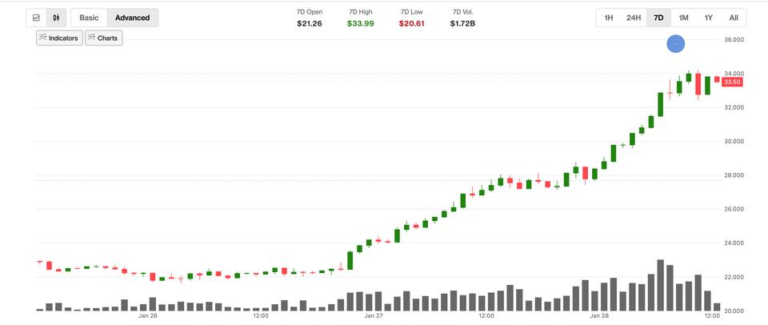
The HYPE token has surged over 30% to $33 this week, leaving bitcoin , ether and other major tokens far behind. Bitcoin has risen just 1.84%, while the CoinDesk 20 Index, a broader market gauge, has gained over 4%, according to CoinDesk data.

“This is a story of the convergence of all asset classes under the megatrend of tokenization in an increasingly financialized world – more and more of which is happening on Hyperliquid,” Hyunsu said, explaining the HYPE rally.

While Hyperliquid started as a decentralized exchange for trading perpetual futures tied to cryptocurrencies, it has since expanded its product suite to include trading in equity indices, stocks, commodities, and major fiat currency pairs.

This shift stems from the Hyperliquid Improvement Proposal-3 (HIP-3), launched in October 2025, which allows anyone staking 500,000 HYPE tokens to freely create markets for non-crypto assets.

The timing couldn’t have been better, as traditional assets, especially gold and silver, have gone bonkers since late 2025, driving huge trading volumes and fees in Hyperliquid’s markets for those assets. The silver-USDC market has registered a trading volume of over $1 billion in the past 24 hours alone. The numbers look even more impressive on a broader scale.

“Within just 3 months of this upgrade, Hyperliquid’s HIP-3 markets have captured over $1B in Open Interest, ~$25B in total trading volume and over $3M in total fees, all transparently on-chain,” Hyunsu noted. “Users globally are now able to access and trade equities (for example those in countries that could not access US equities) or get exposure to the incredible metals trade over the last few months.”

The boom in fees translates into higher prices for HYPE via a token-burning mechanism. Hyperliquid burns HYPE based on protocol fees through an automated mechanism, with up to 97% of fee revenue used to buy back HYPE and remove coins from circulation.

“It’s a deflationary mechanism not found in any other blockchain ecosystem, and an incredible structural tailwind for our treasury,” Hyunsu said.

He explained that the nonstop 24/7 availability of traditional markets on Hyperliquid allows traders to react to global events, helping to achieve fairer spot prices outside regular hours and even on weekends when traditional markets are closed.

UK Bans Coinbase Ads For Trivializing Crypto Risks: Report

0

The UK’s advertising watchdog has reportedly banned a series of Coinbase advertisements claiming they presented the crypto exchange as a solution to cost-of-living concerns while making light of the risks of investing in crypto.

The UK Advertising Standards Authority said the ads — which included a satirical musical-style video and three posters — were “irresponsible” and “trivialized the risks of cryptocurrency,” The Guardian reported on Wednesday.

“We considered that using humour to reference serious financial concerns, alongside a cue to ‘change,’ risked presenting complex, high-risk financial products as an easy or obvious response to those concerns,” the ASA said.

Coinbase released the video advertisement in July, but Clearcast, which approves ads for TV, rejected it, saying it showed crypto as a “potential solution to economic challenges, without sufficient evidence for this claim,” The Telegraph reported in August. 

A screenshot from Coinbase’s musically-charged ad depicts the UK as littered with rats and trash. Source: YouTube

Even with the TV ban, the ASA said the video was shown online, while the three posters had been put up in “high-traffic areas such as the London Underground and rail stations.”

The posters included text that read “home ownership out of reach,” “eggs now out of budget,” and “real wages stuck in 2008,” and all included the slogan “If everything’s fine, don’t change anything” next to Coinbase’s logo.

The ASA said none of the advertisements contained information about the risks of crypto. The Financial Conduct Authority has said that crypto ads must be “labeled with prominent risk warnings.”

Coinbase CEO defended ad after TV ban

Coinbase CEO Brian Armstrong defended the TV ad in August, arguing the TV ban meant “there must be a kernel of truth in it.”

“Needing to update the system and improve society is not a political statement on either party in the UK,” he said. “It’s a statement about how the traditional financial system is not working for many people and how crypto represents a way to improve that.”

“We welcome the attacks and any other attempts to censor this message, as it just helps it spread,” Armstrong added.

Related: UK dodges ‘US malaise’ as regulator finalizes crypto rules

The two-minute ad depicts people singing “everything is just fine, everything is grand” as their home crumbles around them, interspersed with scenes of a dilapidated street overflowing with trash bags and rats, and dancing cleaners.