

New research shows stablecoin issuers, led by Tether, generated the majority of crypto protocol revenue in 2025, highlighting a shift away from trading-driven income toward payment and settlement infrastructure. Stablecoins Overtake Trading as Crypto’s Top Revenue Engine Stablecoin issuers emerged as the clear revenue leaders in crypto last year, according to new research from Coingecko. […]
XRP Price Pattern Draws Unusual Comparisons To Silver: Analyst

Trusted Editorial content, reviewed by leading industry experts and seasoned editors. Ad Disclosure
Traders have been looking at a chart that lines up XRP’s major moves with decades of silver data. The match is not perfect. It is, however, striking enough to get people talking about what might happen next. Some see it as a warning. Others see a possible roadmap for big gains.
Silver And XRP In Parallel
According to chart comparisons shared by market watchers, silver’s long swings since 1980 echo many of XRP’s moves since 2016.
Silver climbed to about $48 in early 1980, crashed to roughly $3.4 by the early 1990s, then drifted for years before a run toward $50 in 2011.
XRP, on a far faster clock, pushed to highs above $3 in 2018, fell sharply into 2020, recovered, then found a new peak in late 2024.
The shapes on the charts — rises, deep drops, long quiet stretches — look similar. That resemblance is what’s being discussed.
The time guide we follow, the White Rabbit, is the event itself, which will point out the treasure!
A nova flash, getting closer. pic.twitter.com/eAqAfZXEo7
— Dark Defender (@DefendDark) January 26, 2026
What The Numbers Show
Reports say silver has jumped roughly 278% since 2025, sitting near $109 per ounce in recent sessions. Gold has also moved, trading above $5,000 per ounce as investors seek safety.
Those metal moves have pulled attention back to assets that follow big macro flows. XRP, currently trading around $1.90, is much smaller and far more volatile than either metal, so any similar move could be much larger in percentage terms, but it would likely be sharper and riskier too.
History Moves At Different Speeds
Silver’s shifts played out over many years. XRP’s similar pattern appears compressed into a few market cycles. That is important. Time matters in markets because long pauses can build a stronger base, and quick cycles can spark fast moves that reverse just as fast.
Reports have disclosed that some traders believe crypto cycles keep pace with liquidity and headlines; metals react more to reserve flows and long-term real rates. Both effects can push prices hard, but they do so at different paces.
Risk And Reward In Plain Sight
If XRP keeps following this pattern, a large upswing could follow a breakout. At the same time, the pattern is no guarantee. Price moves have many causes. Legal shifts, big fund flows, and macro shocks can all change the path.
XRP has shown it can fall far and recover in dramatic ways. That playbook brings opportunities but also steep pain for those who buy late or hold through violent swings.
Where Traders Might Look Next
According to some analysts, key levels from past cycles will matter. Support near recent lows could act as a floor; fresh inflows into crypto or a rotation out of metals might be the trigger for a large move. Volume, broader market risk appetite, and where big holders place their bets will all be watched closely.
Featured image from CoinFlip, chart from TradingView

Editorial Process for bitcoinist is centered on delivering thoroughly researched, accurate, and unbiased content. We uphold strict sourcing standards, and each page undergoes diligent review by our team of top technology experts and seasoned editors. This process ensures the integrity, relevance, and value of our content for our readers.
Four risks from stablecoins that drain $1.5tn from banks, says Standard Chartered – DL News

- More than $1.5 trillion could flee the traditional banking system.
- US regional banks are the most vulnerable to this capital flight.
- Skirmishes between banks and stablecoin providers have been ongoing as regulation stalls in the US.
Stablecoins are coming for bank deposits — and traditional lenders aren’t happy about it.
Stablecoins settle instantly, work around the clock, and increasingly offer better returns than traditional savings accounts.
It’s that last point that poses the most risk for banks that rely on customer deposits.
Now, UK-based Standard Chartered has quantified the damage.
Analysts expect roughly $500 billion to leave developed-market banks in the US by the end of 2028, with another $1 trillion to flee emerging-market banks.
That assessment from Geoffrey Kendrick, Standard Chartered’s global head of digital assets research, comes just as the Clarity Act stalls over whether stablecoins should pay yield directly to holders.
As of writing, the draft bill bans digital asset service providers from paying interest to stablecoin holders — a provision that has pitted major banks against Coinbase and other crypto companies, delaying the legislation’s approval.
Here are the four risks outlined by Standard Chartered for US banks.
Difference between loans and deposits
For Kendrick, the clearest measure of risk from stablecoins to banks’ business models comes from the difference between what banks earn on loans and what they pay on deposits.
It’s called the net interest margin income, or NIM.
Banks may pay customers, say, 2% on their deposits, then lend out that money at 5%. The 3% spread is the bank’s profit.
If those deposits leave for stablecoins, that profit disappears, Kendrick said.
Regional US banks are the most vulnerable to this capital flight, with NIM representing up to 80% of total revenue for some institutions.
Investment banks like Goldman Sachs and Morgan Stanley, on the other hand, are less exposed, with NIM comprising less than 30% of their revenue.
Limited redepositing cushion
If stablecoin issuers held their reserves in bank deposits, the outflow would be cushioned.
But they don’t, Kendrick argued.
“The two dominant stablecoin issuers — Tether and Circle — hold just 0.02% and 14.5% of their reserves in bank deposits, respectively, so very little re-depositing is happening,” Kendrick said.
Instead, both issuers hold their reserves in US Treasury bills and money market funds.
That means that if users convert $100 to stablecoins, nearly all of that money leaves the traditional banking system entirely, typically flowing into US Treasury bills and money market funds.
Geographic concentration
Roughly one-third of all stablecoin demand comes from developed markets, with the broad majority originating in emerging economies.
And since more than 95% of stablecoins are denominated in US dollars, US banks would bear the brunt of any deposit flight.
Although Australian banks show levels of vulnerability to deposit flight similar to those of US regional banks, the risks to non-US banks remain pretty limited for now, according to Kendrick
Retail versus wholesale
Kendrick explained another problem.
Banks pay lower interest rates on regular customers’ savings accounts because those deposits are insured by the Federal Deposit Insurance Corporation, or FDIC.
But if those customers move their money into stablecoins, banks will have to replace that funding by borrowing from other sources — such as institutional investors — that charge much higher rates.
Even if a bank’s total deposits stay the same, its costs go up.
“Stablecoins are the first big blockchain-based disrupter of financial markets”, concluded Kendrick.
Pedro Solimano is a markets correspondent based in Buenos Aires. Got a tip? Email him at psolimano@dlnews.com.
Dogecoin turns lower after failing to hold $0.124
Dogecoin edged higher over 24 hours but failed to build momentum, with late-session selling flipping short-term structure heavier and keeping price locked in consolidation.
News Background
Dogecoin traded largely as a proxy for broader crypto sentiment, with no token-specific catalyst driving price action. The session was defined by consolidation rather than conviction, as traders hesitated to commit ahead of clearer directional signals from the wider market.
That balance shifted late in the session, when sellers briefly took control and pushed DOGE back below a key intraday level. The move reinforced the view that, for now, rallies are being treated as opportunities to reduce exposure rather than establish fresh longs.
Price Action Summary
DOGE rose about 0.6% over the 24-hour window, climbing from $0.1228 to $0.1246, but the advance remained confined to a tight ~3% range. Early in the session, a sharp volume burst drove a brief push above $0.1230, allowing price to probe higher levels.
That strength failed to carry through. Trading activity thinned as DOGE drifted sideways near the top of the range, before the final hour turned softer. A late pullback dragged price back toward the lower end of the range, signaling fading upside momentum.
Technical Analysis
The technical picture reflects range-bound conditions with growing downside pressure. DOGE briefly broke higher on elevated volume, but follow-through buying was limited, and price rotated back into consolidation shortly afterward.
In the most recent hour, DOGE broke below $0.1243, a level that had previously acted as short-term support. Sellers defended that area on the bounce, flipping it into near-term resistance and establishing a softer short-term bias despite the broader 24-hour range holding intact.
This leaves structure mixed: higher timeframes still show consolidation, while intraday charts suggest sellers are becoming more active on rallies.
Key levels to watch:
- Support: $0.1222 initially, followed by the psychological $0.12 level
- Resistance: $0.1243 first, then $0.1255, the prior intraday high
What traders say is next?
As long as $0.1222 holds, traders expect DOGE to remain range-bound, with choppy price action and limited follow-through in either direction. A reclaim of $0.1243 would help neutralize the short-term breakdown, opening the door for a retest of $0.1255.
If $0.1222 fails, downside risk increases quickly toward $0.12. A decisive break below that level would likely signal that consolidation is resolving lower, exposing DOGE to a deeper corrective move.
For now, traders see DOGE stuck in a wait-and-see phase, with volume behavior likely to determine whether the next move is a breakdown or another range rotation.
Bespoke Merchandise Launches 24 Hour Express Catalog, Empowering Marketing Managers with Instant Promotional Products.

This innovative service is designed to provide branded promotional products in 24 Hours and will provide marketing managers with instant solutions for promotions.
Melbourne, Australia — Bespoke Merchandise, a leader in promotional products and conference merchandise industry, is proud to announce the launch of its new service, the 24 hour and 3 Day service catalogue. This service offers marketing managers a cutting-edge solution for any last minute needs for a promotion, helping them get branded promotional products in as soon as 24 hours.
With the new Express Catalog, Bespoke Merchandise continues their commitment to innovation by offering a fast ready-to-function branded promotional products that empowers businesses and individuals to meet any marketing needs and deadlines. Whether they are in need of drinkware, stationery, tech, apparel, homeware, or other miscellaneous promotional products, the Express Catalogue is capable of providing a 24 Hour or a 3 Day Service.
“We are thrilled to introduce our new Exclusive 24 Hour / 3 Day Express Catalogue, which reflects our dedication to addressing the evolving needs of our clients. This service is tailored to provide Marketing Managers with instant products, ensuring that they stay ahead in plans and deadlines. Whether you are looking for promotional tote bags or promotional bamboo pens or promotional travel mugs, our express 24 hour service will get you the branded promotional products that you need” said spokesperson Jake from Bespoke Merchandise.
The new service includes 100’s of promotional products, allowing users to choose items that suite their branding needs. With this fast turn around time, their express catalogue is in line with the demands of the promotional products market in Australia.
About Bespoke Merchandise
“We’re more than just a supplier — we’re your personalised promo merch concierge. We help businesses across Australia bring their brand to life with high-quality custom merchandise that makes a lasting impression. Whether you’re preparing for a conference, trade show, corporate event, or promotional campaign, we work with you to select, customise and deliver the perfect branded products to meet your goals” says Jake from Bespoke Merchandise.
From eco-friendly giveaways and practical everyday essentials to tech gear and premium branded items, their curated range is designed to boost visibility, engagement and brand recall long after the event ends. With expert guidance on custom printing, embroidery and finishing options, they take the guesswork out of promo products — so their client can focus on what matters most: connecting with the audience.
They pride on reliable service, competitive pricing and attention to detail at every stage of the process. No matter the size of the business or order, their team is committed to delivering promotional merchandise that reflects the customer’s brand values and leaves a memorable impression.
At Bespoke Merchandise, it’s not just about great products — their concierge service is designed to help the customer tell their story through thoughtful, memorable branded promotional products.
For more information about Bespoke Merchandise and the launch of the 24 Hour Express Catalogue, visit https://bespokemerchandise.com.au/.
A Press Release from Web2D, for more information click here. https://web2d.com.au/
Contact Information:
Business: Bespoke Merchandise
Contact Name: Jake Smith
Email: jake@bespokmerchandise.com.au
Website: https://bespokemerchandise.com.au/
Country: Australia
Standard Chartered Predicts Stablecoins Could Drain $500B From US Bank Deposits

Trusted Editorial content, reviewed by leading industry experts and seasoned editors. Ad Disclosure
Stablecoins could pose a significant challenge to the US banking system over the next several years, with as much as $500 billion in deposits potentially moving out of traditional banks by the end of 2028, according to a new analysis from Standard Chartered.
Stablecoins Could Pressure Bank Earnings And Deposits
The forecast, reported by Reuters and published Tuesday, suggests that regional US banks are likely to be the most vulnerable to deposit losses driven by the growing adoption of dollar‑pegged digital tokens.
Geoff Kendrick, Standard Chartered’s global head of digital assets research, said smaller and mid‑sized lenders face greater exposure as stablecoins increasingly take on roles traditionally handled by banks, including payments and other core financial services.
Standard Chartered’s analysis focused on banks’ net interest margin income — the spread between what lenders earn from loans and what they pay out to depositors.
As deposits leave the banking system, that income stream could come under pressure, particularly for institutions that rely heavily on consumer and commercial deposits as a funding source.
Kendrick warned that US banks face mounting risks as payment networks and fundamental banking activities gradually migrate toward stablecoin‑based systems.
Banks And Crypto Firms Clash
While the country’s stablecoin bill, the GENIUS Act, presently prohibits issuers from paying interest on the tokens, banks are concerned that it would allow third parties, including cryptocurrency exchanges, to offer returns on stablecoin holdings.
Over the past few months, banking industry groups have argued that this “stablecoin loophole” could intensify competition for deposits, potentially triggering large-scale outflows from banks and raising broader financial stability risks. They have called for changes to the bill regarding this matter.
Crypto companies have pushed back against those claims, arguing that prohibiting interest payments tied to stablecoins would limit competition and innovation in the financial sector, thereby delaying the anticipated markup of another key piece of legislation for the crypto market.
Earlier this month, a Senate Banking Committee hearing to debate and vote on the anticipated crypto market structure legislation was postponed, in part because lawmakers could not agree on how to address banks’ concerns over deposit flight.
Kendrick noted that the ultimate scale of deposit losses will depend in part on how stablecoin issuers manage their reserves. If issuers hold a substantial portion of their backing assets within the US banking system, the impact on deposits could be less severe.
The two biggest stablecoin issuers in the crypto market, Tether (USDT) and Circle (USDC), hold most of their reserves in US Treasuries rather than bank deposits, meaning little of the funds are recycled back into the banking system.
Featured image from OpenArt, chart from TradingView.com
Editorial Process for bitcoinist is centered on delivering thoroughly researched, accurate, and unbiased content. We uphold strict sourcing standards, and each page undergoes diligent review by our team of top technology experts and seasoned editors. This process ensures the integrity, relevance, and value of our content for our readers.
Bitmine stakes additional 113,280 ETH, totaling $7B in staked assets: On-chain data

Bitmine, the Ethereum treasury company chaired by Fundstrat’s Tom Lee, staked an additional 113,280 ETH worth about $341 million today, according to data from Arkham Intelligence.
Tom Lee(@fundstrat)’s #Bitmine staked another 113,280 $ETH($340.68M) an hour ago.
In total, #Bitmine has now staked 2,332,051 $ETH($7B), 55% of its total holdings.https://t.co/P684j5YQaG pic.twitter.com/Q4VDKaxmFp
— Lookonchain (@lookonchain) January 28, 2026
The transaction brings Bitmine’s total staked Ethereum to 2.3 million ETH, valued at approximately $7 billion, representing 55% of the company’s holdings.
Bitmine holds 4.2 million ETH in total, roughly 3.5% of the entire ETH supply, with a portfolio valuation of $12.8 billion that includes 193 BTC and $682 million in cash.
The Atlanta-based company ranks as the world’s largest Ethereum treasury holder and the second-largest crypto treasury overall behind Strategy.
Bitmine, founded in 1995, pivoted from Bitcoin mining hardware to Ethereum-focused treasury management after Lee became chairman in late 2025. The company counts ARK, Pantera, and Kraken among its investors.
Bitmine plans to launch MAVAN, a US-based validator network, in Q1 2026, with projected annual staking revenues of $374 million.
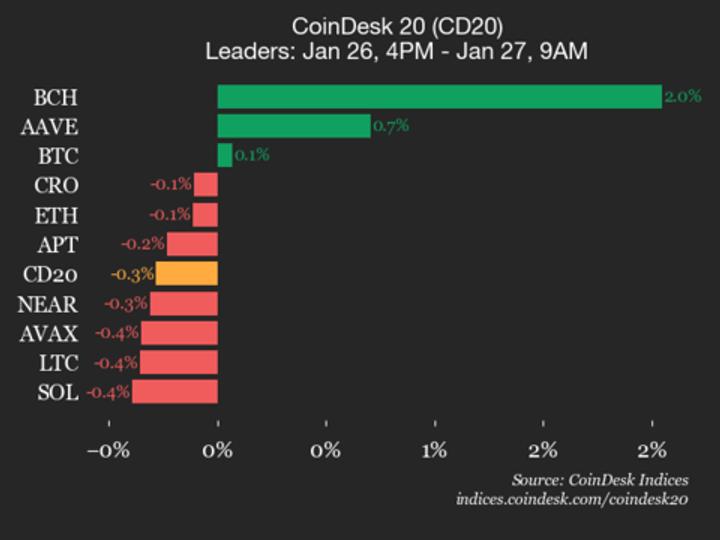
Bitcoin Cash (BCH) Gains 2% While Index Declines
Pudgy Penguins is emerging as one of the strongest NFT-native brands of this cycle, shifting from speculative “digital luxury goods” into a multi-vertical consumer IP platform. Its strategy is to acquire users through mainstream channels first; toys, retail partnerships and viral media, then onboard them into Web3 through games, NFTs and the PENGU token.
The ecosystem now spans phygital products (> $13M retail sales and >1M units sold), games and experiences (Pudgy Party surpassed 500k downloads in two weeks), and a widely distributed token (airdropped to 6M+ wallets). While the market is currently pricing Pudgy at a premium relative to traditional IP peers, sustained success depends on execution across retail expansion, gaming adoption and deeper token utility.
Trouble for Circle as Tether launches ‘Made in America’ stablecoin – DL News

- Tether’s USAT is now available to US users through major exchanges.
- The stablecoin is issued by Anchorage Digital Bank under the GENIUS Act framework.
- It enters a hot market: Circle’s CEO estimated stablecoin adoption could grow 40% annually.
Tether is finally coming to America.
On Tuesday, the world’s largest stablecoin issuer launched USAT, marking its official entry into the US market after years locked out by regulatory uncertainty.
USAT is a federally regulated, dollar-backed stablecoin designed to operate under the Genius Act.
“USAT is now available to US users seeking a dollar-backed token built to operate within the US’ dedicated federal regime,” Tether said in a statement.
The move takes a direct shot at Circle, which has largely dominated the US stablecoin market. And while Tether’s flagship USDT stablecoin commands a $186 billion market cap globally — dwarfing Circle’s $71 billion USDC — it wasn’t available to US customers.
USAT changes that.
The launch follows Congress passing the Genius Act last summer, which established a federal framework for stablecoins.
Adoption for stablecoins by traditional institutions is also coming. At the World Economic Forum last week in Davos, Switzerland, Circle CEO Jeremy Allaire said that stablecoin adoption could see 40% annual growth, while US Treasury Secretary Scott Bessent has predicted the sector will grow tenfold by 2030.
White House connections
Bo Hines is USAT’s CEO.
The 29-year-old former Republican congressional candidate previously ran the White House’s crypto council with crypto czar David Sacks before joining Tether last September.
Hines played a key role in several of the landmark crypto initiatives pursued by President Donald Trump’s second administration, including the Genius Act.
During discussions around the Genius Act, Hines’s became more familiar with Tether.
“One name kept coming up, and that was Tether,” Hines said last September, recalling his conversations with Sacks. “And we said to ourselves: ‘How can we be the crypto capital of the planet without having the most impactful company in the space operating here in the United States?”
Some of Trump’s top aides already had deep ties to the stablecoin company.
Cantor Fitzgerald, which manages USAT’s reserves, was until recently led by Howard Lutnick — Trump’s pick for Commerce Secretary.
Lutnick, who has an estimated net worth of $3.3 billion, defended Tether during his Senate confirmation hearing in January of 2025, comparing criticism of USDT’s use in money laundering to “blaming Apple because criminals use Apple phones.”
Meanwhile, Cantor holds a 5% stake in Tether and manages billions in US Treasuries backing the company’s reserves. The financial giant is one of 24 primary dealers authorized to trade government bonds directly with the Federal Reserve.
Besting banks
Tether is a giant.
The company is the 17th-largest holder of US Treasuries globally — ahead of Germany, South Korea, and Australia. The company made more than $13 billion in profits in 2024 from interest on those holdings.
But even though it is one of the most profitable companies in the world, Tether has had to deal with heavy scrutiny over USDT’s role in illicit finance.
In 2024, the UN Office on Drugs and Crime reported that $17 billion in USDT was connected to underground crypto exchanges and criminal activity. The company has frozen about 1,800 cryptocurrency wallets linked to illicit activities since 2014.
Tether has spent over a year emphasising its commitment to compliance as it prepared for US entry.
Pedro Solimano is a markets correspondent based in Buenos Aires. Got a tip? Email him at psolimano@dlnews.com.
5 Projects With the Math to Deliver Exponential Returns

Finding a 100x return has become increasingly difficult as crypto markets mature. Bitcoin is struggling near $87,400. Ethereum has dropped 7% to around $2,860. Most altcoins that delivered exponential gains in previous cycles now carry heavy resistance levels and exhausted holder bases waiting to exit.
Yet presale markets continue offering entry before public listings and price history. For investors hunting the next 100x crypto presale, the question is which projects have the structure and positioning to deliver exponential returns rather than modest multiples.
This list examines five presales currently active, ranked by their potential to become the next 100x crypto presale based on entry pricing, market positioning, and realistic post-listing scenarios.
1. Zero Knowledge Proof (ZKP)
When analyzing candidates for the next 100x crypto presale, Zero Knowledge Proof presents the clearest mathematical case.
The project’s Initial Coin Auction started with an effective price near $0.001 during Stage 1. Stage 2 is now live with daily supply reduced to 190 million tokens. As stages progress, supply tightens mechanically while demand has room to grow. Analysts modeling the auction project effective pricing could reach $0.05 to $0.10 by later stages based on participation trends alone.
Post-listing is where the 100x math materializes. Comparable privacy-focused Layer 1 infrastructure has historically traded between $0.50 and $2.00 once adoption curves steepen. If ZKP reaches $0.50 from a Stage 2 entry near $0.001, that represents a 500x return. Even conservative projections targeting $0.10 suggest 100x upside from current levels.
What makes ZKP a credible candidate for the next 100x crypto presale is execution. Over $100 million was self-funded into infrastructure before public participation. The system is built, not promised.
2. Sonami (SNMI)
Sonami presents interesting math at the lower end of presale pricing. Tokens are currently available at $0.001, and traders are discussing potential listing prices between $0.005 and $0.01 based on comparable Solana ecosystem projects. That represents 5-10x from current levels — not 100x, but meaningful for a project still in early stages.
The Solana Layer 2 focus addresses real congestion issues that have plagued the network during high-activity periods. By processing transactions off-chain and settling back on Solana, the project aims to maintain speed while reducing fees.
The presale remains in early stages, which means higher risk but also wider potential if the team executes on its roadmap. For the next 100x crypto presale, Sonami represents a longer-shot candidate worth monitoring.
3. Remittix (RTX)
Remittix offers more modest but achievable projections. The presale has raised $28.5 million at $0.119 per token. Analyst projections suggest a listing price around $0.28, representing roughly 2.4x from current levels. That is not 100x territory, but the cross-border payments market is large enough that significant post-listing growth remains possible.

The project allows crypto-to-fiat conversion across 30+ countries with low fees and near real-time exchange rates. Smart contracts have passed audit and appeared on CertiK’s pre-launch leaderboard. For investors seeking the next 100x crypto presale, Remittix is better categorized as a lower-risk, moderate-return option rather than an exponential play.
4. Bitcoin Hyper (HYPER)
Bitcoin Hyper has raised over $24 million with dynamic pricing that increases through presale stages. The current structure creates a gap between early entry prices and potential listing values, though exact multiples depend heavily on market conditions at launch.
The Bitcoin Layer 2 narrative has attracted significant capital this cycle. Whale purchases exceeding $274,000 suggest confidence from larger investors. The project offers 49% staking APY currently, which decreases as participation grows. Whether Bitcoin Hyper becomes the next 100x crypto presale depends on execution and timing, but the capital raised indicates meaningful institutional interest.
5. NexChain (NEX)
NexChain positions itself as an AI-optimized Layer 1 with $12 million raised. The “AI x Crypto” narrative is one of the dominant themes this cycle, and infrastructure plays in that sector have historically delivered strong multiples when adoption materializes.

The project has completed audits and launched a testnet. Tokens support network fees, governance, and AI marketplace access. Mainnet is planned for early 2026. The next 100x crypto presale may come from AI infrastructure if the sector continues expanding, making NexChain a speculative but relevant candidate.
What the Next 100x Crypto Presale Actually Requires
Exponential returns require specific conditions: early entry before price discovery, exposure to structural demand trends, clean charts without historical resistance, and execution that matches ambition.
The next 100x crypto presale will likely come from a project targeting a market larger than crypto alone, distributing fairly enough that early participants are not diluted, and building infrastructure before selling tokens.
Not every presale can become the next 100x crypto presale. Most will deliver modest returns or fail entirely. The difference lies in identifying projects where entry pricing, market positioning, and execution capability align.
