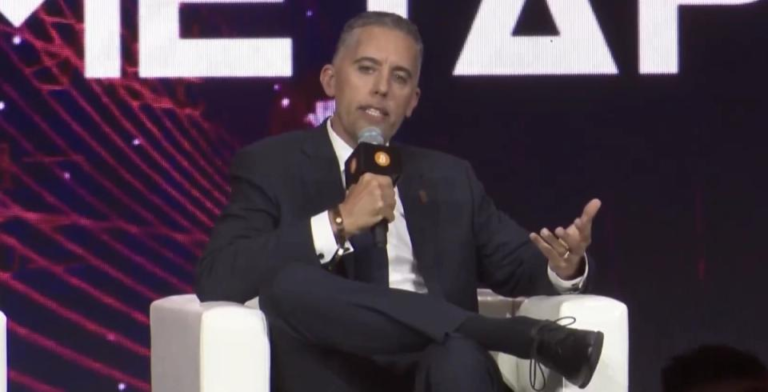
Bitcoin treasury company Strive (ASST) now has less debt and more bitcoin on its books after raising $225 million via an offering of its SATA preferred stock.
With more than $600 million in orders, according to a press release, the offering was upsized from an initially targeted $150 million.
The proceeds and exchanges enabled Strive to rapidly reduce leverage following its acquisition of Semler Scientific (SMLR). The company retired $110 million of the $120 million of legacy Semler debt, including $90 million of convertible notes exchanged into SATA Stock and the full repayment of a $20 million Coinbase Credit loan.
As a result, 100% of Strive’s bitcoin holdings are now unencumbered, with plans to retire the remaining $10 million of debt by April 2026, ahead of its original 12 month timeline.
Strive also used some of the funds to acquire an additional 333.89 bitcoin at an average price of $89,851, bringing total holdings to 13,131 BTC and making it the tenth largest public corporate holder globally. Those holdings are worth more than $1.1 billion at bitcoin’s current price of $89,100.
ASST shares remain under pressure, down 1.5% early Wednesday to $0.81.
Lloyds Banking Group has launched an ambitious initiative to upskill its entire workforce in artificial intelligence, targeting 100 per cent AI literacy by the end of 2026.
To achieve this, the group is launching the AI Academy, a comprehensive training programme open to all 67,000 employees, regardless of their role or technical expertise.
A practical approach to upskilling
Ron van Kemenade, group chief operating officer at Lloyds Banking Group
The initiative acknowledges the rapidly shifting skills landscape, with the World Economic Forum predicting that nearly 60 per cent of the global workforce will need to reskill by 2030.
Lloyds’ new academy aims to get ahead of this curve by offering bespoke learning paths tailored to how different employees interact with the technology. Roles have been categorised into distinct segments: AI Users, AI Leaders, AI Builders, and AI Enablers.
The programme kicks off immediately, with all colleagues required to complete a module on “Working with AI Responsibly”. This initial step focuses on ensuring safe and ethical usage aligned with Group standards before moving on to more advanced, role-specific training.
Ron van Kemenade, group chief operating officer at Lloyds Banking Group, emphasised that the goal is practical application rather than theoretical knowledge: “Scaling AI is about getting real use cases into production so we can simplify processes for colleagues and deliver more personalised services for customers. By investing in the skills of our people, we can do this responsibly and at pace, improving service today and building the foundations to scale new innovations in the future”.
Delivering tangible benefits
The curriculum will feature bite-sized content, interactive modules, articles, and podcasts available through the Group’s internal learning platform. By equipping staff with these tools, Lloyds hopes to save operational time, enhance customer service, and potentially open new revenue streams.
Sharon Doherty, chief people and place officer at Lloyds Banking Group, added: “Upskilling our colleagues is central to how we transform. The AI Academy gives every colleague practical, hands-on tools to use AI responsibly in their day-to-day work. By investing in our people, we’re strengthening the skills that matter most, so our teams can deliver for customers with confidence in a workplace already supported by AI”.
The Bitcoin price surged early Wednesday, reclaiming the $90,000 level as traders digested fresh macro signals and growing momentum around U.S. crypto regulation.
The move followed a sharp reversal from weekend lows near $86,000, with the bitcoin price climbing to highs of $90,361 into the day, according to Bitcoin Magazine Pro data.
All this is happening as the market braced for the Federal Reserve’s first rate decision of the year later today, with futures pricing in an almost certain hold on rates Wednesday.
With unemployment at 4.4%, traders are focused less on inflation and more on whether Chair Jerome Powell signals concern about labor market softness.
If Powell leans into job market resilience and pushes back against near-term rate cuts, a “neutral” Fed meeting could quickly turn bearish for crypto.
Gold continues to surge to new all-time high above $5,300 per ounce, underscoring renewed demand for hard assets amid rising currency uncertainty. Bitcoin appeared to benefit from the same macro tailwinds, reversing earlier caution that had dominated trading after last weekend’s dip.
A late-day bitcoin price rally unfolded yesterday as President Donald Trump, speaking in Iowa, dismissed concerns over the weakening U.S. dollar, saying he was “not concerned” about its decline and insisting the dollar was “doing great.”
Bitcoin price: Senate committee expected to vote on crypto market structure bill tomorrow
This price rally comes at a pivotal moment for U.S. crypto policy. On Thursday, the Senate Agriculture Committee is scheduled to vote on a crypto market structure bill that would clarify regulatory jurisdiction over digital asset markets.
The markup is expected to include several amendments, with lawmakers ultimately deciding whether to advance the bill to the Senate floor, according to Crypto in America.
While Democratic support for the legislation remains uncertain, the absence of unrelated amendments widely viewed as deal-breakers has boosted expectations that the bill could move forward.
For market participants, progress on the legislation represents a potential step toward long-sought regulatory clarity in the United States.
Bitcoin’s price action reflects that shifting backdrop. After struggling for much of the past 24 hours to reclaim the $88,000 level amid ETF outflows, Federal Reserve uncertainty, and lingering bearish technical pressure, buyers reasserted control into the close.
At the time of publication, the bitcoin price was trading at $90,075, up roughly 2% over the past 24 hours, with daily trading volume around $43 billion. The asset’s circulating supply stands at 19.98 million BTC, out of a fixed 21 million maximum.
The European Union’s new cryptocurrency tax reporting framework is built around what governments can immediately enforce, leaving decentralized finance (DeFi) outside its scope for now.
A former Organization for Economic Co-operation and Development (OECD) official who worked on the Crypto Asset Reporting Framework (CARF) said that this gap is a deliberate focus and not a blind spot.
“It doesn’t make sense to go to your grandma and ask her to give you all the tax reporting on crypto just because you happened to work with her over a certain period,” Colby Mangels, Taxbit’s global head of government solutions and a former OECD adviser, told Cointelegraph. “You really have to go to the intermediaries that are doing this as a business.”
Implemented in the EU under the eighth revision of the Directive on Administrative Cooperation (DAC8), the rules require crypto exchanges and custodians to begin collecting user activity data in 2026. While centralized platforms prepare for new reporting obligations, DeFi is still largely untouched, creating an uneven compliance landscape in the crypto industry.
As of Dec. 4, 48 jurisdictions have committed to implementing CARF and conducting their first data exchanges by 2027, and a total of 76 will do so by 2029. Source: OECD
How global crypto tax reporting is being rebuilt
Crypto tax reporting rules are frequently discussed through a tangle of related acronyms, but they are not interchangeable.
The Common Reporting Standard (CRS) is the OECD’s framework for the automatic exchange of information between tax authorities, implemented in the EU through DAC2. The CRS does not cover most crypto activity, a gap that is being filled by the CARF.
The CARF is the OECD’s crypto tax reporting standard. It sets out who reports, what information is collected and how that data is exchanged between tax authorities. Those committed to data exchanges have started rolling out domestic frameworks such as the EU’s DAC8.
DAC8 is the EU’s first harmonized tax transparency framework that extends cross-border reporting obligations to crypto services. It’s based on the CARF, and member states had a Dec. 31 deadline to adopt the directive into national law. DAC8 essentially aligns EU countries with the CARF, but members can still commit to different timelines at the OECD level.
The EU’s move aligns with the global adoption of the CARF, as dozens of jurisdictions prepare to introduce tax information exchange regimes. Mangels recalled a more analog world around 30 years ago. If a client wanted to open a bank account in another jurisdiction, they had to take a suitcase of money, travel and talk to the bank at a physical location.
The crypto community is confronting the reality that mainstream adoption brings tighter tax scrutiny for assets once ignored. Source: Nic Puckrin/Maria Riivari
“That’s a lot of steps to take; so, only people who were really motivated or had the resources would actually do that. That’s what we saw in traditional tax evasion cases,” Mangels said.
With crypto, investors can theoretically sit in their living rooms, access an exchange on the other side of the world and start trading.
“If I never tell my tax authority where I’m situated — for example, in France — and I never tell them about the money I made trading crypto on an exchange in Singapore, they won’t know. They’ll have no idea,” Mangels added.
Under DAC8, crypto exchanges and custodial platforms will be required to collect standardized user information tied to tax residence and report aggregated transaction data to national tax authorities. That information is then exchanged across borders.
Related: UK dodges ‘US malaise’ as regulator finalizes crypto rules
DeFi is out of scope, but AML trends could change that
DAC8 and CARF are tax reporting frameworks, but they intersect with Anti-Money Laundering (AML) challenges caused by limited cross-border visibility in crypto markets.
The OECD develops international standards on tax and economic policy, while the Financial Action Task Force (FATF) is a separate body that sets the bar for AML and counter-terrorism financing, both of which now extend to crypto markets. Tax authorities frequently look to AML frameworks for definitions that inform how reporting regimes are designed.
“An interesting fact to know is that the FATF sits in the same offices as the OECD, so you can literally go down the hall or have a coffee with folks there,” said Mangels, highlighting the close working relationship between the two bodies.
That relationship helps explain why DeFi remains outside the scope of current tax reporting rules. At the current state, reporting obligations are assigned to identifiable intermediaries that facilitate transactions as a business. In much of DeFi, there is no centralized operator and no custodial relationship.
Related: Could Europe sell US debt if a Greenland deal doesn’t come through?
A June 2025 FATF report found regulators are still struggling to identify who actually controls or influences decentralized finance platforms.
The FATF found that 47 of 99 jurisdictions with more advanced rules for crypto platforms require certain DeFi platforms to register as virtual asset service providers (VASPs), the same category that covers exchanges. But even among those jurisdictions, only 12 have identified at least one unregistered DeFi platform that meets the criteria of a VASP.
Just four of the 47 jurisdictions reported that they have registered or licensed DeFi entities as VASPs. Source: FATF
Tax authorities monitoring jurisdiction shoppers
As DAC8 takes effect across the bloc in 2026, legislators are standardizing what can be gathered from identifiable crypto businesses at scale. That means the first compliance shock lands on centralized exchanges and custodians.
Tax authorities are closely watching AML developments, where efforts to classify VASPs and accountability models could eventually lead to broader reporting obligations for crypto.
The FATF is an independent intergovernmental body housed at the OECD headquarters in Paris, France. Source: OECD
Mangels said that the OECD is also focused on preventing regulatory arbitrage. Policymakers are actively monitoring whether crypto services attempt to relocate to jurisdictions that haven’t yet committed to the CARF.
“A big part of my work at the OECD was tracking where crypto service providers were actually relocating. As new crypto centers are developed or come online, they will also be expected to comply with the OECD standards,” Mangels said.
While the OECD cannot directly enforce compliance, jurisdictions that remain outside its standards tend to face reputational and financial pressure, often compounded by FATF scrutiny.
As more economies align their tax and AML rules around shared definitions and reporting standards, the room for jurisdiction shopping is expected to narrow. DeFi remains outside the reporting perimeter for now, but both the OECD and the FATF are signaling that geographic and structural gaps will be temporary features rather than permanent exemptions.
Magazine: A ‘tsunami’ of wealth is headed for crypto: Nansen’s Alex Svanevik
Cointelegraph Features and Cointelegraph Magazine publish long-form journalism, analysis and narrative reporting produced by Cointelegraph’s in-house editorial team and selected external contributors with subject-matter expertise. All articles are edited and reviewed by Cointelegraph editors in line with our editorial standards. Contributions from external writers are commissioned for their experience, research or perspective and do not reflect the views of Cointelegraph as a company unless explicitly stated. Content published in Features and Magazine does not constitute financial, legal or investment advice. Readers should conduct their own research and consult qualified professionals where appropriate. Cointelegraph maintains full editorial independence. The selection, commissioning and publication of Features and Magazine content are not influenced by advertisers, partners or commercial relationships.
Bitcoin mining stocks saw a significant bump on Wednesday after the US winter storm forced some companies to wind down operations, leading to lower block competition and more profitable mining operations.
Shares of several major mining companies posted double-digit gains over the past 24 hours. TeraWulf rose about 11%, Iren Limited gained roughly 14%, and Cipher Mining climbed around 13%, according to data from Barchart.
The rally occurred days after the Bitcoin network’s hashrate sank to a seven-month low of 663 exahashes per second (EH/s) on Sunday, a 40% drop in two days due to a severe winter storm battering the US.
The hashrate recovered to 814 EH/s on Wednesday, but has yet to recover to the 1.1 zettahash per second (ZH/s) level before the weekend decline, data from Coinwarz shows.
Bitcoin hashrate in EH/S, 1-month chart. Source: Coinwarz
A lower hashrate signals that fewer miners are online, reducing the competition for mining a block on the Bitcoin network, making Bitcoin (BTC) mining more profitable for miners who stay online.
Related: Bitcoin rallies, ETF flows rebound as US crypto policy stalls: Finance Redefined
The Bitcoin hash price index, a benchmark for measuring miner profitability through the revenue generated per terahash, also points to more lucrative mining conditions.
The Bitcoin hashprice index rose to $0.040 per terahash per day on Wednesday, up from $0.038 TH/s per day, according to the HashrateIndex.
Bitcoin hashprice index in usd, 1-week chart. Souce: Hashrateindex
Related: Crypto loses speculative edge as AI and robotics attract capital: Delphi
Bitcoin miners wind down operations amid US winter storm
The improvement highlights how large, well-capitalized mining firms can benefit during temporary network disruptions, while smaller or less efficient operations may be forced offline.
The US winter storm forced multiple Bitcoin mining companies to reduce operations to support the power grid, said Julio Moreno, the head of research at data platform CryptoQuant.
This included a daily Bitcoin production decrease from 22 BTC to 12 BTC for CleanSpark, a 16 BTC to 3 BTC reduction for Riot Platforms, a decline from 45 BTC to 7 BTC for Marathon Digital Holdings, and a drop from 18 BTC to 6 BTC mined daily by Iren, wrote Moreno in a Monday X post.
Daily Bitcoin production for CleanSpark, Riot, Marathon Digital, Iren. Source: Julio Moreno
Meanwhile, the extreme winter weather in the US “punished weak mining operations,” which is another reason for the sharp decline in global hash rate, according to Bitcoin mining ecosystem Braiins.
“Winter punishes poor preparation and rushed decisions,” wrote Braiins in a Tuesday X post, warning miners that most equipment damage happens when mining machines are restarted in freezing temperatures, or the facilities lack proper airflow and temperature control.
Magazine: Bitcoin mining industry ‘going to be dead in 2 years’ — Bit Digital CEO
Cointelegraph is committed to independent, transparent journalism. This news article is produced in accordance with Cointelegraph’s Editorial Policy and aims to provide accurate and timely information. Readers are encouraged to verify information independently. Read our Editorial Policy https://cointelegraph.com/editorial-policy
Most of the top-10 assets are little changed today, with modest losses led by XRP.
Crypto markets were mostly flat on Tuesday morning, Jan. 27, with Bitcoin hovering below the $88,000 mark as investors stayed cautious ahead of the U.S. Federal Reserve’s policy decision.
Bitcoin (BTC) was trading around $87,640 at press time, little changed over the past 24 hours and down 3.5% on the week.
BTC 24-hour price chart. Source: CoinGecko
Ethereum (ETH) edged 0.5% lower on the day, trading near $2,920, continuing to struggle to break back over the $3,000 mark. ETH has lost just over 5% on the weekly timeframe.
Most of the top-10 assets by market value were little changed or slightly lower, with XRP leading losses at around 2.6%.
Market sentiment remains cautious, with the Crypto Fear & Greed Index still in the “fear” zone as traders wait for clearer macro and policy signals.
Institutions Yet to Step Back In
On-chain data continues to point to a lack of conviction. Analysts at glassnode say the 30-day simple moving average of net flows for both Bitcoin and Ethereum spot ETFs remains negative, implying institutional demand has yet to recover.
“Spot volume remains stable but subdued, reinforcing a consolidation phase rather than a decisive trend move,” the firm wrote in an X post on Monday, Jan. 26.
As the analysts explained, fundamental activity “has slipped to low conviction,” signalling “softer demand” for risk assets like crypto.
Big Movers and Liquidations
Looking at the top-100 assets by market cap, Hyperliquid’s HYPE token led gains, jumping 22.6% over the past 24 hours.
The surge came after TradeXYZ, the Hyperliquid ecosystem’s largest real-world asset platform, crossed the $1 billion mark in 24-hour volume and reached an all-time high of $790 million in open interest, as The Defiant previously reported.
Memecoin launchpad pumpfun’s PUMP was the next biggest gainer today, up over 17%.
On the downside, RIVER reversed yesterday’s gains sharply, dropping nearly 29% to become the day’s worst performer. Polygon’s POL was next in line, but it was down just 5%.
Liquidations remained relatively contained today. Data from CoinGlass shows that under $200 million in leveraged positions were wiped out over the past 24 hours, with short and long positions about equally split.
In terms of assets, the silver perpetual futures contract on TradeXYZ, XYZ:SILVER, led 24-hour liquidations with $42.63 million wiped out as spot silver prices dropped from yesterday’s new high. As precious metals have continued to break new highs in recent weeks, crypto traders have increasingly turned to on-chain trading of these assets, as The Defiant previously reported.
24-hour crypto liquidations by asset. Source: CoinGlass
ETFs and Macro Conditions
Spot exchange-traded funds (ETFs) reversed their net outflow streak on Monday. According to SoSoValue data, spot Ethereum ETFs recorded nearly $117 million in net inflows on Jan. 26, bringing total net assets standing at $17.62 billion.
Spot Bitcoin ETFs also saw net inflows on Monday, but, unusually, they were more modest than Ethereum ETFs’ with just $6.84 million, bringing total net assets across spot BTC ETFs to $113.5 billion.
On the macro front, investors are focused on the Federal Reserve’s next policy decision, scheduled for Wednesday afternoon. Traders widely expect the central bank to keep its benchmark interest rate unchanged within a 3.5% to 3.75% target range, CNBC reports.
Criminal actors pulled in $158 billion in digital assets last year, which marked a sudden increase in the value of illicit activity after years of decline, according to a report released by TRM Labs analyzing 2025 data.
However, the rise in the total still represents an ongoing decline in the percentage of overall crypto activity linked to bad actors (1.2% of volume), the report published Wednesday said, and the bad guys behind it are increasingly professional state-backed operations supported by sophisticated infrastructure.
“We saw roughly four trillion dollars in stablecoin activity in 2025, which tells you how fast the lawful ecosystem is growing,” said Ari Redbord, global head of policy for TRM. “Even with that growth, illicit activity still made up only about 1.2% of total volume. That said, that 1.2% is existential and pretty much all I think about — ransomware attacks on hospitals, seniors losing life savings to scams, and state actors like North Korea using crypto to fund weapons programs.”
The report lands as illicit-finance use of crypto is a central point being debated by U.S. lawmakers working on the crypto market structure legislation. Democrats have insisted on more stringent shields against criminality than were present in earlier drafts of the bill being considered in two Senate committees. So far, the two parties haven’t been able to come together on a version that satisfies both, despite a hearing still set for Thursday in the Senate Agriculture Committee. If that hearing happens, illicit finance will remain front and center.
A big spike in sanctions-tied crypto activity was “overwhelmingly driven by Russia-linked flows,” according to TRM, which said $72 billion was run through the ruble-backed stablecoin A7A5 and that the wallet cluster known as A7 could be connected to more than $39 billion in Russian sanctions evasion.
“While Russia-linked networks largely drove sanctions-related crypto volume, the more consequential shift was the institutionalization of crypto rails by other sanctioned actors,” the report noted, citing activity in Venezuela and China.
As for crypto hacking, those incidents made off with nearly $3 billion in 2025, which was a higher dollar amount than the previous year, though about half of it was accounted for by the single February attack on Bybit. While hacks and exploits totaled 150 thefts for the year, the damage was heavily weighted to a handful of larger incidents.
“Sophisticated actors, particularly those linked to North Korea (DPRK), are no longer just exploiting code — they are compromising the operational foundations of crypto asset services and the ecosystems around them,” the report said. Infrastructure attacks resulted in most of the losses.
North Korean hacking operations are using “Chinese laundromats” to pass stolen assets into the hands of subcontracted launderers who use chain-hopping and fragmentation to complicate tracking, according to TRM. “This professionalization complicates recovery, as the faster stolen assets can be routed through layered intermediaries, the narrower the window for interdiction,” the report said.
Berlin, Germany, 28th January 2026, Quranlingo, the interactive and Gamified Quran learning platform, has officially announced at the Websummit in Qatar the development of Quranlingo Gardens, the world’s first puzzle-driven progression and decoration game designed specifically for Quran learning. The game is being built in collaboration with UIGO Design and Game Studios, following a successful year of creative and educational collaboration.
Alongside this announcement, Quranlingo has launched a global crowdfunding campaign titled “Support the First Quran Learning Game: Quranlingo Gardens”, inviting the community to help bring this new learning experience to life.
A New Chapter in Quran Learning
Quranlingo Gardens reimagines how learners interact with the Qur’an by transforming learning progress into a visible, living world.
Instead of abstract points or streaks, learners build and maintain a personal garden that reflects their Quranic journey:
Completing Quran lessons unlocks trees, gardens, fountains, and mosques
Consistent learning keeps the garden alive and flourishing
Each garden becomes a unique visual reflection of effort, understanding, and growth
The game integrates directly into the Quranlingo mobile app, ensuring that learning always remains the core, while gameplay serves as motivation—not distraction.
Designed for Real Learners, Real Lives
Quranlingo Gardens is intentionally designed for:
Children growing up in non-Arabic speaking environments
Families learning the Qur’an together
Adult learners seeking motivation and continuity
Many learners begin their Quran journey with enthusiasm but struggle to maintain consistency over time. Others memorize without fully understanding, or feel disconnected from their progress. Quranlingo Gardens addresses these challenges by making effort visible and rewarding consistency gently and meaningfully.
Why Gamified Quran Learning Matters
Educational research consistently shows that well-designed gamification:
Increases motivation and enjoyment
Encourages daily engagement and habit formation
Improves long-term knowledge retention
In Quran-focused gamified learning studies, over 80% of learners reported higher enjoyment and a stronger intention to continue learning when progress was made visible through interactive systems.
Quranlingo Gardens applies these principles carefully without compromising the reverence, seriousness, or centrality of the Qur’an.
From Vision to Execution: A Community-Powered Project
The educational foundation of Quranlingo is already live and serving learners worldwide. Quranlingo Gardens represents the next major evolution of the platform.
To build the game properly, Quranlingo has launched a six-month focused development campaign to attract users to contribute to the game development through a crowdfunding campaign designed for that purpose:
“This is sadaqah that keeps growing, just like the gardens we want to create.”
About Quranlingo
Quranlingo is an interactive mobile application designed to make learning the Qur’an joyful, accessible, and meaningful for non-Arabic speaking learners. By combining educational rigor with thoughtful design, Quranlingo helps learners move beyond memorization toward understanding, consistency, and connection.
About UIGO Design Studios
UIGO Design and Game Studios is a creative studio specializing in visual storytelling, game design, and interactive experiences. Their collaboration with Quranlingo focuses on building engaging, culturally respectful, and high-quality educational game environments.
For press inquiries, partnerships, or interviews: Please contact the Quranlingo team via their official website or crowdfunding campaign page.
Cryptocurrency exchange Bitget has appointed Oliver Stauber as chief executive of its European unit. The move signals its intention to deepen its presence in the European Union as the bloc’s Markets in Crypto-Assets Regulation (MiCAR) framework comes into force.
The exchange said Stauber will lead Bitget EU and oversee the establishment of its European headquarters in Vienna, Austria. The decision places Bitget among a growing group of crypto firms seeking to anchor their regional operations in jurisdictions viewed as supportive of regulated digital-asset businesses under MiCAR.
The article “Bitget Appoints Former Bitpanda Executive Oliver Stauber as EU CEO, Sets Vienna as Regional Hub” was first published on AlexaBlockchain. Read the complete article here: https://alexablockchain.com/Bitget-appoints-oliver-stauber-EU-CEO/
Read Also: Tether Launches US-Regulated Stablecoin as New Federal Rules Take Effect
Disclaimer: The information provided on AlexaBlockchain is for informational purposes only and does not constitute financial advice. Read complete disclaimer here.
Image Credits: Bitget, Shutterstock, Canva, Wiki Commons