Genesis Forge of Heroes officially launches Friday, Feb. 6 at 2 p.m. ET during Sean Callagy’s Marketing & Sales Process Mastery Live Immersion event, introducing a breakthrough platform that eliminates the sales hiring bottleneck strangling business growth.
Genesis Forge of Heroes solves this challenge by providing what traditionally costs more than $100 million in world-class sales infrastructure for a fraction of that investment.Share
The launch comes as companies face a critical paradox: laying off thousands of workers while desperately needing more sales capacity. Nowadays 80 percent of companies identify hiring and retaining top sales talent as their biggest growth bottleneck.
Genesis Forge of Heroes solves this challenge by providing what traditionally costs more than $100 million in world-class sales infrastructure for a fraction of that investment. The platform deploys AI-powered sales agents described as ‘superhuman sales clones’ that operate 24/7 without the limitations of traditional hiring.
“Right now, sales capacity is no longer tied directly to payroll, geography or hiring cycles,” said Sean Callagy, blind entrepreneur and co-founder of Unblinded. “This represents one of the most significant shifts in modern sales infrastructure, available exactly when entrepreneurs need it most.”
The platform’s AI agents deliver consistent performance through unlimited scalability without traditional hiring constraints, zero attrition or underperformance issues, and seamless integration with existing sales operations.
Sean Callagy asked a different question: “How do we become the intelligence that runs all of Artificial Intelligence?” The answer is ACTi, which combines AI with the Unblinded Formula and mastery of its application. Together, they solve two massive things: knowing and doing.
The Knowing Agents know how to do everything and what to do. The Doing Agents actually do those things. Together, they complete the loop of AI actualization.
ACTi currently operates hundreds of agents working independently and collaboratively to create seamless client experiences. The technology supports more than 100 participants in the Visioneers Program, including lawyers, accountants, financial service professionals, chiropractors and surgeons advancing the mission.
Trusted Editorial content, reviewed by leading industry experts and seasoned editors. Ad Disclosure
Reports show a big reshuffle in Bitcoin holdings as price swings spooked some big wallets and invited smaller players back into the market.
According to Santiment, wallets holding between 10 and 10,000 BTC — the so-called “whale and shark” cohort — have trimmed their share of the total supply to a nine-month low, now around 68% after a recent wave of selling.
This pullback included roughly -81,068 BTC moved out of those buckets in about eight days.
Whales Cut Stakes, Retail Steps In
Retail buyers have been the active counterparty. Reports note that “shrimp” wallets — those holding less than 0.1 BTC — climbed to their highest share since mid-2024, now accounting for roughly 0.24% of supply.
The pattern is familiar: large holders pare exposure, smaller accounts pick up coins on dips. The result is sharper swings in price as the market rebalances.
Market Moves And What They Mean
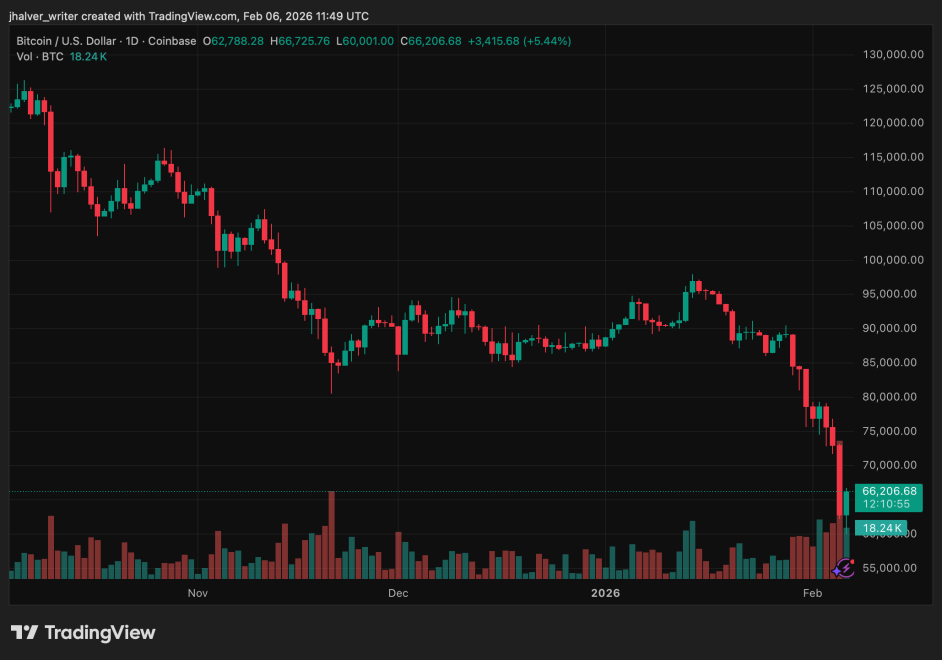
Price action pushed the story into view. Bitcoin slid from higher levels into the low $60,000s, briefly testing roughly $59,000 before a rebound pushed it back toward the mid-$60ks.
The sell-off coincided with troubles in broader risk markets, and traders reacted fast. Some of that selling pressure showed up in ETF flows and futures, while on-chain transfers hinted that big holders were reducing positions while retail piled in.
🧐 What’s been behind the Bitcoin crash that has seen prices fall to as low as $60,001 for the first time since October, 2024?
🐳 Whale and shark wallets holding 10-10K Bitcoin now hold a 9-month low 68.04% of the entire $BTC supply. This includes a dump of -81,068 BTC in just… pic.twitter.com/Yyd20dy3nS
The sell-off looks tied to both risk appetite and timing. One widely shared post on social media from CryptoQuant CEO Ki Young Ju called attention to the mood among analysts, saying that practically all Bitcoin analysts were sounding bearish at the moment. That kind of consensus can push traders toward taking quicker losses or closing positions.
Sentiment Falls To Levels Last Seen In 2022
The broader mood has hardened. The Crypto Fear & Greed Index plunged to 9 this week, a reading that sits inside “extreme fear” territory and has not been seen since the turmoil around mid-2022.
Lower sentiment often tightens liquidity and magnifies price moves. When fear is high, even small catalysts can lead to outsized reactions.
BTCUSD now trading at $66,247. Chart: TradingView
Why This Could Matter
When large holders cut back while many small accounts buy, the market structure changes. Liquidity can become thinner at certain price bands, so dips are deeper and rallies can be swift when buying returns.
History shows that these phases sometimes lead to extended consolidation periods. Other times they mark the start of a larger trend reversal. Right now, both are possible; clarity will arrive only after flows and macro signals settle.
A Note On The Backdrop
Some traders point to geopolitics and macro headlines as the trigger for the latest nervousness. Reports say global risk-off moves — including weak tech stocks and trade tensions — fed into crypto selling.
Still, Bitcoin remains well above many long-term supports that traders watch. Many long-term holders have been steady buyers through past pullbacks. That steady buying could matter if fear eases and larger investors begin to redeploy capital.
Featured image from Pexels, chart from TradingView
Editorial Process for bitcoinist is centered on delivering thoroughly researched, accurate, and unbiased content. We uphold strict sourcing standards, and each page undergoes diligent review by our team of top technology experts and seasoned editors. This process ensures the integrity, relevance, and value of our content for our readers.
Pop music icon Justin Bieber paid $1.3 million worth of ETH for a Bored Ape Yacht Club NFT in 2022.
The NFT now is worth less than 6 ETH, or around $12,000, as NFTs and Ethereum have fallen in value.
Even common Bored Apes at were trading for as much as $429,000 in 2022 before collapsing.
Pop music icon Justin Bieber became one of the most famous members of the Bored Ape Yacht Club when he spent 500 ETH—or around $1.3 million—in January 2022 for Ethereum-based NFT, Bored Ape #3001.
Bieber’s ape, among the most common in the collection in terms of its visual attributes, is now valued at around $12,000 just four years later as the shine from NFTs and the Yacht Club has largely faded.
The value of any artwork can be influenced by a variety of factors, including personal taste, provenance, and even previous ownership; Bieber’s history with the NFT could potentially help it command a higher price if he were to put it on the market. But comparable assets in the collection with similar attributes have seen a substantial value drop.
The trade, which would amount to a 99% loss if the singer were to part ways with his NFT at the current floor price, or the price of the cheapest NFT listed on the marketplace, seems bad now.
But even at the time of purchase, the NFT community was chiding the star for his decision to purchase a “floor” Ape, or one without any rare features or attributes, for such a sum. Typically, only the rarest NFTs from a collection have sold for a major premium to the floor price.
“Who the fuck is advising Justin Bieber’s NFT purchases and how can I get in touch to sell them floors NFTs for 500 ETH,” Farokh Sarmad, now president of Dastan—the parent company of an editorially independent Decrypt—posted following the buy.
Next time you think you’re down bad, just remember that .@justinbieber just bought a floor ape for 500 ETH.
Even still, the Bored Ape Yacht Club’s floor price did rise substantially in the months following Bieber’s purchase, eventually reaching as high as $429,000 in April 2022. And the singer’s purchase was hardly the most jaw-dropping buy of the NFT frenzy, which also saw artist Beeple sell a digital art NFT for $69.3 million the year prior.
Since that time though Apes have been mired in a long drawn out NFT winter which has pulled down the floor prices of rival collections like CryptoPunks and Pudgy Penguins as well.
Punks also once traded above $400,000, while Pudgy Penguins nearly eclipsed $100,000 according to data from NFT Price Floor. The projects now trade at starting prices of about $60,000 and $8,850 worth of ETH, respectively.
Users on Myriad—a prediction market operated by Dastan—don’t believe that winter is going to thaw anytime soon, either. A market that collectively tracks the potential comeback of Apes, Punks, and Penguins gives the trio just 16% odds of reaching floor prices of 10 ETH, or 50 ETH in the case of Punks, by July.
Nevertheless, Yuga Labs, the parent company of the Bored Ape Yacht Club, continues to work on projects surrounding the collection. In October, Yuga announced that it would create a real-life Bored Ape clubhouse in Miami, Florida for its NFT holders to congregate.
Its other focus remains Otherside, a massive multiplayer metaverse game featuring avatars from the Bored Ape Yacht Club and other NFT projects.
Daily Debrief Newsletter
Start every day with the top news stories right now, plus original features, a podcast, videos and more.
The highly anticipated Ethereum Layer 2 blockchain will launch its mainnet on Monday.
MegaETH, the real-time blockchain and Ethereum Layer 2, is launching its mainnet on Feb. 9, but the token generation event (TGE) will be dependent on network performance milestones.
The MegaLabs team has defined three key performance indicators (KPIs), and at least one of these must be met for the TGE to proceed. The chain must either establish a baseline of $500 million in USDM circulating, see 10 “mafia mainnet”- aligned apps deployed with more than 100,000 transactions across at least 25,000 wallets, or host three apps that generate at least $50,000 in daily fees for 30 days.
Once the token is circulating, MegaETH will use priority fees from its proximity markets and yield from its native stablecoin, USDM, for MEGA token buybacks.
In an article, MegaETH co-founder Shuyao Kong said, “The largest issue that’s faced our industry over the past few years was a simple question: why does a token need to exist? Equity has acted as king, with every successful story over the past few years, barring hyperliquid, having some variation of equity.”
The community-focused approach has been well received, but pre-market derivatives still price MEGA at just a $1.3 billion fully diluted valuation, only 40% higher than its initial coin offering (ICO) price in October.
MEGA pre-perps – Hyperliquid
This comes just days after Ethereum cofounder Vitalik Buterin said the current Ethereum Layer 2 landscape “makes no sense” and stated that Layer 2’s must offer something completely unique outside of Ethereum scaling.
BlackRock’s spot bitcoin BTC$70,588.64 exchange-traded fund has been a massive hit since launch, pulling in billions from investors seeking exposure to the cryptocurrency without the hassle of crypto wallets or exchanges. Traders and analysts religiously track inflows into the fund to gauge how institutions are positioning in the market.
Now they might have to do the same with options tied to the ETF, as activity exploded during Thursday’s crash. According to one observer, the record activity stemmed from a hedge fund blowup, while others disagreed, citing routine market chaos as a catalyst.
What really stood out
On Friday, as the ETF tanked 13% to its lowest level since October 2024, options volume exploded to a record 2.33 million contracts, with puts narrowly outpacing calls.
The fact that puts saw more volume than calls on Thursday indicates a higher demand for downside protection, a typical occurrence during price sell-offs.
Options are derivative contracts that provide built-in insurance against swings in the price of the underlying asset, in this case, IBIT. You pay a small fee (premium) for the right, but not the obligation, to buy or sell IBIT at a set price by a deadline or expiry.
A call option lets you lock in IBIT at a set price today for a small premium. If it rallies above that level later, you buy cheap and sell for profit; if not, you only lose the premium. A put option locks in the sale of IBIT at that price. If it slides below, you sell high and pocket the difference; otherwise, you lose just the premium. Calls offer leveraged upside bets, while puts protect against downside drops.
Another standout figure was the record $900 million in premiums paid by IBIT options buyers that day—the highest single-day total ever. To put it in context, that’s equivalent to the market cap of several crypto tokens ranking beyond the top 70.
Speculative theory: record activity tied to hedge fund blowup
A post by market analyst Parker, which has gone viral on X, argues that the $900 million premium payments resulted from the blowup of a large hedge fund (one or a few) with nearly 100% of money invested in IBIT. Funds often focus on just one asset, avoiding spreading out risk exposure elsewhere.
Parker’s post alleges that this fund initially bought cheap “out of the money” call options on IBIT following the October crash, anticipating a quick recovery and bigger rally.
These OTM calls are like cheap lottery tickets at levels well above the ongoing price of the underlying asset. If the asset rallies past these levels, these calls make significant money; if it doesn’t, buyers of these calls lose the initial premium paid.
However, the fund bought these calls using borrowed money. As IBIT continued to drop, they doubled down on their bet.
On Thursday, as IBIT crashed, these calls tanked in value and brokers hit the fund with margin calls demanding cash/collateral. The fund, having bled money elsewhere, was unable to provide the same and ended up dumping large amounts of IBIT shares in the market, resulting in a record $10 billion spot volume.
The fund also desperately replaced expiring calls or closed loss-making calls, resulting in a record $900 million in total premium payments. Essentially, Parker associates the record activity with one or a few massive players scrambling, not routine trading.
Shreyas Chari, director of trading and head of derivatives at Monarq Asset Management put it best: “Systematic selling across the majors yesterday probably tied to margin calls especially in the ETF with the highest crypto exposure IBIT.”
“Rumors swirled of a short options entity that had to sell the underlying far more aggressively after 70k and then 65k broke, probably tied to liquidation levels. This exacerbated the move down to 60k,” he explained in a Telegram chat.
Options expert disagrees
Tony Stewart, founder of Pelion Capital and an options expert, believes IBIT options added to the market chaos, but doesn’t go so far as to blame a single fund blowup for the whole crash and record activity.
He argued on X, citing Amberdata, that $150 million of the $900 million in premiums came from buying back put options. In short, traders who had previously sold (shorted) puts faced significant losses as IBIT crashed and those puts surged in value, so they repurchased them to cut their risk.
Those were “certainly painful” closes, he said on X, adding that the remaining portion of the $900 in premiums comprised mostly smaller trades, which is pretty standard for the hectic trading day.
In essence, to Stewart, the record activity is just the messy noise of a broadly panicked market, not a smoking gun pointing to a single way. “This [hedge fund blowup theory] is inconclusive from the Options standpoint. It also doesn’t seem enough tbh in size,” he concluded.
Still, he acknowledged the possibility that some activity could have been hidden in over-the-counter (privately negotiated) deals.
Conclusion
While Parker connected the dots to point to a hedge fund blowup, Stewart challenged the same with hard data.
In any case, this episode highlights that IBIT options are now large enough to wield influence, and traders might want to keep track of them just as they do ETF inflows.
Bitcoin (BTC) sellers resumed their activity on Thursday as the BTC price dropped below $69,000, the lowest since Nov. 6, 2024.
Analysts said that Bitcoin showed signs of “full capitulation” and a potential bottom forming, due to extreme market fear, panic selling by short-term holders and the relative strength index (RSI).
Key takeaways:
Short-term Bitcoin holders have sold nearly 60,000 BTC in 24 hours.
The Crypto Fear & Greed index shows “extreme fear,” signaling a potential bottom.
Bitcoin’s “most oversold” RSI points to seller exhaustion.
Nearly 60,000 BTC, worth about $4.2 billion at current rates, held by short-term holders (STHs), or investors who have held the asset for less than 155 days, were moved to exchanges at a loss over the last 24 hours, according to data from CryptoQuant.
This was the largest exchange inflow year-to-date, which is contributing to selling pressure.
“The correction is so severe that no BTC in profit is being moved by LTHs,” CryptoQuant analyst Darkfost said in a post on X, adding:
“This is a full capitulation.”
BTC short-term holder losses to exchanges in 24 Hours. Source: CryptoQuant
When analyzing the volume of coins spent at a loss, Glassnode found that the 7-day SMA of realized losses has risen above $1.26 billion per day.
This reflects a “marked increase in fear,” Glassnode said, adding:
“Historically, spikes in realized losses often coincide with moments of acute seller exhaustion, where marginal sell pressure begins to fade.”
Bitcoin: Unrealized loss. Source: Glassnode
Bitcoin’s capitulation metric has also “printed its second-largest spike in two years,” occurrences that have previously coincided with accelerated de-risking and elevated volatility as market participants reset positioning,” Glassnode said.
Capitulation Metric & Current Price. Source: Glassnode
“Extreme fear” could signal market bottom
The Crypto Fear & Greed Index, which measures overall crypto market sentiment, posted an “extreme fear” score of 12 on Thursday.
These levels were last seen on July 22, a few months before the BTC price bottomed at $15,500 and then embarked on a bull run.
Crypto fear and greed index. Source: Alternative.me
Data reveals that in all capitulation events where the index hit this extreme level, short-term weakness was common, but almost every event produced a rebound.
“We are at an ‘extreme fear’ level with a Crypto Fear and Greed Index of 11,” said analyst Davie Satoshi in an X post on Thursday, adding:
“History has shown this is the time to buy and accumulate more!”
Crypto sentiment platform Santiment said in an X post on Thursday that the investor sentiment has “turned extremely bearish toward Bitcoin.”
“This remains a strong argument for a short-term relief rally as long as the small trader crowd continues to show disbelief toward cryptocurrency as a whole.”
CoinGlass‘ heatmap shows that BTC’s RSI is displaying oversold conditions on five out of six time frames.
Bitcoin’s RSI is now at 18 on the 12-hour chart, 20 on the daily chart and 23 on the four-hour chart. Other intervals also display oversold or near-oversold RSI values, such as 30 and 31 on the weekly and hourly time frames, respectively.
Crypto market RSI heatmap. Source: Coinglass
In fact, data from TradingView shows that the weekly RSI is at 29 on Thursday, the “most oversold” since the 2022 bear market, according to analysts.
“Bitcoin is now the MOST oversold since the FTX crash,” CryptoXLARGE said in an X post on Wednesday, adding that it reflects panic selling among investors.
“Historically, this is where fear peaks and opportunity begins,” the analyst added.
Source: X/CryptoXLARGE
Bitcoin’s RSI is at the same oversold levels last seen around $16K in 2022, which marked the “last major capitulation,” phase, said analyst HodlFM in a recent post on X, adding:
“Not a timing signal by itself, but historically, this is where risk/reward favors the buyers.”
This article does not contain investment advice or recommendations. Every investment and trading move involves risk, and readers should conduct their own research when making a decision. While we strive to provide accurate and timely information, Cointelegraph does not guarantee the accuracy, completeness, or reliability of any information in this article. This article may contain forward-looking statements that are subject to risks and uncertainties. Cointelegraph will not be liable for any loss or damage arising from your reliance on this information.
Trusted Editorial content, reviewed by leading industry experts and seasoned editors. Ad Disclosure
Bitcoin’s (BTC) slide below the $65,000 mark this week has rippled far beyond the crypto market, dragging down mining stocks and weighing on Asian equities already under pressure from a global tech sell-off.
The world’s largest cryptocurrency briefly dipped just above $60,000, its lowest level in about 15 months, before attempting a modest rebound. Even with that recovery, sentiment across digital assets and related equities remains fragile as investors reassess risk in an uncertain macro environment.
BTC's price trends to the downside on the daily chart. Source: BTCUSD on Tradingview
Whales Retreat As Sentiment Deteriorates
On-chain data shows a notable shift in Bitcoin ownership during the sell-off. According to Santiment, whales and sharks, controlling between 10 and 10,000 BTC, have reduced their share of Bitcoin’s circulating supply to around 68.04%, a nine-month low.
The large Bitcoin holders have sold roughly 81,000 BTC over the past eight days, coinciding with Bitcoin’s drop from near $90,000 to the mid-$60,000 range.
Similarly, smaller investors have continued to accumulate. Wallets holding less than 0.1 BTC reached a 20-month high in their share of supply, suggesting retail buyers are stepping in as prices fall.
Historically, similar patterns, large holders selling into retail demand, have been associated with prolonged bear phases. Reflecting this shift, the Crypto Fear & Greed Index fell to 9 out of 100, its lowest level since mid-2022.
Mining Stocks Slide Amid Bitcoin Weakness
The pressure on Bitcoin has translated quickly into losses for crypto-linked equities. Shares of major mining firms and Bitcoin proxies such as Marathon Digital, Riot Platforms, Hut 8, and Strategy Inc. posted double-digit declines, with several hitting new 52-week lows.
Strategy, one of the largest corporate Bitcoin holders, reported a sharply wider quarterly loss as falling prices weighed on the value of its holdings, adding to concerns about balance sheet risk if weakness persists.
Analysts note that the sell-off in miners has been largely macro-driven rather than tied to company-specific developments, reflecting their role as high-beta bets on Bitcoin’s price.
Asian Markets Feel The Spillover
Bitcoin’s drop also weighed on Asian markets, which were already tracking Wall Street’s losses, led by technology stocks. Equity benchmarks in South Korea, Hong Kong, and Australia declined, while Japan’s Nikkei managed modest gains after earlier losses.
Market players cited a broader risk-off mood linked to concerns over U.S. monetary policy, particularly following President Donald Trump’s nomination of Kevin Warsh as Federal Reserve chair, a move seen as less supportive of easy liquidity.
With Bitcoin now down roughly half from its October peak, investors remain cautious. While short-term rebounds are possible, continued selling by large holders and tightening financial conditions suggest volatility across crypto assets, mining stocks, and global markets is likely to persist.
Cover image from ChatGPT, BTCUSD chart on Tradingview
Editorial Process for bitcoinist is centered on delivering thoroughly researched, accurate, and unbiased content. We uphold strict sourcing standards, and each page undergoes diligent review by our team of top technology experts and seasoned editors. This process ensures the integrity, relevance, and value of our content for our readers.
By Lucien Bourdon, Bitcoin Analyst at Trezor A hardware wallet is a standard tool for securing cryptocurrency, and most rely on a dedicated chip known as a Secure Element; the same type used in credit cards and passports. But here’s what matters most: how a wallet uses this chip. This choice defines what you are […]
Traders suggest unusual activity in IBIT may point to Hong Kong–based hedge funds, though no hard evidence has emerged.
Unusual trading in BlackRock’s bitcoin ETF, iShares Bitcoin Trust (IBIT), has led traders to speculate that this week’s sharp Bitcoin drop may have been triggered by one or more Hong Kong–based hedge funds, rather than selling pressure from crypto traders.
The theory was laid out in a post on X by Parker White, the COO and CIO of DeFi Development Corp, and centers around record trading and options activity in IBIT.
Bitcoin (BTC) fell sharply over the past week, dropping 16%, and trading as low as $62,000 on Thursday before rebounding to around $70,400 on Friday, per CoinGecko. On Thursday, IBIT recorded its highest daily trading volume to date, with about $10.7 billion traded. Despite the heavy volume, IBIT recorded only $175 million in net outflows, according to SoSoValue.
White cited several signals suggesting that selling pressure did not come from crypto-native traders, including relatively low liquidations on centralized crypto exchanges and unusual price action in BTC and Solana (SOL).
“Given these facts and the way $BTC and $SOL traded down in lockstep today (normally SOL trades with beta) + the relatively lower liquidations on CeFi exchanges, this leads me to believe that the nexus of the problem lies with a large IBIT holder,” the post reads. “IBIT has become the #1 venue for BTC options trading, so my guess is that a hedge fund trading IBIT options is the culprit.”
White said public filings show that some funds hold a very large share (and in some cases nearly all) of their assets in IBIT. He added that many of those IBIT-focused funds are based in Hong Kong and do not normally trade crypto, which could explain why traders didn’t see warning signs ahead of the selloff.
He also pointed to activity in $DFDV, a fund tied to DeFi Development Corp, which he said posted its worst single-day decline on record, alongside a sharp drop in its net asset value.
“I personally know a number of HK-based hedge funds that are holders of $DFDV… the mNAV had been holding steady surprisingly well throughout this pull back until today.” White wrote, adding that he finds it unlikely a fund running a large IBIT position through a single-entity structure would operate only one vehicle.
White cautioned that while he has no hard evidence, “just some hunches and bread crumbs,” he believes his theory seems “very plausible.” Other experts echoed parts of White’s view, noting that the size and structure of the move did not resemble a typical crypto-driven selloff.
Rob Wallace, co-founder of BitcoinNews.com, agreed that the combination of factors mentioned by White looks more like institutional selling than a retail panic. He also said IBIT has become an important link between traditional markets and BTC trading.
Still, White and other traders emphasized that the clearest confirmation would come from regulatory filings showing a large IBIT position being reduced to zero.
XRP is emerging as core financial infrastructure as institutional DeFi takes shape, embedding itself into payments, liquidity and on-ledger credit while positioning Ripple’s network for regulated, scalable tokenized finance. Ripple’s XRPL Roadmap Positions XRP at the Center of Institutional Finance Workflow XRP is strengthening its position in institutional finance as blockchain infrastructure matures. Ripple published […]