OneDome, the UK-based housing and fintech platform, has raised $25 million in a Pre-Series C funding round, taking total funding raised to date to $40 million.
The round was funded largely by existing investors alongside Channel 4 Ventures, whose investment was announced in late 2025.
The funding will be used to support the next phase of growth, including continued investment in technology, product development, and expansion of OneDome’s integrated housing and financial services platform.
The raise follows a period of strong momentum for the company. OneDome was ranked the 4th fastest-growing fintech and 17th fastest-growing technology business in the UK by the Deloitte Fast 50 2025, based on 1,700% revenue growth between 2021 and 2024. In 2026, the company was also named the 6th fastest-growing technology business by the Sunday Times Tech 100, having grown revenues by 4,066% between 2022 and 2025.
The platform currently arranges approximately $1.4 billion of mortgage lending per month and works with a network of over 500 mortgage brokers, making it one of the largest mortgage and property platforms in the UK.
Babek Ismayil, Founder and CEO of OneDome, said: “Buying a home is still one of the most stressful and disjointed financial transactions people go through. We started OneDome to fix that by bringing everything under one roof and turning homebuying into a simple, transparent retail experience. This funding allows us to scale what is already a profitable and fast-growing platform, while continuing to challenge how homes are bought and financed in the UK.”
Political action committees (PACs) representing the interests of the crypto industry have already secured millions of dollars in funding as the US heads toward its midterm elections.
Super PACs are the uber-rich, no-limits, non-disclosure counterparts to crypto PACs. Last year, the industry spent at least $245 million in campaign contributions alone.
The main super PAC funded by the cryptocurrency industry, Fairshake, raised some $133 million in 2025, bringing its total cash on hand up to over $190 million. Venture capital firm a16z contributed an initial $24 million, while Coinbase and Ripple each donated $25 million.
This influx of cash has alarmed activist and election reform groups. Saurav Ghosh, director of the Campaign Legal Center — a legal center concentrated on voting rights, fair districting and campaign finance reform — told Cointelegraph:
“This kind of influence buying ultimately undermines the democratic process by marginalizing everyday Americans, ensuring that their voices and interests take a backseat to the crypto industry’s deregulatory desires.”
Bipartisan support ensures crypto lobby’s success
The US crypto industry’s main goal is to pass a large framework law, the CLARITY Act, which passed in the House of Representatives this summer and moved on to the Senate. The bill still hasn’t managed to satisfy the crypto industry, particularly Coinbase, nor the ethics and oversight concerns of Senate Democrats.
Now, the CLARITY Act is in limbo, and Congress is shifting its attention to the 2026 midterm elections. For nearly 80 years, the president’s party has almost always lost the midterms, the federal elections in the off-year between presidential elections. This is particularly important for the crypto industry, which enjoys more full-throated support among the Republican Party. Take, for example, the roll call for the Senate’s vote on the GENIUS Act: Nearly twice as many Democrats voted against the motion compared to those in support of it.
Some in the crypto space have taken this to mean they need to take a partisan stance. Cameron and Tyler Winklevoss, founders of the crypto exchange Gemini, have poured millions into the conservative PAC Digital Freedom Fund, which aims to boost pro-crypto and pro-Trump candidates.
Others have stressed the need for bipartisan support, warning that backing one party is bound to backfire once the other eventually takes power.
Representative Sam Liccardo, a crypto-friendly Democrat, told Politico in October 2025, “I don’t think anybody in this town would recommend that an industry put their eggs in one party’s basket.”
One major lobby, Fairshake, has shown it’s more than willing to support Democrats, so long as they are sufficiently pro-crypto. The Super PAC actually spent more money in support of Democrats than it did Republicans from 2023 to 2024, according to Open Secrets.
Whether it be among Republicans or Democrats, the crypto industry’s political strategy has changed significantly both in how much and where it spends its dollars.
How did we get here?
Crypto made headlines in 2024 for donating nearly a quarter of a billion dollars to different political campaigns and super PACs — the largest contribution of any single industry.
But this wasn’t crypto’s first step in the political arena. During the crypto bull run of 2020-2021, crypto companies made massive ad buys. Celebrities like Matt Damon were advertising crypto investment platforms. Now-convicted fraudster Sam Bankman-Fried slapped the name of his now-defunct crypto exchange, FTX, onto the home of the Miami Heat basketball team.
At the same time, crypto increased its lobbying efforts in Washington. Major platforms like Coinbase and fintech developers like Ripple padded their budgets as the industry gained visibility.
Coinbase raised spending from $1.5 million in 2020 to $3.9 million in 2021. Ripple more than tripled the amount it spent on lobbying over the same period, spending $330,000 in 2020 and more than $1.1 million in 2021.
One major donor from the crypto space was Bankman-Fried. He made more than $100 million in political campaign contributions in the 2022 midterms. “He leveraged this influence, in turn, to lobby Congress and regulatory agencies to support legislation and regulation he believed would make it easier for FTX to continue to accept customer deposits and grow,” federal prosecutors said in a later indictment.
By Bankman-Fried’s own admission, he supported campaigns on both sides of the aisle, though he found Republicans “far more reasonable” on crypto.
The crypto market crashed soon after. FTX went bust, the Terra stablecoin system collapsed, and the Securities and Exchange Commission (SEC), the US’ main finance regulator under then-Chair Gary Gensler, opened enforcement actions against many crypto companies operating in the US.
American Airlines Arena was renamed FTX Arena in 2021 and has since been changed to Kaseya Center. Source: RoofLogos
Related: SBF always played both sides of the aisle despite new Republican plea
In 2023, the presidential election cycle began. Trump ran against ex-Vice President Kamala Harris. Crypto, for the first time, was on the presidential platform. Trump visited a Bitcoin (BTC) conference and made promises of ending “regulation by enforcement.
Crypto poured money into the race through PACs and super PACs. For the 2024 selections, these were namely:
Fairshake raised a whopping $260 million from 2023 to 2024, at least $92 million of which came from Coinbase. It made $126 million in independent expenditures and transfers to affiliated committees.
Independent expenditures are expenditures “for a communication that expressly advocates the election or defeat of a clearly identified candidate and which is not made in coordination with any candidate or their campaign or political party,” per the FEC.
According to Follow the Crypto, the two other single-issue crypto PACs are affiliated with Fairshake, despite one being liberal and the other conservative. Defend American Jobs made $57 million in independent expenditures, and Protect Progress made $34.5 million over the same 2023-2024 period.
This vast amount of money entering PACs reflects a broader shift in how companies seek political influence.
“Super PACs are increasingly becoming in vogue for special interests who want to make their presence known in Washington,” Michael Beckel, research director of Issue One — a bipartisan political reform organization watching big money in politics — told Cointelegraph.
“Industry-aligned super PACs with huge bank accounts have made a huge splash and helped thwart new regulations on their business interests.”
Just a few years ago, “corporate influence operations focused more on lobbying and direct campaign contributions,” Beckel explained. “Now we’re seeing sector-specific super PACs with massive bank accounts.”
And it’s changing how laws are made in Washington.
Crypto lobby affects policy as Trump seeks to “nationalize” elections
Blockchain bigwigs now regularly visit Washington to meet with lawmakers and advise policymakers on how to regulate the industry.
Issue One vice president of advocacy Alix Fraser said, “The Trump administration is packed with tech industry insiders who have acted in the interest of their own companies — not the American people — to rig policy for their own profit.”
The degree to which the crypto industry is involved in the legislative process is no more apparent than with the market structure bill making its way through the Senate. Work on the bill stalled in mid-January after Coinbase withdrew its support.
The exchange’s CEO, Brian Armstrong, wrote on X:
Source: Brian Armstrong
The main point of contention is a provision that would outlaw one of Coinbase’s products: stablecoin yields for consumers. Banks are pushing to outlaw the practice, saying a flight of deposits from insured lenders could threaten financial stability. The crypto industry and Coinbase argue that the ban stifles innovation and is anti-competitive.
Earlier this week, the White House scheduled a closed-door summit for leaders from the crypto and banking industries to hash out their differences, but according to Reuters, no deal was made.
According to reporter Eleanor Terrett, Senate Democrats said that the talks were “constructive” and were optimistic about the chances of passing a bill. Reporter Sander Lutz said that Senate Minority Leader Chuck Schumer is “desperate” to get the bill finished, as Fairshake alone now has $193 million in its coffers.
“These payments help explain the crypto industry’s success in curtailing efforts to meaningfully regulate their business model, which is consistent with a well-established practice of wealthy corporate special interests using lobbying and political contributions to influence policy decisions,” Ghosh told Cointelegraph.
“This kind of influence buying ultimately undermines the democratic process by marginalizing everyday Americans, ensuring that their voices and interests take a backseat to the crypto industry’s deregulatory desires.”
Rick Claypool, research director at consumer rights advocacy group Public Citizen, told Cointelegraph that big money from lobbies like crypto pushes out the priorities of most voters from the agenda.
“This feeds cynicism — the sense that our elected officials prioritize the interests of wealthy donors over all other constituents — and erodes faith in our democratic institutions.”
Related: US crypto market structure bill in limbo as industry pulls support
The increased influence of monied interests in Washington comes at a time when election integrity itself is under threat. Trump has recently said Republicans should “nationalize” the midterm elections.
“The Republicans should say, ‘We want to take over. We should take over the voting, the voting in at least many — 15 places … the Republicans ought to nationalize the voting,’” he said.
He added that he will only accept the results if they are “honest,” while claiming that there was widespread voter fraud in many American cities. Election experts have refuted the claims. House Speaker Mike Johnson has admitted that he himself has no evidence of his own claims of voter fraud.
Marc Elias, a partner at Elias Law Group, said that Trump “is not interested in following the Constitution. As we have seen before, he prefers to act by force.”
Crypto is set to increase its influence in Washington as the very elections themselves are at risk of tampering and interference from the highest levels of government.
Magazine: 6 weirdest devices people have used to mine Bitcoin and crypto
Cointelegraph Features and Cointelegraph Magazine publish long-form journalism, analysis and narrative reporting produced by Cointelegraph’s in-house editorial team and selected external contributors with subject-matter expertise. All articles are edited and reviewed by Cointelegraph editors in line with our editorial standards. Contributions from external writers are commissioned for their experience, research or perspective and do not reflect the views of Cointelegraph as a company unless explicitly stated. Content published in Features and Magazine does not constitute financial, legal or investment advice. Readers should conduct their own research and consult qualified professionals where appropriate. Cointelegraph maintains full editorial independence. The selection, commissioning and publication of Features and Magazine content are not influenced by advertisers, partners or commercial relationships.
IREN’s (IREN) latest earnings offered a snapshot of a company mid-transition, with shares currently paying the price for that transition. The firm reported weaker-than-expected revenue and earnings as bitcoin BTC$65,998.81 mining took a back seat to its rapidly expanding AI cloud ambitions.
Crushed by record-low margins after the 2024 halving, bitcoin miners are recasting themselves as digital infrastructure players, converting power-hungry mining sites into AI-ready data centers in a bid for more stable, long-term revenue.
One of last year’s best-performing stocks, not just in crypto, but for the whole market, IREN has come back to earth a bit since hitting a record high near $77 in November. Down about 20% amid Thursday’s market crash, shares are flat on Friday at $39.77.
IREN has secured $3.6 billion in GPU financing tied to its Microsoft contract, alongside a $1.9 billion customer prepayment, funding that management says will cover roughly 95% of GPU-related capital expenditures as it scales its AI business, a development JPMorgan analysts Reginald Smith and Charles Pearce described as encouraging.
IREN’s fiscal second-quarter revenue fell sequentially as lower average hashrate, fewer coins mined and a quarter-over-quarter drop in bitcoin prices weighed on results, according to the Wall Street bank.
The drag from mining was partly offset by rapid growth in cloud services, where revenue more than doubled from the prior quarter to $17 million. That figure came in above JPMorgan’s $14 million estimate but well short of the Street’s $28 million forecast. Management said all GPUs currently energized are fully contracted, a signal the bank described as encouraging as the company pivots toward AI infrastructure.
Cost controls also helped cushion the quarter. Cash SG&A dropped sharply to $43 million, while power costs declined on lower average hashrate. As a result, adjusted EBITDA reached $75 million, beating the bank’s estimate, driven by lower operating and energy expenses. The bank has an underweight rating on the stock.
Investment bank B. Riley raised its price target on IREN to $83 from $74 while reiterating its buy rating, arguing that the recent pullback has created an attractive entry point.
The upgrade comes despite a softer fiscal second quarter, during which adjusted EBITDA of $75.3 million missed expectations. B. Riley said the earnings miss is overshadowed by IREN’s progress on its AI pivot, including $3.6 billion in low-cost GPU financing tied to its Microsoft deal, a $1.9 billion prepayment that covers about 95% of GPU capex, and an expanded power portfolio now exceeding 4.5 gigawatts (GW).
Compass Point analyst Michael Donovan reiterated a buy rating and a $105 price target on IREN, saying the latest earnings show a company better positioned for growth, even though recent results were weaker. He said IREN now has more secure power and a clearer plan to fund its expansion, which matters more than one soft quarter.
Donovan described the fourth quarter as a period of change. Revenue fell to $184.7 million as the company mined less bitcoin while shifting its facilities from older bitcoin-focused machines to newer chips used for artificial intelligence. Even so, the mix of revenue improved as AI-related services began to make up a larger share of the business.
He pointed to the $3.6 billion financing package linked to IREN’s Microsoft project as an important milestone. The funding is larger than originally planned and is structured so that money is drawn as construction moves forward and revenue contracts kick in.
Donovan expects IREN to begin recognizing revenue from Microsoft toward the end of the second quarter of 2026, with revenue increasing in stages after that. By the end of 2026, he sees a path for the business to generate about $3.4 billion in annualized revenue.
TrumpRx.gov aggregates steep cash-pay discounts on more than 40 branded drugs, routing users to manufacturers or pharmacies without insurance or accounts.
GLP-1 drugs like Ozempic, Wegovy, and Zepbound anchor the launch, with prices cut by as much as 85–93% from U.S. list prices under a most-favored-nation framework.
Supporters hail the platform as a breakthrough on affordability, while critics argue it benefits a narrow slice of patients and sidesteps deeper reforms to insurance and drug pricing.
TrumpRx.gov, a government-backed platform aimed at slashing U.S. prescription drug prices by tying them to the lowest rates paid in other developed countries, launched late Thursday.
The site, branded as a “most-favored-nation” pricing tool, is positioned as a clearinghouse to help users find the best pricing for prescription drugs. Users can search for medications, see sharply discounted cash prices, generate printable or digital coupons, and are then routed to participating manufacturers or pharmacies to complete purchases. No insurance is required, and no account is needed.
The White House has billed TrumpRx as a transparency play designed to bypass middlemen—pharmacy benefit managers, insurers, and opaque rebate structures that have long distorted U.S. drug pricing. At launch, the platform lists more than 40 branded drugs from major pharmaceutical companies, including Eli Lilly, Novo Nordisk, Pfizer, and AstraZeneca, with additional medications promised in the coming months.
The rollout focused heavily on GLP-1 agonists, the blockbuster drugs used to treat diabetes and obesity that have become a flashpoint in the broader healthcare affordability debate. Monthly list prices for these drugs often exceed $1,000 in the U.S., far higher than prices in Europe or Asia.
Via the TrumpRx portal, those numbers drop sharply for cash-paying users, based on coupons offered by pharma companies:
Ozempic (semaglutide for diabetes) is listed as low as $199 per month, down from roughly $1,028.
Wegovy (semaglutide for obesity) starts at $199 per month for injectable pens, down from $1,349, while the newly approved pill version is listed starting at $149 per month.
Zepbound (tirzepatide) from Eli Lilly appears at $299–$346 per month, compared with list prices exceeding $1,000.
Trump called the cuts—up to 85-93% on certain doses—historic, framing them as the product of direct negotiations with drugmakers and proof that aggressive federal leverage can break what he described as entrenched price-gouging by pharmaceutical giants.
“It’s the biggest thing to happen in health care, I think, in many, many decades,” he said at the White House announcement Thursday. At the event, the administration highlighted other steep discounts, including asthma inhalers from AstraZeneca dropping from $458 to $51. A military spouse spoke about how lower drug prices could reshape family planning and long-term health decisions.
Supporters quickly seized on the announcement as a political and cultural win. Conservative media and pro-Trump accounts on social media circulated screenshots of TrumpRx price listings and launch videos, framing the platform as a rare, tangible intervention in an area where Americans routinely feel powerless. The emphasis on GLP-1 drugs—now entangled with conversations about obesity, productivity, and healthcare access—gave the rollout broader resonance beyond traditional partisan lines.
But critics were equally quick to puncture the narrative.
So there it is: they killed the ACA because this loon wanted to launch a scam with HIS name: trump Rx.
Millions of Americans losing their Healthcare because of his greed and his ego. pic.twitter.com/l8NBa8ALTJ
Health policy experts and Democratic lawmakers have argued that TrumpRx targets a relatively narrow slice of the market: uninsured patients or those paying cash. Most Americans, they noted, rely on insurance plans where copays and negotiated rates may already undercut—or complicate—the TrumpRx pricing.
Others pointed out that similar self-pay discounts for some GLP-1 drugs already exist through private platforms like GoodRx, raising questions about how much of the “savings” represent genuinely new price reductions versus repackaged existing deals with “Trump” branding.
Skeptics also challenged the headline percentage cuts, noting that list prices themselves are inflated artifacts of the U.S. rebate system. In that context, a dramatic discount can still leave patients paying more than international peers—and can obscure who ultimately absorbs the cost difference. On social media and in policy circles, detractors labeled TrumpRx a “gimmick” or a politically timed workaround that avoids deeper reforms to patent law, pharmacy benefit manager incentives, and insurance design.
There are also unanswered questions about sustainability. TrumpRx relies on voluntary manufacturer participation and negotiated pricing, rather than statutory caps. Whether drugmakers continue offering steep discounts once the political spotlight fades—or expand them beyond a curated list of high-profile drugs—remains unclear.
Still, the platform represents a notable escalation in the federal government’s willingness to directly intervene in drug pricing optics, if not yet the underlying system. For millions of Americans managing chronic conditions without insurance—or priced out of coverage—TrumpRx could provide real, immediate relief.
For everyone else, it reopens a familiar question in U.S. healthcare: When prices finally fall, who is actually paying the difference—and who decides how long the discounts last?
Daily Debrief Newsletter
Start every day with the top news stories right now, plus original features, a podcast, videos and more.
Crypto markets are adding to overnight gains in U.S. morning trade on Friday, with bitcoin BTC$70,271.59 climbing above $68,000, up nearly 17% since hitting $60,000 late yesterday.
Bitcoin is now higher by 2.5% over the past 24 hours. Ether ETH$2,086.85 is up 2.2% and solana SOL$88.38 2%. Outperforming is XRP XRP$1.4693, which has climbed to $1.50, now higher by 17% over the last day.
Crypto-related stocks are seeing major upside moves Friday after plunging in the previous session.
Strategy (MSTR) — which reported a $14.2 billion fourth-quarter loss late Thursdy — is higher by 14%, though at $122, still lower by 22% year-to-date. Galaxy Digital (GLXY) is up 15% and bitcoin miner MARA Holdings (MARA) is up 12%.
Underperforming on Friday is bitcoin miner-turned AI infrastructure provider IREN (IREN), down 1.8% after disappointing earnings results Thursday night.
Saylor gets serious about Quantum
Those looking for bottom signals are pointing to last night’s Strategy earnings call in which Michael Saylor pledged a commitment to leading a Bitcoin security program that will address the quantum threat.
Some in crypto have argued that bitcoin’s security model faces a serious threat from quantum computing — a threat so imminent that many investors are either selling or refusing to allocate to bitcoin at all.
“Saylor’s announcement tells me prices have finally gotten the Bitcoin community to acknowledge and address quantum risk,” wrote Quinn Thompson.
Poised for technical bounce
Paul Howard, director at crypto trading firm Wincent, noted that bitcoin is now back at price levels last seen 14 months ago with key momentum indicator RSI flashing deeply oversold conditions. He added that trading volumes in BTC and ETH have surged to their highest in over two years. That technical setup that often invites at least a short-term bounce.
“It would be odd if we did not see at least some short term reversion here,” he said.
Updated (14:55 UTC): Adds price of bitocin rising past $70,000.
intelliflo and Söderberg & Partners today announced a new strategic partnership designed to deliver greater efficiency, smarter workflows and an enhanced technology experience for financial advice firms.
The partnership will see Söderberg & Partners’ proprietary tools integrated directly into the intelliflo platform, enabling intelliflo system users to access enhanced functionality through a seamless, connected experience.
Beyond the technology integration, both organisations are committed to jointly defining a dedicated Söderberg & Partners adviser journey. By combining intelliflo’s market leading advice platform with Söderberg & Partners’ expertise and tools, the partnership aims to significantly reduce operational friction and unlock meaningful efficiency gains for partner firms.
The collaboration reflects a shared ambition to help advisers spend less time on administration and more time delivering value to clients, while supporting scalable, sustainable growth.
Commenting on the partnership, Walter Nunez Ovtcharenko from Söderberg & Partners said: “We are thrilled to enhance our partners’ experience by integrating Söderberg & Partners’ innovative advisory tools with the Intelliflo platform. This collaboration is a testament to our commitment to provide superior technology solutions, enabling our partners to achieve greater efficiency and success in their advisory services.”
Nick Eatock from intelliflo said: “We are always looking for ways to increase efficiencies for our adviser community and free up valuable time. Söderberg is a valued partner in helping us achieve this ambition, and we look forward to collaborating with their team to bring new solutions to advisers as the organisation continues to grow. Their partnership has been instrumental, and our modern technology enables seamless integration with the Söderberg ecosystem. We’re excited to build on this strong relationship and deliver even more options as their offering expands.”
Representatives from both organisations said the partnership marks an important step in strengthening collaboration across the advice ecosystem and delivering practical innovation that makes a real difference to firms.
Both intelliflo and Söderberg & Partners are excited to work more closely together as they continue to develop integrated solutions that support adviser success in an evolving regulatory and operational landscape.
Bitcoin’s BTC$70,830.66 Feb. 5 collapse will go down as one of the most historic selloffs on record. Below are the key statistics that help define the event and indicate how much further there may be to fall.
The bitcoin price started the day near $73,000 and fell to a low around $62,000, a drop — or, as some market participants call it, a candle — of more than $10,000. The day’s 14% decline was the largest single-day drop since November 2022, during the implosion of crypto exchange FTX.
The Fear and Greed Index dropped into single digits, a level seen only a handful of times in bitcoin’s 17-year history. At the same time, bitcoin was the third most oversold it has ever been on the RSI, an indicator that measures the speed and change of price movements.
Supply in profit and loss
The circulating supply in loss, meaning the number of coins that last moved at prices higher than the market price, surged to almost 10 million BTC. That is the fourth-highest level ever, comparable with the 2015, 2019 and 2022 bear-market bottoms.
Total Supply in Loss (Glassnode)
Another measure, the amount of long-term holders’ circulating supply that is at a loss, reached 4.6 million BTC. At the lows of previous bear markets, the figure exceeded 5 million BTC, suggesting this metric is approaching, but has not yet fully matched, prior extremes.
Total Supply in Loss by LTHs (Glassnode)
Supply in profit and supply in loss have nearly converged, a condition that has historically aligned with the bottom of major market declines. At present, roughly 10 million BTC sit in profit and 10 million BTC sit in loss.
While nobody knows for certain whether the bottom is in for bitcoin, history suggests it is likely close, especially with bitcoin already recovering toward $68,000.
Still, market participants may be waiting for bitcoin to test its 200-week moving average, currently near $58,011.
Bitcoin’s next major catalyst may come from the common assumption being flipped on its head that interest rates are bullish for Bitcoin only when they fall, according to a crypto analyst.
“I think we should expect that having more accommodative policies may in fact actually not be the catalyst to help us go into a bull market,” ProCap Financial chief investment officer Jeff Park said during an interview with Anthony Pompliano on Thursday.
“We have to accept that reality and possibility,” Park said. Accomodative policies, such as lowering interest rates, are employed by the US Federal Reserve to stimulate economic growth, reduce unemployment, and increase liquidity. Bitcoiners often see these conditions as more favorable for riskier assets such as Bitcoin (BTC), as traditional investments like bonds and term deposits become less attractive.
Jeff Park spoke to Anthony Pompliano on The Pomp Podcast. Source: Anthony Pompliano
Rising interest rates are usually seen as a negative for Bitcoin, but Park said that may not be the case forever. He said Bitcoin’s next biggest upside catalyst — and potentially its “endgame” — may be its entry into what he called a “positive row Bitcoin,” where the asset’s price continues to rise even as US Federal Reserve interest rates rise.
“Perfect holy grail” for Bitcoin
“This is the mythical, elusive perfect holy grail of what Bitcoin is meant to be, which is when Bitcoin goes up as interest rates go up, which is very counterintuitive to the QE theory,” he said.
However, Park said this idea would undermine the “risk-free rate itself.”
Park emphasizes the monetary system “is broken”
“In that world, what we’re saying is actually because the risk-free rate is not the risk-free rate, because the dollar hegemony is not the dollar hegemony, and we are no longer able to price the yield curve in the ways we’ve known,” Park said.
Related: Bitcoin price rebounds 11% above $65K: Who is buying the dip?
Park explained that the monetary system is “broken” and the relationship between the Fed and the US Treasury is “not at the level it should be” to drive the direction of national securities.
Traders on the crypto prediction platform Polymarket are giving the highest probability, 27%, to three total Fed interest rate cuts in 2026.
Bitcoin is trading at $70,503 at the time of publication, down 22.53% over the past 30 days, according to CoinMarketCap.
Magazine: Bitcoin’s ‘biggest bull catalyst’ would be Saylor’s liquidation: Santiment founder
Cointelegraph is committed to independent, transparent journalism. This news article is produced in accordance with Cointelegraph’s Editorial Policy and aims to provide accurate and timely information. Readers are encouraged to verify information independently. Read our Editorial Policy https://cointelegraph.com/editorial-policy
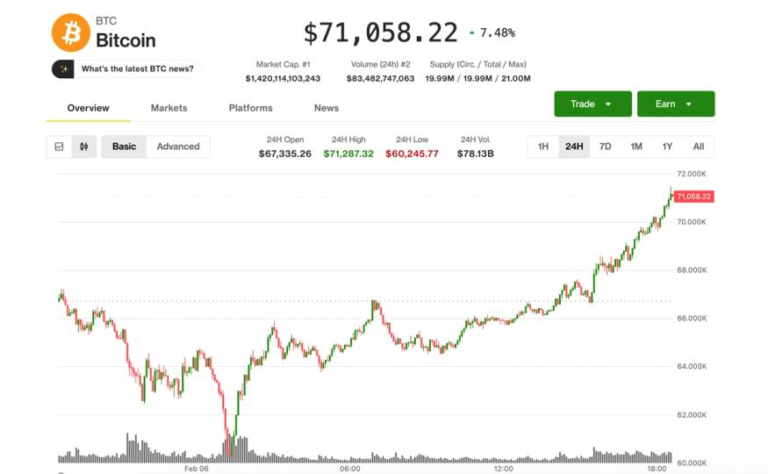
Bitcoin has regained some of its footing after briefly touching $60,000 on Thursday.
The crash was prompted by a plethora of factors.
Market watchers say Bitcoin’s selloff over the past three months is unprecedented.
Bitcoin jumped back above the $70,000 mark on Friday as investors piled back into the asset class following a volatile week for the cryptocurrency market at large.
The $1.3 trillion digital asset is up over 6% today after plunging to nearly $60,000 earlier on Thursday. Ether has jumped more than 7% to above $2,000 while XRP trades at $1.46, up nearly 20%.
Market watchers say the worst is over.
“While it is difficult to say, conditions appear to be aligning for crypto to bottom,” David Duong, global head of investment research at Coinbase, told DL News.
Bitcoin’s crash was brought on by a combination of factors: collapsing leverage, miners forced to sell, AI hype unravelling, quantum computing risks, and the typical four-year boom-bust cycle patterns that Bitcoin investors expect and sell into.
Investors grappling with Bitcoin’s volatility quickly began to bemoan a bear market, with some experts saying crypto markets could get thrashed even more.
Selloff across the board
The downturn wasn’t exclusive to Bitcoin, however.
Duong added that gold and silver also got battered in trading this week, as did tech equities across the board.
After a tremendous run that took silver to $118 from $74 in January, the precious metal dropped nearly 40% in the past week. Gold, which towered to a fresh price record of $5,500, also pulled back this week, dropping about 13%.
Both have since bounced back.
Bitcoin is down from this time last year. Source: CoinGecko.
Tech equities, which typically move in tandem with Bitcoin as “risk on” assets, also jumped. The Nasdaq was up 2% on Friday.
Amid Bitcoin’s decline came President Trump’s announcement for the new Federal Reserve chair: Kevin Warsh.
Warsh, who served as a member of the Federal Reserve Board of Governors from 2006 to 2011, has made pro-crypto statements in the past. And despite Warsh previously claiming that interest rates need to be lower, his history as an inflation hawk has spooked investors.
“A combination of factors has weighed on sentiment — from Warsh’s appointment as Fed chair to mixed results from tech earnings,” Duong told DL News.
Bitcoin making history
Experts reckon this week’s Bitcoin crash was an outlier.
“The current price action is not just painful; it is unprecedented,” crypto options exchange Deribit’s chief commercial officer Jean-David Peiquignot told DL News.
“For the first time in Bitcoin’s history, the market is on track for a third consecutive monthly decline.”
Bitcoin’s swift drop — last week it was trading at nearly $83,000 — came as highly leveraged traders got liquidated. In fact, over $2.65 billion in futures positions were closed yesterday, according to CoinGlass data.
Peiquignot continued that the number of liquidations this week means that the bottom should be in, although left the door open for more unexpected “macro catalysts” that could lead to more pain.
Bitcoin has been grappling with increased volatility since October 10 — the biggest liquidation event in the history of crypto — when over $19 billion in digital asset bets were liquidated.
Mathew Di Salvo is a news correspondent with DL News. Got a tip? Email at mdisalvo@dlnews.com.
Chinese regulators have broadened their crackdown on crypto activities, imposing strict oversight on tokenization and stablecoin issuance in a Friday notice.
“Recently, influenced by various factors, speculative activities related to virtual currencies and the tokenization of real-world assets have occurred frequently, posing new challenges and situations for risk prevention and control,” said the notice, issued jointly by eight national organizations including the People’s Bank of China (PBOC) and the China Securities Regulatory Commission (CSRC).
The notice reiterates China’s blanket ban on crypto, saying that trading, issuing or facilitating transactions involving digital currencies such as bitcoin BTC$65,998.81, ether ETH$1,926.58, or stablecoins like Tether’s USDT USDT$0.9995 is illegal.
The prohibition extends to foreign entities and individuals offering such services within China. It also bans domestic entities from issuing digital currencies overseas without regulatory approval.
The notice singles out stablecoins — cryptocurrencies pegged to fiat currencies — for special scrutiny. Authorities argue stablecoins replicate key functions of sovereign money and therefore threaten monetary control.
The new rules make clear that no entity, Chinese or foreign, may issue a stablecoin linked to the renminbi abroad without government approval. That includes overseas branches of domestic firms.
The rules also tighten control over tokenization, the fast-growing trend of turning ownership of real-world assets like equities, real estate or funds into digital tokens.
Chinese firms that want to tokenize assets overseas now must obtain approvals or file with regulators, and their financial and tech partners are required to meet heightened compliance standards, the notice said.
China’s crackdown on cryptocurrencies and related activities have been a staple over the past years. The new set of rules build on Chinese authorities in 2021 deeming all crypto-related business activities illegal and prohibiting crypto mining, often called a “China ban.” In 2017, authorities banned Initial Coin Offerings (ICOs), labeling them as illegal fundraising and financial fraud, and ordered domestic cryptocurrency exchanges to shutter fiat-to-crypto trading operations.