Bitcoin miner Cango (CANG) completed the sale 4,451 BTC over the weekend, raising roughly $305 million in USDT as it looks to reduce leverage and reposition its business around artificial intelligence infrastructure.
The company said it raised $305 million from the sale, suggesting an average sale price of about $68,524 per coin, or not far above multi-year low prices for bitcoin.
Shares are little-changed in Monday trading, but are lower by 83% on a year-over-year basis.
The company’s bitcoin sales were “based on a comprehensive assessment of current market conditions,” the firm said, as it plans to shift into AI computing infrastructure. Cango plans to deploy modular GPU units across its global network of over 40 sites to serve small and mid-sized businesses needing on-demand AI inference capacity, it said.
The company used the proceeds of its BTC sale to pay down a bitcoin-collateralized loan, bolstering its balance sheet. The company still holds 3,645 BTC worth more than $250 million, according to data from BitcoinTreasuries.
“In response to recent market conditions, we have made a treasury adjustment to strengthen balance sheet and reduce financial leverage, which provides increased capacity to fund our strategic expansion into AI compute infrastructure,” the company wrote in a letter to shareholders.
Its move into the AI sector comes as it faces what it framed as a gap between rising compute demand and existing grid capacity. Cango wrote that it’s well positioned to take advantage of that gap.
Cango is not alone. A growing group of bitcoin miners is scaling back exposure to pure mining and redirecting capital and infrastructure toward AI data centers and high-performance computing.
Bitfarms (BITF) has said it plans to exit crypto mining entirely by around 2027, and famously declared it’s no longer a bitcoin company as it shifts to high-performance computing and AI workloads.
Analysts at KBW have warned that the industry’s pivot toward AI workloads is compelling, but that the path to monetization is fraught with execution risks. That led to a downgrade not only on Bitfarms but also in Bitdeer (BTDR) and Hive Digital (HIVE).
Trusted Editorial content, reviewed by leading industry experts and seasoned editors. Ad Disclosure
Bitcoin is struggling to hold the $70,000 level as the market shows clear signs of weakening demand following weeks of sustained selling pressure. After several failed recovery attempts, price action continues to reflect fragile sentiment, with liquidity thinning and volatility increasing. Investors remain cautious as macro uncertainty, declining risk appetite, and persistent outflows from speculative assets weigh on the broader crypto market.
A recent analysis from Axel Adler indicates that the bear market underway since November 2025 has entered a deeper phase following last Friday’s sharp decline, which pushed total drawdown to roughly 46% from the cycle peak. This magnitude of correction historically marks a transition from an early pullback into a more mature bearish stage, where sentiment typically deteriorates further before stabilization occurs.
The report highlights that Bitcoin has approached the 1.25× Realized Price Band, a historically significant level that often separates standard corrections from capitulation phases. When price tests this boundary, market structure tends to become highly sensitive to liquidity shifts and investor positioning.
Whether Bitcoin can hold above this zone will likely determine the short-term direction. A sustained breakdown could signal deeper capitulation dynamics, while stabilization may provide the foundation for eventual accumulation.
Bear Market Drawdown Signals Transition Into Deeper Phase
Adler notes that the Bitcoin Bear Market Correction Drawdowns chart places the current 2025–2026 decline in historical context, comparing its magnitude with previous bear cycles. The metric tracks percentage drawdowns from each cycle’s all-time high on a logarithmic scale, allowing a clearer assessment of structural market stress rather than nominal price moves alone.
Bitcoin Bear Market Correction Drawdowns | Source: Axel Adler
The current bear phase began after Bitcoin topped near $124,450 in October 2025. By November, the market had entered a persistent downtrend, with the correction expanding from roughly −20% to −30% initially before accelerating to around −46% by early February. Notably, the pace intensified sharply: the drawdown moved from approximately −28% on January 28 to −46% by February 6. A modest rebound followed, with price briefly stabilizing near $70,700, still implying a drawdown of roughly −43%.
Historically, earlier cycles saw significantly deeper declines, including roughly −93% in 2011, around −83% in both the 2013–2015 and 2017–2018 bear markets, and about −76% during the 2021–2022 correction. Against that backdrop, the current decline appears less severe so far.
Adler argues that three months of persistent downside momentum signal entry into a deeper corrective phase. Stabilization between −40% and −50% would suggest moderating cycle volatility, while a drop beyond −50% could reopen downside targets toward the −60% to −70% range.
Bitcoin Tests Critical Support As Downtrend Pressure Intensifies
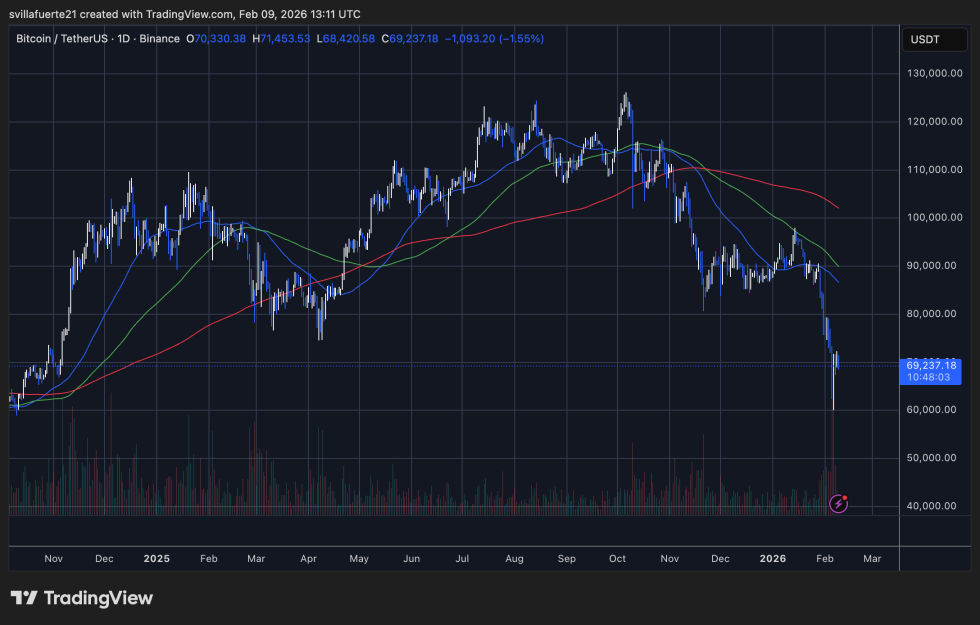
Bitcoin’s latest price action shows a clear deterioration in market structure after the sharp breakdown toward the $65K–$70K region. The chart highlights a decisive loss of short-term support, followed by an aggressive selloff that pushed price well below the key moving averages, signaling sustained bearish momentum rather than a simple correction.
BTC testing fresh demand | Source: BTCUSDT chart on TradingView
Notably, BTC is trading under the 50-, 100-, and 200-period moving averages, all of which are beginning to slope downward. This alignment typically reflects a transition from consolidation into a more established downtrend. The rejection near the mid-$90K area earlier in the cycle appears to have confirmed a lower high, reinforcing bearish continuation risk.
Volume dynamics also deserve attention. The sharp spike during the most recent drop suggests forced selling, likely driven by liquidations and panic positioning. Historically, such spikes can either mark capitulation or precede further downside if follow-through selling emerges.
From a structural perspective, the $65K zone is now critical. Holding above it could allow stabilization and a potential relief bounce. However, a sustained breakdown below this level would likely expose the next demand region closer to the low-$60K range, where stronger historical support may emerge.
Featured image from ChatGPT, chart from TradingView.com
Editorial Process for bitcoinist is centered on delivering thoroughly researched, accurate, and unbiased content. We uphold strict sourcing standards, and each page undergoes diligent review by our team of top technology experts and seasoned editors. This process ensures the integrity, relevance, and value of our content for our readers.
Polymarket said Monday it has filed a federal lawsuit against Massachusetts, arguing that only federal regulators—not individual states—have authority over its event-based prediction markets. Polymarket Seeks Federal Ruling to Block Massachusetts Enforcement Polymarket’s chief legal officer, Neal Kumar, disclosed the action in a post on X, saying the company is seeking to block Massachusetts from […]
XRP’s on-chain data shows mounting stress as profitability collapses, losses deepen, and selling pressure accelerates, signaling a critical behavioral shift among holders that mirrors past downturn phases flagged by Glassnode. XRP On-Chain Profitability Flips Negative After Cost Basis Breakdown, Glassnode Says XRP showed signs of deteriorating holder profitability after on-chain data highlighted a breakdown in […]
Farcaster co-founders Dan Romero and Varun Srinivasan said Monday they are joining stablecoin-focused startup Tempo, signaling a pivot away from crypto-native social media and toward blockchain-based payments.
The move follows last month’s acquisition of Farcaster by Neynar, a long-time infrastructure provider for the protocol that offers APIs and tools for developers building on the network.
Farcaster was once pitched as crypto’s answer to Twitter, a protocol-based alternative where users controlled their identities and data. After Neynar’s acquisition, Romero, Srinivasan and several members of their team at Merkle, the company behind Farcaster, stepped away from the project.
In a post on X, Romero said he’s now focused on building a “fast, inexpensive and transparent” global payments network at Tempo.
Launched quietly last year, Tempo has quickly drawn attention as one of the most well-capitalized new ventures in the stablecoin space. It was incubated by payments giant Stripe and crypto venture firm Paradigm, both of which have deep experience in building and scaling financial infrastructure. Tempo’s goal is to power international payments using stablecoins, offering an alternative to traditional cross-border systems that remain costly, slow and opaque.
Trusted Editorial content, reviewed by leading industry experts and seasoned editors. Ad Disclosure
Bitcoin is struggling to reclaim the $70,000 level after several days of recovery from the recent $60,000 low, reflecting a market still searching for stability. The rebound offered temporary relief following intense selling pressure, yet momentum appears fragile as resistance continues to cap upside attempts. Volatility remains elevated, and sentiment has yet to fully recover from the sharp drawdown that pushed prices toward multi-month lows.
Amid this uncertain backdrop, fresh data indicate that the Binance SAFU Fund has purchased an additional 4,225 BTC, valued at roughly $299.6 million. The move comes at a time when broader market confidence remains subdued, immediately drawing attention from analysts tracking institutional positioning and liquidity dynamics. Historically, large strategic purchases during periods of weakness have sometimes preceded stabilization phases, although they do not guarantee an immediate reversal.
Binance SAFU Fund Bitcoin transfers | Source: Arkham
Market participants are now debating whether this accumulation reflects long-term confidence from major players or simply opportunistic positioning within an ongoing corrective cycle. While some analysts interpret the purchase as a constructive signal, others remain cautious, noting that macro conditions, exchange flows, and derivative positioning continue to exert pressure on price. For now, Bitcoin’s ability to sustain recovery above key resistance levels will likely determine whether this rebound evolves into a trend shift or remains a temporary bounce.
Data from Arkham indicates that Binance’s SAFU Fund has now accumulated a total of 10,455 BTC, worth roughly $734 million at current prices. This expansion of reserves is notable because it occurs during a period of persistent market fragility, when liquidity conditions remain tight, and investor sentiment is still recovering from recent drawdowns. Such activity from a major exchange-linked fund tends to attract attention, as it can reflect both strategic treasury management and broader confidence in Bitcoin’s long-term market structure.
From a market perspective, these purchases matter primarily due to their signaling effect rather than immediate supply impact. While the acquired volume represents only a fraction of circulating supply, institutional accumulation during corrective phases has historically coincided with stabilization periods, particularly when retail flows remain defensive.
However, this should not be interpreted automatically as a bullish catalyst. Exchange inflows, derivative positioning, and macroeconomic uncertainty continue to influence short-term price behavior.
Currently, the market remains in a transitional phase characterized by elevated volatility, cautious positioning, and selective accumulation. Large entities adding exposure while prices consolidate below key resistance levels can indicate long-term confidence, but confirmation typically requires improving liquidity conditions, declining exchange sell pressure, and stronger spot demand. Until those factors align, Bitcoin’s recovery remains tentative despite visible institutional participation.
Market Structure Weakens: Bitcoin Tests Long-Term Support Zones
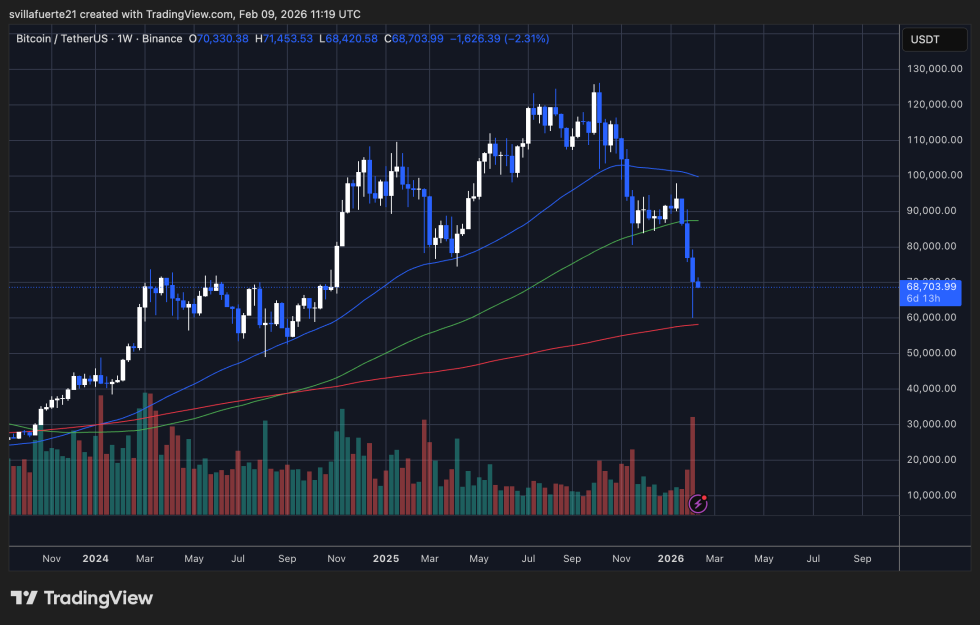
Bitcoin’s weekly structure continues to show a fragile recovery attempt after the sharp breakdown that pushed price back below the $70,000 zone. The chart highlights a clear rejection from the region above $90,000 earlier in the cycle, followed by a sequence of lower highs and accelerated downside momentum. This pattern typically reflects distribution transitioning into a corrective phase rather than a simple pullback.
BTC consolidates around key demand level | Source: BTCUSDT chart on TradingView
Price is currently trading beneath the short-term moving average cluster while approaching the longer-term trend support represented by the 200-week moving average area. Historically, this zone often acts as a structural support during deep corrections, but it does not guarantee an immediate reversal. Momentum indicators inferred from price behavior suggest sellers still dominate the order flow.
Volume dynamics reinforce this interpretation. The recent decline occurred alongside noticeable spikes in trading activity, indicating forced selling, liquidation cascades, or repositioning by large participants rather than passive drift lower.
If Bitcoin stabilizes above the mid-$60K region, consolidation could emerge before a new directional move. However, a sustained breakdown below that zone would likely open the door to deeper retracement levels, potentially testing prior accumulation areas formed earlier in the cycle.
Featured image from ChatGPT, chart from TradingView.com
Editorial Process for bitcoinist is centered on delivering thoroughly researched, accurate, and unbiased content. We uphold strict sourcing standards, and each page undergoes diligent review by our team of top technology experts and seasoned editors. This process ensures the integrity, relevance, and value of our content for our readers.
The Federal Reserve’s proposed “skinny master account” has triggered a rare three-way collision among crypto firms, fintech advocates, and community banks, exposing deep disagreements over who should access the nation’s core payment rails and under what rules. Banks Warn of Risk as Crypto Supports Fed’s Payment Account Prototype In December 2025, the Federal Reserve Board […]
In her latest investment strategy newsletter, Lyn Alden argues that the Federal Reserve has quietly shifted back into balance sheet expansion, ushering in what she calls a “gradual print” rather than a dramatic return to crisis-era stimulus. Alden’s Latest Analysis Breaks Down the Fed’s Balance Sheet Pivot and What Comes Next According to Lyn Alden’s […]
Entrust and Google partner to help highly regulated industries strengthen defenses against fast‑growing, sophisticated fraud while improving onboarding efficiency.
The collaboration combines Entrust AI-powered identity verification (IDV) solutions with the Google Cloud infrastructure, AI capabilities, and extensive security expertise, including threat intelligence and incident response.
Leveraging Gemini AI models, the partnership will deliver a solution built for the rapidly evolving AI landscape.
Entrust, a global leader in trusted identity-centric security solutions, today announced a strategic collaboration with Google to accelerate innovation in identity verification (IDV) and AI-driven security. The integrated solution will help organizations strengthen security defenses against the rapid rise and sophistication of fraud while improving onboarding efficiency through deep reporting and actionable insights. These capabilities are particularly important in highly regulated industries such as financial services and insurance, where the consequences of identity fraud are high for organizations and the people they serve.
With a 40% year-over-year surge in injection attacks at onboarding, the threat of identity fraud is intensifying as the volume and complexity of deepfakes grows, and businesses need robust, multi-layered fraud prevention to protect their customers and operations.
This new partnership will bring together Entrust IDV solutions with Google Cloud’s advanced infrastructure and broad security expertise, including its threat intelligence and incident-response ecosystem, enhanced by its Gemini AI models. Organizations will gain a more sophisticated view of fraud insights and identity verification performance to better understand and respond to their threat environments, through real‑time analytics and clear visibility into emerging trends.
“Our partnership with Entrust reflects Google’s commitment to helping businesses innovate securely and at scale,” said David Engelbrecht, Head of Go-to-Market, Google Cloud. “By combining Entrust identity verification solutions and their deep fraud intelligence with Google Cloud’s AI and infrastructure, we’re enabling organizations to deliver frictionless, trusted experiences for their customers.”
“Partnering with Google allows us to push the boundaries of what is possible in identity-centric security solutions and help the world’s largest organizations stay ahead of increasingly sophisticated fraud while creating seamless digital experiences for their customers,” said Tony Ball, President of Payments & Identity and Incoming CEO at Entrust. “With more than 1 billion identity verifications worldwide, Entrust has unparalleled insight into identity fraud and how to combat it.”
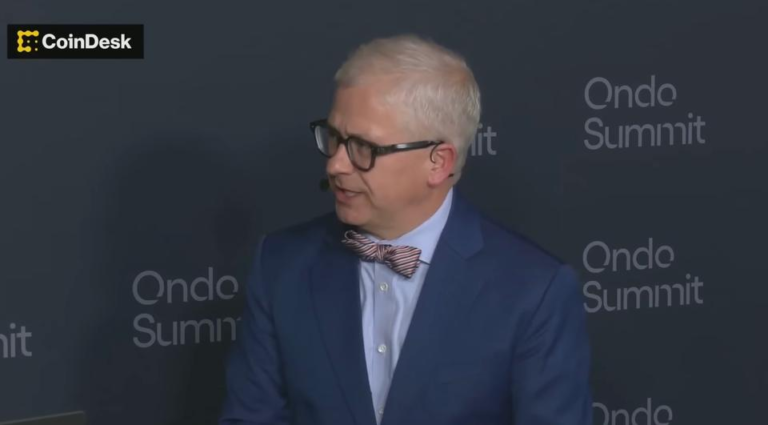
Speaking on CoinDesk Live at the Ondo Summit in New York City, former House Financial Services Chair Patrick McHenry and White House advisor Patrick Witt said a sweeping crypto market structure bill could pass within months.
Latest developments: Optimism is rising across Washington and industry.
McHenry and Witt discussed the growing momentum for landmark crypto legislation, even as debates intensify over yield, DeFi, and ethics.
McHenry predicted a finalized market structure bill could reach the president’s desk by Memorial Day.
Witt said President Trump has personally prioritized the legislation following passage of the Genius Act.
Inside the White House push: Negotiations are narrowing.
Witt said a recent White House–brokered meeting on stablecoin yield surfaced “new areas of agreement” while clearly defining remaining red lines.
He said the administration’s goal is to move from high-level principles to drafting actual legislative language.
Witt emphasized his role is to broker a deal that can survive both Senate and House scrutiny.
The sticking point: Stablecoin yield is the biggest unresolved issue.
Witt said there is broad agreement on banning deceptive practices, including marketing stablecoins as FDIC-insured deposits.
The dispute centers on whether centralized exchanges should be allowed to pay passive yield on idle stablecoin balances.
Banks, especially community lenders, see yield as a threat to deposit funding, while crypto firms argue yield drives platform engagement.
Why DeFi matters: McHenry says it’s foundational.
McHenry said market structure legislation “doesn’t work without DeFi.”
He argued decentralization is the source of crypto’s efficiency, transparency and lower costs compared with traditional finance.
McHenry said tokenized lending products are already cheaper than traditional securities lending, signaling strong market demand.
The politics: Ethics concerns loom but may not block passage.
McHenry said ethics rules should apply permanently to all officials, not target any single administration or family.
Witt said some Democratic proposals would have imposed sweeping restrictions on officials’ spouses and were “grossly over-scoped.”
Both said a narrower ethics compromise could still unlock bipartisan support, though Republicans could move the bill forward on partisan votes if needed.
What comes next: A compressed legislative timeline.
Witt said drafting teams are now “trading paper” and working through specific statutory language.
He said the White House is pushing banks and crypto firms to negotiate in good faith.
McHenry said Senate action could come before Easter, setting up a rapid sprint toward final passage.