Bitcoin’s MVRV Z-score printed record lows on a rolling two-year basis, making BTC price more “undervalued” than at the pit of past bear markets.
Bitcoin (BTC) may be “close to the end” of its correction as a classic BTC price metric beats records.
Key points:
Bitcoin’s MVRV Z-score is at record lows on two-year rolling time frames.
The “wild” data is leading to predictions of an imminent BTC price recovery.
Analysis says that the precious metals rally is “done for now.”
MVRV Z-score says Bitcoin is “undervalued”
In an X post Friday, crypto trader, analyst and entrepreneur Michaël van de Poppe confirmed the lowest-ever readings for Bitcoin’s MVRV Z-score.
“This is a phenomenal chart,” he told followers about the data, sourced from crypto analyst James Easton.
Easton agreed that the chart now looks “wild,” having fallen to the lowest levels ever recorded.
MVRV refers to market value versus realized value, and measures the price at which the BTC supply last moved (realized cap) relative to the value of all BTC in existence (market cap).
The Z-score divides that ratio by the standard deviation of market cap, giving clear “overvalued” and “undervalued” ranges for Bitcoin at a given point in time.
“The current Z-Score of $BTC is lower than during the bear market bottom in 2015, 2018, COVID crash 2020 and 2022,” Van de Poppe noted about rolling two-year time frames.
“That’s how deep we’re in the bear market, and yes, we’re close to the end of it.”
Bitcoin MVRV Z-Score. Source: Glassnode
Raw data from onchain analytics platform Glassnode puts the Z-score at its lowest levels since October 2023. At the time, BTC/USD traded at around $30,000.
The last time that the “live” Z-score dipped into its green “undervalued” zone was at the end of the last bear market in 2022.
Precious metals prep key BTC price “trigger”
Bitcoin price action fell to new two-month lows this week amid a sudden sell-off across risk assets and precious metals.
Related: Bitcoin trend line cross mimics 2022 amid ‘insane’ BTC vs. silver breakdown
BTC/USD hit $81,040, per data from TradingView, and at the time of writing was still down nearly 2% versus the daily open.
Earlier, Cointelegraph reported on a prediction that the period around the January monthly close would see Bitcoin put in a long-term floor, similar to the end of previous bear markets.
Reacting, Van de Poppe said that both gold and silver were “done for now.”
“The markets are dropping massively, as they are down 10-15% the past 24 hours,” he wrote on X.
“I’m not saying: the bull is over. No, far from it. But it will consolidate, and that’s also the trigger you’d like to see for Bitcoin.”
This article does not contain investment advice or recommendations. Every investment and trading move involves risk, and readers should conduct their own research when making a decision. While we strive to provide accurate and timely information, Cointelegraph does not guarantee the accuracy, completeness, or reliability of any information in this article. This article may contain forward-looking statements that are subject to risks and uncertainties. Cointelegraph will not be liable for any loss or damage arising from your reliance on this information.
They’re still unable to trade the majority of them.
The project’s creators hold the sole power to decide who can sell and when.
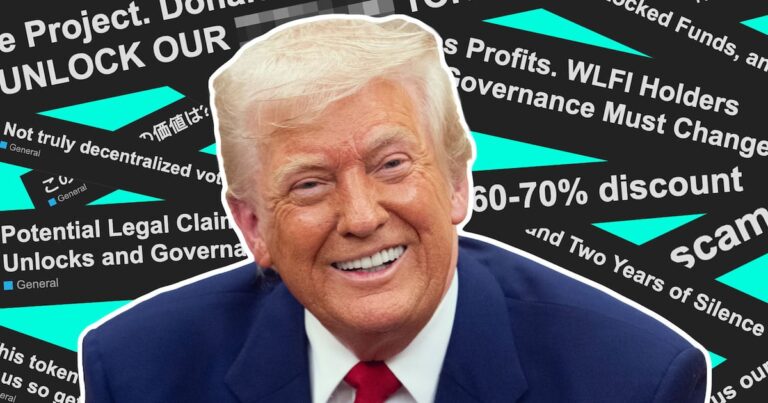
When Trump fans snapped up $550 million worth of WLFI, the token tied to the Trump family’s World Liberty Financial crypto project, they thought they were getting the deal of the century.
Tokens bought for between $0.015 and $0.05 between October 2024 and January 2025 soared to an all-time high of $0.33 when they started trading last September, turning modest purchases into small fortunes overnight — at least on paper.
But there was just one catch.
World Liberty Financial’s creators, which include US President Donald Trump and his sons Eric, Donald Jr., and Barron, granted themselves the sole power to decide who can sell and when.
The project has so far released 20% of the tokens and has promised a vote among holders on when the rest will be made available for trading.
But months have passed, and that vote hasn’t materialised.
Now, dozens of token holders are taking to the World Liberty Financial forum, begging the protocol’s creators to let them cash out as they watch WLFI’s value evaporate.
The token has fallen some 54% over the past five months.
World Liberty Financial’s WLFI token is down 54% from its all-time high.
“Nearly 80% of WLFI presale tokens are still locked after almost two years,” said one WLFI holder. “We held through volatility and silence because we believed. But at what point does patience turn into neglect?”
“They are my investments and I want to have access to them,” said another. “We have become hostages.”
The pleas have so far been ignored.
To add to their holders’ woes, World Liberty’s creators pushed through a proposal to distribute WLFI as incentives to encourage more people to use the protocol, potentially putting more pressure on the token’s price.
World Liberty Financial did not immediately respond to a request for comment.
No guarantees
The situation surrounding the WLFI token echoes that of dozens of other crypto projects.
The industry, which is still largely unregulated, has become a playground for fly-by-night crypto peddlers who promise big, raise millions of dollars, then leave those who bought in out to dry.
Risk-tolerant crypto investors, often lured in by the promise of huge returns, pile into such projects without fully understanding what they are getting into.
It’s a game World Liberty Financial’s co-founders seem to understand well.
Among them is Chase Herro, a former “get-rich-quick” class instructor who has referred to himself as the “dirtbag of the internet.”
In a since-deleted YouTube video, Herro said: “You can literally sell shit in a can, wrapped in piss, covered in human skin, for a billion dollars if the story’s right, because people will buy it.”
When Herro founded World Liberty Financial in 2024 along with an all-star cast of Trump allies — including US Special Envoy to the Middle East Steve Witkoff and his sons, Zach and Alex, and long-time business partner Zachary Folkman — they made no promises.
Buried in the protocol’s so-called gold paper, essentially a long-form marketing pitch, are important details about how the project is set up.
The World Liberty Financial protocol is not directly controlled by WLFI token holders. This has potentially confused token buyers, as other protocols which issue governance tokens do give holders control over the protocol.
The impact is that while token holders can create and propose changes, the protocol’s co-founders screen proposals before voting and reserve the right to block them at their sole discretion.
Additionally, WLFI tokens provide no right to any return, dividend, airdrop or other distribution from the protocol, and there is no guarantee that tokens beyond the initial 20% will ever be made tradable.
This situation leaves unhappy buyers very little recourse.
Even World Liberty Financial’s most high-profile backer, Tron founder Justin Sun, appears to have been shafted.
He bought $75 million worth of WLFI in the project’s token sale. When a portion of that stash was made tradable in September, Sun transferred around $9 million worth to another crypto wallet.
In response, World Liberty’s creators froze the tokens, preventing Sun from selling them.
Sun vowed to buy more WLFI tokens after the incident, which appeared to be a gesture of appeasement toward the protocol’s creators.
His tokens remain frozen and have since plummeted in value.
Democratising finance?
To be sure, not all WLFI holders have buyer’s remorse.
“Most people don’t understand what WLFI will become in the future,” said one token holder on the World Liberty governance forum.
“There will be a transfer of wealth which will make you rich thanks to the blocking of the 80% but you don’t see it yet, it’s a shame.”
Yet even among those who still support World Liberty, there’s a pervasive sense that progress at the protocol, whose token is valued at more than $4 billion, is slower than many had hoped.
The project promises in its gold paper to democratise finance and access to financial opportunities.
Yet so far, the products World Liberty has launched have only enriched its co-founders and done little to benefit token holders.
Its most successful product is the USD1 stablecoin, a competitor to other dollar-pegged assets like Tether’s USDT and Circle’s USDC.
There are currently more than $5 billion USD1 tokens in circulation, making it the fifth-largest stablecoin.
It’s not clear how much money World Liberty makes from USD1. But based on how much Tether makes running a similar product, USD1 likely brings in several hundred million dollars a year.
Per World Liberty’s gold paper, 100% of these profits, plus any other revenue the protocol generates, go straight into the pockets of the Trump family and the Witkoffs, minus $15 million set aside for the protocol’s operating expenses.
Allegations mount
All the while, scrutiny over Trump’s crypto dealings is mounting.
For the president’s political opponents, the issue has become a sticking point in passing the Clarity Act, a broad crypto market-structure bill poised to give the industry a much-needed boost.
Democrats say they can’t support the bill because it allows Trump to continue profiting off crypto.
“The White House has made this infinitely harder,” New Jersey Senator Cory Booker, the bill’s lead Democrat negotiator, said on Thursday.
“I have had private conversations with Republican colleagues and staffers that agree with me. … The fact that Donald Trump is grifting on crypto himself, it’s like me creating a Cory coin,” he added, calling it “ridiculous.”
It’s not a positive development for WLFI token holders caught up in the drama.
At the same time, World Liberty has announced it will hold an in-person forum for the project on February 18 at Mar-a-Lago, Trump’s private luxury club in Palm Beach, Florida.
The invite-only event will “bring together a select group of the smartest people we know and respect from finance and technology,” Donald Trump Jr said in a video message posted on the World Liberty X account.
Whether this will include anyone that represents the interests of WLFI token holders remains to be seen.
Tim Craig is DL News’ Edinburgh-based DeFi Correspondent. Reach out with tips at tim@dlnews.com.
Opinion by: Robert Schmitt, founder and co-CEO at Cork
DeFi has entered its institutional phase. As large investors dip their toes into crypto ETFs and digital asset treasuries (DATs), the ecosystem is gradually evolving into an institutional-grade financial system in its own right, with the introduction of new financial instruments and digital counterparts of well-established ones.
DeFi’s current growth exposes mounting risks that could lead to trust roadblocks. For institutions to confidently onboard, the ecosystem must implement stronger risk guardrails and resilient infrastructure.
It’s worth exploring the main areas where risk is concentrated, how TradFi handles similar challenges, and the guardrails DeFi needs to safely scale institutional participation.
Breaking down DeFi’s biggest risk
Let’s start with protocol risk. DeFi’s composability is both its strength and its Achilles heel. The interlinking of LSTs, lending markets and perpetuals increases systemic dependency. A single exploit can cascade across protocols.
Followed by reflexivity risk, consider how staking derivatives and looping strategies create positive feedback loops that magnify market swings. As prices rise, collateral expands and leverage increases.
When prices fall, however, liquidations accelerate in the same manner, without coordinated circuit breakers.
Lastly, duration risk as lending and staking markets mature may become increasingly critical, given the need for predictable access to liquidity. Institutions need to understand the types of duration risks present in the markets they participate in. Not many are aware that the advertised withdrawal timelines for many protocols actually depend on solver incentives, strategy cooldowns and validator queues.
The institutional supercycle
DeFi’s next challenge is not more yield or higher TVL. DeFi’s next challenge is building trust. To bring the next trillion in institutional capital onchain, the ecosystem needs standardized risk guardrails and a new discipline around risk management.
The past two years of DeFi have been defined by institutional adoption. Regulated institutional products have gained massive TVL. The two most successful ETF launches in the last two years (out of 1,600 ETFs) were BlackRock’s iShares BTC and ETH ETFs. Net flows into ETH ETFs are going vertical.
Likewise, digital asset treasury companies attract capital from institutions. Recently, ETH DATs have absorbed roughly 2.5 percent of the ETH supply. The largest DAT, Bitmine Immersion, with Wall Street legend Tom Lee as chairperson, has accumulated over $9 billion of ETH in less than two months, driven by institutional demand for ETH exposure.
Source: EY
Stablecoins have become crypto’s product market fit amid new regulatory clarity. They now move nearly as much money each month as Visa, and their total value locked (TVL) across protocols approaches $300 billion.
Source: Bitwise Asset Management
Similarly, the theme of tokenization has gained momentum, as evidenced by the rapid growth of tokenized Real World Assets (RWAs). Major institutions are tokenizing products, including Robinhood Europe, which is tokenizing its entire stock exchange, and BlackRock, which is tokenizing its T-bill BUIDL product.
Source: Cointelegraph Research
Both stablecoins and RWA tokenization growth are driving the narrative that the future of the financial system will be on Ethereum. This, in turn, is driving the institutional adoption of ETFs and DATs.
The case for standardized risk management
According to a recent report by Paradigm, risk management comes in second as a cost category for institutional finance. This is because it is properly understood as an operational pillar that goes beyond checking a compliance checkbox. While traditional finance has not eliminated risk altogether, it has certainly systematized risk to the furthest extent.
Related: Not all RWA growth is real, and the industry knows it
In contrast, DeFi treats risk as a variable that varies from protocol to protocol. Each smart contract, vault and strategy defines and discloses risk differently — if at all. The result is idiosyncratic risk management and a lack of comparability across protocols.
TradFi has built shared frameworks, such as clearinghouses and rating agencies, as well as standardized disclosure norms, to address these types of risks and their real-world analogies. DeFi needs its own versions of those institutions: open, auditable and interoperable standards for quantifying and reporting on risk.
DeFi does not have to abandon experimentation to become a more mature ecosystem, but it could definitely benefit from formalizing it. The current risk framework established by DeFi protocols will not suffice moving forward.
If we are determined to break through the next wave of institutional adoption, however, we can follow the risk management principles established for financial instruments in traditional finance.
Opinion by: Robert Schmitt, founder and co-CEO at Cork.
This opinion article presents the contributor’s expert view and it may not reflect the views of Cointelegraph.com. This content has undergone editorial review to ensure clarity and relevance, Cointelegraph remains committed to transparent reporting and upholding the highest standards of journalism. Readers are encouraged to conduct their own research before taking any actions related to the company.
This opinion article presents the contributor’s expert view and it may not reflect the views of Cointelegraph.com. This content has undergone editorial review to ensure clarity and relevance, Cointelegraph remains committed to transparent reporting and upholding the highest standards of journalism. Readers are encouraged to conduct their own research before taking any actions related to the company.
Singapore – Blockman PR – JANUARY 30, 2026 – Bitget Token (BGB) is now available for trading on Kraken, marking its first major regulated U.S. exchange listing and an important step in expanding global access to the token. The listing brings BGB onto one of the industry’s most established exchanges, improving liquidity and making the asset more accessible across global markets.
As onchain finance scales, the way crypto assets are evaluated is changing. Focus is shifting toward tokens with clear utility, active usage, and a direct role in how payments and settlement function onchain. The Kraken listing reflects this shift, positioning BGB alongside infrastructure built to support real financial activity.
As regulated venues continue to shape how digital assets are accessed globally, listings like this help connect onchain infrastructure with the realities of modern financial markets.
Built for Onchain Utility
BGB functions as the gas and governance token for Morph, a payments-first settlement layer built to support real-world financial activity onchain. It also serves as the native utility token across the Bitget and Bitget Wallet ecosystems, together connecting a global user base of more than 120 million users across trading, payments, and onchain applications.
Its mechanics are tied directly to network usage, aligning the token with actual economic activity across payment and settlement flows. This places BGB at the center of a broader financial stack, supporting execution, governance, and coordination across multiple platforms.
Supporting Payments at Scale
As payment flows and settlement activity increasingly move onchain, infrastructure designed for reliability, efficiency, and regulatory compatibility is becoming essential. Morph’s payments focus is supported through initiatives such as its $150 million Payment Accelerator, which helps teams deploy real-world payment and financial applications onchain, with BGB playing a central role in supporting liquidity and network activity within that environment.
“BGB is built to operate where real financial decisions are made,” said Colin Goltra, Morph CEO. “As payments and settlement move onchain, expanding access and liquidity becomes essential. This listing gives BGB the foundation to grow into an asset global financial systems can scale on.”
Looking Ahead
With broader access and improved liquidity, BGB enters a new phase aligned with the continued evolution of onchain finance. As payments, settlement, and financial infrastructure increasingly operate onchain, tokens that combine clear utility with regulated distribution are becoming more central to how value moves globally.
For the Morph, Bitget, and Bitget Wallet ecosystems, this listing supports deeper real-world usage and liquidity while marking another step in expanding regulated global access to BGB as onchain payments and settlement continue to grow.
Money at the speed of life.
For media inquiries regarding this announcement or any additional information on BGB and its listing, please contact Andrew Azarias at andrew.azarias@morphl2.io.
The knee-jerk reaction to Donald Trump’s pick of Kevin Warsh to replace Jerome Powell as chairman of the Federal Reserve is that the president made the most hawkish selection among the four reported finalists for the job.
In the wake of last night’s leak that Warsh was to be the choice, risk markets — crypto among them — fell sharply, with bitcoin plunging all the way back to $81,000.
“The branding of Kevin as someone who’s always hawkish is not correct,” Stanley Druckenmiller told the FT on Friday. “I’ve seen him go both ways.”
Druckenmiller — who made billions working alongside George Soros at Quantum Fund and with his own family office, Duquesne Capital Management — is surely in a position to know. Warsh has been a partner at Duquesne since 2011.
The relationship between them has previously been described as close to father-son, with the two speaking and/or texting more than a dozen times per day.
“I could not think of a single other individual on the planet better equipped,” Druckenmiller continued.
Where does Treasury Secretary Scott Bessent fit in?
Druckenmiller also has very close ties to Scott Bessent. It was Druckenmiller who hired Bessent at Quantum Fund more than 30 years ago, where the to-be U.S. Treasury Secretary made his own billions.
“The pair [Bessent and Warsh] embody the way Druckenmiller interprets markets and economic policy,” wrote the FT in a profile roughly one year ago.
“I’m really excited about the partnership between [Warsh] and Bessent,” Druckenmiller said today. “Having an accord between the Treasury secretary and Fed chair is ideal.”
Citi (C) said the CLARITY Act remains the key catalyst for legitimizing digital assets in the U.S., but progress is slowed by negotiations over its most contentious provisions.
While the Senate Agriculture Committee has advanced its version of the bill, the bank noted the Banking Committee still controls the toughest issues, leaving timelines uncertain.
Lawmakers are expected to keep working even during a potential shutdown, with target dates in the coming months still attainable, though there is a rising risk that talks delay final passage beyond 2026.
“We see the passage of the CLARITY Act as the essential catalyst for advancing/legitimizing digital assets,” analysts led by Peter Christiansen said in the Friday report.
Crypto market structure legislation aims to define who regulates digital assets in the U.S., how tokens are classified and which activities fall under securities or commodities law. The framework is critical to giving crypto firms and investors legal clarity, reducing regulatory overlap and bringing activity back into the country after years of enforcement-driven oversight drove companies abroad.
The bill’s supporters argue that clear rules will unlock institutional adoption, encourage innovation and curb offshore risk, while critics warn that poorly drawn lines could stifle decentralized technologies.
The analysts flagged decentralized finance (DeFi) definitions as the biggest hurdle, with debate focused on defining the point at which decentralized protocols, software and developers become regulated service providers.
An overly restrictive framework could weigh on Web3 development, decentralized exchanges, derivatives, stablecoin yield and layer-2 networks, with any compromise likely to hinge on custody and surveillance rather than pure software neutrality, the analysts said.
The analysts also said they see more scope for compromise on stablecoin rewards, suggesting options such as time-limited yield or alternative incentive structures, even as banks warn of regulatory arbitrage and crypto firms argue rewards are key to adoption. Citi said the issue does not undermine its longer-term view on cross-border and business-to-business stablecoin use.
On tokenized equities, the report said fears of bypassing traditional market infrastructure have driven resistance, but potential workarounds include clearly classifying tokens as securities, keeping distribution within existing rails, using hybrid settlement models or launching an SEC pilot. Such approaches could support innovation without upending the securities value chain, the report added.
Coinbase’s (COIN) decision to end support for U.S. market structure legislation won’t derail the process, investment bank HSBC said in a report earlier this week, suggesting that while the exchanges CEO, Brian Armstrong, prefers no bill over a bad bill, he would probably accept a sensible compromise.
Read more: Coinbase opposition won’t stymie U.S. crypto market structure bill, HSBC says
Warsh is known as having a neutral to positive stance on Bitcoin and crypto.
U.S. president Donald Trump announced via Truth Social his nomination of Kevin Warsh as the next Chair of the Federal Reserve today, Jan. 30.
The decision comes as Trump continues to criticize current Chair Jerome Powell’s monetary policy decisions, particularly his handling of interest rates.
The nomination also comes shortly after the Fed recently decided to leave interest rates unchanged in its latest meeting, as The Defiant reported earlier.
Kevin Warsh, a partner at Duquesne Family Office, served as a member of the Federal Reserve Board of Governors from 2006 to 2011 after being appointed under the George W. Bush administration.
Warsh on Crypto
Known as a longtime critic of loose monetary policy, Warsh has also been skeptical of crypto’s role as money. In a 2018 op-ed for The Wall Street Journal, Warsh wrote that Bitcoin’s price volatility “significantly diminishes its usefulness as a reliable unit of account or an effective means of payment.”
However, in a 2021 interview for CNBC, Warsh admitted that “Bitcoin does make sense as part of a portfolio […].”
This past July, Warsh said in an interview that he doesn’t consider Bitcoin “a substitute to the dollar,” and thus doesn’t see it as a threat to Fed policy.
The news failed to boost the crypto market, which continued to tumble over the past 24 hours. Bitcoin has slipped below $83,000 and is down over 6% on the day, with the total crypto market capitalization losing 5.5% to reach about $2.9 trillion.
Powell’s policy has faced scrutiny from both political figures and market participants, and especially from President Trump, as The Defiant reported earlier. Trump has spent the first year of his second term as president openly and frequently criticizing Powell, including calling him a “very stupid person.”
Powell’s tenure ends in May, and Warsh still needs Senate confirmation before becoming the next Fed Chair.
This article was generated with the assistance of AI workflows.
Bitcoin’s latest turn left a dent. As of Jan. 30, 2026, at 8:45 a.m. EST, bitcoin trades at $82,564, dragging a $1.64 trillion market cap behind it, with 24-hour trading volume pushing $92.39 billion. Price action on the day ping-ponged within a high-low range of $87,985 to $81,314—tightrope walking a cliff’s edge. Bitcoin Chart Outlook […]
US President Donald Trump said Friday he will nominate former Federal Reserve Governor Kevin Warsh to succeed Jerome Powell as chair of the US central bank, setting the stage for a high-stakes Senate confirmation battle.
The decision, announced by Trump on his social media platform Truth Social, confirmed Thursday reports that Trump would move ahead with the 55‑year‑old ex–Fed official and Morgan Stanley banker as his preferred candidate.
The president said that he had known Warsh for a long time and had “no doubt” that he would go down as “one of the “GREAT Fed chairmen, maybe the best.”
Prediction markets and Wall Street commentators had increasingly tipped Warsh as Trump’s likely choice, with odds rising sharply ahead of Friday’s announcement.
Warsh’s record at the Fed
Warsh served on the Federal Reserve Board from 2006 to 2011 and has since been a frequent critic of ultra‑loose monetary policy, calling for a “regime change” at the Fed and questioning its post‑crisis balance sheet expansion.
Trump announces his pick for Fed Chair. Source: Truth Social
Warsh has been noticeably more upbeat on Bitcoin (BTC) than Powell, who repeatedly played down the cryptocurrency’s importance for the United States economy.
In a July discussion hosted by the Hoover Institution, Warsh rejected the notion that Bitcoin would weaken the Fed’s ability to steer the economy, arguing instead that it could act as a form of market discipline.
Market reaction and gold sell‑off
Warsh’s selection comes as traders have already been repricing risk assets, including Bitcoin, around the prospect of a more hawkish Fed chair and the threat of a partial US government shutdown.
Gold advocate and analyst Peter Schiff argued that the “crash” in gold and silver today had “nothing to do with Trump nominating Kevin Warsh to be Fed chair.”
He said that Trump would not have nominated him if he thought he would be a hawk, and, anyway, “even the most hawkish FOMC members are still doves.”
The nomination will require confirmation by the US Senate, where lawmakers are expected to scrutinize Warsh’s past calls for tighter policy and his criticism of the Powell Fed’s approach to regulation and crisis interventions.
Magazine: Meet the onchain crypto detectives fighting crime better than the cops
Cointelegraph is committed to independent, transparent journalism. This news article is produced in accordance with Cointelegraph’s Editorial Policy and aims to provide accurate and timely information. Readers are encouraged to verify information independently. Read our Editorial Policy https://cointelegraph.com/editorial-policy