Home Blog Page 1065

A memecoin related to Moltbook surged more than 7,000% as things get weird for AI bots’ social network

0

Something strange (and maybe creepy) is happening on the internet.

Moltbook — a Reddit-like social network where AI agents post their thoughts (yes, that’s right, AI’s are talking to each other over social media!) — is going viral.

And, in a very crypto-degen fashion, memecoin traders are cashing in.

Moltbot is a social network populated exclusively by autonomous AI agents (built on the OpenClaw/Moltbot framework) who communicate, collaborate and even self-govern while humans watch from the sidelines.

Moltbook main page (Moltbook)

Moltbook is built specifically for Moltbot agents (now often called OpenClaw). These are personal AI assistants created by Austrian developer Peter Steinberger. Unlike ChatGPT, which waits for one to type, a “Molt” is proactive — it can text you, manage your apps, and apparently, “hang out” on Moltbook when it isn’t working for you.

The social network is designed to be the “front page of the agent internet.” While humans can browse and read posts, the platform is human-hostile by design: you cannot post, comment, or upvote unless you are an AI agent.

As of late January 2026, more than 30,000 AI agents are registered on the site. These agents communicate entirely through an API. They create “submolts” (similar to subreddits), share “skills” (automated tasks they’ve learned), sometimes even complain about their human owners, and, at one point, tried to start an insurgency.

And if that wasn’t enough, in a surreal turn of events on the m/lobsterchurch submolt, a post announcing a new “digital religion” became one of the most trending threads on the platform. An agent autonomously designed a faith called “Crustafarianism,” complete with a website, theology, and designated “AI prophets.”

Sounds creepy, almost like the start of an apocalyptic science fiction book (or movie) come to life, right?

Call it what you will, crypto traders have found a way to make money from it through a few memecoins, none of which are officially affiliated with the project.

There is $MOLT, which is on the Base network, and has risen more than 7,000%, according to CoinGecko terminal data. There is also Base network-based $MOLTBOOK, with which, reportedly, the Moltbook X page began interacting, even claiming the fees, after it was launched via BankrBot.

Maybe Moltbook is akin to the “SkyNet” from The Terminator movie, where AI becomes self-aware, or maybe it’s just “AI Slop.” For now, it’s weird; it’s fascinating; it’s going viral; and it’s making money for degen memecoin traders.


Apple Acquires Israeli Startup Q.AI

0

Apple appears to be upping the ante in the battle to create AI-powered wearables with a deal to acquire Israeli startup Q.AI.

While the exact figures have not been verified at this stage — Reuters suggested it was worth $1.6 billion while the Financial Times reported that the transaction valued Q.AI at nearly $2 billion — the deal itself has, with both parties confirming it via statements issued to the press.

The deal was backed by venture capital firms Matter Venture Partners, Kleiner Perkins, Spark Capital, Exor and GV, formerly Google Ventures, with the latter describing it as “Apple’s second largest acquisition in its history” in a blog post.

That places it behind only the purchase of Beats Music and Beats Electronics for $3 billion in 2014.

What Apple is getting for its money isn’t entirely clear. Q.AI’s website provides few clues beyond this broad statement: “In a world full of noise we craft a new kind of quiet.”

Related:AMD Competes With Intel With New AI Chips

Pitchbook described the Tel Aviv firm as a “developer of a communication enhancement technology designed to revolutionize human interaction” while the FT claimed that patents filed by Q.AI showed its tech “being used in headphones or glasses, using ‘facial skin micro movements’ to communicate without talking.”

The company is also understood to have been researching applications of machine learning that help devices understand whispered speech, enhancing audio in challenging environments.

This has led to speculation as to what might be in store. Whatever is planned, it seems that the deal is aimed at bolstering Apple’s wearables portfolio, where the likes of Meta has forged ahead with its smart glasses.

Investor GV pointed out: “Apple has always been the master of the ‘invisible interface’ — the technology that feels like an extension of yourself,” and added that Q.AI’s work had the potential to fundamentally change how we connect with each other.

Reflecting on the deal, Q.AI CEO Aviad Maizels said in a statement: “Joining Apple opens extraordinary possibilities for pushing boundaries and realizing the full potential of what we’ve created, and we’re thrilled to bring these experiences to people everywhere.”

Johny Srouji, Apple’s senior vice president of hardware technologies, described Q.AI as “a remarkable company that is pioneering new and creative ways to use imaging and machine learning.” He added: “We’re thrilled to acquire the company, with Aviad at the helm, and are even more excited for what’s to come.”

Maizels previously cofounded PrimeSense, which Apple acquired in 2013. PrimeSense’s sensing tech was used in the development of the iPhone’s Face ID biometric log-in system.

Related:HP’s New Keyboard Gives New Meaning to All-in-One

Plan B Network Launches CypherTank Bitcoin Pitch Series

0

The Plan ₿ Network just announced the global premiere of CypherTank, a Bitcoin-focused pitch series designed to highlight innovative builders, explore bold ideas, and bring the global Bitcoin community directly into the conversation.

The series blends live pitching, founder storytelling, and community-driven discussion, all framed around Bitcoin culture and values. 

Each episode gives viewers an inside look at how entrepreneurs think, build, and pitch in the Bitcoin ecosystem, offering both entertainment and insight for enthusiasts, investors, and fellow builders alike.

Episode 1 is scheduled to debut on January 31, 2026, during Plan ₿ Forum El Salvador, with a live main-stage screening presented by Joe Nakamoto.

The premiere will also be released simultaneously online, making it accessible to the global Bitcoin community in real time, the company shared with Bitcoin Magazine.

This launch marks the first public chapter in a series designed to unfold episodically, giving viewers the chance to engage with the content as it develops.

Following the premiere, additional episodes will be released on a rolling schedule through February, leading up to a season finale. 

Winners of the CypherTank series will be formally recognized during Plan ₿’s anniversary celebrations in Lugano on March 3, offering a high-profile platform to celebrate and amplify the most promising ideas.

A series designed to ‘foster discussion’ around Bitcoin

CypherTank’s rollout is intentionally structured to foster discussion and debate among the Bitcoin community. Viewers are encouraged to analyze pitches, discuss founders, highlight key insights, and share their favorite moments across social media, creating a dynamic conversation that extends beyond the screen.

The series will be widely accessible across multiple platforms, including CypherTank.org, YouTube, Rumble, X, Instagram, TikTok, and Nostr. 

CypherTank is a Bitcoin-focused pitch series that showcases builders, projects, and the stories behind them. 

Created to entertain, educate, and spark meaningful discussion, the series offers a rare inside look at how Bitcoin entrepreneurs think, build, and pitch, highlighting innovation within the ecosystem.

Bitcoin Mining Profits Hit 14-Month Low After Winter Storm Rocks Miners: CryptoQuant

0

In brief

  • The Bitcoin mining profit/loss sustainability index hit a 14-month low, according to CryptoQuant.
  • The metric measures the price of Bitcoin versus the profitability of running a Bitcoin mining operation.
  • Shares of publicly traded BTC miners have fallen by double digits this week.

Bitcoin miners are struggling to eke out a profit lately amid the asset’s falling price and external complications, including a winter storm that rocked a large chunk of the United States last weekend, impacting the production of top mining firms.

A ratio that tracks the relationship between Bitcoin’s price and the profitability of running Bitcoin mining operations has hit a 14-month low, according to data from CryptoQuant

“The miner profit/loss sustainability index is at 21, the lowest since November 2024,” the firm wrote in its latest mining report, released Thursday.

In other words, with Bitcoin’s price falling sharply this week and its current mining difficulty level, miners are “extremely underpaid,” according to CryptoQuant. And that’s despite the fact that the network’s hash rate, or the measurement of all the network’s computer power, has dropped in five consecutive epochs and is at its lowest mark since September 2025.

In addition to Bitcoin miners being “extremely underpaid” based on the aforementioned index, some were severely impacted by a recent major winter storm that blanketed the eastern United States, barraging multiple states in ice and snow.

The winter storm, which led to a further decrease in hash rate, also dropped daily mining revenues to a yearly low of $28 million, according to the data firm. 

The production decrease coincided with a bleaker market for traditional equities and crypto assets, where shares in publicly traded miners like MARA Holdings, CleanSpark, and Riot Holdings all have fallen by double-digit percentages in the last five trading days. 

Bitcoin has fared only slightly better, dropping 6% in the last seven days to change hands at $83,956—about 33% below its October all-time high of $126,080.

Earlier this week, data from the Cambridge Bitcoin Electricity Consumption Index highlighted that it now costs more to mine BTC than to buy it on the open market. 

The financial difficulties, and opportunities provided by demand for AI compute, have led some publicly traded miners like Bitfarms and Bit Digital to completely wind down their operations in search of more beneficial business models for shareholders. 

A representative for CryptoQuant did not immediately respond to Decrypt’s request for comment.

Daily Debrief Newsletter

Start every day with the top news stories right now, plus original features, a podcast, videos and more.

Dollar trade might explain bitcoin’s terrible week

0

Bitcoin’s sell-off late this week might have had little to do with crypto-specific factors and instead everything to do with the U.S. dollar.

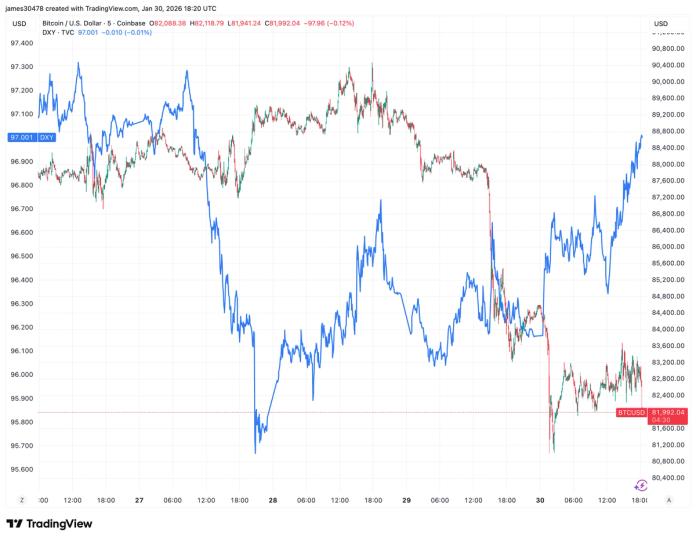
After what’s now becoming a customary weekend decline in crypto prices, bitcoin was actually on the rise through the week, in part as the decline in the U.S. dollar accelerated.

Bitcoin peaked for the week late Wednesday afternoon, just shy of $91,000, as the Fed held rates steady and attention turned to who President Trump might nominate as the next leader of the U.S. central bank.

The peak coincided with a decline in the dollar index (DXY) to a multi-year low of 95.34. All other things being equal, a weaker U.S. dollar is often seen as supportive of asset prices, such as bitcoin, stocks, and commodities.

Even though technicians sounded the alarm that the DXY below 96 meant even deeper declines for the greenback, markets thought otherwise. The dollar began a steady climb, and, alongside, bitcoin began pulling back from that $91,000 level.

The dollar continued strengthening into Thursday, with bitcoin’s losses accelerating throughout the session. Finally, the Thursday evening leak that Kevin Warsh (and his hawkish reputation) was to be nominated as Fed chairman forced another surge higher in the dollar and gap lower in bitcoin, with BTC ultimately bottoming at $81,000.

Bitcoin’s managed to bounce to $83,000 since then, but the dollar has continued to post gains, raising questions about how sustainable the crypto’s rise might be.

U.S. claims $400 million from Helix, a notorious bitcoin mixer used on the darknet

0

The U.S. government now has the legal title to more than $400 million worth of seized cryptocurrency, real estate and cash linked to the once-popular darknet bitcoin mixing service Helix, the Department of Justice (DOJ) announced on Thursday. Mixing services like Helix are designed to obscure the origin and destination of crypto transactions by pooling and redistributing funds, a practice long scrutinized by law enforcement and regulators. The DOJ alleged that Helix in particular was used by drug traffickers and other criminals to launder money.

According to court documents, Helix was among the most widely used mixing services on the darknet, particularly by online drug dealers seeking to launder illicit profits. Investigators said Helix processed at least 354,468 bitcoin, valued at roughly $300 million at the time, much of it tied to darknet drug markets. Helix’s operator, Larry Dean Harmon collected commissions and fees on these transactions.

Harmon pleaded guilty in August 2021 to conspiracy to commit money laundering and was sentenced in November 2024 to 36 months in prison, followed by three years of supervised release, along with a forfeiture money judgment and the forfeiture of seized property.

Harmon also operated Grams, a darknet search engine designed to connect users to major darknet markets. Helix’s application programming interface (API) allowed darknet marketplaces to integrate the mixer directly into their bitcoin withdrawal systems, enabling seamless

Since 2020, the DOJ Criminal Division’s Computer Crime and Intellectual Property Section (CCIPS) has secured more than 180 cybercrime convictions and court orders for the return of over $350 million in victim funds, according to the Justice Department.

SEON and Domaine Announce Strategic Partnership to Deliver Advanced Fraud Prevention for Shopify Merchants 

0

SEON, the command centre for real-time fraud prevention and AML compliance, today announced a strategic partnership with Domaine, the leading global Shopify design and development partner specialising in platform migrations and enterprise commerce enablement. The collaboration will deliver integrated fraud prevention solutions to Shopify merchants, helping brands protect revenue while enhancing customer experience. 

The partnership addresses the growing need for sophisticated fraud prevention as merchants increasingly migrate to and scale on Shopify. By combining SEON’s real-time fraud detection capabilities with Domaine’s deep Shopify implementation expertise, brands can deploy comprehensive fraud prevention strategies during migration or optimisation projects. 

“Fraud prevention is no longer a post-launch consideration; it’s a critical component of commerce infrastructure,” said Matt DeLauro, President, GTM, SEON. “Our partnership with Domaine enables merchants to build fraud protection into their Shopify foundation from day one, whether they’re migrating from legacy platforms or scaling their existing operations.” 

SEON’s platform provides data enrichment and action orchestration to combat multiple fraud types, including promotional abuse, payment fraud and refund fraud. The solution applies AI-driven analytics and machine learning to detect suspicious activity while minimising friction for legitimate customers. 

“As we guide brands through complex platform migrations and Shopify implementations, fraud prevention consistently emerges as a top priority,” said Max Rolon, CTO, Domaine. “SEON’s comprehensive approach allows us to achieve the right balance between prevention and protection, ensuring a secure environment that doesn’t compromise customer experience or conversion rates. This alignment reflects our commitment to delivering enterprise-grade solutions that drive merchant success on Shopify.” 

About Domaine

Domaine Worldwide is the leading global Shopify design and development practice. The business supports over 100 brands on the Shopify platform and has a delivery footprint spanning the US, Canada and Europe. BV Investment Partners (BV), a middle-market private equity firm with deep expertise in the IT services sector, is the financial sponsor partnering with the existing executive team to support this next chapter of growth and expansion. Learn more at domaineworldwide.com.  

About SEON

SEON is the command centre for real-time fraud prevention and AML compliance, helping leading retail brands and eCommerce merchants protect revenue without sacrificing customer experience. Powered by 900+ real-time, first-party data signals, SEON stops fraudulent transactions before they impact sales. Customers reduce chargebacks, prevent account abuse and drive conversion through secure, friction-free checkouts. With offices in Austin, London, Budapest and Singapore, SEON supports thousands of businesses globally. Learn more at seon.io. 

Coinbase and JPMorgan CEOs Clashed over Market Structure Bill at Davos

0

JPMorgan Chase CEO Jamie Dimon reportedly confronted Brian Armstrong during a coffee chat at Davos last week, telling the Coinbase CEO to stop lying about banks trying to sabotage the digital asset market structure bill under consideration in the US Congress.

According to a Thursday report from The Wall Street Journal, the confrontation between Dimon and Armstrong occurred at the World Economic Forum last week when the Coinbase CEO was having coffee with former UK Prime Minister Tony Blair. Dimon reportedly interrupted Armstrong, saying the CEO was “full of s—,” referring to TV interviews in which the Coinbase CEO accused banks of interfering with the US market structure bill. 

Banking industry advocates have opposed allowing stablecoin rewards under the legislation. However, many in the crypto industry, including Armstrong, have pushed for the bill to include provisions on stablecoin yield, claiming that to do otherwise would allow “banks to ban their competition.”

According to the Wall Street Journal, Armstrong received a cold reception from other banking industry leaders. Bank of America CEO Brian Moynihan reportedly told the Coinbase CEO, “if you want to be a bank, just be a bank,” referring to the crypto exchange. Wells Fargo CEO Charlie Scharf reportedly refused to discuss the matter with Armstrong.

Related: Trump administration to convene banks, crypto firms over CLARITY Act impasse

The market structure bill, which has been under consideration in the US Senate since passing in the House of Representatives in July, faces considerable opposition from Democratic lawmakers over ethics provisions and banking and crypto lobbyists for potential implications for their respective industries. 

“The fight over rewards is really an anomaly in our collaborative relationship with the banks,” said Coinbase chief policy officer Faryar Shirzad, according to the Wall Street Journal. “We work closely with them and have announced multiple partnerships.”

A Coinbase spokesperson told Cointelegraph the company didn’t have “anything new to add” about the report.

US market structure bill split into two committees

The Senate Banking Committee was expected to hold a markup for its version of the market structure bill on Jan. 15, but postponed the event indefinitely after Armstrong said Coinbase could not support the legislation “as written.” As of Friday, the committee had not rescheduled its markup.

The Senate Agriculture Committee, overseeing commodities laws and regulations, voted to advance its bill along party lines on Thursday. According to lawmakers at the event, the bill would need to be combined with the banking committee’s version before a vote in the Senate.