Tether, issuer of the world’s most popular stablecoin USDT, wrapped up 2025 with a net profit of over $10 billion, the company reported Friday, bolstered by steady growth in its flagship token and growing exposure to U.S. Treasuries and gold.
The fourth-quarter attestation, signed by accounting firm BDO Italy, showed Tether holding $6.3 billion in excess reserves, a buffer over its $186.5 billion in liabilities tied to issued tokens. USDT’s circulating supply grew by $50 billion over the year, to over $186 billion.
The firm continued ramping up its holdings of U.S. Treasuries, reaching $122 billion in direct exposure and $141 billion including overnight reverse repurchase agreements. That positions the company among the largest holders of U.S. government debt globally.
Tether also maintained significant allocations to gold and bitcoin, reporting holdings of $17.4 billion and $8.4 billion, respectively. The company has been buying physical gold at a rate of up to two tons a week, a pace that could total more than $1 billion in monthly purchases, according to a Bloomberg interview with Ardoino earlier this month.
Tether’s investment portfolio, which is separated from reserve assets, was valued at $20 billion.
“With USDT issuance at record levels, reserves exceeding liabilities by billions of dollars, Treasury exposure at historic highs, and strong risk management, Tether enters 2026 with one of the strongest balance sheets of any global company,” said Paolo Ardoino, CEO of Tether, in a statement.
The latest report comes amid rising global demand for stablecoins, with Tether’s USDT remaining the dominant digital dollar in circulation. Earlier this week, Tether launched USAT — a new stablecoin tailored for the U.S. market — in partnership with Anchorage Digital, a U.S.-based federally chartered crypto bank. The move marks a bid to carve out regulatory-compliant ground in the U.S.
Brazilian fintech PicPay has raised $434 million through its initial public offering (IPO) in New York that valued the company at $2.5 billion.
Editorial
This content has been selected, created and edited by the Finextra editorial team based upon its relevance and interest to our community.
The fintech, which boasts 66 million customers and a banking licence in Brazil, provides an array of services including loans, insurance, and cards.
PicPay’s Netherland-based holding group stated shares were sold for $19 each.
The company initially filed for an IPO in 2021, but withdrew due to market instability. PicPay made a second attempt for an IPO earlier this month.
PicPay was founded in 2012 and acquired by the billionaire leaders of global meatpacking empire JBS, Wesley and Joesley Batista. The brothers secured a US listing for JBS in 2025.
The company rivals NuBank, another Brazilian fintech that has dominated in digital financial services, and recently got conditional approval to launch a US national bank.
Bitcoin’s break below $84,000 tilts the advantage in favor of the bears, opening the doors for a potential fall to $74,508.
Several major altcoins have slipped below their support levels, signaling that the bears are attempting to take charge.
Bitcoin (BTC) remains under pressure as sellers attempt to sustain the price below the $84,000 level. BTC’s fall near $81,000 caused $1.77 billion in liquidations in the past 24 hours, per CoinGlass data.
Several analysts have turned bearish and expect BTC’s downtrend to continue. They anticipate BTC to fall below the crucial $74,500 low, made in April 2025, following US President Donald Trump’s “Liberation Day” tariff announcement.
Crypto market data daily view. Source: TradingView
However, not everyone is bearish on BTC. Swyftx lead analyst Pav Hundal told Cointelegraph that BTC may form a bottom over the next 40 days if history repeats, as BTC bottoms “have historically lagged gold’s relative strength by about 14 months.”
Could BTC and the major altcoins start a relief rally? Let’s analyze the charts of the top 10 cryptocurrencies to find out.
Bitcoin price prediction
BTC turned down sharply from the 20-day exponential moving average (EMA) ($89,165) on Thursday and fell below the $84,000 support.
The $80,600 level is the crucial support to watch out for in the near term. If bears pull the Bitcoin price below $80,600, the BTC/USDT pair may extend the decline to the critical support at $74,508.
Buyers are likely to have other plans. They will attempt to defend the $80,600 level and push the price above the moving averages. If they do that, it shows that the market has rejected the dip below $84,000. The pair may then surge to the $94,789 to $97,924 resistance zone.
Ether price prediction
Ether (ETH) turned down from the moving averages on Thursday and fell below the $2,787 level, indicating selling on minor rallies.
The downsloping 20-day EMA ($2,999) and the relative strength index (RSI) in negative territory indicate an advantage to sellers. The Ether price may slump to the $2,623 level, which is likely to attract buyers. However, if the bears prevail, the ETH/USDT pair is likely to resume the downtrend toward $2,111.
Time is running out for the bulls. They will have to swiftly push the ETH/USDT pair above the moving averages to signal strength. The pair may then climb to the resistance line.
BNB price prediction
The failure of the bulls to maintain BNB (BNB) above the 20-day EMA ($890) on Thursday triggered selling, which has pulled the price to the uptrend line.
The bulls are expected to vigorously defend the uptrend line, as a close below it may sink the BNB/USDT pair to the $790 level. A break and close below the $790 support risks starting the next leg of the downtrend to $730.
Contrarily, if the BNB price turns up from the uptrend line, it suggests that the bulls remain buyers on dips. The pair may then reach the $928 to $959 overhead resistance zone, where the bears are expected to step in.
XRP price prediction
XRP (XRP) turned down from the moving averages and fell below the $1.77 level, indicating that the bears remain in control.
The XRP/USDT pair is likely to descend to $1.61, which is a critical level to watch out for. If sellers yank the XRP price below the $1.61 support, the pair risks falling to the support line of the descending channel pattern.
Instead, if the price turns up from $1.61, it is expected to face selling at the moving averages. If buyers overcome the hurdle, the pair may reach the downtrend line. A close above the downtrend line suggests that the bulls are back in the driver’s seat.
Solana price prediction
Solana’s (SOL) range-bound action from $117 to $147 resolved to the downside on Thursday, signaling that the bears are attempting to take charge.
If the Solana price closes below $117, the SOL/USDT pair risks falling to the $95 support. Buyers are expected to mount a strong defense at the $95 level, as a break below it may sink the pair to $79.
The bulls will have to push the price back above the moving averages to suggest that the break below $117 may have been a bear trap. The pair may then ascend to the $147 resistance.
Dogecoin price prediction
Dogecoin (DOGE) closed below the $0.12 support on Thursday, signaling the resumption of the downtrend.
The bulls will attempt to push the Dogecoin price back above the breakdown level of $0.12 but are expected to face solid resistance from the bears. If the price turns down from the $0.12 level or the moving averages, it heightens the risk of a collapse to the Oct. 10, 2025, low of $0.10.
This negative view will be invalidated in the near term if the DOGE/USDT pair turns up and breaks above the moving averages. That suggests solid buying at lower levels, opening the gates for a potential rally to $0.16.
Cardano price prediction
Cardano (ADA) is witnessing a tough battle between the buyers and sellers at the $0.33 level.
If the Cardano price closes below the $0.33 support, the ADA/USDT pair may decline to the support line of the descending channel pattern. The bulls are expected to defend the support line, which is close to the Oct. 10, 2025, low of $0.27.
Contrary to this assumption, if the price turns up from the current level and breaks above the downtrend line, it signals that the bulls are active at lower levels. That opens the doors for a rally to the breakdown level of $0.50.
Related: Ethereum loses $2.8K support as charts point to possible 22% downside
Bitcoin Cash price prediction
Bitcoin Cash (BCH) plunged below the $563 support on Thursday, completing a bearish head-and-shoulders pattern.
The bulls will attempt to push the Bitcoin Cash price back above the $563 level but are expected to face solid resistance from the bears. If the price turns down from $563, it suggests that the bears have flipped the level into resistance. That increases the likelihood of a drop to $518 and thereafter to the pattern target of $456.
This bearish view will be negated in the short term if buyers drive the price above the $604 resistance. The BCH/USDT pair may then jump to $631 and subsequently to $670.
Hyperliquid price prediction
Hyperliquid (HYPE) turned down from the breakdown level of $35.50 on Thursday, indicating that the bears are fiercely defending the level.
The 20-day EMA ($26.36) is the critical support to watch out for on the downside. If the price turns up from the 20-day EMA, the bulls will again attempt to propel the HYPE/USDT pair above $35.50. If they succeed, the pair may rally to $44.
Conversely, if the Hyperliquid price breaks below the moving averages, the pair may consolidate from $35.50 to $20.82 for a while longer. The downtrend may resume on a break below $20.82.
Monero price prediction
The failure of the bulls to push Monero (XMR) above the 50-day simple moving average (SMA) ($482) shows that the bears are selling on every minor rise.
The bulls are attempting to defend the $417 support as seen from the long tail on the candlestick. The relief rally is expected to face selling at the moving averages. If the price turns down from the moving averages, the risk of a break below the $417 level increases. The XMR/USDT pair may then nosedive to $360.
Buyers have an uphill task ahead of them. They will have to drive the Monero price above the 20-day EMA ($501) to signal a comeback. The pair may then march toward $546, where the sellers are expected to step in.
This article does not contain investment advice or recommendations. Every investment and trading move involves risk, and readers should conduct their own research when making a decision. While we strive to provide accurate and timely information, Cointelegraph does not guarantee the accuracy, completeness, or reliability of any information in this article. This article may contain forward-looking statements that are subject to risks and uncertainties. Cointelegraph will not be liable for any loss or damage arising from your reliance on this information.
Bitcoin’s (BTC) price has dropped 14.5% in the past 16 days, pushing the Crypto Fear & Greed Index to 16 (Extreme Fear), which is its lowest rating year-to-date.
Crypto Fear & Greed Index. Source: alternative.me
While selling has dominated markets over the past two weeks, Bitcoin derivatives data suggest the current trader positioning may lead to a recovery. Analysts are now weighing whether the latest sell-off has created conditions for a relief rally.
Key takeaways:
Binance open interest has climbed more than 30% from its October 2025 lows, confirming rising activity within the Bitcoin futures market.
A move toward $92,000 may put over $6.5 billion in short positions at risk of liquidation.
Market imbalance opens the door to a relief rally
From a technical standpoint, BTC has swept its swing lows between $80,000 and $83,000, clearing a large cluster of long liquidations. With that downside liquidity taken, attention is shifting higher.
CoinGlass data shows that a move toward $92,000 may place over $6.5 billion in cumulative short positions at risk of liquidation. By contrast, a drop to $72,600 would only threaten about $1.2 billion. This imbalance means upside moves may force short sellers to buy back positions, potentially accelerating price recovery.
Additionally, crypto commentator MartyParty framed the recent move as part of a Wyckoff Accumulation “Spring,” where price briefly dips below support to shake out weak hands before reversing.
In this context, the sweep below $83,000 may act as a final liquidity grab, allowing larger participants to buy discounted Bitcoin. If followed by sustained buying, the next phase may exhibit a price expansion with upside targets extending back toward $100,000.
Related: Bitcoin’s ‘miner exodus’ could push BTC price below $60K
Bitcoin futures positioning shows mixed signals
Bitcoin’s decline triggered an estimated $800 billion in liquidations over the past 24 hours, the largest single-day event since late November, when BTC last traded near $81,000.
Yet, according to crypto analyst Darkfost, the open interest on Binance has risen to 123,500 BTC, exceeding levels seen ahead of the Oct. 10, when open interest fell to 93,600 BTC. A roughly 31% increase since then suggests traders are rebuilding exposure rather than fully exiting the market.
Open Interest in Bitcoin term. Source: CryptoQuant
Broader derivatives activity has also cooled. Monthly Bitcoin futures volume across all exchanges fell to about $1.09 trillion in January, the lowest since 2024. Trading remained concentrated on major venues, led by Binance with $378 billion, followed by OKX at $169 billion and Bybit near $156 billion.
Related: Bitcoin loses crucial $84K support: How low can BTC price go?
This article does not contain investment advice or recommendations. Every investment and trading move involves risk, and readers should conduct their own research when making a decision. While we strive to provide accurate and timely information, Cointelegraph does not guarantee the accuracy, completeness, or reliability of any information in this article. This article may contain forward-looking statements that are subject to risks and uncertainties. Cointelegraph will not be liable for any loss or damage arising from your reliance on this information.
A wave of heavy redemptions swept through crypto ETFs, led by an $818 million bitcoin exit that dragged every major asset class into outflows. Ether, XRP, and solana all followed bitcoin lower as risk appetite vanished in unison. Bitcoin Triggers Massive ETF Selloff With Brutal Outflows Across Board The crypto ETF market suffered a decisive […]
Talos raises an additional $45 million in a Series B extension, bringing total Series B to $150 million at a roughly $1.5 billion post‑money valuation. Talos announced a $45 million extension to its Series B, adding strategic investors Robinhood Markets, Sony Innovation Fund, IMC, QCP and Karatage alongside returning backers A16z Crypto, BNY and Fidelity […]
Revolut’s billionaire co-founder and CEO Nik Storonsky has switched his residency back to the UK months after a filing error saw his address changed to the United Arab Emirates, according to the Financial Times.
Editorial
This content has been selected, created and edited by the Finextra editorial team based upon its relevance and interest to our community.
In October, a Companies House filing from Storonsky’s family office changed his address to the UAE, leading to “concern” from UK regulators, according to the Financial Times.
However, the family office has now amended that filing, changing his residency back to the UK. Storonsky was born in Russia but is a British citizen.
In an interview last month, cited by the FT, the Revolut chief called stories about his switch to the UAE “fake news,” adding that he splits his time between the UK, Europe, Dubai, and Latin America.
“From the family office’s point of view, since I’m also a director, they used my Dubai address for correspondence,” he explained.
The FT notes that Revolut has not previously said that the UAE residency filing was made in error or tried to correct media reports about the change.
The initial reports of a move in October led regulators to seek assurances from Revolut, reports the FT. In 2024, the fintech giant finally secured a UK banking license after a three year wait but it is still stuck in a “mobilisation” period.
UK chancellor Rachel Reeves has reportedly clashed with Bank of England governor Andrew Bailey over efforts to accelerate Revolut’s authorisation as a fully-licenced bank, with Reeves eager to see the fintech get the greenlight as soon as possible.
Reports that Storonsky had left the UK also raised concerns about the country’s attractiveness to entrepreneurs, coming in the wake of another fintech billionaire, Checkout.com boss Guillaume Pousaz, switching his country of residence from the UK to tax haven Monaco.
Other super-rich residents have also left in the wake of changes to the UK’s non-dom regime and increased taxes on capital gains, which were introduced by Reeves as part of 2024’s Budget.
The European Commission said it will send formal notices to 12 countries for failing to fully implement the EU’s tax reporting rules for digital assets.
In its January infringements package released on Friday, the commission, which serves as the European Union body responsible for proposing legislation and ensuring member states follow certain laws and regulations, said Belgium, Bulgaria, Czechia, Estonia, Greece, Spain, Cyprus, Luxembourg, Malta, the Netherlands, Poland and Portugal would face letters of formal notice “to fully implement the new tax transparency and information exchange rules on crypto-assets.”
Citing EU directives, the commission said it would give the member states two months to respond and comply with the letter or it “may decide to issue a reasoned opinion.”
The commission’s directive on taxes, which expanded the EU’s regulatory framework concerning digital assets, requires member states “to adapt to new developments of different markets and consequently to effectively tackle identified conducts of tax fraud, tax evasion and tax avoidance” by having crypto asset service providers report certain user and transaction data.
The approach was more aligned with the Organization for Economic Cooperation and Development (OECD)’s crypto framework.
Related: France flags 90 unlicensed crypto companies ahead of MiCA cutoff: Report
In the same notice, the commission also cited a letter of formal notice sent to authorities in Hungary for failing to comply with the EU’s Markets in Crypto Assets (MiCA) framework, giving the country two months to respond.
According to the commission, some crypto asset services providers have suspended or discontinued certain services under an amendment to Hungarian law concerning “exchange validation services.”
“While Hungary aims to strengthen anti money laundering (AML/CFT) safeguards, such measures must remain compatible with MiCA,” said the European Commission.
MiCA framework is moving along
Since EU lawmakers passed MiCA in 2023, requirements for token issuers and crypto asset service providers have been implemented in stages to give companies the opportunities to be in compliance.
Under the regulatory framework, most crypto companies that had been operating before December 2024 have until July 1 at the latest to comply with all MiCA requirements or cease offering services, though some member states shortened this compliance window.
Magazine: Here’s why crypto is moving to Dubai and Abu Dhabi
Cointelegraph is committed to independent, transparent journalism. This news article is produced in accordance with Cointelegraph’s Editorial Policy and aims to provide accurate and timely information. Readers are encouraged to verify information independently. Read our Editorial Policy https://cointelegraph.com/editorial-policy
Trusted Editorial content, reviewed by leading industry experts and seasoned editors. Ad Disclosure
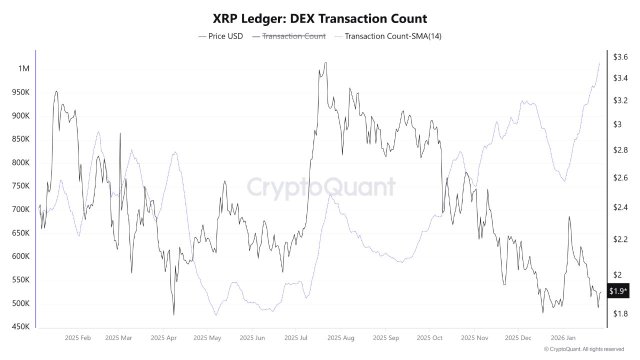
Even years after its inception, the XRP Ledger, one of the leading networks in the crypto space, continues to attract robust adoption and real-world usage. With thousands of transactions being conducted on the leading network’s DEX on a daily basis, it has now reached a historical level that marks its growing role in decentralized trading.
Decentralized Trading On XRP Ledger Accelerates
XRP is experiencing heightened interest not just in buying activity from traders; the XRP Ledger has been seeing significant usage over the past few weeks. While adoption has increased toward the network, the Ledger’s Decentralized Exchange (DEX) activity is breaking past prior highs.
Xaif Crypto, a market expert and investor on the X platform, reported that the Ledger DEX activity has surged to new levels. Specifically, data shows that the activity recently reached a 13-month high, signaling a sharp uptick in on-chain trading across the network.
As more liquidity and transactions move over XRPL’s native DEX infrastructure, the increase is indicative of increasing user involvement. Sustained growth in DEX activity frequently indicates deeper adoption and expanding use cases, in contrast to brief spikes caused solely by speculation.
According to the chart shared by the expert, the number of transactions on the 14-day MA rose to approximately 1.014 million, breaking the ceiling that held throughout all of 2025. With this level of DEX transactions, the XRP Ledger is becoming a more active center for decentralized trade within the larger cryptocurrency ecosystem.
Source: Chart from Xaif Crypto on X
Xaif Crypto stated that this massive transaction count is not just a mere spike; it signals sustained momentum for the Ledger. Currently, the network is witnessing a fresh wave of liquidity and real user engagement. As a result, the expert declares that the Ledger is heating up in 2026.
This milestone comes as the XRP Ledger rolls out a new Lending Protocol (XLS-66), which is attracting institutional-grade credit to the network. With the new Lending Protocol, the Ledger is now evolving into a full financial layer with Rippled 3.1.0.
The protocol includes the ability to create loans on the Ledger, with loan brokers being able to generate fixed-term and fixed-rate, uncollateralized loans. These loans are predictable for professional use.
In addition, these loans are held in a Single Asset Vault, allowing risk-isolated liquidity. Another feature is the off-chain underwriting for uncollateralized options. It boasts native efficiency, which offers low-cost lending without a middleman or intermediaries. In the meantime, Decentralized Finance (DeFi) on the Ledger has just undergone a boost.
The Lending Protocol Gains Institutional Support
Following its historical launch a few days ago, the new XRP Lending Protocol is now experiencing significant support from institutional-level investors. One of the earliest companies to interact with the new protocol is Evernorth, a leading public treasury company.
According to BankXRP, the company is backing the native lending protocol to help transition a $100 billion market cap into a productive, yield-bearing ecosystem. These kinds of moves are an indication that the future of institutional DeFi is becoming native-driven.
XRP trading at $1.75 on the 1D chart | Source: XRPUSDT on Tradingview.com
Featured image from Shutterstock, chart from Tradingview.com
Editorial Process for bitcoinist is centered on delivering thoroughly researched, accurate, and unbiased content. We uphold strict sourcing standards, and each page undergoes diligent review by our team of top technology experts and seasoned editors. This process ensures the integrity, relevance, and value of our content for our readers.
Gold, silver, and the whole metals market have experienced an unprecedented session, as prices have crumbled down in what analysts qualified as one of the worst days for silver and gold since 1921, wiping close to $7 trillion in market capitalization. Gold Falls Under $5,000, Silver Losses Over 25% in Brutal Session The precious metals […]