
Home Blog Page 1066

Derivative Path and CloudMargin Announce Strategic Partnership to Deliver Integrated Derivatives and Collateral Management Solution

0

WHY THIS MATTERS:

OTC derivatives markets are facing rising operational and regulatory pressure as margin rules, reporting requirements and counterparty risk controls continue to tighten. For many regional banks and buy-side firms, fragmented front-office, risk and collateral systems create manual breaks, reconciliation challenges and audit exposure. The move toward unified, cloud-native workflows reflects a broader industry shift away from siloed point solutions toward integrated platforms that support straight-through processing and regulatory readiness by design. As compliance becomes more continuous and data-driven, institutions increasingly need systems that connect trade execution, agreement data and collateral management in real time. This partnership addresses a critical gap by aligning derivatives execution and margin management within a single, automated operating model.

Derivative Path, a leading provider of cloud-based capital markets technology and risk management solutions, and CloudMargin, the only collateral and margin management solution purpose-built for the cloud, today announced a strategic partnership that will deliver a unified front-to-back workflow for over-the-counter (OTC) derivatives and collateral management. The collaboration enables seamless integration between Derivative Path’s DerivativeEDGE® platform and CloudMargin’s award-winning collateral management platform, enhancing operational efficiency and transparency for regional and community banks, and buy-side institutions.

The strategic alignment brings together two best-in-class technologies to solve an increasingly urgent market need: the ability to manage front-office activities, compliance, and collateral workflows in a unified, automated, and audit-ready environment. Integration is already underway, with the first clients expected to begin onboarding imminently.

“This partnership exemplifies what true complementarity looks like in capital markets technology,” said Zack Nagelberg, Chief Growth Officer at Derivative Path. “We’ve built DerivativeEDGE to serve as the system of record and pre-and post-trade workflow engine for OTC derivatives.  By integrating with CloudMargin’s market-leading collateral platform, we are removing workflow friction for our clients while increasing control, transparency, and scalability.”

Through single sign-on (SSO) access and automated data handoff between the platforms, clients will be able to accelerate onboarding, eliminate manual reconciliation, and meet their compliance and reporting obligations with ease. Legal entity and agreement data already housed in DerivativeEDGE can be ported into CloudMargin, reducing implementation timelines and minimizing setup friction.

CloudMargin CEO Stuart Connolly said: “CloudMargin is proud to partner with Derivative Path to offer an end-to-end solution that transforms how banks and buy-side institutions manage their derivatives and collateral workflows. The combination of our straight-through processing (STP) and automated margin workflow and Derivative Path’s market-proven derivatives platform provides clients with a future-proof foundation for regulatory compliance and operational resilience.”

Key Integration Benefits

End-to-End Workflow: From trade execution to margin settlement, including valuations, margin calls, interest statements, and SWIFT connectivity to global custodians.

Time to Value: Faster client onboarding with pre-integrated data flows between systems.

Compliance and Control: Enhanced transparency, automated reporting, and audit readiness across both platforms.

Scalable Architecture: Cloud-native systems designed for security, scalability, and resiliency.

FF NEWS TAKE:

This integration strengthens the case for cloud-based, end-to-end capital markets infrastructure. The real impact will be felt by smaller and mid-tier institutions seeking enterprise-grade controls without enterprise complexity. Watch for accelerating adoption as margin and collateral workflows become a focal point for operational resilience.
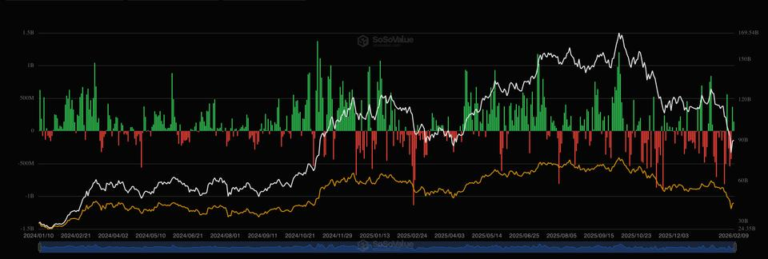

U.S. BTC ETFs register back-to-back inflows for first time in a month

0

For the first time in nearly a month, U.S. bitcoin exchange-traded funds (ETFs) have recorded back-to-back net inflows, snapping a redemption streak that stretched back to mid-January.

According to SoSo value data, the consecutive inflows shift began on Friday with $471.1 million in fresh capital, followed by a $144.9 million on Monday. This comes as bitcoin bounced back from Thursday’s $60,000 low to around $70,000.

In mid-January, bitcoin peaked near $98,000 after a two week rally that started at $87,000. The subsequent sell-off to $60,000 saw investors yank millions of these spot ETFs.

Broadly speaking, investors still appear confidence about the cryptocurrency’s long-term prospects, as evident from the spot ETFs’ resilient asset under management (AUM).

According to Checkonchain, the cumulative AUM of the 11 funds has only decreased by about 7% since early October, sliding from 1.37 million BTC to 1.29 million BTC. Bitcoin, meanwhile, is down over 40% since hitting record highs above 126,000 in October.

AI is no savior when markets get tough … but it can help, says Nickel Digital chief

0

When markets get tough, as crypto did at the end of January, investment companies need all the help they can get to make the right decisions, fast. No surprise, then, that many are turning to AI, the shiniest new weapon in the arsenal, to analyze and suggest ways of minimizing losses and even making a profit.

Almost all (96%) executives at a surveyed group of trading firms that collectively manage around $14 trillion in assets said AI is already playing a major role in core investment processes, according to research recently carried out by Nickel Digital Asset Management. But it’s not enough, a human hand is still needed, said Anatoly Crachilov, founding partner and CEO of the firm.

AI is transforming quantitative trading just as it is almost every other industry and human endeavor. Going beyond the large language models (LLMs) that seem to have permeated so much of day-to-day life, there are also machine learning and predictive AI approaches that analyze historical data to forecast what’s coming next. They’re weak, however, at identifying incorrect information that can lead to erroneous conclusions and poor decision-making.

“It’s a very tough market. AI will not save you; it’s not a savior,” Crachilov said in an interview.

Despite the slump in crypto prices that engulfed the market at the end of last month, London-based Nickel, which runs a multimanager platform allocating to more than 80 teams, remains positive for the year. “Perhaps an achievement in its own right,” Crachilov said.

The crossover between crypto trading and AI is becoming most advanced in areas like risk management. While AI might still struggle to outperform high-speed sniper bots targeting the latest low-liquidity crypto tokens, for example, a sweet spot is where sentiment and data-driven models can learn how to manage risk.

Each manager attached to Nickel operates within a well-defined risk framework that includes maximum drawdown limits at times of increased volatility. Sometimes human intervention is needed and an “old school” approach, Crachilov explained, as opposed to relying on data-driven, machine-learned automation.

“If the market goes into distress, like it went on a few occasions in recent memory, sometimes you have to exercise discipline and stop those managers who break [max drawdown] limits, whether it’s AI driving their strategy or not,” Crachilov said. “Ultimately, there is a hard stop on how much pain we would allow in the portfolio.”

Questions about how much human involvement there should be in AI-driven trading strategies, or the manner in which a human override is triggered, were too technical and nuanced for Nickel’s relatively high-level survey of managers, Crachilov said.

He said Nickel operates “a military-style operation,” where a rich data flow collects over 100 million data points from the underlying book every 24 hours. “While this part is very well informed, it still requires human involvement. And we’re still in conversation with managers, even in the middle of the night,” Crachilov said.

The natural evolution toward being fully automated still has to account for the possibility of erroneous or incomplete data feeds from places like crypto exchanges, according to Crachilov.

For example, a human would realize that data indicating a certain position is down 100% was probably the result of something being wrong with a data feed, he said. But an automated AI system might mechanically enforce a limit when it wasn’t required.

“You need a human overlay. The whole crypto ecosystem is still very fragile. And some of the exchanges may go into timeout for 15 minutes, or see wrong data, or produce patches of bad data, which may inadvertently force the system to shut some of the managers for no good reason,” Crachilov said.

It really comes down to the firm’s risk-management philosophy, which is to remove a single point of failure from any point in the process, said Nickel’s head of investor relations Charles Adams.

“If there was one autonomous agent which is monitoring the whole portfolio, let’s say something goes wrong with it, the risks could be potentially catastrophic,” he said. “The whole point is that we have this very well diversified fund split between over 80 managers today across hundreds, if not thousands of sub accounts on exchanges, and removing that single point of failure is very important to us.”

LMAX unveils new exchange to break the wall down between crypto and FX

0

Institutional crypto exchange provider LMAX Group has unveiled Omnia Exchange, designed to allow users to seamlessly convert FX, crypto, stablecoins and other digital assets in one platform, the company said on Tuesday.

Described as a “a unified multi-asset infrastructure layer,” Omnia allows users to trade any asset directly against any other 24/7, without restrictions on size or type, and to settle on traditional rails or instantly on the blockchain, according to a press release.

LMAX’s cryptocurrency-focused business has long been a major player when it comes to institutional crypto trading, reporting $8.2 trillion in institutional volume last year.

Whereas LMAX Digital is an institutional crypto execution venue and custodian, focused on crypto-FX pairs, Omnia aims to bring FX, crypto, stablecoins and other digital assets under one roof, allowing any asset to be traded directly against any other (not just crypto vs fiat), a spokesperson for LMAX said via email.

LMAX CEO David Mercer said Omnia “crosses the rubicon” between traditional markets and digital marketplaces.

“Omnia Exchange is the foundation for a new paradigm in capital markets delivering the ability for institutions to exchange any asset, anytime, anywhere,” Mercer said in a statement. “By opening access to wholesale FX and digital asset markets globally, we’re removing barriers, reducing friction and unlocking liquidity. Institutions can exchange value as simply as sending a message, creating hyper-efficient capital.”

A recent deal between LMAX Group and Ripple to integrate the latter’s RLUSD reflects broader momentum behind stablecoins as tools for institutional market access, not just crypto-native use.

Why Bitcoin Crashed Over 10% in One Week

0

Despite BTC’s rebound from a brief dip to $60,000, retail investor sentiment remains firmly in the “extreme fear” zone.

The crypto market went through another round of wild swings in early February after Bitcoin suddenly plunged to the low-$60,000s in just a few hours on Feb. 5, dragging the rest of the market down with it, before bouncing back to near $70,000.

As of Monday morning, the largest cryptocurrency by market cap is trading around $68,860, down 3.2% in the past 24-hours and almost 12% over the past seven days.

Bitcoin price vs. crypto liquidations as of early February. Source: Coinglass

Data from Coinglass shows more than $2 billion in leveraged crypto positions were liquidated in that short window on Thursday, mostly made up of long bets forced to close as prices fell. That wave of automatic selling pushed the slide further than fundamentals alone would suggest.

Jeff Park, a Bitwise portfolio manager, suggested on X on Thursday evening that a lot of the indiscriminate selling seemed to come from multi-strategy hedge funds running delta-hedged trades “possibly with growth equity correlations spillovers.”

Hello from Hong Kong

Parker White, chief investment officer at DeFi Development Corporation, wrote in an X post several hours after Park that the market crash was probably triggered by the sudden collapse of Hong Kong hedge funds, as The Defiant previously reported.

Those funds held call options in IBIT, BlackRock’s spot Bitcoin exchange-traded fund and one of the largest in the market, which saw about $10.7 billion in trading that day — nearly double its previous record — with roughly $900 million in options premiums changing hands.

White suggested that Asia-based hedge funds had run a leveraged IBIT options trade funded in yen, added more leverage after losses, got hit by funding costs and silver trades, and then the final Bitcoin move triggered the collapse.

“We know that Asian traders, particularly in China, have been deeply involved in the Silver and Gold trade. Silver was down 20% today, which was the 2nd largest 1 day move in a very long time (largest on Jan 30). We also know that the JPY carry trade has been unwinding at an increasingly rapid pace,” White wrote.

But if the liquidation actually happened, it won’t show up in 13F filings — quarterly reports that disclose institutional holdings — until 45 days after the quarter ends, so mid‑May is the earliest the full picture could emerge.

Tanisha Katara, founder of Katara Consulting Group, echoed the sentiment, noting in commentary for The Defiant that institutional products like ETFs can accelerate both rallies and sell-offs.

She noted that U.S. spot Bitcoin ETFs, which provide streamlined access to the crypto market for large financial players, are now also net sellers, showing that having a way in doesn’t guarantee long-term commitment. Katara told The Defiant:

“The digital gold narrative has been conclusively debunked by this cycle. Like Gold is up 72% while Bitcoin is down 28% over the same period. What’s left is the infrastructure thesis: stablecoins, tokenisation, DeFi primitives, governance systems, and programmable money.”

Adding to the chaos, South Korea’s Bithumb mistakenly gave away thousands of BTC during a promotion, briefly sparking heavy local selling, though the exact amount of dumped tokens remains unclear.

As The Defiant reported earlier, users rushed to cash out their accidentally airdropped BTC and offramp funds, briefly sending the price of Bitcoin on Bithumb almost 18% below market price across other exchanges globally.

the-defiant
BTC/KRW on Bithumb amid an accidental giveaway. Source: LookOnchain

The mishap already prompted South Korea’s Financial Supervisory Service to warn it will tighten oversight and impose tougher penalties on financial firms.

Further Declines Ahead

As crypto struggles, other global risk assets are also unstable. Kyle Rodda, senior financial market analyst at Capital.com, explained in commentary shared with The Defiant that “everything is the one trade in the markets right now,” with fundamentals acting more as triggers than as main drivers of daily swings.

“The week ahead will also be dominated by U.S. data, with a batch of inflation figures and Non-Farm Payrolls data released in coming days after the latter was delayed by the partial US Government shutdown. The narrative is less pronounced given the resilience of U.S. economic activity recently, but the markets continue to try and balance signs of a sluggish labour market with sticky prices,” Rodda added.

Georgii Verbitskii, founder of crypto investment app TYMIO, told The Defiant that the sell-off also reflected long-term holders trimming exposure. He noted that Bitcoin’s inflation-hedge narrative was being questioned short-term, and predicted that the market would likely go lower:

“At this point, I don’t see strong catalysts for the upside. Most likely, Bitcoin will spend some time ranging between $55,000 and $67,000, possibly slightly higher. Looking further out, a deeper move toward the low $40,000s can’t be ruled out over the course of the year — especially given that 2026 is shaping up to be a challenging period across global markets.”

Speaking with The Defiant, Ryan Li, CEO of Surf, an AI tool built for crypto, pointed out that sentiment among retail investors is “extremely low right now, firmly in ‘extreme fear’ territory and on par with the November lows.”

Data from the Greed & Fear Index shows that even with Bitcoin bouncing back to $70,000 over the past 24 hours, investors are indeed still stuck in “extreme fear.”

Alphabet Taps Bond Market for $20B as Michael Burry Warns of a ‘Motorola Moment’

0

Alphabet surprised markets with a $20 billion U.S. bond sale, far above expectations, as hyperscalers ramp up record borrowing to fund massive artificial intelligence (AI)‑driven capital spending. The AI Capex Explosion In a move that signals either supreme confidence or a desperate arms race, Google parent Alphabet (GOOGL) tapped the U.S. high-grade bond market on […]

Fugitive Daren Li sentenced to 20 years in the U.S. for $73M international crypto scam

0

A federal judge in California sentenced in absentia a dual national of China and St. Kitts and Nevis to 20 years in prison for his role in a $73 million international crypto scam.

Daren Li, who is a fugitive after removing an ankle electronic monitoring device in December, was also handed three years of supervised release for his role in an international cryptocurrency investment conspiracy carried out from scam centers in Cambodia, according to a court statement on Monday.

Cambodia has become a hub for “pig butchering” crypto scams, generating over $30 million daily via forced labor compounds, according to a TRM Labs report. A separate TRM report revealed how over $96 billion in crypto has flowed to Cambodia-linked companies since 2021, used heavily for money laundering and fraud.

“As part of an international cryptocurrency investment scam, Daren Li and his co-conspirators laundered over $73 million dollars stolen from American victims,” Assistant Attorney General A. Tysen Duva of the Justice Department’s Criminal Division said in the statement.

Duva said the court’s criminal division is working with global law enforcement officials to find, detain and return Li to the U.S. to serve his entire sentence.

Li pleaded guilty on Nov. 12, 2024, in the Central District of California to conspiring with others to launder funds obtained from victims through crypto scams and related fraud. As part of his plea agreement, Li said he and his cronies would contact victims directly through unsolicited social-media interactions, telephone calls and messages and online dating services. Their tactics entailed gaining victims’ trust by establishing professional or romantic relationships with them, then luring them into using spoof platforms to appear to invest in crypto.

In other instances, the group posed as tech-support staff and induced victims to send funds via wire transfer or cryptocurrency trading platforms to purportedly remediate a non-existent virus or other false computer-related problem.

Social engineering scams, such as fake investment offers and impersonation tactics, were the leading threat to crypto users, accounting for losses in the billions of dollars and representing nearly 41% of all crypto security incidents in 2025.

I’m not confident we hit a true capitulation in bitcoin, derivatives expert says

0

About a week ago, bitcoin dropped more than 10% in a day to around $60,000 before rebounding to $70,000 in recent days. The question is, did the slide mark “capitulation,” when holders panic-sell at a loss, exhaust bearish pressure and set the stage for a new bull run?

The futures market says no, suggesting there’s scope for another leg lower, according to Amberdata’s director of derivatives, Greg Magadini.

“[The] lack of ‘reaction’ in the futures basis doesn’t make me confident we hit a true CAPITULATION moment,” Magadini said in a market note Monday.

Magadini is referring to how futures typically trade in relation to the spot price during bearish trends and capitulation phases.

Futures are standardised derivative contracts to buy or sell an underlying asset, like bitcoin, at a set price on a future date. Traders use futures to bet on price direction, buying contracts when they expect a rally or shorting when they anticipate a decline, without actually owning the asset itself.

The price difference, or basis, between futures and spot markets reveals market sentiment and trader positioning. When futures trade at a significant premium to spot prices, it signals bullish optimism among investors. Conversely, a discount indicates bearish pressure.​

Historically, bitcoin bear markets have tended to bottom out, with standard futures and perpetual futures trading at significant discounts to spot on major exchanges. These massive discounts represented capitulation and mark the final bear-market flush.

Last week, however, futures slipped into a discount only for a short time.

“Although the 90-day basis dropped lower on each leg down for BTC, these moves barely ranged -100bps. Today, fixed basis remains around 4% for BTC (inline with risk-free treasury yields),” Magadini said.

Compare that with the end of the 2022 bear market, when the 90-day futures traded at a 9% discount as the bitcoin price bottomed out below 20,000. So, if history is a guide, bitcoin could see another leg lower where futures traders capitulate, pushing prices into a steep discount relative to the spot price.

Bitcoin recently changed hands near $69,000, a 1% drop since midnight UTC, according to CoinDesk data.

MrBeast’s Beast Industries buys Step banking app following $200M BitMine deal

0

Beast Industries, the retail and media powerhouse established by top YouTuber Jimmy Donaldson, has acquired Step, a mobile-first financial services app designed for the next generation of spenders, according to a Monday press release. Terms of the deal have not been made public.

Donaldson, known online as MrBeast, said the deal reflects his own experience growing up without financial guidance.

“Nobody taught me about investing, building credit, or managing money when I was growing up,” he said. “I want to give millions of young people the financial foundation I never had.”

The acquisition will unite Step’s innovative technology and full-tech fintech team with Beast Industries’ global audience and philanthropic initiatives to make financial wellness tools and education more accessible, especially for younger users.

Jeff Housenbold, CEO of Beast Industries, said in a statement that the acquisition underscores the company’s belief that financial health is essential to overall well-being and that many people still lack access to the tools and education needed to build long-term financial security.

He noted that the deal aims to give people the tech‑driven solutions they need to build financial security and money‑management skills.

Step, which has attracted more than 7 million users through its mobile platform, has been focused on improving the financial future of the next generation through accessible tools, financial literacy, and credit-building, according to CEO CJ MacDonald.

The banking solution previously raised roughly $500 million from backers including Stephen Curry, Charli D’Amelio, and Justin Timberlake.

The transaction follows a $200 million investment in Beast Industries from BitMine Immersion Technologies, the leading Ethereum treasury firm, signaling potential expansion into digital asset offerings alongside traditional financial services.

Beast Industries operates one of the most-watched channels on YouTube, with more than 460 million subscribers and roughly 5 billion monthly views. The company also runs Feastables, a snack brand, and oversees philanthropic efforts that have delivered tens of millions of meals to communities in need.

Housenbold revealed just a few months ago that Beast Industries was expanding beyond entertainment into regulated sectors, with plans for a financial platform and mobile services aimed at MrBeast’s audience.

France Arrests Six in Crypto Ransom Kidnapping of Magistrate, Mother

0

French authorities recently arrested six suspects accused of kidnapping a magistrate and her mother in a cryptocurrency ransom scheme. Targeting Cryptocurrency Wealth French prosecutors announced Feb. 8 that six suspects, including a minor, have been arrested after a magistrate and her mother were held captive for about 30 hours in a cryptocurrency ransom scheme. Lyon […]