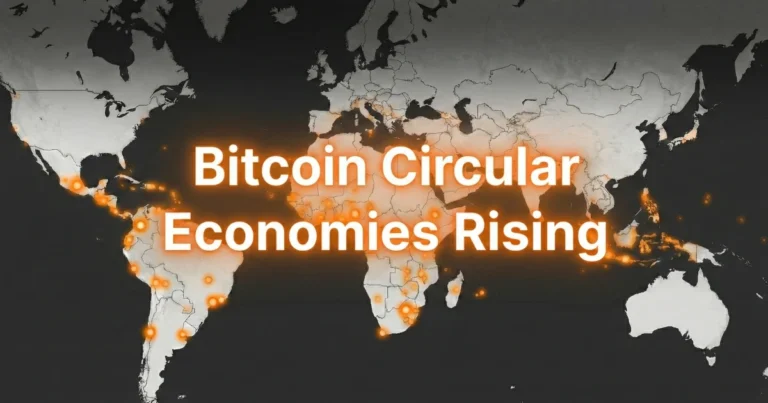
The Bitcoin Circular Economy Summit just took place in El Salvador’s Bitcoin Beach, and what an event it was. The invite-only summit saw two days of presentations from communities from across the world, from Indonesia to Peru, from Africa to Bolivia. The summit saw an alleged 29 different countries represented among the small crowd of perhaps 60 attendees and speakers.
The event was put together by the Bitcoin Beach team, lead by Mike Peterson and Roman Martinez, the BCES took place in El Zonte’s community center, a new location built up to support El Zonte’s growing population and economy.
The topics covered ranged from overviews of various Bitcoin Circular Economies (BCEs), to discussions about strategy, tooling, financial sustainability, economic theory, and even education for leaders to become more effective communicators and fundraisers.
Attendees told stories of incredible success with brick and mortar adoption in countries with failing currencies, of eye-watering transformation, growth, and gratitude from remote communities apparently forgotten by civilization, of hope and good-hearted behaviour demonstrated by the long reach of Bitcoin donors and Bitcoin activists, looking to deliver sound money to the furthest reaches of the world.
The Bitcoin Beach White Paper
Since 2019, El Zonte’s Bitcoin Beach has become a world-renowned brand, the biggest success story in the Bitcoin circular economy world. Its novel story has been told many times, but some key takeaways were discussed in depth at the summit, providing an overview of what is documented in detail in the Bitcoin Beach White Paper.
Concentrate Adoption in one Location
BCE leaders advised against taking a shotgun approach to Bitcoin adoption, especially when it comes to brick-and-mortar-like stores, and deep impact social work. Choose a town, street, or specific community and work hard to get mass adoption in a limited location first. This arguably benefits from multiple network effects seen in branding. Instead of random locations across a country accepting Bitcoin, a single location can attract tourists in higher numbers, resulting in more bitcoin payments being made to merchants, which they need to see to remain motivated.
This contrasts a classic scenario of less organized attempts at getting brick and mortar adoption, where the shop clerk downloads the Bitcoin app but only sees bitcoin spenders show up once or twice a month. Volume strengthens the connection between Bitcoin and that local community, resulting in more sustainable interest and adoption. Concentrating the Bitcoin brand in one town or street in a city leverages commonly seen marketing strategies, where multiple stores of the same type cluster together, to benefit from each other’s broad advertising efforts.
Build a High-Trust Team
“Don’t be hasty in who you bring along,” said Mike Peterson on stage when discussing the Bitcoin Beach White Paper. People will want to join, but it is important not to rush into relationships with people you don’t know well. It is better to build a small team of high-trust, well-known individuals than grow too fast and take unnecessary risks.
Bitcoin not crypto
The topic of crypto also came up, as donations are often offered to social impact communities of this sort in a wide range of cryptocurrencies; however, speakers and panelists all agreed that keeping Bitcoin as the main brand and flag was crucial. One of the reasons is the wide proliferation of crypto-related scams across the world, including in low-income, low-education communities. Bitcoin, unlike most other crypto brands, is very well known and has a strong reputation, with BCEs throughout the world working to educate on the same themes and network, it is a lot easier to bypass concerns from local community leaders and educate the public about the most secure and successful crypto currency available.
Communicate in Bitcoin, not Dollars
Many of the BCEs represented had Bitcoin donors, some of them anonymous, with simple but powerful demands from the recipients. Bitcoin Beach’s founding donor, who still communicates with Peterson, originally demanded that the bitcoin be used to buy things, not sold for dollars and then used. Bitcoin adoption as a medium of exchange was a prerequisite for the donations and the relationship to continue.
Donors of this kind, who are likely OG Bitcoin maximalists, also insist that leaders talk about value in SATS, not in dollars, challenging a manner of speech that has become normalized in the industry, something like “I’ll send you 20 dollars worth of Bitcoin”.
Peterson insisted that donors hate this and want Bitcoin to be discussed in SATS (Satoshis, the smallest denomination of bitcoin) or in BTC terms, a condition clearly aimed at making bitcoin a common unit of account.
Sustainability
Sustainability was also an important topic across the Summit. In the context of Bitcoin circular economies, it means being able to survive and continue to grow as a local bitcoin hub, when donations dry out. The question of how to achieve sustainability touches a variety of important topics, including what might eventually become an economic theory of microeconomies powered by Bitcoin.
The Bitcoin Beach team highlighted the importance of tourism as a source of external capital into the local economy, but recognized that not all BCEs are conducive to tourism. Some are in very remote areas, others are in hostile and dangerous political environments. Attendees generally recognized that some BCEs might always depend on donations, depending on the situation, but also discussed ways in which some BCEs can form economic relationships with each other.
Motiv in Peru, for example, serves two communities in particular who have developed an economic relationship, one produces artisan crafts, sewn by Indigenous women from a small town in the mountains of Peru, and the other is a tourist hub in Lima that buys the goods from them in bitcoin and resells them to Bitcoin tourists. Peterson highlighted the importance of understanding what makes your community special and working with locals to develop their local talent.
Another aspect of sustainability is the focus of agency instead of assistance, in the non-profit version of BCEs. Rather than just buy things and gift them to impoverished communities, education and economic empowerment are encouraged, highlighting the “teach a man to fish” as superior and more likely to survive.
Bitcoin economic theory would suggest that teaching long lasting life-skills to developing communities is preferable to just giving them free stuff forever, since the faucet of bitcoin donations is fundamentally finite. While in the fiat model, more dollars will always be created — and the quicker they get spent, the better — eventually finding their way through the web of NGOs, to the hands of charity recipients. The never-ending printing machine creates a permanent underclass of economic dependence through foreign aid, defeating the sense of urgency that motivates the pursuit of sustainability.
Finally, sustainability at a personal level for BCE leaders was also discussed, as burnout, divorce, and self-sacrifice for a social cause is a familiar story. Martinez and Peterson spoke from personal experience, highlighting the importance of staying healthy as a Bitcoin leader in these communities, and not biting more than you can chew, so to speak, else you might “become a single point of failure”. Instead, they suggested leaders educate and train others to continue this important work.
Fund Raising
When it comes to fundraising, a variety of organizations are actively contributing to the non-profit side of Bitcoin, some of them for-profit entities with non-profit arms, others fueled by Bitcoin donors of all sizes, from around the world.
Paystand
Paystand, an American B2B payments company that uses Bitcoin in a variety of ways to provide its business solution to major corporations, also has a non-profit arm under the same brand, actively supporting BCEs across the world. They offer grants from 10k to 50k USD, depending on the project, can donate almost anywhere, even through the Human Rights Foundation, and are happy to offer mentorship to aspiring applicants. Applications to the Paystand non-profit can be made at their dot org site.
Something that Paystand representatives insisted on communicating is that the organization does not expect any kind of advertising in return; their business operations do not depend on it at all, instead considering their work to support BCEs as part of their mission as Bitcoiners.
Fedi
The Fedi for-profit technology company also provides grants to BCEs throughout the world, though largely focused on Africa until recently, they are now actively expanding into Latin America and have established deep roots in Indonesia. They also offer grants on a case-by-case basis, asking applicants what specific problem they are looking to solve, and providing support, but opting to empower leaders, rather than get deeply involved in specific communities.
The Fedi app has now reached an impressive level of maturity, supporting collusion-resistant multi-signature mints, ecash denominated not just in Bitcoin but also local fiat for shorter-term payment requirements, social network-like capabilities for local communities to communicate and organize, payment rails to internet service providers in various countries, and much more.
The Federation of Bitcoin Circular Economies
The FBCE, a growing association of Bitcoin circular economies, co-founded by Bitcoin Beach, El Zonte, Bitcoin Ekasi, South Africa, and Toronto’s Scott Wolfe, also offers grants, having completed two massive rounds since 2024. The FBCE gives grants to initiatives that demonstrate enough proof of work, usually starting with small donations and growing from there, for a time, depending on the project.
Other Fundraising Platforms
Other fund raising platforms were mentioned by multiple attendees, as reliable ways to raise funds for BCE initiatives, among them were Angor.io and Geyser.fund which enable users to raise funds over time from many donors, kind of like a go-fund-me for Bitcoin. Bittasker.com also had a strong presence at the event as a sponsor, with a new platform for funding tasks and employing locals to get work done in BCEs, further advancing the medium exchange cause of Bitcoin. Donors could fund specific tasks, repairs, or infrastructure upgrades, like construction work via Bittasker in collaboration with BCE leaders on the ground.
The Technology Stack
As digital money, Bitcoin requires a certain amount of infrastructure while also empowering BCEs with significant technological capabilities. To unlock Bitcoin circular economies, a variety of tools have been custom-built for this kind of adoption by various organizations and were regularly mentioned and used by the attendees.
Blink
Blink wallet, which rose to fame with El Zonte’s Bitcoin Beach, emerged as the most popular wallet among BCEs at the summit. Its Lightning native integration, on-chain capabilities, easy-to-use mobile app design, and stable SATS features appear to deliver the best experience so far for these kind of low-tech environments.
Fedi Wallet
Fedi also had a very strong presence, supporting a large set of BCEs in Africa and Indonesia, with its broad set of tools, including local fiat-denominated ecash, lightning to ecash integration, and social network-like experiences, which are designed specifically to serve and empower Bitcoin circular economies of all kinds.
Bittasker
Bittasker, a sponsor of the event, showed off its beautiful interface, boasted about its integration with Nostr as well as smart contract capabilities via Rootstock, which provides a trustless, smart escrow system for funding micro tasks in Bitcoin. Bittasker includes a job board and uses the Boltz back end for trust-less bridging between the various Bitcoin layers.
K1 BTMs
K1, a Bitcoin ATM company, also sponsored the event and showed off their coins for sats BTM, which has become a staple of Bitcoin hubs, turning coins into SATS. The machines are lightning native, and have various upgrades and versions with more advanced capabilities, showing up at schools, retirement homes, and BCEs across the globe.
Tiankii
Tiankii, another sponsor of the summit, showed off its bolt cards, which serve as bitcoin debit cards of sorts, for payments on terminals like the Bitcoinize machine. These cards are particularly useful in areas with low internet, where users might not have a mobile phone handy, nor data, accessing the Bitcoin network through the merchant’s terminal, delivering the ultimate payment experience in today’s digital world, offline tap to pay.
Bitbooks
Anyone raising funds and trying to run a tight ship needs clear accounting, and one of the sponsors, BitBooks.com, focuses on just that. Their Bitcoin native accounting platform offers instant reconciliation across payments, dual currency view, automatic exchange rate calculations, and even a new experimental algorithm that can help users decide whether to pay in fiat or in bitcoin depending on price volatility and the user’s specific needs.
AmityAge
AmityAge is a Bitcoin financial services company with a strong educational offering. Dusan Matuska, its co-founder and CEO, delivered a memorable, interactive workshop on how to get past common objections in Bitcoin adoption, how to better understand and listen to the challenges faced by new users, and how to think about the process of evangelizing Bitcoin. Their platform hosts a variety of educational tools, financial and educational, available to the Bitcoin curious.
Concluding Thoughts
Having attended Bitcoin conferences and events for over a decade, I was left both breathless and deeply satisfied with what I saw at the Bitcoin Circular Economy Summit. Unlike large industry conferences, which focus on how to gain traction in traditional markets, serve major corporations, and, in general, solve the problems of fiat at the top of the global markets, this summit looked in the opposite direction.
The BCEs represented, the individuals I met, and the stories I heard reminded me that Bitcoin is not a tool for its own sake, it is not a high-tech, science fiction endeavour, nor is it fundamentally about number-go-up. Bitcoin is a means to an end, and BCEs have that end goal, that objective very clear in their minds, to reach those whom society at large has failed, to onboard onto global finance those who live beyond Banks’ profit margin, to deliver sound money to good people in hostile environments, because they also deserve hope and are hungry for growth.
Bitcoin is a means to an end, not an end in itself.