Home Blog Page 1059

Bitcoin Price Crashes To $75,000 Range As Crypto Sells-Off

0

Bitcoin price plunged to nearly $75,000 today during a continuous and sharp, high-volume sell-off that erased more than 10% from recent highs and pushed the asset below $80,000 for the first time since April 2025.

Data shows BTC fell from a 24-hour high of $84,356 to a low of $75,644 in a matter of hours, as sellers overwhelmed bid support across major exchanges. 

The move marked one of the steepest single-day declines of the year and triggered widespread liquidations in derivatives markets.

The sell-off accelerated after bitcoin price failed to hold support near $82,500. Once that level broke, price moved quickly through thin liquidity zones, with little evidence of sustained dip-buying until the mid-$70,000 range. Traders described the move as a deleveraging event rather than a gradual risk-off rotation.

On the daily chart, the bitcoin price broke below a rising trendline that had held since late December. Price also slipped decisively under the 50-day exponential moving average near $90,000, flipping that level into overhead resistance, according to Bitcoin Magazine Pro Data. 

Volume expanded during the breakdown, signaling forced exits and margin liquidations rather than low-conviction selling.

Bitcoin price analysis as the U.S. government enters partial shutdown

Despite the sharp decline, on-chain data suggests renewed interest from new buyers. Network data shows a surge in new bitcoin addresses over the past 24 hours, reaching the highest daily increase in nearly two months. 

Bitcoin’s drop also outpaced most recent declines in traditional markets, but it still held up better than gold during the same window. While BTC fell roughly 6% to 8% during the sell-off, gold posted a steeper drawdown, reinforcing bitcoin’s relative strength during the volatility.

Until the bitcoin price reclaims the $82,000 to $84,000 range, traders say downside risk remains elevated. The next key support zone sits in the low-to-mid $70,000s, with longer-term focus shifting toward whether the market can stabilize.

The U.S. government entered a partial shutdown after Congress failed to pass a full-year spending package by the Friday midnight deadline, leaving several major departments temporarily unfunded. 

The Senate approved a funding deal to keep most agencies running through September and a two-week stopgap for Homeland Security, but the measure awaits House approval, which cannot occur until lawmakers return from recess Monday. 

The impasse is driven by Democratic demands for changes to immigration enforcement practices following the fatal shooting of two U.S. citizens in Minnesota, with divisions persisting within the House GOP.

At the time of writing, the bitcoin price is trading at $77,825, down 7% over the past 24 hours, as daily trading volume reached $75 billion.

The asset is now 8% below its seven-day high of $84,368 and sits just 1% above its seven-day low of $77,534.

Solana DeFi platform step finance hit by $27 million treasury hack as token price craters

0

Step Finance, a decentralized finance (DeFi) portfolio tracker built on Solana, said some of its treasury wallets were compromised in a security breach under active investigation.

Onchain data shared by blockchain security firm CertiK shows that 261,854 SOL, worth roughly $27 million at current prices, was unstaked and transferred during the incident.

The platform disclosed the breach in a post on X and asked cybersecurity firms to assist with the investigation. It did not specify how the attacker gained access or whether user funds were affected.

The platform’s governance token, STEP, dropped over 80% in the last 24 hours, according to SoSoValue data. Step also operates a validator node on Solana and uses validator earnings to fund STEP token buybacks.

Founded in 2021, Step Finance aggregates yield farms, LP tokens and DeFi positions across nearly all Solana protocols into a single dashboard.

It also runs SolanaFloor, a Solana-focused media outlet, and organizes the Solana Crossroads conference. In late 2024, it acquired Moose Capital (now Remora Markets) and plans to offer tokenized equity trading on Solana.

Brazilian giant Nubank gets conditional approval for US national bank

0

Brazilian digital banking giant Nubank is setting its sights on the US after securing conditional approval from the Office of the Comptroller of the Currency for the formation of a de novo national bank.

Editorial

This content has been selected, created and edited by the Finextra editorial team based upon its relevance and interest to our community.

Nubank, which already claims 127 million customers across Brazil, Mexico and Colombia, is now poised to make a serious push in the US under co-founder Cristina Junqueira, who has re-located north.

Once fully approved, the national bank charter will allow Nu to operate under a comprehensive federal framework, facilitating the launch of deposit accounts, credit cards, lending and digital asset custody.

The firm is already working to establish strategic US hubs in Miami, the San Francisco Bay Area, Northern Virginia, and the North Carolina Research Triangle.

It has now entered the bank organisation phase, which involves satisfying specific OCC conditions alongside pending required approvals from the FDIC and the Federal Reserve. During this phase, the company will focus on fully capitalising the institution within 12 months and opening the bank within 18 months, as required by regulators.

“Receiving federal approval for a national bank charter is a significant step in our journey to becoming a solid, compliant, and competitive regulated institution in the US,” says Junqueira, CEO of the emerging US business.

Adds co-founder and CEO David Vélez: “This approval isn’t just an expansion of our operation; it’s an opportunity to prove our thesis that a digital-first, customer-centric model is the future of financial services globally.”

‘Whales’ are buying the dip while everyone else runs for the exits

0

Very large investors, or whales, holding 10,000 bitcoin or more are currently the only ones that are buying the largest cryptocurrency as prices plummet.

All other holder groups are hitting the sell button, according to onchain data.

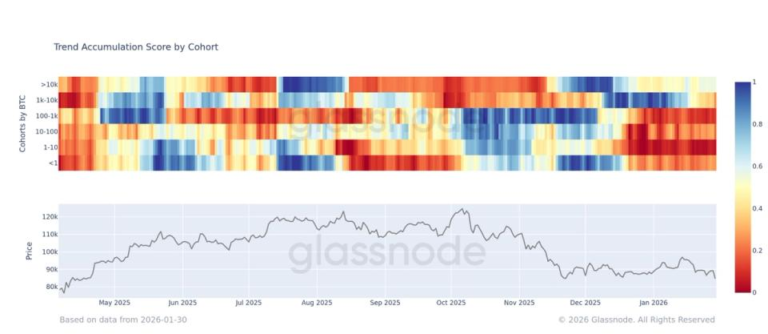
This divergence is highlighted by Glassnode’s Accumulation Trend Score by wallet cohort, which measures the relative behavior of different entity sizes based on both balance and the amount of bitcoin acquired over the past 15 days. Scores closer to 1 indicate buying, while values near 0 signal selling.

Bitcoin accumulation trend (Glassnode)

According to Glassnode data, the largest whales are in a “light accumulation” phase and have maintained a neutral-to-slightly-positive balance trend since bitcoin fell to $80,000 in late November. During this period, price has largely consolidated, trading within a $80,000 to $97,000 range through the end of January.

Bitcoin is now trading near $78,000, according to CoinDesk data.

In contrast, all smaller cohorts are net sellers, particularly retail holders with less than 10 BTC. This group has been in persistent selling for over a month, reflecting continued downside and risk aversion among smaller participants.

At the same time, the number of unique entities holding at least 1,000 BTC has increased from 1,207 in October to 1,303.

Number of Entities with balance 1k BTC (Glassnode)

Number of Entities with balance 1k BTC (Glassnode)

Since bitcoin’s October all-time high, growth in this cohort suggests that larger holders have been buying into the correction. Whales holding at least 1,000 BTC are now back at December 2024 highs, reinforcing the view that large players are absorbing supply while smaller holders continue to exit.

XRP’s Playbook Goes Beyond Payments: Pundit Reveals More Use Cases

0

Trusted Editorial content, reviewed by leading industry experts and seasoned editors. Ad Disclosure

Crypto pundit X Finance Bull has highlighted that XRP’s use case extends beyond payments, with a focus on tokenization. This comes as experts such as Canary Capital CEO Steven McClurg have predicted that the altcoin will be the token of choice for real-world assets (RWAs) tokenization. 

How XRP’s Utility Extends Beyond Payments

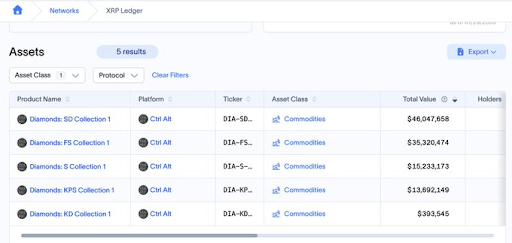
In an X post, X Finance Bull drew attention to how XRP’s utility extends beyond payments, alluding to $110 million in tokenized diamonds transactions that were settled on the XRP Ledger. The pundit noted that five diamond collections were tokenized on the network through Ctrl Alt. 

He further remarked that the Ledger is expanding beyond cross-border payments into full RWA tokenization, with XRP, as the network’s native token, being used to settle these tokenized transactions. X Finance Bull added that the playbook is to build the payments infrastructure first, then tokenized assets second, and finally the full financial rails third. 

XRP
Source: Chart from X Finance Bull on X

The crypto pundit declared that the network will be used to settle all types of transactions, aligning with predictions that the altcoin could become the backbone of global finance. Thanks to its expanded utility, X Finance Bull also noted that the narrative that the Ledger is just about payments is officially outdated. 

It is worth noting that prior to X Finance Bull’s revelation, Canary Capital’s CEO predicted that the token would dominate the RWA industry, which is projected to become a trillion-dollar industry at some point. He made the prediction based on Ripple’s moves over the last two years and how the crypto firm has integrated the Ledger into many Wall Street transactions, boosting institutional adoption in the process. This is one of the reasons McClurg is confident that XRP’s price can significantly appreciate in the long term.

What Ripple Treasury Move Means For The Altcoin

X Finance Bull also recently explained what the launch of the Ripple treasury platform means for XRP’s adoption. He noted in an X post that the crypto firm is adding digital asset expertise to the treasury platform, which will drive the altcoin’s integration. Based on this, he declared that the impact of the altcoin is direct. 

First, he stated that corporations will get unified visibility across cash and digital assets. Furthermore, thanks to XRP, settlements become instant, and the cost of FX drops. The move will also unlock more working capital as yield optimization runs 24/7. Lastly, the pundit stated that tokenized assets and programmable payments become native. He believes working on infrastructure that solves real corporate problems is the best way to drive institutional adoption, not through marketing. 

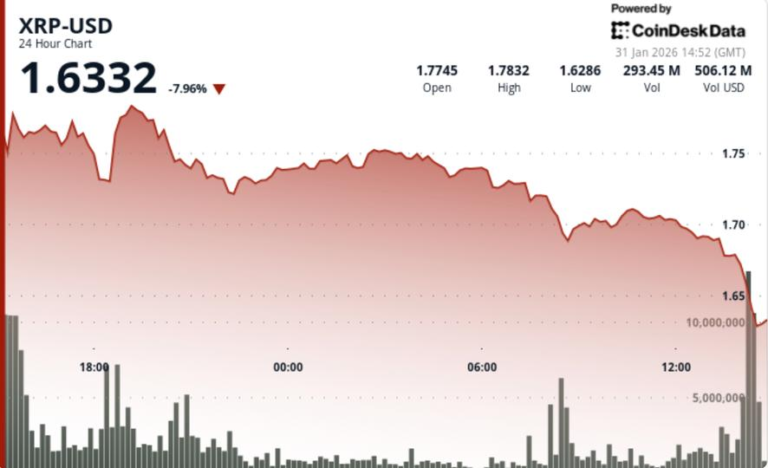
At the time of writing, the XRP price is trading at around $1.74, down in the last 24 hours, according to data from CoinMarketCap.

XRP
XRP trading at $1.72 on the 1D chart | Source: XRPUSDT on Tradingview.com

Featured image from Shutterstock, chart from Tradingview.com

Editorial Process for bitcoinist is centered on delivering thoroughly researched, accurate, and unbiased content. We uphold strict sourcing standards, and each page undergoes diligent review by our team of top technology experts and seasoned editors. This process ensures the integrity, relevance, and value of our content for our readers.

Bitcoin breaks key support level as Glassnode warns of further price breakdown

0

U.S. president Donald Trump’s surprise nomination of former Fed governor Kevin Warsh as the next Federal Reserve chair boosted the dollar, unwound the precious metals rally, and is bringing bitcoin below a key support level.

Onchain data shared by Glassnode shows bitcoin was consolidating just above key structural support around $83.4K, the lower bound of its short-term holder cost basis model.

A breakdown below that zone could open the door to a deeper slide toward $80.7K, the so-called True Market Mean.

That breakdown is occurring. Over the past 7-day period bitcoin lost more than 9.2% of its value and now trades at $81,200.

The broader market, measured via the CoinDesk 20 (CD20) index, lost 12.4% of its value over that period. That has meant the Crypto Fear & Greed Index dropped to “extreme fear” over the week.

Glassnode’s report notes that short-term holder supply held at a loss with BTC above that level remained at 19.5%, well below the 55% capitulation threshold, suggesting some resilience despite downside pressure. However, buyer conviction is being tested as price drifts lower.

On the derivatives side, funding rates remain muted, pointing to cautious speculative appetite. Options markets are pricing in greater demand for downside protection, with dealer gamma flipping negative below $90K. That increases the risk of volatility spikes if support breaks.

Taken together, the data paints a picture of a fragile but not yet broken market. Liquidity remains the key variable.

The crypto market may currently be gripped by fear, but that could be a good signal.

According to crypto analytics platform Santiment, sentiment across various cryptocurrency communities has plunged to extreme lows, levels that have historically preceded price recoveries.

In a report, Santiment highlighted the rise in bearish commentary on social media as a rare bright spot in an otherwise downbeat environment.

“While network fundamentals are stagnant, crowd sentiment has hit extreme negativity levels,” the firm wrote. “Historically, this excessive bearishness is a strong contrarian indicator that a local bottom could be near.”

While prices have been dropping throughout the last few months, long-term bitcoin holders are selling at the fastest pace since August. Crypto prices fell over the week, seemingly over the U.S. dollar’s decline reversing.

Some industry observers say the current mood may be short-lived, however.

Bitwise’s CIO Matt Hougan had recently joined CoinDesk’s Markets Outlook, where he said crypto is in the late stages of a bear-market bottom. Historically, crypto markets have tended to move in the opposite direction of the crowd, the report points out.

The 24/7 Global Stock Market Is Impossible On Today’s Blockchain

0

Opinion by: Joshua Sum, head of product at Solayer Labs

Consider a single, borderless financial market operating around the clock, where a farmer in Nebraska can instantly hedge wheat futures. At the same time, a pension fund in Tokyo trades Tesla shares seamlessly, all without permission, intermediaries or geographic constraints. 

This isn’t science fiction.

It’s the logical endpoint of blockchain technology and asset tokenization, a vision that has captivated everyone from JPMorgan executives to Silicon Valley dreamers.

Yet this remains a distant future. Not because we lack ideas, but because we’re trying to build it on a foundation — today’s blockchain infrastructure — that is fundamentally not ready for use on this scale.

The tokenization paradox

The irony is almost painful. We’ve successfully solved the hard part: Real-world assets — stocks, bonds, commodities and real estate — are all being digitized at breakneck speed.

Nobody wants to admit that we’ve created digital stock certificates for a market that operates at the speed of a fax machine with the integrity of a back-alley dice game.

Current layer-1 blockchains suffer from three critical failures that make institutional-grade trading impossible.

When infrastructure becomes the bottleneck

First, the throughput ceiling. These networks simply cannot handle the volume that real markets demand. When a single popular asset launch can congest an entire blockchain for hours, how are we supposed to process millions of daily trades across thousands of tokenized assets? The numbers simply don’t add up.

Second, latency. Slow block times and uncertain finality make efficient price discovery nearly impossible. High-frequency trading? An uphill battle. Even basic arbitrage becomes a risky gamble when you can’t guarantee execution speed. The result is massive, persistent slippage that makes traditional exchanges look like Formula 1 cars by comparison.

Perhaps most damaging is the unequal playing field. Rampant maximal extractable value (MEV), the sophisticated front-running and sandwich attacks that plague current networks, creates precisely the kind of market manipulation that sends institutional investors running for the exits. When sophisticated bots can systematically extract value from every trade through opaque transaction ordering, it’s no longer a fair market, and the game is already rigged.

The real-world cost of technical compromises

The stakes couldn’t be higher. For institutions, this infrastructure represents an unacceptable risk profile. The possibility of a blockbuster trade failing mid-execution or being front-run by algorithmic predators simply doesn’t align with industry-standard risk parameters. They won’t deploy serious capital into systems that can’t guarantee fundamental execution integrity.

Related: No-code tools can unlock tokenization for institutional asset managers

For retail users, the promise of democratized access becomes a cruel joke when the playing field is structurally tilted toward those with the most sophisticated MEV extraction tools. We’ve inadvertently recreated the worst aspects of traditional finance — insider advantages and systematic exploitation — while eliminating the regulatory protections that at least attempt to level the playing field.

Meanwhile, the window of opportunity is rapidly closing. Traditional finance is waking up to the potential of tokenization, but it is also witnessing blockchain’s current limitations in real time. Every failed trade, every front-run transaction and every network congestion event reinforces their skepticism about the promise of the decentralized approach.

Building the foundation that finance deserves

To realize the dream of a 24/7 global exchange, we need a paradigm shift. We need to build upon the progress of high-throughput networks like Solana, which proved that scalable base-layer performance is achievable, while recognizing that the extreme demands of global finance require a new, specialized class of infrastructure. Incremental optimizations are not enough. What we need is a quantum leap forward in scalability.

The requirements are clear, even if the solutions aren’t trivial. Performance must be a prerequisite, not an aspiration. We’re talking about networks capable of processing over 100,000 transactions per second with sub-second finality as a starting point, not some distant goal to achieve through workarounds.

Fairness must be engineered at the protocol level. Transaction ordering needs to be genuinely first-come, first-served, eliminating the opportunity for malicious MEV that turns every trade into a potential victim of algorithmic predation. Ethics aside, this creates the predictable execution environment that serious capital demands.

Perhaps most critically, we need seamless composability that makes the entire ecosystem feel like a unified marketplace. Assets and liquidity must move atomically across different execution environments without the friction that currently fragments markets.

The technical architecture, including new execution layers natively compatible with ecosystems like the Solana Virtual Machine, already exists to solve these problems. This allows for specialization without fracturing liquidity or developer momentum.

Incremental fixes won’t cut it when you’re trying to rebuild global finance. The current approach of layering solutions onto inadequate foundations is like installing racing stripes on a horse and expecting it to compete at Daytona.

The dream of a 24/7 global exchange isn’t failing due to a lack of ambition. The problem isn’t the vision; it’s the foundation.

The trillion-dollar opportunity of tokenized assets is real, and it’s waiting. It demands infrastructure engineered from the ground up to meet the scale, speed and integrity that global finance requires. The question isn’t whether this future will arrive.

It’s whether the blockchain industry will build the engine it truly deserves or watch traditional finance build it instead.

Opinion by: Joshua Sum, head of product at Solayer Labs.

This opinion article presents the contributor’s expert view and it may not reflect the views of Cointelegraph.com. This content has undergone editorial review to ensure clarity and relevance, Cointelegraph remains committed to transparent reporting and upholding the highest standards of journalism. Readers are encouraged to conduct their own research before taking any actions related to the company.