

Crypto exchange-traded funds (ETFs) closed the final full week of January under heavy pressure, with deep losses across bitcoin, ether, XRP, and solana funds. Persistent risk-off sentiment drove one of the worst weekly drawdowns of the year. January Ends in Pain as Bitcoin, Ether Lead Mass ETF Exodus The final week of January delivered a […]
Singapore Gulf Bank Adds Stablecoin Settlement for Institutional Clients

The bank said its institutional clients will be able to manage fiat currencies and stablecoins in one place.
Singapore Gulf Bank (SGB) said it has upgraded its multi-currency, real-time clearing network, SGB Net, to support stablecoins alongside fiat currencies, allowing institutional clients to manage both within a single banking platform.
Under the new setup, clients will be able to trade, mint, convert, hold and transfer stablecoins including Circle’s USDC and Tether’s USDT across blockchains such as Ethereum, Arbitrum and Solana. According to a spokesperson for the bank, the service is only available to SGB’s corporate clients.
The upgrade extends Singapore Gulf Bank’s clearing system into the stablecoin market, according to a press release viewed by The Defiant. SGB Net currently processes about $2 billion in monthly fiat transaction volumes, the bank said.
“Our ambition is to become the one bank for all of finance,” said Shawn Chan, chief executive officer of SGB.
“Stablecoins have become the working capital of the digital asset economy, yet managing them remains unnecessarily complex. This upgrade to SGB Net positions SGB as the default bank for managing fiat and multiple stablecoins within a single, regulated infrastructure.”
The bank said the service includes compliance checks such as KYC, KYB and AML. Digital asset custody and transaction security are provided through a partnership with Fireblocks.
The total stablecoin market currently stands at about $304.9 billion, according to DefiLlama, just underneath its all-time high. USDT accounts for roughly 60% of the market with a market cap of over $185 billion.
Singapore Gulf Bank said it is working with issuers, partners and regulators on risk management and operational standards. Access to the network is expected to roll out to clients sometime in Q1 2026.
Singapore Gulf Bank is backed by Whampoa Group and Mumtalakat and is regulated by the Central Bank of Bahrain.
BTC rebounds to $79,000, but HOOD, COIN, MSTR remain sizably lower

Trading just below $79,000 in midday U.S trade Monday, bitcoin has bounced from its worst weekend level below $75,000.
At $78,700, BTC is higher by 2% over the past 24 hours and up 7% from its weakest price of the weekend, but still down more than 10% on a week-over-week basis. Ether is also up about 2% over the past day, but down 19% from week-ago levels.
Crypto’s weekend move “broke key short-term support and stood out for its speed and depth, even by typical weekend standards,” said Adrian Fritz, chief investment strategist at 21shares.
According to Fritz, the sell-off was triggered by another round of forced deleveraging, as over $2 billion in crypto derivatives were liquidated in a rapid burst. “Liquidations in perps accelerated the downside momentum, rather than discretionary spot selling,” he said.
U.S. stocks traded higher on Monday, with the Nasdaq and S&P 500 each ahead 0.6% and the Dow Jones Industrial Average higher by 0.9%. While bitcoin in January closed out its fourth-consecutive month of losses, expert tradfi market analyst Ryan Detrick noted the DJIA was higher for a ninth-straight month in January. That ranks among the Dow’s longest ever winning streaks, said Detrick, who reminded that future returns for stocks tend to be strong after such runs.
Gold and silver are having a volatile day, but are currently down modestly after their worst one-day sell-off since 1980 on Friday.
The modest bounce in crypto is having little effect on digital asset-related stocks, which remain down sharply across the board. Among them, Roinbhood (HOOD) is down 9%, Circle (CRCL) down 5%, and Coinbase (COIN) and Strategy (MSTR) down 3%.
Key U.S. economic data as February begins
The ISM manufacturing PMI, a key gauge of U.S. factory activity based on surveys of purchasing managers, came in hotter than expected at 52.6 in January, compared with a forecast of 48.5. This marks the first expansion in manufacturing activity in 12 months and the strongest reading since 2022.
January is typically a reorder month following the holiday period, which often results in elevated readings. This seasonal pattern was also evident in January 2025 and January 2024.
Looking ahead, investors will be awaiting this Friday’s January U.S. jobs report for clues about whether the Federal Reserve might cut rates again after pausing rate cuts at its January meeting last week.
NY Prosecutors Raise Alarm over GENIUS Act on Fraud: Report

Several New York district attorneys have reportedly warned about the US federal stablecoin law, the GENIUS Act, claiming it fails to adequately address fraud.
According to a Monday CNN report, New York Attorney General Letitia James and four district attorneys signed onto a letter saying that the GENIUS Act will “provide legal cover” for stablecoin issuers to potentially participate in fraud.
The letter reportedly pointed a finger at issuers Tether and Circle, claiming that the companies have profited off crimes in stablecoin markets, specifically accusing Tether of only freezing some suspicious transactions in USDt (USDT).
“The reality for many victims, therefore, is that funds stolen in or converted to USDT will never be frozen, seized, or returned,” said the letter, according to CNN. “They [Tether] currently decide on a case-by-case basis when they will assist law enforcement in recovering funds for victims, and nothing prevents them from stopping all reissuance entirely.”
Regarding Circle, the letter said the stablecoin issuer “claims to be an ally in the fight against financial fraud,” but its policies were “significantly worse than those of Tether for victims of fraud.”
Chief strategy officer Dante Disparte reportedly said Circle “has always prioritized financial integrity and advancing US and global regulatory standards for stablecoins,” adding:
“[The GENIUS Act] makes clear that stablecoin issuers must abide by applicable financial integrity rules for combating illicit activity, while enhancing clear consumer protection norms. We have followed prevailing rules as a US regulated financial institution, and we will continue to advance these standards.”
Tether reportedly said that it “takes fraud, consumer harm, and the misuse of USDT extremely seriously and maintains a zero-tolerance policy toward illicit activity,” but the company did not have “a blanket legal obligation to comply with state-level civil or criminal processes in the way a US-regulated financial institution would.” The stablecoin issuer’s headquarters is in El Salvador.
Related: Trump: US has to ‘make it so that China doesn’t get the hold‘ of crypto
The GENIUS Act, which was signed into law by US President Donald Trump in July, established a framework for payment stablecoins in the country. The bill requires implementation 18 months after enactment or 120 days after US agencies approve regulations related to the law.
NY AG could face crypto lawyer challenger in 2026
Letitia James, who as of Monday had not made any public statements indicating she was not running for reelection as New York Attorney General this year, could face a challenger representing interests aligned with many in the crypto industry.
In November, former Coinbase policy lawyer Khurram Dara said he plans to run as a Republican to unseat James, claiming that the attorney general had engaged in “lawfare” against the crypto industry in the state. Both potential candidates have an April 6 deadline to file.
Magazine: Bitget’s Gracy Chen is looking for ‘entrepreneurs, not wantrepreneurs’
Cointelegraph is committed to independent, transparent journalism. This news article is produced in accordance with Cointelegraph’s Editorial Policy and aims to provide accurate and timely information. Readers are encouraged to verify information independently. Read our Editorial Policy https://cointelegraph.com/editorial-policy
Epstein Leaks Shake BTC vs. XRP Rivalry

Trusted Editorial content, reviewed by leading industry experts and seasoned editors. Ad Disclosure
Shadows of the past impact today. The surfacing of emails linking Jeffrey Epstein to early crypto academia and Bitcoin development circles has done more than just reignite old gossip.
It’s weaponized the ‘civil war’ between Bitcoin maximalists and the Ripple ($XRP) army. For years, the debate centered on centralization versus decentralization. Now? It has shifted to a far more dangerous battleground for legacy assets: reputational toxicity.
The leaked correspondence, which highlights connections between the disgraced financier and the MIT Media Lab, a hub that funded early Bitcoin core development, is being used by Ripple proponents to challenge Bitcoin’s claim to moral superiority.
Bitcoin advocates, naturally, are firing back at $XRP’s opaque early distribution. Why does this mudslinging matter? Because it creates a ‘compliance landmine’ for institutional investors. BlackRock and Fidelity deal in risk management; they don’t want assets with skeletons in the closet.
The data suggests that as the ‘old guard’ fights over who has the cleaner history, smart money is quietly exiting the crossfire to find infrastructure built for the regulatory clarity of the modern era.
This flight to quality is steering capital toward Bitcoin Hyper ($HYPER). Unlike legacy tokens entangled in the ‘dark ages’ of crypto’s libertarian wild west, Bitcoin Hyper is engineered as a clean-slate solution. By combining Bitcoin’s settlement security with a compliance-ready Layer 2 architecture, it offers the fresh start that institutions and weary retail investors are desperate for.
Engineered for Transparency: The SVM Advantage
While Bitcoin and Ripple trade blows over historical associations, Bitcoin Hyper is fixing the technical debt that plagues both chains. Let’s be honest: Bitcoin is too slow for DeFi, and Ripple’s centralization remains a dealbreaker for purists.
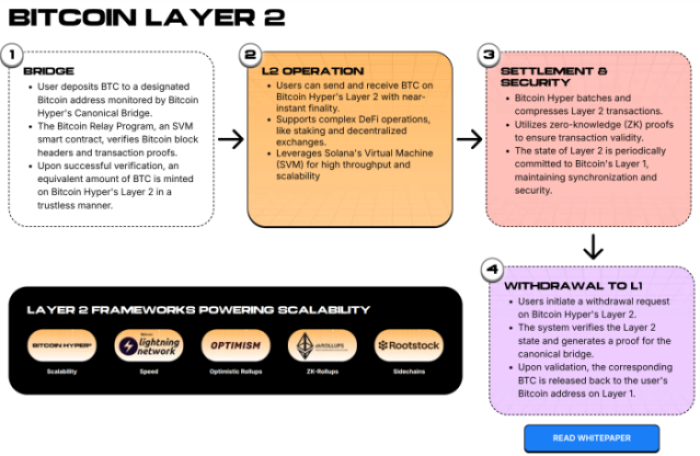
Bitcoin Hyper bridges this gap by integrating the Solana Virtual Machine (SVM) directly as a Bitcoin Layer 2.
Source: Bitcoin Hyper
Central to this ecosystem is the Canonical Bridge, a trustless gateway that allows users to migrate value into a high-speed environment without the ‘handshake deals’ or counterparty risks exposed in recent leaks.
Technical Superiority by the Numbers
-
Sub-Second Finality: Move at the speed of light, not the speed of an aging ledger.
-
Minimal Fees: Transaction costs as low as $0.01.
-
Standardized Security: By utilizing a single trusted sequencer with periodic L1 state anchoring, Bitcoin Hyper ensures every transaction is verifiable on the Bitcoin mainnet.
This approach aligns perfectly with the ‘2026 transparency standards’ regulators are currently drafting. The Canonical Bridge ensures that liquidity is unified and verifiable, positioning Bitcoin Hyper as a safe harbor for developers who want to build on Bitcoin without inheriting the legal or social baggage of its early years.
For a further breakdown of the proejct check out our ‘What is Bitcoin Hyper?‘ guide.
Whale Wallets Signal Shift to New Infrastructure
The market’s appetite for a ‘fresh start’ protocol shows up clearly in the on-chain data. While legacy large caps struggle with sentiment headwinds, Bitcoin Hyper has raised over $31.1M in its ongoing presale. That capital inflow suggests investors are pricing in the value of a high-performance Layer 2 free from the regulatory crossfire hitting the major incumbents.

Source: Bitcoin Hyper / X
Smart money is moving. Etherscan data reveals that two high-net-worth wallets accumulated $879.9K during the presale, with the largest single buy hitting $500K. This accumulation pattern typically precedes a wider retail rotation, as whales position themselves before the token lists on major exchanges.
With Bitcoin Hyper‘s presale price at $0.013675, early entrants are securing positions at a valuation that reflects the project’s infrastructure potential rather than speculative hype. Plus, the protocol offers high APY for immediate staking, with a modest 7-day vesting period for presale stakers, a structure designed to incentivize long-term alignment over mercenary capital.
The only question now – ‘How to Buy Bitcoin Hyper?’
This article is for informational purposes only and does not constitute financial advice. Cryptocurrencies are volatile; investors should perform their own due diligence and be aware of the risks involved in presale assets.

Editorial Process for bitcoinist is centered on delivering thoroughly researched, accurate, and unbiased content. We uphold strict sourcing standards, and each page undergoes diligent review by our team of top technology experts and seasoned editors. This process ensures the integrity, relevance, and value of our content for our readers.
BlackRock sends over $670M in Bitcoin, Ethereum to Coinbase

BlackRock moved over $670 million in Bitcoin and Ethereum to Coinbase Prime on Monday, according to Arkham Intelligence data.
Specifically, the asset management giant deposited 6,918 Bitcoin worth approximately $539 million and 58,327 Ethereum valued at about $133 million into the institutional trading and custody platform.
The movements are tied to operational requirements for BlackRock’s spot Bitcoin ETF (IBIT) and Ethereum ETF, which involve creation and redemption processes requiring direct custody arrangements.
Large-scale asset transfers do not automatically signal an intent to sell. Still, BlackRock’s move warrants close monitoring as markets remain under pressure following a sharp weekend sell-off that pushed Bitcoin below $75,000.
BlackRock’s IBIT recorded $528 million in net outflows last Friday, its largest single-day redemption since launch, while total outflows across all US-listed spot Bitcoin ETFs reached $1.5 billion for the week, per Farside Investors.
BitMine (BMNR) added nearly $100 million in ETH amid market plunge

BitMine Immersion Technologies (BMNR), the largest Ethereum-focused treasury firm, continued its weekly ether purchase streak even as a sharp crypto sell-off deepened its unrealized losses and sent its stock to new 7-month lows.
The firm said in a Monday update that it bought 41,788 ETH last week, its largest weekly token haul so far this year, worth around $96 million at current prices. The purchase lifted BitMine’s total ETH holdings to 4,285,125 tokens, or about 3.55% of Ethereum’s circulating supply, according to a company update released Monday. The firm also holds 193 bitcoin , $586 million in cash, a $200 million stake in Beast Industries and a $20 million stake in Eightco Holdings.
Ether fell to around $2,300 over the weekend, pulling the firm’s total crypto, cash and equity holdings down to $10.7 billion. In Monday morning U.S. trade, the price had recovered modestly to $2,360. BMNR shares were lower by 5%>
With crypto prices falling sharply last week, the firm is estimated to be sitting on roughly $6 billion in unrealized losses on its position.
Chairman Thomas Lee said ether’s price weakness contrasts with rising activity on the Ethereum blockchain, noting that daily transactions and active addresses recently hit record highs.
“During the crypto winter of 2021-2022 or 2018-2019, Ethereum transaction activity and active wallets declined, which is counter to what we have seen in the past 12 months,” Lee said.
He argued that lingering effects from October’s crypto crash and the recent surge in precious metals prices have weighed on the market, sucking out liquidity from the crypto economy.
BitMine has also ramped up staking, lifting its total staked ETH to nearly 2.9 million tokens, or about two-thirds of its holdings, generating an estimated $188 million in annualized staking revenue.
Bitcoin Had A Brutal Dip To $74,500. Here’s What’s Happening

Bitcoin is stabilizing slightly today after one of its most punishing weeks in years, but the damage across crypto markets has already been done.
The bitcoin price fell below $80,000 over the weekend for the first time since April 2025, briefly plunging to lows near $75,000 amid cascading liquidations and a broader sell-off across global risk assets.
As of early Monday, BTC was trading around $78,400, up about 1% on the day, according to Bitcoin Magazine data, after shedding roughly 12% over the past seven days.
That decline has erased more than $200 billion from bitcoin’s market capitalization, capping a brutal stretch that saw the asset lose roughly $800 billion in value since peaking above $126,000 in October.
Market participants point to a convergence of macroeconomic stress, geopolitical risk and structural fragility in crypto markets as the primary drivers of the sell-off.
Bitcoin’s drop coincided with a sharp “risk-off” move across global markets. U.S. equities slid late last week, led by steep losses in technology stocks after Microsoft’s earnings disappointed investors. That weakness spilled into European and Asian markets on Monday, while traditional safe havens also came under pressure.
Gold and silver both suffered historic losses, with silver posting its worst single-day decline since 1980. Analysts say the simultaneous sell-off in crypto and precious metals reflects a surging U.S. dollar and shifting expectations around U.S. monetary policy following the nomination of Kevin Warsh to succeed Jerome Powell as Federal Reserve chair.
Thin liquidity over the weekend exacerbated price swings, triggering a wave of forced liquidations across derivatives markets.
According to Coinglass, more than $2 billion worth of BTC long and short positions have been liquidated since Thursday, including $2.56 billion across all cryptocurrencies on Saturday alone — one of the largest single-day liquidation events on record.
Liquidations occur when leveraged traders are automatically forced out of positions as prices fall, creating a feedback loop of selling pressure that can accelerate declines.
Institutional investors have also been pulling back. Digital asset investment products recorded a second consecutive week of outflows totaling $1.7 billion, according to CoinShares, wiping out all year-to-date inflows and pushing 2026 flows into negative territory.
Bitcoin and Ethereum products led the withdrawals, while short BTC products and tokenized precious metals saw inflows, suggesting rising demand for downside protection.
Bitcoin whale activity
Earlier today, Binance confirmed it purchased 1,315 bitcoin, worth roughly $100 million, as part of a plan to convert its $1 billion Secure Asset Fund for Users (SAFU) reserve from stablecoins into BTC over the next 30 days.
Binance cofounder Changpeng “CZ” Zhao said he had lost confidence in a 2026 BTC “super cycle,” citing intense FUD, market turbulence, and accusations that Binance-related events contributed to a historic liquidation cascade.
Members of the crypto community accused CZ of selling BTC over the weekend and accused him of being responsible for the massive October 10, 2025 crypto crash that led to large crypto liquidations.
Corporate bitcoin holders have also come under scrutiny. Bitcoin’s brief dip below Strategy’s average purchase price put the company’s massive treasury holdings under pressure, though analysts say there is no risk of forced selling because the BTC is not pledged as collateral.
Bitcoin’s drop below Strategy’s $76,052 cost basis somewhat erased the psychological floor beneath Michael Saylor’s leveraged accumulation strategy, exposing growing strain as the firm’s stock trades far below its peak and its equity premium vanishes.
While there’s no immediate financial distress and no forced selling risk, tightening capital markets and fading investor appetite are shrinking Strategy’s ability to fund further Bitcoin purchases through share issuance.
At the time of writing, BTC is rebounding to around $78,380, up 1% over the past 24 hours, trading just below its seven-day high as market capitalization climbs to roughly $1.57 trillion.
Billionaire Crypto Founder Comes Under Fire: Why TRON’s Justin Sun Is Trending
Trusted Editorial content, reviewed by leading industry experts and seasoned editors. Ad Disclosure
Billionaire crypto founder Justin Sun has come under fire following accusations of insider trading. The TRON founder is said to have devised means to manipulate TRX’s price during the 2017 bull run.
TRON Founder Justin Sun Accused Of Insider Trading
In an X post, finance expert Tenten alleged that Justin Sun used the identities of multiple of his employees based in Beijing to operate accounts on the Binance exchange, which he used to manipulate TRX’s market cap. Tenten further stated that the crypto founder carried out aggressive and large-scale sales at the end of 2017 and the beginning of 2018.
She also alleged that this insider trading and “predatory practices” involving the TRX token on Binance were how Justin Sun amassed his wealth. Meanwhile, Tenten claimed that she had been in a relationship with the TRON founder in the early stages of his network’s development, which is how she got this information.
Tenten was commenting on a report that highlighted the SEC’s allegations against Justin Sun of fraud and wash trading. She stated that she has evidence showing that the TRON founder indeed used employees’ identities to artificially inflate the TRX price on Binance. She added that she is willing to fully cooperate with an SEC investigation and to submit all relevant WeChat records.
The finance expert stated that the crypto founder’s employees were the ones who provided her with these chats, which prove that he was involved in market manipulation. She requested that the U.S. authorities contact her so that she can forward this information. It is worth noting that the SEC has halted the case against the TRON founder, though it has not yet been dismissed.
Interestingly, her allegations follow the letter that House Democrats sent to the SEC about a “Pay-to-Play” in how it has handled Justin Sun’s case since the crypto founder invested in the Trump-linked World Liberty Financial (WLFI).
“Ignore The FUD”
Justin Sun has yet to openly address these allegations. However, following Tenten’s statements, he urged the TRON community to ignore the FUD and keep building and holding. In another X post, he highlighted how TRX is holding up well despite the crypto market crash. Meanwhile, Tenten has made further allegations, including that the crypto founder tried to defame her.
In an X post, she claimed that, in response to her initial allegations, Justin Sun has disseminated a large amount of false, malicious, and defamatory content targeting her. According to her, the TRON founder did this through Chinese crypto KOLs, with whom he has a long-term relationship.
She also accused these KOLs of being involved in market manipulation, stating that they usually work with crypto projects to make calls about their tokens. Then the team dumps the tokens after retail investors buy into it.
At the time of writing, the TRX price is trading at around $0.2821, down in the last 24 hours, according to data from CoinMarketCap.
Featured image from Pixabay, chart from Tradingview.com
Editorial Process for bitcoinist is centered on delivering thoroughly researched, accurate, and unbiased content. We uphold strict sourcing standards, and each page undergoes diligent review by our team of top technology experts and seasoned editors. This process ensures the integrity, relevance, and value of our content for our readers.
HIP-4 proposal will add outcome-based trading to platform

Hyperliquid’s token, HYPE, climbed 10% over the past 24 hours after the decentralized exchange detailed HIP-4, a proposal to bring “outcome” trading to its platform.
The new contract type would support prediction markets and options-style derivatives, both long-requested features, according to the team.
“There has been extensive user demand in both of these areas, and builders will likely think of novel applications as well,” Hyperliquid wrote in a post on X.
Outcomes are fully collateralized contracts that settle at a fixed price within a specified range. They introduce dated markets and non-linear payoffs to Hyperliquid’s system, which until now has focused on perpetual futures. Unlike traditional leveraged derivatives, outcomes do not require margin trading or risk liquidations.
Outcome trading will launch on testnet first, with mainnet deployment to follow once technical development is complete. Hyperliquid plans to start with a curated set of markets before potentially opening the system to permissionless listings, pending user feedback, it said.
HYPE gained traction over the past month after the exchange’s permissionless markets, which allow anyone to create markets on assets like crypto, stocks, and gold by staking 500,000 HYPE tokens, have exploded to record highs. The token is up 33% over the past month.