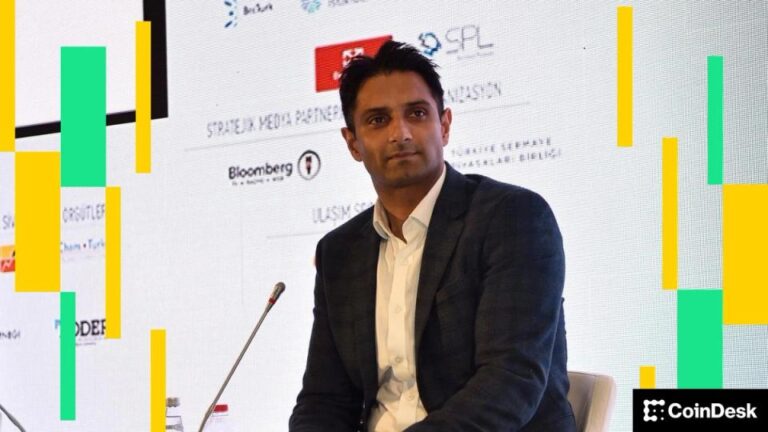
OKX Ventures, the venture capital arm of the global cryptocurrency exchange, has made a strategic investment in STBL, a next-generation stablecoin and yield infrastructure provider.
STBL, co-founded by Reeve Collins, who also co-founded Tether, and tokenization pioneer Avtar Sehra, also announced a partnership with Hamilton Lane (HLNE), an alternative-investment management firm, and Securitize, a regulated digital securities issuance firm whose clients include BlackRock (BLK).
The plan is to develop a stablecoin backed by real-world assets (RWA) on OKX’s Ethereum-compatible layer-2 blockchain X Layer, the companies said on Thursday.
The endeavor features a feeder fund to Hamilton Lane’s Senior Credit Opportunities Fund (SCOPE), issued and tokenized via Securitize, according to a press release.
“RWA markets are entering a new phase, where tokenization must deliver real utility, not just representation,” said Sehra, who is also CEO of the company. “STBL provides a purpose-built architecture for RWA-backed stablecoins combined with compliant yield management.”
The collaboration shows how tokenization brings utility to assets when it’s paired with regulated issuance and programmable settlement, said Securitize CEO Carlos Domingo.
“By embedding institutional private credit directly into onchain money flows, we’re turning tokenized assets into functional building blocks: assets that can be settled, composed and used across financial applications, not just held,” Domingo said.
Volume across Polymarket and Kalshi hit $400 million for the first time, with sports and political markets drawing nearly all the liquidity.
Open interest (OI) across crypto prediction markets just hit $1 billion for the first time, a surge likely fueled by increased activity around the 2026 Super Bowl.
According to data from Artemis, open interest across platforms, Polymarket, Kalshi, Limitless, Opinion, and others, jumped above $1.1 billion for the first time on Feb. 7, setting a new all-time high. OI indicates the value of all currently active positions — in this case, the “yes” or “no” positions across predictions — that have yet to be resolved, making it an indicator of capital inflow and liquidity.
Open interest across prediction markets. Source: Artemis
As for spot volume, it also reached a new historic record of $1.4 billion across platforms, with Kalshi generating $800 million and Polymarket about $311 million on Super Bowl Sunday, Feb. 8, Artemis data shows.
Capital allocation on prediction markets. Source: Paradigm
Digging into sectors where users placed the most bets, sports led with $375.3 million, while politics was close behind at $359.7 million, and culture trails at $84.5 million, according to data from crypto venture capital firm Paradigm’s new dashboard, which tracks liquidity across sectors on Polymarket and Kalshi, the two largest marketplaces by OI and trading volume.
But the growing interest in placing bets on real-world outcomes doesn’t come without risks. In a recent report, analysts at blockchain security firm CertiK warned that despite the surge, prediction markets are still exposed to security risks like oracle attacks, admin key vulnerabilities and front-running.
The firm also warned that artificial volume on prediction markets reached 60% on some platforms “during airdrop farming peaks, distorting liquidity metrics, while probability outputs remained reliable for forecasting.”
The spike in prediction market OI coincided with news that Jump Trading, a high-frequency trading firm, is reportedly set to gain small stakes in both Kalshi and Polymarket in exchange for providing liquidity, Bloomberg reported on Feb. 9, citing sources familiar with the matter.
Binance did not cause the crypto market liquidation event on Oct. 10, but every exchange — centralized or decentralized — saw massive liquidations that day after China imposed rare earth metal controls and the U.S. announced fresh tariffs, said Binance Co-CEO Richard Teng.
About 75% of the liquidations took place around 9:00 p.m. ET, alongside two unrelated, isolated issues: a stablecoin depegging and “some slowness in terms of asset transfer,” Teng said Thursday at CoinDesk’s Consensus Hong Kong conference.
“The U.S. equity market plunged $1.5 trillion in value that day,” he said. “The U.S. equity market alone saw $150 billion of liquidation. The crypto market is much smaller. It was about $19 billion. And the liquidation on crypto happened across all the exchanges.”
Some users were affected by this, which Binance helped support, he said, an action other exchanges did not take.
Binance facilitated $34 trillion in trading volume last year, he said, with 300 million users. Trading data does not show that there were any massive withdrawals from the platform.
“The data speaks for itself,” he said.
Speaking more broadly, Teng said the crypto market was tracking broader geopolitical tensions but that institutions are still pouring into the sector.
“At the macro level, I think people are still uncertain about interest rate movements going forward,” he said. “And there’s always the trend of geopolitics, tension, etc. Those weigh on these assets such as crypto.”
However, long-term industry participants will have seen crypto’s prices moving cyclically, he said, pointing to how the sector’s changed in the past four to six years.
“I think what we have to look at is the underlying development,” he said. “At this point in time, retail demand is somewhat more muted compared to the past year, but the institutional deployment, the corporate deployment is still strong.”
Institutions are still entering the sector, even despite the market, he said, “meaning the smart money is deploying.”
Trusted Editorial content, reviewed by leading industry experts and seasoned editors. Ad Disclosure
Paxful, once one of the largest peer‑to‑peer (P2P) Bitcoin marketplaces, has agreed to pay a $4 million criminal penalty after pleading guilty to multiple federal offenses, the US Department of Justice (DOJ) announced Wednesday.
The charges include conspiracies to promote illegal prostitution, operate an unlicensed money transmitting business, violate the Bank Secrecy Act, and knowingly transmit funds derived from criminal activity.
Paxful’s Compliance Failures
Prosecutors said the company was aware that some customers were using the platform to move proceeds from criminal activity, including fraud schemes and illegal prostitution.
Among the most significant examples cited was Paxful’s relationship with Backpage, a now‑defunct online classifieds site whose owners admitted in criminal proceedings that it profited from illegal prostitution, including advertisements involving minors.
The Justice Department stated that between December 2015 and December 2022, Paxful’s collaboration with Backpage and a related copycat site resulted in nearly $17 million worth of Bitcoin being sent from Paxful wallets to those platforms.
The plea agreement outlines a broader pattern of compliance failures. From July 2015 through June 2019, Paxful and its founders marketed the exchange as not requiring know‑your‑customer (KYC) verification. Customers were allowed to open accounts and conduct transactions without sufficient identity checks.
The company also provided third parties with anti‑money laundering policies that prosecutors said were not actually implemented or enforced. In addition, Paxful failed to file suspicious activity reports despite being aware of illicit conduct on the platform.
As a result, authorities concluded that the exchange became a vehicle for a range of criminal activity, including prostitution, fraud, romance scams, extortion schemes, hacks attributed to malign state actors, and even the distribution of child sexual abuse material.
Cooperation Earns Reduced Sentence
In determining the resolution, the Department of Justice considered the seriousness of the offenses, which involved processing millions of dollars in illicit transactions.
While Paxful did not voluntarily disclose the wrongdoing in a timely manner, it received credit for cooperating with investigators, which included gathering and producing extensive documentation, providing updates from its internal investigation, and undertaking significant remedial measures.
Under the plea agreement, Paxful acknowledged that the appropriate criminal penalty under the law would be $112.5 million. However, after conducting an independent financial analysis, the Justice Department determined that the company lacked the ability to pay that amount. As a result, the penalty was reduced to $4 million.
The case has also ensnared company leadership. On July 8, 2024, Paxful co‑founder and former chief technology officer Artur Schaback pleaded guilty to conspiracy to fail to maintain an effective anti‑money laundering program in connection with the same conduct.
The 1-D chart shows the total crypto market cap’s drop below $2.3 trillion on Wednesday. Source: TOTAL on TradingView.com
Featured image from OpenArt, chart from TradingView.com
Editorial Process for bitcoinist is centered on delivering thoroughly researched, accurate, and unbiased content. We uphold strict sourcing standards, and each page undergoes diligent review by our team of top technology experts and seasoned editors. This process ensures the integrity, relevance, and value of our content for our readers.
Bitcoin treasury company Strategy will further lean on its preferred stock sales to acquire Bitcoin, shifting from its strategy of selling common stock, says CEO Phong Le.
“We will start to transition from equity capital to preferred capital,” Le told Bloomberg’s “The Close” on Wednesday.
Stretch (STRC) is Strategy’s perpetual preferred stock, launched in July, and is aimed at buyers looking for stability by offering an annual dividend of over 11%.
STRC is the company’s fourth perpetual preferred offering, launched to finance its Bitcoin (BTC) purchases. It’s an alternative to issuing new shares that dilute its stock price.
Strategy CEO Phong Le appears on Bloomberg’s “The Close” on Wednesday. Source: YouTube
Le admitted that its preferred stock will “take some seasoning” and marketing to pitch traders on the offering, but added that “throughout the course of this year, we expect Stretch to be a big product for us.”
Strategy could restart offerings as STRC hits $100
STRC reclaimed its par value of $100 at the close of trading on Wednesday for the first time since mid-January, which Le said was the “story of the day.”
The stock had dipped below $94 earlier this month as Bitcoin crashed under $60,000, but with it now trading at par — the price Strategy has designated as its minimum — the company could again offer shares to fund more Bitcoin purchases.
Bitcoin has traded mostly flat over the last 24 hours at around $66,800, down from an intraday high of over $68,000.
Buying Bitcoin treasury rivals a “distraction”
Analysts have warned that the crypto treasury space is becoming crowded as companies compete for a small segment of traders, leading to some companies’ crypto holdings being worth more than the companies themselves.
Related: Saylor’s Strategy buys $90M in Bitcoin as price trades below cost basis
In that case, some analysts said that rival treasury firms could move to acquire underperforming companies to scoop up Bitcoin on the cheap, but Le said Strategy isn’t interested in making such a move.
“I think in any new market, whether it be electric cars or AI or SaaS software, you want to focus on your core product,” Le said. “I think it would be a distraction to go buy, at a discount to net asset value, another digital asset treasury company.”
Shares in Strategy (MSTR) ended trading on Wednesday down over 5% at $126.14.
Magazine: Bitget’s Gracy Chen is looking for ‘entrepreneurs, not wantrepreneurs’
Cointelegraph is committed to independent, transparent journalism. This news article is produced in accordance with Cointelegraph’s Editorial Policy and aims to provide accurate and timely information. Readers are encouraged to verify information independently. Read our Editorial Policy https://cointelegraph.com/editorial-policy
WLFI$0.1063, the Trump-family-linked crypto project, will soon launch a foreign exchange platform called World Swap, its co-founder, Zak Folkman, said on stage at Consensus Hong Kong.
The forex teaser adds to a growing list of products orbiting the project’s USD1 stablecoin as the project positions itself as a full-stack financial ecosystem, with further announcements expected at a Mar-a-Lago event later this month.
Speaking on stage, Folkman said the company’s goal is to abstract away much of the complexity associated with crypto wallets and cross-border transfers, allowing users to send and receive digital dollars in a manner similar to popular payment apps.
He framed the planned foreign exchange service as a direct challenge to traditional remittance providers that often charge fees ranging from 2% to 10% per transaction.
The company’s broader strategy centers on USD1, a dollar-pegged stablecoin that Folkman said is backed by cash and cash equivalents.
Folkman also highlighted the launch of World Liberty Markets, a lending platform that has attracted hundreds of millions of dollars in deposits within weeks of going live, and partnerships with decentralized finance protocols to increase the token’s utility.
In late January, Crypto Twitter users had spotted AMG Software Solutions LLC, a Puerto Rico-based company that owns WLFI’s intellectual property, had registered trademarks related to World Swap.
Aurora Labs has launched a new integration layer that makes NEAR Intents integration faster and easier for wallets and trading platforms worldwide. Solving the Integration Bottleneck Aurora Labs announced the launch of the Intents Widget, a new integration layer designed to make NEAR Intents accessible within third-party applications. The release is accompanied by Intents Widget […]
Trusted Editorial content, reviewed by leading industry experts and seasoned editors. Ad Disclosure
Hong Kong financial authorities have announced new rules to expand the scope of product offerings, allowing the integration of crypto margin financing and perpetual contracts into the local virtual assets market.
Hong Kong Approves Crypto Margin Financing, Perps
On Wednesday, Hong Kong’s Securities and Futures Commission (SFC) unveiled a framework for licensed corporations that provide virtual asset dealing services (VA brokers) to offer virtual asset financing.
According to the SFC’s circular, the financial watchdog will permit VA brokers to extend credit to margin clients with strong credit profiles and sufficient securities collateral, under Pillar P of its Access, Safeguards, Products, Infrastructure and Relationships (ASPIRe) roadmap.
This will allow eligible margin clients to “increase their participation in VA trading, which can enhance the liquidity of Hong Kong’s VA market. At the same time, this can also facilitate the development of VA financing in a risk-controlled environment.”
Under the new guidance, only the two leading cryptocurrencies, Bitcoin (BTC) and Ether (ETH), will be eligible as VA collateral. The regulator also released a high-level framework for licensed virtual asset trading platforms to offer crypto perpetual contracts to professional investors.
“Under the ASPIRe roadmap, Pillar P reflects the SFC’s commitment to expanding the scope of product offerings, including Perps. This initiative aims to deepen market liquidity, broaden risk management tools for investors, and further strengthen Hong Kong’s position as a leading global virtual asset hub,” the watchdog affirmed.
The SFC emphasized that the introduction of Perps will bring new opportunities to the market, but noted that it also carries “a range of risks that are distinct from those associated with traditional futures or spot trading of virtual assets.”
Therefore, the framework requires platform operators to have robust management measures and transparent processes governing valuation, margining, collateralization, and liquidation management.
Hong Kong Digital Landscape In ‘Defining Stage’
Speaking at Consensus Hong Kong 2026 on Wednesday, Eric Yip, SFC’s Executive Director of Intermediaries, shared his views on the watchdog’s regulatory enhancements for the next phase of Hong Kong’s crypto assets ecosystem.
Yip affirmed that Hong Kong’s crypto asset development has entered a “defining stage, shaped by the SFC’s ASPIRe roadmap that outlines a future-proof regulatory framework aimed at deepening market quality, resilience, and global competitiveness.”
He emphasized this year’s focus on liquidity, “cultivating market depth, strengthening price discovery, and building investor confidence through a strategic blend of expanded access and responsible product innovation.”
As the executive explained, the SFC is expanding the city’s crypto product suite under Pillar P while maintaining regulatory guardrails aligned with traditional financial market standards.
Notably, Yip highlighted the SFC’s greenlight of crypto margin financing, which will be anchored to the existing securities margin financing framework. He noted that it will provide clarification on the use of crypto assets as collateral, “enabling responsible leverage that supports liquidity without undermining financial stability.”
In addition, he also outlined the new high-level framework for leveraged perpetual contracts for professional investors, which sets out a principles-based model.
Discussing how to bridge innovation and regulatory clarity, he pointed to the upcoming Digital Asset Accelerator to be set up under Pillar Re, which will serve as a structured communication channel between the regulatory agency and industry innovators.
He concluded that “liquidity does not emerge organically; it must be cultivated through openness, strong governance, and a purposeful regulatory design. Through targeted access reforms, product expansion, and structured innovation support, Hong Kong is well-positioned to become a leading global digital assets centre where liquidity thrives on a foundation of integrity, resilience, and international cooperation.”
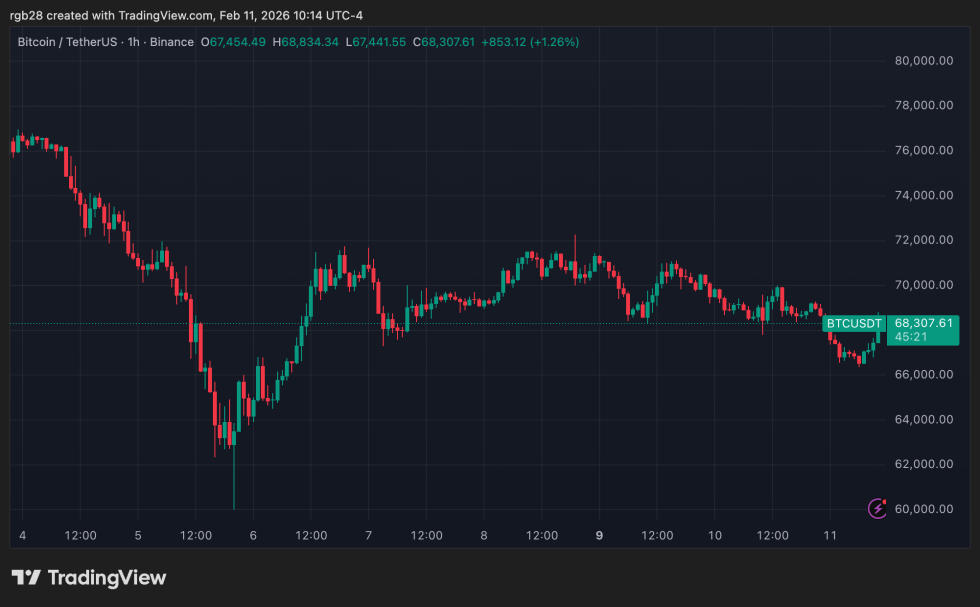
Bitcoin trades at $68,307 in the one-week chart. Source: BTCUSDT on TradingView
Featured Image from Unsplash.com, Chart from TradingView.com
Editorial Process for bitcoinist is centered on delivering thoroughly researched, accurate, and unbiased content. We uphold strict sourcing standards, and each page undergoes diligent review by our team of top technology experts and seasoned editors. This process ensures the integrity, relevance, and value of our content for our readers.
Aster, a decentralized perpetual exchange endorsed by Binance founder Changpeng Zhao, plans to launch Aster Chain’s mainnet in March, the team announced on X on Wednesday.
The rollout, part of the company’s 2026 roadmap, is designed to boost Aster’s infrastructure with a dedicated network for its on-chain products as well as tools for builders and integrated fiat on/offramps.
The layer 1 testnet went live in early February 2026 after initial whitelisted testing in late 2025, with over 50,000 participants. The upcoming mainnet launch will mark a shift from testing to full production after the project completed several testnet phases.
Aster plans to focus on community-driven upgrades to its decentralized exchange in 2026.
Key initiatives include governance features powered by the native token, staking and on-chain participation, and expanded access to real-world assets like stock perpetual markets, enhancing its synthetic trading offerings beyond crypto.
Blockchain transactions per second (TPS) numbers are often treated as a performance gauge, but they don’t tell the full story of whether a network can scale in practice.
Carter Feldman, founder of Psy Protocol and a former hacker, told Cointelegraph that TPS figures are often misleading because they ignore how transactions are actually verified and relayed across decentralized systems.
“Many pre-mainnet, testnet or isolated benchmarking tests measure TPS with only one node running. At that point, you might as well call Instagram a blockchain that can hit 1 billion TPS because it has one central authority validating every API call,” Feldman said.
Part of the issue is how most blockchains are designed. The faster they try to go, the heavier the load on every node and the harder decentralization becomes. That burden can be reduced by separating transaction execution from verification.
New projects advertise high TPS, though live network usage rarely approaches those ceilings. Source: MegaETH
TPS numbers ignore the cost of decentralization
TPS is a valid benchmark for blockchain performance. If a network has higher TPS, it can handle more real usage.
But Feldman argued most headline TPS figures represent ideal settings that don’t translate to real-world throughput. The impressive numbers don’t show how the system performs under decentralized conditions.
“The TPS of a virtual machine or a single node is not a measure of a blockchain’s real mainnet performance,” said Feldman.
“However, the number of transactions per second a blockchain can process in a production environment is still a valid way to quantify how much usage it can handle, which is what scaling should mean.”
Every full node in a blockchain must check that transactions follow the protocol’s rules. If one node accepts an invalid transaction, others should reject it. That’s what makes a decentralized ledger work.
Related: Firedancer will speed up Solana, but it won’t reach full potential
Blockchain performance considers how fast a virtual machine executes transactions. But bandwidth, latency and network topology matter in the real world. So, performance also depends on how transactions are received and verified by other nodes across the network.
As a result, TPS figures published in white papers often diverge from mainnet performance. Benchmarks that isolate execution from relay and verification costs measure something closer to virtual machine speed than blockchain scalability.
EOS, a network on which Feldman was a former block producer, smashed initial coin offering records in 2018. Its white paper suggested a theoretical scale of around 1 million TPS. That remains an eye-popping figure even by 2026 standards.
EOS never reached its theoretical TPS target. Earlier reports claimed it could hit 4,000 transactions under favorable settings. However, research conducted by blockchain testers at Whiteblock found that in realistic network conditions, throughput fell to roughly 50 TPS.
In 2023, Jump Crypto demonstrated that its Solana validator client, Firedancer, reached what EOS couldn’t by testing 1 million TPS. The client has since been rolling out, with many validators running a hybrid version known as Frankendancer. Solana in live conditions today typically processes around 3,000-4,000 TPS. Roughly 40% of those transactions are non-vote transactions, which better reflect actual user activity.
Solana recorded 1,361 TPS without vote transactions on Feb. 10. Source: Solscan
Breaking the linear scaling problem
Blockchain throughput usually scales linearly with workload. More transactions reflect more activity, but it also means nodes receive and verify more data.
Each additional transaction adds computational burden. At some point, bandwidth limits, hardware constraints and synchronization delays make further increases unsustainable without sacrificing decentralization.
Feldman said that overcoming this constraint requires rethinking how validity is proven, which can be done through zero-knowledge (ZK) technology. ZK is a way to prove that a batch of transactions was processed correctly without making every node run those transactions again. Because it allows validity to be proven without revealing all underlying data, ZK is often pushed as a solution to privacy issues.
Related: Privacy tools are rising behind institutional adoption, says ZKsync dev
Feldman argues that it can ease the scaling burden as well via recursive ZK-proofs. In simple terms, that refers to proofs verifying other proofs.
“It turns out that you can take two ZK-proofs and generate a ZK-proof that proves that both of these proofs are correct,” Feldman said. “So, you can take two proofs and make them into one proof.”
“Let’s say we start with 16 users’ transactions. We can take those 16 and make them into eight proofs, then we can take the eight proofs and make them into four proofs,” Feldman explained while sharing a graphic of a proof tree where multiple proofs ultimately become one.
How several proofs become one. Source: Psy/Carter Feldman
In traditional blockchain designs, increasing TPS raises verification and bandwidth requirements for every node. Feldman argues that with a proof-based design, throughput can increase without proportionally increasing per-node verification costs.
That does not mean ZK eliminates scaling tradeoffs entirely. Generating proofs can be computationally intensive and may require specialized infrastructure. While verification becomes cheap for ordinary nodes, the burden shifts to provers that must perform heavy cryptographic work. Retrofitting proof-based verification into existing blockchain architectures is also complex, which helps explain why most major networks still rely on traditional execution models.
Performance beyond raw throughput
TPS is not useless, but it is conditional. According to Feldman, raw throughput figures are less meaningful than economic signals such as transaction fees, which provide a clearer indicator of network health and demand.
“I would contend that TPS is the number two benchmark of a blockchain’s performance, but only if it is measured in a production environment or in an environment where transactions are not just processed but also relayed and verified by other nodes,” he said.
LayerZero Labs unveiled its Zero chain and claimed it can scale to 2 million TPS by leveraging ZK tech. Source: LayerZero
Blockchain’s dominant and existing design also influenced investments. Those modeled around sequential execution can’t easily bolt on proof-based verification without redesigning how transactions are processed.
“In the very beginning, it was almost impossible to raise money for anything but a ZK EVM [Ethereum Virtual Machine],” Feldman said, explaining Psy Protocol’s former funding issues.
“The reason people didn’t want to fund it in the beginning is that it took a while,” he added. “You can’t just fork EVMs or their state storage because everything is done completely differently.”
In most blockchains, higher TPS means more work for every node. A headline figure alone does not show whether that workload is sustainable.
Magazine: Ethereum’s roadmap to 10,000 TPS using ZK tech: Dummies’ guide
Cointelegraph Features and Cointelegraph Magazine publish long-form journalism, analysis and narrative reporting produced by Cointelegraph’s in-house editorial team and selected external contributors with subject-matter expertise. All articles are edited and reviewed by Cointelegraph editors in line with our editorial standards. Contributions from external writers are commissioned for their experience, research or perspective and do not reflect the views of Cointelegraph as a company unless explicitly stated. Content published in Features and Magazine does not constitute financial, legal or investment advice. Readers should conduct their own research and consult qualified professionals where appropriate. Cointelegraph maintains full editorial independence. The selection, commissioning and publication of Features and Magazine content are not influenced by advertisers, partners or commercial relationships.