Home Blog Page 3

Brazil’s securities regulator sets up task force with 60-day deadline for tokenization proposal

0

Brazil’s securities regulator, the Comissão de Valores Mobiliários (CVM) said it created a working group to draft an experimental framework for tokenized securities.

The regulator said the framework will cover the registration, custody, trading and settlement of securities using distributed ledger technology.

The group must send its first proposal to the CVM’s board within 60 days of being formally installed, while a broader review will run for 120 days, with a possible 30-day extension.

The group brings together 14 CVM departments and may consult government agencies, market associations, self-regulatory bodies and outside specialists. It will also review cybersecurity risks, international regulatory models and results from earlier sandbox programs, the regulator said.

Brazil already applies securities law according to a token’s economic characteristics. The CVM’s 2022 guidance clarified that using blockchain does not change whether an asset qualifies as a security.

The new review will focus on what happens around the asset.

Blockchains can combine functions that are normally split between exchanges, custodians, registrars, depositories and settlement systems. That raises questions over who controls the official ownership record, how private keys are held, when transactions can be reversed and who is liable when systems fail.

Crypto prices slip without a macro catalyst as PUMP steals the show: Crypto Markets Today

0

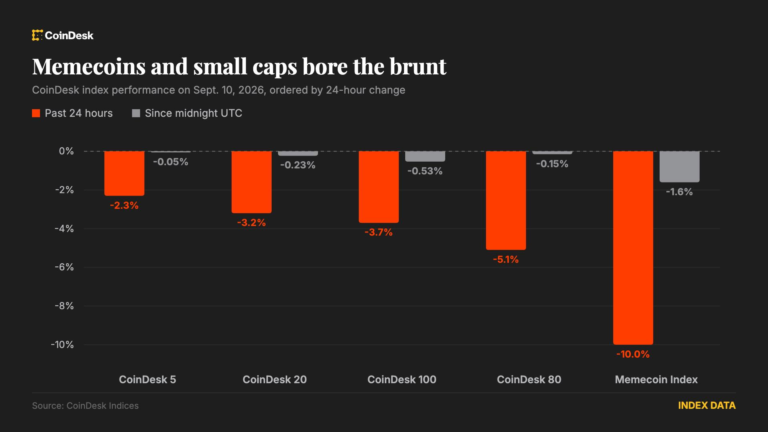
The crypto market is drifting lower, with bitcoin losing 1% since midnight UTC while ether (ETH) is holding up marginally better, shedding 0.65% even as some other risk assets, like U.S. equity index futures, advance.

Futures on the Nasdaq 100 and S&P 500 indexes posted gains of 0.35% and 0.20%, respectively, expanding the divergence between crypto and stocks that has defined much of this year.

Gold is little changed, holding above $4,000, and the Dollar Index (DXY) also barely moved, leaving crypto without a clean macro narrative to lean on.

CoinMarketCap’s Fear and Greed index sits at 34, deep in “fear” territory, while the average relative strength index (RSI) across crypto pairs has slipped to 44.07, nudging back toward the oversold conditions that set up July’s relief rally.

Derivatives positioning

  • Churn over conviction: Crypto futures are characterized by churning rather than new position establishment. While trading volume surged 81% to $127 billion in the past 24 hours, open interest (OI) remained flat at approximately $111 billion.
  • Leverage demand stalls: Bitcoin futures OI growth stalled near 750K BTC, failing to gain traction despite a recent swing that took the price above $64,000. This stagnation indicates that demand for leverage remains low and is a clear sign investors are not comfortable increasing their risk exposure. A similar pattern of caution is evident in ether (ETH) and XRP futures.
  • Solana capital outflow: Solana (SOL) is seeing a distinct trend of contraction, with futures OI declining to 62 million tokens, the least since early May. This represents a significant drop from the June 24 peak of over 76 million, signaling substantial position unwinding and capital outflows from the SOL market.
  • Bitcoin cash outlier: stands out as today’s exception. OI in BCH futures has surged by 20% to 1.73 million tokens, matching the record high set on June 21. This build-up increases the likelihood of volatile price action ahead, particularly as the token has slipped 3% to $213 over the past 24 hours.
  • Bearish market delta: Broadly speaking, bears appear to be driving the price action across most top-tier tokens. This is reflected in negative 24-hour cumulative volume delta (CVD) readings for most major coins, including bitcoin and ether. Notably, the privacy-focused ZEC has posted the most negative CVD in the market.
  • Volatility fear gauge alert: Traders should stay alert for potential market turbulence. Bitcoin’s 30-day implied volatility index (BVIV) is nearing the 36% mark. This level has served as a floor in recent years; previous instances of the index hitting this threshold have often preceded major volatility booms and sharp bitcoin price slides.
  • Options sentiment divergence: On the Deribit options exchange, persistent downside caution is keeping BTC and ETH puts priced higher than calls. However, 24-hour volume figures reveal a tactical bias toward the upside: the $70,000 Bitcoin call has emerged as the most-traded contract, while the $2,450 call is leading the rankings for ether.

Token talk

  • Zcash (ZEC) reversed course on Monday after its recent run, falling 3.68% to $527. The pullback follows a period of outperformance and may reflect profit-taking.
  • AI tokens are among the broader losers, with FET dropping 2.94% and TAO shedding 2.58%, giving back some of the gains posted last week as the sector struggles to sustain momentum.
  • is the standout mover of the past 24 hours, surging 20% following a wave of noise on social media, led by crypto influencer Ansem who posted bullish analysis alluding to the company making $30 million to $40 million per month in a bear market.
  • Jupiter (JUP) also advanced, rising 1.02% to $0.197 alongside a pickup in trading volume, continuing the token’s gradual rehabilitation after weeks of heavy losses.
  • Lighter (LIT) slipped a further 1.83%, extending a pullback from its record highs as profit-taking continues to weigh on a token that surged more than 200% between May and early July.
  • CoinMarketCap’s Altcoin Season indicator is at 55/100, the highest reading in months, though the Fear and Greed score of 34 suggests the market remains cautious despite pockets of altcoin strength.

Bank of Korea prepares for live CBDC transactions with 9 banks in September

0

The Bank of Korea’s central bank digital currency (CBDC) plans are moving forward with nine participating banks.

The second phase of BOK’s CBDC program is scheduled for September with real-transaction testing, Yonhap News Agency reported on Monday.

“The Bank of Korea will provide the infrastructure for the institutional CBDC, and each bank will conduct its own business using deposit tokens,” a BOK official told YNA. “From the second phase, we will lay the groundwork for commercialization.”

The BOK’s second phase will expand to include a total of nine participating banks, including Gyeongnam Bank and iM Bank. The country’s top three banks, KB Kookmin, Shinhan, Hana, and Woori Financial Group, are also participating in the CBDC project.

“The goal is to create an environment where the won can be traded freely regardless of time or place,” Yonhap quoted the government as saying.

CBDCs are a digital form of blockchain-based fiat currency that are managed by the issuing central bank and considered legal tender. Only a handful of countries have officially introduced a CBDC. Bahamas unveiled one in October 2020, Nigeria in 2021, and Jamaica in 2022, according to the Atlantic Council’s CBDC tracker.

A BTC price volatility surge may be brewing, key indicator suggests: Crypto Daily

0

While past patterns are never a guarantee of future performance, volatility metrics are widely known to be mean-reverting. This cyclical nature suggests that periods of below-average volatility are often followed by higher turbulence, while above-average volatility paves the way for market stability.

Currently, the index is trading below both its 30-day and 200-day simple moving averages. In essence, volatility is relatively “cheap” and sitting at a historically reliable support zone, suggesting the measure could be set to rise, which means another round of turbulence.

For now, bitcoin continues to trade just above $64,000, maintaining the range-bound price action that has persisted since last Wednesday. While some analysts have noted two consecutive weeks of spot ETF inflows, the capital movement is tiny compared with the billions yanked from the market during the preceding eight-week outflow streak.

Global volatility gauges in traditional markets are currently offering mixed signals. South Korea’s KOSPI VIX is currently above 70%, its highest level since the 1990s. Meanwhile, Wall Street’s VIX jumped over 12% to reach 18% on Friday, where it continues to hover. However, these levels have been in the play for months, which means that stocks are anything but panicked.

Additionally, the MOVE index, the 30-day volatility gauge for U.S. Treasury notes that underpins global finance, remains steady around 70%, as it has since April, offering a constructive cue for risk assets. Stay alert!

Hyperliquid plans to introduce decentralized prediction markets in HIP-4 upgrade

0

Hyperliquid said its HIP-4 upgrade, which introduced “outcome trading” to the decentralized exchange, will support permissionless deployment of the contracts in a future enhancement.

Once live, anyone will be able to offer a prediction market on the platform, subject to templates approved by validators, Hyperliquid said on Telegram on Sunday. In the meantime, they remain under the authority of validators.

Prediction markets, a sector dominated by Polymarket and Kalshi, allow participants to bet on event outcomes and have evolved into a multibillion-dollar sector of the blockchain industry. Users take positions on events from central bank interest-rate decisions to who performs at the Super Bowl halftime show.

The growing popularity of the platforms — the FIFA World Cup, which wrapped up Sunday with Spain winning its third title, drew more than $50 billion in bets — has attracted centralized trading platforms like Coinbase and Robinhood into the sector to offer customers a one-stop shop for predictions markets alongside more conventional financial trading.

Cross-chain protocol Allbridge halts after $1.65 million flash loan exploit

0

Allbridge Core has paused its cross-chain stablecoin protocol after an attacker stole roughly $1.65 million from its Solana liquidity pools, according to security firms CertiK and PeckShield.

Allbridge is a bridge that lets users move assets between blockchains that do not communicate directly. Its Core product uses liquidity pools to transfer native stablecoins such as USDC and USDT without issuing wrapped versions of the assets.

The attacker used a $1.12 million flash loan from Solana lending protocol Kamino to rapidly swap USDC and USDT, manipulating the pools’ internal ratios before withdrawing assets at favorable rates, according to Onchain Lens. A flash loan is a loan taken and repaid within the same transaction.

The stolen assets were bridged to an Ethereum address and dispersed across additional addresses. It isn’t currently clear how much remains under the attacker’s control.

Allbridge said it paused the protocol while investigating, and told liquidity providers to withdraw from affected pools. The initial manipulation left the pools imbalanced and created a temporary arbitrage opportunity. Allbridge asked traders who profited from the pricing distortion to return funds for LP compensation.

Allbridge suffered a similar flash loan attack in 2023 that drained roughly $650,000 from its BNB Chain pools. The firm later said it recovered most of the funds and changed its liquidity and withdrawal calculations. Allbridge had raised $2 million in 2022 to expand the bridge and fund security audits.

Amazon Japan distributor AZ-Com Maruwa to adopt yen stablecoin JPYC for payments

0

A Japanese logistics company that counts Amazon Japan as a client plans to settle payments in the regulated yen stablecoin JPYC with business partners, including independent truck drivers, according to a report by Nikkei Asia.

Tokyo-listed AZ-COM Maruwa Holdings (9090), which reported 230.5 billion yen ($1.4 billion) in revenue for the fiscal year ended March, plans to use JPYC for fees and other payments to its network of around 2,300 partners, including subcontractors and truck drivers. The company has been working with Amazon Japan since 2017, providing delivery services for its online shopping operations.

The move marks the first large-scale corporate use of a stablecoin in day-to-day operations in Japan, signaling that mainstream adoption of tokenized assets continues to expand even as broader cryptocurrency valuations remain subdued in a lingering bear market.

JPYC is Japan’s first fully regulated yen-pegged stablecoin, and is issued by Tokyo-based fintech firm JPYC Inc. The stablecoin debuted in October last year under the Payment Services Act and maintains a strict 1:1 peg to the yen. It is 100% backed by bank deposits and Japanese government bonds. As of last week, its onchain circulation had surpassed 2 billion yen.

South Korea Uncovers 30 Cases Unfair Trading

0

South Korea’s financial authorities investigated more than 40 cases of unfair trading, including market manipulation and fraudulent crypto trading, in the last two years. 

According to an X post by Financial Services Commission Chair Lee Eog-won, 30 of them reported or referred to investigative agencies, identifying 25 suspects since the Virtual Asset User Protection Act took effect in July 2024.

Lee said the average unlawful gains were around 1.4 billion Korean won ($940,000).

“Today marks the second anniversary of the enactment of the ‘Virtual Asset User Protection Act…’ It was a meaningful time that brought the virtual asset market, which was outside the institutional framework at the time, into the fold of the law and created an opportunity to establish a user protection system for virtual assets,” said Lee.

Related: South Korea to bring digital assets under new state asset management system

The Virtual Asset User Protection Act is designed to protect users who buy and store crypto assets with virtual asset service providers. 

VASPs are legally required to separate user deposits and virtual assets from their own corporate holdings, holding client deposits in banks. 

The legislation also targets illicit activities such as insider trading, wash trading and market manipulation, enhancing the Financial Services Commission (FSC) authority to supervise and inspect VASPs. 

“We will continue to enhance market surveillance investigation and monitoring systems based on AI, and proactively respond to high-risk areas,” Lee added.

Cointelegraph is committed to independent, transparent journalism. This news article is produced in accordance with Cointelegraph’s Editorial Policy and aims to provide accurate and timely information. Readers are encouraged to verify information independently.

The GENIUS Act turns 1: State of Crypto

0

A year on, the rules aren’t quite ready for implementation, but we have a much clearer idea as to how the regulators are thinking about stablecoins and where they’re likely to land on those rules.

In an emailed statement, Crypto Council for Innovation CEO Ji Hun Kim called the passage of the bill “a landmark moment.”

“A year in, agencies, institutions, and innovators are building on a clearer foundation, and stablecoins are moving rapidly toward mainstream adoption,” he said.

The various regulators have proposed rules out for comment on the different aspects of stablecoin governance and regulation, including a proposal that would require stablecoin issuers to conduct similar know-your-customer checks to more traditional financial firms. The FDIC published 144 questions a few months ago about how it would oversee stablecoin issuers, looking at concerns like custody, capital and liquidity standards. The OCC, for its part, put out its own proposal in February laying out how it was interpreting the law.

There’s still a few months left before these rules start being finalized. And in the meantime, the industry is still working on getting the Digital Asset Market Clarity Act passed.

The text of the combined Clarity Act drafts is not yet public, at least as of Friday night. While industry sources expected the bill to be released last week, the timeline has constantly evolved. On Thursday, Senators Cynthia Lummis and Bernie Moreno were supposed to brief Trump on the bill. There was no public readout of that meeting available after, but both lawmakers tweeted about Trump’s remarks on the election later Thursday.

Tether’s USDT hits 2-year countdown threatening its position on U.S. crypto platforms

0

This year, Tether rolled out USAT — launched with U.S. standards in mind and issued through U.S. banking partner Anchorage Digital. So far, it remains at a relatively low level of usage.

“Non-compliant stablecoins cannot be used by U.S. institutions when the safe harbor expires in 2028, but we don’t expect the market to wait,” said Kevin Wysocki, head of policy at Anchorage Digital, the crypto-native bank that manages a number of stablecoins. He said the company believes institutional users will move toward “compliant, bank-issued digital dollars well ahead of that deadline.”

Do they have two years?

GENIUS included a three-year grace period for compliance, and two years remain, after which U.S. crypto platforms won’t be able to offer stablecoins whose issuers haven’t checked all the regulatory boxes. However, there seems to be some disagreement over whether foreign issuers are meant to enjoy that same safe harbor. Some lawyers in finance assume that Tether gets until July 18, 2028, to comply, but others have suggested that foreign issuers would have to comply the moment GENIUS officially goes live, which is likely six months from now in January.

“Upon the effectiveness of the GENIUS Act, foreign issuers will need to immediately comply with lawful orders to seize and freeze coins held by illicit actors, but they will have a runway of approximately two more years to prepare for the additional requirements so that their coins may remain eligible for listing on U.S. centralized trading platforms,” said Justin Levine, a lawyer at Davis Polk who advises clients on stablecoin issues, adding that one of those remaining requirements — registration with the Office of the Comptroller of the Currency — is likely to require a “significant undertaking”