

New Yorkers face escalating “pig butchering” investment scams draining life savings through fake crypto platforms, prompting Attorney General Letitia James to issue a stark warning and prevention guide as fraudsters deploy increasingly sophisticated digital tactics. ‘Pig Butchering’ Scams Cost Victims Thousands to Millions, NY AG Says Consumer protection efforts continue to target evolving financial fraud […]
World Liberty Financial to tokenize Trump International Hotel & Resort, Maldives, in partnership with DarGlobal and Securitize

Broader WLFI Strategy to Tokenize Real-World Assets Begins with Flagship Hospitality Development
World Liberty Financial (“WLFI”) has today announced plans to tokenize loan revenue interests in Trump International Hotel & Resort, Maldives, in partnership with Securitize, Inc. a leading platform for tokenizing real-world assets, and DarGlobal PLC (LSE: DAR), an international luxury real estate developer. This initial offering reflects WLFI’s broader strategy to design, structure, and distribute WLFI-branded tokenized real-world asset offerings.
Trump International Hotel & Resort, Maldives is a flagship luxury hospitality development by DarGlobal, created in collaboration with The Trump Organization, and scheduled for completion in 2030. The resort is set to feature approximately 100 ultra-luxury beach and overwater villas.
The initial tokenized offering aims to provide eligible accredited investors with both a fixed yield and loan revenue streams from a prime Maldivian hospitality asset underpinned by a globally recognized brand. Through the loan interest payments, investors will therefore gain exposure to the underlying asset’s performance, including both potential income distributions and the potential for certain profits upon any future sale, within a regulated securities framework.
“We built World Liberty Financial to open up decentralized finance to the world. With today’s announcement, we are now extending that access to tokenized real estate,” said Eric Trump, co founder of World Liberty Financial. “For the first time, eligible participants can be a part of an iconic property like Trump International Hotel & Resort, Maldives. We are excited about future endeavors as we bring more world-class assets on-chain.”
“Real estate has been one of the hardest asset classes to tokenize effectively,” said Carlos Domingo, Co-Founder and CEO of Securitize. “We believe that scalable on-chain real estate products issued with compliance, governance, and market structure in mind will be globally sought after. That’s exactly what this partnership with WLFI is designed to deliver.”
“This marks a breakthrough for real estate investment,” said Ziad El Chaar, CEO of DarGlobal. “Together, we are rethinking how qualified investors can access, trade, and ultimately gain liquidity in loan revenue interests in high-quality real estate as it is being developed.”
The tokens described herein will be offered in a private placement pursuant to Rule 506(c) of Regulation D under the Securities Act of 1933, as amended (the “Securities Act”), and offered and sold only to verified accredited investors, or to non-US persons in an offshore transaction under Regulation S of the Securities Act. The tokens will be subject to significant restrictions on transfer and resale and have not been registered under the Securities Act or any state securities laws, and may not be offered or sold in the United States except pursuant to an available exemption from registration.
The initial offering is expected to be issued on supported public blockchains, with plans to enable access via select third-party partners and wallets, subject to applicable requirements. The parties also may support additional on-chain utilities, including the ability for eligible users to use their holdings as loan collateral through WLFI Markets, where permitted by law.
SOL Traders Lose Reasons To Hold As Solana Activity Slumps

Key takeaways:
-
SOL is struggling to hold $80 as a 75% drop in futures’ open interest shows that traders are heading for the exits rather than opening new bets.
-
Solana remains heavily dependent on retail and memecoin activity, while Ethereum maintains its lead in high-value decentralized finance.
Solana’s native token, SOL (SOL), has hit a wall, repeatedly failing to break back above $89 over the last two weeks. This sluggish price action comes after a rejection at the $145 level in mid-January and a sharp drop to $67.60 during the Feb. 6 crash. Demand for bullish leverage has essentially evaporated as traders brace for more pain.
Those betting against SOL are currently paying an annual rate of 20% just to keep their short positions open, a rare and aggressive move. When funding rates stay negative like this for over a week, it shows that bears have a lot of conviction. In contrast, ETH’s annualized funding rate sat at 1% on Wednesday. While that’s below the usual 6% neutral mark, it’s nowhere near the lopsided levels seen in SOL.
Frustration is mounting as SOL underperformed the rest of the crypto market by 11% over the past 30 days.

Even though SOL is still holding its spot among the top seven cryptocurrencies by market cap, the 67% slide from its $253 peak in September 2025 has left a mark on both onchain activity and derivatives. In fact, SOL futures open interest has dropped 75% from its $13.5 billion high seen only five months ago.
Lower SOL prices reduce incentives, discouraging long-term holding
This price slump is also hurting the decentralized applications (dApps) built on Solana. Revenues are down across the board, from staking and decentralized exchanges to launchpads and lending platforms. Investors are starting to worry about a “death spiral,” where falling prices lead to fewer incentives, making it harder for people to justify holding SOL for the long haul.

Weekly dApps revenue on Solana dropped to $22.8 million, the lowest since October 2024. Curiously, the memecoin launchpad Pump generated $9.1 million in revenue during those seven days, accounting for 40% of the entire network. In comparison, weekly DApps revenue on Ethereum totaled $16 million, up 2% from the previous month.
Related: Pump.fun rolls out trader cashbacks in tweak to memecoin model
Unlike Solana, the top revenue-generating DApps on Ethereum are Sky, Flashbots, and Aave—key infrastructure players for decentralized finance. Essentially, Solana is heavily dependent on retail onboarding and the memecoin sector, while Ethereum has secured its lead in total value locked (TVL) and use cases that require higher decentralization.
This weak institutional demand is visible in SOL exchange-traded funds (ETFs). Solana’s high transaction volume and second-place spot in TVL haven’t been enough to convince traditional investors to buy into SOL ETFs offered by Bitwise, Fidelity, Grayscale, 21Shares, Coinshares, and REX-Osprey.

While relevant, Solana’s $2.1 billion in ETF assets under management is still 86% behind Ethereum’s $15.8 billion. Many investors have lost confidence that demand for Solana DApps will spike anytime soon, likely a side effect of the heavy hype around memecoins and launchpads.
For SOL to regain its bullish momentum, it will likely need a push from sectors like artificial intelligence infrastructure and prediction markets. These areas show promise, but the competition is fierce.
Presently, weak SOL derivatives and Solana onchain metrics are a warning sign. Any further disappointment may trigger another price drop, putting the already shaky $78 support level at serious risk.
This article does not contain investment advice or recommendations. Every investment and trading move involves risk, and readers should conduct their own research when making a decision. While we strive to provide accurate and timely information, Cointelegraph does not guarantee the accuracy, completeness, or reliability of any information in this article. This article may contain forward-looking statements that are subject to risks and uncertainties. Cointelegraph will not be liable for any loss or damage arising from your reliance on this information.
Warren warns crypto bailout would enrich Trump family biz: Report
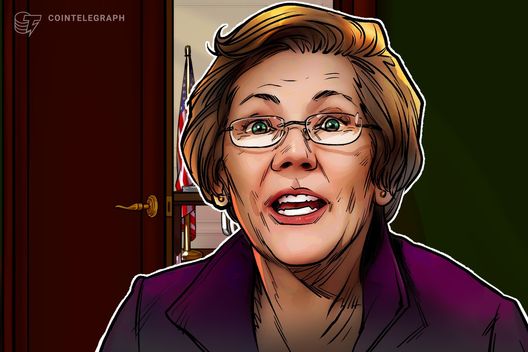
Senator Elizabeth Warren said it was “deeply unclear” if the US government has plans to intervene in the current Bitcoin selloff.
Raj Parekh: Open source payment systems will transform finance, stablecoin integration faces critical infrastructure gaps, and startups have unique opportunities in B2B payments

Open source payment systems could revolutionize finance by integrating stablecoins and blockchain technology.
Key takeaways
- Open source payment systems present a transformative opportunity for the financial landscape.
- The integration of blockchain technology can significantly enhance payment systems.
- There’s a notable lack of infrastructure for stablecoin integration within fintech.
- Future payment systems are expected to shift towards open source models.
- Blockchain is anticipated to play a crucial role in the evolution of payments.
- Startups have significant opportunities in B2B payments and payroll via stablecoins.
- Stablecoins facilitate easier global expansion by reducing compliance burdens.
- Payment systems typically begin as neutral entities, which is key to their longevity.
- Blockchain governance structures mirror historical decentralized governance models.
- Organizations will choose blockchain networks based on specific use cases.
- Stablecoin issuers need political leverage and distribution partners for success.
- Central banks have yet to feel the impact of stablecoins on their markets.
- Major economies are incentivized to adopt stablecoins to compete globally.
- Card payments still have growth potential in the global market.
- Governments may adopt permissionless blockchains for payment systems in the future.
Guest intro
Raj Parekh is Head of Stablecoins and Payments at the Monad Foundation, where he leads the blockchain’s payment ecosystem strategy. Previously, he served as Director of Visa’s Global Crypto Product, where he launched stablecoin settlement infrastructure now processing hundreds of millions in volume and pioneered Visa’s strategy to accept stablecoins from crypto-native issuers. He founded Portal, a developer platform for stablecoin payments across blockchains, which was acquired by the Monad Foundation in July 2025 and continues operating as a wholly-owned subsidiary.
The potential of open source payment systems
- “I’m a big believer in just open source payment systems. I think that’s just a huge opportunity and something we’ve never seen before.” – Raj Parekh
- Open source technology could transform traditional payment systems by enabling more flexible and innovative solutions.
- The combination of blockchains offers a pathway to achieve significant advancements in payment systems.
- “I think with the combination of blockchains we do have something that we can actually achieve.” – Raj Parekh
- Understanding the potential impact of open source technology is crucial for financial organizations looking to innovate.
- Open source systems may eventually replace traditional banking methods in the future.
- “It made a lot more sense for everything to move to open source systems at some point.” – Raj Parekh
- The strategic shift towards open source models reflects a broader trend in the evolution of payment systems.
Infrastructure gaps in fintech for stablecoin integration
- “A lot of missing infrastructure in the space if I’m a fintech or an FI or someone that wants to go build with this infrastructure there just wasn’t really a lot of options.” – Raj Parekh
- The lack of infrastructure presents a critical gap affecting the development of fintech solutions using stablecoins.
- Fintech companies face challenges in integrating stablecoins due to limited infrastructure options.
- The absence of robust infrastructure limits the potential for innovation in the stablecoin space.
- Addressing these infrastructure gaps is essential for the growth of stablecoin-based financial solutions.
- The current state of fintech infrastructure poses challenges for stablecoin integration.
- Organizations need to navigate these limitations to successfully implement stablecoin solutions.
- The development of comprehensive infrastructure is necessary for the widespread adoption of stablecoins.
Opportunities for startups in stablecoin payment solutions
- “I still think there’s a lot of opportunity around specific verticals around B2B payments… I think you’re starting to see a lot of uptake in companies that are thinking about payroll differently as well.” – Raj Parekh
- Startups have significant opportunities in specific payment verticals that larger companies may overlook.
- The stablecoin space presents potential for innovation and growth in B2B payments and payroll.
- Stablecoins simplify global operations by reducing compliance and regulatory burdens.
- “Stablecoins have effectively made being a global company a lot easier and faster where a lot of the traditional companies have all this compliance and regulatory and legal overhead.” – Raj Parekh
- Understanding the current landscape of payment solutions is crucial for startups entering the stablecoin space.
- The potential for startups in stablecoin payment solutions is driven by the limitations of larger organizations.
- Startups can leverage stablecoins to address niche markets and innovate in payment solutions.
The role of blockchain in transforming payments
- “I think blockchains are gonna play a really big role in changing that.” – Raj Parekh
- Blockchain technology is anticipated to have a transformative impact on the future of payments.
- The integration of blockchain can enhance the efficiency and security of payment systems.
- Blockchain offers a new paradigm for financial transactions, shifting away from traditional methods.
- The potential of blockchain in payments is driven by its ability to provide decentralized and transparent solutions.
- Organizations need to understand the implications of blockchain technology for the payments industry.
- The evolution of payment systems will likely be influenced by ongoing developments in blockchain technology.
- Blockchain’s role in payments highlights a shift towards more innovative and efficient financial solutions.
The importance of neutrality in payment systems
- “Payments have always been an incredibly neutral system that’s grown over time.” – Raj Parekh
- Neutrality is essential for the durability and success of payment systems.
- Successful payment systems often start as neutral organizations, which contributes to their longevity.
- The historical context of payment systems like Visa and SWIFT provides insight into the importance of neutrality.
- Blockchain governance structures mirror historical decentralized governance models in payment systems.
- “These things are not novel from an organizational standpoint but payment system is just being so broadly impactful.” – Raj Parekh
- Understanding the role of neutrality in payment systems is crucial for analyzing future blockchain implementations.
- The governance structures in blockchain reflect established practices in traditional payment systems.
Strategic considerations for stablecoin issuers
- “We typically look for issuers that are either working that have political leverage or working directly with their governments.” – Raj Parekh
- Stablecoin issuers need political leverage and distribution partners to succeed in uncertain regulatory environments.
- Not all stablecoin issuers are strategically thinking about their market position and growth potential.
- “It’s pretty clear you can tell the ones that are thinking about this strategically versus the ones that are seeing the opportunity for what it is today.” – Raj Parekh
- Strategic considerations are crucial for stablecoin issuers navigating the competitive landscape.
- Understanding the challenges faced by stablecoin issuers is essential for successful market positioning.
- The success of stablecoin issuers depends on their ability to navigate regulatory contexts and leverage partnerships.
- Stablecoin issuers must consider their strategic approach to market entry and growth.
Central banks and the impact of stablecoins
- “I think we’re still in the early days where central bankers don’t really feel the impact of stablecoins yet in their market.” – Raj Parekh
- Central banks have yet to fully experience the impact of stablecoins on their markets.
- The rise of stablecoins presents a potential shift in monetary policy for central banks.
- Central banks will either innovate with the private sector or ignore the rise of dollarization.
- “Once they do [feel the impact], they’re gonna either try to innovate and work with the private sector.” – Raj Parekh
- Engaging with policymakers willing to innovate is crucial for the stablecoin space.
- The relationship between stablecoins and central banking indicates a potential future shift in monetary policy.
- Collaboration between the stablecoin industry and responsive policymakers is essential for effective regulation.
The future of global payment systems
- “If you’re a major bank or policymaker in another country call it like a major economy it seems in your interest to want to get ahead or be a participant here.” – Raj Parekh
- Major economies have a strategic interest in adopting stablecoins to compete globally.
- Countries could achieve global payment system integration by leveraging blockchain technology.
- “Leveraging open source systems like blockchains connected to their domestic systems could actually be a huge accelerant.” – Raj Parekh
- The potential of blockchain technology for rapid integration highlights a shift in global payment systems.
- Understanding the competitive landscape of stablecoins is crucial for major economies considering adoption.
- The integration of blockchain technology could significantly impact global payment systems.
- The future of global payment systems will likely be influenced by technological advancements and strategic interests.
The ongoing relevance of card payments
- “Card payments still have a lot of room to run there’s still a lot of market structures and infrastructure companies that are required to be stood up.” – Raj Parekh
- Card payments continue to have growth potential in the global market.
- The competitive landscape of payment systems includes ongoing opportunities for card payments.
- Blockchains offer an easy payment system with low upstart costs compared to traditional card issuing.
- “Blockchains just being open source and just available anywhere is an easy payment system for a user to inherit with very little upstart cost.” – Raj Parekh
- Understanding the role of card payments in the payment system landscape is crucial for strategic planning.
- The viability and potential growth of card payments reflect their ongoing relevance in the market.
- The operational advantages of blockchain technology highlight its accessibility and cost-effectiveness.
Governments and the shift towards digital currencies
- “What you can do is lean into technology that makes cash increasingly inconvenient.” – Raj Parekh
- Governments will increasingly lean into technology to make cash less convenient, benefiting tax compliance.
- The strategic viewpoint reflects how governments might leverage technology to enhance tax compliance.
- Governments will likely adopt permissionless blockchains for their payment systems in the long term.
- “I’m obviously a big believer in permissionless public blockchains… they’re just gonna move a lot faster.” – Raj Parekh
- The potential shift in government payment systems towards blockchain solutions highlights a trend in digital currency adoption.
- Understanding the relationship between cash usage, tax compliance, and government technology initiatives is crucial.
- The adoption of blockchain technology by governments indicates a significant shift in financial systems.
Societe Generale-FORGE Launches EUR Coinvertible on XRP Ledger With Ripple Support
Societe Generale-FORGE has expanded its euro-backed stablecoin EUR Coinvertible to the XRP Ledger, accelerating institutional blockchain adoption in Europe and deepening Ripple integration as compliant digital assets gain momentum across global financial markets. Societe Generale-FORGE Expands EUR Coinvertible to XRP Ledger Societe Generale-FORGE, the digital assets subsidiary of French banking group Societe Generale, announced on […]
Stripe-owned Bridge wins approval for national trust bank

Stripe-owned Bridge has received conditional approval from the Office of the Comptroller of the Currency (OCC) to organize a federally chartered national trust bank.
Editorial
This content has been selected, created and edited by the Finextra editorial team based upon its relevance and interest to our community.
Once fully approved, Bridge will be authorized to offer businesses custody of digital assets, stablecoin issuance and orchestration and stablecoin reserve management.
The approval positions Bridge to help enterprises, fintechs, crypto businesses, and financial institutions build with digital dollars inside a clear federal framework.
States the firm: “Our compliance framework already positions Bridge to be Genius ready. Now achieving a national trust bank charter will provide our customers the regulatory backbone they need to build with stablecoins confidently and at scale.”
Bridge’s authorisation follows similar approvals gained by Circle and Ripple, as fintech firms at the intersection of crypto and payments increasingly look to bank status as a means to broaden their reach and bypass state-by-state licencing.
Will Bitcoin End Its Sideways Move Below $70K With This Setup?

Bitcoin (BTC) trades in a tight $65,000–$70,000 range on Wednesday, a structure that has held for the past two weeks.
The lower time frames show a bullish divergence, signaling fading short-term selling pressure, while futures data indicate fresh long positions opened from $66,000.
Analysts say the compression may precede a breakout attempt, with liquidity clusters below $66,000 and above $71,000 being the zones that may define the next directional move.
Bitcoin’s bullish divergence rests near a support level
On the one-hour chart, Bitcoin is forming a descending channel similar to last week’s structure that preceded a move toward $70,000. Within this channel, a clear bullish divergence has developed in the relative strength index indicator (RSI).
A bullish divergence occurs when the price makes lower lows or equal lows while the RSI prints higher lows. This sequence suggests that selling pressure is losing strength on the shorter time frame.
A sustained break above $68,000 may confirm momentum, leading to a price rally toward the external liquidity and resistance level above $71,500.
The invalidation level sits below $66,000, where internal liquidity is present near the $65,000. A breakdown beneath that region invalidates the divergence setup and shifts focus to the higher-time-frame support range between $62,000 and $60,000.
Derivatives data shows aggregated open interest has climbed 3% to $15.50 billion from $15.10 billion over the past two days, even as the price drifted lower.
The aggregated funding rate has ticked higher to 0.046%, suggesting a growing long exposure from futures traders.
Since Feb. 15, roughly $250 million in aggregated long liquidations have occurred, forcing leveraged positions to close below $67,000. These long-side sell-offs reduce excess leverage, which may stabilize price and create better conditions for an uptrend once traders re-engage in the market.

Related: Bitcoin’s tech stock divergence is a ‘fire alarm’ for fiat: Arthur Hayes
Futures momentum and macro positioning
Crypto analyst Amr Taha noted a sharp drop in Binance Bitcoin futures power 30-day change, which tracks the net change in price, funding, and open interest. The index fell to -0.18, matching levels last seen between April and May 2024.

Taha said that this may mark a turning point for BTC, as similar deep negative readings between April and May 2024 led to a strong rebound that pushed Bitcoin above the $100,000 level, once the index turned positive in the latter half of 2024.
Meanwhile, crypto analyst Dom said that the spot order books show thin liquidity between $66,000 and $69,000, describing the current activity as neutral, with BTC’s price compressing ahead of a breakout attempt.
Liquidity heatmaps shared by BTC trader Daan show dense liquidity clusters below $66,000 and above $71,000, pointing to areas where stop orders and resting positions are likely concentrated.

Related: Bitcoin 2024 buyers steady BTC price as trader sees $52K ‘next week or so’
This article does not contain investment advice or recommendations. Every investment and trading move involves risk, and readers should conduct their own research when making a decision. While we strive to provide accurate and timely information, Cointelegraph does not guarantee the accuracy, completeness, or reliability of any information in this article. This article may contain forward-looking statements that are subject to risks and uncertainties. Cointelegraph will not be liable for any loss or damage arising from your reliance on this information.
Peter Thiel Dumps Ethereum Treasury Play ETHZilla

Trusted Editorial content, reviewed by leading industry experts and seasoned editors. Ad Disclosure
Peter Thiel and entities tied to Founders Fund have fully exited ETHZilla, the publicly traded Ethereum treasury play that once marketed itself as a proxy bet on corporate ETH accumulation. A Schedule 13G/A filed Tuesday shows the reporting group finished 2025 with no remaining common shares, wiping out a position that had been closely watched across both crypto and small-cap equity circles.
Thiel Exists Ethereum Treasury Play
The amended filing, dated Feb. 17, 2026, is unusually blunt on the current footprint: “Aggregate amount… 0.00. Percent of class… 0.0%. Ownership of 5 percent or less of a class.” The positions are reported as of Dec. 31, 2025, meaning the exit was completed by year-end.
PETER THIEL EXITS ETHEREUM DAT “ETHZILLA” AMID $ETHZ TOKENIZED JET ENGINE FOCUS: FILING pic.twitter.com/nnMeT32LQ4
— Aggr News (@AggrNews) February 18, 2026
That zeroed-out line item is a sharp contrast to what Thiel-related vehicles disclosed just a quarter earlier. In a prior Schedule 13G/A reporting holdings as of Sept. 30, 2025, Thiel was listed with 928,389 shares beneficially owned, representing 5.6% of the class at that time, with additional blocks attributed to Founders Fund entities. The same filing noted the company’s 1-for-10 reverse stock split effective Oct. 20, 2025, with reported share counts adjusted accordingly.
ETHZilla’s story arc matters because it tried to translate the Bitcoin treasury template into an ETH-native wrapper at a moment when public-market vehicles were being pitched as liquid, leverable on-ramps to digital asset exposure. Thiel’s initial involvement, widely reported as a 7.5% stake disclosed in August 2025, helped legitimize that pitch, at least briefly.
More recently, ETHZilla has been signaling a pivot away from a pure ETH-treasury identity and toward tokenized real-world assets, including aviation. In an 8-K tied to a Feb. 12 press release, the company said its subsidiary launched “Eurus Aero Token I,” describing it as “a tokenized real-world asset instrument” that gives exposure to aircraft engines on lease “through tradable digital tokens representing contractual revenue rights.”
The sequencing leaves traders with an uncomfortable, unresolved question: did Founders Fund’s exit precede (and implicitly front-run) the strategy shift, or was it simply a portfolio cleanup after the initial “ETH treasury” narrative cooled?
On X, one commentator framed Thiel’s timing as part of a broader pattern, though several of the post’s claims go beyond what’s in the SEC filing. The account @treebook78 called Thiel a “master at sensing crises,” writing that he “dodged this current dip too,” and arguing he’s an “exit master” who gets out early when bubbles or stress build.
“Back in 2022, he posted diamond hands on SNS telling people to hold Bitcoin forever, but then he quietly sold everything and avoided the Luna crash and FTX collapse (as I recall),” @treebook78 wrote.
At press time, Ethereum traded at $1,984.
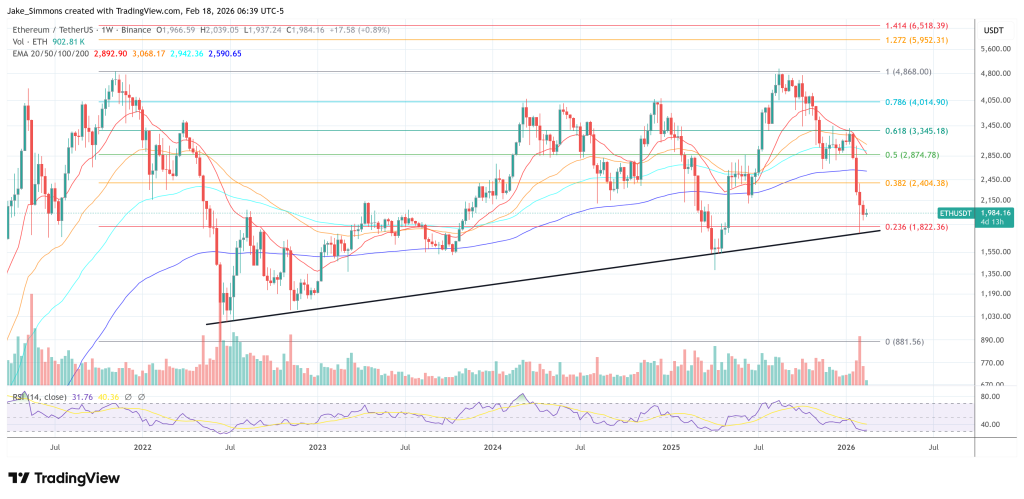
Featured image created with DALL.E, chart from TradingView.com

Editorial Process for bitcoinist is centered on delivering thoroughly researched, accurate, and unbiased content. We uphold strict sourcing standards, and each page undergoes diligent review by our team of top technology experts and seasoned editors. This process ensures the integrity, relevance, and value of our content for our readers.
World Liberty Financial plans to tokenize Trump Hotel in Maldives

World Liberty Financial has announced a new tokenization initiative involving loan revenue interests in the Trump International Hotel & Resort, Maldives, in collaboration with Securitize and DarGlobal.
The project, developed by DarGlobal in partnership with The Trump Organization and slated for completion in 2030, will feature approximately 100 luxury beachfront and overwater villas.
The offering is designed to give accredited investors exposure to fixed yields and loan revenue streams derived from the resort’s performance, including income potential and future sale participation.
The announcement came during the World Liberty Forum at Mar-a-Lago on February 18. It represents the platform’s first major push into real estate tokenization, following the launch of USD1, a stablecoin that has accumulated substantial market capitalization.
“We built World Liberty Financial to open up decentralized finance to the world. With today’s announcement, we are now extending that access to tokenized real estate,” Trump stated.
Bringing fractional ownership to high-end hospitality properties has long posed challenges for blockchain-based finance. The luxury resort sector remains largely untapped by tokenization efforts, though interest in converting traditionally illiquid assets into tradeable digital securities has grown among institutional participants seeking regulatory clarity.
Securitize CEO Carlos Domingo believes properly structured and regulated tokenized offerings could attract huge global interest through initiatives like the collaboration with World Liberty.
The tokens will be issued via private placement to accredited and offshore investors under securities exemptions, deployed on public blockchains, and may support collateral use within WLFI Markets, subject to legal requirements.