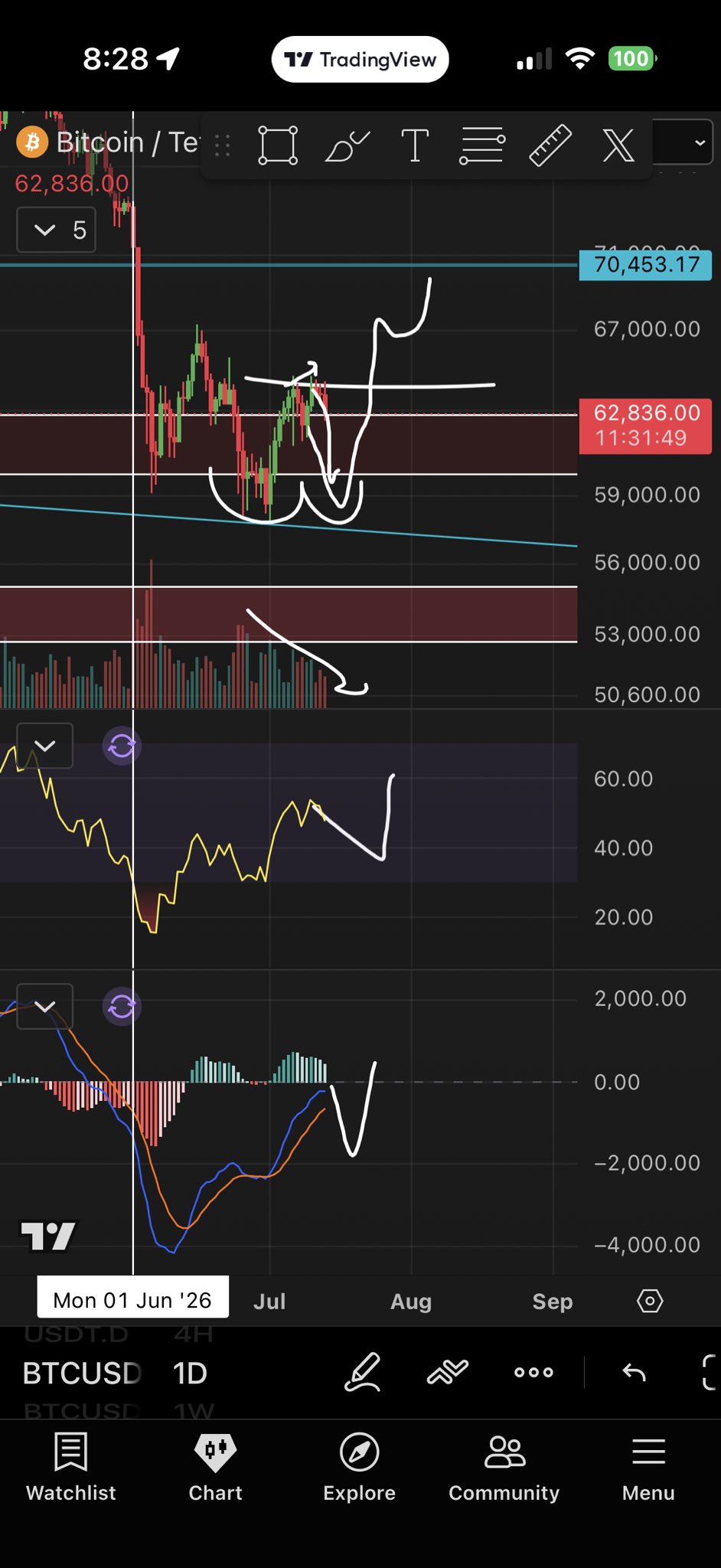
Traders may want to keep an eye on LTC$41.82 in the coming weeks and months. One of the earliest altcoins, LTC may see bullish price action, potentially outperforming the broader market, including bitcoin BTC$62,387.04.
Here’s why.
Litecoin’s fourth reward halving is due around July 27, 2027 when the payment will drop by 50% to 3.125 LTC. Litecoin has a peculiar tendency to bottom out anywhere between six to 12 months before the event.
The evidence is there.
LTC bottomed in late June 2022 at around $40, just over a year before the third halving on Aug. 2, 2023. In the intervening period, it rallied to as high as $114 by July 2023, only to pull back to $80 in the lead-up to the event. In November 2022, the month that crypto exchange FTX collapsed and pulled down the wider market, litecoin actually rose more than 40%.
A similar pattern played out before the first two halvings. In each case, LTC bottomed out months beforehand, rallied and then dropped back a bit into the event. (Check the Daily Signal)
If history holds true, that means litecoin could find a bottom any time now.
Nakamoto Inc. (Nasdaq: NAKA) shut down its last legacy healthcare clinics on June 19, 2026, completing a pivot that transforms the Nashville-based company into a pure-play Bitcoin operating business with no remaining ties to the healthcare sector that once defined it.
The move has been in the works for months. Nakamoto has steadily built out three core verticals — media and information services, asset management and financial services, and consulting and advisory services — all structured to generate recurring revenue independent of Bitcoin’s price.
Remaining administrative tasks from the healthcare wind-down are expected to close out by the end of Q3 2026.
Chairman and CEO David Bailey called it a clean break. “With our healthcare clinics now closed, Nakamoto continues to be focused on executing its strategy as a Bitcoin operating company,” Bailey said in a statement Monday. “We are now entirely focused on scaling those businesses and building durable long-term value for our shareholders.”
The media vertical is the most visible piece of the platform. Through subsidiary BTC Inc., the company controls Bitcoin Magazine, The Bitcoin Conference, and the Bitcoin for Corporations program — a suite of properties that gives the company a reach into institutional and retail Bitcoin communities that rivals cannot replicate.
The asset management arm, UTXO Management, handles public and private market investments across the Bitcoin ecosystem. The advisory practice targets corporate clients seeking Bitcoin strategy and market intelligence.
All three businesses are designed to generate cash without relying on BTC treasury appreciation — a structural distinction that separates Nakamoto from simple Bitcoin holding companies.
Nakamoto’s transition into a pure-bitcoin play
The transition has not been without cost. In March 2026, Nakamoto sold 284 BTC, booking a $166.2 million fair-value loss for fiscal year 2025.
In June, the company sold roughly 600 BTC and Bitcoin derivatives to repay a debt obligation to Kraken, pushing the remaining loan maturities to 2027. Nakamoto ended that transaction holding approximately 4,467 BTC on its balance sheet.
The healthcare clinic’s roots trace back to KindlyMD, Inc. (then trading as KDLY), a Salt Lake City-based healthcare provider founded in 2019 as the Utah Therapeutic Health Center, focused on holistic pain management and opioid-alternative care.
On May 12, 2025, KindlyMD entered into a definitive merger agreement with Nakamoto. The deal was backed by over $710 million in financing, including approximately $540 million in a PIPE raise and $200 million in convertible notes, attracting more than 200 investors across six continents.
KindlyMD shareholders approved the transaction by written consent on May 18, 2025, and the merger closed on August 14, 2025.
Nakamoto became a wholly-owned subsidiary and the combined company rebranded as Nakamoto Inc. in January 2026 — trading on Nasdaq under the ticker NAKA.
Bitcoin Magazine is published by BTC Inc, a subsidiary of Nakamoto Inc. (NASDAQ: NAKA)
A group of law enforcement organizations and a coalition of Catholic organizations have become the latest two groups urging caution over the US CLARITY Act, which is heading for a key hearing in July.
In letters sent Tuesday, four law enforcement organizations reached out to White House officials with concerns that the CLARITY Act could create oversight gaps when it comes to illicit activity.
“Regulatory certainty should not come at the expense of accountability, transparency, victim protection, or public safety,” they said. The Alliance to End Human Trafficking, founded by US Catholic Sisters, said these oversights could make it harder to crack down on human trafficking.
The CLARITY Act, which is set for a House hearing on July 17, aims to establish a regulatory framework for digital assets but has garnered a number of critics. It cleared the Senate Banking Committee in May, with most Democrats voting against it, while the banking industry has also pushed back, arguing the bill would allow crypto firms to offer stablecoin yields without facing the same requirements as traditional financial institutions.
The law enforcement group includes the National District Attorneys Association, the National Association of Assistant United States Attorneys, the International Association of Chiefs of Police and the National Sheriffs’ Association.
In the letter addressed to Acting Attorney General Todd Blanche and White House digital assets adviser Patrick Witt, the group said it was concerned with the Blockchain Regulatory Certainty Act, or Section 604 of the legislation, which it claims would create oversight gaps, hinder illicit-activity probes and weaken Know-Your-Customer and Anti-Money-Laundering requirements compared with traditional finance.
Section 604 of the market structure bill addresses the regulatory framework for digital asset service providers and seeks to protect non-controlling developers, open-source contributors, self-custody tools and certain DeFi infrastructure from being automatically classified as money transmitters.
The letter said there was no concern with individuals who write or publish software code or with responsible technological innovation, but with exemptions on crypto transactions that may affect law enforcement’s ability to investigate.
“Our concern is with broad exemptions that may shield individuals or entities whose activities facilitate the movement of digital assets, create obstacles to legitimate oversight, or weaken longstanding investigative and enforcement authorities relied upon by law enforcement.”
However, Lindsay Fraser, chief policy officer at the Blockchain Association, said the letter showed a “fundamental misunderstanding” of the CLARITY Act.
“Section 604 does one narrow thing,” she said. “It prevents non-custodial software developers from being misclassified as money transmitters when they do not custody assets or control transactions.”
“It does not immunize criminals. It does not limit sanctions enforcement. It does not stop prosecutions for money laundering, fraud, or terrorist financing.”
Anti-trafficking advocates push back
Meanwhile, the Alliance to End Human Trafficking sent a similar letter Tuesday to Senate Republican Leader John Thune and Senate Democratic Leader Chuck Schumer, also flagging Section 604 but from a human rights abuse perspective.
Related: Crypto isn’t the problem with the US economy, says senator
Certain provisions under Section 604 could create “broad carveouts and regulatory ambiguities” that may make it “more difficult to responsibly monitor illicit financial activity tied to trafficking, organized crime, child exploitation, sanctions evasion and other forms of abuse,” it said.
“The test of any financial system is not simply whether it generates wealth or innovation, but whether it safeguards human life and dignity.”
Screenshot of June 23 AEHT letter. Source: Punchbowl News
CLARITY Act proponent Senator Cynthia Lummis took the opposite view, stating Thursday that “Regulatory ambiguity doesn’t just hurt builders. It helps criminals… The CLARITY Act closes the gaps bad actors exploit.”
“The CLARITY Act is clear: writing code is not money transmission. That distinction will matter for a generation of builders,” she added on Tuesday.
Magazine: Japanese pension fund tips 1% in crypto, G7 urges action on NK hackers: Asia Express
Former Ethereum Foundation contributors and Ether treasury firms Bitmine and Sharplink have backed a new research and development nonprofit that aims to make Ethereum ready for institutional use.
Sharplink said on Monday that the organization, Ethlabs, was formed to “ready Ethereum for the next phase of institutional adoption,” with the company pitching in with Bitmine, Ethereum co-founder Joe Lubin and other Ethereum contributors on its funding effort.
“As stablecoins, tokenized real-world assets, funds and autonomous AI commerce move on-chain, they are converging on Ethereum as the neutral, credibly permissionless settlement layer for the global economy,” Sharplink said. “Ethlabs exists to ensure the network is ready to absorb that demand at scale.”
The launch comes days after former Ethereum Foundation contributor Trenton Van Epps warned that Ethereum is facing a core development funding crisis and amid an ongoing wave of departures from the Foundation, most recently co-executive director Hsiao-Wei Wang, who left last week.
Source: Ethlabs
Sharplink’s announcement said Ethlabs brings together “technologists who have guided the network through its most consequential upgrades over the past decade. This initiative gives that work a dedicated institutional home with stable, long-term funding.”
Ethlabs was co-founded by five former senior Ethereum Foundation researchers: Ansgar Dietrichs, Barnabé Monnot, Caspar Schwarz-Schilling, Josh Rudolf and Julian Ma.
Related: Ethereum bull David Hoffman explains why he sold his ETH
Lubin said in a statement that Ethereum “is entering its next stage of evolution” and that there should be “a number of steward nodes of Ethereum” that should work to grow the utilization of the blockchain.
“By providing a long-term, independent home to researchers and developers advancing Ethereum’s core technology and values, Ethlabs will be instrumental in preparing the network for the next major wave of adoption,” he added.
Ethereum Foundation crisis deepens
In May, Ethereum co-founder Vitalik Buterin said the Ethereum Foundation’s resources were limited, noting that the organization only held about 0.16% of the total supply of Ether (ETH).
Former EF contributor Trenton Van Epps warned last week that Ethereum risks entering a “slow-burning funding crisis,” amid continued selling of the asset by the Foundation.
“The EF is intentionally leaving a power vacuum for new structures to step up and influence the direction of Ethereum,” said Ethereum educator David Hoffman. “I think the Ethlabs direction holds the brightest future for Ethereum.”
Ether is trading 65% down from its peak at around $1,700, levels last seen in October 2023 and April 2025, as sentiment remains at crypto winter lows.
Bitcoin’s onchain activity is surging despite the asset remaining deep in a bear market.
The number of Bitcoin transactions recently climbed above 820,000 per day, according to Glassnode data. The increase comes as bitcoin trades around $62,000, roughly 50% below its October all time high, a period when network activity would typically be expected to weaken.
The transaction count is the highest since April 23 2024, the immediate aftermath of the last halving event and debut of the Runes protocol, a Bitcoin fungible token standard, which brought with it a considerable spike in transaction fees.
Similar to how ERC-20 tokens operate on Ethereum, Runes allow users to create and transfer fungible assets directly on Bitcoin.
Runes appears once again to be driving a rush in Bitcoin activity, with transactions carrying Rune protocol messages, known as Runestones, surging above 600,000 per day, also marking a two-year high, Glassnode data show.
The U.S. Senate passed a sweeping housing affordability bill Monday night — and tucked inside its pages is a provision that could permanently reshape America’s digital currency landscape: a formal ban on a Federal Reserve-issued central bank digital currency through the end of 2030.
The 21st Century ROAD to Housing Act cleared the Senate 85-5, with Republican leaders insisting the CBDC restriction ride along with one of the most bipartisan bills in years. The House was poised to fast-track a vote as early as Tuesday, putting the measure on a direct path to President Donald Trump’s desk for signature.
The bill’s language is sweeping: the Board of Governors of the Federal Reserve System or any Federal Reserve bank may not issue, create, or circulate a central bank digital currency — directly or through any intermediary — through December 31, 2030.
It explicitly shields private stablecoins, carving out any “open, permissionless, and private” dollar-denominated asset.
Trump set the political foundation for the ban in January 2025, signing an executive order barring his administration from any CBDC activity, warning it would threaten “the stability of the financial system, individual privacy, and the sovereignty of the United States”.
New Fed Chair Kevin Warsh, who replaced Jerome Powell, has called a U.S. CBDC a “bad policy choice” — making the Fed and the White House, for once, aligned.
The crypto market, meanwhile, isn’t celebrating. Bitcoin was trading near $62,000 Tuesday morning — down more than 3.7% on the day — as a Nasdaq tech selloff bled into digital assets.
BTC has now lost roughly half its value since setting an all-time high above $125,000 in July 2025, and some analysts say the pain may not be over: at least one widely-followed technical indicator is pointing to a potential additional drop of 15% or more before a bottom forms.
Additional crypto Senate legislation in the works
The CBDC ban is the latest piece in a three-part legislative puzzle the Trump-era Congress has been assembling.
In July 2025, Trump signed the GENIUS Act — the first federal stablecoin law in U.S. history — requiring issuers to hold one-to-one reserves, make monthly disclosures, and obtain federal licensing. The law essentially gave private digital dollars a legal green light at the same moment the government’s version was being blocked.
The third and most complex piece is still pending. The Digital Asset Market Clarity Act — the industry’s long-sought framework for determining when a crypto token is a security versus a commodity — cleared the Senate Banking Committee 15-9 on May 14 and landed on the Senate Legislative Calendar on June 1.
Galaxy Research has put the odds of passage this year as high as 60%, but the clock is running out.
The bill needs at least seven Democratic votes to clear the Senate floor, and senators must act before August — when the legislative calendar effectively shuts down ahead of midterm campaigning.
Senator Bill Hagerty told Fox Business on June 18 that he hoped the Clarity Act could clear the floor in the weeks ahead. Without it, a key question — who actually regulates crypto, the SEC or the CFTC — remains unanswered heading into an election cycle.
If Trump signs the housing bill this week, it will mark the most concrete federal action against a government digital dollar yet. The message from Washington is becoming harder to misread: private crypto has a seat at the table, and the Fed’s version of a digital dollar does not.
Financial infrastructure provider OpenPayd said Wednesday that it has secured authorization under the European Union’s Markets in Crypto-Assets Regulation (MiCA), allowing it to offer crypto services across the European Economic Area (EEA) via passporting.
The license lets OpenPayd operate as a crypto asset service provider (CASP) to offer services such as fiat-to-stablecoin on-ramping and off-ramping, the company said in a statement seen by Cointelegraph.
“Stablecoins are rapidly becoming part of mainstream financial infrastructure,” OpenPayd CEO Iana Dimitrova said, adding that MiCA gives businesses greater confidence to use digital asset technology for payments, treasury operations and growth.
The license was issued by the Malta Financial Services Authority (MFSA), an OpenPayd spokesperson told Cointelegraph. The regulator has also granted MiCA licenses to crypto companies, including OKX and Gemini.
The approval comes days before a July 1 MiCA transitional deadline, as crypto companies race to secure authorization under the bloc’s crypto rules. On Tuesday alone, Bitcoin Suisse secured a MiCA license in Liechtenstein and Ripple announced preliminary CASP approval in Luxembourg.
OpenPayd counts Kraken, OKX among its clients
OpenPayd’s MiCA authorization comes about a year after the company launched its stablecoin infrastructure, which allows businesses to manage fiat currencies and digital assets through a single platform.
The company said it processes more than $240 billion in annualized transaction volume for over 1,100 businesses worldwide, including Kraken, eToro, OKX and B2C2.
Source: OpenPayd
OpenPayd was founded in London in 2018 by Ozan Ozerk, a fintech entrepreneur who also founded European Merchant Bank, a Lithuania-based digital bank.
Related: EU committee advances digital euro bill after key vote
OpenPayd eyes Nasdaq debut
OpenPayd’s MiCA license news comes as the company is pursuing a public listing in the US.
Earlier in June, OpenPayd announced a proposed merger with special purpose acquisition company Titan Acquisition Corp, a deal that would see its shares trade on Nasdaq under the ticker “OP” if approved.
The transaction values OpenPayd at about $1.1 billion and is expected to close in the fourth quarter of 2026, subject to shareholder and regulatory approvals.
H100 Group shareholders cast their votes in Stockholm on Tuesday, giving the company’s board authority to close acquisitions of two Norwegian bitcoin treasury firms — a deal that would take the company’s holdings from 1,051 BTC to around 3,500 BTC and rank it second among Europe’s listed bitcoin treasury companies.
The annual general meeting was the decisive checkpoint for H100’s binding share purchase agreements with Moonshot AS and Never Say Die AS.
The two Norwegian companies hold a combined 2,450 BTC. Under the deal’s structure, existing H100 shareholders retain 30% of the merged entity, with the sellers taking 70%.
Adam Back, the British cryptographer best known as the inventor of Hashcash and the CEO of Blockstream, is a central figure in H100’s expansion.
Back invested SEK 21 million — about $1.98 million — in H100 through a convertible loan structure with an option to expand to SEK 277 million, tying his capital to the company’s bitcoin accumulation strategy.
He is a backer of Future Holdings AG, the Zurich-based bitcoin treasury firm H100 agreed to acquire in January in a separate deal that kicked off the consolidation run.
Back’s involvement gives H100 a credibility anchor that few European treasury firms can claim. His 1997 Hashcash paper was cited in Satoshi Nakamoto’s Bitcoin whitepaper, and Blockstream has been a cornerstone institution in BTC infrastructure since its founding in 2014.
The deal would put H100 behind Bitcoin Group SE — the German firm that holds 3,605 BTC — among Europe’s listed bitcoin treasury companies. At Tuesday’s price of $62,453 per coin, down more than 3.7% on the day amid a broader market selloff, a 3,500 BTC treasury carries a market value near $218 million.
H100’s pivot from health-tech company to bitcoin treasury vehicle has been one of the more dramatic corporate identity shifts in European markets over the past year. The company’s stock climbed 280% after its bitcoin strategy announcement, and the Moonshot and Never Say Die acquisitions are the culmination of a consolidation effort that began with the Future Holdings letter of intent in January.
The model mirrors what Strategy built on the other side of the Atlantic: treat BTC as the core reserve asset, issue shares to fund accumulation, and grow holdings through deal-making.
H100 has added a Nordic angle, absorbing regional firms to build scale in a market where BTC treasury companies have proliferated without a clear dominant player.
Meanwhile, BSTR eyes public listing with 30,021 bitcoin
On top of all this, Cantor Equity Partners I shareholders vote Friday to bring Back’s Bitcoin Standard Treasury Company public on Nasdaq under the ticker BSTR — entering the global leaderboard at fifth place with 30,021 BTC secured at close.
The ranking may not hold long. A $1.5 billion PIPE deal is in motion, and Samson Mow ran the math on X Tuesday: fully deployed at current prices, it buys roughly 23,500 additional coins, pushing BSTR’s total to around 53,500 BTC and second place globally — behind only Strategy.
Mow’s kicker was this: BSTR would hold the lowest cost basis of any major treasury, arriving while BTC trades near its 200-day moving average around $62,000.
The investment bolsters concerns about foreign influence, originally stemming from a major investment by MGX, a UAE state-backed investment company, that boosted the market capitalization of the Trump family’s stablecoin by almost $2 billion overnight.
Here’s where it gets interesting. Within months of the deal, the Trump Administration took policy decisions that benefited the UAE, according to the letter. In May 2025, it approved a $1.4 billion arms sale to the country, despite congressional concerns about weapons flowing to armed groups in Sudan where more than 150,000 people have died.
In the same month, Treasury created a “Known Investor Pilot” program to streamline investment approvals through CFIUS, a fast-track process that the UAE had lobbied for.
The Department of Commerce also rescinded Biden-era chip export restrictions, allowing the UAE to receive up to triple or quadruple the number of advanced chips it previously could have imported. It authorized G42, a UAE AI company chaired by Sheikh Tahnoon bin Zayed Al Nahyan, to receive 35,000 Nvidia Blackwell chips. The deal was worth over a billion dollars.
But U.S. intelligence officials reportedly caught G42 providing U.S. technology that was used to enhance China’s missile capabilities. Though G42 allegedly committed to divesting its Chinese holdings, reports suggest the firm attempted to obfuscate its ties to Beijing by moving its business holdings in China to a new investment firm.
Analysts track this using a metric called spent transaction outputs (STXO), which, in simple terms, tracks the movement of BTC on the blockchain. An OG moving coins after holding them for half a decade is almost always a sign of impending liquidation or profit-taking.
During the peak of the bullish cycle, single-day sell-offs sometimes exceeded 142,000 BTC, sending shockwaves through the market.
But that’s not the case anymore.
The timing of this slowdown in OG selling is not a coincidence, according to analysts at CryptoQuant. Currently, bitcoin is trading around $63,000, which, as it turns out, could be the “break-even” point for the most expensive coins this group could have possibly purchased five years ago, analysts explained on X.
By looking to hold at these levels, the OGs are effectively removing a massive source of selling pressure that capped BTC’s gains above $100,000 last year.
In other words, sell-side pressures are weakening just as some contrary indicators warn of a bottom. Note that outflows from spot ETFs have also slowed over the past two weeks in a positive sign for the cryptocurrency.
As of this writing, bitcoin changed hands near $62,750, largely unchanged on a 24-hour basis.