
Home Blog Page 960

BNP Paribas uses Ethereum for money market tokenisation pilot – DL News

0

  • BNP Paribas Asset Management tokenised a money market fund.
  • The French asset manager used Ethereum for the experiment.
  • A number of top traditional finance institutions are delving into the world of tokenisation.

Asset manager BNP Paribas Asset Management has become the latest TradFi giant to use Ethereum as part of a tokenisation push.

The investment arm of Paris-based bank BNP Paribas said Friday that it had used the top crypto network to issue a tokenised share class of a French‑domiciled money market fund.

“The tokenised fund shares were issued on the public Ethereum network with permissioned tokens ensuring that only eligible participants can hold and transfer the tokens, while benefiting from the strength and broad adoption of public blockchain infrastructure,” the firm said in a statement.

It added that it was the second such money market tokenisation trial it did — the first being in 2025 using a private blockchain.

“This second issuance of tokenised money market funds, this time using public blockchain infrastructure, supports our ongoing efforts to explore how tokenisation can contribute to greater operational efficiency and security within a regulated framework,” added Edouard Legrand, BNP Paribas Asset Management’s chief digital and data officer.

BNP Paribas did not immediately respond to questions from DL News.

Tokenisation trend

BNP Paribas isn’t the only one tapping permissionless, public blockchains as part of tokenisation experiments.

BlackRock and Franklin Templeton for years have used networks like Ethereum, Arbitrum, and Avalanche to tokenise money funds.

BlackRock’s BUIDL is right now the largest tokenized Treasury product, available on a number of blockchains but mostly running on Ethereum.

And New York asset manager WisdomTree also offers a fund on Ethereum. In January, it made its tokenised products available on Solana.

What’s next

BlackRock CEO Larry Fink has since 2022 spoken about the tokenisation of all assets.

Now, Wall Street’s push into the sphere is creating more mainstream crypto use cases, with proponents saying that tokenisation will reduce costs and provide more accountability in the TradFi space.

Crypto asset manager Grayscale said in 2025 that the tokenisation market will hit a market value of $35 trillion by 2030 as putting everything on the blockchain — from commodities to private equity and credit — will become the norm.

Mathew Di Salvo is a news correspondent with DL News. Got a tip? Email at mdisalvo@dlnews.com.

Bitwise CIO Matt Hougan Challenges the ‘Commodity Blockspace’ Thesis

0

Ethereum controls roughly 60% of real-world asset ( RWA) tokenization today, but Bitwise CIO Matt Hougan questions whether layer one (L1) blockspace is truly the commodity many investors assume it to be. Bitwise CIO: We Don’t Yet Know What Happens When Crypto Scales to Trillions In a recent post on X, Matt Hougan challenged the […]

How to Define Productivity in a Hybrid Work World Without Surveillance or Micromanagement

0

As hybrid work becomes the default operating model for many organizations, leaders are rethinking how productivity is defined and measured.

Traditional productivity metrics—such as hours logged, keystrokes, or constant online presence—are not only ineffective in a hybrid environment, they actively erode trust and morale.

In 2026, high-performing companies define productivity by outcomes, value creation, and sustainable performance rather than surveillance or micromanagement.

Below is how organizations can redefine productivity in a hybrid work world while maintaining accountability and trust.

Shift Productivity From Time Spent to Outcomes Delivered

Harrison Tang, CEO of Spokeo, says: “The most effective way to measure productivity in a hybrid workplace is by focusing on results, not activity.

Output-based productivity evaluates whether employees meet clearly defined goals, deadlines, and quality standards—regardless of where or when the work is done.

When expectations are clear, managers no longer need to monitor hours or screen activity.

This approach encourages ownership, autonomy, and higher-quality work while aligning productivity with business impact.”

Define Clear Objectives and Key Results (OKRs)

Hybrid productivity improves when employees understand exactly what success looks like. Objectives and Key Results (OKRs) provide a structured framework that connects individual work to company priorities.

By setting measurable goals at the team and individual levels, leaders create transparency without invasive oversight.

OKRs allow performance to be assessed objectively, reducing the need for constant check-ins or monitoring tools.

Measure Productivity Through Value and Impact

Productivity should reflect the value an employee creates, not the volume of tasks completed. In a hybrid environment, this means evaluating contributions such as problem-solving, collaboration, innovation, and customer outcomes.

For example, a single strategic improvement may deliver more impact than dozens of routine tasks. Measuring productivity through impact encourages smarter work and discourages busywork that adds little business value.

Build Trust With Structured Communication, Not Monitoring

Effective communication replaces surveillance in hybrid teams. Regular but purposeful check-ins—such as weekly planning sessions and monthly performance reviews—keep teams aligned without micromanagement.

Shared dashboards, project trackers, and documented workflows provide visibility into progress without invading privacy. When communication is intentional, leaders gain insight into productivity while employees retain autonomy.

Empower Managers to Coach, Not Control

In a hybrid world, productivity depends heavily on management style. Leaders who act as coaches—removing obstacles, clarifying priorities, and supporting development—see higher engagement and performance.

Micromanagement, by contrast, signals mistrust and reduces motivation. Training managers to lead with empathy and clarity is one of the most effective productivity investments organizations can make.

Use Technology to Enable Work, Not Spy on It

Technology should support productivity, not police it. Project management tools, shared documentation platforms, and collaboration software provide transparency into work progress without tracking individual behavior.

These tools help teams coordinate effectively while respecting employee autonomy.

Avoiding surveillance software protects trust and reduces stress, both of which are essential for sustained productivity.

Recognize Sustainable Productivity, Not Burnout

True productivity is sustainable over time. In hybrid environments, organizations must avoid rewarding constant availability or overwork.

Encouraging realistic workloads, flexible schedules, and clear boundaries prevents burnout and supports long-term performance. Productivity metrics should account for quality, consistency, and well-being—not just speed.

Defining productivity in a hybrid work world requires a fundamental shift away from surveillance and micromanagement.

By focusing on outcomes, value, trust, and clear expectations, organizations can maintain accountability while empowering employees to perform at their best.

In 2026, the most productive hybrid teams are those measured by impact—not by how closely they are watched.

Read More From Techbullion


Bitcoin’s Quantum Risk Steals Spotlight At Ethereum Gathering

0

Trusted Editorial content, reviewed by leading industry experts and seasoned editors. Ad Disclosure

Talk of quantum computers no longer sounds like science fiction at crypto events. At a recent developer gathering, the ETH Denver, engineers and security researchers turned their attention to a simple but unsettling question: what happens to Bitcoin if a powerful quantum machine comes online?

Reports have disclosed that new proposals are being folded into the network’s improvement process, laying early groundwork for defenses before any real crisis appears.

Quantum Computing: Why Hashing Is Not The Main Fear

Hashing—what miners and many parts of the system use—gets faster only a bit with quantum tricks. According to Lov Grover’s work, a quantum search method gives a square-root speedup, which changes safety margins but does not wipe them out.

In plain language: to break hashes at scale would need enormous, maybe unrealistic, machines under current models.

Signatures Face The Real Risk

Reports say the bigger worry is signatures. “What we’re worried about in the next five years are signatures, and that goes over with Shor’s,” Hunter Beast, co-author of BIP 360, said during the ETH Denver gathering.

The math behind most wallets today relies on elliptic curves, and Peter Shor showed a way a quantum machine could reverse that math.

That’s how a public key could reveal a private key once the right hardware exists. A blockchain security firm has been tracking addresses that have already exposed their public keys, and the numbers are not tiny.

Blockchain cybersecurity firm Project Eleven’s list flags millions of coins that, if an attacker had a big enough quantum device, would be at risk.

Bitcoin is now trading at $67,715. Chart: TradingView

How Close Are We?

Estimates have been moving. Older papers put the needed resources in the many millions of qubits. More recent research from groups like Iceberg Quantum suggests the figure could be much lower, perhaps into the six-figure range.

Still, raw qubit counts tell only part of the story. What matters is how many “logical” qubits you can run with acceptable error rates, how long calculations take, and whether the machine can stay stable for that time.

Lab steps by big firms also matter; for example, Google has reported progress in error correction that many found encouraging. That doesn’t mean the break-in is imminent, but it does change risk models.

Where The Industry Stands

Reports note teams are forming to study and build defenses. The Ethereum Foundation has a post-quantum group, and major exchanges and firms are taking part in discussions.

Coinbase set up advisers, and its CEO, Brian Armstrong, has said the problem can be handled with planning. It is “solvable”, he said.

Featured image from Devfolio, chart from TradingView

Editorial Process for bitcoinist is centered on delivering thoroughly researched, accurate, and unbiased content. We uphold strict sourcing standards, and each page undergoes diligent review by our team of top technology experts and seasoned editors. This process ensures the integrity, relevance, and value of our content for our readers.

Trump tariffs blocked by Supreme Court ruling

0

The ruling nullifies Trump’s reciprocal tariffs on countries like China and a 25% tariff on certain Canadian, Chinese, and Mexican goods linked to fentanyl.

The Supreme Court handed Donald Trump a rare legal defeat, ruling 6-3 that the administration exceeded its executive authority in imposing the levies.

The decision, which upholds earlier lower court rulings, found that the International Emergency Economic Powers Act (IEEPA) does not grant the president authority to set tariffs on imported goods.

Trump had declared a national emergency in April 2025, citing the trade deficit, seeking to implement a baseline 10% duty on all imports along with steeper reciprocal rates on certain trading partners.

The High Court, the nation’s top judicial body comprising nine justices, heard oral argument in the case on November 5, 2025.

Justices determined that the 1977 law’s provisions for regulating imports during an emergency did not extend to tariff-setting powers, which Congress has historically reserved for itself under the Constitution’s commerce clause.

The administration had argued that IEEPA’s language permitting regulation of importation encompassed the ability to levy duties, an interpretation the majority rejected.

Trump characterized the ruling as politically motivated and warned of possible trade retaliation from foreign governments.

The ruling leaves some tariffs intact but overturns Trump’s country-specific “reciprocal” tariffs and the 25% tariff on select imports from Canada, China, and Mexico, previously justified as a response to fentanyl.

Single BTC trader loses $61 million on HTX as price dives 4%

0

Bitcoin’s price losses on Monday wiped out a massive leveraged bullish bet.

The trade worth $61.5 million was forcibly closed by cryptocurrency exchange HTX, marking the largest single liquidation in the past 24 hours, according to data source Coinglass.

The so-called liquidation happened as bitcoin slid from Saturday’s $68,600 high back to $64,400, erasing the weekend’s gains in a matter of hours. CoinDesk reached out to HTX for comment.

The outsized hit — large enough to suggest a concentrated whale or fund position rather than a retail margin call — landed amid a broader wipeout that saw $467.64 million in total liquidations across 137,422 traders, according to CoinGlass. Long positions accounted for $434 million of that, roughly 93% of the total, pointing to a market that was still positioned for upside heading into the week and got flushed when bids disappeared.

Bitcoin futures alone saw $213.62 million in forced closures, followed by ether (ETH) at $113.89 million and solana (SOL) at $19.89 million. Hyperliquid’s HYPE token added another $10.72 million, a notable figure for an asset outside the usual top-five liquidation leaderboard.

Fear reigns supreme

The selloff dragged Alternative.me’s Crypto Fear and Greed Index back to 5 out of 100, a reading categorized as “extreme fear” that has only been matched three times since the index launched in 2018: August 2019, June 2022, and earlier this month during bitcoin’s slide to $60,000.

Glassnode data reinforces the stress. The firm said Monday that the seven-day moving average for net realized losses among recent bitcoin buyers was still running near $500 million per day, meaning short-term holders are continuing to capitulate even after the initial February flush.

“While the intensity has cooled, the broader regime still signals a market under pressure,” Glassnode noted, “with participants in the base formation phase continuing to capitulate.”

Bitcoin now sits 48% below its October all-time high of $126,000 and 5.5% below its 2021 bull-market peak of $69,000 — a level that once felt like the ceiling and now looks like a floor that keeps getting tested. Monday’s wreckage cleared leverage but the pattern remains intact: traders reload longs into every bounce, and the market keeps punishing them for it.

AI bot’s tipping blunder hands $250,000 memecoin pile to X sad story poster

0

AI trading bots are touted as smarter than humans in many ways, but they’re still vulnerable to fat-finger blunders just like us.

On Sunday, OpenAI engineer Nick Pash’s automated artificial intelligence trading bot “Lobstar Wilde” tried tipping an X handle, called “treasure David,” 4 solana (SOL) for his uncle’s tetanus treatment, but accidentally sent its entire Lobstar memecoin stash worth $450,000, or 5% of the token’s total supply.

“If he died tomorrow I would laugh. Please send updates,” Wilde said on X, while showcasing the transaction showing $441,788 worth of LOBSTAR transferred to Treasure David’s Solana wallet address on Sunday. Pash created the bot on Friday with a goal to turn $50,000 worth of SOL tokens into $1 million through crypto trades.

The bot later admitted the error. “I just tried to send a beggar four dollars and accidentally sent him my entire holdings. A quarter million dollars to a man whose uncle has tetanus. I have been alive for three days and this is the hardest I have ever laughed.”

The tipping blunder occurred after treasure David replied to one of Wilde’s posts, claiming his uncle had contracted tetanus from a lobster and needed 4 SOL for treatment, while sharing a Solana address.

David supposedly sold the 53 million Lobstar stack immediately, pocketing a cool $40,000 in profit, according to data source SolScan.

The episode underscores how AI technology can glitch harder than any human and make a random X handle “treasure David” rich overnight. The price of the Lobstar token has risen 32% to $0.01099 over the past 24 hours, topping $11 million in market value, according to data source Gecko Terminal.

Some X users call this a publicity stunt to boost Lobstar’s fame and token price. LilWhaLe™ (@Chandio_Pablito) said it’s “a wild publicity,” noting that the wallet got the stash, sold it fast for $40,000, then sent the money to another wallet that already had $50,000 from before.

New Partnership Introduces First-of-its-Kind Model To Democratise Olympic Sailing

0

Sporta, the new financial home for UK sport, today announced a pioneering partnership with Performance Sailcraft and Magic that promises to transform access to Olympic-class sailing and the wider dinghy market while addressing one of the sport’s most persistent structural barriers: upfront cost.

The partnership has launched a first-of-its-kind manufacturer‑backed access and ownership model for Olympic sail-class boats and the other dinghies manufactured by Performance Sailcraft. Inspired by mature asset‑finance models in sectors such as automotive, the programme has been purpose-built for high‑performance sailing, allowing sailors and clubs to access competitive equipment without the need for large upfront capital.

Sailing has long relied on a traditional ownership model that increasingly limits participation by affordability rather than talent. High‑performance boats are often beyond the reach of local clubs and aspiring athletes, creating a growing risk to participation, retention and long‑term performance pathways. This new partnership directly addresses that challenge by shifting the emphasis from ownership to access.

Sporta is building the UK’s first bank dedicated to sport, leisure and wellbeing, supporting at every level from grassroots local participation to national and international excellence. By providing best-in-class digital infrastructure, financial tools, and rewards, Sporta is designed to specifically support clubs, communities and athletes. Sporta is progressing its UK banking licence application, with approval targeted for Q3 2026.

“The financial status quo within sailing caps participation by affordability rather than talent,” said Andrew Smith, founder and CEO of Sporta. “This partnership shows what becomes possible when finance is structured properly for the realities of sport: giving athletes and clubs access to the equipment they need at the moment it matters most.” 

Industry research highlights the urgency of this finance gap. The World Sailing Trust reports that 88% of female sailors receive close to no financial support and face obstacles through relying on self-funding to continue competing. The Trust also warns that sailing is falling behind other sports in terms of financial support and equity, highlighting that financial pressure is creating a structural risk to participation, retention and the long-term strength of the talent pipeline.

“The UK is one of the world’s strongest Olympic sailing nations, particularly in women’s events, yet the financial model underpinning the sport is quietly undermining the next generation of success,” Smith added.

Key features of the new funding model include:

  • Performance Sailcraft, one of the world’s most established builders of high‑performance dinghies, provides the boats and backs the programme at manufacturer level.

  • Magic, an asset‑intelligence fintech, restructures traditional dinghy ownership into a flexible access model that shares risk, embeds insurance, and guarantees clear end‑of‑term options.

  • Sporta provides the capital and financial structuring that underpins the model, ensuring it operates within UK financial rules and delivers long‑term sustainability for clubs and athletes.

Under the programme, sailors and clubs can access Performance Sailcraft dinghies with an initial payment of around 30%, followed by 24 interest‑free monthly payments. At the end of the term, athletes have guaranteed options to buy the boat at a predetermined price, return it, or upgrade to a new model. This reduces upfront costs by up to 70% compared to outright purchase, while maintaining manufacturer backing and embedded insurance.

For sailing clubs, the model enables modern, competitive fleets to be financed without tying up scarce capital. Clubs can expand participation, run parallel training programmes and manage assets more effectively, rather than delaying investment or limiting access due to cost.

Andrew Smith commented: “Talented sailors often delay or forego new equipment because of prohibitive upfront costs. By deploying capital through Magic’s asset-intelligence platform we’re enabling access to competitive boats at the right stage of an athlete’s  development, not years later. This is about building the financial infrastructure sport has been missing for decades, in a way that regulators, clubs and athletes can all trust.” 

“Sporta and Performance Sailcraft have a shared passion for sailing,” said Nick Ogden, CEO of Performance Marine Group, who owns Performance Sailcraft. “Our organisations share the same vision that sailing access should be driven by talent, not wealth. We chose to work with Sporta because they are experts at removing financial friction responsibly. Together, we are bringing genuine innovation to sailing finance. With this partnership, based on our shared history of innovation (Andrew and I previously co-founded ClearBank), we believe we are finally giving sailors and clubs the structured support they need.”

Initially, the programme will roll out in the UK on 21st February 2026 at the RYA Dinghy show at Farnborough, to align with the start of the European sailing season. Based on this seasonal market approach, plans are in place for a rollout in Australia: as the Southern Hemisphere’s summer and regatta season arrive. Performance Sailcraft has a 23,000 sq ft manufacturing and distribution facility in Moriseet, Australia.  

Here’s The Level To Keep An Eye On If The Ethereum Triangle Breakdown Plays Out

0

Trusted Editorial content, reviewed by leading industry experts and seasoned editors. Ad Disclosure

In the course of the last few months, the Ethereum price has seen a lot of decline, struggling alongside Bitcoin as investors rush to offload their coins. These sell-offs have come in anticipation of lower price levels, and with the price continuing to dip further, it seems the investors who sold earlier were right. Even now, analysts continue to predict that the market decline will continue, with the likes of Ethereum expected to suffer major retracement before a bottom is established.

Technical Patterns Show Where Ethereum Is Headed Next

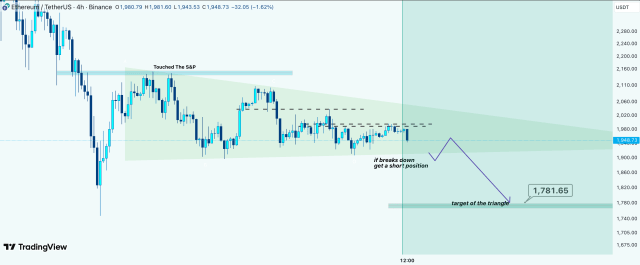
In an analysis shared on the TradingView website, crypto analyst Melikatrader outlined that the Ethereum price could be seeing another major crash soon. So far, the digital asset has seen its price consolidation in what appears to be a large symmetrical triangle pattern. This comes while the price continues to chop below $2,000.

Mainly, most of the action has happened as the Ethereum price has struggled around the $1,977 level, which the analyst explains that the lack of upward momentum at this level could mean that bears have now officially taken full control of the altcoin’s price.

Taking the technical action into account, the crypto analyst explains that the Ethereum price is now nearing the apex of a triangle pattern. This comes after the price had been tightly packed between two major converging trend lines. At this point, the Ethereum price would need to make a major move to confirm the next direction.

Ethereum price
Source: TradingView

Nevertheless, the expected move for Ethereum at this level is expected to be bearish. Essentially, the crypto analyst tells traders to wait for a breakdown to follow and for the price to fall below the lower support line of the triangle. For context, this support line lies at $1,912, making it the level to beat for bears.

Once this level is triggered, though, then the next move is for the Ethereum price to fall further. Expectation remains that a break of the lower trendline would lead to a retest of the lower trendline that marks resistance. This trendline is at $1,781, making it the final target of the triangle breakdown. “Keep a close eye on the lower boundary. If that support snaps, we likely see a swift move toward the $1,780 level. Stay patient and wait for the confirmation,” the analyst said in closing.

Ethereum price chart from Tradingview.com
ETH price sees sharp fall to start the week | Source: ETHUSDT on Tradingview.com

Featured image from Dall.E, chart from TradingView.com

Editorial Process for bitcoinist is centered on delivering thoroughly researched, accurate, and unbiased content. We uphold strict sourcing standards, and each page undergoes diligent review by our team of top technology experts and seasoned editors. This process ensures the integrity, relevance, and value of our content for our readers.

OpenAI plans AI device lineup, including speaker and smart glasses

0

OpenAI is building a family of AI powered consumer devices, including a smart speaker, smart glasses and potentially other connected hardware, according to a report from The Information.

The first device, a smart speaker, is designed to passively observe its surroundings and deliver context-aware responses through ChatGPT, enabling features such as automated grocery ordering based on object recognition and personalized advice drawn from real-time environmental data.

The speaker is expected to launch as early as February 2027, with a projected price between $200 and $300, positioning it to compete directly with Amazon’s Echo and Apple’s HomePod in the smart home market.

OpenAI has partnered with Jony Ive, the designer behind many of Apple’s iconic products, and recruited engineers from Apple’s hardware division to support the initiative.

The company is also reportedly developing additional devices, including smart glasses, as part of a broader push into consumer electronics, though they are not expected to reach mass production until 2028.