Home Blog Page 959

Bitcoin’s Dip Under $65K Pushes Crypto Liquidations to $500M

0

In brief

  • Bitcoin fell from $67.6K to $64.4K in two hours, triggering over $500 million in liquidations across the board.
  • Bitcoin and Ethereum positions accounted for nearly 70% of total liquidations.
  • One analyst told Decrypt that crypto remains “anchored at the far end of the risk curve,” rather than a safe haven.

Bitcoin’s sharp pullback on Monday triggered a flurry of liquidations across crypto markets, wiping out over $470 million in leveraged positions.

The leading cryptocurrency fell roughly 4.6% from $67,600 to $64,435 in less than two hours during early Asian trading, according to CoinGecko data. The sudden collapse has resulted in over $505 million in liquidated positions across all assets over the past 24 hours, per CoinGlass data, with

accounting for $232 million and Ethereum for $126 million.

Bitcoin is currently trading at around $66,280, down 2.7% on the day.

“The downturn was not triggered by a sudden ‘black swan’ event or unexpected negative news,” Tim Sun, senior researcher at HashKey Group, told Decrypt. “Instead, it was driven by policy uncertainty stemming from fluctuations in U.S. tariff policy, compounded by rising geopolitical risks. Together, these factors forced the market to reprice risk assets.”

The U.S. Supreme Court’s Friday ruling stated that President Donald Trump’s “reciprocal” tariffs are illegal. That hasn’t stopped Trump from imposing a sweeping 10% global tariff in response to the ruling.

The selloff underscores Bitcoin’s continued sensitivity to macro uncertainty, with risk assets repricing amid fluctuations in tariff policy and geopolitical tensions rather than crypto-specific catalysts.

Users on prediction market Myriad, owned by Decrypt’s parent company Dastan, have assigned a 37% chance that Bitcoin’s next move will propel it to $84,000. That probability has dropped almost 10% from Sunday’s peak of 46.4%, reflecting  growing pessimism among investors.

Macro catalysts

Sun pointed to a confluence of pressures: sticky December PCE inflation data, Middle East tensions pushing crude oil to periodic highs, and interest rate markets now pricing out any chance of a March rate cut.

The markets have repriced rate-cut expectations from 90% last week to 96% as of Monday, according to the FedWatch tool, suggesting that the Federal target rate is likely to remain unchanged at 3.50% to 3.75% at the next FOMC meeting. On Myriad, predictors place just a 21% chance on a rate cut of more than 25bps before July, down from 40% earlier in the month.

The broad contraction in risk appetite is a result of these developments, the HashKey analyst said. It is evident in the crypto market’s drop and gold’s 1.23% uptick today, at 5,166 per ounce.

“In an environment defined by policy uncertainty, sticky inflation, and geopolitical risk, risk appetite has contracted significantly,” Sun explained. “Assets with high volatility and high liquidity dependence were the first to face pressure, driving the broad correction in risk assets.”

Another factor that is playing a critical role in Bitcoin’s drop is crypto assets being treated as ‘risk assets’ by institutional capital. “Instead, they remain firmly anchored at the far end of the risk curve,” Sun said.

Looking ahead, he expects limited inflows and a protracted bottoming process due to increased uncertainty that has “dampened the willingness of ‘sidelined’ capital to enter the market.”

He cautioned that bounces are likely to be “technical recoveries” without sustained liquidity support, and any periodic bounces are more likely to be technical recoveries rather than trend reversals.”

The key to a crypto market rebound lies in a convergence of macro signals turning positive, Sun said. He pointed to inflation trends, energy prices, geopolitical developments, and stability in traditional risk assets as critical watchpoints.

“If traditional risk assets remain under pressure, crypto is unlikely to rally independently,” Sun added. “A stabilization in stocks is a prerequisite for a crypto recovery.”

Daily Debrief Newsletter

Start every day with the top news stories right now, plus original features, a podcast, videos and more.


Bitdeer sold all its bitcoin (BTC) to fund its move into AI data centers

0

Bitdeer (BTDR) a Singapore-based bitcoin mining and AI infrastructure company has reduced its bitcoin treasury stash to zero, marking a sharp break from the miner playbook of hoarding coins as a signal of conviction seen by the likes of Strategy (MSTR).

The company reported BTC holdings of zero as of Feb. 20, excluding customer deposits. It produced 189.8 BTC on their weekly update and sold the entire amount. Instead of positioning bitcoin as a balance sheet reserve, Bitdeer is turning production into liquidity.

Bitdeer said the decision to sell bitcoin should not concern the broader market, in a post on X, noting it is evaluating multiple powered land acquisition opportunities and believes it is prudent to prepare liquidity now, while continuing to grow hash rate and mine more bitcoin for shareholders.

Operationally, growth remains intact for the company. Bitdeer mined 668 bitcoin in January, up 430% year over year, and increased its self mining hash rate to 63.2 EH per second (EH/s), with total proprietary hash rate reaching 65.1 EH/s.

Bitdeer is accelerating its push into AI infrastructure, rolling out NVIDIA GB200 NVL72 systems in Malaysia and advancing conversions of several sites in the U.S. and Europe from crypto mining to AI data centers.

AI expansion is far more capital intensive than incremental mining buildouts, requiring large scale GPU clusters and data center upgrades.

Bitdeer recently priced a $325 million convertible notes offering and a $43.5 million equity raise to fund datacenter expansion, HPC and AI cloud growth, and ASIC development.

Unlike bitcoin mining, which is tied to price cycles and halvings, AI and HPC contracts can offer more predictable revenue streams. The pivot also represents an attempt by miners to be valued less as leveraged bitcoin proxies and more as digital infrastructure and AI plays.

Peers are moving in the same direction. Riot Platforms (RIOT) recently sold $200 million worth of bitcoin to fund operations and AI expansion. While Bitfarms (BITF) are dropping its “bitcoin company” identity and doubled down on AI in the U.S. MARA Holdings (MARA) is also expanding into HPC and AI through a planned 64% stake in France based Exaion.

Bitdeer shares are down 1% in pre-market, trading at $7.70 per share.

Ethereum Price May Slip Below $1.5K as Buterin Keeps Selling ETH

0

Ethereum’s native token, Ether (ETH), is on track to test and potentially break the $1,500 support level in the coming days.

Key takeaways:

  • Ethereum has entered the breakdown phase of its prevailing bearish continuation pattern.

  • ETH price may decline below $1,500 by early March amid founder-led selling.

ETH bear pennant breakdown targets $1,475

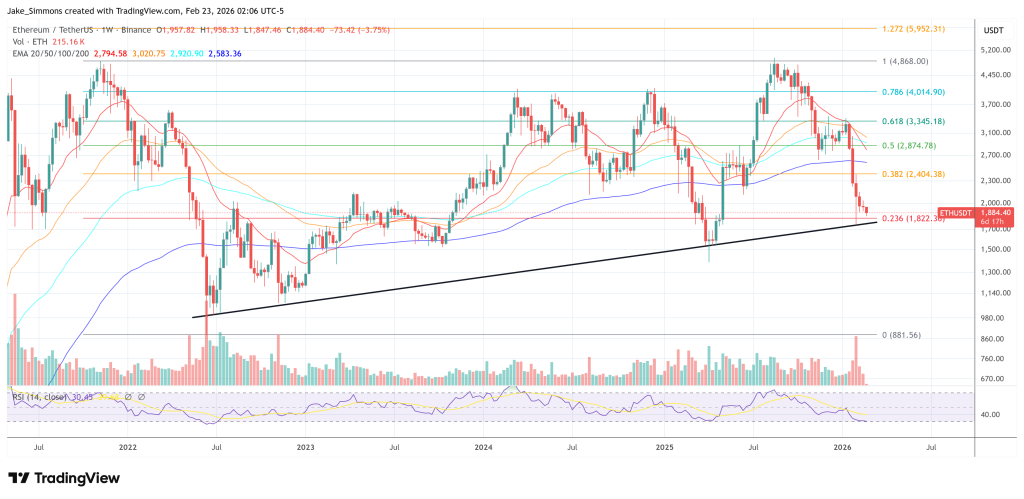
On Monday, ETH’s price dropped by more than 5.60% to about $1,850 amid a broader de-risking sentiment led by nervousness surrounding tariffs.

In doing so, the biggest altcoin broke below the lower trendline of its prevailing bear pennant pattern, with rising volumes indicating traders’ conviction behind the breakdown move.

Edit the caption here or remove the text

A bear pennant breakdown typically resolves when the price falls by as much as the previous downtrend’s height.

Applying the same principle to ETH’s charts would bring its downside target to $1,475, close to the psychological support level of $1,500, by the end of February or early March.

Related: Ethereum price: Classic chart pattern puts sub-$2K ETH in focus

The bulls must therefore reclaim the pennant’s lower trendline as support, followed by a continued rally above the 20-day exponential moving average (20-day EMA, the green line) at $2,085, which may invalidate the bearish outlook.

Vitalik Buterin will likely sell more ETH soon

Ethereum co-founder Vitalik Buterin’s planned ETH sales have not helped the bulls regain their footing in February.

On Jan. 30, Buterin said he would withdraw and sell 16,384 ETH via his Kanro entity to fund ecosystem work, open-source software and other long-term initiatives during an Ethereum Foundation “mild austerity” phase.

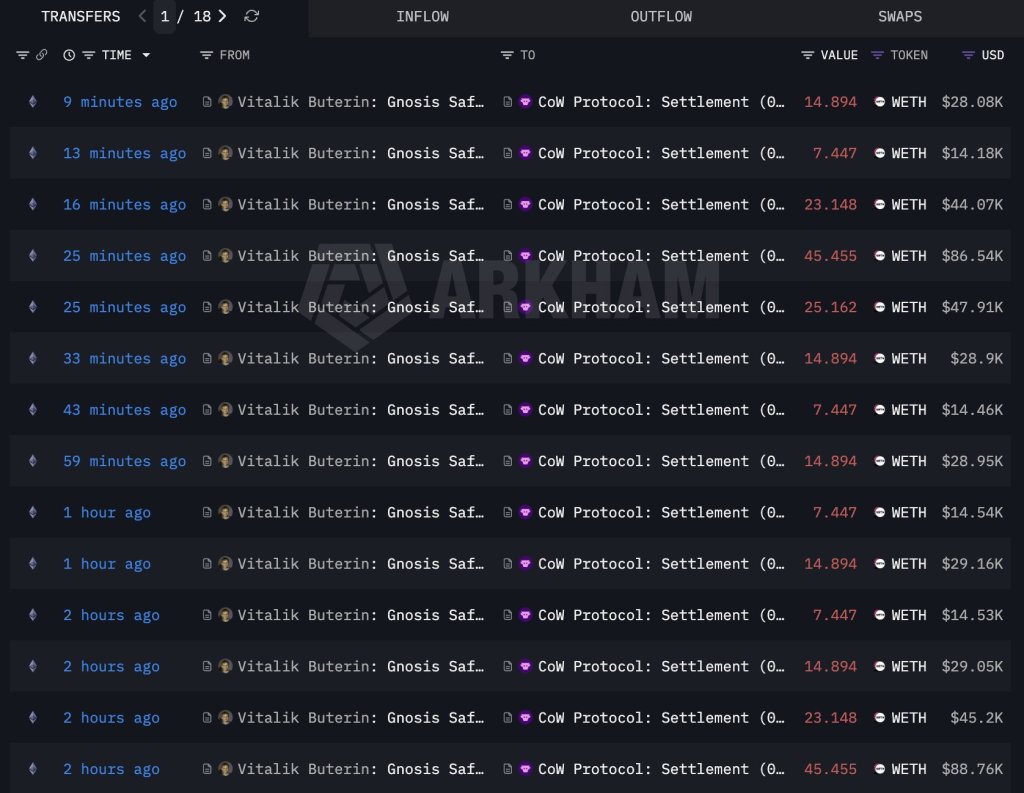
Since early February, onchain tracker Arkham Intelligence has flagged about 9,000 ETH sold in batches, with the pace picking up again over the past 48 hours after a 3,500 ETH withdrawal from Aave.

Vitalik Buterin “is selling ETH faster again,” said onchain monitoring resource, Lookonchain, on Monday.

Source: X

Ethereum’s price has dropped 18.55% so far in February, aligning with Buterin’s ETH distribution. The overhang could grow if he liquidates the remaining ~7,350 ETH.

History shows how founder-linked supply, including Ethereum Foundation treasury transfers, can amplify bearish sentiment among traders.

For instance, the May 2021 35,000 ETH transfers (about $125 million at that time) preceded a 50% ETH price drop within weeks.

Later, the foundation transferred another 20,000 ETH ($95 million) to Kraken on Nov. 11, 2021, a move that, in hindsight, coincided with Ether’s price peaking near $4,700 before the next leg lower.

Such conditions further increase ETH’s odds of hitting its pennant target below $1,500 in the coming days.