Home Blog Page 948

Terraform Estate Sues Jane Street Over Trades Tied to 2022 Crypto Market Collapse: WSJ

0

In brief

  • The Terraform wind-down trust accuses Jane Street of trading on non-public information.
  • The complaint centers on liquidity withdrawals during the May 2022 depeg that led to TerraUSD and FTX’s collapse.
  • The case could test insider liability in crypto markets, Decrypt was told.

The Terraform Labs bankruptcy administrator has sued Jane Street, alleging the quantitative trading firm used non-public information to profit at the height of the crypto market’s collapse in 2022.

The lawsuit centers on allegations that Jane Street obtained advance insight into Terraform’s internal liquidity decisions and positioned trades around those moves as TerraUSD began to lose its dollar peg, according to a report from The Wall Street Journal on Monday.

“Jane Street abused market relationships to rig the market in its favor during one of the most consequential events in crypto history,” Terraform Labs court-appointed plan administrator Todd Snyder alleged in a statement to WSJ.

The move follows a lawsuit filed in a U.S. federal court in late December against Jump Trading, which accused the trading firm of unlawfully profiting from and materially contributing to the collapse of the Terra ecosystem.

“This desperate suit is a transparent attempt to extract money when it is well-established that the losses suffered by Terra and Luna holders were the result of a multi-billion dollar fraud perpetrated by the management of Terraform Labs,” Jane Street told Decrypt. “We will defend ourselves vigorously against these baseless, opportunistic claims.”

Decrypt has reached out to Terraform Labs wind-down trust for comment, but has not yet received a response.

“This lawsuit seems to argue that the most important moves do happen in private chats before hitting the blockchain,” Andrew Rossow, public affairs attorney and CEO of AR Media Consulting, told Decrypt.

The case “matters significantly, because the court isn’t just judging a trade anymore; it’s setting a precedent that ‘privileged access’ in DeFi is a legal liability, and not just a competitive advantage,” Rossow said.

If the allegations are proven, the case could signal a shift toward applying a stricter misappropriation theory in crypto markets.

Under that approach, liability would not depend on a traditional corporate insider relationship. Instead, a market maker could face exposure if it obtained confidential information from a protocol team and used it to trade against the broader market, Rossow explained.

The theory would also broaden the definition of an “insider” in such cases. Private chat groups or informal back channels could be treated as the functional equivalent of a corporate boardroom, meaning insider status could extend to anyone with direct access to a protocol’s crisis communications.

“It suggests that in crypto, an ‘insider’ isn’t just an executive; it’s anyone with a private line to the ‘war room’ of a protocol during a crisis,” Rossow said.

The legal observer said the case will likely hinge on materiality and source.

Terraform collapsed in May 2022 after its algorithmic stablecoin TerraUSD lost its dollar peg, sending its sister token Luna into a near-total wipeout within days. The roughly $40 billion implosion erased billions in investor value and intensified stress across the broader crypto market.

The fallout contributed to a wider industry downturn that led to a string of failures, including the eventual collapse of FTX later that year.

Terraform filed for bankruptcy in January 2024, and a wind-down trust was later established to pursue recoveries for creditors. Founder Do Kwon has since pleaded guilty to criminal charges and is serving a 15-year prison sentence.

Editor’s note: This story has been updated with a response from Jane Street.

Daily Debrief Newsletter

Start every day with the top news stories right now, plus original features, a podcast, videos and more.


Tether-backed crypto exchange is ditching the ‘retail’ label to build the secret plumbing for Europe’s biggest banks

0

Spain’s largest cryptocurrency exchange, Bit2Me, moved 5.3 billion euros (around $6.24 billion) in trading volume in 2025, an eightfold jump since 2023, as it shifted from a consumer-facing platform to backend infrastructure for banks and law enforcement.

That volume was accompanied by growth in business-to-business revenue, which jumped from 18% of the total in 2023 to 27% in 2025. Crypto-backed loans, a relatively new offering, rose 672% in a single year, with the company’s CFO, Pablo Casadio, saying he sees the crypto industry entering a financial infrastructure phase that the company is taking advantage of, given its backing.

The exchange, backed by various banks including Bankinter, Unicaja, and Cecabank as well as telecom giant Telefónica and Tether, made $25 million in revenue last year.

Read more: Spanish bank Bankinter joins BBVA and Tether with stake in crypto exchange Bit2Me

Much of that came from a new API product that allows institutions to effectively outsource their crypto operations. Spanish wholesale bank Cecabank, which also holds a stake in the company, has integrated Bit2Me’s infrastructure to offer digital asset services to other regional banks, complementing a similar liquidity deal with BBVA’s Turkish crypto subsidiary, Garanti BBVA Kripto.

The exchange became the first in Spain to secure an EU Markets in Crypto Assets (MiCA) license and spent 3,000 hours on regulatory-compliant work and 2.5 million euros ($2.9 million) to achieve it, Bit2Me executives told reporters during a briefing.

The effort temporarily pushed its EBITDA into negative territory, but opened doors that few crypto firms can access and allowed it to start expanding. The company last week started expanding into the Portuguese market, with plans to enter Italy, France and Germany in the near future.

Bit2Me also unveiled that it has been eyeing the U.S. and Middle East markets, which are far more competitive. “If we do anything, it needs to be done the way we did it in Spain, everything by the book,” Andrei Manuel, the platform’s COO and co-founder, said during the briefing attended by CoinDesk.

Turning siezed crypto to fiat

It has also been acting as a “crypto liquidator” for the Spanish government. Bit2Me has built a pipeline to convert confiscated digital assets into euros, working directly with Interpol, Europol and national police, its executives added.

The system leverages blockchain analytics firm Chainalysis to ensure traceability. In 2025, Bit2Me processed 1.5 million euros ($1.76 million) in seized crypto on behalf of agencies that include Interpol, Europol, and Spanish police. These funds are converted into fiat currency for the state.

While other governments still auction off crypto through third parties, Spain’s direct liquidation model mirrors the U.S. Marshals Service’s deal with Coinbase.

BVNK Secures MiCA Licence in Malta to Expand European Stablecoin Operations

0

BVNK, the enterprise stablecoin infrastructure provider, has secured its Crypto-Asset Services Provider (CASP) licence from the Malta Financial Services Authority (MFSA).

The licence marks a major milestone for the company as the European Union transitions to its new harmonised regulatory framework for digital assets, known as MiCA (Markets in Crypto-Assets). With the CASP licence secured in Malta, BVNK can now offer MiCA-regulated digital-asset services and passport them across all European Economic Area (EEA) member states.

A unified European offering

According to the announcement, the new regulatory approval allows BVNK to offer enterprise customers three critical European financial capabilities from a single platform:

  • MiCA-regulated digital-asset services via the new CASP licence.

  • Euro payments facilitated by the company’s existing Electronic Money Institution (EMI) licence.

  • Direct access to the EU’s Single Euro Payments Area (SEPA) scheme, achieved through the Bank of Lithuania’s CENTROlink system.

This combination is designed to give BVNK a competitive advantage by enabling its clients to move compliantly and seamlessly between traditional Euro payments and stablecoin settlements.

Tina Meschino, general counsel at BVNK, commented on the regulatory milestone: “We are delighted to have obtained our CASP licence in Malta, a leading hub for digital innovation. We’ve always had a positive relationship with the MFSA and we’re excited to continue working with them, and to passport our digital-asset services to EEA members.”

She added: “With our MiCA and EMI licences in place in Malta, plus our direct access to SEPA, we can provide customers with a unique, fully regulated bridge between EUR payments and stablecoin settlement. It’s a reflection of the strength of BVNK’s compliance, governance, and partnerships across Europe’s financial system.”

Building on a high-growth year

The regulatory approval follows a period of significant growth for the fintech. Over the past year, BVNK reports that it scaled to $30billion in annualised processing volume.

The company, which powers financial products and cross-border money movement across more than 130 countries, also recently signed up major new global enterprise customers, including Visa, Worldpay, and dLocal. With the CASP licence now in place, the company states it is entering 2026 with a strengthened foundation for continued international growth.

Bitcoin (BTC) dips under $63,000 and history says more pain ahead before bottom forms

0

Bitcoin dipped below $63,000 during Asian trading hours, extending overnight weakness amid President Donald Trump’s tariffs and AI jitters that have soured investor sentiment.

The leading cryptocurrency by market value is already down nearly 7% for the week, trading at levels last seen on Feb. 6 when prices nearly dropped to $60,000, CoinDesk data shows.

“Similar to equities, Bitcoin has had a sharp pullback today, driven largely by renewed tariff-related uncertainty, similar to the events of April 2025. Furthermore, ratcheting geopolitical tensions could likely prove bearish for BTC in the short-term,” Matt Howells-Barby, vice president at Kraken, Pro Trader, and host of Trading Spaces, told CoinDesk in an email.

He added that the $60,000 level is a key support that bulls are watching closely. “If that level fails to hold, we could potentially see a move into the mid-to-low $50K range,” he noted.

The U.S. stocks fell Monday after Trump said he would place temporary 15% tariffs on imports from other countries, up from the 10% rate announced Friday following the Supreme Court’s decision to struck down his tariffs strategy. Meanwhile, investors continued to sell shares in companies that stand to lose the AI revolution.

History favors a deeper sell-off in BTC

History shows BTC rarely bottoms until the 50-week average price crosses below the 100-week average price. This so-called bear cross has marked the end of every major bear market, including those in 2022 and 2018.

We’re nowhere near that signal today, as the 50-week average price remains well above the 100-week.

So, if past data is a guide, the market could slide further, potentially to $50,000 or lower, as several experts told CoinDesk at Consensus Hong Kong before the averages cross bearish and capitulation sets in.

Bitcoin’s weekly chart in candlestick format with key averages. (TradingView)

The pattern may seem counterintuitive: The 50-week average dropping below the 100-week signal further weakens momentum.

But it fits the moving averages’ lagging nature perfectly: crossovers confirm what’s already happened – not predict what’s next – so long-term ones have tended to market bear market bottoms in bitcoin.

That said, as with any indicator, the past record offers no assurance of future results.

Nigerian Leader Unveils New Regulatory Framework for Country’s Digital Asset Market

0

Nigerian President Bola Tinubu has launched a comprehensive regulatory regime for Nigeria’s digital asset market, headlined by the creation of the Virtual Asset Regulatory Council. A New Strategic Oversight Body Nigerian President Bola Tinubu has unveiled a sweeping new framework to regulate the country’s fast-growing digital asset market, establishing the Virtual Asset Regulatory Council (VARC). […]

Incard Secures EMI Licence to Continue Its Mission of Building the Financial Operating System for Digital Entrepreneurs

0

Incard, the financial platform for high-growth digital companies, has been granted an Electronic Money Institution (EMI) licence in the UK, a major milestone in the company’s ambition to reconfigure how entrepreneurs manage their finances. 

Incard is now regulated by the Financial Conduct Authority (FCA) as an Authorised Electronic Money Institution, giving it the autonomy to issue electronic money (e-money), and directly provide payment and card accounts, as well as foreign exchange services. 

Theo Cesarini, CEO of Incard, said: “Securing an EMI licence is pivotal. At Incard, we are building a financial platform for digital entrepreneurs to manage their finances in a way that makes sense for their businesses. The banking system hasn’t served their needs well and we’ve developed an orchestration layer that pulls together what they need in a single place, whether that is access to business banking, corporate cards, cash flow management, invoicing, or ad spend. As we are an Authorised E-Money Institution, we can move faster to overcome the fragmentation that currently exists in the banking and payments infrastructure.”

Cesarini continued: “Modern businesses operate at a different speed. They need a financial institution that understands their unique workflows while keeping pace with their growth. This EMI licence means we can respond effectively to our clients’ needs and expand our product offering.” 

The regulatory approval from the FCA unlocks the next phase of Incard’s development. Since Incard was launched in 2024, it has gained traction among e-commerce brands, agencies, affiliates and resellers. The platform is already used by brands such as Azio Beauty, Aloe Paris, and Ankhway, and more than £500m has been transacted on Incard by its users to date. 

In early February, Incard announced its £10m Series A funding round, which was led by Smartfin and included participation from Founders Capital, MountFund and top-tier angel investors. With this investment, and the EMI licence, Incard will continue to develop its app store and further invest in AI and automation. 

BTC, ETH, SOL, XRP extend losses as AI scare trade unsettles risk markets

0

Macro jitters from an emerging AI disruption trade are compounding crypto-native weakness, with majors posting 8-11% weekly losses across the board.

Bitcoin slid to around $62,900 on Tuesday, down 2.1% on the day and 7.5% on the week, extending a grinding move lower that has so far refused to produce either a clean breakdown or a strong bounce.

The price action has pinned the market inside the $60,000-to-$70,000 band that formed after the Feb. 5 flush — a range that is starting to feel less like a base and more like a holding pattern waiting for a catalyst.

Altcoins are faring worse. Ethereum traded near $1,829, down 8% on the week. XRP fell 10.8%, Solana’s SOL shed 11.3%, and dogecoin dropped nearly 10%. The underperformance across majors reflects a market where risk appetite is shrinking toward bitcoin and even that bid is thinning.

CryptoQuant flagged sell-side pressure among altcoins at five-year highs, suggesting holders are actively distributing into a market where buyers remain scarce outside of the largest cap.

That kind of structural selling tends to grind prices lower without the dramatic liquidation candles that attract dip buyers, making it a slower bleed that is harder for momentum traders to position around.

FxPro chief market analyst Alex Kuptsikevich said in an email bitcoin’s recent attempt at recovery is shaping up as consolidation rather than reversal. He pointed to a bearish pennant forming on the daily chart, noting that a move below the mid-$65,000 area would confirm downside continuation while a break above $70,000 would invalidate the pattern.

More broadly, he described the $60,000-to-$70,000 range as historically significant — a zone that acted as the ceiling for the entire 2021 cycle and now appears to be serving as a battlefield between long-term accumulators and newer holders cutting losses.

AI fears return

Adding to the pressure is a macro dynamic that has nothing to do with crypto directly but is draining the same pool of risk capital.

A Citrini Research report flagged an emerging “AI scare trade” this week, warning of widespread economic disruption from artificial intelligence across delivery, payments, and software sectors. The note triggered selling in tech-adjacent equities as investors reassessed which companies benefit from AI adoption and which face displacement risk.

That kind of broad risk recalibration tends to hit crypto on a lag. Digital assets don’t always sell off in lockstep with equities, but they are sensitive to the same shifts in liquidity and positioning that drive risk-off moves — and right now, the mood in both markets is pointing the same direction.

Bitcoin is now 48% below its October all-time high and sitting 5.5% below its 2021 peak of $69,000. The longer it trades in this range without reclaiming higher ground, the more the technical picture tilts toward the bears.

The $33 Billion Inundation: Ethereum Inflows Hit a 15-Month High As Price Teeters At $1,955

0

Trusted Editorial content, reviewed by leading industry experts and seasoned editors. Ad Disclosure

Ethereum is struggling to hold above the $2,000 level as the broader crypto market enters a more fragile phase marked by persistent selling pressure, fading momentum, and elevated uncertainty. Despite several rebound attempts in recent weeks, price action has remained subdued, with liquidity conditions tightening and investor sentiment turning increasingly cautious. The inability to secure sustained acceptance above this psychological threshold has reinforced the perception that the market is still navigating a corrective environment rather than transitioning into a clear recovery phase.

A recent CryptoQuant report provides additional context by highlighting a sharp increase in exchange activity. According to the data, total Ethereum inflows to Binance over the past 30 days reached roughly $33.3 billion — the highest level recorded since last November. This surge comes as ETH trades near $1,955 after a gradual but persistent decline in recent weeks.

Historically, rising inflows to major exchanges tend to indicate a growing supply of assets available for trading. When substantial volumes of Ethereum move onto platforms like Binance, they may be used for spot sales, derivatives collateral, or portfolio rebalancing. Consequently, this spike in inflows signals heightened market activity and potentially increased short-term volatility.

Exchange Inflows Surge As Market Tests Supply Absorption

While the recent surge in Ethereum inflows to Binance may initially appear bearish, the report emphasizes that this development should not automatically be interpreted as a negative signal. Elevated exchange inflows can sometimes reflect strategic repositioning rather than immediate selling intent. Investors may be preparing to actively trade, hedge exposure, or adjust portfolio allocations, particularly during periods of heightened volatility when liquidity access becomes more critical.

Ethereum Binance Exchange Flow | Source: CryptoQuant

In addition, strong inflow phases have occasionally preceded periods of price stabilization. When additional supply entering exchanges is met by sufficient demand, markets can transition into consolidation rather than extended declines. This dynamic often depends on broader liquidity conditions, derivatives positioning, and macro sentiment rather than inflows alone.

That said, registering the highest inflow level since last November places Ethereum in a structurally sensitive phase. The market’s reaction to these flows will likely provide clearer directional signals in the coming weeks. If the added supply translates into persistent sell-side pressure, downside risks could remain elevated. Conversely, if demand absorbs this liquidity effectively, the current phase may represent redistribution ahead of a more constructive move rather than sustained weakness.

Ethereum Price Holds Fragile Ground Below Key Resistance

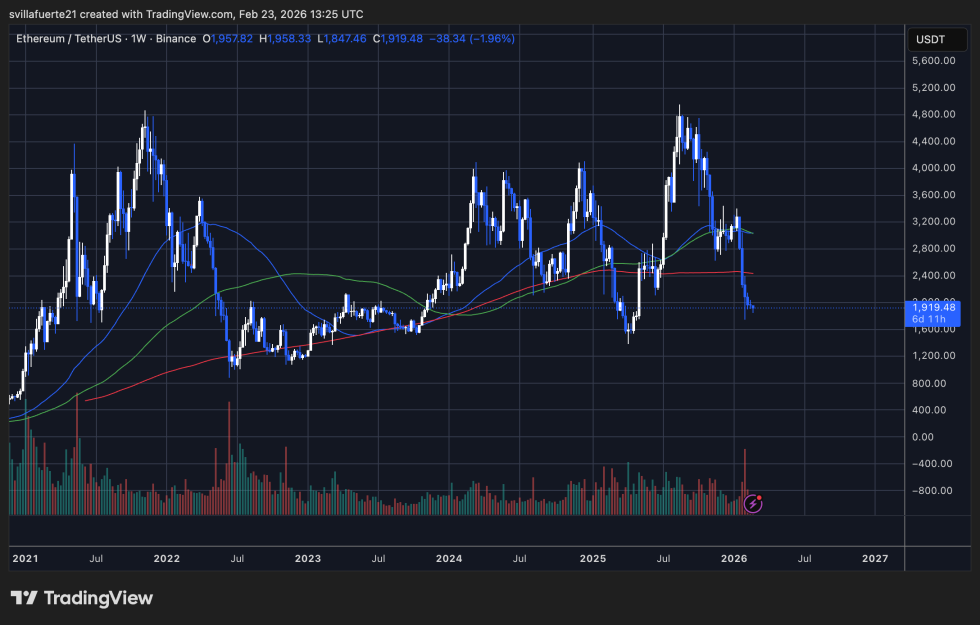
Ethereum’s weekly chart reflects a structurally fragile environment as price continues trading below the $2,000 psychological threshold. After failing to sustain momentum above the mid-2025 highs near the $4,800 region, ETH has established a sequence of lower highs and lower lows — a classic downtrend formation indicating persistent distribution rather than consolidation.

ETH testing critical demand level | Source: ETHUSDT chart on TradingView

Technically, Ethereum is now positioned beneath its key moving averages, which previously acted as dynamic support during the rally phase. These averages have rolled over and now function as resistance zones, limiting recovery attempts unless decisively reclaimed. The recent rejection near the $3,000 area reinforced this bearish transition, accelerating downside momentum toward the current ~$1,900 region.

Volume trends show declining participation compared with the expansion phase, suggesting reduced speculative enthusiasm. However, declining volume during corrections can sometimes precede stabilization if selling pressure becomes exhausted.

From a structural perspective, immediate support appears near the $1,800–$1,900 range, where prior consolidation occurred. A sustained break below this zone could expose deeper retracement levels toward historical accumulation areas. Conversely, reclaiming the $2,200–$2,400 region with strong volume would be required to shift short-term momentum back toward a neutral or constructive bias.

Featured image from ChatGPT, chart from TradingView.com 

Editorial Process for bitcoinist is centered on delivering thoroughly researched, accurate, and unbiased content. We uphold strict sourcing standards, and each page undergoes diligent review by our team of top technology experts and seasoned editors. This process ensures the integrity, relevance, and value of our content for our readers.

Who will ZachXBT expose as ‘insider traders’ on Thursday? Polymarket thinks these firms

0

Blockchain investigator ZachXBT hasn’t named the target yet. Polymarket bettors are already pricing it in.

A prediction market asking which crypto company ZachXBT will expose for insider trading has drawn nearly $3 million in volume since the on-chain sleuth posted on X that a “major investigation” into one of crypto’s most profitable businesses would drop on February 26. He offered no specifics beyond alleging insider trading.

That was enough. Within hours, Polymarket traders began placing bets across several candidates, and the resulting odds function as a real-time map of where the market thinks the bodies are buried.

Polymarket is a blockchain-based prediction platform where users trade contracts on real-world outcomes using real money. The odds tend to reflect genuine conviction because bettors risk capital rather than just opinions. The platform gained mainstream credibility during the 2024 U.S. election cycle and has since become crypto’s de facto sentiment gauge for unresolved events.

As of Asian morning hours Tuesday, Meteora is the heavy favorite at 43%, with $319,000 in volume on that outcome alone. The Solana-based liquidity layer has been a recurring name in community discussions around meme coin market structure — particularly around how launch liquidity gets seeded and who ends up on the right side of early price moves.

Its proximity to politically linked token activity, including Trump-themed meme coins, has kept it in the spotlight.

Axiom sits at 13%, followed by Pump.fun at 12% with the highest single-outcome volume at $332,000 — suggesting heavy two-way action rather than consensus. Pump.fun’s inclusion tracks with months of scrutiny over early-wallet sniping on the platform, though the project has denied allegations of insider advantages.

Jupiter rounds out at 8% and MEXC at 7%. Jupiter’s presence reflects broader questions about Solana DeFi routing and fee extraction, while MEXC has faced persistent social media chatter about listing behavior and whale-friendly timing on meme coin markets.

The odds have shifted notably since the market opened. Axiom, Pump.fun, and Jupiter have all fallen 37-42% from their initial readings, while Meteora has consolidated its lead — a pattern that suggests early speculation has given way to more directional conviction as bettors parse ZachXBT’s prior work and posting patterns for clues.

None of this constitutes evidence, however. Prediction markets price belief, not fact, and Polymarket’s odds reflect the collective speculation of a few thousand traders rather than any inside knowledge of the investigation itself.

But the market is doing what prediction markets do best — forcing participants to put capital behind their hunches rather than just tweeting them.

The answer arrives in two days.

Mashreq Launches First-of-its-Kind Digital Cross-Border Accounts for Non-Resident Pakistanis in the UAE

0

Mashreq, a leading financial institution in the MENA region, has announced the launch of a new cross-border banking service aimed specifically at its UAE-based Pakistani customers.

For the first time in the UAE, Pakistani nationals living in the Emirates who already hold a Mashreq UAE account can now open an account with Mashreq Pakistan entirely remotely. The service is managed fully through the Mashreq UAE mobile app.

Eliminating cross-border friction

The new digital service replaces the traditional manual account-opening process. It eliminates the need for physical documents or the requirement for expatriates to make in-person visits to branches back in Pakistan, creating a seamless, end-to-end digital experience.

Once the account is activated, users gain access to a unified global dashboard within their existing app. This allows customers to view and manage both their UAE and Pakistan account balances in one place, offering enhanced visibility and control over their cross-border finances.

Fee-free instant remittances
Fernando Morillo, group head of retail banking at Mashreq

A major draw of the new service is the integration of Quick Remit, an exclusive feature available only to Mashreq account holders. Using this tool, customers can send money to their home country instantly and completely free of charge.

Furthermore, Pakistani customers who open an account with Mashreq Pakistan will receive a current account with zero minimum balance requirements, alongside a free domestic PayPak debit card.

Fernando Morillo, group head of retail banking at Mashreq, commented: “We are delighted to introduce this pioneering digital service, which marks a significant milestone for Mashreq and our customers. As the first bank in the UAE to enable non-resident Pakistanis to open accounts in their home country digitally—without physical paperwork or branch visits—we are demonstrating our commitment to reimagining banking through innovation. Our zero-fee Quick Remit service further enhances the experience, empowering customers with greater convenience, speed, and value.”

Ghazal AlSakaal, global head of digital strategic partnerships at Mashreq, added: “By enabling seamless and secure cross-border account opening, we are breaking down traditional banking barriers and delivering meaningful impact to our customers. We believe this service will redefine how expatriates engage with their financial needs across borders, and we look forward to further enhancing the region’s financial landscape through innovative initiatives.”