Home Blog Page 93

Ripple’s RLUSD stablecoin goes live in Japan after regulatory approval

0

The launch delivers on a memorandum of understanding the two firms signed in August 2025 and builds on a relationship dating to 2016, when Ripple and SBI began working together on cross-border payments and blockchain infrastructure in Asia.

RLUSD will “serve as a bridge for payments, tokenization and collateral management,” connecting Japanese businesses to global dollar liquidity, said Jack McDonald, Ripple’s senior vice president of stablecoins, in a statement.

RLUSD is Ripple’s bet on the regulated end of the stablecoin market, and it is separate from XRP, the closely-linked token the company is best known for. Ripple has long pitched RLUSD as an enterprise token for settlements and tokenization, the practice of issuing real-world assets onchain.

The Japan launch extends that effort into Asia at a moment when stablecoins are drawing formal rules in the U.S., Europe and across the region, turning the dollar-token market into a race for official approval as much as for users.

Whether RLUSD can close the gap on USDT and USDC remains to be seen, however. Approvals like Japan’s give it the credentials to compete for institutional use, but it still has to convert that standing into the volume and liquidity its much larger rivals already command.

Bitcoin, ether lead $1 billion liquidation losses as AI trade keeps going

0

Bitcoin dropped to $59,175 overnight, its lowest point since early June, before recovering to about $61,500 by Thursday morning, per CoinDesk data. Nearly $1 billion worth of futures positions were liquidated across crypto majors, such as bitcoin, ether, solana, and others, to tokenized versions of stocks, such as Micron Technology Inc (MU) and Sandisk (SNDK).

The dip triggered roughly $430 million in long liquidations on bitcoin-tracked futures, or bets on higher prices that were automatically closed as the price fell.

No single catalyst drove the move. Bitcoin has lost about 10% since Monday’s peak near $65,500, pulled lower by the same forces that have dominated all week: a hawkish Fed, six straight weeks of ETF outflows, thinning summer liquidity, and a quarter-end options expiry on June 30 that traders say is keeping the market unstable.

Major market-maker Wintermute had flagged $59,000 as the bear-market low to watch in its Tuesday’s note.

The bounce came from outside crypto. Micron Technology reported quarterly earnings after the close that shattered analyst estimates, sending its shares sharply higher and lifting the broader memory chip complex.

SK Hynix separately disclosed plans for a U.S. stock listing seeking roughly $29 billion, one of the largest offerings ever. Samsung and Kioxia rallied in Asia Thursday morning.

The same AI chip trade that sent the Kospi down 10% on Monday on fears the spending boom was stalling is now the thing steadying crypto, with Micron’s results reading as confirmation that demand for AI memory is structural, not speculative.

The quarter-end remains the week’s live risk. Bitcoin’s $59,000 low held, but $1.6 billion in leveraged long positions sit clustered below $58,000, per CoinGlass, meaning a break there would accelerate the drop.

Thursday’s PCE inflation print, the Fed’s preferred price gauge, is the next data point that could move the market in either direction.

Strategy (MSTR) Falls Below $100 For First Time Since 2024

0

Shares of Strategy Inc. (NASDAQ: MSTR) crossed below $100 on Wednesday for the first time since March 2024, extending a collapse that has erased more than 80% of the stock’s value from its all-time high of approximately $474 reached in November 2024.

The breach of the $100 threshold carries weight beyond the number itself. Strategy, the Bitcoin treasury company led by Executive Chairman Michael Saylor, built its investment thesis around the premise that its leveraged exposure to Bitcoin would generate returns that outpace traditional assets.

That thesis is now under pressure as Bitcoin trades near $61,000 — well below the company’s average acquisition cost of roughly $75,656 per coin.

Strategy holds 847,363 BTC across its treasury, a position valued at approximately $53 billion at current prices. Against an average cost basis implying a total investment closer to $64 billion, the company is sitting on an unrealized paper loss of more than $11 billion. That gap between cost and market value has become a weight on the stock.

The decline accelerated through a series of events over the past six weeks. In May, Strategy used cash reserves to repurchase $1.5 billion in convertible bonds at a discount, cutting its dividend coverage buffer from a target of 24 months down to roughly six months at the low point. 

On June 1, the company sold 32 BTC — its first Bitcoin sale since 2022 — to demonstrate that it could cover dividend obligations through asset liquidation if needed. MSTR shares fell nearly 6% on that news.

Strategy’s STRC is under pressure

The company’s preferred stock, STRC, has also come under pressure. The instrument fell to a record low of $83 in mid-June, far below its $100 par value. Strategy has since increased STRC dividend frequency to twice per month and rebuilt cash reserves to approximately $1.1 billion, but the market has not yet returned the preferred stock to par.

Speaking at The Bitcoin Conference, Saylor said Strategy’s STRC preferred stock has become one of the fastest-growing credit products globally, attracting billions in retail capital by offering an 11.5% dividend while leveraging Bitcoin as its underlying capital base. 

He argued, at the time, that scaling Bitcoin-backed digital credit products like STRC could significantly expand Bitcoin adoption and drive future price appreciation.

Strategy has not stopped buying Bitcoin. The company added 1,587 BTC for $100 million earlier in June and 520 BTC for $35 million on June 22. But continued accumulation at prices above the current market value has done little to restore confidence among common shareholders.

Shares of Strategy are currently at $98.83. 

Emergency Action as Magic Internet Money (MIM) Depegs 50%

0

Decentralized finance platform Abracadabra said Wednesday that it launched emergency measures after its crypto-collateralized stablecoin, Magic Internet Money (MIM), fell 50% below its $1 peg. 

“We’re acutely aware of the MIM depeg and are taking emergency actions to remedy the situation,” the team said on Wednesday.

It said effective immediately, it will begin gradually “increasing interest rates across all Cauldrons, including deprecated markets, to encourage debt repayment and reduce the outstanding MIM supply.” 

The MIM depeg is a stark reminder that even overcollateralized DeFi stablecoins can be fragile in thin-liquidity environments and bear markets, underscoring the persistent risks of crypto-backed money.

Abracadabra describes itself as an omnichain DeFi lending platform that utilizes interest-bearing tokens as collateral to mint MIM, a dollar-pegged stablecoin that launched in May 2021. 

MIM’s troubles began in mid-June, when it slipped to 74 cents before a brief recovery to 89 cents, then plunged to 49 cents on Wednesday, according to CoinMarketCap. The current circulating supply of MIM is about $104 million. 

MIM depeg exceeds 50%. Source: CoinMarketCap

“The current depeg creates a natural incentive for borrowers to repay debt at a discount, accelerating supply contraction and strengthening the path back to the peg,” the team said.

“Our priority is simple: restore confidence, improve market structure, and return MIM to a healthy (and liquid) peg.”

Related: DeFi TVL drops 39% in 2026 amid market downturn and record hack activity

By raising Cauldron interest rates, the protocol makes it more expensive for borrowers to maintain positions, encouraging repayment that burns MIM, contracts supply and helps restore the peg.

It comes less than 10 days after Abracadabra injected $100,000 into its primary liquidity pool on Curve Finance on June 15, when the stablecoin first slipped from its peg.  

“This will serve as a base for liquidity to restore balance across Curve Pools after unexpected liquidity withdrawals due to recent DeFi incentive strategy changes,” it said at the time. 

Cauldron liquidity is thin

The DeFi stablecoin is minted by borrowing against yield-bearing tokens in Abracadabra’s “Cauldrons,” but it relies on crypto collateral and deep liquidity pools, primarily on the Curve Finance platform, to maintain its $1 peg. 

Thin and imbalanced liquidity in decentralized exchange pools is fueling selling pressure that makes the stablecoin vulnerable to further depegging, potentially amplified by broader market caution.

The broader crypto market has fallen about 3%, or roughly $60 billion, in the past 24 hours, with Bitcoin briefly dropping below $60,000

Magazine: Japanese pension fund tips 1% in crypto, G7 urges action on NK hackers: Asia Express

Forget max pain. Bitcoin is well below the $72,000 magnet going into $10 billion options expiry

0

Bitcoin’s price drop ahead of Friday’s quarterly options settlement has once again cast doubt on the popular “max pain theory.”

The max pain level for this expiry stands at $72,000, significantly above current spot prices of around $61,700. On Friday at 8:00 ET, options worth $10 billion will expire on Deribit, the world’s largest crypto options exchange.

Max pain, as the name suggests, refers to the price level where options buyers – those who purchased call and put contracts to hedge against volatility – would lose the most money on expiry. In that scenario, option buyers suffer maximum losses, while their counter parties who sold options (also known as writers) stand to benefit.

The theory suggests that ahead of expiry, these option writers actively try to push the spot price toward the max pain level, effectively pinning bitcoin there. Crypto social media has long embraced the idea, particularly after BTC appeared to gravitate toward the max pain point ahead of several monthly and quarterly settlements in 2020–2021. That pattern, even if partly coincidental and driven by other market forces, helped solidify belief in the theory.

Law Enforcement, Catholic Groups Send Letters To U.S. Government Warning CLARITY Act Would Create Crypto Crime Loopholes

0

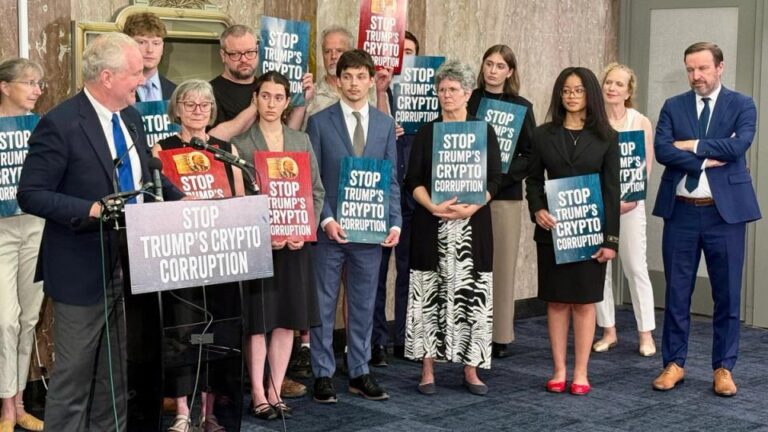
A coalition of four major law enforcement organizations and a separate group of nearly 100 Catholic leaders sent letters Tuesday warning that a provision in the Digital Asset Market Clarity Act would weaken the oversight tools investigators and prosecutors rely on to combat financial crime. 

The law enforcement letter, addressed to Acting Attorney General Todd Blanche and Patrick Witt, executive director of the President’s Council of Advisors for Digital Assets, came from the National District Attorneys Association, the National Association of Assistant United States Attorneys, the International Association of Chiefs of Police, and the National Sheriffs’ Association. 

Together, the groups represent more than 70,000 prosecutors, sheriffs, chiefs of police, investigators, and other law enforcement professionals.

Their central concern is Section 604 of the bill — a provision that incorporates the Blockchain Regulatory Certainty Act, or BRCA, which would establish that a developer or infrastructure provider who cannot move or control a user’s digital assets is not a money transmitter under federal law. 

Proponents argue the language is essential to protect software developers from criminal prosecution. Law enforcement groups counter that the exemptions are too broad.

“As currently drafted, Section 604 risks creating gaps in oversight and accountability that could impede those efforts,” the groups wrote, adding that their concern is “not with individuals who merely write or publish software code, nor with responsible technological innovation,” but rather with exemptions that could shield actors who facilitate the movement of digital assets while obstructing investigators.

The groups also contend the bill falls short on anti-money laundering and countering the financing of terrorism requirements, pointing out it does not establish suspicious activity monitoring and reporting obligations comparable to those applied to traditional financial intermediaries. They warned that certain provisions could exempt mixers, tumblers, and some decentralized finance businesses from AML and know-your-customer requirements.

The other letter, sent to Senate Majority Leader John Thune and Senate Democratic Leader Charles Schumer, carried signatures from roughly 80 organizations and leaders, including the Alliance to End Human Trafficking, the Jesuit Conference’s Office of Justice and Ecology, and dozens of Catholic sisters and survivor advocates.

“Human traffickers are quick to exploit new technologies when oversight fails to keep pace,” the groups wrote, arguing that the bill’s regulatory gaps could make it harder to trace financial flows tied to trafficking, child exploitation, and organized crime.

Background: What the CLARITY Act would do

H.R. 3633, the Digital Asset Market Clarity Act, is the most significant piece of crypto legislation to advance in Congress in years. The House passed it 294-134 in July 2025. The Senate Banking Committee cleared the bill 15-9 in May 2026, placing it on the Senate Legislative Calendar eligible for a floor vote.

The bill divides oversight of digital assets between the Securities and Exchange Commission and the Commodity Futures Trading Commission, creating a framework for crypto exchanges, brokers, stablecoin issuers, and DeFi participants. 

The Trump administration has made the legislation a priority, and crypto industry groups have pushed to keep Section 604’s developer protections intact.

To advance in the Senate, the bill needs 60 votes — a threshold that gives moderate Democrats significant leverage. Senators Mark Warner of Virginia and Catherine Cortez Masto of Nevada have both tied their support to law enforcement’s sign-off on Section 604, making the opposition letters a direct threat to the bill’s prospects.

Yesterday, Congress scheduled a July 17 hearing in New York on the CLARITY Act, a major crypto market structure bill that would divide oversight between the SEC and CFTC, as lawmakers push toward potential passage later this year.

BTC Falls Under $60,000 As Traders Predict A Relief Bounce

0

Bitcoin (BTC) hit new two-week lows at Wednesday’s Wall Street open as traders predicted a rally to a “poor” lower high.

Key points:

  • Bitcoin price action edges closer to range lows, which traders still see holding.
  • A relief bounce should enter soon, they say, with targets closer to $70,000.
  • US-Iran peace progress has little bullish impact on risk assets, with US stocks flat at the open.

BTC price nears range lows: Is $70,000 next?

Data from TradingView showed BTC price action dropping below $60,000 for the first time since June 10.

BTC/USD four-hour chart. Source: Cointelegraph/TradingView

Traders had warned of increasing short interest with rising funding rates, boosting the odds of a capitulatory move lower.

“It’s time to start bouncing soon on the LTF,” trader Killa wrote in ongoing commentary on X, referring to low time frames. 

“Range bound till proven otherwise.”

BTC/USD chart segment. Source: Killa/X

Killa uploaded a further chart showing a relief bounce toward $70,000, being due following the bounce.

BTC/USD chart segment. Source: Killa/X

Fellow trader RektProof had a broadly similar forecast, seeing BTC/USD trading in a range with $60,000 as its floor “for the rest of the month.”

“Overall, a move to supply and back down to the EQ lows before forming back to poor highs + 70k,” he added.

BTC/USDT one-hour chart. Source: RektProof/X

Stocks tread water as Hormuz oil transit progresses

On a macro level, US stocks appeared to have already priced in relief from the US-Iran peace deal.

Related: BTC price four-year trend calls for $76K as analysis says Bitcoin ‘not broken’

Upside was limited at the open despite US President Donald Trump offering further details of mutual cooperation between the two sides.

Trump specifically made reference to the Strait of Hormuz oil transit route, writing in a post on Truth Social that there would be “no tolls, no insurance costs, & no other charges of any kind being sought or received by Iran on ships traveling” via the route.

Source: Truth Social

The S&P 500 traded up 0.4% at the time of writing, while the Nasdaq Composite Index even turned slightly negative on the day.

Earlier, Cointelegraph reported on several factors keeping risk-asset enthusiasm in check, including forward earnings guidance by tech giant Micron Technologies and the May print of the Personal Consumption Expenditures (PCE) index, due out on Wednesday and Thursday, respectively.

Why did MemeCore’s M token suddenly plunge 80%?

0

Blockchain project MemeCore’s M token collapsed about 74% over 24 hours, sliding from a high near $2.92 to as low as $0.51 before steadying around $0.74, with no exploit, hack or announcement to account for the drop.

The fall erased close to $3 billion in market value. M’s market capitalization dropped below $1 billion, to about $969 million, from roughly $3.8 billion before the slide, per CoinDesk data.

Trading was thin relative to the size of the move, with only about $21 million changing hands over the day.

No confirmed catalyst has emerged. But M is a token that widely-known onchain investigator ZachXBT publicly questioned months ago.

In an April post, he asked why the exchange Kraken had listed M for spot trading in July 2025 and how it cleared the exchange’s due diligence, alleging that insiders had “manipulated the price” to a $6 billion market capitalization and an $18 billion fully diluted valuation. The latter is the value the token would carry if every coin that will ever exist were already circulating.

South Korea Links Token Securities to Wider Market Reforms

0

South Korea’s financial regulator folded token securities infrastructure into a broader overhaul of the country’s capital markets, alongside plans for faster settlement, longer trading hours and greater use of artificial intelligence.

On Tuesday, the Financial Services Commission (FSC) said it had launched a capital market infrastructure review meeting to coordinate reforms across government agencies and market operators. According to the FSC, plans for token securities will be further discussed separately through a public-private council before being linked to the wider initiative. 

The initiative includes a roadmap for shortening the securities settlement cycle, expected by October, and a Korea Securities Depository (KSD) system for settling over-the-counter trades in unlisted shares and fractional investment products by the end of 2026. 

The move places tokenized securities within the country’s broader effort to modernize traditional financial markets, potentially bringing blockchain-based investment products closer to systems used for mainstream securities settlement and trading. 

FSC Vice Chairman Kwon Dae-young said the initiative would build on broader efforts to improve the capital market, guided by four policy priorities: trust, shareholder protection, innovation and market access.

South Korea prepares token securities framework for 2027

South Korea’s token securities initiative predates the latest capital-market review. In January, the National Assembly approved amendments recognizing blockchain-based distributed ledgers as valid securities registries and permitting the issuance and circulation of token securities. 

According to the FSC, the framework is scheduled to take effect in February 2027, after regulators complete subordinate rules and supporting infrastructure. At the second meeting of its public-private token securities council in May, the FSC said it was targeting July for the release of proposed subordinate regulations and guidelines. 

Related: South Korea reviews Hana Bank’s Dunamu stake under banking rules: Report

Technical infrastructure is also under development. Samsung SDS said in May that it had won a KSD contract to build a token securities management platform that connects the depository’s existing electronic securities account system to blockchain-based data. The company aims to complete the platform by February 2027, when the new framework is scheduled to take effect.

According to the FSC, detailed token securities plans will continue to be discussed by the public-private council before being linked to the broader review, part of South Korea’s preparations for a real-time, continuously accessible and integrated digital market.

Magazine: Japanese pension fund tips 1% in crypto, G7 urges action on NK hackers: Asia Express

Trump Cancels Signing of Housing Bill with CBDC Ban

0

US President Donald Trump cancelled the signing ceremony for a housing bill containing a ban on a central bank digital currency (CBDC) as he looked for Republicans in Congress to prioritize a controversial voting bill.

In a Wednesday morning Truth Social post, Trump said that the signing for the 21st Century ROAD to Housing Act, passed by the US Senate and House of Representatives, would be cancelled “until such time as we pass the desperately needed SAVE America Act.”

Source: Donald Trump

The housing bill, passed by the House on Tuesday, included a provision barring the US Federal Reserve from issuing or creating a CBDC “or any digital asset that is substantially similar” until the end of 2030. However, the legislation also included a carve-out for stablecoins, allowing “dollar-denominated currency that is open, permissionless and private.”

Many had expected Trump to sign the bill, aimed at tackling housing affordability, into law on Wednesday without issues. However, the president said in March that he would “not sign other bills” until the SAVE America Act was passed. The legislation would require voters to provide proof of US citizenship in person to register, with critics saying the measure would disenfranchise citizens already eligible to vote.

Related: US Senate passes housing bill with CBDC ban until 2030

Senate Republicans largely supported the housing bill, which passed the chamber in a 85-5 vote on Monday. Tim Scott, the Republican who chairs the Senate Banking Committee, expressed support for the legislation as recently as Wednesday morning before Trump’s announcement, as did Democratic Senator Elizabeth Warren, who co-sponsored the bill.

“I don’t say this often these days, but Congress actually passed something good,” said Warren.

Could Trump’s position also impact crypto market structure?

Given the president’s opposition to signing any bill into law other than the SAVE America Act, it’s unclear whether Trump also intends to veto or delay signing of crypto-related bills. 

As of Wednesday, the US Senate was still waiting to potentially vote on the Digital Asset Market Clarity (CLARITY) Act, a bill expected to change the roles of financial regulators in overseeing and enforcing digital asset laws. However, Trump said in May that he intended to codify a “future-proof digital asset market structure,” likely referring to CLARITY.

If Trump vetoes either bill, Congress could override him with a two-thirds majority in both chambers.

Magazine: AI is banking the unbanked in Africa… faster than crypto